
Key Takeaways
- Companies incorporating in El Salvador as a Sociedad Anónima must meet the minimum share capital threshold established under the Código de Comercio before the Centro Nacional de Registros will process a registration application.
- Foreign investors are required to maintain a physical registered office address in El Salvador, making local address compliance a non-negotiable structural obligation from the point of formation.
- Beneficial ownership disclosure requirements apply to corporate structures operating in El Salvador, meaning that decisions around shareholding layers and nominee arrangements carry direct regulatory consequences.
- Under the Código de Comercio, the CNR serves as the administering body for the Registro de Comercio, and any documentation submitted must conform to its procedural standards to avoid outright rejection of the incorporation filing.
Entity formation in El Salvador is governed by the Código de Comercio (Commercial Code), with registration administered through the Centro Nacional de Registros (CNR), the body responsible for maintaining the Registro de Comercio. Meeting the incorporation requirements in El Salvador is a prerequisite for legal operation; non-compliance results in rejected applications or the inability to conduct business lawfully.
This article covers the structural, documentary, and compliance requirements that apply across the formation process. Requirements can differ based on entity type, the sector your business operates in, and whether foreign capital is involved.
Foreign investors and business owners establishing a legal presence in El Salvador for the first time will find this article most directly applicable to their situation.
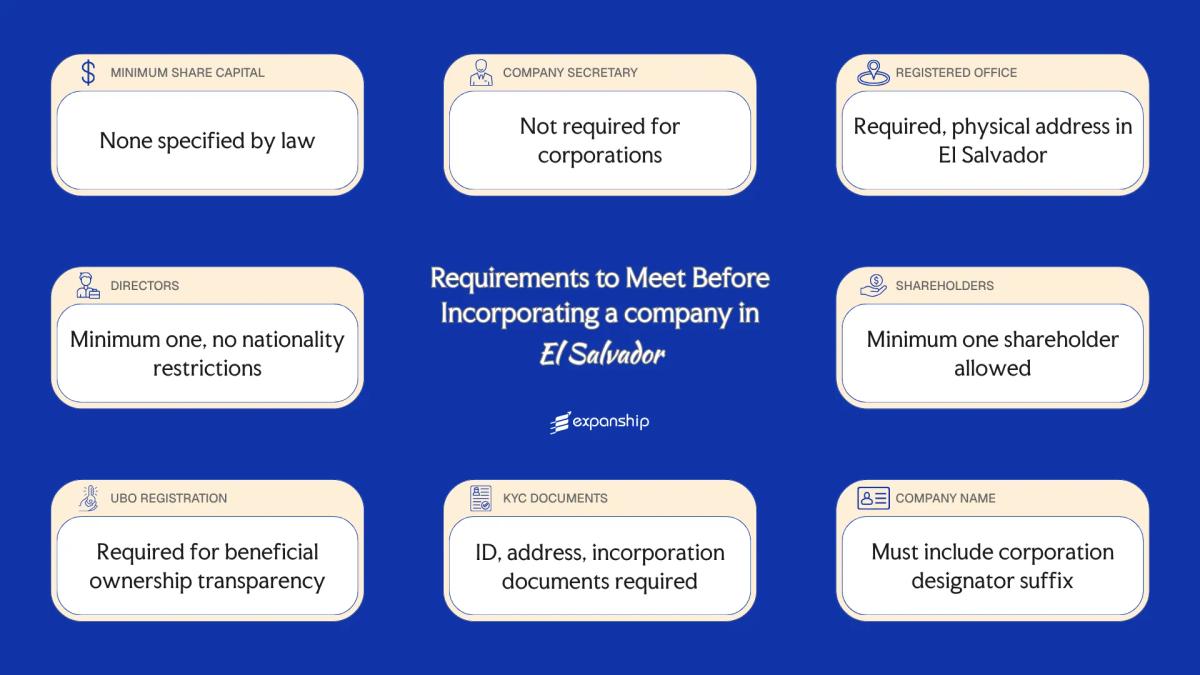
Minimum Share Capital Requirements in El Salvador
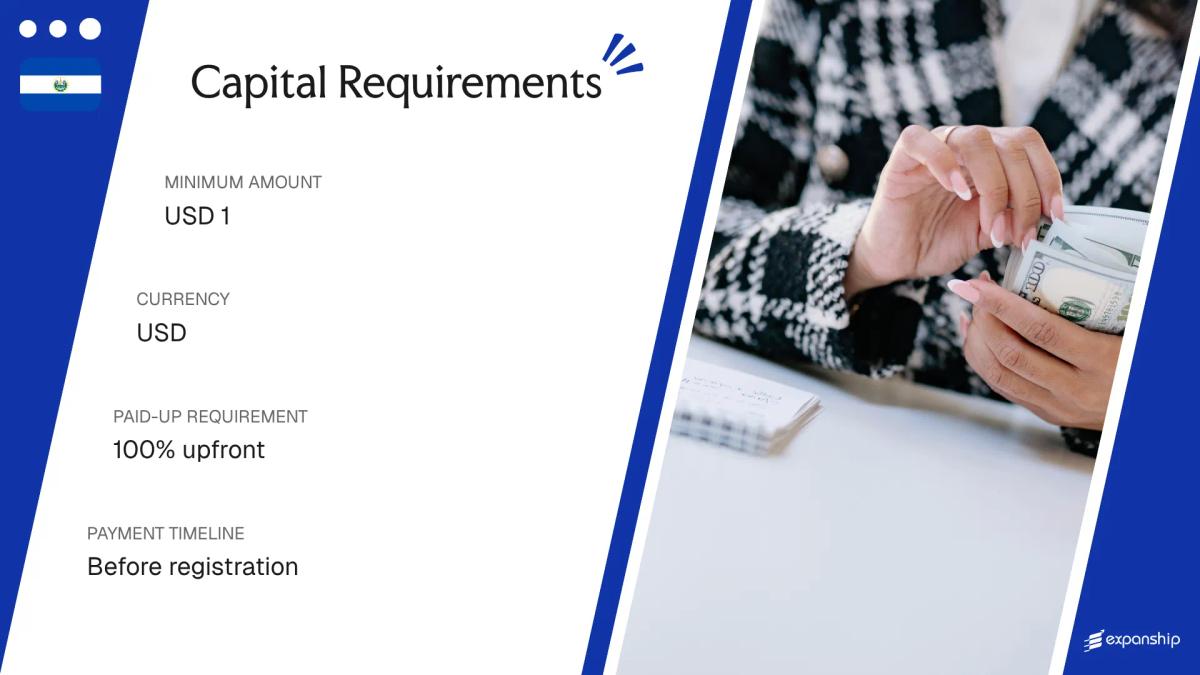
Under El Salvador minimum share capital requirements, the Sociedad Anónima (S.A.) operates on a par value share system, as governed by the Código de Comercio. Capital requirements are verified at the point of incorporation through the Centro Nacional de Registros (CNR), which oversees the registration of commercial entities.
Share capital obligations are a one-time structural requirement tied to incorporation rather than an ongoing statutory maintenance obligation. Your articles of incorporation must reflect an authorized capital structure that meets the statutory minimums established under commercial law.
| Parameter | Detail |
|---|---|
| Minimum Authorized Share Capital | USD 2,000 for a Sociedad Anónima |
| Maximum Authorized Share Capital | No statutory maximum |
| Minimum Paid-Up Capital | 5% of authorized capital at incorporation |
| Paid-Up Requirement at Incorporation | Minimum 5% must be paid up upon formation |
| Accepted Currency | United States Dollar (USD) |
| Accepted Forms of Contribution | Cash and in-kind contributions |
| Timeframe to Deposit Capital | At the time of incorporation |
Meeting the 5% paid-up minimum at incorporation does not discharge the obligation to pay up the remaining capital. The balance must be contributed within the timeframe specified in the company's own statutes.
Company Secretary Requirements in El Salvador
Under El Salvador company secretary requirements, the Código de Comercio does not impose a standalone company secretary role equivalent to those found in common law jurisdictions. For a Sociedad Anónima, corporate governance obligations are instead distributed among the board of directors and, where applicable, a statutory auditor (auditor fiscal).
Corporate secretary obligations in El Salvador are typically fulfilled through the board's secretary function, which carries responsibility for maintaining corporate minute books, certifying board resolutions, and ensuring that shareholder meeting records are properly documented under the Registro de Comercio framework.
Qualification criteria for who may serve in this secretarial capacity include:
- The role is generally filled by a natural person, not a corporate entity.
- No statutory residency requirement specifically applies to the board secretary position.
- The individual must have legal capacity to act under Salvadoran civil law.
- No professional licensing (such as a legal or notarial qualification) is mandated by the Código de Comercio for this role.
- A director of the same company may concurrently serve as secretary.

Incorporate a Company in El Salvador
Set up your Salvadoran Sociedad Anónima with full compliance support, from deed of incorporation through Registro de Comercio registration.
Registered Office Requirements in El Salvador
Under El Salvador registered office requirements, every company formed under the Salvadoran Commercial Code must maintain a fixed, physical domicile within the country, recorded in the company's deed of incorporation and registered with the Centro Nacional de Registros (CNR). Failure to maintain a compliant registered address can result in administrative sanctions, including the CNR's ability to challenge the legal standing of corporate acts performed without a valid domicile on record.
- A physical address within El Salvador is required; virtual-only addresses without a physical presence do not satisfy the domicile requirement.
- The address must be locally based; a foreign address cannot serve as the legal domicile of a Salvadoran entity.
- Proof of occupation, such as a lease agreement or property title, is generally required to support the registered address.
- The legal domicile is publicly recorded in the CNR's Registro de Comercio and accessible to third parties.
- Any change to the registered address must be formally documented through a deed amendment and submitted to the Registro de Comercio for updated inscription.
- The address declared at incorporation must correspond to the actual place of business or administrative operations of the company.
Director Requirements in El Salvador
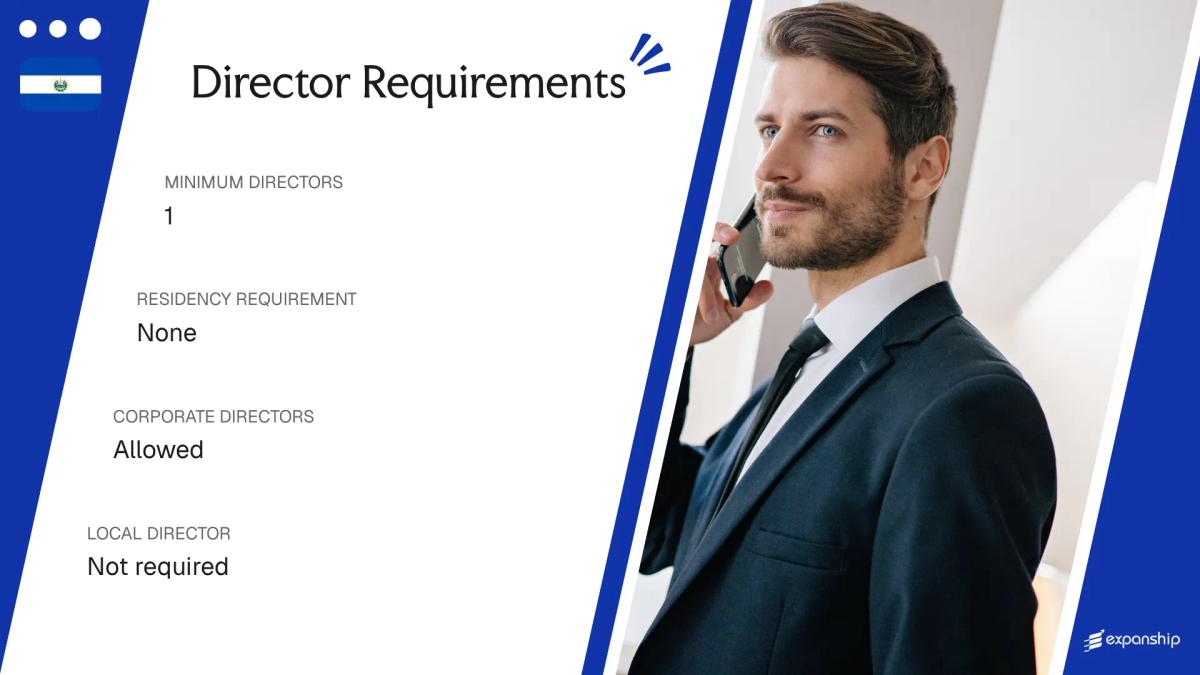
Under El Salvador director requirements for incorporation, directors of a Sociedad Anónima assume statutory duties governed by the Código de Comercio, including fiduciary responsibility toward the company and personal liability for acts carried out outside their authorized scope.
| Parameter | Detail |
|---|---|
| Minimum Number of Directors | A minimum of one director is required, though a Junta Directiva with three members is standard for most Sociedades Anónimas. |
| Maximum Number of Directors | No statutory maximum is defined under the Código de Comercio. |
| Local/Resident Director Required | No statutory requirement for a locally resident director. |
| Nationality Restrictions | No nationality restrictions apply to director appointments. |
| Minimum Age Requirement | Directors must have reached the age of legal majority, which is 18 years under Salvadoran law. |
| Corporate Directors Permitted | No statutory provision expressly permits corporate entities to serve as directors. |
| Director Must Be a Shareholder | No statutory requirement obligates a director to hold shares in the company. |
| Publicly Listed on Registry | Director information is recorded with the Centro Nacional de Registros (CNR) and is publicly accessible. |
| Disqualification Conditions | Persons declared bankrupt, convicted of fraud, or legally incapacitated are disqualified from serving as directors. |
Unlike many civil law jurisdictions, El Salvador does not require any director to be a Salvadoran national or resident, meaning a company's entire Junta Directiva can be composed of foreign nationals residing abroad.
Shareholder Requirements in El Salvador
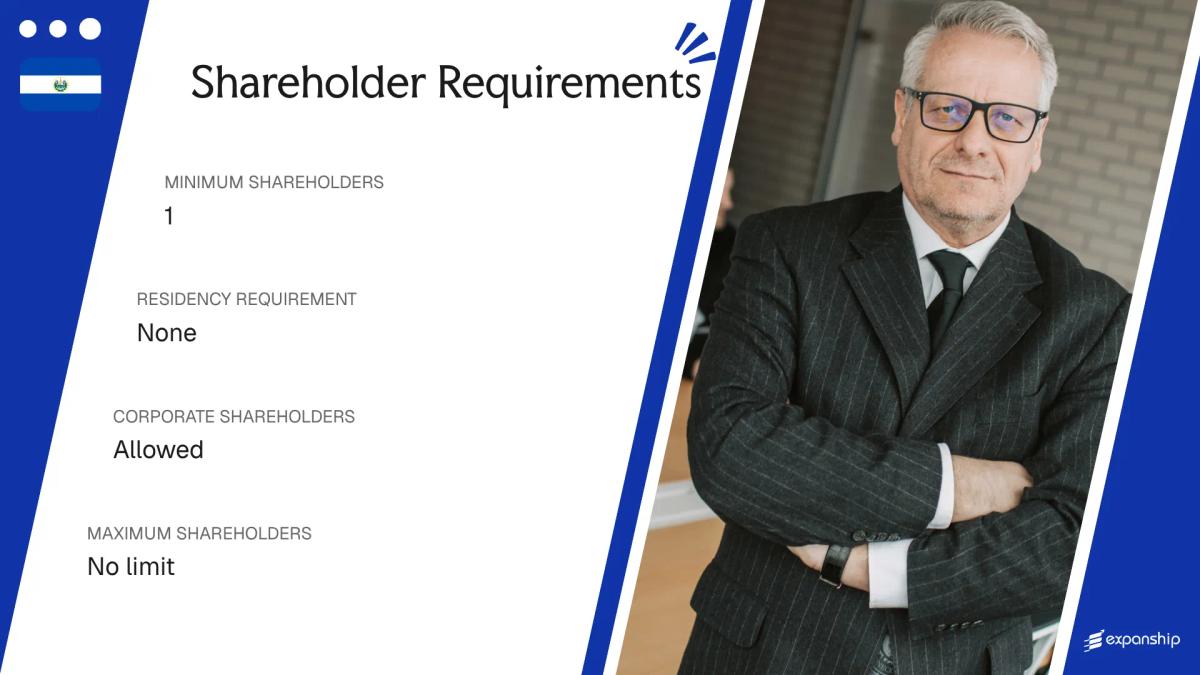
Under El Salvador's Código de Comercio, a Sociedad Anónima requires a minimum of two shareholders at incorporation. No statutory maximum applies, and a sole shareholder structure is not permitted under this corporate form.
Nationality and Residency Restrictions
El Salvador imposes no nationality or residency requirements on shareholders. Foreign nationals and non-resident individuals may hold shares without restriction on ownership percentage.
Corporate Shareholders
Corporate entities are permitted to act as shareholders in a Salvadoran Sociedad Anónima. No specific conditions restrict corporate shareholder participation beyond standard incorporation documentation requirements.
Shareholder Liability
Shareholder liability is limited to the amount of capital each party has subscribed. Extended personal liability does not arise under ordinary circumstances, consistent with the limited liability structure the Sociedad Anónima provides.
Register of Shareholders
A register of shareholders must be maintained at the company's registered office. This register is not publicly accessible, though updates are required to reflect any changes in share ownership as they occur.
Shareholder Structuring Support for Your El Salvador Incorporation
Get guidance on meeting El Salvador's shareholder requirements and structuring your company correctly from the outset.
UBO / Beneficial Ownership Disclosure Requirements in El Salvador
El Salvador beneficial ownership disclosure requirements are governed primarily by the Anti-Money Laundering Law (Ley Contra el Lavado de Dinero y de Activos) and regulations issued by the Financial Intelligence Unit (Unidad de Inteligencia Financiera, UIF). A beneficial owner is generally defined as any natural person who, directly or indirectly, holds or controls 25% or more of a legal entity's shares or voting rights.
- Identify all natural persons meeting the 25% ownership or control threshold at the time of incorporation.
- Submit beneficial ownership information to the UIF through the obligated entity's compliance reporting process.
- Maintain internal UBO records accessible to authorities upon request.
- Report material changes in ownership or control to the UIF within the applicable regulatory timeframe.
| Parameter | Detail |
|---|---|
| Ownership Threshold for UBO Status | 25% of shares or voting rights |
| Filing Authority | Unidad de Inteligencia Financiera (UIF) |
| Disclosure Deadline at Incorporation | No specific statutory deadline confirmed |
| Publicly Accessible Register | No |
| Penalties for Non-Disclosure | Administrative and criminal sanctions under the Anti-Money Laundering Law |
| Ongoing Update Obligation | Yes, upon material changes in ownership or control |
KYC / Document Requirements in El Salvador
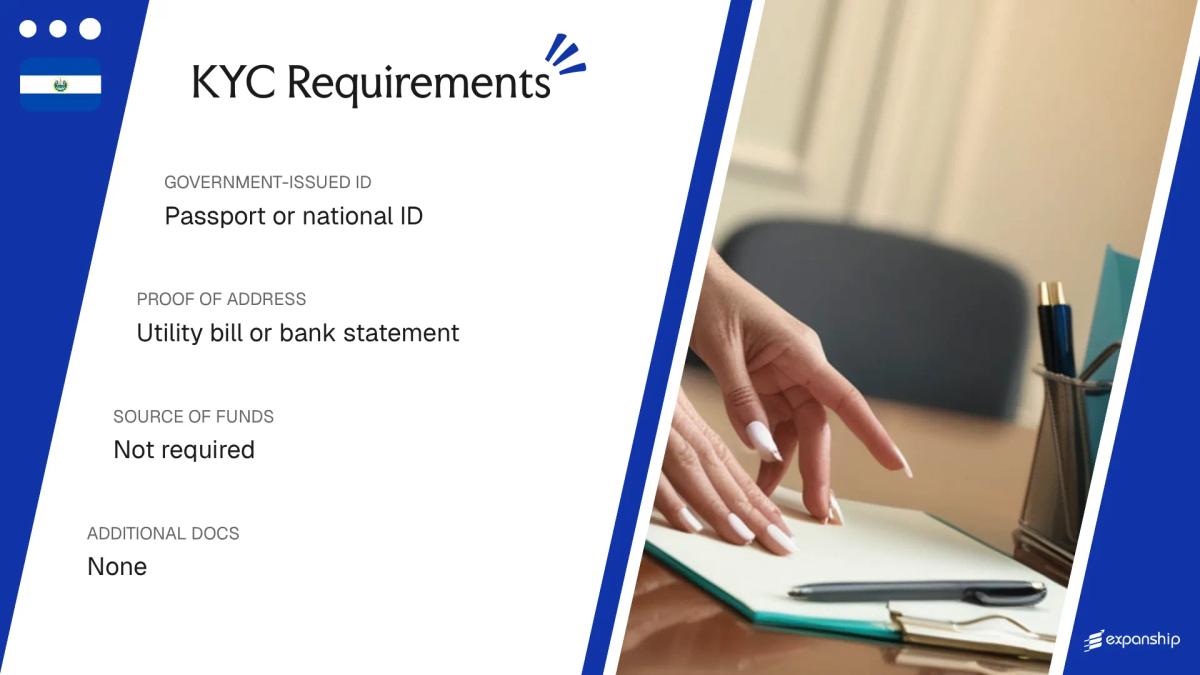
KYC obligations at the point of incorporation in El Salvador are governed by the Ley Contra el Lavado de Dinero y de Activos, enforced through the Unidad de Investigación Financiera (UIF), which operates under the Fiscalía General de la República. Due diligence requirements apply to all founding shareholders, directors, and beneficial owners before the entity is registered.
Individual / Personal Documents
- Valid government-issued photo identification (passport or national ID card)
- Proof of residential address dated within three months, such as a utility bill or bank statement
- Completed KYC declaration form identifying the individual's role in the entity
- Recent passport-sized photograph may be required by the receiving notary
Corporate Documents
- Certificate of incorporation or equivalent constitutional document from the parent entity's jurisdiction
- Current register of directors and register of shareholders
- Proof of registered office address for the corporate shareholder or director
- Certificate of good standing, where the parent jurisdiction issues one
Source of Funds Documentation
- Recent bank statements covering a minimum of three to six months
- Audited financial statements or accountant's letter confirming origin of capital
- Written declaration from the shareholder explaining the source of investment funds
Notarisation and Apostille Requirements
- Foreign-issued documents generally require apostille certification under the Hague Convention
- Documents not in Spanish must be accompanied by a certified translation completed by a sworn translator
- Notarisation by a Salvadoran notario público may be required for certain constitutional documents
Incomplete or untranslated foreign documents submitted without apostille certification are the most frequent cause of registration delay at the Centro Nacional de Registros.
Company Name Requirements in El Salvador
El Salvador company name requirements are assessed at the point of registration to ensure the proposed denominación social is unique and does not conflict with an existing registered entity. Each name is evaluated against the commercial registry's records before incorporation proceeds.
Names must be composed in Spanish, though foreign-language words may be permissible in certain contexts. The legal suffix must reflect the adopted corporate form, such as "S.A." for a Sociedad Anónima or "S. de R.L." for a Sociedad de Responsabilidad Limitada.
Certain words are restricted or prohibited outright. Terms implying government affiliation, regulated financial activity, or national institutions generally require prior approval from the relevant authority before they can appear in a business name.
Name reservation is available through the Centro Nacional de Registros (CNR). The reservation holds the proposed name for a limited period while the incorporation process is completed, and it is applied for directly at the CNR prior to submitting the full incorporation documentation.
Compliance Services for Companies in El Salvador
Maintain your Salvadoran entity in good standing with the CNR and other regulatory bodies through ongoing compliance support.
Conclusion
El Salvador company incorporation requirements span multiple legal and administrative layers, governed primarily by the Código de Comercio and overseen by the Centro Nacional de Registros. Among the requirements covered, the minimum share capital threshold for a Sociedad Anónima and the mandatory local registered office address carry particular practical weight for foreign investors. Beneficial ownership disclosure obligations add a further compliance dimension that affects corporate structuring decisions. Once these requirements are understood, the immediate next step is translating that knowledge into a documented formation process aligned with CNR procedures.
Expanship's Corporate Services for El Salvador Expansion
Navigating El Salvador's corporate formation requirements involves working within a specific legal framework, from the Sociedad Anónima de Capital Variable structure to CNR filings and notarial deed requirements. Expanship's El Salvador corporate services company formation support is designed to reduce the administrative weight of these requirements, so your team can focus on operational priorities rather than procedural ones.
Our services cover the full incorporation lifecycle and ongoing compliance obligations:
- We prepare and file all company registration documents with the CNR and relevant authorities on your behalf.
- Registered agent and local office provision is available to satisfy El Salvador's physical presence requirements.
- We manage government filings and liaise directly with regulatory bodies throughout the process.
- Post-incorporation compliance management keeps your entity in good standing with local obligations.
- Banking introduction assistance is available to help your business establish a local account.
- Tax registration and coordination with the Ministerio de Hacienda are handled as part of our service scope.
To discuss your requirements, contact Expanship El Salvador.
Frequently Asked Questions (FAQ)
Yes, the minimum share capital differs between the two main entity types. A Sociedad Anónima (SA) requires a minimum paid-in capital of $2,000 USD, while a Sociedad de Responsabilidad Limitada (SRL) requires a minimum of $2,000 USD as well, though the SRL caps the number of partners at 25. Both entity types require that capital be fully subscribed at the time of incorporation, with a portion paid in at the point of registration.
If the registered office address is no longer valid, the company must update its registration with the Centro Nacional de Registros (CNR) to reflect the new address. Failure to maintain a valid local address can affect the entity's good standing and may result in difficulties receiving official correspondence from Salvadoran regulatory authorities. Updating the registered office requires a formal amendment filed with the CNR's Registro de Comercio.
Beneficial ownership information in El Salvador is reported to the Registro de Beneficiarios Finales, which operates under the Ministerio de Hacienda. This obligation applies to legal entities incorporated under Salvadoran law and requires disclosure of any natural person holding 25% or more of the ownership or voting rights. Non-compliance with this reporting obligation carries administrative penalties under the country's anti-money laundering framework.
El Salvador does not legally restrict company names to Spanish, but in practice the constitutive deed and all registration documents must be executed in Spanish before a Salvadoran notary. Names incorporating foreign-language words are generally accepted, provided they do not conflict with existing registered entities or violate public order provisions under the Commercial Code. The Registro de Comercio performs a name availability check before approving registration.
Foreign shareholders must typically provide a valid passport, proof of residential address, and a bank reference or equivalent source of funds documentation, as part of the due diligence process required under El Salvador's anti-money laundering regulations. Where a corporate entity acts as shareholder, certified copies of its constitutional documents, ownership structure, and the identity documents of its own beneficial owners are required. All foreign documents submitted to Salvadoran authorities must be apostilled and, where applicable, accompanied by a certified Spanish translation.
El Salvador imposes no nationality or residency restrictions on shareholders of either an SA or an SRL. Foreign individuals and foreign-incorporated entities can hold shares in a Salvadoran company without restriction, making the jurisdiction accessible to fully foreign-owned structures. Ownership by foreign legal entities does, however, trigger additional documentary requirements at the time of incorporation to satisfy the CNR's verification process.
Legal Disclaimer
The information provided in this article is for general informational purposes only and does not constitute legal, tax, or professional advice. While we strive to ensure the accuracy and timeliness of the content, laws and regulations are subject to change, and the application of laws can vary widely based on specific facts and circumstances.
Readers should not act upon this information without seeking professional counsel tailored to their individual situation. Expanship and its authors disclaim any liability for actions taken or not taken based on the content of this article.
For specific advice regarding your business setup, compliance requirements, or any legal matters, please consult with qualified legal and tax professionals in the relevant jurisdiction.