
Key Takeaways
- Under Legislative Decree No. 57, Bitcoin's status as legal tender in El Salvador — combined with the absence of capital gains tax on crypto assets — gives digital asset businesses a legally codified operating environment unavailable in most jurisdictions.
- El Salvador's territorial tax system means foreign-sourced income falls entirely outside the local tax base, allowing companies structured around international operations to limit their Salvadoran tax exposure to domestically generated revenue only.
- A USD-denominated economy eliminates the currency conversion risk that affects treasury management, cross-border pricing, and financial reporting for businesses incorporated in neighboring Central American markets.
- Membership in the CAFTA-DR trade agreement provides Salvadoran-registered entities with preferential market access across multiple economies, a structural trade advantage that extends beyond what incorporation in a non-signatory jurisdiction could offer.
Situated in Central America, El Salvador is an independent republic bordered by Guatemala, Honduras, and the Pacific Ocean. Company registration falls under the oversight of the Centro Nacional de Registros (CNR), the government body responsible for commercial registry and legal entity formation. Foreign businesses most commonly establish a Sociedad Anónima when entering the market. The country operates a territorial tax system, meaning income sourced outside its borders is generally not subject to local taxation.
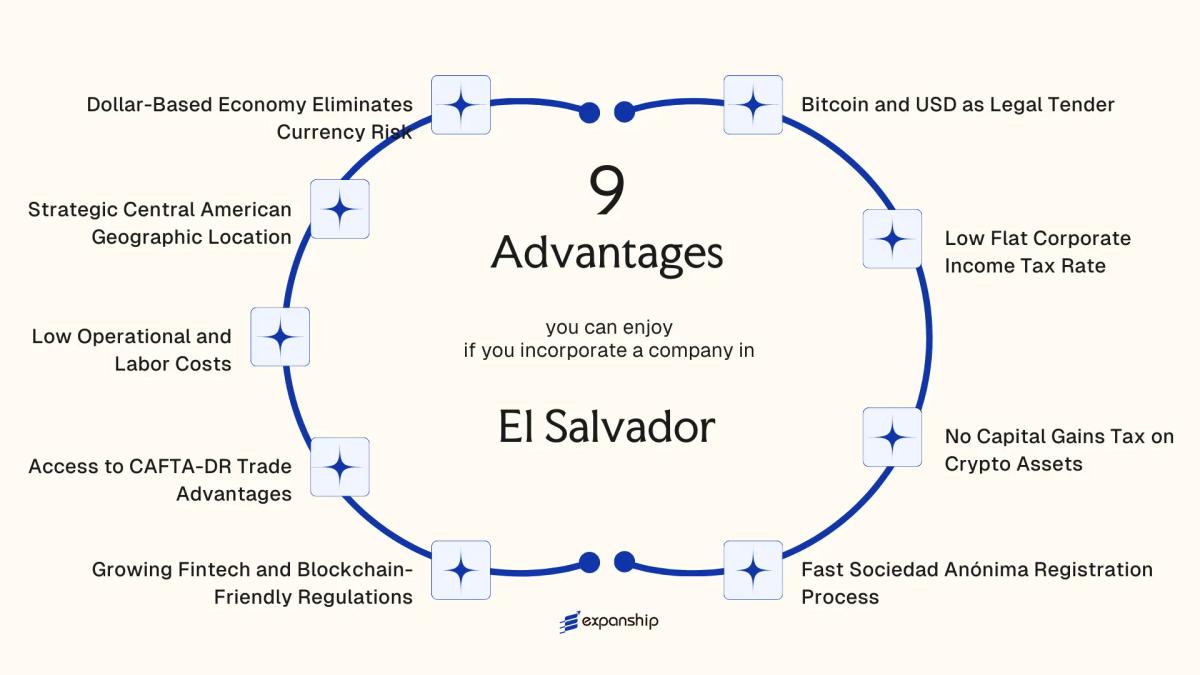
Foreign ownership is broadly permitted across most sectors, and there are no general restrictions on repatriating capital or profits, which has contributed to a steady flow of foreign direct investment in recent years. The benefits of incorporating in El Salvador span taxation, monetary policy, trade access, and regulatory structure. This article examines each of those advantages in detail.
Bitcoin and USD as Legal Tender
Passed in June 2021, the Bitcoin Law (Ley Bitcoin, Legislative Decree No. 57) made El Salvador the first country to grant Bitcoin status as legal tender alongside the US dollar, which has served as the official currency since 2001.
What Dual Legal Tender Status Means in Practice
Any business operating in the country must accept Bitcoin as payment for goods or services unless it lacks the technical capacity to process transactions. Your company can price contracts, settle invoices, and hold treasury in either currency without requiring conversion through a regulated financial intermediary.
The Business Advantage for Foreign Companies
This arrangement gives foreign firms a direct Bitcoin legal tender El Salvador business advantage: transacting in Bitcoin carries no mandatory exchange rate exposure to a local fiat currency. For businesses in payments, remittances, or digital asset services, operating under a recognized legal framework reduces the compliance ambiguity that exists in jurisdictions where Bitcoin has no formal monetary status.
Your contracts and payment obligations in Bitcoin are legally enforceable under Salvadoran law, removing the grey-area risk that affects crypto-denominated agreements in most other jurisdictions.
Low Flat Corporate Income Tax Rate
El Salvador applies a flat corporate income tax rate of 30% on net taxable income, governed under the Código Tributario and administered by the Ministerio de Hacienda. For foreign investors structuring a Sociedad Anónima or any other recognized legal entity, this single-rate system removes the uncertainty that progressive tax schedules create in higher-rate jurisdictions across Latin America and Europe.
A flat structure means your tax liability scales predictably with profit. There are no bracket thresholds to monitor, no phase-ins as revenue grows, and no penalty for commercial success at higher income levels. This predictability simplifies financial modeling for foreign-owned firms operating across multiple jurisdictions simultaneously.
Territorial tax principles further shape the overall burden. Income sourced outside the country is generally not subject to local corporate tax, which matters directly for holding structures or businesses with regional operations.
The 30% rate applies to net income after allowable deductions, so the effective rate your business pays can fall below the statutory figure depending on operating expenses and applicable exemptions under domestic law.
Why this structure works in practice for foreign-owned firms:
- Deductible operating expenses reduce the taxable base, so the headline rate rarely reflects the actual liability
- The single-rate design eliminates bracket-related structuring complexity common in tiered systems
- Territorial sourcing rules allow international income to remain outside the local tax base under qualifying conditions
- Administrative filings follow a standardized annual cycle, reducing ongoing compliance overhead

Incorporate a Company in El Salvador
Set up your Salvadoran Sociedad Anónima with full compliance support, from registration through ongoing tax administration.
No Capital Gains Tax on Crypto Assets
Under the Bitcoin Law (Legislative Decree No. 151, enacted in 2021), gains derived from Bitcoin transactions are exempt from capital gains tax for qualifying entities. This exemption reflects the government's policy intent to position the country as a destination for digital asset businesses, and for your company, it translates directly into retained profit that would otherwise be taxed in most other jurisdictions.
The practical scope matters here. When a business sells Bitcoin or other qualifying digital assets at a profit, that gain is not subject to the standard income tax treatment applied to capital disposals. In many jurisdictions, capital gains on crypto assets are taxed at rates ranging from 15% to 30% or higher. Structuring operations through a Salvadoran entity means those gains remain untaxed at the corporate level under current law.
| Asset Type | Tax Treatment | Legal Basis |
|---|---|---|
| Bitcoin | Exempt from capital gains tax | Bitcoin Law, Decree No. 151 (2021) |
| USD (Legal Tender) | No foreign exchange gain exposure | Monetary Integration Law (2001) |
| Other Digital Assets | Subject to general tax rules | Tax Code, Salvadoran IRS (DGII) |
Eligibility for the Bitcoin Law exemption applies to entities operating within the formal corporate framework, so your firm must be properly registered and compliant with the Dirección General de Impuestos Internos (DGII) to rely on this treatment. Non-Bitcoin digital assets do not automatically receive the same exemption and fall under standard tax assessment by the DGII.
Fast Sociedad Anónima Registration Process
El Salvador Sociedad Anónima registration advantages begin with one of the more accessible incorporation frameworks in Central America. Under the Código de Comercio, a Sociedad Anónima (SA) can be constituted with as few as two shareholders, and there is no mandatory minimum paid-in capital that must be deposited before registration. This directly reduces the cash burden on foreign founders at the pre-operational stage.
Registration is processed through the Centro Nacional de Registros (CNR), the statutory body responsible for commercial and property records. Once notarized articles of incorporation are submitted, the CNR typically completes registration within a matter of days rather than weeks. For foreign investors structuring a regional operation, shorter formation timelines mean your entity can open bank accounts, sign contracts, and hire staff without extended delays.
Shareholders and directors are not required to be Salvadoran nationals, and foreign individuals can hold 100% ownership. A registered local address is required for CNR filings, but physical presence during formation is not mandatory for all stages when working through a notary.
Keep the following in mind:
- A public notary must execute the incorporation deed under Salvadoran law
- The CNR registration is separate from tax registration with the Ministerio de Hacienda
- Corporate bylaws must specify share structure and governance provisions at formation
- A local registered address must appear in CNR filings
You can verify current CNR procedures directly on the official registry portal.
A Salvadoran SA can be incorporated without a Salvadoran resident director, which is less common among other civil law jurisdictions in the region.
Growing Fintech and Blockchain-Friendly Regulations
El Salvador fintech friendly regulations advantage stems from a deliberate legislative effort to position the country as a digital asset jurisdiction rather than adapt existing frameworks retroactively. The result is a regulatory environment built around crypto-native business models from the ground up, which reduces structural friction for fintech founders setting up operations.
The CNAD as a Dedicated Supervisory Body
The National Digital Assets Commission, known by its Spanish acronym CNAD, was established under the Digital Assets Issuance Law (Ley de Emisión de Activos Digitales) enacted in 2023. This legislation created a specific licensing and oversight regime for digital asset service providers, separating them from the general financial regulator, the Banco Central de Reserva. For a crypto startup, being regulated by a body designed specifically for digital assets means your compliance obligations are defined by people who understand the technology, not adapted from rules written for traditional banking.
What the Regulatory Framework Means in Practice
Businesses offering token issuance, digital asset custody, or exchange services can apply for formal authorization under the DASP (Digital Asset Service Provider) framework. Operating under a recognized license grants your entity legal standing that many offshore structures cannot offer, which matters when opening institutional banking relationships or negotiating contracts with regulated counterparties. The El Salvador blockchain regulatory environment benefits firms that need both legal clarity and operational flexibility within a single jurisdiction.
Get Clarity on El Salvador's Fintech Regulatory Framework
Understand which licenses apply to your digital asset business and how to structure your entity for compliance under Salvadoran law.
Access to CAFTA-DR Trade Advantages
El Salvador's participation in the Dominican Republic-Central America Free Trade Agreement (CAFTA-DR) creates concrete preferential market access that a locally incorporated company can act on immediately. CAFTA-DR trade advantages for El Salvador companies include duty-free or reduced-tariff entry into the United States market for a wide range of goods, governed by the agreement's rules of origin requirements.
- Goods manufactured or substantially transformed within the country can qualify for preferential tariff treatment when exported to the United States, the world's largest consumer market, under CAFTA-DR's country-of-origin provisions.
- Your business also gains reciprocal access to the markets of Costa Rica, Guatemala, Honduras, Nicaragua, and the Dominican Republic under the same treaty framework, effectively covering a regional consumer base exceeding 50 million people.
- CAFTA-DR includes intellectual property protections, investment dispute mechanisms, and government procurement rights that extend beyond tariffs, giving your firm a structured legal environment for cross-border operations.
- For businesses in manufacturing, agro-processing, or textile sectors, the agreement's cumulation rules allow inputs sourced from other CAFTA-DR member states to count toward origin thresholds, which can reduce production costs while preserving preferential export status.
Meeting rules-of-origin thresholds is a condition of access, and eligibility varies by product category under the treaty's specific annexes.
Low Operational and Labor Costs
Low operational costs represent a concrete, measurable advantage for foreign companies incorporating in El Salvador. The national minimum wage varies by sector under the Salvadoran Labor Code, with rates for commercial and service workers set at around $365 per month as of the most recent adjustment. For a foreign-owned Sociedad Anónima staffing a mid-sized team, that differential translates directly into lower fixed overhead compared to operating in North America or Western Europe.
Office and commercial lease rates in San Salvador are considerably lower than in comparable regional capitals, reducing the cost base for businesses that require a physical presence. Your firm can establish a functional operational footprint without the capital outlay that similar setups require in Mexico City or Bogotá.
Labor regulations are governed by the Código de Trabajo, which sets standard provisions for working hours, severance, and social security contributions to the Instituto Salvadoreño del Seguro Social (ISSS). Employer social security contributions are set at approximately 7.5% of payroll, a structurally lower burden than most OECD-member jurisdictions.
A foreign-owned Sociedad Anónima employing 10 commercial-sector staff at minimum wage would carry an estimated monthly payroll of roughly $3,650, plus approximately $274 in ISSS employer contributions, totaling under $4,000 monthly for a full local team.
Strategic Central American Geographic Location
El Salvador's Central American strategic location advantage stems from its position on the Pacific Coast, bordered by Guatemala and Honduras, placing it within a 4-hour flight radius of major North and South American cities. For a business with regional distribution or service delivery requirements, this translates into reduced transit times and lower logistics costs across the isthmus.
The country's two main ports, Puerto de Acajutla on the Pacific and the dry port facilities at Inka Terminal, connect Salvadoran entities to Pacific shipping routes serving Mexico, Colombia, and beyond. Combined with the San Óscar Arnulfo Romero y Galdámez International Airport near San Salvador, your firm has both air and sea access to regional markets without routing through a third country.
Central American hub benefits for El Salvador companies extend to ground logistics as well. The Pan-American Highway runs directly through the country, enabling overland freight movement across Guatemala, Honduras, and Nicaragua from a single base of operations.
- Proximity to the SICA (Central American Integration System) member state markets
- Access to free trade zones regulated under the Free Trade Zone Law (Ley de Zonas Francas Industriales y de Comercialización)
- Ground connectivity via the Pan-American Highway corridor
Free trade zone tax incentives tied to geographic operations require your company to meet specific investment thresholds and export-oriented activity requirements under the Free Trade Zone Law.
Dollar-Based Economy Eliminates Currency Risk
El Salvador's dollarized economy benefit for businesses is structural, not incidental. The U.S. dollar has been the country's official currency since 2001, when the Monetary Integration Law (Ley de Integración Monetaria) formally replaced the colón. Your company operates, invoices, and holds reserves in USD by default, with no conversion mechanism required.
For a foreign investor, this removes an entire category of financial exposure. Businesses incorporated in countries with managed or floating currencies must account for exchange rate fluctuations when repatriating profits, pricing contracts, or reporting earnings. None of that applies here.
Consider the practical implications:
- Contracts with international clients can be denominated in USD without triggering cross-border currency conversion costs
- Financial statements require no foreign exchange adjustment entries for the functional currency
- Treasury management is simplified because there is no local currency to hedge against the dollar
- U.S.-based investors or partners face zero currency translation risk when dealing with a Salvadoran subsidiary
Because the dollar is legal tender under a standing legislative framework rather than a currency peg, there is no central bank mechanism that could alter the exchange rate through policy intervention. A peg can be broken; a dollarized system under statute carries a different risk profile entirely.
This structure is particularly relevant for firms that price services globally in USD or hold dollar-denominated assets, as the entity's functional currency aligns with the primary currency of international trade without any conversion friction.
Is El Salvador the Right Jurisdiction for You?
Determining whether El Salvador is the right jurisdiction for your business depends on the specific profile of your operations. The benefits covered in this blog apply most directly to foreign investors in fintech, digital assets, export-oriented trade, and cost-sensitive service businesses. Comparing it against jurisdictions that attract a similar investor profile makes the distinction clearer. Panama and Costa Rica are the most realistic regional alternatives a foreign investor would evaluate alongside El Salvador, given their proximity, dollar-linked monetary arrangements, and established incorporation frameworks. Mexico is included as the largest economy in the region, often considered by investors seeking Central American or Latin American market access.
What the comparison reveals is not that one country dominates across every parameter, but that El Salvador holds a distinct position on Bitcoin legal tender status and flat-rate corporate taxation. Those two structural features, established by the Bitcoin Law (Legislative Decree No. 57) and the Tax Code respectively, create conditions that the neighbouring jurisdictions do not replicate.
| Parameter | El Salvador | Panama | Costa Rica | Mexico |
|---|---|---|---|---|
| Corporate Income Tax Rate | 30% flat (net income) | 25% (territorial) | 30% | 30% |
| Bitcoin as Legal Tender | Yes (Legislative Decree No. 57) | No | No | No |
| Official Currency | USD | USD (de facto) | Costa Rican Colón | Mexican Peso |
| Capital Gains Tax on Crypto | None (general principle) | Not established | Not established | Taxable as income |
| CAFTA-DR Membership | Yes | No | Yes | No (separate NAFTA/USMCA) |
| Territorial Tax System | Partial | Yes (strict territorial) | Yes (territorial) | No (worldwide) |
| Incorporation Entity (Foreign-Friendly) | Sociedad Anónima | Sociedad Anónima | Sociedad Anónima | S.A. de C.V. |
Compliance Services for Companies in El Salvador
Maintain your El Salvador entity in good standing with ongoing regulatory filings, tax compliance support, and corporate secretarial services.
Conclusion
El Salvador's position as a jurisdiction for foreign-owned businesses rests on a combination of structural features that are difficult to replicate elsewhere in Central America. The absence of capital gains tax on Bitcoin and other crypto assets, combined with the recognition of BTC as legal tender under the Bitcoin Law (Legislative Decree No. 57), creates a legally grounded foundation for firms operating in the digital asset space. Overlay that with a flat 30% corporate income tax rate applied only to Salvadoran-source income, and foreign earnings remain outside the local tax base entirely.
For businesses incorporating through a Sociedad Anónima, the USD-denominated economy removes the exchange rate exposure that affects neighboring markets. That structural feature has direct consequences for treasury management, cross-border pricing, and financial reporting.
What fits one business may not fit another. Companies without operations or revenue tied to the Central American region, or those outside the fintech and digital asset sectors, may find fewer of these provisions directly applicable to their structure. The benefits of incorporating in El Salvador are most concentrated for entities where crypto transactions, trade under CAFTA-DR, or cost-efficient Central American operations are part of the core business model. Knowing which provisions apply to your specific entity type and activity is what determines whether this jurisdiction produces a material advantage or simply an administrative presence.
Start Your El Salvador Company With Expanship Today
To start an El Salvador company with Expanship, you engage a firm that covers the full formation process for Sociedad Anónima structures, manages ongoing compliance obligations under the Código de Comercio, and liaises directly with the Centro Nacional de Registros (CNR) on your behalf. The service is built around the specific regulatory and tax environment this blog has outlined, from Bitcoin Law implications to CAFTA-DR eligibility requirements.
Expanship's scope across the formation and maintenance lifecycle includes:
- Preparation and legalization of all incorporation documents, including the escritura de constitución
- Registered agent and registered office provision within El Salvador
- Filing coordination and direct liaison with the CNR and Registro de Comercio
- Post-incorporation compliance management, including annual filings and corporate book maintenance
- Tax registration support with the Ministerio de Hacienda
- Banking introduction assistance for both traditional and digital asset-compatible accounts
Expanship El Salvador is available to answer jurisdiction-specific questions and move your formation forward.
Frequently Asked Questions (FAQ)
The Bitcoin Law (Decreto Legislativo No. 57, enacted in 2021) grants Bitcoin legal tender status alongside the U.S. dollar, meaning businesses are legally permitted to accept, hold, and transact in Bitcoin without triggering additional reporting obligations specific to currency conversion. For incorporated entities, this creates a legal framework to conduct Bitcoin-denominated commercial activity that most other jurisdictions do not provide. The law also obligates merchants to accept Bitcoin if a customer requests it, unless the business lacks the technical means to process it.
Corporate income tax in El Salvador is levied at a flat rate of 30% on net taxable income for companies with annual income above a defined threshold, with a reduced rate of 25% applying to entities below that threshold. This is a territorial-adjacent system where locally sourced income is subject to tax. Income earned entirely outside the country may be treated differently depending on the nature of the activity and applicable tax residency rules.
A registered legal address within El Salvador is required to complete the Sociedad Anónima registration process with the Centro Nacional de Registros (CNR). This address is used for official correspondence and regulatory filings. A virtual or registered agent address can satisfy this requirement in many cases, though specific notarial and CNR submission procedures must still be fulfilled through a locally authorized professional.
A company incorporated in El Salvador qualifies as a Salvadoran-origin entity for the purposes of the Dominican Republic-Central America Free Trade Agreement (CAFTA-DR), which governs trade between El Salvador and the United States, along with several other Central American and Caribbean nations. This grants qualifying goods and services preferential tariff treatment when exported to CAFTA-DR member markets. Eligibility for specific tariff benefits depends on rules of origin requirements set out in the agreement, which vary by product category.
Under the current framework established alongside the Bitcoin Law, capital gains derived from Bitcoin transactions are not subject to capital gains tax in El Salvador. This treatment applies specifically to Bitcoin given its legal tender classification. Other digital assets or tokens not covered by the Bitcoin Law may fall under different tax treatment, and the Ministerio de Hacienda retains authority to issue clarifying guidance on assets outside the Bitcoin Law's scope.
Registration of a Sociedad Anónima through the Centro Nacional de Registros generally takes between five and fifteen business days once all required documentation has been submitted in proper form. The process involves notarial deed preparation, publication requirements, and formal entry into the Registro de Comercio. Delays typically arise from incomplete documentation or errors in the articles of incorporation rather than processing backlogs at the CNR itself.
Legal Disclaimer
The information provided in this article is for general informational purposes only and does not constitute legal, tax, or professional advice. While we strive to ensure the accuracy and timeliness of the content, laws and regulations are subject to change, and the application of laws can vary widely based on specific facts and circumstances.
Readers should not act upon this information without seeking professional counsel tailored to their individual situation. Expanship and its authors disclaim any liability for actions taken or not taken based on the content of this article.
For specific advice regarding your business setup, compliance requirements, or any legal matters, please consult with qualified legal and tax professionals in the relevant jurisdiction.