
Key Takeaways
- El Salvador's limited network of double taxation treaties creates measurable cross-border tax exposure for foreign investors structuring regional operations or repatriating profits from subsidiaries.
- Mandatory compliance with the Bitcoin Law (Decreto Legislativo No. 57), which granted Bitcoin legal tender status, introduces exchange rate volatility and accounting complexity that most corporate structures in other jurisdictions do not face.
- Bureaucratic processing delays at the Centro Nacional de Registros (CNR) and the Ministerio de Hacienda extend incorporation and compliance timelines beyond what foreign investors typically encounter in comparable Latin American markets.
- Weak enforcement of intellectual property rights places technology, brand-driven, and creative sector businesses at elevated risk of infringement with limited practical recourse through the domestic judicial system.
El Salvador operates under an evolving regulatory framework, shaped by a mix of civil law traditions and a series of significant legislative reforms over the past decade. The Commercial Code governs company formation and corporate conduct, but practical compliance extends across multiple agencies, tax obligations, and sector-specific rules that foreign investors frequently underestimate.
This article examines the structural, legal, financial, and operational disadvantages that arise when registering a business in the country. The disadvantages of incorporating in El Salvador vary considerably based on your chosen entity type, the industry you operate in, and whether your business involves cross-border transactions or local employment.
Foreign investors entering manufacturing, financial services, or technology sectors are most likely to encounter these friction points directly. Those structuring holding companies or regional subsidiaries may face a different subset of challenges than operators running locally active businesses.
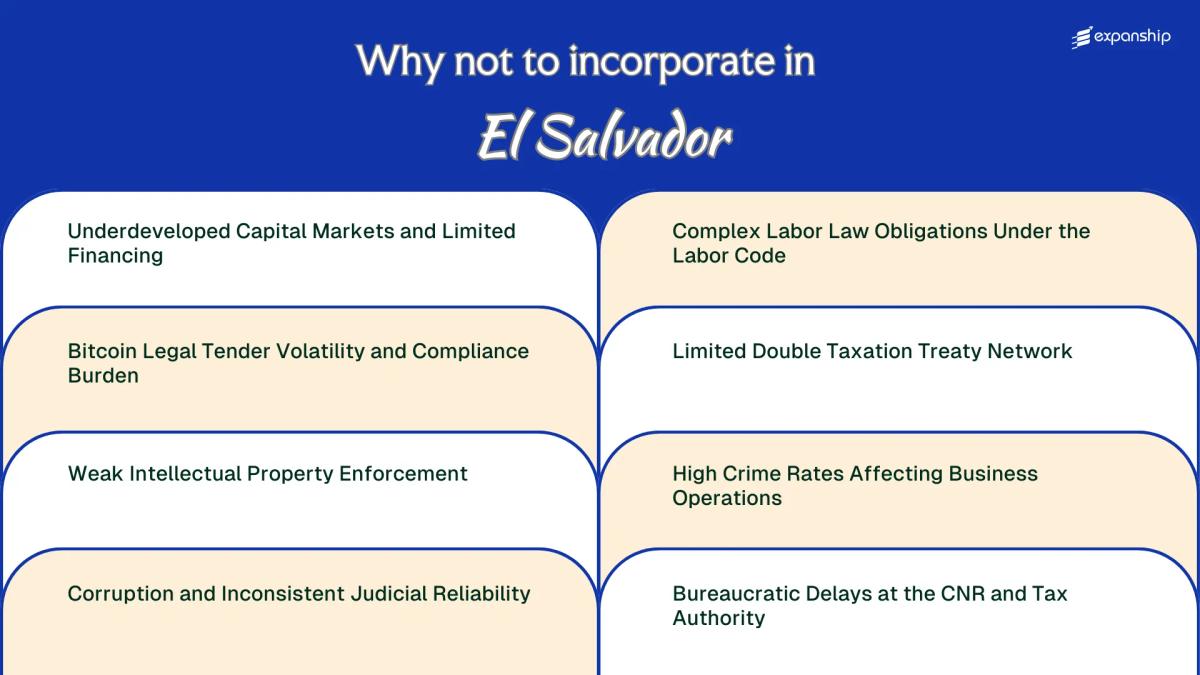
Underdeveloped Capital Markets and Limited Financing
Accessing equity financing through public markets is not a viable path for most businesses incorporated in El Salvador. El Salvador limited business financing risks stem directly from the shallow depth of the local capital market infrastructure.
Structural Limits of the Bolsa de Valores de El Salvador
The Bolsa de Valores de El Salvador, the country's sole stock exchange, lists a limited number of securities and sees comparatively low daily trading volumes. For a foreign-owned entity seeking to raise growth capital through equity issuance, this means there is effectively no functioning public market to tap.
Debt financing options through local banks carry high interest rates relative to regional peers, and credit access for newer or foreign-owned firms without established local collateral is frequently restricted. The Superintendencia del Sistema Financiero oversees the banking and securities sector, but regulatory oversight alone does not expand the available pool of capital.
Consequences for SME and Foreign Entity Funding
El Salvador SME funding challenges are compounded by the absence of a developed venture capital ecosystem or government-backed alternative finance schemes comparable to those in larger Latin American economies. Your business becomes largely dependent on retained earnings or offshore financing arrangements, both of which carry their own cost and structural limitations.
Foreign businesses incorporated here should budget for the likelihood that local financing will be unavailable or prohibitively expensive, making pre-entry capitalization planning a non-negotiable requirement.
Bitcoin Legal Tender Volatility and Compliance Burden
Bitcoin legal tender risks in El Salvador begin with the Bitcoin Law (Legislative Decree No. 57, enacted June 2021), which originally required all businesses to accept Bitcoin as payment. That mandatory acceptance clause created immediate accounting exposure for foreign-owned firms holding Bitcoin on their balance sheets during price swings.
A 30–40% intraday price move in Bitcoin translates directly into revenue recognition uncertainty. Your financial statements, prepared in US dollars under local tax rules, must reflect the realized value at the time of each transaction, complicating month-end reporting.
Practical burdens this creates for your business include:
- Reconciling Bitcoin transactions at daily exchange rates adds bookkeeping hours that dollar-only operations never incur
- Treasury management requires deciding whether to convert Bitcoin proceeds immediately, exposing your firm to conversion fees each time
- Auditors unfamiliar with crypto asset accounting may charge premium rates to sign off on Bitcoin-denominated revenue
- Tax filings with the Ministerio de Hacienda require accurate valuation of each Bitcoin transaction, creating documentation obligations absent in most peer jurisdictions
While a 2022 amendment softened the mandatory acceptance requirement, the law still designates Bitcoin as legal tender, meaning the compliance framework governing its use remains active.

Company Incorporation in El Salvador
Understand the full regulatory and compliance requirements before registering your business in El Salvador.
Weak Intellectual Property Enforcement
El Salvador intellectual property enforcement problems stem from a legal framework that, while formally structured, lacks the institutional capacity to protect foreign-owned brands and innovations in practice. IP rights are registered through the Centro Nacional de Registros (CNR), and the governing legislation is the Ley de Marcas y Otros Signos Distintivos. Registration alone, however, does not translate into reliable protection once infringement occurs.
Enforcement actions depend on judicial proceedings that move slowly and produce inconsistent outcomes. If a competitor or third party uses your trademark without authorization, pursuing a civil or criminal remedy through the Salvadoran courts can take years, during which your brand continues to suffer unauthorized use without meaningful recourse.
| Enforcement Factor | Practical Constraint for Foreign Businesses |
|---|---|
| Primary enforcement route | Civil litigation through ordinary courts; no dedicated IP tribunal |
| Average civil case resolution | Multi-year proceedings with no statutory fast-track for IP disputes |
| Customs IP recordal | Available but limited operational capacity to intercept infringing goods at borders |
| Criminal IP enforcement threshold | Requires demonstrating commercial scale; minor infringements rarely prosecuted |
Customs-based enforcement, where border authorities can seize counterfeit or infringing goods, exists on paper but operates with limited resources. Your ability to stop infringing imports depends heavily on proactive recordal and ongoing coordination with customs officials, which creates an administrative burden that firms in more developed IP regimes do not face at the same intensity.
Corruption and Inconsistent Judicial Reliability
El Salvador corruption risks for businesses are well-documented in international indices. Transparency International's 2023 Corruption Perceptions Index ranked the country 104th out of 180 nations, placing it in the lower half of global standings. For a foreign firm, this signals real exposure at multiple points of operation, from licensing approvals to contract enforcement.
Judicial independence is a structural concern. In 2021, the Legislative Assembly removed all five Supreme Court justices and the Attorney General in a single session, an act widely criticized by international legal observers and the Inter-American Commission on Human Rights. That event directly undermines your ability to rely on the judiciary as a neutral arbiter in commercial disputes.
Contract enforcement through Salvadoran courts tends to be slow and, in some cases, outcome-unpredictable when one party has political connections. The World Bank rule of law indicators for the country score below regional averages, which translates to measurable legal uncertainty for your business.
- Commercial disputes may not receive impartial adjudication under the current judicial structure
- Regulatory approvals from bodies like the CNR can be subject to informal influence
- Anti-corruption compliance obligations under local law still fall on your entity regardless of enforcement gaps
- Political interference in state institutions can alter licensing or regulatory conditions without legal notice
Following the 2021 judicial removal, El Salvador's Constitutional Chamber was reconstituted within hours, making it one of the fastest institutional overhauls of a supreme court in Latin American history.
Complex Labor Law Obligations Under the Labor Code
El Salvador labor law compliance challenges begin at the hiring stage. The Labor Code (Código de Trabajo) imposes a wide range of employer obligations that can surprise foreign businesses accustomed to more flexible regulatory environments.
Mandatory Benefits and Compensation Requirements
Under the Labor Code, employers must provide a legally mandated Christmas bonus (aguinaldo), paid annual leave, and severance calculated on seniority. Each of these obligations carries its own calculation formula, meaning payroll administration is significantly more complex than in jurisdictions with a single statutory redundancy rate.
Foreign firms without local HR expertise frequently miscalculate aguinaldo entitlements, exposing the business to claims filed through the Ministry of Labor and Social Welfare (Ministerio de Trabajo y Previsión Social).
Restrictions on Workforce Adjustments
Terminating employees without just cause requires severance payments under Article 58 of the Labor Code, with entitlements scaling by length of service. This makes workforce downsizing considerably more costly than in many Central American peers, where at-will termination frameworks carry lower financial exposure.
Collective bargaining rights add another layer of obligation when unions are present, though union density in El Salvador remains relatively low outside certain industrial sectors.
Addressing Labor Law Compliance Risks in El Salvador
Understand the employer obligations under El Salvador's Labor Code before you hire. Expanship can connect your business with local counsel to assess compliance exposure specific to your structure and sector.
Limited Double Taxation Treaty Network
El Salvador's double taxation treaty limitations create measurable exposure for foreign companies, particularly those repatriating profits or receiving cross-border payments subject to withholding tax.
- El Salvador has signed very few comprehensive double taxation treaties, meaning dividend, interest, and royalty payments flowing out of the country face withholding taxes without the rate reductions that treaty networks typically provide.
- Without treaty relief, foreign parent companies absorb the full domestic withholding tax burden on profit distributions, directly eroding after-tax returns in a way that treaty-covered jurisdictions would offset.
- The absence of broad DTT coverage gaps means transfer pricing disputes between your local entity and a foreign related party lack the mutual agreement procedures that treaties ordinarily provide.
- Countries with extensive networks, such as the Netherlands or Singapore, give multinationals structural withholding tax advantages that entities incorporated in El Salvador simply cannot access.
- Withholding tax risks for foreign companies are compounded by the fact that the Ministerio de Hacienda applies domestic rates by default when no treaty override exists.
High Crime Rates Affecting Business Operations
El Salvador crime risks for business operations remain a material concern for any foreign entity establishing a physical presence in the country. Despite a significant reduction in homicide rates following the government's state of exception declared in March 2022 under Legislative Decree No. 333, structural security costs are already embedded into the operating environment.
Before the crackdown, MS-13 and Barrio 18 extortion networks routinely targeted businesses through "renta" payments. Many firms in logistics, retail, and construction factored these demands into operating budgets as an informal cost of doing business.
Even with gang violence suppressed, your business still faces elevated private security expenditure. Physical infrastructure in certain municipalities outside San Salvador remains exposed, and supply chain operations in those areas carry measurable risk premiums.
- Security personnel and surveillance systems represent overhead costs uncommon in peer markets
- Business interruption insurance in high-risk zones carries higher premiums
- Expatriate staff assignments may trigger hardship allowances, increasing payroll costs
A foreign-owned distribution firm operating across three departments outside the capital could reasonably budget $40,000–$70,000 annually in private security contracts, perimeter infrastructure, and staff risk allowances — costs that would not arise at equivalent scale in Panama or Costa Rica.
Bureaucratic Delays at the CNR and Tax Authority
El Salvador CNR bureaucratic delays during incorporation create timeline risk that foreign investors frequently underestimate. The Centro Nacional de Registros (CNR) handles commercial registry filings, and processing times for new entities can extend well beyond initial estimates, particularly when documentation requires notarization, translation, or correction cycles.
Registration at the CNR requires a public deed executed before a Salvadoran notary, which must then be submitted to the Registro de Comercio. Each step introduces a dependency on local professionals, and any deficiency in the deed triggers a formal objection that restarts the queue.
Tax registration with the Dirección General de Impuestos Internos (DGII) presents separate delays. Your business cannot operate legally until it holds a Número de Identificación Tributaria (NIT), and obtaining this requires an in-person process that is difficult to manage remotely.
- Processing delays directly affect your ability to open corporate bank accounts
- Objections from the CNR are issued in writing and require notarized responses
- DGII registration queues are handled independently from the CNR timeline
Foreign business owners who appoint a local legal representative without verifying their standing with the CNR risk objection notices going unaddressed, which can result in automatic rejection of the registration filing.
Overcoming El Salvador's Business Incorporation Challenges
Overcoming El Salvador's business incorporation challenges requires a structural approach rather than reactive fixes after problems arise. The disadvantages covered in this blog — spanning regulatory, financial, and operational dimensions — call for deliberate entity-level and compliance-level decisions made before registration.
- Elect a peso-denominated accounting policy under the jurisdiction's tax code to reduce Bitcoin-related volatility exposure in your financial statements.
- Register IP assets with the Centro Nacional de Registros before commencing operations to establish a dated legal record under local enforcement frameworks.
- Structure the entity's capitalization using foreign parent equity or offshore credit facilities to offset the absence of accessible domestic financing.
- File for recognition under the CNR's expedited digitized procedures and monitor DGII compliance deadlines to reduce bureaucratic delay risk.
- Incorporate explicit force majeure and security-related clauses into commercial contracts governed by the Código de Comercio to address operational crime exposure.
- Review withholding tax obligations on cross-border payments from the outset, given the limited double taxation treaty network in force.
These steps address identifiable structural gaps within the Salvadoran regulatory framework but do not eliminate the underlying systemic risks. Each measure operates within a system where judicial inconsistency and enforcement gaps remain institutional realities.
El Salvador's Overall Business Viability
El Salvador's overall business viability score reflects a jurisdiction caught between genuine reform momentum and structural constraints that have not yet resolved. The Bitcoin Law, the Sociedad Anónima framework, and a dollarized economy create a distinctive profile. Conducting a full El Salvador business viability risks assessment before committing to incorporation is a practical prerequisite.
| Pros | Cons |
|---|---|
| Full dollarization eliminates currency exchange risk for USD-denominated operations | Bitcoin's status as legal tender introduces accounting complexity and compliance uncertainty |
| No capital gains tax on certain asset classes under the tax code | The treaty network is limited, creating double taxation exposure for cross-border structures |
| Strategic Pacific and Atlantic coast access supports trade logistics | High crime rates generate security costs that directly affect operational budgets |
| Territorial tax system exempts foreign-sourced income from local liability | Corruption and inconsistent judicial outcomes reduce contract enforceability |
| Low flat corporate income tax rate relative to regional peers | CNR and tax authority delays extend incorporation and registration timelines |
| Weak IP enforcement limits protection for technology and brand-dependent businesses |
Structural weaknesses in the judicial system, capital markets, and regulatory infrastructure represent real friction for foreign firms. For the right business profile, however, the tax treatment of foreign-sourced income and the stable currency environment remain concrete advantages.
Corporate Compliance Services in El Salvador
Maintain your entity's good standing in El Salvador with registered agent support, annual filings, and regulatory monitoring under local CNR and tax authority requirements.
Conclusion
The El Salvador incorporation drawbacks summary reflects a jurisdiction with genuine structural friction: Bitcoin's legal tender status introduces accounting and compliance obligations with no equivalent in comparable markets, the CNR and MH registration processes remain prone to delay, and the limited tax treaty network constrains cross-border structuring. These are not minor administrative inconveniences. For businesses with international operations, each factor carries material cost and risk. Professional guidance on entity formation, tax positioning, and ongoing compliance reduces exposure considerably.
Expanship's El Salvador Expansion Services
From managing CNR registration timelines to maintaining compliance with El Salvador's Labor Code and Bitcoin reporting obligations, the administrative load of operating in this jurisdiction is real. Expanship's El Salvador company formation services are built around reducing that operational burden, giving your business a structured path through the specific regulatory requirements this market demands.
Our team supports your entity across the full incorporation and post-incorporation cycle:
- Your company registration is handled end-to-end, including document preparation and notarization requirements.
- A registered agent and local office address are provided to satisfy CNR residency requirements.
- We liaise directly with government agencies and regulatory bodies on your firm's behalf.
- Post-incorporation compliance management keeps your business in good standing with local authorities.
- Banking introduction assistance helps connect your entity with suitable financial institutions.
- Tax registration and liaison with the Ministerio de Hacienda are coordinated on your behalf.
Reach out to Expanship El Salvador to discuss your incorporation requirements.
Frequently Asked Questions (FAQ)
It affects companies with cross-border income flows most severely. El Salvador has a minimal number of active double taxation agreements, meaning dividends, royalties, and service fees paid to foreign parent companies are exposed to withholding taxes without treaty relief in most cases. Holding structures routed through jurisdictions with broader treaty networks will not benefit from reduced rates if El Salvador is the source country.
The Ministerio de Trabajo y Previsión Social can issue fines and mandate back payments if your company fails to meet obligations under the Labor Code, including mandatory profit-sharing, severance under Article 58, and social security contributions to the ISSS. Repeat violations can result in escalating sanctions and operational restrictions. Severance calculations in El Salvador are not discretionary — they are formula-based and legally enforceable.
It is documented. El Salvador consistently ranks poorly on Transparency International's Corruption Perceptions Index, and contract enforcement through the civil courts has historically been slow and unpredictable. Foreign investors without local legal representation face disproportionate exposure, since procedural familiarity and relationships within the system can materially affect case outcomes.
The Centro Nacional de Registros (CNR) processes company registrations that, in straightforward cases, can take several weeks, but delays caused by documentation errors, apostille requirements on foreign-issued documents, or backlog at the Registro de Comercio can extend this to two months or longer. Tax registration with the Ministerio de Hacienda and obtaining an NIT adds a further processing layer. Foreign applicants who underestimate these timelines frequently encounter problems meeting contractual start dates.
Registration with the CNR's Registro de la Propiedad Intelectual establishes legal ownership, but registration alone does not guarantee enforcement. The practical problem is that pursuing infringement through the Salvadoran court system is slow, costly, and outcomes are inconsistent. Companies relying on proprietary branding or technology should factor in the cost of active monitoring and the realistic possibility that civil remedies will be difficult to obtain in a timely manner.
By most operational measures, yes. Guatemala and Costa Rica both rank higher than El Salvador on the World Bank's historical Doing Business indicators for starting a business and enforcing contracts. The combination of multi-step CNR procedures, mandatory notarial involvement for deed-based incorporation under the Commercial Code, and the added compliance layer introduced by the Bitcoin Law makes El Salvador procedurally more demanding than several of its regional peers.
Late or incorrect filings trigger surcharges and interest under El Salvador's Tax Code, and the Ministerio de Hacienda has authority to issue tax assessments, freeze accounts, and pursue collection through administrative enforcement. New foreign-owned entities are particularly vulnerable during the first operating year, when transfer pricing documentation requirements and VAT registration obligations must be met within strict statutory deadlines. Operating without a valid NIT registration can also prevent your business from issuing valid invoices, effectively blocking legal revenue collection.
Legal Disclaimer
The information provided in this article is for general informational purposes only and does not constitute legal, tax, or professional advice. While we strive to ensure the accuracy and timeliness of the content, laws and regulations are subject to change, and the application of laws can vary widely based on specific facts and circumstances.
Readers should not act upon this information without seeking professional counsel tailored to their individual situation. Expanship and its authors disclaim any liability for actions taken or not taken based on the content of this article.
For specific advice regarding your business setup, compliance requirements, or any legal matters, please consult with qualified legal and tax professionals in the relevant jurisdiction.