

Key Takeaways
- Under the Corporations Act 1972, administered by the Nauru Companies Registry, every company must maintain a local registered office address and appoint a registered agent as a structural condition of incorporation.
- Foreign investors are required to satisfy beneficial ownership disclosure obligations under Nauru's AML framework, identifying ultimate beneficial owners as part of the entity formation process.
- Directors, shareholders, and company secretaries must each meet jurisdiction-specific eligibility criteria, with residency conditions applying to certain officer roles depending on the entity type.
- KYC documentation and share capital thresholds must be satisfied before the Nauru registrar will formalise a company's legal standing, with deficiencies post-incorporation risking deregistration.
Entity formation in Nauru is governed by the Corporations Act 1972, administered through the Nauru Companies Registry. Meeting the incorporation requirements in Nauru is a prerequisite for obtaining legal standing as a registered business entity.
This article addresses structural and compliance requirements across several categories, from share capital and directorship to beneficial ownership disclosure and documentation.
Failure to satisfy these requirements results in rejection of the registration application or, where deficiencies arise post-incorporation, potential deregistration or inability to operate lawfully.
Specific requirements differ depending on the type of entity being formed and the nature of the business activity, so not all provisions apply uniformly to every applicant.
Foreign investors and business owners seeking to establish a formal legal presence through Nauru company registration requirements will find this article most relevant to their due diligence process.
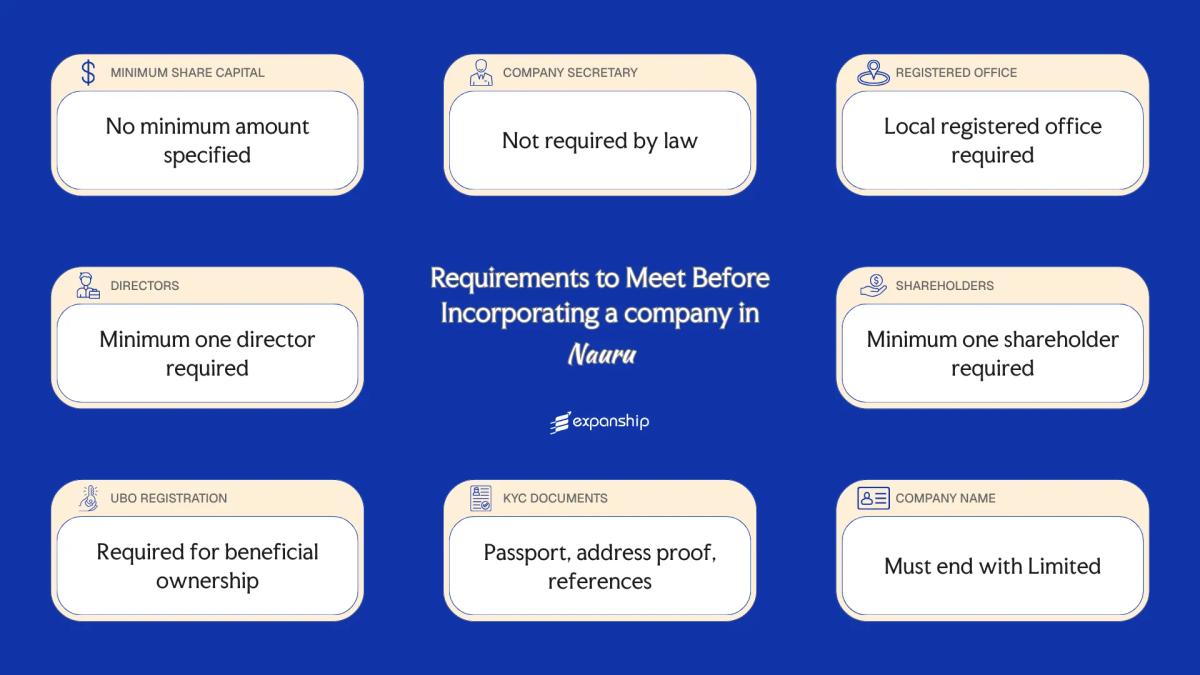
Minimum Share Capital Requirements in Nauru

Under the Nauru Companies Act 1972 and the framework governing International Business Companies, Nauru minimum share capital requirements impose no statutory minimum for authorized or paid-up capital. The Registrar of Companies, operating under the Nauru government's corporate registry, does not require capital verification at the point of incorporation.
Shares may be issued with or without par value, giving your business flexibility in structuring the authorized capital within the IBC framework. Nauru company share capital rules treat the capital structure primarily as a constitutional matter defined in the company's articles, rather than an ongoing statutory obligation imposed by regulation.
| Parameter | Detail |
|---|---|
| Minimum Authorized Share Capital | No statutory requirement |
| Maximum Authorized Share Capital | No statutory requirement |
| Minimum Paid-Up Capital | No statutory requirement |
| Paid-Up Requirement at Incorporation | No statutory requirement |
| Accepted Currency | No restriction specified; foreign currencies generally accepted |
| Accepted Forms of Contribution | Cash and non-cash contributions permissible under the articles |
| Timeframe to Deposit Capital | No statutory timeframe prescribed |
Even without a minimum requirement, your company must define an authorized share capital in its constitutional documents. Leaving this undefined or inadequately structured can create complications when issuing shares or onboarding investors later.
Company Secretary Requirements in Nauru
Under the Naurus Companies Act 1972, appointing a company secretary is a formal obligation for entities incorporated in the jurisdiction. Nauru company secretary requirements apply to all registered companies, with the role carrying specific administrative and compliance duties.
The secretary is responsible for maintaining statutory registers, filing annual returns with the Nauru registrar, and ensuring that resolutions and minutes are properly recorded. Corporate secretary obligations extend to acting as the official point of contact between the company and regulatory authorities.
Qualification criteria for who may serve as company secretary in Nauru:
- The secretary must be a natural person; a body corporate generally cannot hold this position alone.
- No formal professional qualification is mandated under general company law, though competency in corporate administration is expected.
- Residency within Nauru is not a statutory requirement for the role.
- A sole director of the company cannot simultaneously serve as the company secretary.
- The individual must be at least 18 years of age at the time of appointment.

Incorporate a Company in Nauru
Set up your legal entity in Nauru with guidance on registration, compliance, and ongoing corporate maintenance.
Registered Office Requirements in Nauru
Nauru registered office requirements mandate that every company incorporated under the Corporations Act 2006 maintains a physical address within the country at all times. Failure to maintain a compliant registered address can result in administrative penalties or the company being struck off the register by the Nauru Registrar of Corporations.
- A physical street address within Nauru is required; a P.O. Box alone does not satisfy the requirement.
- Virtual office arrangements are not formally recognised as compliant registered office addresses under the Corporations Act 2006.
- The address must be locally based; an overseas address cannot serve as the registered office of a Nauruan entity.
- Documentary evidence of occupancy, such as a lease agreement or proof of ownership, is generally required to confirm the address is accessible and in use.
- The registered office address is recorded on the public company registry and is accessible to third parties.
- Any change to the registered office address must be formally notified to the Registrar of Corporations; the updated address takes effect only upon acceptance of the filing.
Director Requirements in Nauru

Under Nauru's International Business Companies Act 1994, directors of an IBC assume statutory duties of care and fiduciary obligations to the company upon appointment. Liability for acts of negligence, default, or breach of duty rests directly with the individual director.
| Parameter | Detail |
|---|---|
| Minimum Number of Directors | One director is required. |
| Maximum Number of Directors | No statutory maximum is prescribed. |
| Local/Resident Director Required | No residency requirement exists under the IBC framework. |
| Nationality Restrictions | No nationality restrictions apply to director appointments. |
| Minimum Age Requirement | Directors must be at least 18 years of age. |
| Corporate Directors Permitted | Corporate directors are permitted under the Act. |
| Director Must Be a Shareholder | No statutory requirement for directors to hold shares. |
| Publicly Listed on Registry | Director details are not publicly disclosed on a central registry. |
| Disqualification Conditions | Persons who are bankrupt or have been convicted of fraud-related offences may be disqualified from serving. |
Despite Nauru's small size and offshore-friendly framework, a single corporate entity can fulfill the entire director requirement for an IBC, with no individual person ever needing to be formally named on any public record.
Shareholder Requirements in Nauru

Under the Nauru Companies Act 2008, a company may be incorporated with a single shareholder, making sole shareholder structures permissible. There is no statutory upper limit on the number of shareholders a company may have.
Nationality and Residency Restrictions
Nauru shareholder requirements incorporation rules do not impose nationality or residency conditions on shareholders. Foreign nationals and non-residents may hold shares without restriction on ownership percentage.
Corporate Shareholders
Corporate entities are permitted to act as shareholders in a Nauruan company. No special conditions are attached solely by virtue of the shareholder being a corporate body rather than a natural person.
Shareholder Liability
Shareholder liability is generally limited to the amount unpaid on their shares. Extended liability does not ordinarily arise unless a court pierces the corporate veil under applicable legal principles.
Register of Shareholders
A company must maintain a register of shareholders as required under the Companies Act 2008. This register is not publicly accessible but must be kept current and available for inspection by authorized parties.
Shareholder Structuring Support for Your Nauru Company
Get guidance on meeting shareholder eligibility criteria and structuring your Nauru entity in line with the Companies Act 2008.
UBO / Beneficial Ownership Disclosure Requirements in Nauru
Nauru beneficial ownership disclosure requirements are not governed by a dedicated statutory UBO framework at this time. No legislation currently mandates the registration of beneficial owners with a central authority or public registry.
KYC / Document Requirements in Nauru

Nauru KYC document requirements are governed by the Anti-Money Laundering Act 2008, administered by the Financial Intelligence Unit. All persons involved in the incorporation of a company under the Corporations Act 1972 must submit identity and due diligence documentation before registration proceeds.
Individual / Personal Documents
- Certified copy of a valid government-issued passport or national identity card
- Proof of residential address dated within three months, such as a utility bill or bank statement
- Completed and signed KYC declaration form as required by the registered agent
- Recent passport-sized photograph may be required depending on the registered agent's internal procedures
Corporate Documents
- Certificate of incorporation of the corporate shareholder or director entity
- Constitutional documents, including articles of association or equivalent instrument
- Register of current directors of the corporate entity
- Proof of the entity's registered office address, such as a utility bill or official correspondence
Source of Funds Documentation
- Recent bank statements covering a minimum of three months
- Audited financial statements or management accounts where applicable
- A signed written declaration explaining the origin of capital contributed
Notarisation and Apostille Requirements
- Foreign-issued documents generally require notarisation by a qualified notary public
- Nauru is not a party to the Hague Apostille Convention, so alternative legalisation through consular channels may apply
- Certified English translations are required for any document not originally in English
Incomplete or uncertified identity documents submitted for corporate shareholders are the most common cause of registration delays.
Company Name Requirements in Nauru
Nauru company name requirements are assessed at the point of incorporation through the registrar, which reviews proposed names for uniqueness and compliance before approval is granted. A name identical or deceptively similar to an existing registered entity will be rejected.
Proposed names must include a legal suffix indicating limited liability, such as "Limited" or "Ltd." The name must be rendered in the Latin alphabet.
Certain words are subject to restriction and require prior consent from the relevant authority before use. Words implying a connection to the government, royal patronage, or regulated sectors such as banking or insurance fall into this category.
Name reservation is generally available prior to formal incorporation, allowing you to secure a proposed name for a defined period while documentation is prepared. Applications are submitted to the registrar.
Compliance Services for Companies in Nauru
Stay compliant with Nauru's corporate regulations through ongoing compliance support, annual filings, and registry maintenance.
Conclusion
Nauru company incorporation requirements span several distinct obligations, from minimum share capital thresholds to director residency conditions and beneficial ownership disclosure under the country's AML framework. Registered agent appointment stands out as a non-negotiable structural requirement, as does the maintenance of a local registered office address. Once these obligations are understood, a foreign investor moves into the operational phase: selecting a compliant corporate structure, appointing qualified officers, and engaging with the Nauru registrar to formalise the entity's legal standing.
Expanship's Corporate Services for Nauru Expansion
Expanship's Nauru corporate services incorporation support is structured around the specific requirements that govern entity formation under Nauru's regulatory framework, including beneficial ownership disclosure obligations, registered office compliance, and director qualification rules. Your business carries the legal and administrative responsibility for meeting those requirements. Expanship's role is to reduce the operational burden of managing them correctly from the outset.
Beyond initial registration, our service scope covers the full formation and post-incorporation cycle:
- We prepare and file all incorporation documents with the relevant Nauruan authorities on your behalf.
- Our team provides registered agent and local office services to satisfy residency-based compliance requirements.
- We handle direct liaison with government bodies and regulatory offices throughout the filing process.
- Ongoing compliance obligations are tracked and managed after your entity is established.
- Banking introduction support is available to help your firm access appropriate financial services.
- Tax registration and coordination with local authorities is included as part of the setup process.
Reach out to Expanship Nauru to discuss your incorporation requirements.
Frequently Asked Questions (FAQ)
Yes, foreign nationals may act as sole directors of a Nauru-incorporated company. There is no statutory residency or nationality requirement for directors under the Corporations Act 1972, though you must ensure a valid registered office address is maintained within Nauru to satisfy local presence obligations.
The requirement for a company secretary depends on whether one is prescribed under your company's constitutional documents or the relevant provisions of the Corporations Act 1972. Where a secretary is required, residency is not mandated, meaning a foreign individual or corporate entity may fill the role.
Nauru has enacted anti-money laundering and financial transparency obligations that require companies to identify and disclose ultimate beneficial owners to the relevant regulatory authority. Failure to maintain accurate UBO records can result in compliance breaches under Nauru's AML framework, which aligns with FATF standards the country has committed to observing.
Foreign shareholders are generally required to submit certified copies of a valid passport, proof of residential address, and background information sufficient to satisfy the registered agent's due diligence obligations. These requirements reflect Nauru's AML/KYC obligations and apply regardless of the shareholder's country of residence or the size of their shareholding.
Nauru company names must not be identical or deceptively similar to an already-registered entity, and certain words implying government affiliation, banking, or regulated activity require prior approval or supporting evidence before the Registrar will accept them. Your chosen name must also comply with general provisions under the Corporations Act 1972 governing misleading or prohibited terminology.
A registered office in Nauru is a statutory requirement, and failing to maintain one puts your company in breach of the Corporations Act 1972. The Registrar has authority to take compliance action against defaulting entities, which can include administrative penalties or striking the company from the register.
Legal Disclaimer
The information provided in this article is for general informational purposes only and does not constitute legal, tax, or professional advice. While we strive to ensure the accuracy and timeliness of the content, laws and regulations are subject to change, and the application of laws can vary widely based on specific facts and circumstances.
Readers should not act upon this information without seeking professional counsel tailored to their individual situation. Expanship and its authors disclaim any liability for actions taken or not taken based on the content of this article.
For specific advice regarding your business setup, compliance requirements, or any legal matters, please consult with qualified legal and tax professionals in the relevant jurisdiction.


