

Key Takeaways
- Nauru imposes zero corporate income tax on income sourced outside its borders, making it one of the few Pacific jurisdictions where foreign-earned profits can be retained within a registered entity without local tax erosion.
- Companies registered under Nauruan corporate law benefit from a privacy-oriented registry structure that limits public disclosure of beneficial ownership and directorship details, a feature embedded in the jurisdiction's legislative framework rather than applied administratively.
- The Nauru Financial Intelligence Unit oversees corporate compliance within a legal architecture modelled on Australian common law, giving registered International Companies access to a tested and judicially coherent body of commercial precedent.
- Holding, trading, and IP-focused structures stand to gain the most measurable advantage from Nauru's combination of low annual maintenance costs and unrestricted foreign ownership, provided the entity is positioned correctly within the owner's broader cross-border structure.
Nauru is an independent island republic in the central Pacific Ocean, operating under a sovereign legal and regulatory framework that is distinct from any surrounding territory or colonial administration. Company registration falls under the authority of the Nauru Financial Intelligence Unit and related government bodies responsible for corporate oversight. Foreign businesses incorporating here most commonly use the International Company as their legal vehicle of choice.
The jurisdiction maintains a zero-tax posture on income derived outside its borders, making it a structurally different environment from most onshore regimes. Foreign ownership of locally registered entities faces no blanket restrictions, and the government has historically maintained an open position toward inbound foreign direct investment across most sectors.
Understanding the benefits of incorporating in Nauru requires looking at several distinct areas — tax treatment, privacy protections, ownership rules, and the legal architecture that governs registered entities. This article examines those key advantages in factual terms, drawing on the regulatory conditions that apply to foreign-owned companies registered under Nauruan law.
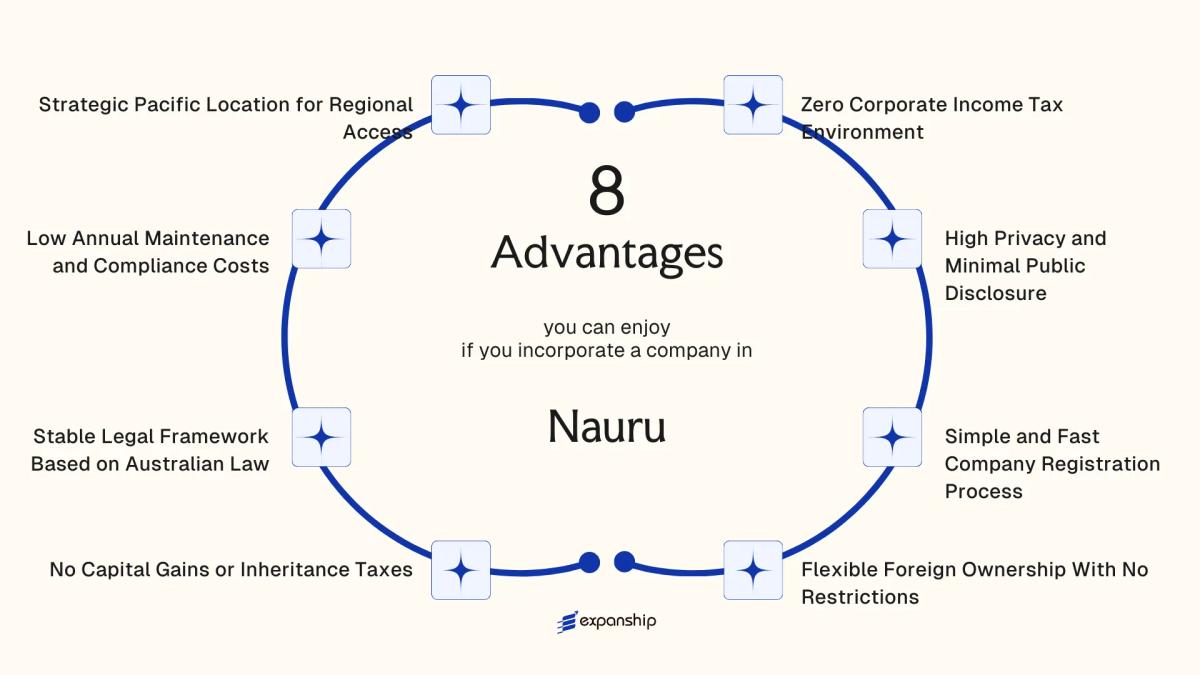
Zero Corporate Income Tax Environment
Nauru does not impose corporate income tax on companies incorporated under its laws. That single structural feature is the foundation of the Nauru zero corporate income tax advantage for foreign business owners.
What the Tax Structure Actually Means
Under Nauru's domestic legal framework, there is no general corporate income tax rate applied to business profits. For a foreign-owned entity, this means profits earned through a Nauruan company are not subject to a local tax charge at the corporate level, allowing full retention of earnings before any home-country obligations are considered.
The Practical Difference for Retained Earnings
Standard corporate tax rates across OECD member states average around 23%, meaning a firm operating through a Nauruan structure avoids that class of liability entirely at the jurisdiction level. Your business retains the full pre-tax profit figure within the corporate structure, which directly affects reinvestment capacity and distributable reserves.
One condition applies: your home country's tax rules, including controlled foreign corporation legislation, will independently govern how distributions or attributed profits are treated at the shareholder level.
Profits retained inside your Nauruan company are not reduced by a local corporate tax charge, preserving the full earned amount within the entity.
High Privacy and Minimal Public Disclosure
Nauru company privacy and confidentiality benefits stem primarily from what the jurisdiction does not require. Under the Companies Act 1972, non-resident domestic companies are not obligated to file annual financial statements with a public registry. There is no publicly searchable database of shareholders or directors equivalent to what exists in the UK, Australia, or EU member states.
Shareholder details are recorded in the company's internal register but are not disclosed to any public body as a matter of routine compliance. This structural separation between internal record-keeping and public reporting means that ownership information stays within the company itself, accessible only through formal legal process.
The practical advantages of this framework include:
- No public filing of beneficial ownership information under standard incorporation conditions
- Director identities are not exposed through a centrally published national register
- Financial accounts are maintained privately, without statutory audit requirements for non-resident entities
- Share structures and ownership percentages remain confidential absent a legal order
For a foreign business owner, this means the entity can operate without competitors, counterparties, or the general public being able to identify the firm's ownership structure through an open registry search.

Incorporate a Company in Nauru
Set up a non-resident company in Nauru with minimal public disclosure requirements and a straightforward registration process.
Simple and Fast Company Registration Process
Registration under the Corporations Act 1972 (Nauru) is administered centrally, and the process does not require a physical presence in the country. For foreign investors, this means your business can be formally constituted without traveling to the island or appointing a local resident director, which eliminates a logistical barrier common in many other offshore jurisdictions.
The Nauru fast company registration benefits stem partly from the registry's document requirements, which are minimal compared to onshore jurisdictions. A standard incorporation typically requires basic identification documents, a proposed company name, and details of directors and shareholders. No notarization of foreign documents through a Nauruan consulate is generally required, which reduces the administrative chain considerably.
| Requirement | Detail |
|---|---|
| Minimum Directors | 1 |
| Resident Director Required | No |
| Physical Presence Required | No |
| Governing Legislation | Corporations Act 1972 (Nauru) |
| Registered Agent Required | Yes |
Processing times are short relative to onshore corporate registries. Once documents are submitted through a licensed registered agent, formation can be completed within days rather than weeks. That speed has a direct operational consequence: your entity can open bank accounts, sign contracts, and engage counterparties sooner, shortening the gap between decision and deployment of capital.
A licensed registered agent must be appointed, and that agent acts as the formal conduit with the Nauruan registry, ensuring filings meet local statutory requirements without requiring your ongoing involvement in procedural compliance.
Flexible Foreign Ownership With No Restrictions
Nauru 100 percent foreign ownership benefits begin at the structural level: the country imposes no statutory requirement for local shareholding. Foreign nationals can hold the entirety of a company's shares without partnering with a Nauruan resident or citizen. This removes a condition that exists in many Asia-Pacific jurisdictions, where mandatory local equity thresholds directly dilute an investor's control over profits and governance.
Under the Nauru Corporations Act, a foreign-owned entity faces no prescribed minimum local directorship tied to ownership rights. Your business structure reflects your actual ownership without regulatory interference in the equity split.
Keep these points in mind:
- Full foreign shareholding is permitted from day one of incorporation
- No resident partner or nominee shareholder is legally required to meet ownership thresholds
- Profit repatriation rights are not conditioned on local equity participation
- Certain regulated sectors may carry separate licensing conditions; confirm sector-specific rules before structuring
This matters practically because restructuring a company post-incorporation to correct a forced equity arrangement is expensive and time-consuming in jurisdictions that mandate it. Forming a fully foreign-owned entity from the outset eliminates that operational and legal overhead entirely.
Nauru's offshore corporate framework predates many better-known Pacific financial centres, having established its companies legislation in the early 2000s before regional regulatory pressure reshaped most rival hubs.
No Capital Gains or Inheritance Taxes
Nauru imposes no capital gains tax on profits derived from the sale of assets, including shares, real estate, or business interests held through a registered entity. For foreign investors, the Nauru no capital gains tax advantage means that appreciation in asset value is not eroded at the point of disposal — the full realized gain remains within your structure.
What This Means for Investment Exits
No withholding mechanism applies to capital gains distributions made to non-resident shareholders. A foreign investor who exits a holding position, sells a subsidiary, or liquidates an asset portfolio receives proceeds without a domestic tax event triggered at the entity level. That distinction matters significantly when structuring multi-stage exits or reinvesting proceeds across jurisdictions.
Under the Companies Act 1975, which governs corporate entities on the island, there is no provision for capital gains assessment on corporate transactions.
Intergenerational Wealth and Business Succession
Nauru levies no inheritance tax, estate duty, or succession tax. For family-owned structures and wealth holding vehicles, this removes a tax trigger that commonly forces asset liquidation during ownership transitions. The full value of a business interest can transfer between generations or to designated beneficiaries without a domestic tax charge reducing the transferred amount.
This treatment applies regardless of the residency status of the beneficiary, which gives foreign-owned firms structural flexibility when planning succession outside the jurisdiction.
Plan Your Nauru Tax Structure With Confidence
Speak with our corporate services team about structuring your company in Nauru to fully utilize its capital gains and inheritance tax exemptions.
Stable Legal Framework Based on Australian Law
Nauru's legal system draws directly from Australian common law, and that foundation offers your business a meaningful degree of predictability. The Nauru Australian-based legal framework benefits foreign incorporators precisely because it rests on a well-documented body of case law and statutory precedent, rather than an untested or opaque domestic system.
- Corporate disputes and contractual matters are interpreted through common law principles developed over generations in Australian courts, giving foreign directors a familiar reference point for legal obligations and rights.
- The Companies Act 1975, which governs business registration and corporate conduct, follows structural conventions recognizable to any adviser trained in Commonwealth jurisdictions, reducing the time and cost needed to understand local compliance requirements.
- Australian legal influence extends to contract enforcement standards, meaning agreements governed by Nauruan law carry a degree of enforceability clarity that matters when your entity enters cross-border commercial relationships.
- For investors accustomed to civil law systems, engaging counsel familiar with Australian common law doctrine is straightforward, since the talent pool spans the entire Commonwealth.
- The stable legal system for businesses means that the rules governing your company's formation, operation, and dissolution are unlikely to shift arbitrarily, which reduces legal risk over the holding period of a long-term structure.
Low Annual Maintenance and Compliance Costs
Nauru low annual compliance cost benefits are among the most structurally significant for foreign-owned companies. Annual government fees for registered entities remain comparatively low, and there is no mandatory audit requirement for most private companies under the Nauru Corporations Act 1972. This removes a recurring professional expense that can run into thousands of dollars annually in higher-regulation jurisdictions.
Renewal obligations are straightforward. Your company is required to file an annual return and pay the corresponding renewal fee to the Nauru Registry of Corporations. Beyond this, there is no requirement to prepare audited financial statements for submission to a public authority, which substantially reduces the cost of maintaining a compliant structure year on year.
For businesses without complex local operations, the annual administrative burden stays minimal. A registered agent address and a local registered office are the primary structural requirements, both of which are standard inclusions in most corporate service packages.
A foreign-owned holding company incorporated in Nauru with no local trading activity could realistically maintain full compliance for under USD 1,500 per year, covering registered agent fees, the annual return filing, and government renewal fees, compared to equivalent structures in Singapore or Hong Kong where annual compliance costs routinely exceed USD 3,000 to USD 5,000.
Strategic Pacific Location for Regional Access
Nauru sits within the Pacific Islands Forum region, placing any registered entity roughly equidistant between major Asia-Pacific economies. For a business targeting markets across Oceania, Southeast Asia, or the broader Pacific Rim, that geographic positioning reduces logistical friction in ways that a European or Caribbean offshore structure simply cannot replicate.
Time zone alignment matters operationally. The country operates on UTC+12, which overlaps with business hours across Australia, New Zealand, Japan, and coastal East Asian markets. Your firm can conduct real-time correspondence with counterparts in Sydney, Tokyo, or Auckland within a standard working day, without the scheduling gaps common when managing Pacific operations from Atlantic-based jurisdictions.
Nauru is a member of the Pacific Islands Forum and maintains diplomatic ties with several key regional states. This membership situates a registered business within a recognized regional framework, which can carry weight in commercial relationships across Oceania where origin and regional affiliation factor into procurement and partnership decisions.
- Regional proximity to Australia and New Zealand, two of the Pacific's largest economies by GDP
- UTC+12 time zone coverage across East Asia and Oceania
- Pacific Islands Forum membership supporting regional commercial recognition
Nauru's geographic advantages are primarily practical and relational; your business must still independently assess whether any specific trade agreements or preferential market access arrangements apply to your sector and counterparty jurisdiction.
Why Nauru Stacks Up Against Rival Offshore Hubs
Evaluating the Nauru vs other offshore jurisdictions advantages requires placing it against the competitors a prospective incorporator would realistically weigh. The most relevant comparators are Vanuatu, the Marshall Islands, and Samoa — each Pacific-based, each targeting similar non-resident business structures, and each frequently appearing in the same due diligence shortlists. The comparison below isolates parameters where the Republic of Nauru holds a neutral or favourable position.
What the table makes visible is a structural point: several Pacific offshore centers have moved toward public registries or increased filing obligations under FATF pressure or bilateral agreements. Under the Nauru Companies Act 2017, administered by the Nauru Registry, no public disclosure of beneficial ownership is required for non-resident entities, and there is no annual financial statement filing requirement for offshore companies. That combination — absent in jurisdictions like Vanuatu, which has tightened disclosure norms — is what distinguishes the compliance burden for a foreign-owned holding or trading structure.
| Parameter | Nauru | Vanuatu | Marshall Islands | Samoa |
|---|---|---|---|---|
| Corporate income tax (non-resident) | 0% | 0% | 0% | 0% |
| Public beneficial ownership registry | No | Partial | No | No |
| Annual financial statement filing | Not required | Required in some cases | Not required | Not required |
| Governing legislation | Companies Act 2017 | Companies Act 2012 | Business Corporations Act | International Companies Act 1987 |
| Legal system base | Australian common law | Mixed (French/English) | US common law | English common law |
| Annual government fee structure | Low | Moderate | Moderate | Low–Moderate |
Compliance Services for Nauru Companies
Ongoing compliance support for Nauru-registered entities, including annual government filings, registered agent maintenance, and regulatory correspondence.
Conclusion
Nauru's position as an offshore incorporation destination rests on a combination of structural features that are difficult to replicate elsewhere in the Pacific. The absence of corporate income tax, the privacy protections built into its company registry, and the Australian legal foundation together create a framework with genuine utility for internationally operating businesses. These are not incidental features; they reflect deliberate legislative choices embedded in the country's corporate statutes.
That said, the benefits of incorporating in Nauru are not uniformly applicable to every business type. A firm with significant operations in high-tax jurisdictions, or one subject to sector-specific licensing requirements, will need to assess carefully how a Nauru entity fits within its broader structure. The zero-tax environment and low compliance overhead are most advantageous when the entity is used for holding, trading, or IP-related purposes under a structure that is defensible in the owner's home jurisdiction.
The case for Nauru offshore incorporation rests on access to a low-cost, legally coherent, and private corporate environment in a jurisdiction that has codified its commercial law on a proven common-law model. For business owners whose priorities include cost efficiency, ownership confidentiality, and structural flexibility, the fit is clear. Confirming that fit against your specific facts, and executing the formation correctly under the applicable registry rules, is the step that determines whether these advantages translate into real commercial value.
Let Expanship Handle Your Nauru Company Formation
Expanship supports foreign business owners through every stage of Nauru company formation benefits with Expanship at the center of that process — from selecting the right entity type under the Nauru Corporations Act 1972 to maintaining annual compliance obligations with the Nauru Business Registry. The firm's familiarity with the Registry's filing requirements, disclosure rules, and renewal procedures means your entity is structured correctly from the outset.
Expanship's service scope covers the full lifecycle of your offshore entity:
- Preparation and legalization of incorporation documents in accordance with Nauru's statutory requirements
- Provision of a registered agent and registered office address within Nauru
- Government filing and direct liaison with the Nauru Business Registry on your behalf
- Post-incorporation compliance management, including annual return filings and record maintenance
- Banking introduction assistance to help your entity establish an operational account
Each service addresses a practical gap that foreign owners commonly face when incorporating in a jurisdiction they do not physically operate from. Registered agent provision, for instance, is a statutory requirement under Nauru corporate law, not an optional add-on.
Reach out to Expanship Nauru to discuss your incorporation requirements.
Frequently Asked Questions (FAQ)
Yes, foreign nationals can hold full ownership of a company registered under the Nauru Corporations Act without any requirement for local shareholding. There is no mandatory joint-venture structure or minimum local equity threshold. This applies equally to individual foreign investors and foreign corporate shareholders acting as sole owners.
Offshore companies incorporated under Nauru's regulatory framework are not subject to corporate income tax on foreign-sourced income. The zero-tax treatment is a function of how offshore entities are classified and assessed under the jurisdiction's tax structure, not a time-limited incentive or negotiated concession. Domestically generated income may be treated differently, so the source of revenue is a relevant factor.
No. The legal framework draws from Australian common law, which means court decisions, contractual interpretation, and corporate governance principles follow common law precedent rather than a civil code. This structure is recognizable to lawyers and directors from the United Kingdom, Australia, and other Commonwealth jurisdictions. It reduces the interpretive uncertainty that can arise in less familiar legal systems.
Registration timelines are generally short relative to many other jurisdictions, with straightforward applications processed within a few business days under normal conditions. The simplified documentation requirements under the Corporations Act contribute to this pace. Delays typically arise when submitted documents are incomplete or require additional verification.
No capital gains tax applies to share disposals involving offshore companies registered in the jurisdiction. This treatment extends to inheritance transfers as well, meaning equity passed between generations or through estates is not subject to a separate tax charge at the corporate or shareholder level. Investors should separately verify tax obligations in their country of residence, as home-country rules may still apply.
Nauru company law does not impose a mandatory requirement for a locally resident director in all cases, though a registered agent or registered office address within the jurisdiction is generally required for compliance purposes. A physical operational presence is not compulsory for an offshore entity. The specific obligations depend on the entity type and the activities being conducted.
Annual maintenance costs are generally low, consisting primarily of the government renewal fee and the registered agent's annual service charge. There are no audit requirements for standard offshore entities, and financial statements are not mandatorily filed with a public registry. The absence of these recurring professional obligations keeps the ongoing cost structure comparatively modest.
Nauru's corporate registration framework does not require beneficial ownership information or detailed director and shareholder data to be included in publicly searchable records. This means third parties cannot access ownership details through a standard public registry search. Disclosure obligations may still arise under international information exchange agreements, particularly where Nauru has entered into tax information-sharing arrangements with other countries.
Legal Disclaimer
The information provided in this article is for general informational purposes only and does not constitute legal, tax, or professional advice. While we strive to ensure the accuracy and timeliness of the content, laws and regulations are subject to change, and the application of laws can vary widely based on specific facts and circumstances.
Readers should not act upon this information without seeking professional counsel tailored to their individual situation. Expanship and its authors disclaim any liability for actions taken or not taken based on the content of this article.
For specific advice regarding your business setup, compliance requirements, or any legal matters, please consult with qualified legal and tax professionals in the relevant jurisdiction.