

Key Takeaways
- Nauru's absence from any double taxation treaty network means foreign investors face the full burden of cross-border withholding taxes without any bilateral relief mechanism to offset exposure.
- Companies incorporated in Nauru encounter severe practical limitations when establishing international banking relationships, as correspondent banks routinely restrict or decline accounts linked to the jurisdiction due to its offshore reputation and compliance profile.
- The limited accessibility and underdeveloped nature of Nauru's corporate legislative framework, including restricted public access to instruments such as the Companies Act, creates material uncertainty for foreign investors attempting to verify statutory obligations or enforce corporate rights.
- Nauru's history on the FATF grey list has generated lasting compliance scrutiny that requires counterparties, auditors, and financial institutions to apply enhanced due diligence to any entity with a Nauru connection, adding cost and friction to routine business operations.
Nauru operates under a lightly regulated and largely undeveloped corporate framework, placing it outside the mainstream of established offshore financial centres. The disadvantages of incorporating in Nauru span regulatory, financial, and operational categories, each examined individually in the sections that follow.
Not all disadvantages apply equally. The practical impact depends significantly on your business structure, the industry you operate in, and the jurisdictions where your clients, counterparties, or banking relationships are based.
Nauru's primary corporate legislation is accessible via the Companies Act, though published government legal databases remain limited in accessibility compared to most jurisdictions. Foreign investors considering the jurisdiction for holding structures, asset protection, or international trade operations are most likely to encounter the drawbacks outlined here.
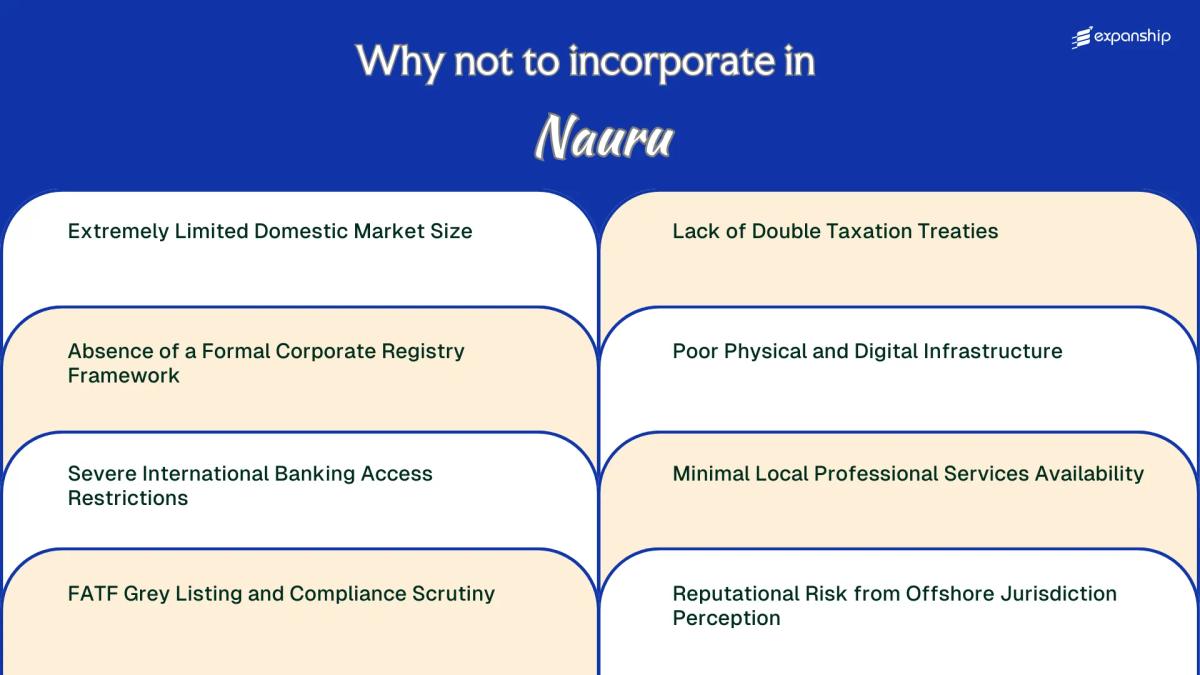
Extremely Limited Domestic Market Size
Nauru small market limitations for business are among the most structurally binding constraints any foreign entity will encounter. With a population of approximately 10,000 people, the domestic consumer base cannot support most commercially viable business models.
No Scale for Revenue Generation
The island covers roughly 21 square kilometres, and its economy depends heavily on phosphate mining and foreign aid rather than private consumption. Any firm incorporated locally will find that domestic sales volume alone cannot justify operational costs, forcing immediate reliance on export-oriented revenue that itself faces logistical barriers.
Nauru domestic market size constraints also affect pricing power and supplier terms. Because local demand is too thin to attract competitive suppliers or distribution networks, your input costs will typically exceed those in larger regional markets.
Structural Dependency on External Trade
Most goods consumed domestically are imported through a narrow supply chain, which means your business bears the cost of that same chain. The absence of meaningful inter-industry linkages within the economy leaves firms without local B2B demand to draw from.
A foreign business incorporated here with any revenue dependency on the local market faces near-certain shortfalls, as the domestic economy cannot generate sufficient transaction volume to sustain most commercial operations.
Absence of a Formal Corporate Registry Framework
The Nauru corporate registry framework problems begin at a structural level: the country does not operate a publicly accessible, centralized company registry comparable to those found in most incorporated jurisdictions. Without a functioning registry infrastructure, there is no reliable public record of company ownership, directorships, or filing history that counterparties can independently verify.
For your business, this creates immediate credibility problems when dealing with overseas banks, suppliers, or partners who require standard due diligence documentation.
Gaps in the Nauru company registration system mean that basic corporate lifecycle events — such as confirming good standing or retrieving historical filings — have no standardized process. This forces you to rely on intermediaries whose records may be inconsistent or incomplete.
The practical burdens this creates include:
- Obtaining a certificate of good standing becomes a manual, time-intensive process with no guaranteed turnaround
- Third-party verification services cannot cross-check your entity against a live public database, increasing counterparty refusal rates
- Legal disputes involving ownership or directorship records lack a neutral authoritative source, raising litigation risk and cost
The lack of corporate governance framework in Nauru also means statutory obligations may not be consistently enforced or documented, which, while occasionally reducing administrative load, simultaneously makes your entity harder to legitimize abroad.

Company Incorporation in Nauru
Understand the full scope of incorporating a company in Nauru, including structural requirements and compliance obligations.
Severe International Banking Access Restrictions
Nauru international banking access restrictions represent one of the most concrete operational barriers a foreign business owner will encounter after incorporation. Correspondent banking relationships, which international transactions depend on, are routinely declined for entities associated with the jurisdiction by major financial institutions in the United States, European Union, and United Kingdom.
| Barrier | Specific Burden |
|---|---|
| Correspondent bank refusals | Major clearing banks in USD, EUR, GBP routinely reject account requests from Nauru-linked entities |
| KYC/AML documentation threshold | Foreign compliance teams typically demand multi-year audited financials, which newly formed entities cannot provide |
| Account opening timelines | Where accounts are opened, processing periods at offshore-friendly banks can exceed 90 days |
| Transaction monitoring scrutiny | Ongoing transactions face enhanced due diligence reviews, adding processing delays of 5 to 15 business days per wire |
Banking challenges for Nauru companies stem partly from the jurisdiction's historical placement on international watchlists, which has conditioned global compliance departments to treat associated entities as high-risk by default. Your business may be entirely legitimate, yet the originating jurisdiction alone is sufficient for an automatic rejection under many banks' internal risk policies.
Even institutions in jurisdictions with more permissive onboarding standards, such as certain Pacific or Southeast Asian banks, frequently impose transaction volume caps or restrict currency pairs available to your account. Nauru business account opening problems are therefore not limited to the initial application stage. Ongoing operational restrictions can prevent your firm from receiving payments in major currencies or settling cross-border invoices without significant delays and additional compliance documentation.
FATF Grey Listing and Compliance Scrutiny
Nauru FATF grey list compliance risks are not theoretical. The Financial Action Task Force has previously placed the country on its list of jurisdictions under increased monitoring, signaling deficiencies in anti-money laundering and counter-terrorist financing frameworks. For any foreign business owner, that designation alone triggers automatic scrutiny from correspondent banks, payment processors, and institutional counterparties worldwide.
Businesses incorporated here face enhanced due diligence requirements from foreign financial institutions under FATF Recommendation 19. That means higher compliance costs, longer onboarding timelines, and frequent rejections before a single transaction clears.
The FATF monitoring process imposes reporting obligations on member states that affect how they treat your entity. Your business may be required to demonstrate source of funds, ultimate beneficial ownership, and transaction purpose at a level of detail uncommon in standard jurisdictions.
- FATF grey-listing imposes enhanced due diligence obligations on counterparties dealing with your entity
- Correspondent banks in FATF-compliant jurisdictions may refuse or delay processing payments linked to your business
- Ultimate beneficial ownership disclosure requirements apply with heightened scrutiny under AML compliance frameworks
- Regulatory re-assessment cycles mean your entity's compliance status can shift without direct notice to you
Despite its offshore reputation, Nauru has no formal financial intelligence unit operating at full FATF-compliant capacity, meaning AML compliance scrutiny of locally incorporated entities depends heavily on foreign regulators rather than domestic oversight.
Lack of Double Taxation Treaties
Nauru has not entered into any double taxation treaties with other countries. For foreign business owners, this absence of Nauru double taxation treaty arrangements means income may be taxed in both the source country and the jurisdiction where the company is registered.
No Treaty Network and Its Direct Cost Implications
Without bilateral tax agreements, withholding taxes on dividends, royalties, and interest payments cannot be reduced through treaty provisions. A business operating across multiple jurisdictions faces the full statutory withholding rates of each country, with no mechanism to claim relief at the Nauru end.
Structural Exclusion from Cross-Border Tax Planning
The no tax treaties Nauru situation also disqualifies entities from using the jurisdiction as part of a treaty-shopping structure, which many holding company arrangements depend on. Countries such as the Netherlands or Singapore maintain extensive treaty networks exceeding 90 agreements each, making Nauru structurally incompatible with most international tax planning frameworks. This limitation applies regardless of the company's actual trading activity or the residency of its shareholders.
Addressing Tax and Compliance Challenges in Nauru
Understand the structural tax limitations of operating through a Nauru entity and get guidance on how to structure your business across jurisdictions with these constraints in mind.
Poor Physical and Digital Infrastructure
Nauru infrastructure challenges for businesses are substantial enough to affect even the most basic operational requirements a foreign entity might have.
- The island's sole international internet connection depends on a single submarine cable, meaning any outage in poor digital infrastructure Nauru company operations encounter can halt communications entirely with no redundant pathway.
- Electricity supply is unreliable and generated almost entirely by imported diesel fuel, making consistent power availability a cost and operational risk that most incorporated jurisdictions do not impose.
- Air connectivity is limited to a single runway served by infrequent regional flights, which restricts the movement of personnel and time-sensitive documents critical to corporate administration.
- Banking infrastructure gaps compound Nauru connectivity problems for corporations requiring in-country financial transactions or local account operations.
- No dedicated commercial postal or courier infrastructure exists at a scale comparable to regional financial centres, creating delays in the physical transmission of executed corporate documents.
- Mobile and broadband penetration rates remain among the lowest in the Pacific, restricting remote administration of any locally registered entity.
Minimal Local Professional Services Availability
The lack of professional services in Nauru is a structural constraint that directly affects how you manage incorporation, compliance, and ongoing corporate administration. The island's population of roughly 10,000 people cannot sustain a specialized legal or accounting profession at any meaningful scale.
Qualified corporate lawyers, licensed accountants, and registered auditors with international corporate experience are effectively absent from the local market. Any entity requiring advice on cross-border structuring, financial reporting under IFRS, or regulatory filings must source those services from overseas providers, typically from Australia or New Zealand, at significant cost and logistical delay.
Nauru corporate support services constraints extend to company secretarial work as well. There is no established local profession providing routine compliance maintenance, which means your business has no reliable on-the-ground support for time-sensitive regulatory obligations.
- Licensed local law firms capable of handling commercial matters are not publicly documented as operational
- No local body equivalent to a chartered accountancy institute regulates or accredits practitioners
- Notarization and document authentication frequently require referral to foreign-based officials
Hypothetical scenario: A foreign-incorporated entity requiring annual audit sign-off and a legal opinion on a counterparty contract could face combined fees of USD 8,000–15,000 sourced entirely from Australian service providers, plus two to four weeks of turnaround time due to remote coordination, compared to equivalent services available domestically in jurisdictions with established professional sectors.
Reputational Risk from Offshore Jurisdiction Perception
Nauru offshore jurisdiction reputational risks are not theoretical. The country was listed by the OECD as an uncooperative tax haven in the early 2000s, and despite subsequent reforms, that historical association persists in the perception of international banks, institutional investors, and multinational counterparties.
Your business entity's registered address carries weight in due diligence reviews. Compliance officers at European and North American financial institutions routinely apply heightened scrutiny to firms connected to jurisdictions with documented offshore histories, regardless of current regulatory status.
The practical cost is transactional. Correspondent banking relationships, trade finance arrangements, and investor agreements can be delayed or refused outright when a counterparty's internal risk policy flags the jurisdiction of incorporation.
- Institutional investors may decline to participate in funding rounds involving entities from jurisdictions with unresolved reputational profiles.
- Legal due diligence processes for mergers, acquisitions, or joint ventures may require additional documentation solely on the basis of the registration address.
- Some payment processors and financial platforms apply blanket restrictions that are not easily overridden by individual exemptions.
Reputational concerns about registering a company in Nauru extend beyond finance. Supply chain partners and enterprise clients in regulated industries may face their own compliance obligations that prevent them from contracting with firms incorporated in flagged jurisdictions.
Even if your firm operates with full transparency, your counterparties' internal risk frameworks and regulatory obligations may independently prohibit engagement with entities incorporated in this jurisdiction, without any requirement to justify that decision to you.
Strategies to Overcome These Challenges
Overcoming Nauru incorporation challenges requires structural decisions made well before formation, not adjustments applied after the fact.
- Establish your primary banking relationships in a well-regulated third-country jurisdiction before attempting to open accounts linked to a Nauru-registered entity, given the documented correspondent banking restrictions.
- Confirm the current status of Nauru's standing with the FATF grey list before proceeding, as compliance obligations tied to that listing directly affect counterparty due diligence requirements.
- Engage tax counsel in your home jurisdiction to assess exposure arising from the absence of double taxation treaties, since relief mechanisms available elsewhere will not apply here.
- Source all corporate secretarial and legal support externally, as the minimal local professional services market cannot reliably meet ongoing compliance needs.
- Assess reputational exposure with your banking and commercial partners before registration, given the offshore perception risk associated with this jurisdiction.
Mitigation steps of this kind operate within a regulatory environment that remains underdeveloped relative to comparable offshore jurisdictions. The absence of a formal corporate registry framework means that even standard compliance processes carry structural uncertainty.
Nauru's Overall Business Viability
Nauru business viability risks and limitations are extensive, and the structural disadvantages covered in this blog are real constraints rather than theoretical concerns. Yet for a narrow category of business activity, particularly those with no banking dependency, no treaty requirements, and no need for local operations, the jurisdiction retains a degree of incorporation utility.
| Pros | Cons |
|---|---|
| Low-cost, low-complexity incorporation process | No formal corporate registry framework with standardised filing obligations |
| Minimal ongoing domestic regulatory burden | Severe restrictions on accessing international banking services |
| Absence of corporate income tax on foreign-sourced income | FATF grey listing increases compliance scrutiny from correspondent banks and regulators |
| Sovereign jurisdiction status with independent legal standing | No double taxation treaties, exposing income to potential dual-tax liability |
| Remote location limits exposure to certain geopolitical pressures | Poor physical and digital infrastructure impedes day-to-day business operations |
| Offshore jurisdiction perception creates reputational risk with counterparties and investors |
Taken together, the structural gaps outweigh the fiscal simplicity for most conventional business models. Your assessment of viability should rest on whether the entity's actual operational needs can be met within these constraints, not on the cost of formation alone.
Compliance Services for Companies in Nauru
Understand your ongoing compliance obligations for a Nauru-registered entity, including applicable reporting requirements and regulatory considerations under current frameworks.
Conclusion
The cons of incorporating in Nauru are substantial enough to give most businesses reason for careful consideration. Banking access remains the most operationally disruptive barrier, with correspondent banking relationships nearly impossible to establish under current international scrutiny. The FATF grey listing compounds this, subjecting any entity registered there to heightened due diligence from foreign counterparties. Absent a bilateral tax treaty network, cross-border transactions carry inefficiencies that erode whatever structural benefits the jurisdiction might otherwise offer. For businesses weighing a Nauru company registration, the disadvantages summary points consistently toward execution risk rather than theoretical appeal. Specialist guidance from experienced incorporation practitioners becomes a practical requirement, not a precaution.
Expanship's Nauru Incorporation Support
Incorporating in Nauru carries real operational weight, particularly around Nauru incorporation support for compliance risks tied to FATF grey listing obligations, the absence of a structured corporate registry, and acute banking access barriers. Expanship works alongside your business to manage the procedural and documentary burden these conditions create, helping you maintain standing without overstating what external support can resolve in a jurisdiction with structural limitations.
Our team covers the practical scope of Nauru company formation assistance services across the full incorporation cycle.
- We prepare and structure your company registration documents in accordance with applicable local requirements.
- A registered agent and local office address are provided to satisfy presence obligations.
- We handle direct liaison with government offices and relevant regulatory bodies on your behalf.
- Post-incorporation compliance management keeps your entity in good standing over time.
- Banking introduction assistance connects your business with institutions that accept Nauru-registered entities.
- Tax registration and coordination with local authorities are managed as part of your setup.
Reach out to Expanship Nauru to discuss your specific incorporation requirements.
Frequently Asked Questions (FAQ)
The absence of double taxation treaties affects every entity incorporated in Nauru regardless of structure, since there are no bilateral agreements in force to reduce withholding taxes on dividends, royalties, or interest payments between Nauru and other countries. Without treaty protection, income earned in or routed through Nauru may be taxed in full in the home jurisdiction of your shareholders or parent company, with no credit mechanism to offset double taxation. This applies equally to offshore companies and any locally registered entities.
The primary risk is that your Nauruan company will be unable to open or maintain accounts with internationally connected banks, because most correspondent institutions apply blanket restrictions to high-risk jurisdictions identified by bodies like the FATF. This is not a theoretical risk — Nauru's long-standing reputation as an offshore secrecy jurisdiction has caused major banking groups to exit or refuse relationships with entities registered there. Without correspondent banking, cross-border payments, trade finance, and foreign currency transactions become effectively impossible.
Nauru carries a higher reputational burden than most Pacific peers because of its specific history as an offshore financial centre that attracted regulatory criticism in the early 2000s, prompting it to be placed on international blacklists before subsequent reform efforts. Jurisdictions like Vanuatu or the Cook Islands have established more recognisable offshore regulatory frameworks with dedicated financial services commissions, giving counterparties a clearer compliance basis for engaging with entities from those countries. Nauru lacks an equivalent visible regulatory architecture, which makes due diligence assessments by banks, investors, and legal counterparties more likely to result in rejection.
If Nauru's standing with bodies like the FATF or the OECD Global Forum worsens, your entity faces the risk of being classified as originating from a non-cooperative or blacklisted jurisdiction, triggering mandatory enhanced due diligence or outright exclusion from financial systems in EU member states, the UK, and the US. Companies already operating under such a registration would find it extremely difficult to transfer funds internationally or maintain any payment processing relationships. Restructuring or redomiciling the business would then become the only practical option, at significant cost and administrative burden.
Using offshore advisers can partially compensate for the absence of local accountants, corporate lawyers, and compliance professionals in Nauru, but it does not resolve the underlying structural issue of having no meaningful local professional infrastructure to interact with regulatory or government bodies on the ground. Any filings, statutory obligations, or government interactions that require physical presence or locally licensed professionals will still be constrained by what is available within the country. The practical result is slower processing, higher reliance on a very small pool of local intermediaries, and limited recourse if those relationships fail.
Nauru's internet connectivity depends on a single submarine cable, which means outages or capacity constraints can disrupt access to any government portals, electronic filings, or communication with local agents for extended periods. For a company where directors or shareholders are based overseas, this creates real administrative gaps that are difficult to predict or plan around. Unlike jurisdictions with redundant connectivity and digitised corporate registries, Nauru offers no reliable fallback when its single infrastructure link is compromised.
Legal Disclaimer
The information provided in this article is for general informational purposes only and does not constitute legal, tax, or professional advice. While we strive to ensure the accuracy and timeliness of the content, laws and regulations are subject to change, and the application of laws can vary widely based on specific facts and circumstances.
Readers should not act upon this information without seeking professional counsel tailored to their individual situation. Expanship and its authors disclaim any liability for actions taken or not taken based on the content of this article.
For specific advice regarding your business setup, compliance requirements, or any legal matters, please consult with qualified legal and tax professionals in the relevant jurisdiction.