

Key Takeaways
- Foreign investors incorporating in Nepal must comply with the Companies Act 2063 (2006), administered by the Office of the Company Registrar under the Ministry of Industry, Commerce and Supplies, as the foundational legal instrument governing entity formation.
- Every company registered in Nepal is required to maintain a verifiable physical address within the country as its registered office for the duration of its legal existence.
- Foreign-owned private limited companies must satisfy the mandatory local director requirement, making it one of the most operationally significant governance obligations at the incorporation stage.
- Beneficial ownership disclosure obligations under Nepal's Anti-Money Laundering framework apply to foreign-owned entities and must be addressed as part of the registration and ongoing compliance process.
Company incorporation in Nepal is governed by the Companies Act 2063 (2006), with the Office of the Company Registrar (OCR) under the Ministry of Industry, Commerce and Supplies serving as the primary registration authority. Compliance with the applicable incorporation requirements in Nepal is a prerequisite for obtaining a valid registration certificate, without which a business cannot legally operate.
This article covers the structural and documentary requirements that apply to the company formation process, spanning share capital, governance, identity verification, and related areas. Failure to satisfy these requirements results in rejection of the registration application or, if deficiencies are identified post-registration, potential suspension or deregistration.
Specific requirements under Nepal company formation compliance vary depending on the type of entity, whether foreign investment is involved, and the industry sector. Your entity type and investor profile determine which rules apply to you.
Foreign investors and business owners seeking to establish a private limited company in Nepal will find this article most directly relevant to their situation.
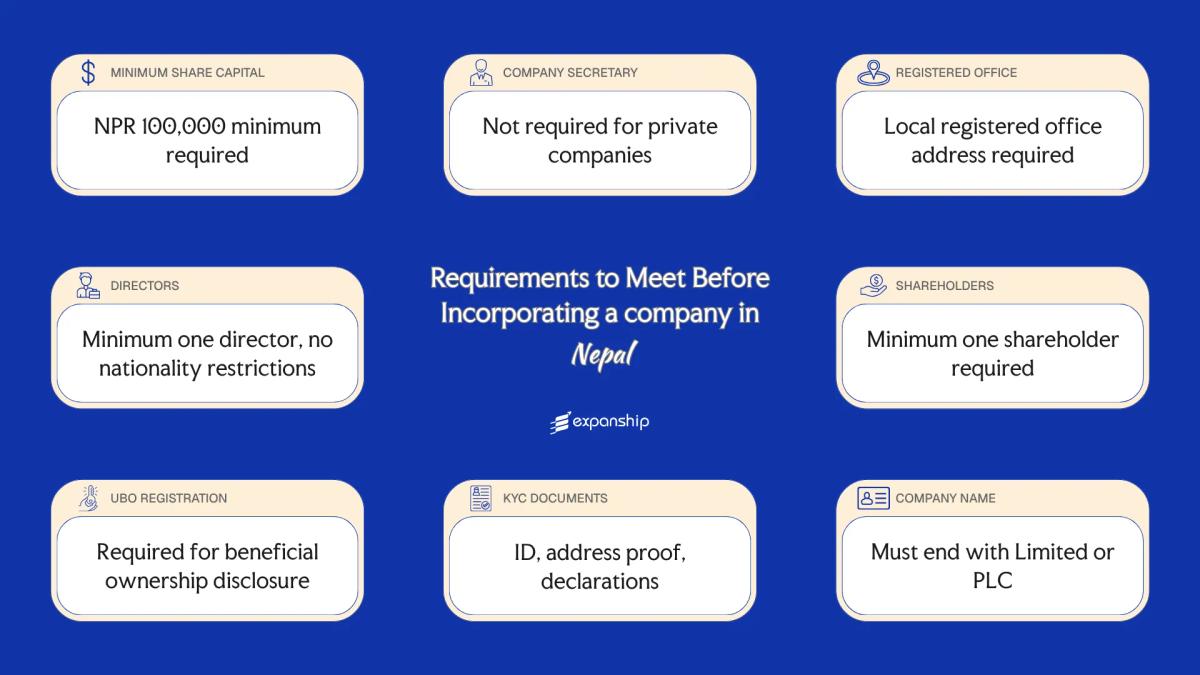
Minimum Share Capital Requirements in Nepal

Under the Companies Act 2006 (Nepal), share capital is structured on a par value system, meaning each share must carry a fixed face value. The Office of the Company Registrar (OCR) under the Ministry of Industry, Commerce and Supplies is the authority responsible for verifying capital structure at the point of incorporation.
Capital requirements differ by company type and, in regulated sectors, may be set by the relevant licensing authority rather than the OCR alone. Paid-up capital obligations are not purely a one-time formality; ongoing compliance with the authorized and paid-up capital structure declared at registration remains a statutory requirement throughout the life of the entity.
| Parameter | Detail |
|---|---|
| Minimum Authorized Share Capital | No statutory minimum for private companies under the Companies Act 2006 |
| Maximum Authorized Share Capital | No statutory maximum |
| Minimum Paid-Up Capital | No statutory minimum for private companies; sector-specific minimums apply in regulated industries |
| Paid-Up Requirement at Incorporation | A portion of authorized capital must be subscribed and paid up at incorporation |
| Accepted Currency | Nepalese Rupee (NPR) |
| Accepted Forms of Contribution | Cash; non-cash contributions permitted subject to valuation and OCR approval |
| Timeframe to Deposit Capital | Capital must be deposited prior to or at the time of incorporation filing with the OCR |
Even where no statutory minimum applies, your company must declare an authorized capital amount in its memorandum of association. The OCR will not process registration without a defined capital structure on record.
Company Secretary Requirements in Nepal
Under the Companies Act 2006 (Nepal), appointing a company secretary is mandatory for public limited companies. Meeting the company secretary requirements Nepal imposes means understanding both eligibility conditions and ongoing corporate obligations under the Office of the Company Registrar.
A company secretary in Nepal is responsible for maintaining statutory books, filing annual returns, and ensuring board resolutions are properly recorded and submitted to the relevant authority.
Qualification criteria for who may serve as company secretary:
- Must hold a recognised qualification in law, accounting, or management, or hold membership with a relevant professional body
- Individual must be a natural person; a corporate entity cannot serve in this capacity
- Must not have been declared insolvent or convicted of a financial offence
- Public limited companies are required to appoint a full-time secretary; private companies face less prescriptive rules
- The individual must be resident in Nepal for practical compliance purposes

Incorporate a Company in Nepal
Set up your business entity in Nepal with accurate filings and full compliance support from registration through to post-incorporation obligations.
Registered Office Requirements in Nepal
Under the Companies Act 2006 (Nepal), registered office requirements Nepal mandates that every private and public company maintain a physical office address within the country where official correspondence and legal notices can be served.
- A physical address within Nepal is required; virtual offices are generally not accepted as a registered office.
- The address must be located in Nepal; foreign addresses do not satisfy this obligation.
- Either ownership documentation or a valid lease agreement for the premises is required to establish the address.
- The registered office address is publicly listed on the company register maintained by the Office of the Company Registrar (OCR).
- Any change to the registered office must be formally notified to the OCR through a prescribed filing process.
- Failure to maintain a compliant registered address can result in regulatory action by the OCR, including penalties and potential striking off of the company.
Director Requirements in Nepal

Under Nepal's Companies Act 2063 (2006), director requirements Nepal company structures must satisfy are defined at both the appointment and operational level, with directors assuming personal liability for acts that breach statutory duties or harm the company.
| Parameter | Detail |
|---|---|
| Minimum Number of Directors | A private company requires at least one director; a public company requires at least three directors. |
| Maximum Number of Directors | No statutory maximum is prescribed under the Companies Act 2063. |
| Local/Resident Director Required | No statutory requirement for a resident or locally domiciled director. |
| Nationality Restrictions | No nationality restrictions are imposed; foreign nationals may serve as directors. |
| Minimum Age Requirement | Directors must be at least 18 years of age at the time of appointment. |
| Corporate Directors Permitted | Corporate entities are not permitted to serve as directors; only natural persons qualify. |
| Director Must Be a Shareholder | No statutory requirement for a director to hold shares in the company. |
| Publicly Listed on Registry | Director details are filed with the Office of the Company Registrar and form part of the public record. |
| Disqualification Conditions | A person declared insolvent, convicted of a criminal offence involving moral turpitude, or previously disqualified by a court order is ineligible to serve. |
Despite no residency requirement, all director appointments must be formally registered with the Office of the Company Registrar in Kathmandu, and foreign directors must submit notarized and apostilled identity documents, making the administrative process notably more involved than the statutory rules suggest.
Shareholder Requirements in Nepal

Under the Companies Act 2006 of Nepal, a private limited company requires a minimum of one shareholder and may have up to 101 shareholders. A single-member structure is therefore permitted, making sole shareholder incorporation a viable option when meeting the shareholder requirements Nepal company law sets out.
Nationality and Residency Restrictions
No residency requirement applies to shareholders of a private limited company. Nepal foreign shareholder rules permit full foreign ownership in most sectors, though certain industries remain subject to restrictions or foreign equity caps under the Foreign Investment and Technology Transfer Act 2019.
Corporate Shareholders
Corporate entities may hold shares in a Nepal-registered company. The shareholding entity must provide valid registration documents and relevant authorisation when subscribing to shares.
Shareholder Liability
Liability is limited to the amount unpaid on a shareholder's subscribed shares. No general circumstances extend this liability beyond the individual capital contribution under standard private limited company structures.
Register of Shareholders
A register of shareholders must be maintained at the company's registered office and updated to reflect any ownership changes. This register is filed with the Office of the Company Registrar, though public accessibility is governed by the Registrar's disclosure procedures.
Shareholder Structure Guidance for Your Nepal Incorporation
Get clarity on ownership rules, foreign equity thresholds, and shareholder documentation requirements before registering your company in Nepal.
UBO / Beneficial Ownership Disclosure Requirements in Nepal
Beneficial ownership disclosure Nepal obligations are governed primarily by the Companies Act 2006 (as amended) and anti-money laundering provisions under the Asset (Money) Laundering Prevention Act 2008, which require companies to identify and disclose individuals who ultimately own or control a significant interest in a registered entity.
- Identify any individual holding a qualifying ownership or control interest in the company at the time of incorporation.
- Submit beneficial ownership particulars to the Office of the Company Registrar (OCR) as part of the registration process.
- Notify the OCR of any subsequent changes to beneficial ownership within the prescribed period following the change.
- Retain internal records of UBO information for inspection by the OCR or competent authorities upon request.
| Parameter | Detail |
|---|---|
| Ownership Threshold for UBO Status | Generally 20% or more of shares or voting rights |
| Filing Authority | Office of the Company Registrar (OCR) |
| Disclosure Deadline at Incorporation | At the time of company registration |
| Publicly Accessible Register | No statutory public register |
| Penalties for Non-Disclosure | Fines under the Companies Act 2006; amount subject to regulatory determination |
| Ongoing Update Obligation | Required upon any change in beneficial ownership |
KYC / Document Requirements in Nepal

KYC document requirements Nepal are governed primarily by the Asset (Money) Laundering Prevention Act, 2008 and its subsequent amendments, which bind the Office of the Company Registrar to verify the identity of all incorporators before registration. The Financial Intelligence Unit of Nepal oversees AML compliance at the national level.
Individual / Personal Documents
- Valid passport or citizenship certificate for each individual director and shareholder
- Recent passport-sized photographs of all individual incorporators
- Proof of residential address, such as a utility bill or bank statement dated within three months
- Personal Permanent Account Number (PAN) issued by the Inland Revenue Department
Corporate Documents
- Certificate of incorporation of the parent or shareholder entity, certified by the issuing authority
- Memorandum and Articles of Association of the corporate shareholder
- Current register of directors of the corporate entity
- Proof of the corporate entity's registered office address
Source of Funds Documentation
- Recent bank statements covering a minimum of three to six months prior to incorporation
- Audited financial statements of the introducing entity or individual where applicable
- A written declaration of the origin of capital being subscribed
Notarisation and Apostille Requirements
- Foreign documents must generally be notarised in the country of origin
- Notarised documents are typically required to be authenticated by the relevant Nepali embassy or consulate abroad
- Official Nepali translations are required for any document not in Nepali or English
Mismatched names between identity documents and incorporation forms are the most frequent cause of registration delays at the Office of the Company Registrar.
Company Name Requirements in Nepal
Company name requirements Nepal are assessed by the Office of the Company Registrar (OCR), which evaluates proposed names before registration is confirmed. Names must be unique and distinguishable from those already on the commercial register.
Proposed names must be in Nepali or English, and the legal suffix must reflect the entity type, such as "Private Limited" or "Limited." No specific character count is publicly mandated, but the name must be sufficiently distinct.
Certain words implying government affiliation, royal or national symbols, or regulated sectors such as banking and insurance require prior approval from the relevant authority. Outright prohibited terms include those considered offensive or misleading to the public.
Name reservation is available through the OCR prior to formal incorporation. Reserved names are generally held for a limited period, during which you must proceed with the full registration process.
Compliance Services for Companies in Nepal
Ongoing compliance support for registered entities in Nepal, including annual filings, OCR obligations, and regulatory reporting.
Conclusion
Nepal company incorporation requirements are governed primarily by the Companies Act 2063 (2006) and administered through the Office of the Company Registrar. Understanding these requirements is the foundation for any foreign investor planning to establish a legal presence in the country.
Among the requirements covered, the mandatory local director rule and the UBO disclosure obligations under the Anti-Money Laundering framework carry particular weight for foreign-owned entities. The registered office must also be maintained at a verifiable physical address within Nepal throughout the company's existence.
Once these obligations are understood, the practical next step is engaging qualified local counsel and beginning the formal registration process with the Office of the Company Registrar.
Expanship's Corporate Services for Nepal Expansion
Expanship's Nepal company formation services are structured around the specific regulatory requirements that govern private and public limited companies under the Companies Act 2006 and the oversight of the Office of the Company Registrar. From document notarisation and MoA preparation to liaising with the Department of Industry, Expanship reduces the administrative load that comes with meeting Nepal's multi-agency registration process.
Our service scope covers the full incorporation and post-registration cycle:
- Preparing and filing company registration documents with the OCR
- Providing registered agent and office address services in Nepal
- Handling government filings and coordinating with relevant regulatory bodies on your behalf
- Managing ongoing compliance obligations after your entity is incorporated
- Facilitating introductions to local banking institutions to support account opening
- Coordinating tax registration and liaison with the Inland Revenue Department
To discuss your requirements, contact Expanship Nepal.
Frequently Asked Questions (FAQ)
Yes, the threshold differs for foreign-invested companies. Under the Foreign Investment and Technology Transfer Act, 2019 (FITTA), foreign investors must meet a minimum investment threshold that exceeds the standard domestic paid-up capital requirement under the Companies Act. The applicable floor depends on the sector and the proportion of foreign ownership being registered.
Failure to maintain or update beneficial ownership records can result in fines imposed by the Office of the Company Registrar (OCR). The OCR has authority to levy financial penalties on the company and its officers for non-disclosure or inaccurate disclosure of ultimate beneficial owners, and repeated non-compliance can trigger further regulatory action.
A virtual address does not satisfy Nepal's registered office requirement. The OCR requires a verifiable physical address within Nepal, supported by documentation such as a lease agreement or ownership proof, and this address is used for all official correspondence and public registry records.
Company names must be registered in Nepali script with the OCR, as Nepali is the official language of record for the companies register. An English transliteration may be used in practice, but the Nepali-script version is the legally binding registered name and cannot be omitted from the incorporation filing.
Foreign shareholders must submit notarized and apostilled or embassy-attested identity documents, including a valid passport and proof of address, whereas Nepali nationals typically submit citizenship certificates. The OCR and, where applicable, the Department of Industry may require additional certified translations if the documents are not in Nepali or English.
Any discrepancy between the stated share capital in the Memorandum of Association and the figures recorded during OCR registration will result in the application being rejected or returned for correction. The Memorandum and Articles of Association must be internally consistent and align with all supporting financial declarations submitted at the time of incorporation.
Legal Disclaimer
The information provided in this article is for general informational purposes only and does not constitute legal, tax, or professional advice. While we strive to ensure the accuracy and timeliness of the content, laws and regulations are subject to change, and the application of laws can vary widely based on specific facts and circumstances.
Readers should not act upon this information without seeking professional counsel tailored to their individual situation. Expanship and its authors disclaim any liability for actions taken or not taken based on the content of this article.
For specific advice regarding your business setup, compliance requirements, or any legal matters, please consult with qualified legal and tax professionals in the relevant jurisdiction.