

Key Takeaways
- Foreign investors operating under the Foreign Investment and Technology Transfer Act (FITTA) 2019 face sector-specific equity caps that can prevent majority ownership, limiting operational control in key industries.
- Company registration through the Office of the Company Registrar (OCR) involves procedural delays that extend timelines beyond what most other South Asian jurisdictions require for comparable entity types.
- The requirement to include a Nepali citizen as a director adds a structural dependency that constrains governance flexibility for foreign-owned or multinational-controlled entities.
- Profit repatriation and capital withdrawal remain subject to regulatory approval processes that introduce uncertainty into financial planning for foreign shareholders.
Nepal operates under an evolving regulatory framework governed by multiple agencies, with company formation and ongoing compliance overseen by the Office of the Company Registrar (OCR) and the Department of Industry. The primary disadvantages of incorporating in Nepal span procedural, structural, and enforcement-related categories, each of which is addressed in the sections that follow.
The severity of these disadvantages is not uniform. A manufacturing firm operating under the Foreign Investment and Technology Transfer Act (FITTA) 2019 faces different constraints than a service-sector entity or a joint venture with a local partner.
This article is most relevant to foreign investors and multinational firms seeking majority ownership, profit repatriation, or full operational control through a registered entity in Nepal. The Companies Act 2006 remains the primary legislative instrument governing corporate formation and structure.
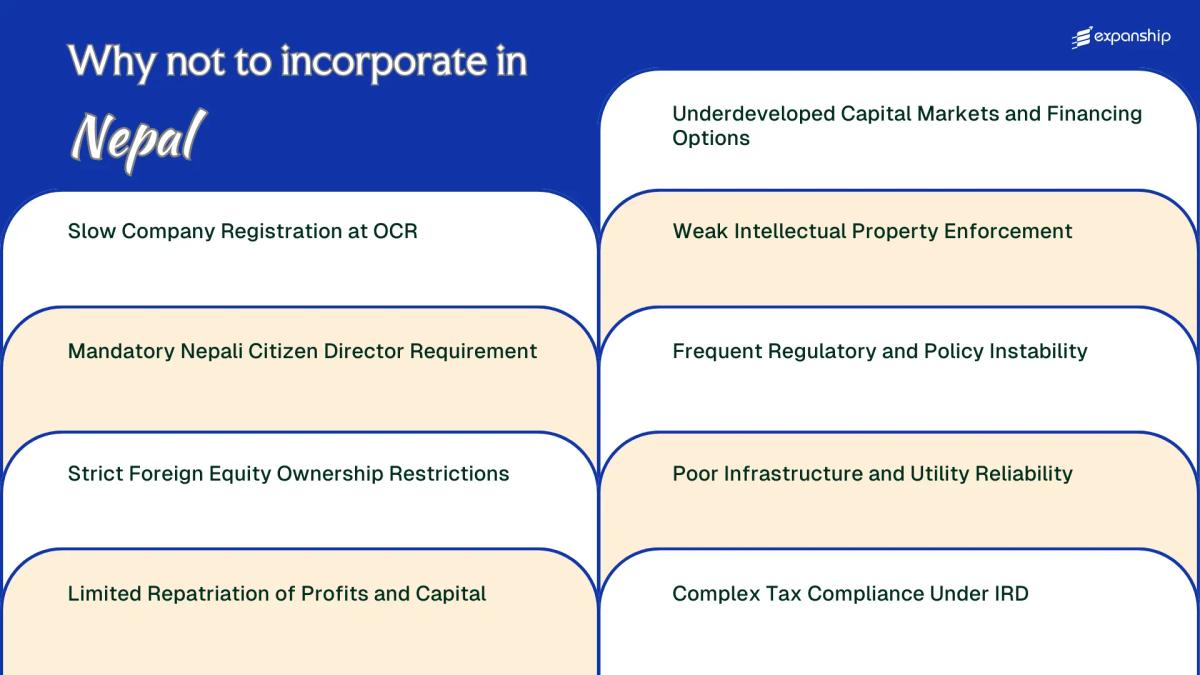
Slow Company Registration at OCR
Slow company registration at OCR is a frequently cited barrier for foreign investors. Delays at the Office of the Company Registrar can extend timelines well beyond initial projections, creating real costs before operations even begin.
Processing Backlogs at the Office of the Company Registrar
OCR, the authority responsible for entity registration under the Companies Act 2006, processes applications manually across several stages, and backlogs are common. Each stage, from name approval to certificate issuance, requires separate submissions, which means a single administrative bottleneck can stall the entire process.
Foreign investors typically face a registration timeline of several weeks, compared to jurisdictions in Southeast Asia where incorporation can be completed within one to three business days. Every week of delay is a week your firm cannot sign contracts, open a bank account, or hire staff under a legal entity.
Why Delays Translate Directly into Business Costs
Idle operational costs accumulate during registration. Office leases, staff salaries, and vendor commitments often begin before the certificate arrives, leaving your business in a legally ambiguous position.
Registration applicants dependent on OCR's physical submission requirements face additional risk when public holidays, political disruptions, or staffing shortages close government offices without advance notice.
Until OCR issues the company registration certificate, your business cannot legally enter contracts or open a corporate bank account in Nepal, making any pre-registration expenditure financially exposed.
Mandatory Nepali Citizen Director Requirement
Under the Companies Act 2063 (2006), private and public companies registered with the Office of the Company Registrar must have at least one director who is a Nepali citizen. For foreign investors, this Nepal Nepali citizen director requirement is not a formality — it creates a structural dependency on a local individual whose interests may not always align with yours.
Finding a trustworthy, qualified Nepali national willing to take on directorship is not straightforward. That person assumes legal liability under Nepali corporate law, which limits the pool of willing candidates and increases the cost of securing one.
This dependency creates tangible operational friction:
- You cannot complete incorporation without a local director in place, delaying your timeline regardless of how prepared your foreign principals are
- The local director holds statutory signing authority, giving a third party formal power over decisions you intend to control
- If your local director resigns or becomes unavailable, you face a compliance breach that requires urgent resolution through the OCR
- Fees paid to local directors as nominees or advisors represent a recurring cost with no equivalent in most comparable Asian jurisdictions
Some foreign joint venture structures may distribute directorship differently, but the Nepali citizen condition on the board remains binding regardless of equity split.

Company Incorporation in Nepal
Set up your company in Nepal with proper directorship structure and full compliance with the Companies Act 2063.
Strict Foreign Equity Ownership Restrictions
Nepal foreign equity ownership restrictions remain one of the more concrete structural barriers a foreign investor will encounter under the Foreign Investment and Technology Transfer Act (FITTA) 2019. Ownership is not simply capped at a single threshold across all sectors. Certain industries are entirely closed to foreign participation, and others permit only minority stakes, meaning your ability to control the business you fund is often legally constrained before operations begin.
| Sector Category | Foreign Ownership Permitted | Practical Burden |
|---|---|---|
| Cottage and small industries | 0% | Fully closed to foreign capital |
| Retail trade (below threshold turnover) | 0% | Foreign entities barred from entry |
| Mass media, consulting in Nepal law | 0% | No foreign stake permissible |
| Specific service sectors | Minority or restricted | Control retained by Nepali partners |
| General manufacturing / approved sectors | Up to 100% in select cases | Subject to BOI approval per project |
Even in sectors nominally open to full foreign ownership, the Board of Investment (BOI) retains discretionary approval authority over each investment. That approval process introduces both delay and uncertainty, and there is no statutory guarantee that a previously approved structure will remain permissible if sector classifications change.
Minimum investment thresholds under FITTA 2019 further narrow your options. Foreign entities must meet prescribed capital floors, which disqualifies smaller businesses from sectors that domestic firms can enter freely. This asymmetry structurally disadvantages foreign-owned firms at the point of incorporation, not merely at the operational stage.
Limited Repatriation of Profits and Capital
Nepal profit repatriation restrictions create a direct cash flow problem for foreign investors. Under the Foreign Investment and Technology Transfer Act (FIFTA) 2019, repatriation is permitted, but only after satisfying conditions set by Nepal Rastra Bank, the country's central bank, which controls all foreign exchange outflows.
Approval is not automatic. Your business must clear outstanding tax liabilities and obtain a tax clearance certificate from the Inland Revenue Department before any remittance is processed.
Foreign exchange availability itself is a separate constraint. Nepal has periodically experienced foreign exchange reserve pressures, which have led to informal delays at the banking level even when formal approval exists.
Repatriation of capital, as opposed to dividends, involves additional scrutiny and documentation, and processing timelines are rarely predictable.
- Tax clearance certificate from IRD is mandatory before initiating any repatriation
- All transactions must go through a commercial bank authorized by Nepal Rastra Bank
- Repatriation must be in the original investment currency as per NRB directives
- Dividend repatriation requires audited financial statements for the relevant fiscal year
- Capital repatriation is subject to separate approval procedures beyond standard dividend remittance
Even fully compliant foreign firms can face repatriation delays during periods of low foreign exchange reserves, a condition entirely outside your control and unrelated to your company's legal standing.
Underdeveloped Capital Markets and Financing Options
Nepal underdeveloped capital markets risks make it structurally difficult for foreign-owned entities to secure growth financing outside of retained earnings or shareholder contributions.
Shallow Equity and Debt Markets
The Nepal Stock Exchange (NEPSE) remains thin by regional standards, with limited institutional participation and low trading volumes that restrict viable exit options for equity investors. Accessing public capital through NEPSE requires compliance with Securities Board of Nepal (SEBON) regulations, and the process is lengthy enough that most foreign-backed firms treat it as practically inaccessible.
Bank lending, meanwhile, is constrained by high interest rates and collateral requirements that disadvantage businesses without locally held fixed assets.
Structural Funding Gaps for Foreign Firms
Nepal SME funding drawbacks are compounded by the absence of a developed venture capital or private equity ecosystem, leaving early-stage foreign businesses with few institutional funding alternatives. The Industrial Enterprises Act and Foreign Investment and Technology Transfer Act (FITTA) 2019 govern capital inflows, but neither creates mechanisms that fill the gap left by underdeveloped domestic credit markets.
Foreign firms in sectors with restricted equity thresholds face the additional constraint of limited borrowing capacity, since debt financing from foreign sources requires Nepal Rastra Bank approval.
Addressing Financing Constraints for Your Nepal Entity
Our team can help you assess viable capital structures and navigate approval requirements under FITTA and Nepal Rastra Bank regulations before you commit to incorporation.
Weak Intellectual Property Enforcement
Nepal intellectual property enforcement weakness is a documented operational risk for foreign businesses holding trademarks, patents, or proprietary technology in the country. Enforcement mechanisms remain underdeveloped relative to Nepal's obligations under the TRIPS Agreement, to which it acceded as a WTO member.
- The Department of Industry administers IP registration under the Patent, Design and Trade Mark Act 1965, but the legislation predates modern IP categories such as software, trade secrets, and geographic indications, leaving your assets legally exposed.
- Trademark enforcement problems in Nepal are compounded by a judiciary with limited specialist IP training, meaning infringement litigation can extend for years without resolution.
- No dedicated IP tribunal exists, so disputes are routed through general civil courts, adding procedural delays and cost that deter foreign firms from pursuing claims.
- Nepal patent protection limitations are particularly acute for pharmaceutical and technology companies, as examination capacity at the registering authority remains constrained.
- Border enforcement against counterfeit goods is inconsistent, reducing the practical value of any registered IP right your business holds domestically.
Frequent Regulatory and Policy Instability
Nepal regulatory instability business risks are not incidental — they are structurally embedded in how the country governs investment. Since 2008, the country has operated under multiple transitional governments, and frequent changes in ruling coalitions have produced inconsistent policy enforcement across ministries.
The Foreign Investment and Technology Transfer Act (FITTTA) 2019 represented a consolidation effort, yet its implementing regulations have been revised without predictable timelines. Your business may find that approvals granted under one policy interpretation are later disputed under revised guidelines from the Department of Industry.
Sector-specific negative lists — industries closed or restricted to foreign capital — have shifted across successive amendments. This creates direct uncertainty in investment planning, particularly for firms that have already committed capital.
- Industrial policy reversals have affected sectors including hydropower, tourism, and manufacturing.
- Licensing conditions have changed mid-process in certain regulated industries.
- Exchange control directives from Nepal Rastra Bank have been updated without extended transition periods.
Nepal ranked 94th out of 190 economies in the World Bank's Doing Business 2020 report under the "Protecting Minority Investors" indicator, reflecting governance unpredictability that compounds policy instability risks for foreign shareholders.
Poor Infrastructure and Utility Reliability
Nepal infrastructure problems for business extend well beyond inconvenience. Unreliable power supply, poor road connectivity outside Kathmandu, and inconsistent internet access directly increase operating costs and reduce productivity for foreign-owned firms.
Load-shedding, though reduced from peak levels in earlier years, remains a risk during dry seasons when hydropower generation drops. Businesses that depend on continuous operations must invest in backup generators or UPS systems, adding capital expenditure that would not be necessary in more developed markets.
Logistics present a separate burden. Nepal is landlocked, and freight movement depends heavily on transit routes through India, which introduces delays, border processing costs, and supply chain exposure that firms in coastal or better-connected economies do not face.
Broadband infrastructure outside major urban centers is inconsistent. For any business model that depends on real-time data, remote teams, or digital service delivery, geographic expansion within the country carries significant connectivity risk.
- Dry-season power shortfalls affect manufacturing and processing industries most severely
- Cold chain and perishable goods logistics are particularly exposed to road and power limitations
- Industrial zones outside Kathmandu Valley often lack reliable three-phase power supply
Foreign businesses operating in manufacturing, processing, or logistics sectors must independently verify utility reliability at their intended facility location before committing to a site lease or investment structure, as infrastructure quality varies sharply by district.
Complex Tax Compliance Under IRD
Nepal tax compliance challenges IRD stem largely from a system that demands technical precision from businesses that may lack local accounting infrastructure. The Inland Revenue Department administers corporate income tax, VAT, and withholding tax obligations under the Income Tax Act 2058 and the Value Added Tax Act 2052, and errors or late filings attract penalties that compound quickly.
Corporate tax is levied at 25% for general entities, with VAT set at 13% and a mandatory registration threshold of NPR 5 million in annual turnover. Missing that threshold calculation means either premature compliance costs or retroactive penalties.
Monthly VAT filing is compulsory for registered businesses, regardless of trading activity in that period. For a foreign-owned firm without a dedicated local finance team, this frequency alone generates sustained administrative overhead.
Audits under the IRD can extend assessments up to four years back, creating prolonged financial exposure. Reconciling foreign-currency transactions with local tax records adds a further layer of complexity that standard international accounting software often fails to handle without customisation.
Strategies to Overcome These Challenges
Overcoming Nepal incorporation challenges requires structural preparation before entry, not reactive adjustment after registration.
- Structure your investment through a sector that permits majority or full foreign ownership under the Foreign Investment and Technology Transfer Act (FITTTA) 2019 to avoid equity cap constraints.
- Appoint a qualified Nepali citizen as a statutory director at the time of filing with the Office of the Company Registrar (OCR) to satisfy the mandatory local director requirement.
- Register with the Inland Revenue Department and establish a compliant VAT and tax filing calendar to reduce exposure under IRD's penalty provisions.
- File a formal intellectual property application with the Department of Industry under the Patent, Design and Trademark Act to establish a legal record of ownership.
- Open a dedicated foreign currency account through a Nepal Rastra Bank-licensed commercial bank to manage profit repatriation within permitted channels.
Each of these steps operates within a regulatory environment where policy amendments, OCR processing timelines, and IRD interpretations remain subject to change. Mitigation reduces exposure but does not eliminate the structural unpredictability inherent to doing business here.
Nepal's Overall Investment Potential
Despite the disadvantages covered throughout this blog, Nepal investment potential despite risks remains a real consideration for businesses targeting South Asian markets, particularly those in hydropower, tourism, agriculture, and IT services. The country's young workforce, improving road and digital connectivity under national infrastructure plans, and its position between India and China give it geographic relevance that few comparable economies can match.
| Pros | Cons |
|---|---|
| Strategic location between India and China offers regional market access | OCR registration timelines frequently extend beyond statutory deadlines |
| Sectors like hydropower and IT services remain open to foreign investment under FITTA 2019 | Foreign equity is restricted or prohibited in several industries under the Negative List |
| A young, low-cost labor pool supports labor-intensive operations | At least one director must be a Nepali citizen, complicating full foreign ownership structures |
| Double taxation treaties with select countries can reduce withholding tax exposure | Profit and capital repatriation requires IRD clearance and involves procedural delays |
| Nepal's tax regime allows sector-specific incentives under the Income Tax Act 2058 | Intellectual property enforcement through the Department of Industry remains structurally weak |
Structural barriers, policy volatility under shifting coalition governments, and infrastructure gaps are not marginal concerns. They are embedded features of the current business environment that require deliberate planning before committing capital.
Corporate Compliance Services in Nepal
Stay aligned with Nepal's regulatory requirements under the Companies Act 2006, IRD tax obligations, and OCR filing deadlines with structured compliance support.
Conclusion
The cons of incorporating a company in Nepal are real and structural, not incidental. Foreign equity caps enforced under the Foreign Investment and Technology Transfer Act, combined with the Office of the Company Registrar's slow registration timelines, create friction before operations even begin. Profit repatriation through Nepal Rastra Bank adds a further layer of procedural delay that directly affects capital mobility. Structural obstacles of this kind require specific preparation rather than general readiness. Firms entering with a clear understanding of the regulatory environment are better positioned to plan timelines, ownership structures, and compliance obligations realistically from the outset.
Expanship's Nepal Expansion Services
Registering and maintaining a foreign company in Nepal involves specific obligations across multiple regulatory bodies, from the Office of the Company Registrar to the Inland Revenue Department. Expanship's Nepal company formation services are structured around these real administrative requirements, helping your business manage OCR filings, director compliance, foreign equity approvals, and IRD tax registration without the delays that typically result from unfamiliarity with local procedures.
Beyond formation, Expanship supports the full scope of your business's operational compliance in Nepal.
- Your company's registration documents are prepared and filed correctly with the OCR from the outset.
- A registered agent and local office address are provided to satisfy statutory requirements.
- Government filings and liaison with Nepali regulatory authorities are handled on your behalf.
- Ongoing post-incorporation compliance obligations are managed to keep your entity in good standing.
- Banking introduction support is available to help your firm open a local account.
- Tax registration and coordination with the IRD are managed as part of your setup.
Reach out to Expanship Nepal to discuss how we can support your entry into this market.
Frequently Asked Questions (FAQ)
The requirement applies broadly to private and public limited companies registered with the Office of the Company Registrar (OCR), and at least one director must be a Nepali citizen. This applies even where a foreign investor holds a majority equity stake in the entity. The practical consequence is that your governance structure must accommodate a local director from day one, which introduces dependency on a third party for statutory filings and board decisions.
The IRD can impose interest charges, financial penalties, and in serious cases pursue criminal liability for willful tax evasion under the Income Tax Act 2058 (2002). Late filing of returns and under-reporting of income both attract penalties, and the IRD has authority to freeze accounts or initiate audits with limited advance notice. The compliance burden is compounded by the frequency of procedural changes, which increases the risk of inadvertent non-compliance.
Direct government fees are relatively low, but the indirect cost of delays can be substantial. Registration at the OCR routinely extends beyond the statutory timeframe due to document backlogs and manual processing, meaning your business cannot legally operate, open a bank account, or obtain sector-specific licenses during that period. For businesses with time-sensitive market entry plans or investor commitments, each additional week of delay translates into lost revenue and extended overhead for local representatives and legal counsel.
Nepal's repatriation framework is among the more restrictive in South Asia. Foreign investors must route repatriation through Nepal Rastra Bank (NRB) approval processes, and the convertibility of the Nepalese rupee is limited — it is pegged to the Indian rupee but not freely convertible against major currencies. Countries such as Sri Lanka and Bangladesh, despite their own controls, offer more established banking corridors for outward remittances, making Nepal comparatively harder for capital exit.
Enforcement is weak in practice, even where your IP is formally registered under the Patent, Design and Trade Mark Act 1965. Civil litigation through Nepali courts is slow, injunctive relief is difficult to obtain quickly, and customs-level enforcement against counterfeit goods is inconsistent. For technology companies or brands that depend on IP exclusivity, this means registration alone provides limited commercial protection without parallel contractual and operational safeguards.
Routing foreign investment through a locally registered holding company does not exempt the underlying investment from FITTA 2019 scrutiny. The Department of Industry and relevant sectoral regulators look through the structure to identify the ultimate beneficial owner, and foreign-controlled entities remain subject to sector restrictions and equity caps regardless of intermediate holding arrangements. Attempting to obscure foreign control through nominee structures also carries legal risk under Nepali company and investment law.
Policy reversals and regulatory amendments in Nepal have historically affected approved investments, including changes to tax incentives, sector classifications, and repatriation procedures. Because Nepal lacks a stable single-window regulatory framework with legislative protection for vested rights, an approval granted under one policy regime can be effectively undermined by subsequent ministerial or departmental notifications. This creates real uncertainty for long-term capital commitments, particularly in infrastructure and energy sectors where project timelines extend over multiple years.
Legal Disclaimer
The information provided in this article is for general informational purposes only and does not constitute legal, tax, or professional advice. While we strive to ensure the accuracy and timeliness of the content, laws and regulations are subject to change, and the application of laws can vary widely based on specific facts and circumstances.
Readers should not act upon this information without seeking professional counsel tailored to their individual situation. Expanship and its authors disclaim any liability for actions taken or not taken based on the content of this article.
For specific advice regarding your business setup, compliance requirements, or any legal matters, please consult with qualified legal and tax professionals in the relevant jurisdiction.