

Key Takeaways
- Nepal's Income Tax Act 2058 sets corporate rates below the regional average, giving eligible foreign-owned entities a measurable cost advantage over comparable structures in neighbouring jurisdictions.
- Under the Foreign Investment and Technology Transfer Act 2019, foreign investors can hold 100% ownership in qualifying sectors, removing the need for a local partner in industries such as manufacturing and technology services.
- Businesses operating in hydropower, export-oriented manufacturing, or IT services benefit from a regulatory environment that has been progressively structured to accommodate foreign capital through the Department of Industry and Investment Board Nepal.
- Because FITTA 2019 defines a specific negative list of restricted sectors, investors in eligible industries gain the clarity of knowing their ownership rights and repatriation entitlements before committing capital to the jurisdiction.
Situated in South Asia between China and India, Nepal is a sovereign federal democratic republic governed under its 2015 Constitution. For businesses evaluating the benefits of incorporating in Nepal, the starting point is the Office of the Company Registrar, the authority responsible for company registration under the Companies Act, 2006. Foreign businesses most commonly establish a private limited company to operate within the country.
Nepal maintains a territorial tax posture with moderate corporate rates governed by the Income Tax Act, 2002. The government has progressively opened sectors to foreign participation, and the Foreign Investment and Technology Transfer Act (FITTA), 2019 formalizes the legal basis through which foreign capital can enter and exit the economy.
Foreign direct investment policy continues to evolve, with the Department of Industry and the Investment Board Nepal administering approvals depending on the scale and sector of investment. General openness to foreign ownership varies by industry, with certain sectors restricted and others fully accessible to overseas entities. This article examines the key advantages that Nepal company formation offers to international businesses.
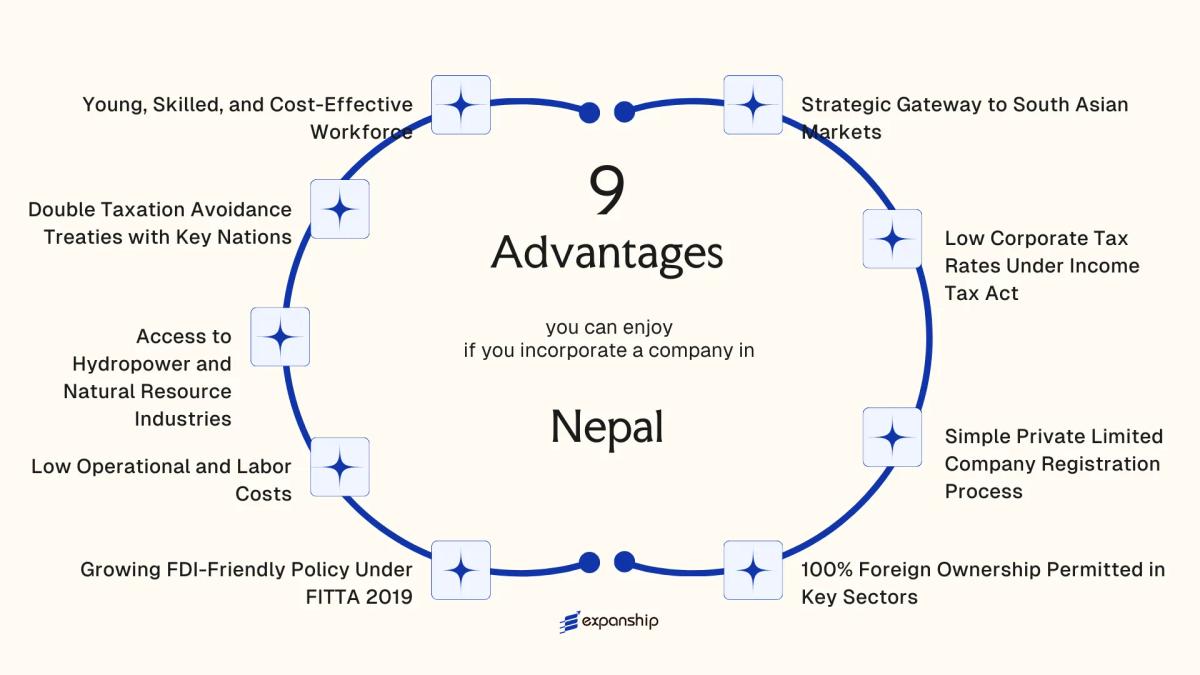
Strategic Gateway to South Asian Markets
Sitting between India and China, Nepal occupies a geographic position that gives your business direct overland access to two of the world's largest consumer economies. As a member of the South Asian Association for Regional Cooperation (SAARC), it also connects you to the broader South Asian trade bloc.
Proximity to India and the SAARC Trade Framework
Nepal shares an open border with India under the 1950 Treaty of Peace and Friendship, which permits relatively unrestricted movement of goods and people between the two countries. For a business incorporated here, this translates into a practical distribution pathway into the Indian market without the customs friction that applies to third-country exporters.
SAARC preferential trade arrangements further extend your firm's reach across Bangladesh, Sri Lanka, Pakistan, and other member states. Nepal's access to India-China markets also benefits from its position along trade corridors that are being developed under regional connectivity initiatives, giving goods manufactured or processed locally a viable route northward into Tibet and beyond.
A Nepal-registered entity can serve as an operational base for South Asia market entry through Nepal, reducing border-crossing costs that non-SAARC competitors face.
Low Corporate Tax Rates Under Income Tax Act
Nepal's Income Tax Act 2058 sets the standard corporate tax rate at 25% for most private limited companies. That figure sits below several South Asian peers, and for businesses in designated priority sectors, the rate drops further, making the tax structure a concrete cost variable worth accounting for in financial planning.
Under the Income Tax Act 2058, entities engaged in special industries, export-oriented businesses, and firms operating in underdeveloped regions qualify for tax concessions that reduce the effective rate. A foreign-owned private limited company generating export revenue, for instance, may benefit from rates as low as 15% on eligible income. These reductions are statutory, not discretionary, which means your tax exposure is calculable from the outset rather than subject to case-by-case negotiation.
The Nepal corporate tax rate advantages become particularly apparent when viewed against comparable registration destinations in the region. The 25% headline rate, combined with sector-specific reductions, gives cost-sensitive investors a predictable base for projecting after-tax returns.
Key reasons the tax structure works in your favour:
- Concession rates apply automatically under statute, removing reliance on bilateral rulings
- Export income qualifies for reduced rates, directly benefiting firms with cross-border revenue models
- Special industry status covers manufacturing and processing, expanding eligibility beyond niche categories
- The Income Tax Act 2058 provides written, enforceable rules rather than informal guidance

Company Incorporation in Nepal
Incorporate a private limited company in Nepal with full foreign ownership support, tax registration, and compliance setup handled end to end.
Simple Private Limited Company Registration Process
Registering a private limited company under Nepal's Companies Act 2006 involves a relatively contained administrative process, which reduces the time and cost typically associated with establishing a foreign business presence. The Office of Company Registrar (OCR), operating under the Ministry of Industry, Commerce and Supplies, serves as the central authority for company registration. For foreign investors exploring Nepal private limited company registration benefits, the structural simplicity of the OCR's requirements is itself a practical advantage.
A private limited company in Nepal requires a minimum of one shareholder and can have up to 101 shareholders, with no minimum paid-up capital requirement for domestic firms. Foreign-invested companies are subject to capital thresholds set under the Foreign Investment and Technology Transfer Act (FITTA) 2019, but the corporate structure itself imposes no excessive layering of approvals at the OCR level. This means your entity can be legally constituted without the multi-tier incorporation procedures common in larger South Asian jurisdictions.
| Requirement | Detail |
|---|---|
| Minimum Shareholders | 1 |
| Maximum Shareholders | 101 |
| Governing Legislation | Companies Act 2006 |
| Registration Authority | Office of Company Registrar (OCR) |
| Minimum Directors | 1 |
Once the memorandum and articles of association are submitted and approved by the OCR, the firm receives a registration certificate that serves as the foundational legal document for all subsequent regulatory steps. The contained shareholder structure of a private limited entity also restricts share transferability by default, giving founders direct control over the ownership composition without requiring separate shareholder agreements to enforce that restriction.
100% Foreign Ownership Permitted in Key Sectors
Nepal permits 100% foreign ownership in a defined range of sectors under the Foreign Investment and Technology Transfer Act (FITTA) 2019. This means your firm can hold the entire equity stake without requiring a local partner, eliminating shared control over profits, decisions, and exits.
Under FITTA 2019, foreign investors can own 100% of a private limited company in sectors including manufacturing, tourism, IT, hydropower, and infrastructure, subject to minimum investment thresholds. The absence of a mandatory joint venture requirement gives you full operational authority from day one.
Keep these points in mind to preserve that ownership position:
- Confirm your target sector appears on the permitted list under FITTA 2019 before incorporation
- Meet the minimum foreign investment threshold, which varies by sector
- Register with the Department of Industry or relevant authority depending on sector classification
- Obtain approval from the Investment Board Nepal for large-scale projects above defined thresholds
- Some sectors remain restricted or require government approval; verify the negative list annually
Full ownership directly affects how you repatriate dividends and returns. Under FITTA 2019, a wholly foreign owned entity is entitled to repatriate profits, dividends, and proceeds from share sales through a commercial bank, without needing a local co-owner's consent.
Nepal allows 100% foreign ownership in the hydropower sector, including generation and transmission projects, which is more open than several neighboring economies where energy infrastructure requires mandatory state or local equity participation.
Growing FDI-Friendly Policy Under FITTA 2019
The Nepal FITTA 2019 foreign investment benefits are codified in a single, consolidated statute: the Foreign Investment and Technology Transfer Act 2019 (FITTA 2019). Enacted to replace an older, fragmented framework, this legislation establishes legally binding protections that reduce the regulatory uncertainty foreign investors often face in emerging markets.
Defined Protections Against Expropriation and Repatriation Restrictions
FITTA 2019 guarantees the right to repatriate invested capital, dividends, and proceeds from the sale of shares through banking channels without prior government approval. This matters because repatriation restrictions are among the most cited barriers to committing capital in developing economies. The Act also prohibits nationalization of foreign-invested enterprises, except under defined public interest conditions with mandatory compensation.
Dispute Resolution and Regulatory Transparency Under a Single Law
Foreign investors are entitled to resolve disputes through international arbitration under FITTA 2019, a provision that removes dependency on domestic court processes unfamiliar to most overseas investors. The Department of Industry (now operating under the Investment Board Nepal for large-scale projects) serves as the primary regulatory interface, creating a defined institutional point of contact rather than dispersed oversight. Having a single governing statute also means that FDI-friendly policy Nepal 2019 obligations are consolidated in one document, simplifying legal due diligence for your counsel and reducing interpretation risk across multiple regulatory instruments.
Understand Your Rights as a Foreign Investor in Nepal
Speak with Expanship to map how FITTA 2019 protections apply to your specific investment structure and sector.
Low Operational and Labor Costs
Low operational costs in Nepal are among the most concrete financial advantages available to foreign companies establishing a presence in South Asia. Office rentals, utilities, and administrative expenses run significantly lower than in regional peers like India or Thailand, which directly reduces your fixed cost base from day one.
- Monthly commercial office rents in Kathmandu average a fraction of comparable space in Mumbai or Bangkok, meaning a foreign firm can establish a registered office and functional workspace without committing to the capital overhead typical of larger regional hubs.
- Electricity costs, while subject to Nepal Electricity Authority tariff schedules, remain comparatively low for commercial consumers, particularly relevant for firms in light manufacturing or data-intensive operations.
- General overhead categories, including local accounting services, company secretarial support, and statutory compliance filings with the Office of the Company Registrar, carry lower professional service fees than most Southeast or East Asian jurisdictions.
- Under the Foreign Investment and Technology Transfer Act 2019 (FITTA), foreign-owned private limited companies can operate within the same cost structure as domestic firms, with no regulatory surcharge applied to foreign entities for licensing or annual compliance renewals.
For a foreign business running regional operations or a back-office function, this cost profile allows capital to be directed toward growth activity rather than absorbed by fixed structural expenses.
Access to Hydropower and Natural Resource Industries
Nepal hydropower industry investment benefits stem from one structural reality: the country holds an estimated 83,000 MW of technically feasible hydropower potential, of which less than 3,000 MW had been developed as of recent estimates. That gap represents direct entry points for foreign-owned generation, transmission, and infrastructure companies.
Under the Foreign Investment and Technology Transfer Act 2019 (FITTA 2019) and the Electricity Act 1992, foreign entities can participate in hydropower generation projects through licensing issued by the Department of Electricity Development. Survey licenses and generation licenses are the two primary instruments, each covering distinct project phases.
- Survey licenses authorize feasibility and geological assessment work.
- Generation licenses permit construction and commercial operation of power plants.
For foreign investors in the natural resources sector, this licensing structure means your firm can enter at the pre-development stage, which carries lower capital requirements than acquiring operational assets.
A 100 MW hydropower project in Nepal, developed under a generation license with a 35-year concession term, could sell power under a Power Purchase Agreement with the Nepal Electricity Authority at government-set tariffs, providing long-term revenue visibility that is structurally uncommon in liberalized energy markets.
Export-oriented projects may also supply power to India under bilateral energy trade frameworks, adding a cross-border revenue dimension that purely domestic licensing would not capture.
Double Taxation Avoidance Treaties with Key Nations
Nepal double taxation avoidance treaty benefits apply to foreign-incorporated businesses operating across borders, reducing the risk of the same income being taxed twice in two separate jurisdictions. Nepal has concluded tax treaties with a number of countries, including India, China, Austria, Mauritius, Norway, Pakistan, Qatar, Sri Lanka, and South Korea, among others.
Under these agreements, treaty provisions typically govern the allocation of taxing rights over dividends, royalties, interest income, and business profits. For a foreign company earning income sourced from Nepal, this means reduced withholding tax rates may apply rather than the standard domestic rates under the Income Tax Act, 2058.
The practical value for investors is direct: where your home country has an active treaty with Nepal, double tax relief may be claimed through foreign tax credits or exemptions, depending on the treaty's terms. This is particularly relevant for entities structured through Mauritius or other treaty-favorable jurisdictions.
- Treaty benefits apply to residents of signatory states, so the residency status of your entity determines eligibility.
- Specific reduced rates vary by treaty and income type; the text of each bilateral agreement governs.
Treaty benefits are available only to entities that qualify as tax residents of a signatory country under the terms of that specific bilateral agreement.
Young, Skilled, and Cost-Effective Workforce
Nepal skilled workforce advantages for business become apparent when you examine the country's demographic structure. Roughly 65% of the population falls within the working-age bracket, producing a continuous supply of labor-market entrants each year. For a foreign-owned entity, this means recruitment pipelines remain active without the wage inflation pressures common in more mature economies.
Literacy, Technical Training, and English Proficiency
Tribhuvan University and a network of technical and vocational education and training (TVET) institutions produce graduates across engineering, IT, accounting, and hospitality disciplines annually. English is a medium of instruction at many private colleges, which reduces communication barriers for multinational firms operating regional or back-office functions from Kathmandu.
Wage Competitiveness
The government sets minimum wage levels through periodic revisions under the Labour Act 2017, coordinated by the Department of Labour. Current minimum wage rates for general workers remain significantly below those in India, Thailand, or the Philippines, giving cost-conscious investors a meaningful operational advantage when staffing mid-level and entry-level roles locally.
Practical Implications for Staffing a Foreign-Owned Company
- Foreign firms incorporated as private limited companies under the Companies Act 2006 can hire local staff directly without mandatory joint-venture requirements in most sectors.
- The Social Security Fund, governed by the Contribution-Based Social Security Act 2017, structures employer contributions at defined rates, making payroll cost forecasting straightforward.
- IT and business process outsourcing firms have found Kathmandu-based teams cost-effective for functions including software development, data processing, and customer support.
How Nepal Stacks Up Against Regional Competitors
Comparing Nepal against its South Asian peers reveals specific structural advantages relevant to foreign investors evaluating the region. The jurisdictions most worth examining alongside Nepal are India, Bangladesh, and Sri Lanka — each targets overlapping investor profiles in manufacturing, services, and resource sectors, and each is realistically on the shortlist of businesses evaluating South Asia for incorporation.
Where Nepal vs South Asia competitors business advantages become most apparent is in the combination of tax treatment and ownership access. India imposes a 22% base corporate tax rate for domestic companies (higher for foreign entities), while Bangladesh applies a 27.5% rate for listed companies and 30% for non-listed ones. Nepal's flat 25% rate under the Income Tax Act 2058 sits comparably, but its 100% foreign ownership permissions in a broader set of sectors — governed by the Foreign Investment and Technology Transfer Act (FITTA) 2019 — reduce structural friction that investors encounter elsewhere in the region.
| Parameter | Nepal | India | Bangladesh | Sri Lanka |
|---|---|---|---|---|
| Standard Corporate Tax Rate | 25% | 22% (domestic); higher for foreign cos | 30% (non-listed) | 30% |
| Foreign Ownership (General Sectors) | Up to 100% (FITTA 2019) | Sector-dependent; FDI caps apply | Up to 100% in most export-oriented sectors | Up to 100% in most sectors |
| Minimum Paid-Up Capital (Foreign) | NPR 20 million (~USD 150,000) | Varies by sector and entity type | BDT 50,000+ (varies by sector) | No statutory minimum for most sectors |
| Governing Investment Law | FITTA 2019 | FEMA 1999 | Bangladesh Investment Authority Act | BOI Act |
| Tax Treaty Network | Limited (approx. 11 treaties) | Extensive (90+ treaties) | Moderate (30+ treaties) | Moderate (40+ treaties) |
Compliance Services for Companies in Nepal
Stay aligned with Nepal's regulatory requirements — from annual filings with the Office of the Company Registrar to tax compliance under the Income Tax Act 2058.
Conclusion
Nepal offers a defined set of structural advantages that make it a credible option for foreign investors seeking a cost-effective, regionally connected base in South Asia. The benefits of incorporating in Nepal rest on three pillars that hold up under scrutiny: a tax regime governed by the Income Tax Act 2058 that keeps corporate rates below the regional average, unrestricted foreign ownership in eligible sectors under the Foreign Investment and Technology Transfer Act 2019, and access to a workforce whose cost-to-skill ratio remains competitive against neighbouring markets.
Not every business will extract equal value from these conditions. A firm targeting hydropower concessions, manufacturing, or technology services will find the regulatory environment more accommodating than one operating in a restricted sector listed under FITTA 2019's negative list. Your industry classification and ownership structure determine how much of the framework applies directly to your entity.
For businesses that do fall within eligible categories, the Office of the Company Registrar's registration process and FITTA's foreign investment approval pathway create a reasonably defined route to operational status. The underlying conditions that make this jurisdiction worth considering are already in place. What follows is a matter of matching your specific structure to the framework correctly.
Start Your Nepal Company Formation With Expanship
Nepal company formation with Expanship covers the full incorporation lifecycle for a private limited company registered under the Companies Act 2063 and investment approvals processed through the Department of Industry or the Investment Board of Nepal, depending on the scale and sector of your business. From entity structuring to obtaining a Permanent Account Number (PAN) from the Inland Revenue Department, the support is mapped to the actual regulatory sequence you will encounter.
Expanship's service scope for Nepal incorporations includes:
- Preparation and notarization of incorporation documents, including the Memorandum of Association and Articles of Association
- Registered office address and resident agent provision to satisfy Companies Act requirements
- Filing with the Office of the Company Registrar and coordination with the Department of Industry for foreign investment approvals under FITTA 2019
- Post-incorporation compliance management, including annual return filings and renewal of business registration certificates
- PAN registration liaison with the Inland Revenue Department
- Banking introduction assistance to support corporate account opening with local financial institutions
Each step is handled with reference to the specific procedural requirements set by the Office of the Company Registrar and the relevant sectoral regulators, so your entity is structured correctly from the point of registration.
To discuss your incorporation requirements, contact Expanship Nepal directly.
Frequently Asked Questions (FAQ)
Yes, foreign nationals can hold 100% equity in a Nepali private limited company, but only in sectors where full foreign ownership is permitted under the Foreign Investment and Technology Transfer Act (FITTA) 2019. Certain industries — including those on the negative list maintained by the Department of Industry — are restricted or entirely closed to foreign investors. Before proceeding with registration, you should verify your intended business activity against the current restricted and prohibited sector schedules published under FITTA 2019.
The standard corporate income tax rate under the Income Tax Act 2058 (2002) is 25% for most businesses. Preferential rates apply to specific sectors: manufacturing entities are generally taxed at 20%, while certain priority industries may qualify for further concessions. Tax incentives for export-oriented firms and industries operating in Special Economic Zones differ from the standard rate, so your effective rate depends on sector classification and operational structure.
Registration through the Office of the Company Registrar (OCR) typically takes between seven and fifteen working days once all required documents are submitted in proper order. Delays can occur if foreign investment approval from the Department of Industry is required prior to OCR registration, which adds a separate processing stage. The total timeline for a foreign-invested entity is therefore longer than for a domestically owned firm.
FITTA 2019 sets a minimum foreign investment threshold, which has been subject to revision; as of recent regulatory guidance, the floor for foreign direct investment is NPR 20 million. This threshold applies to the total foreign equity contribution and must be met for the investment to qualify for protections and repatriation rights under the Act. Investments falling below this figure may not be eligible for the legal safeguards and profit repatriation provisions that FITTA 2019 provides.
Nepal has concluded Double Taxation Avoidance Agreements (DTAAs) with a limited number of countries, including India, China, Austria, Norway, and Mauritius, among others. These treaties generally reduce or eliminate withholding tax on dividends, interest, and royalties paid to residents of the treaty partner country, with specific rates defined in each agreement. If your home country does not have a DTAA with Nepal, the domestic withholding tax rates under the Income Tax Act 2058 apply in full.
A private limited company in Nepal is not statutorily required to appoint a Nepali national as a director, and foreign nationals can serve on the board. However, at least one director must be designated, and the company must maintain a registered office address within Nepal as required under the Companies Act 2063 (2006). Practical compliance obligations — such as filing with the OCR and coordinating with local tax authorities — often make having a local representative or contact administratively convenient.
Under FITTA 2019, foreign investors are entitled to repatriate dividends, proceeds from the sale of shares, and principal amounts of foreign loans through banking channels, subject to approval from the Department of Industry and compliance with Nepal Rastra Bank foreign exchange regulations. Repatriation requires documentation confirming that all applicable taxes have been settled and that the investment was registered under FITTA 2019. Unregistered foreign investments do not carry the same statutory repatriation rights.
Nepal's statutory minimum wage is among the lower benchmarks in South Asia, making labor costs competitive for manufacturing and services operations relative to markets such as India or Sri Lanka. Wage rates are set by the Government of Nepal through periodic minimum wage notifications, with separate scales for unskilled, semi-skilled, and skilled categories. Actual total employment costs also depend on mandatory contributions to the Social Security Fund under the Contribution-Based Social Security Act 2074 (2017), which requires both employer and employee contributions.
Legal Disclaimer
The information provided in this article is for general informational purposes only and does not constitute legal, tax, or professional advice. While we strive to ensure the accuracy and timeliness of the content, laws and regulations are subject to change, and the application of laws can vary widely based on specific facts and circumstances.
Readers should not act upon this information without seeking professional counsel tailored to their individual situation. Expanship and its authors disclaim any liability for actions taken or not taken based on the content of this article.
For specific advice regarding your business setup, compliance requirements, or any legal matters, please consult with qualified legal and tax professionals in the relevant jurisdiction.