

Key Takeaways
- All Dutch companies must register their ultimate beneficial owners in the Handelsregister maintained by the Kamer van Koophandel (KvK), a mandatory obligation under the UBO registration framework applicable to entities incorporated in the Netherlands.
- Although the besloten vennootschap (BV) structure carries no minimum share capital requirement following legislative reform, the registered office address must reflect genuine substance rather than a nominal presence, which carries practical implications for tax residency determinations.
- Under Book 2 of the Burgerlijk Wetboek (Dutch Civil Code), the foundational legal instrument governing entity formation, structural and documentary requirements must be satisfied before the KvK will accept a company registration application.
- Foreign nationals face no formal residency restriction to serve as directors of a Dutch BV, but the location where management decisions are made can determine the entity's tax residency and trigger compliance obligations accordingly.
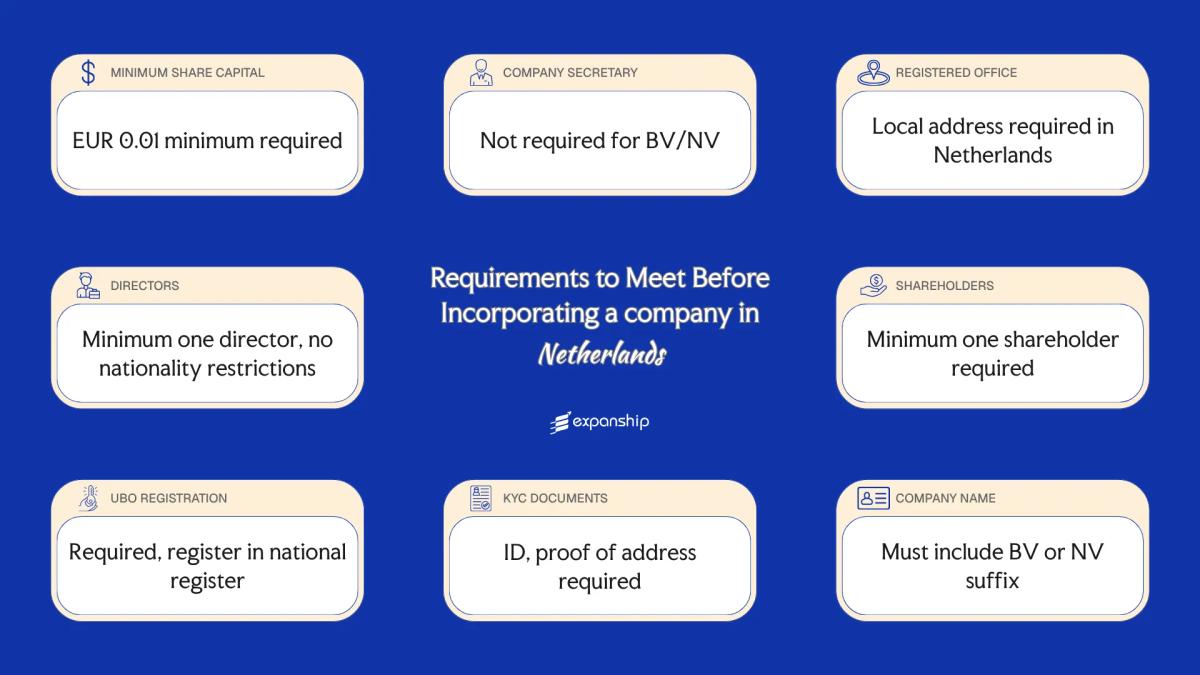
Entity formation in the Netherlands is governed by Book 2 of the Burgerlijk Wetboek (Dutch Civil Code), with registration administered by the Kamer van Koophandel (KvK), the Dutch Chamber of Commerce. Meeting Netherlands incorporation requirements is a legal precondition for operating as a registered entity, and non-compliance results in rejection of the application or, in cases of post-registration breaches, administrative penalties.
This article covers the structural, documentary, and regulatory requirements applicable to company registration in the Netherlands, without detailing the formation process itself.
Requirements can differ based on the legal structure chosen, the sector in which the entity operates, and the residency or nationality of its shareholders and directors. Foreign investors establishing a besloten vennootschap (BV) or another Dutch entity type should treat this article as a reference point for understanding what formal obligations apply before and during registration.
Minimum Share Capital Requirements in the Netherlands
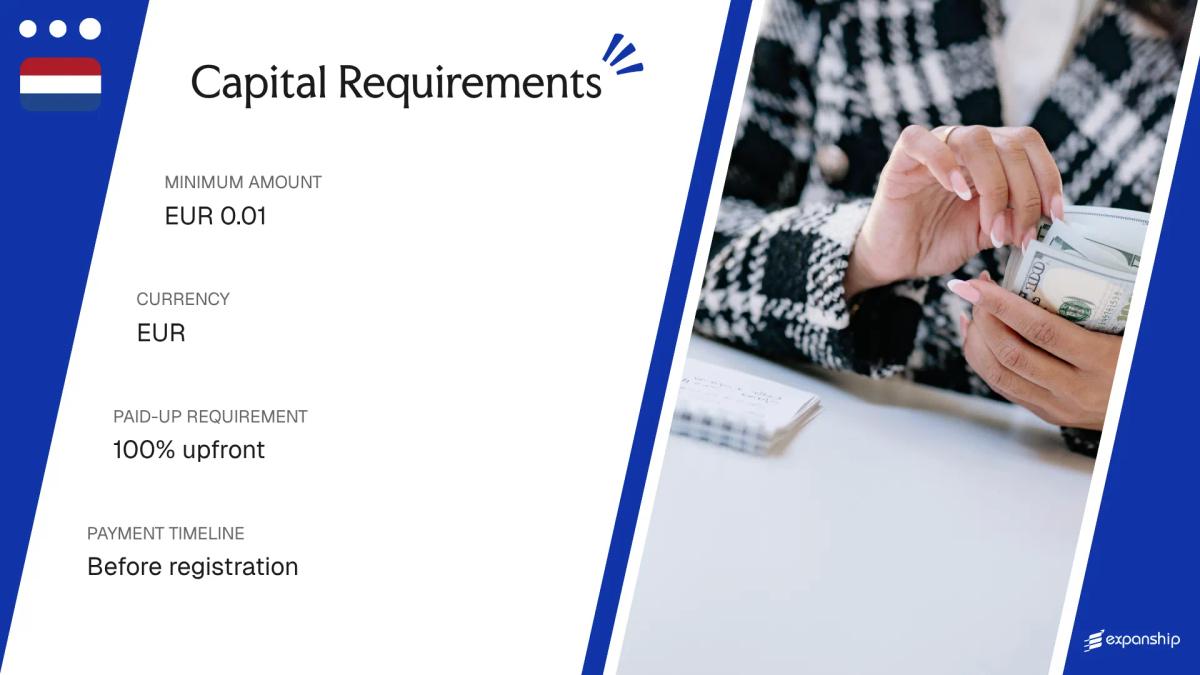
Since 2012, the Netherlands has operated under a no-par value share system for the besloten vennootschap (BV), following amendments to Book 2 of the Dutch Civil Code. Netherlands minimum share capital requirements were simultaneously abolished, removing the previous EUR 18,000 statutory minimum.
The Dutch Business Register (Handelsregister), maintained by the Netherlands Chamber of Commerce (Kvk), processes BV incorporations. Share capital details are declared in the notarial deed of incorporation and registered with the KvK; no separate capital verification by a bank or financial authority is required at formation.
| Parameter | Detail |
|---|---|
| Minimum Authorized Share Capital | No statutory requirement |
| Maximum Authorized Share Capital | No statutory requirement |
| Minimum Paid-Up Capital | No statutory requirement |
| Paid-Up Requirement at Incorporation | At least EUR 0.01 per share must be paid up upon issuance |
| Accepted Currency | Euro (EUR); foreign currency permissible if stated in the articles |
| Accepted Forms of Contribution | Cash or non-cash contributions (in-kind assets subject to valuation) |
| Timeframe to Deposit Capital | At the time of share issuance, as stipulated in the deed of incorporation |
A BV still requires at least one share to be issued and paid up at incorporation. Issuing shares with zero payment is not permitted under Dutch law, even though no floor amount is prescribed.
Company Secretary Requirements in the Netherlands
Under Dutch corporate law, there is no statutory requirement to appoint a company secretary for a besloten vennootschap (BV). Netherlands company secretary requirements, as understood in common-law jurisdictions, have no direct equivalent under the Burgerlijk Wetboek (Dutch Civil Code).
Certain administrative and compliance functions that a company secretary would typically handle are instead assigned to the managing board (bestuur). Dutch BV secretary obligations, where voluntarily adopted, may be defined in the company's articles of association (statuten).
If your business chooses to appoint a person or entity to perform a secretarial function, general eligibility considerations include:
- No mandatory licensing or professional qualification is required under Dutch law for a voluntary company secretary role.
- Both natural persons and legal entities may be appointed to fulfil a secretarial function.
- There is no residency or nationality condition attached to this role under the Burgerlijk Wetboek.
- Duties may include maintaining corporate records, coordinating board meeting documentation, and managing statutory correspondence.
- The scope of the role is governed by the firm's own statuten rather than by a national regulatory framework.

Incorporate a Company in the Netherlands
Set up a Dutch BV with full statutory compliance, from drafting articles of association to registering with the Dutch Chamber of Commerce (KvK).
Registered Office Requirements in the Netherlands
Netherlands registered office requirements apply to all besloten vennootschappen (BVs) and naamloze vennootschappen (NVs) incorporated under Dutch law, with the statutory seat address recorded in the deed of incorporation and registered with the Dutch Chamber of Commerce (Kamer van Koophandel, KvK). Failure to maintain a valid, registered address can result in administrative sanctions by the KvK, including suspension of the company's registration or referral to the Public Prosecution Service in cases of structural non-compliance.
- A physical address within the Netherlands is required; P.O. boxes alone are not accepted by the KvK.
- Virtual office addresses are permitted, provided the service supplier furnishes a genuine street address.
- The address must be located in the Netherlands; a foreign address does not satisfy Dutch statutory seat obligations.
- Proof of entitlement to use the address is required, such as a lease agreement, ownership document, or a signed domiciliation agreement.
- The registered address is publicly visible on the KvK Handelsregister (Commercial Register) and accessible to third parties.
- Any change to the registered address must be formally notified to the KvK, typically within one week of the change taking effect.
Director Requirements in the Netherlands
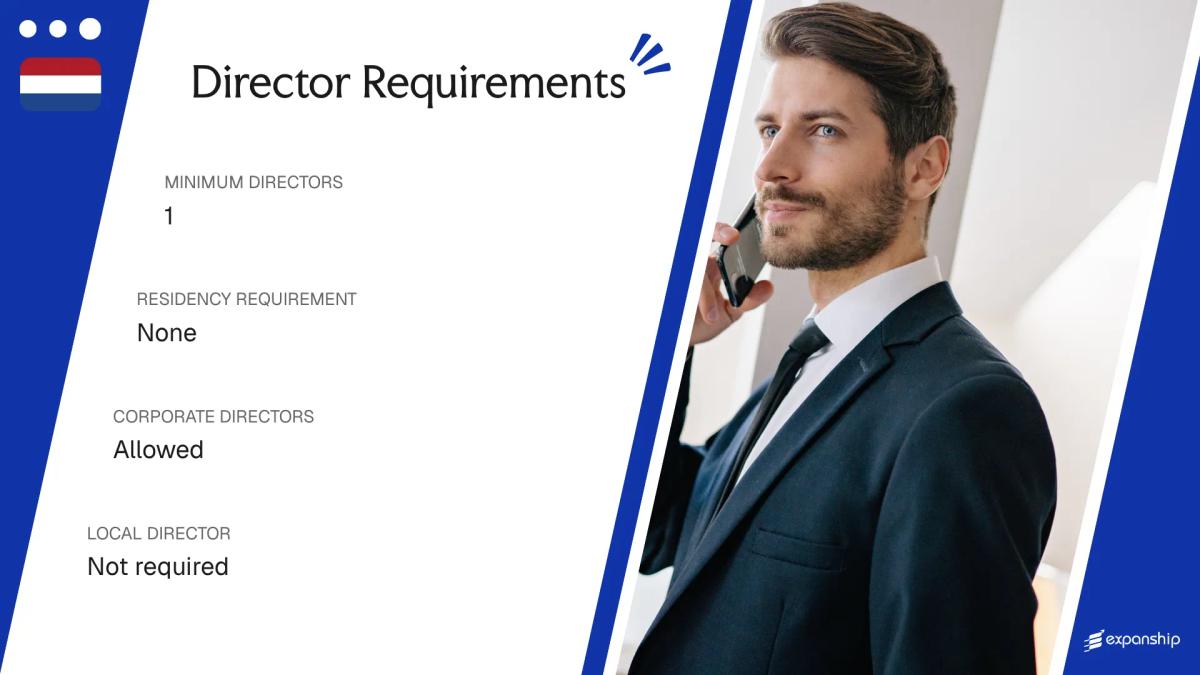
Under the Burgerlijk Wetboek (Dutch Civil Code), directors of a besloten vennootschap assume personal liability for mismanagement, failure to file annual accounts on time, and improper tax remittances, with the Belastingdienst holding broad authority to pursue directors individually for unpaid corporate tax obligations. Netherlands director requirements place no residency restriction on appointment, but the Handelsregister (KVK) mandates that all directors be registered within the commercial register upon taking office.
| Parameter | Detail |
|---|---|
| Minimum Number of Directors | One director is required. |
| Maximum Number of Directors | No statutory maximum is set. |
| Local/Resident Director Required | No residency requirement exists under Dutch law. |
| Nationality Restrictions | No nationality restrictions apply. |
| Minimum Age Requirement | Directors must be at least 18 years of age. |
| Corporate Directors Permitted | Yes, legal entities may serve as directors of a BV. |
| Director Must Be a Shareholder | No, directorship and shareholding are separate roles. |
| Publicly Listed on Registry | Yes, all directors are listed in the KVK Handelsregister and are publicly accessible. |
| Disqualification Conditions | Directors may be disqualified by court order following proven mismanagement or bankruptcy fraud under Book 2 of the Burgerlijk Wetboek. |
A corporate entity, including a foreign-incorporated company, can serve as the sole director of a Dutch BV without any requirement to appoint a natural person alongside it.
Shareholder Requirements in the Netherlands
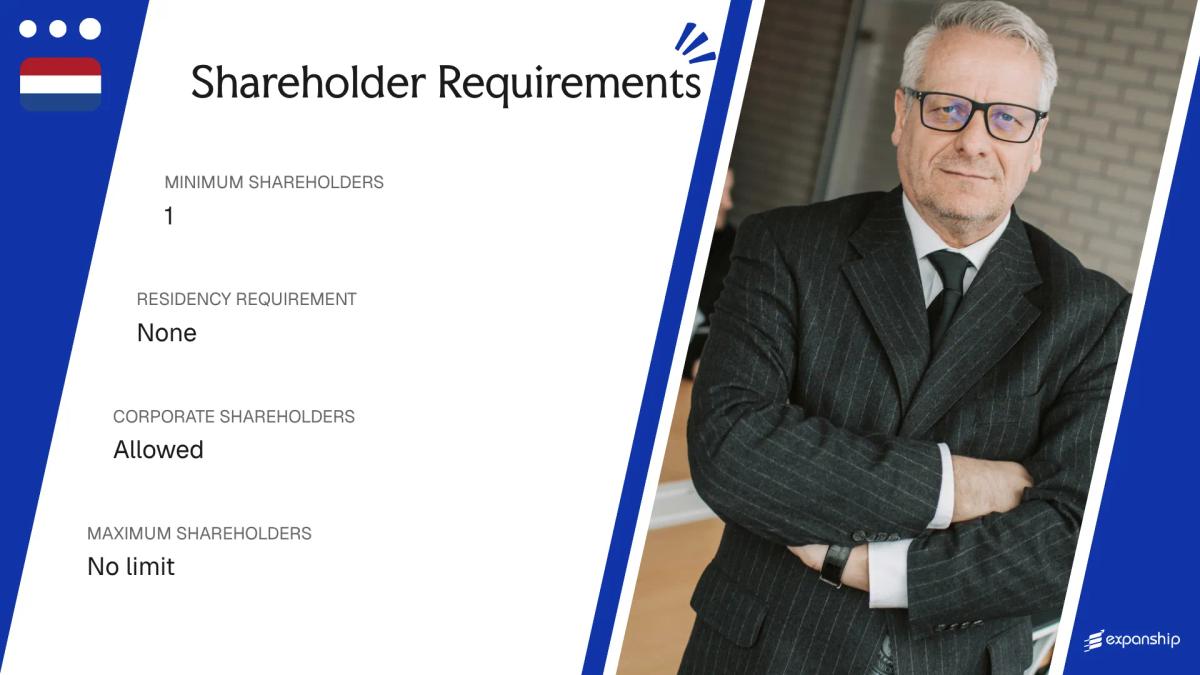
A Dutch besloten vennootschap (BV) requires a minimum of one shareholder. There is no statutory maximum, allowing the structure to accommodate a sole founder or a large group of investors.
Nationality and Residency Restrictions
Netherlands shareholder requirements impose no nationality or residency conditions on shareholders. Foreign individuals and entities may hold shares without restriction on ownership percentage.
Corporate Shareholders
Corporate entities are permitted to act as shareholders in a Dutch BV. No special conditions are attached under the Burgerlijk Wetboek (Dutch Civil Code) solely by reason of the shareholder being a legal person rather than an individual.
Shareholder Liability
Liability is limited to each shareholder's capital contribution. Under certain circumstances, such as improper management or abuse of the corporate structure, Dutch courts may pierce the corporate veil and impose extended liability.
Register of Shareholders
Under Dutch aandeelhouder requirements, every BV must maintain a shareholders' register. The register is not publicly accessible, but the entity is obligated to keep it current and make it available for inspection by authorised parties.
Shareholder Structuring Support for Your Dutch BV
Get guidance on meeting shareholder obligations when setting up a besloten vennootschap in the Netherlands.
UBO / Beneficial Ownership Registration Requirements in the Netherlands
Under the Netherlands UBO registration requirements framework, a beneficial owner is any individual who directly or indirectly holds more than 25% of the shares, voting rights, or ownership interest in a legal entity, as established under the Wwft (Wet ter voorkoming van witwassen en financieren van terrorisme) implementing the EU's Fourth and Fifth Anti-Money Laundering Directives.
- Identify all individuals meeting the 25% ownership or control threshold before or at the time of incorporation.
- Submit UBO details to the Dutch Business Register (Handelsregister), maintained by the Kamer van Koophandel (KvK), within one week of incorporation.
- Declare each UBO's full name, date of birth, nationality, residential country, and the nature and extent of the beneficial interest held.
- Update the register within one week of any change in UBO status or details.
| Parameter | Detail |
|---|---|
| Ownership Threshold for UBO Status | More than 25% of shares, voting rights, or ownership interest |
| Filing Authority | Kamer van Koophandel (KvK) via the Handelsregister |
| Disclosure Deadline at Incorporation | Within one week of incorporation |
| Publicly Accessible Register | Partially; certain personal details are restricted from public view |
| Penalties for Non-Disclosure | Criminal and administrative sanctions under the Wwft, including fines |
| Ongoing Update Obligation | Within one week of any change in UBO information |
KYC / Document Requirements in the Netherlands
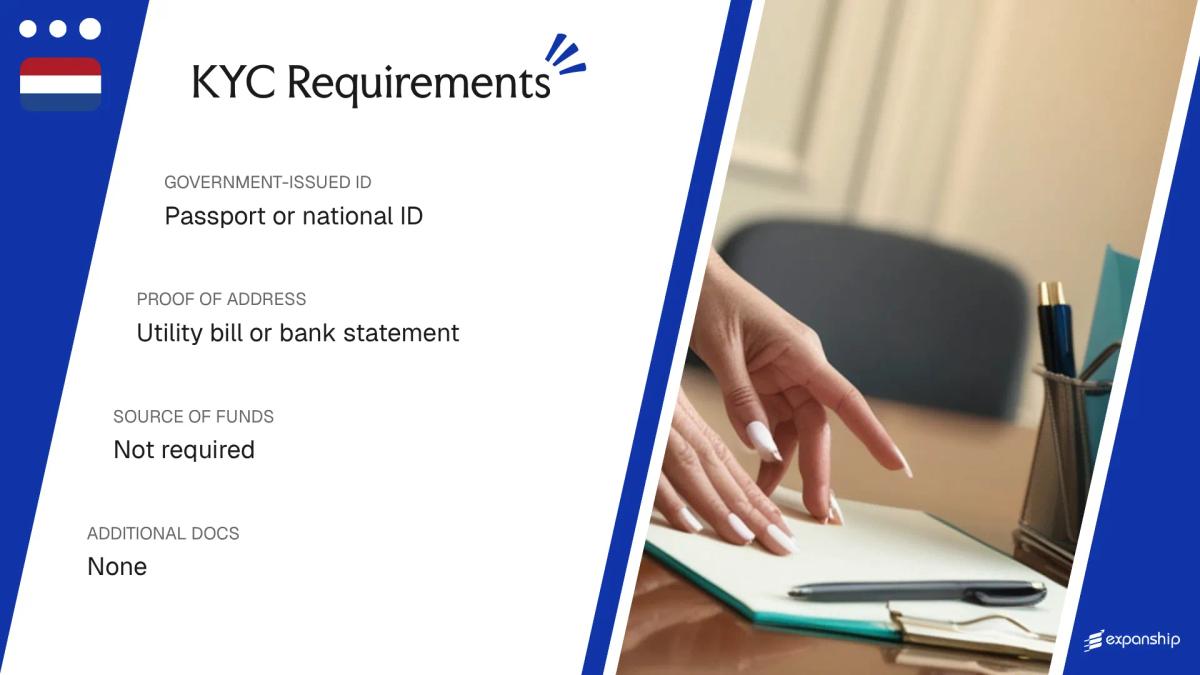
Dutch KYC obligations at the point of incorporation are governed by the Wet ter voorkoming van witwassen en financieren van terrorisme (Wwft), administered by the FIU-Nederland. Civil-law notaries (notarissen), who are mandatory for BV formation, are themselves obligated institutions under the Wwft and must perform client due diligence before executing a deed of incorporation.
Individual / Personal Documents
- Valid government-issued photo ID (passport or national identity card) for each director, shareholder, and UBO
- Proof of residential address dated within three months, such as a utility bill or official bank statement
- Tax identification number where the individual holds one in their country of residence
- Signed declaration confirming the individual's role and authority within the entity
Corporate Documents
- Certificate of incorporation or equivalent constitutional document for the corporate shareholder or director
- Current register of directors confirming who holds authority within the corporate entity
- Proof of registered office address for the corporate entity
- Certified copy of the articles of association or equivalent constitutional document
Source of Funds Documentation
- Recent bank statements evidencing the origin of capital contributed to the entity
- Audited financial accounts where the introducing party is a corporate entity
- Written declaration of source of funds where bank documentation alone is insufficient
Notarisation and Apostille Requirements
- Foreign documents must generally be apostilled under the Hague Convention if issued outside the EU
- Official translations into Dutch, English, or German are required for documents in other languages
- Translations must be prepared by a sworn translator (beëdigd vertaler) recognised in the Netherlands
Mismatched or incomplete UBO documentation is the most frequently cited cause of notarial refusal or delay during BV incorporation.
Company Name Requirements in the Netherlands
Netherlands company name requirements are assessed at the point of registration with the Kamer van Koophandel (KVK), the Dutch commercial registry. A proposed name must be sufficiently distinct from existing registered names to avoid public confusion.
Your entity's name must include the legal suffix "B.V." for a besloten vennootschap. Dutch law does not impose a strict character limit, but the name must be in Roman script.
Certain words are restricted. Terms implying a royal connection, regulatory authority, or a different legal form require prior approval or are prohibited outright.
Name reservation is not formally available through the KVK in the way some jurisdictions offer it. You can apply for a trade name registration, but this does not guarantee exclusive rights to the corporate name ahead of incorporation.
Compliance Services for Companies in the Netherlands
Maintain your Dutch entity's good standing with ongoing compliance support, from annual filing obligations to regulatory reporting requirements.
Conclusion
Incorporating a company in the Netherlands requires meeting a defined set of legal and administrative obligations under Dutch civil and commercial law. The abolition of the minimum share capital requirement for the BV structure was a significant legislative change, but UBO registration with the Handelsregister and the substance-based considerations tied to your registered office address carry practical weight for foreign investors. Director residency carries no formal restriction, though tax residency implications may follow from where management decisions are made. Once these Netherlands BV incorporation requirements are understood, the immediate task shifts to execution: selecting local service providers and preparing compliant documentation.
Expanship's Corporate Services for Netherlands Expansion
Handling Netherlands company formation services involves specific obligations — notarial deed execution through a Dutch civil-law notary, KvK registration, UBO filing with the Handelsregister, and maintaining a genuine local office address. Expanship works alongside you to manage the administrative coordination these requirements generate, reducing the time your team spends on Dutch regulatory processes.
Beyond registration, our services cover the full incorporation and compliance cycle:
- We prepare and coordinate all company registration documents, including notarial deed requirements specific to the BV structure.
- A registered office address and agent are provided to satisfy Dutch Handelsregister obligations.
- We liaise directly with the KvK, Belastingdienst, and other relevant Dutch authorities on your behalf.
- Post-incorporation compliance, including UBO register updates and annual filing obligations, is managed on an ongoing basis.
- Banking introductions are facilitated to support your Dutch entity's operational setup.
- Tax registration with the Belastingdienst and relevant local authority coordination are handled as part of the process.
Reach out to Expanship Netherlands to discuss your incorporation requirements.
Frequently Asked Questions (FAQ)
No residency requirement applies to directors of a Dutch BV under Dutch corporate law. A company can be managed entirely by foreign nationals living abroad, though your tax advisers should assess whether non-resident directors affect the entity's place of effective management, which has consequences for Dutch corporate tax residency under the Wet op de vennootschapsbelasting 1969.
A Dutch BV must maintain a registered office at a physical address in the Netherlands, as recorded in the Dutch Business Register (Handelsregister) held by the Netherlands Chamber of Commerce (KVK). Virtual office addresses are accepted by the KVK provided the service provider can receive and forward official correspondence there, but using an address solely to satisfy registration while all operations occur abroad may draw scrutiny from the Dutch Tax and Customs Administration (Belastingdienst).
Any natural person who directly or indirectly holds more than 25% of the shares, voting rights, or economic interest in a Dutch legal entity must be registered as a UBO in the UBO register held by the KVK, as required under the Wet toezicht trustkantoren 2018 and the underlying EU Anti-Money Laundering Directives. The 25% threshold is a floor, not a safe harbour; a person exercising effective control through other means can also qualify as a UBO regardless of their ownership percentage.
Failure to register UBOs or submitting false information to the KVK's UBO register is a criminal offence under Dutch law and can result in fines or, in serious cases, imprisonment. The obligation is ongoing, meaning any change in beneficial ownership must be updated promptly, and the entity's directors bear responsibility for ensuring accuracy.
The document requirements differ between individual and corporate shareholders. Individual shareholders typically provide government-issued identification and proof of address, while corporate shareholders must supply corporate constitutional documents, proof of good standing, and UBO information for the parent entity. Where a corporate shareholder is itself incorporated in a jurisdiction with limited public disclosure, additional certified or apostilled documentation is generally required by the incorporating notary.
Yes, a Dutch BV can be incorporated and operated with a single natural person serving simultaneously as the sole director and sole shareholder. Dutch law does not prohibit this structure, and it is a common arrangement for sole-founder businesses and holding entities incorporated through the standard notarial deed process at a Dutch civil law notary.
Legal Disclaimer
The information provided in this article is for general informational purposes only and does not constitute legal, tax, or professional advice. While we strive to ensure the accuracy and timeliness of the content, laws and regulations are subject to change, and the application of laws can vary widely based on specific facts and circumstances.
Readers should not act upon this information without seeking professional counsel tailored to their individual situation. Expanship and its authors disclaim any liability for actions taken or not taken based on the content of this article.
For specific advice regarding your business setup, compliance requirements, or any legal matters, please consult with qualified legal and tax professionals in the relevant jurisdiction.