

Key Takeaways
- The Netherlands applies a corporate income tax rate that increases the fiscal burden on profits exceeding €200,000, reducing the net return for mid-to-large trading operations relative to lower-rate EU jurisdictions.
- Foreign founders structuring a BV must satisfy Dutch substance requirements for tax residency, meaning a nominee-director arrangement or purely offshore management will not secure Dutch treaty access under the country's extensive tax treaty network.
- Under ATAD implementation and Dutch domestic anti-avoidance rules, interest deduction limitations and CFC provisions add layers of structural complexity that increase compliance costs for holding and intragroup financing arrangements.
- Incorporating a BV requires a notarial deed executed by a Dutch civil-law notary, making the formation process more procedurally constrained and costly than jurisdictions that permit online or self-certification incorporation without mandatory notarial involvement.
The Netherlands operates under a heavily regulated corporate and tax framework, shaped by EU directives, domestic fiscal legislation, and multilateral compliance standards. Understanding the disadvantages of incorporating in Netherlands is relevant before committing to a Dutch legal structure.
The categories covered in this article span tax exposure, administrative burden, disclosure obligations, and operational cost — each carrying different weight depending on your sector and intended structure.
Not every disadvantage applies equally across all business types. A holding company faces different friction points than an actively trading firm, and a sole foreign shareholder encounters different compliance pressures than a joint venture.
This article is most relevant to foreign investors and non-resident founders considering a besloten vennootschap (BV) as their primary entry vehicle into the Dutch or EU market.
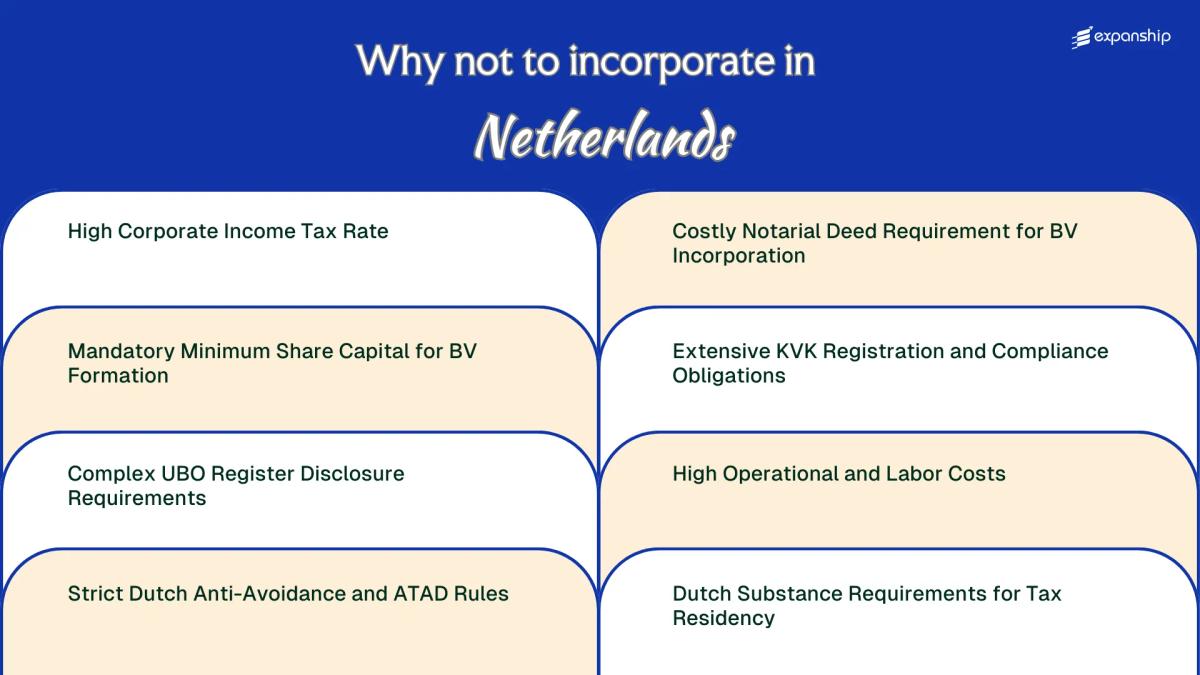
High Corporate Income Tax Rate
The Netherlands imposes corporate income tax (vennootschapsbelasting) at a standard rate of 25.8% on taxable profits exceeding €200,000. This is among the higher rates within Western Europe and represents a direct Netherlands corporate income tax drawback for foreign-owned businesses generating significant profits.
A Two-Tier Rate That Can Mislead
Profits up to €200,000 are taxed at a reduced rate of 19%, which can create a misleading initial impression for foreign investors projecting tax exposure. Once your BV scales beyond that threshold, the full 25.8% rate applies to all profits above it, and for growth-oriented businesses, this bracket is reached faster than many anticipate.
What This Means for Foreign-Owned Structures
For foreign companies routing profits through a Dutch entity, the high corporate tax rate Netherlands BV owners face erodes the net return, particularly when combined with dividend withholding tax obligations at 15% under the Wet op de dividendbelasting 1965. The 19% lower band applies only to the first €200,000, offering limited relief for mid-size and larger operations.
Foreign business owners operating profitable Dutch BVs should account for the 25.8% CIT rate on profits above €200,000 when modeling post-tax returns, as this rate materially reduces distributable income before any dividend withholding tax is applied.
Mandatory Minimum Share Capital for BV Formation
Netherlands BV share capital requirements changed significantly under the Flex-BV legislation introduced in 2012, which abolished the previous €18,000 minimum. A BV can now be incorporated with as little as €0.01 in share capital. That sounds permissive on its surface, but the practical reality for foreign founders is more constrained.
Banks and payment service providers routinely treat nominal share capital as a creditworthiness signal. Incorporating with minimal capital can complicate opening a Dutch business bank account, a process already difficult for non-resident directors.
The absence of a statutory floor also shifts liability risk. Under Book 2 of the Dutch Civil Code, directors can face personal liability for obligations entered into before the company has adequate resources to meet them.
For foreign business owners, the capital structure decision creates friction across several areas:
- Undercapitalizing the BV may disqualify your entity from certain trade credit terms with Dutch suppliers who treat paid-up capital as a baseline trust indicator.
- A thin capital base can trigger closer scrutiny from the Belastingdienst when assessing whether the company has genuine economic substance.
- Foreign shareholders expecting to repatriate returns may face Dutch dividend withholding tax exposure that a higher initial capital structure could have been used to partially address through proper structuring.
- Notaries may require evidence that subscribed capital is actually available at incorporation, adding a documentation burden for non-resident founders.

Company Incorporation in the Netherlands
Understand the full capital and compliance requirements for forming a BV in the Netherlands before you commit to a structure.
Complex UBO Register Disclosure Requirements
Netherlands UBO register disclosure risks are not hypothetical for foreign business owners. Under the Wet toezicht trustkantoren 2018 and the implementation of the EU's Fifth Anti-Money Laundering Directive, all BVs and NVs must register ultimate beneficial owners in the Handelsregister maintained by the Kamer van Koophandel (KVK). Any individual holding more than 25% of shares, voting rights, or economic interest qualifies as a UBO and must be disclosed.
The core problem is that this register is partially public. Name, nationality, month and year of birth, country of residence, and the nature and extent of the beneficial interest are accessible to any member of the public without requiring justification.
| Data Field | Publicly Accessible | Restricted to Competent Authorities Only |
|---|---|---|
| Full name | Yes | No |
| Nationality | Yes | No |
| Month and year of birth | Yes | No |
| Exact date of birth | No | Yes |
| Country of residence | Yes | No |
| BSN / Tax Identification Number | No | Yes |
| Nature and extent of interest | Yes | No |
For high-net-worth individuals or owners operating in politically sensitive markets, this level of public exposure creates genuine personal security concerns. Although Dutch law permits exemption requests in exceptional circumstances involving personal safety risks, approvals are rare and the burden of proof falls entirely on the applicant.
Non-compliance carries direct consequences. Failure to register or maintain accurate UBO records is a criminal offence under Dutch law, exposing directors to fines and reputational risk with Dutch financial institutions.
Strict Dutch Anti-Avoidance and ATAD Rules
Dutch ATAD anti-avoidance rules challenges are a real operational burden for foreign-owned entities, particularly holding and finance structures that once benefited from the Netherlands' treaty network. The EU's Anti-Tax Avoidance Directives (ATAD1 and ATAD2), implemented through Dutch domestic legislation, introduced earnings stripping rules that cap interest deductions at 20% of EBITDA, with a threshold of EUR 1 million. For debt-financed acquisitions or intra-group financing arrangements, this restriction can materially increase taxable income.
ATAD compliance risks for Netherlands companies extend to Controlled Foreign Company (CFC) rules, which require Dutch parent entities to include undistributed profits of low-taxed subsidiaries in their taxable base. This applies where the subsidiary is subject to an effective tax rate below 9%.
The hybrid mismatch rules under ATAD2, transposed into the Wet vpb 1969, target mismatches in the tax treatment of entities or instruments across jurisdictions. Structures that were compliant before 2020 may now generate unexpected Dutch taxable income without any change in commercial activity.
- Interest deductions are capped at 20% of EBITDA under the earnings stripping rule
- CFC rules apply where a foreign subsidiary's effective tax rate falls below 9%
- Hybrid mismatch rules can reclassify deductible payments as non-deductible
- Existing structures require review against both ATAD1 and ATAD2 provisions
- The EUR 1 million safe harbour on interest deductions does not scale with entity size
The Netherlands implemented ATAD2 hybrid mismatch rules that go beyond the EU's minimum standard, meaning some structures legal elsewhere in the EU are specifically disallowed under Dutch law.
Costly Notarial Deed Requirement for BV Incorporation
Forming a BV in the Netherlands requires execution of a notarial deed by a Dutch civil law notary (notaris), a mandatory step embedded in Book 2 of the Dutch Civil Code (Burgerlijk Wetboek). This requirement is not optional or procedural in name only — it directly adds cost and time before your company can legally exist.
The Cost Structure Behind the Requirement
Notary fees for BV incorporation typically range from EUR 500 to over EUR 2,000, depending on the complexity of the articles of association and the notary's firm. That fee is paid before the entity generates a single euro of revenue, creating an upfront financial threshold that jurisdictions without mandatory notarial requirements — such as the UK or Ireland — do not impose.
Practical Friction for Foreign Incorporators
Foreign founders who cannot appear in person must arrange a notarized and apostilled power of attorney, which adds both cost and processing time before the notaris can proceed. If your articles of association require amendment after incorporation, each change must again pass through a notary, meaning ongoing structural modifications carry recurring professional fees that compound over the company's lifetime.
Support for Navigating BV Formation Requirements in the Netherlands
Get guidance on managing the notarial deed process, associated costs, and structural requirements when forming a BV as a foreign business owner.
Extensive KVK Registration and Compliance Obligations
KVK registration compliance challenges Netherlands extend well beyond the initial filing, creating an ongoing administrative burden that demands consistent attention and, typically, local professional support. Foreign businesses are often unprepared for the volume of post-incorporation obligations tied to the Kamer van Koophandel.
- Every change to your company's directors, address, or activities must be reported to the KVK within one week, and late updates can result in penalties or inaccurate public records that affect third-party relationships.
- Annual financial statements must be deposited with the KVK under the Wet op de jaarrekening, with filing deadlines and disclosure thresholds that vary by company size classification.
- Foreign-owned entities are subject to the same public register transparency rules as domestic firms, meaning your corporate structure becomes accessible to any party conducting a KVK extract search.
- Non-compliance with Dutch Chamber of Commerce obligations can trigger administrative fines and, in serious cases, director liability under Book 2 of the Burgerlijk Wetboek.
High Operational and Labor Costs
High operational costs Netherlands business owners face extend well beyond incorporation fees. Running a BV comes with recurring structural expenses that are largely non-negotiable under Dutch employment and social security law.
Employer costs in the Netherlands are among the highest in the European Union. On top of gross salary, your firm is required to contribute to employee insurance schemes under the Wet financiering sociale verzekeringen (Wfsv), covering unemployment (WW), disability (WIA), and healthcare-related premiums. These contributions typically add 20–30% to the base salary cost.
Dutch employees are also entitled to a statutory holiday allowance (vakantiegeld) of at least 8% of gross annual salary under the Burgerlijk Wetboek. For a mid-level employee earning EUR 60,000 gross, that adds EUR 4,800 annually per person before any bonus or benefit obligations.
Office space, particularly in Amsterdam and Rotterdam, compounds the burden. Commercial rents in prime locations consistently rank among the highest in continental Europe.
A foreign-owned BV employing five staff at an average gross salary of EUR 55,000 would face employer social contributions of approximately EUR 60,500–82,500 annually, before holiday allowances, pension contributions, or any sector-specific collective labour agreement (CAO) obligations.
Dutch Substance Requirements for Tax Residency
Netherlands substance requirements tax risks are a recurring challenge for foreign-owned holding structures, particularly where the entity is designed to access Dutch tax treaties or the participation exemption. The Dutch Tax and Customs Administration (Belastingdienst) applies substance criteria to assess whether a company is genuinely managed and controlled from the Netherlands.
For Dutch intermediate holding companies, the Belastingdienst expects qualifying board members resident in the Netherlands, sufficient local decision-making authority, and wage costs that reflect actual management activity. If your board meetings are conducted abroad or key decisions are made by a foreign parent, the entity risks being treated as tax resident elsewhere under domestic or treaty rules.
These requirements impose recurring costs: resident directors must be genuinely qualified, local office space must be maintained, and payroll obligations arise even for holding structures with minimal trading activity. Substance-for-hire arrangements through trust companies are scrutinized under the ATAD2 hybrid mismatch rules and transfer pricing documentation requirements under Dutch corporate tax law.
Foreign business owners using a Dutch entity solely as a conduit or treaty access vehicle face the risk that the Belastingdienst will deny treaty benefits or the participation exemption if demonstrable local substance is absent, regardless of formal registration.
Overcoming These Incorporation Challenges
Overcoming Netherlands incorporation challenges requires structural preparation rather than reactive fixes. The disadvantages covered in this blog, from notarial deed costs to substance requirements, each respond to specific procedural and legal measures.
- Elect the BV structure with a EUR 0.01 nominal share capital to satisfy the statutory minimum under Book 2 of the Dutch Civil Code without over-capitalising the entity.
- Register the ultimate beneficial owners through the KVK UBO portal to meet Wwft disclosure obligations before commencing operations.
- Establish documented economic substance in the Netherlands, including local board meetings and resident directors, to satisfy the Belastingdienst's tax residency criteria.
- Engage a Dutch civil-law notary (notaris) to execute the incorporation deed, as this step is a non-negotiable statutory requirement under Dutch law.
- Apply for WBSO (R&D tax credit) status early if the business conducts qualifying innovation activities, to offset the 25.8% corporate income tax exposure.
These steps sit within a regulatory environment governed by the Belastingdienst, the AFM, and the KVK, each of which maintains distinct compliance mandates. Satisfying one authority's requirements does not automatically satisfy another's.
Netherlands Still a Strong Business Destination
The disadvantages covered in this blog are real and, in some cases, structurally embedded in Dutch law. Yet for many foreign businesses, the Netherlands remains a credible destination precisely because those same structures, such as the mature legal system, treaty network, and the BV's flexible governance framework, carry practical weight that offsets the compliance burden.
| Pros | Cons |
|---|---|
| Extensive double tax treaty network reduces withholding tax exposure on cross-border income | Corporate income tax rate reaches 25.8% on profits above EUR 200,000 |
| Participation exemption eliminates Dutch tax on qualifying dividends and capital gains from subsidiaries | Substance requirements demand real office presence, local directors, and payroll to defend tax residency |
| No minimum share capital requirement in practice; EUR 0.01 is legally sufficient for BV formation | Notarial deed requirement adds mandatory legal costs that many comparable jurisdictions do not impose |
| WGBL and Dutch labor law provide a stable employment framework attractive to international talent | High wages and statutory employer contributions raise operational costs significantly above EU averages |
| KVK registration integrates business and VAT administration into a single public register | UBO register disclosure removes confidentiality for any natural person holding 25% or more |
Weighing Netherlands BV risks vs advantages ultimately depends on your business model and cross-border structure. The friction is real, but it is predictable and codified, which allows for accurate planning.
Compliance Services for Companies in the Netherlands
Ongoing compliance obligations for Dutch BVs include annual KVK filings, UBO register maintenance, corporate tax returns, and statutory reporting under Dutch civil law. This service covers the recurring requirements your entity must meet to remain in good standing.
Conclusion
Incorporating a BV in the Netherlands carries real structural costs that your business must factor in from the outset. The cons of Netherlands company registration extend beyond setup fees: notarial deed requirements, KVK compliance obligations, and the substance rules tied to tax residency all impose ongoing administrative and financial demands. UBO register disclosure under the Handelsregisterwet adds a layer of transparency that some business models find restrictive. These are not incidental friction points but fixed features of the Dutch regulatory framework. Professional guidance specific to Dutch corporate law remains a practical consideration for any foreign-owned entity.
Expanship's Netherlands Company Formation Support
Incorporating a Dutch BV involves a specific set of regulatory obligations, from the notarial deed requirement and KVK registration to UBO disclosure and ATAD compliance. Expanship's Netherlands BV formation support services are structured around reducing the administrative and procedural burden these requirements place on your business, so your attention stays on operations rather than paperwork.
Our service scope covers the full incorporation and post-registration cycle. Here is what we handle:
- We prepare and coordinate all company registration documents, including notarial deed requirements.
- A registered office and agent in the Netherlands are provided for your entity.
- We liaise directly with the KVK, Belastingdienst, and other relevant Dutch authorities on your behalf.
- Ongoing compliance obligations are managed after your BV is incorporated.
- Banking introduction support is available to help your firm establish local financial accounts.
- Tax registration with Dutch authorities and local liaison are handled as part of the process.
Reach out through Expanship Netherlands to discuss your incorporation requirements.
Frequently Asked Questions (FAQ)
All BVs registered with the Dutch Chamber of Commerce (KVK) must disclose beneficial owners holding 25% or more of shares, voting rights, or economic interest in the UBO Register. There are no exemptions based on company size or revenue. The register is maintained by the KVK and, following EU anti-money laundering directives, the disclosed data is accessible to competent authorities and certain obliged entities.
Failing Dutch substance requirements means the tax authorities (Belastingdienst) can deny treaty benefits or reclassify the BV as not genuinely tax-resident in the Netherlands. This exposes the entity to double taxation, withholding tax on royalties and dividends at full rates, and potential back-assessments with interest. The ATAD2 rules add further exposure by targeting hybrid mismatches and structures deemed to lack economic reality.
Notarial fees for drafting and executing the deed of incorporation for a Dutch BV typically range from €800 to €1,500, depending on the notary and complexity of the articles of association. This is a mandatory upfront cost with no low-cost alternative, since the Civil Law Notary Act requires a civil-law notary (notaris) to execute the deed. Unlike jurisdictions that allow online self-incorporation without a notary, the Netherlands does not offer that option for BV formation.
Setting share capital at €0.01 is legally permitted under the Flex-BV rules introduced in 2012, but it can undermine creditor confidence and affect your ability to obtain business banking or trade credit. Some Dutch banks apply additional due diligence or decline accounts for thinly capitalised entities. Directors also bear personal liability risk if the company cannot meet its obligations shortly after a distribution, under the solvency test provisions in Book 2 of the Dutch Civil Code.
Yes, the Netherlands implemented both ATAD1 and ATAD2, which directly target holding and IP structures through controlled foreign company (CFC) rules, interest limitation rules capping net interest deductions at 20% of EBITDA, and anti-hybrid rules. A BV used as a holding company for foreign subsidiaries or as an IP holding vehicle must be assessed against these restrictions before assuming Dutch tax treatment is advantageous. Structures that were viable pre-ATAD may now generate unintended tax costs.
Once registered, your BV must keep the KVK trade register updated with any changes to directors, registered address, shareholders, or business activities, typically within one week of the change occurring. Annual financial statements must be filed with the KVK within 13 months of the financial year-end, with shorter deadlines applying to larger companies under the Dutch Civil Code Book 2. Non-compliance can result in fines and, in cases of insolvency, personal director liability for the shortfall in company assets.
The Netherlands has one of the more fully developed anti-avoidance frameworks in the EU, combining ATAD1 and ATAD2 implementation, domestic fraus legis doctrine, and transfer pricing rules aligned with OECD guidelines. Jurisdictions like Luxembourg and Cyprus have implemented ATAD but apply it with varying degrees of administrative rigor. For foreign investors relying on intra-group financing, royalty flows, or holding structures, the Dutch framework demands a higher standard of economic substance and genuine commercial rationale than several competing EU locations.
Legal Disclaimer
The information provided in this article is for general informational purposes only and does not constitute legal, tax, or professional advice. While we strive to ensure the accuracy and timeliness of the content, laws and regulations are subject to change, and the application of laws can vary widely based on specific facts and circumstances.
Readers should not act upon this information without seeking professional counsel tailored to their individual situation. Expanship and its authors disclaim any liability for actions taken or not taken based on the content of this article.
For specific advice regarding your business setup, compliance requirements, or any legal matters, please consult with qualified legal and tax professionals in the relevant jurisdiction.