
Key Takeaways
- The participation exemption under Dutch corporate tax law eliminates tax on qualifying dividends and capital gains received from subsidiary holdings, making the Netherlands a structurally efficient jurisdiction for international holding companies.
- Under Book 2 of the Dutch Civil Code, a Besloten Vennootschap (BV) carries no minimum share capital requirement and imposes no statutory restrictions on foreign ownership, reducing friction for cross-border investors structuring multi-jurisdictional entities.
- R&D-intensive businesses can reduce their effective tax rate on qualifying intellectual property income to 9% through the Innovation Box regime, while also accessing WBSO payroll tax credits to offset the cost of research and development activity.
- Employers who recruit qualifying international talent benefit from the 30% ruling, which allows a tax-free allowance of up to 30% of gross salary for eligible expatriate hires, lowering the real cost of attracting senior foreign professionals to Dutch operations.
Incorporating a company in the Netherlands positions your business within one of continental Europe's most internationally oriented economies — and understanding the benefits of incorporating in Netherlands starts with knowing what kind of jurisdiction you are entering. The Netherlands is an independent sovereign state and founding member of the European Union, situated at the geographic heart of Western Europe's logistics corridor.
Company registration is administered by the Kamer van Koophandel (KVK), the Dutch Chamber of Commerce, which maintains the Handelsregister — the central commercial register for all entities operating in the country. Foreign investors most commonly establish a Besloten Vennootschap (BV) as their primary legal vehicle. The country operates a territorial-leaning tax system with an extensive treaty network, making it structurally attractive for international holding and operating structures.
Foreign ownership of Dutch companies faces no general statutory restrictions, and the country consistently ranks among the top destinations for foreign direct investment in Europe. This article examines the principal advantages that make the Netherlands a substantive choice for international incorporation.
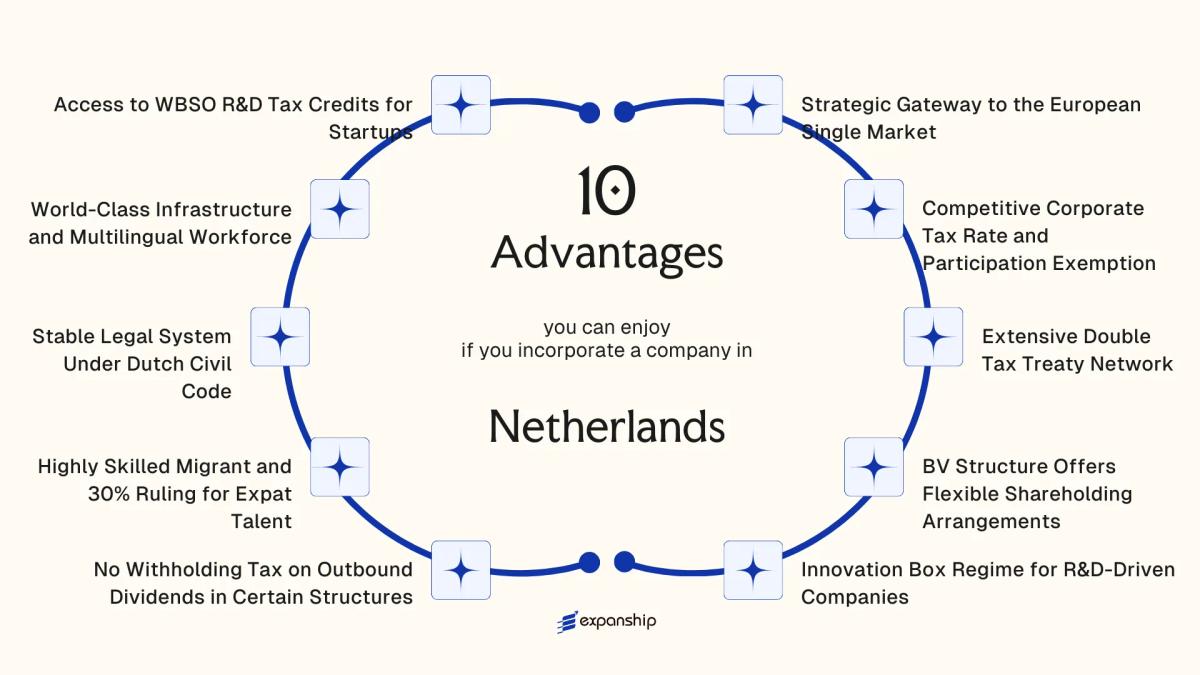
Strategic Gateway to the European Single Market
Incorporating in the Netherlands provides direct access to the European Single Market, a trading area covering over 450 million consumers across 27 member states. A Dutch-registered entity operates under EU law, meaning goods, services, capital, and personnel can move across borders without the customs friction that affects non-EU-based firms.
What Single Market Membership Means in Practice
Passporting rights under EU financial services directives allow a Dutch-licensed financial firm to operate across member states without obtaining separate national licences. For businesses in regulated sectors, this eliminates the cost and delay of duplicating compliance processes in each target country.
Geographic and Logistical Position
The Netherlands sits at the intersection of major European trade routes, with the Port of Rotterdam serving as the largest cargo hub on the continent and Amsterdam Airport Schiphol connecting to over 300 destinations. Distribution networks built around these nodes give your business physical reach that matches the legal reach granted by EU membership.
A single Dutch entity can serve customers across the EU without requiring separate subsidiaries in each member state.
Competitive Corporate Tax Rate and Participation Exemption
Netherlands corporate tax rate advantages begin with a tiered structure under the Wet op de vennootschapsbelasting 1969 (Vpb). Taxable profits up to EUR 200,000 are taxed at 19%, with amounts above that threshold taxed at 25.8%. For a foreign business owner establishing a Dutch BV, the lower bracket applies directly to early-stage profits, reducing the effective tax burden during the growth phase.
The participation exemption (deelnemingsvrijstelling) is where the structure becomes particularly useful for holding operations. Under this regime, dividends and capital gains derived from a qualifying subsidiary are fully exempt from Dutch CIT, provided the parent holds at least 5% of the subsidiary's shares and the subsidiary is not considered a passive low-taxed entity.
For an international group routing income through a Dutch holding company, this exemption means:
- Dividends received from foreign subsidiaries are not taxed again at the Dutch level, preventing double taxation within the group structure
- Capital gains on the disposal of qualifying shareholdings are fully exempt, which matters when restructuring or exiting investments
- The 5% threshold is low relative to equivalent regimes in other EU member states, broadening the range of subsidiaries that can qualify
- No minimum holding period is prescribed for the exemption to apply to dividends in most standard cases
The Dutch vennootschapsbelasting advantages for businesses extend to the predictability of the system. The Dutch Tax and Customs Administration (Belastingdienst) issues binding advance tax rulings, allowing your entity to confirm the tax treatment of a proposed structure before executing it.

Incorporate a Company in the Netherlands
Set up a Dutch BV with full compliance support, from deed of incorporation through Belastingdienst registration.
Extensive Double Tax Treaty Network
With over 100 bilateral tax agreements in force, the Netherlands double tax treaty network benefits foreign businesses by substantially reducing or eliminating withholding taxes on cross-border flows of dividends, interest, and royalties. This treaty coverage extends across major economies in Europe, North America, Asia-Pacific, and the Middle East, giving your business access to reduced source-country tax rates that would otherwise erode returns from international operations.
| Income Type | Standard Dutch Domestic Rate | Example Treaty Rate |
|---|---|---|
| Dividends | 15% | 0–5% (varies by treaty) |
| Interest | 0% domestic | 0–10% (varies by treaty) |
| Royalties | 0% domestic | 0–10% (varies by treaty) |
For holding structures, treaty access is governed by the Wet op de vennootschapsbelasting 1969 (Dutch Corporate Income Tax Act) alongside individual treaty provisions, which together determine whether a Dutch-resident entity qualifies as a beneficial owner. Treaty shopping is constrained by Principal Purpose Test rules under the OECD's Multilateral Instrument (MLI), to which the Netherlands is a signatory, so substance requirements must be satisfied for treaty access to hold.
For international businesses routing income through a Dutch entity, treaty-reduced withholding taxes at source directly lower the cost of repatriating profits. When combined with the participation exemption under Article 13 of the Corporate Income Tax Act, the treaty network creates a tax-efficient path for consolidating foreign earnings at the Dutch holding level without triggering additional layers of taxation.
BV Structure Offers Flexible Shareholding Arrangements
The Netherlands BV flexible shareholding advantages stem from the 2012 reform of Book 2 of the Dutch Civil Code (Burgerlijk Wetboek), which abolished the minimum share capital requirement of EUR 18,000. A BV can now be incorporated with as little as EUR 0.01 in share capital, removing a financial threshold that previously excluded early-stage businesses and lean holding structures.
Beyond the capital floor, the BV permits multiple share classes with distinct economic and governance rights. Founders can issue shares carrying preferential dividend rights, limited or enhanced voting rights, or restricted transferability — all within a single entity. This granularity allows your business to accommodate angel investors, management co-owners, and institutional shareholders under one structural roof without resorting to contractual side arrangements.
Share transfers in a BV are governed by a statutory approval mechanism (blokkeringsregeling) under Dutch Civil Code, giving existing shareholders a say over who enters the cap table. For investor-backed firms, this protects equity integrity across funding rounds.
Keep these points in mind:
- Share class rights must be defined in the articles of association (statuten)
- The blokkeringsregeling can be modified or waived in the statuten
- Voting and profit rights do not need to be proportional to shareholding percentage
- A civil-law notary (notaris) must execute the incorporation deed
A Dutch BV can legally issue shares with no voting rights at all, allowing profit participation without any governance dilution — a feature not universally available across EU jurisdictions.
Innovation Box Regime for R&D-Driven Companies
The Netherlands Innovation Box regime benefits companies that generate income from self-developed intellectual property by applying a reduced effective corporate tax rate of 9% on qualifying profits, compared to the standard Dutch CIT rate of 25.8%. For a foreign-owned business holding IP assets through a Dutch entity, this differential creates a measurable reduction in the tax burden on commercialized innovation.
Qualifying Assets and the Nexus Requirement
Eligible IP includes patents, software developed in-house, and assets arising from qualifying R&D activities certified under the WBSO scheme. Income attributed to such assets qualifies for the 9% rate only to the extent that development costs were incurred directly by the taxpayer, a condition known as the modified nexus approach under OECD BEPS Action 5. This means a firm that genuinely conducts R&D through its Dutch entity, rather than simply licensing in IP, preserves its full access to the reduced rate.
Why the Structure Matters for IP-Holding Companies
Multinational groups that centralize IP ownership in a Dutch operating entity can apply the 9% rate to royalties, licensing revenues, and gains on qualifying assets, rather than treating those returns as ordinary income. The regime is governed under Article 12b of the Corporate Income Tax Act 1969 (Wet op de vennootschapsbelasting 1969), giving it a statutory foundation that provides planning certainty. Advance tax rulings from the Dutch Tax and Customs Administration (Belastingdienst) allow your business to confirm qualifying status before filing.
Structure Your IP Income Under the Dutch Innovation Box
Speak with Expanship's Netherlands specialists to assess whether your R&D activities qualify for the 9% Innovation Box rate and how to structure your entity accordingly.
No Withholding Tax on Outbound Dividends in Certain Structures
Under the Dutch Dividend Withholding Tax Act (Wet op de dividendbelasting 1965), the standard withholding tax rate on outbound dividends is 15%. However, specific structural arrangements allow your business to distribute profits to foreign parent companies entirely free of this charge, which directly preserves capital at the point of repatriation.
- Where a foreign company holds a qualifying interest in a Dutch BV or NV, the exemption under Article 4 of the Dividend Withholding Tax Act may eliminate the 15% levy entirely, provided the participation meets the applicable ownership threshold.
- EU parent companies benefit from the EU Parent-Subsidiary Directive, which removes withholding tax on dividend flows between group entities when the parent holds at least 10% of the subsidiary's shares for a minimum of one year.
- For investors based outside the EU, the Netherlands no withholding tax on dividends outcome is frequently achieved through the country's treaty network, which reduces or eliminates the rate for residents of treaty-partner states.
- Anti-abuse provisions under the Principal Purpose Test and domestic anti-avoidance rules do apply, meaning purely artificial arrangements without genuine economic substance will not qualify for Dutch dividend withholding tax exemption benefits.
For holding structures with substance, this framework means dividend flows up the chain are not eroded before reaching the ultimate shareholder.
Highly Skilled Migrant and 30% Ruling for Expat Talent
The Netherlands 30% ruling benefits for expats represent one of the most quantifiable tax concessions available to internationally recruited employees in the EU. Under the scheme, up to 30% of an eligible employee's gross salary can be paid tax-free as a reimbursement for extraterritorial costs. For your business, this directly reduces the net compensation cost of attracting senior foreign talent without increasing the gross salary on offer.
Eligibility requires that the employee is recruited from abroad, possesses specific expertise scarce in the Dutch labor market, and meets a salary threshold set annually by the Dutch Tax and Customs Administration (Belastingdienst). The ruling is granted for a maximum of five years following legislative changes introduced in 2024.
Separately, the Highly Skilled Migrant (Kennismigrant) visa — administered by the IND (Immigratie- en Naturalisatiedienst) — allows recognized sponsors to bring non-EU talent into the country under an expedited procedure, with processing times significantly shorter than standard work permit routes.
A foreign employee earning EUR 120,000 gross annually could receive EUR 36,000 as a tax-free allowance under the 30% ruling, reducing their effective income tax base to EUR 84,000 — a material difference when benchmarking total compensation packages against competing EU locations.
Stable Legal System Under Dutch Civil Code
The Netherlands stable legal system for businesses rests on a codified civil law framework that has been continuously developed since the Burgerlijk Wetboek (Dutch Civil Code) was comprehensively revised in 1992. Predictability in contract enforcement, property rights, and corporate governance means your entity operates within a defined, well-tested legal structure rather than one subject to frequent judicial reinterpretation.
Dutch corporate law is governed primarily by Book 2 of the Burgerlijk Wetboek, which sets out clear rules on director liability, shareholder rights, and annual reporting obligations for legal entities including the BV. This statutory clarity reduces legal ambiguity for foreign investors structuring cross-border transactions or shareholder agreements under Dutch law.
The judiciary reinforces this foundation. The Amsterdam District Court houses a dedicated chamber for complex commercial disputes, the Netherlands Commercial Court (NCC), which conducts proceedings entirely in English. Foreign businesses can litigate or arbitrate without the cost of translation, a practical advantage when resolving disputes involving international counterparties.
Dutch contract law also permits significant freedom of arrangement, allowing parties to deviate from default statutory provisions in most commercial agreements. That flexibility, embedded within a stable codified system, gives your firm certainty about what rules apply while retaining room to negotiate terms.
The Netherlands Commercial Court handles international commercial cases, but both parties must agree in writing to its jurisdiction before proceedings can be initiated under NCC rules.
World-Class Infrastructure and Multilingual Workforce
The Netherlands infrastructure advantages for businesses are grounded in physical assets that directly reduce operational friction. Schiphol Airport, ranked among Europe's busiest cargo hubs, handles over 1.7 million tonnes of air freight annually. For companies dependent on time-sensitive logistics, that throughput translates into reliable supply chain access to markets across Europe, Asia, and North America from a single location.
Port of Rotterdam and Logistics Depth
Rotterdam is the largest seaport in Europe by cargo volume, processing approximately 470 million tonnes of goods per year. Beyond raw capacity, the port's network of inland waterways, rail connections, and road freight corridors means your business can distribute goods deep into the European continent without relying solely on maritime routes. This multimodal connectivity is particularly relevant for firms in manufacturing, distribution, or wholesale trade.
Digital and Energy Infrastructure
The Amsterdam Internet Exchange (AMS-IX) is one of the world's highest-traffic internet exchanges, making the country a natural base for data-intensive businesses, cloud infrastructure, and technology operations. Reliable energy supply and high data center density support operations that require continuous uptime.
Dutch Multilingual Workforce
English proficiency in the Netherlands ranks consistently at the top of the EF English Proficiency Index among non-native speaking countries. Beyond English, a significant portion of the working population speaks German and French, which are directly relevant to your firm's client communication across the EU's three largest economies.
- High density of university graduates in engineering, finance, and logistics
- Amsterdam and Rotterdam both host international business districts with established expatriate professional communities
- Vocational training through the MBO system produces a skilled technical labour pipeline
Access to WBSO R&D Tax Credits for Startups
The Netherlands WBSO R&D tax credit for startups operates as a direct reduction against wage tax and national insurance contributions, not a deduction from taxable profit. This distinction matters: your company benefits even in loss-making years, which is precisely when early-stage firms need cash flow relief most.
Administered by the Netherlands Enterprise Agency (RVO), the WBSO scheme allows qualifying entities to offset a percentage of R&D wage costs and certain other direct expenditures. For startups, the applicable rate on the first bracket of qualifying labour costs is set higher than the standard rate available to established firms, acknowledging the disproportionate cost burden that R&D carries for businesses without revenue.
The scheme covers a defined scope of technical development work, including the development of new software, physical products, and production processes. Qualifying requires an approved application submitted to RVO before the R&D work begins, and declarations must align with actual hours logged.
Key practical features of the WBSO that benefit foreign-owned Dutch entities include:
- Reduction applies against wage tax withheld at source, meaning the cash benefit is realised monthly rather than at year-end
- Startups receive an elevated first-bracket rate, currently higher than the standard 32% applied to non-startup applicants
- No minimum revenue or profit threshold is required to apply
- Both employees and self-employed founders who pay wage tax through a Dutch payroll can qualify
For a foreign entrepreneur establishing a BV in the Dutch market, this mechanism effectively lowers the real cost of building a technical team during the pre-revenue phase.
Why Netherlands Stands Out Among European Incorporation Hubs
Evaluated against its closest European competitors, the Dutch framework holds a consistent position across multiple structural parameters that matter to foreign businesses: statutory tax rates, treaty access, holding structures, and talent policy. Jurisdictions like Ireland, Luxembourg, and Singapore are frequently cited as alternatives when assessing European incorporation options, and each serves a distinct investor profile. Ireland attracts US multinationals partly through its 12.5% trading rate, while Luxembourg is preferred for fund structuring under the SOPARFI regime. Comparing these against the Dutch position reveals not a single dominant advantage, but a concentration of complementary features within one legal system.
What the comparison consistently shows is that no single competitor matches the same combination of treaty network depth, the participation exemption, the Innovation Box at 9%, and talent incentives like the 30% ruling, all operating under a single civil code framework. For foreign business owners evaluating Netherlands vs other European jurisdictions, that convergence within one entity structure reduces administrative fragmentation across holding, operating, and IP layers.
| Parameter | Netherlands | Ireland | Luxembourg | Singapore |
|---|---|---|---|---|
| Standard CIT Rate | 19% / 25.8% | 12.5% (trading) / 25% (passive) | 17% | 17% |
| IP / Innovation Regime | Innovation Box (9%) | KDB (10%) | IP Regime (80% exemption) | IP Development Incentive |
| Participation Exemption | Yes, 5% minimum holding | Yes (Substantial Holding) | Yes (SOPARFI) | Yes |
| Tax Treaty Network | 90+ treaties | 74+ treaties | 80+ treaties | 90+ treaties |
| Withholding Tax on Dividends | 0% in qualifying structures | 0% in qualifying structures | 0–15% depending on structure | 0% |
| Expat Tax Incentive | 30% Ruling (up to 5 years) | SARP (30% relief) | Impatriate Regime | Not Equivalent |
| Minimum Share Capital (private entity) | €0.01 (BV) | €1 (LTD) | €12,000 (SARL) | S$1 |
| EU Single Market Access | Yes | Yes | Yes | No |
Compliance Services for Companies in the Netherlands
Maintain good standing with Dutch regulatory requirements, including KvK filings, UBO register updates, and annual financial reporting obligations.
Conclusion
The benefits of incorporating in Netherlands rest on a combination of structural tax advantages and legal predictability that few European jurisdictions replicate at the same depth. The participation exemption eliminates Dutch corporate tax on qualifying dividends and capital gains from subsidiary holdings, while the Innovation Box caps effective tax on qualifying IP income at 9%. Together, these provisions serve distinct business profiles: the holding company seeking clean profit repatriation and the R&D-intensive firm protecting its intellectual property returns.
Formed under Book 2 of the Dutch Civil Code and supervised by the Dutch Authority for the Financial Markets (AFM) and De Nederlandsche Bank (DNB), the BV offers foreign investors a familiar limited liability framework with minimal statutory capital requirements. That legal clarity reduces uncertainty when structuring cross-border ownership, which matters considerably when operating across multiple EU member states.
Netherlands company formation advantages are not uniformly relevant to every business. A firm without significant IP or subsidiary holdings will find fewer of these provisions applicable to its specific situation, and the 30% ruling's benefits depend on qualifying expatriate hires. The right structure depends on your industry, shareholder composition, and where your revenue originates. Engaging qualified Dutch legal and tax counsel before incorporation ensures that the entity you form is actually aligned with how your business operates. The mechanics of registration, compliance, and ongoing reporting are the practical steps that follow once that strategic decision is made.
Start Your Netherlands Incorporation Journey With Expanship
When you start a Netherlands company incorporation with Expanship, you work with a team that understands the specific obligations tied to BV formation under the Dutch Civil Code, including registration with the Kamer van Koophandel (KvK) and compliance with the Wet op de vennootschapsbelasting. From applying the Participation Exemption correctly to maintaining a registered office that satisfies substance requirements, the support covers the regulatory mechanics this blog has outlined.
Expanship's service scope for Dutch entity formation includes:
- Preparation and legalization of incorporation documents, including notarial deeds required for BV formation
- Registered agent and registered office address provision to satisfy KvK requirements
- Filing coordination with the KvK and liaison with relevant government bodies
- Post-incorporation compliance management, including annual reporting obligations under Dutch law
- Support with UBO registration under the Wet ter voorkoming van witwassen en financieren van terrorisme (Wwft)
- Banking introduction assistance to support corporate account setup with Dutch financial institutions
Expanship Netherlands does not replace legal counsel but operates alongside it, handling the procedural and administrative functions that consume time and create compliance risk when managed without local expertise.
To discuss your incorporation requirements, contact Expanship Netherlands.
Frequently Asked Questions (FAQ)
The Dutch corporate income tax rate is 19% on taxable profits up to EUR 200,000, with a rate of 25.8% applying to profits above that threshold, as set under the Wet op de vennootschapsbelasting 1969. These brackets apply to the standard regime; profits qualifying under the Innovation Box are taxed at a reduced effective rate of 9%. Your actual liability depends on which income qualifies for specific regimes such as the participation exemption or the Innovation Box.
The 30% ruling applies only to employees recruited from outside the Netherlands who possess specific expertise that is scarce in the Dutch labour market. A key condition is that the employee must have lived more than 150 kilometres from the Dutch border for at least 16 of the 24 months preceding employment, and their taxable salary must meet a statutory minimum threshold, which is adjusted annually by the Belastingdienst. Since 2024, changes introduced to the ruling have capped the income base on which the 30% exemption applies, so the effective benefit is now calculated on a ceiling tied to the WNT norm.
Under Article 13 of the Wet op de vennootschapsbelasting 1969, the participation exemption (deelnemingsvrijstelling) fully exempts qualifying dividend distributions and capital gains received from a subsidiary from Dutch corporate income tax at the parent level. The exemption applies when the Dutch parent holds at least 5% of the nominal paid-up share capital of the subsidiary. Certain anti-abuse conditions apply, particularly where the subsidiary is held primarily for portfolio investment purposes or is subject to a low effective tax rate in its country of residence.
The standard Dutch dividend withholding tax rate under the Wet op de dividendbelasting 1965 is 15%, but this can be reduced or eliminated through the applicable double tax treaty or, within the EU, through the Parent-Subsidiary Directive. Structures that meet specific substance and anti-abuse requirements may qualify for a full exemption. Since 2021, the Netherlands has also introduced a conditional withholding tax on dividends paid to entities in low-tax jurisdictions or in abusive arrangements, so the applicable treatment depends on the receiving entity's profile and jurisdiction.
An early-stage company can access the WBSO (Wet Bevordering Speur- en Ontwikkelingswerk), which provides a wage tax credit reducing payroll tax liabilities on hours spent on qualifying research and development activities. This scheme is administered by RVO (Rijksdienst voor Ondernemend Nederland) and does not require the company to be profitable, making it accessible to startups. Separately, once qualifying intangible assets are developed and generating income, the Innovation Box regime under the Wet op de vennootschapsbelasting 1969 allows that income to be taxed at the reduced 9% rate.
Incorporating a BV typically takes between three and ten business days once all required documentation is in order, though timelines vary by notary and the complexity of the structure. The mandatory steps include drafting and executing the deed of incorporation before a Dutch notaris, registration with the Kamer van Koophandel (KVK, Dutch Chamber of Commerce), and obtaining a RSIN (legal entity and partnership number) for tax purposes. If the company will employ staff or register for VAT, separate registrations with the Belastingdienst are required after KVK registration is complete.
Each jurisdiction presents different treaty and directive access based on the parent company's residence, so a direct comparison requires examining the specific treaty bilateral between the parent's country and each European jurisdiction. The Netherlands maintains one of the largest tax treaty networks globally, with over 90 bilateral treaties, and offers the participation exemption alongside reduced or zero withholding on dividends, interest, and royalties under many of those treaties. Luxembourg and Ireland also offer competitive treaty networks and EU directive access, but the Dutch combination of the participation exemption, the Innovation Box, and WBSO credits can make the Netherlands structurally advantageous for businesses with significant R&D activity.
Legal Disclaimer
The information provided in this article is for general informational purposes only and does not constitute legal, tax, or professional advice. While we strive to ensure the accuracy and timeliness of the content, laws and regulations are subject to change, and the application of laws can vary widely based on specific facts and circumstances.
Readers should not act upon this information without seeking professional counsel tailored to their individual situation. Expanship and its authors disclaim any liability for actions taken or not taken based on the content of this article.
For specific advice regarding your business setup, compliance requirements, or any legal matters, please consult with qualified legal and tax professionals in the relevant jurisdiction.