
Key Takeaways
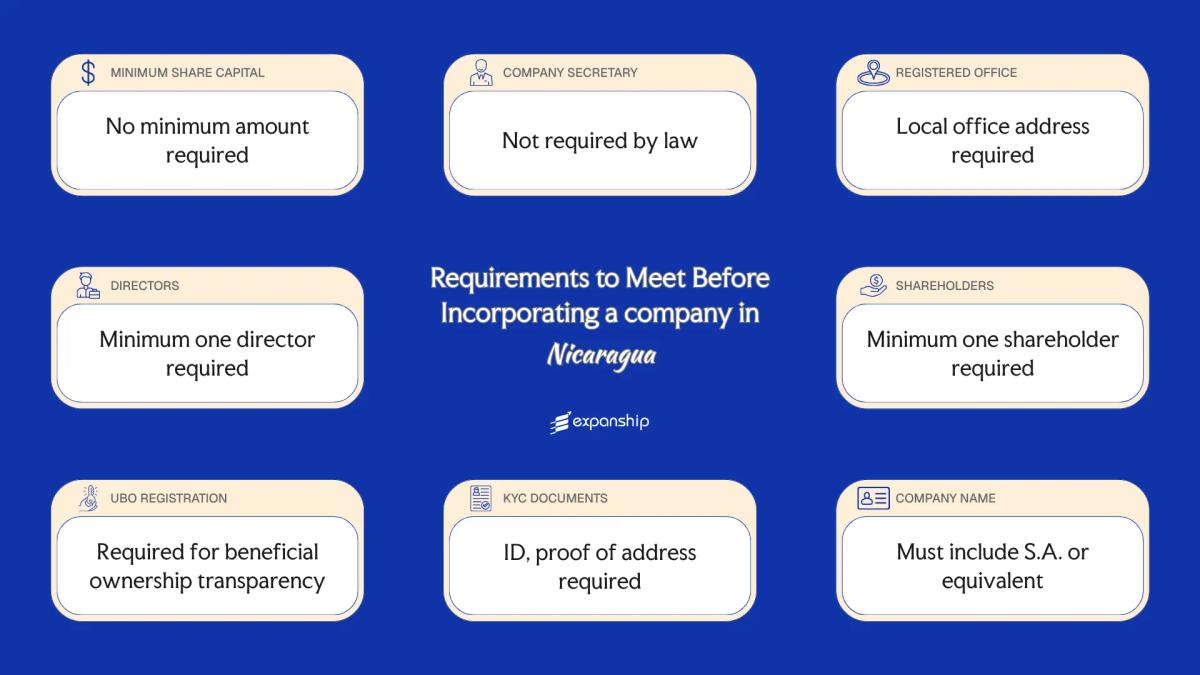
- All Nicaraguan Sociedades Anónimas must be registered with the Registro Mercantil under the framework established by the Código de Comercio, and failure to complete this registration prevents the entity from achieving legal standing.
- A minimum of two shareholders and a board of at least three directors are required to incorporate a Sociedad Anónima in Nicaragua, with no statutory residency restrictions imposed on either group.
- Beneficial ownership disclosure obligations introduced under Nicaragua's anti-money laundering framework constitute an ongoing compliance requirement that extends beyond the initial incorporation filing.
- Foreign investors must satisfy documentary and structural requirements set by the Registro Mercantil, including KYC documentation and registered office and agent appointments, before a Nicaragua entity can lawfully operate.
Company formation in Nicaragua is governed primarily by the Código de Comercio, which establishes the legal framework for registering and operating commercial entities. Oversight of business registration falls under the Registro Mercantil, the national commercial registry that processes incorporation filings and maintains official company records.
Meeting the incorporation requirements in Nicaragua is not optional. Failure to satisfy the conditions set by the Registro Mercantil results in rejection of the registration application or prevents the entity from operating with legal standing.
This article covers the documentary, structural, and compliance-related categories of Nicaragua business registration requirements applicable to foreign investors and locally formed entities. Specific obligations can differ depending on the type of legal structure chosen, the sector in which the business operates, and the profile of its investors.
Foreign entrepreneurs, multinational subsidiaries, and individuals structuring a business presence through a Sociedad Anónima will find this guide most directly relevant to their situation.
Minimum Share Capital Requirements in Nicaragua
Nicaragua minimum share capital requirements are governed by the Código de Comercio de Nicaragua, which applies a par value share system to the sociedad anónima, the most commonly used corporate structure for commercial activity. The Registro Mercantil, operating under the Ministerio de Fomento, Industria y Comercio (MIFIC), oversees incorporation filings and reviews the constitutive deed, which must state the authorized capital and share structure.
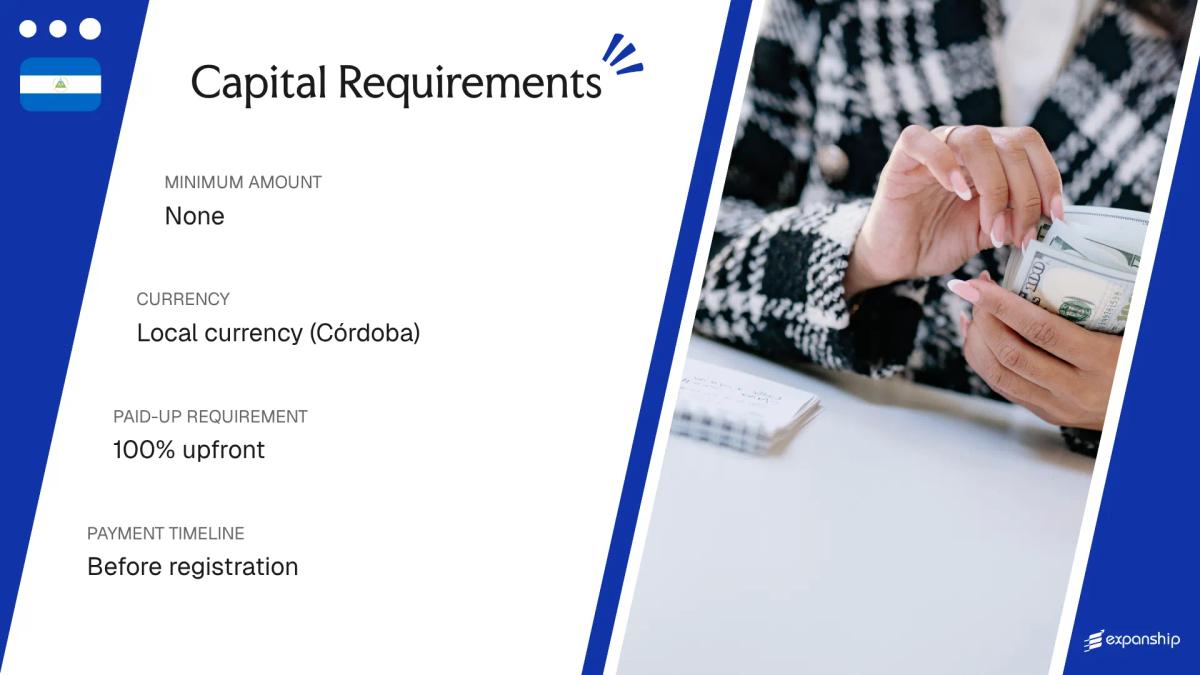
There is no statutory minimum authorized capital prescribed by law for a sociedad anónima, though the capital amount and its division into shares of equal par value must be declared in the articles of incorporation. Capital deposit is not a pre-incorporation requirement enforced through a bank blocked account, and the obligation relates to the structural declaration within the founding document rather than a verified monetary deposit.
| Parameter | Detail |
|---|---|
| Minimum Authorized Share Capital | No statutory minimum |
| Maximum Authorized Share Capital | No statutory maximum |
| Minimum Paid-Up Capital | No statutory minimum |
| Paid-Up Requirement at Incorporation | No statutory requirement |
| Accepted Currency | Córdoba (NIO); foreign currency permissible in practice |
| Accepted Forms of Contribution | Cash and in-kind contributions |
| Timeframe to Deposit Capital | No statutory deadline |
Even with no minimum capital requirement, the authorized capital figure and its division into par value shares must be explicitly stated in the constitutive deed. Omitting this renders the deed defective for Registro Mercantil filing purposes.
Registered Agent Requirements in Nicaragua
Under Nicaragua's commercial framework, appointing a registered agent is a standard requirement for companies formed under the Código de Comercio de Nicaragua. This agent acts as the official point of contact for legal and administrative correspondence directed at your company by local authorities.
The agent holds responsibility for receiving judicial notifications and official communications on behalf of the entity. Maintaining accurate records and ensuring the company meets its ongoing statutory obligations also falls within this role.
Eligible registered agents in Nicaragua must generally meet the following criteria:
- Must be a licensed attorney (abogado) admitted to practice in Nicaragua, or a law firm duly constituted under Nicaraguan law
- Corporate agents must be legally incorporated and registered with the Registro Mercantil
- Individual agents must be resident in Nicaragua, as non-resident individuals are not recognized for this function
- Agents must hold a valid notarial commission (notario público) where notarial duties form part of the engagement
- Foreign nationals may qualify if they hold a valid Nicaraguan legal practice license

Incorporate a Company in Nicaragua
Set up your business entity in Nicaragua with full compliance support, from registration through to ongoing statutory maintenance.
Registered Office Requirements in Nicaragua
Nicaragua registered office requirements mandate that every company formed under the Código de Comercio maintain a fixed, physical address within the country's territory from which official correspondence and legal notices can be received.
- A physical street address is required; a P.O. box alone does not satisfy the legal address requirements.
- The address must be located within Nicaragua; a foreign address is not accepted.
- Virtual office arrangements are generally not recognized as compliant registered office addresses under Nicaraguan commercial law.
- Proof of occupancy, such as a lease agreement or title document, is typically required to establish the address as valid.
- The registered office address is recorded in the Registro Mercantil and forms part of the public company record.
- Any change to the registered address must be formally notified to the Registro Mercantil through an amended filing to remain in good standing.
- Operating with a non-compliant or outdated address can expose your business to failed service of legal process, potential administrative sanctions, and complications with tax authorities including the Dirección General de Ingresos.
Director Requirements in Nicaragua
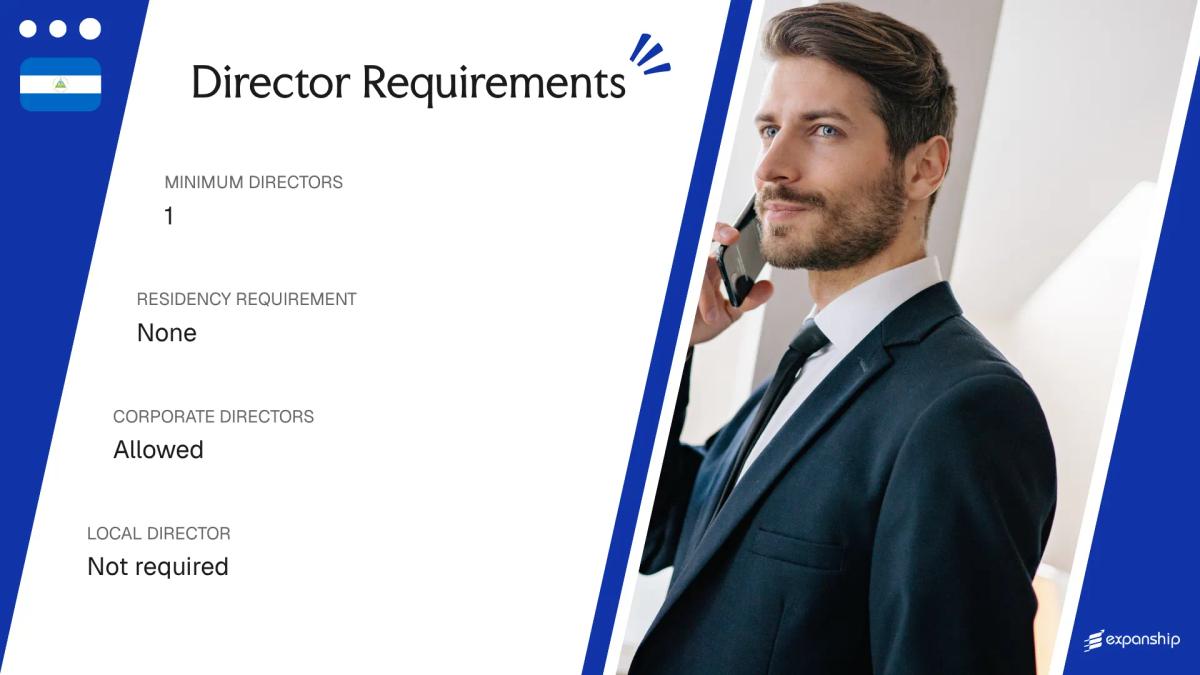
Under the Código de Comercio de Nicaragua, directors of a sociedad anónima assume fiduciary duties toward the company and its shareholders upon appointment. Meeting Nicaragua director requirements incorporation standards means accepting personal liability for resolutions adopted in breach of the law or the company's estatutos sociales.
| Parameter | Detail |
|---|---|
| Minimum Number of Directors | A minimum of three directors is required to form a board (Junta Directiva). |
| Maximum Number of Directors | No statutory maximum is prescribed under the Código de Comercio. |
| Local/Resident Director Required | No statutory requirement for a locally resident director. |
| Nationality Restrictions | No nationality restrictions are imposed on directors. |
| Minimum Age Requirement | Directors must have reached the age of majority, which is 18 years under Nicaraguan civil law. |
| Corporate Directors Permitted | Corporate directors are not recognized; only natural persons may serve. |
| Director Must Be a Shareholder | No statutory requirement for a director to hold shares in the company. |
| Publicly Listed on Registry | Director appointments are recorded in the Registro Mercantil and are therefore publicly accessible. |
| Disqualification Conditions | Individuals subject to civil interdiction or convicted of certain financial crimes may be barred from directorship. |
Unlike many civil law jurisdictions, Nicaragua requires a minimum of three directors even for a privately held sociedad anónima, meaning a sole founder cannot serve as the only director without appointing at least two additional individuals to the board.
Shareholder Requirements in Nicaragua
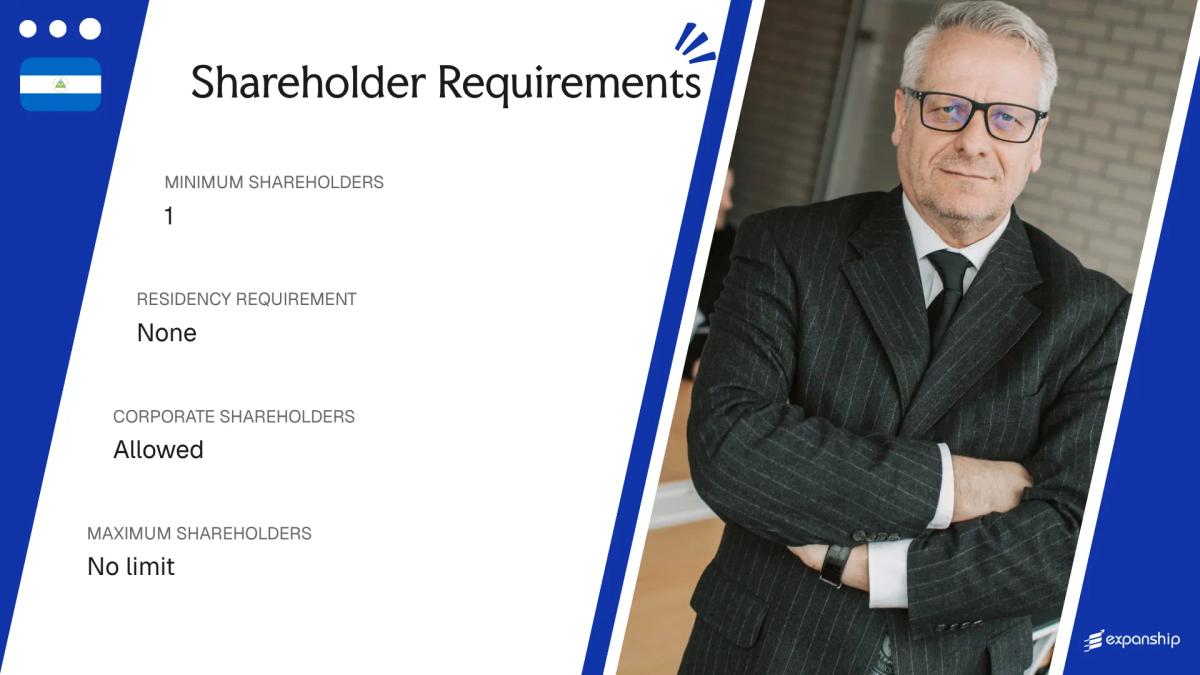
Under the Nicaraguan Commercial Code, a Sociedad Anónima requires a minimum of two shareholders at incorporation. No statutory maximum applies, giving your company flexibility in structuring its ownership.
Nationality and Residency Restrictions
Nicaragua imposes no nationality or residency requirements on shareholders. Foreign nationals and non-residents may hold shares without restriction, and there is no cap on foreign ownership percentage in standard commercial entities.
Corporate Shareholders
Corporate entities are permitted to act as shareholders in a Nicaraguan Sociedad Anónima. The shareholding corporate entity must provide documentation evidencing its legal existence and the authority of its representative to act on its behalf.
Shareholder Liability
Shareholder liability is limited to the amount of capital each shareholder has subscribed and paid into the entity. Nicaraguan corporate law does not generally extend liability beyond that contribution under ordinary circumstances.
Register of Shareholders
A register of shareholders must be maintained at the company's registered office. This register is not publicly accessible, though the firm is obligated to keep it current and accurate under the Commercial Code.
Shareholder Structure Guidance for Your Nicaraguan Entity
Get tailored advice on meeting ownership and shareholder registration requirements when setting up a company in Nicaragua.
UBO / Beneficial Ownership Disclosure Requirements in Nicaragua
Under Nicaragua's Anti-Money Laundering framework, including the Ley No. 793 (Ley Creadora de la Unidad de Análisis Financiero) and related regulations, Nicaragua beneficial ownership disclosure requirements apply to legal entities operating within the country. A beneficial owner is generally defined as any natural person who ultimately owns or controls 25% or more of an entity's shares or voting rights.
- Identify all natural persons holding 25% or more ownership or effective control of the entity.
- Compile beneficial owner information, including full name, nationality, identification document, and address.
- Submit UBO information to the Unidad de Análisis Financiero (UAF), Nicaragua's financial intelligence unit.
- Update disclosures whenever a change in beneficial ownership occurs.
| Parameter | Detail |
|---|---|
| Ownership Threshold for UBO Status | 25% of shares or voting rights |
| Filing Authority | Unidad de Análisis Financiero (UAF) |
| Disclosure Deadline at Incorporation | No specific statutory deadline established |
| Publicly Accessible Register | No |
| Penalties for Non-Disclosure | Sanctions under Ley No. 793; specific penalties subject to regulatory determination |
| Ongoing Update Obligation | Yes, upon any change in beneficial ownership |
KYC / Document Requirements in Nicaragua
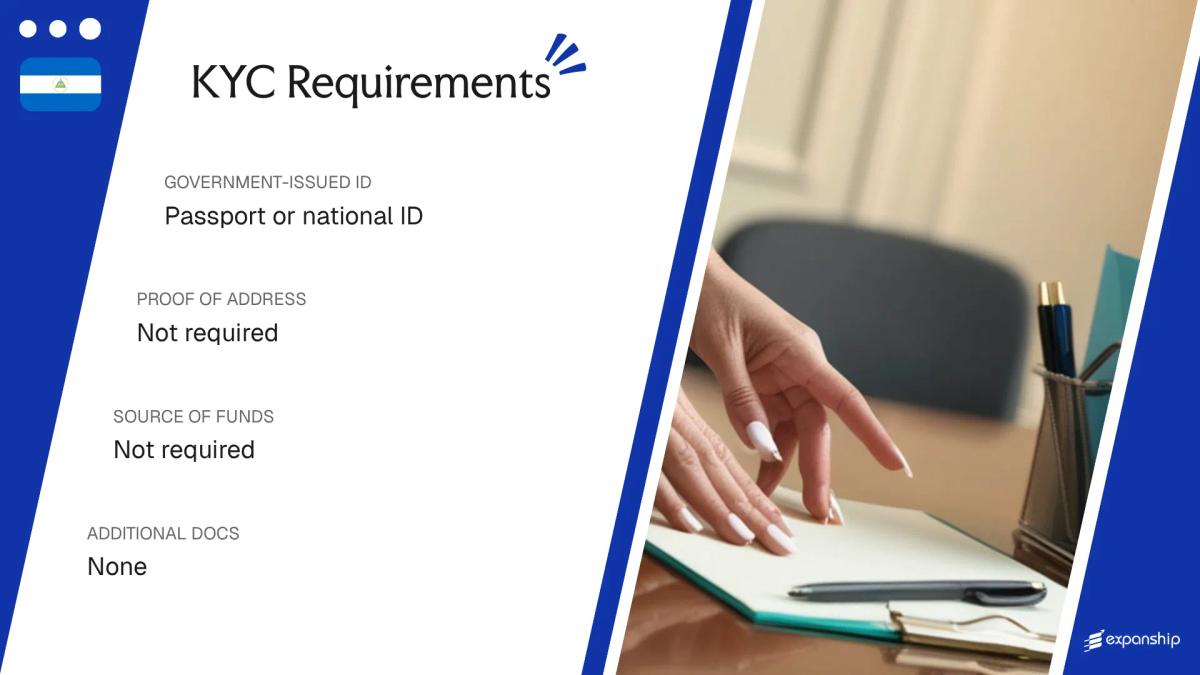
KYC document collection at the incorporation stage in Nicaragua is governed by the Ley No. 977, the Anti-Money Laundering, Counter-Financing of Terrorism and Counter-Financing of Proliferation of Weapons of Mass Destruction Act, administered through the Financial Analysis Unit (UAF). All parties involved in forming a Sociedad Anónima or other legal entity must satisfy due diligence requirements before the public deed of incorporation is executed before a Nicaraguan notary.
Individual / Personal Documents
- Valid government-issued passport or national identity document for each individual director, shareholder, or beneficial owner
- Proof of residential address dated within three months, such as a utility bill or bank statement
- Completed KYC intake form disclosing personal background and the nature of the individual's role in the entity
- Recent passport-sized photograph may be requested by the notary or registered agent
Corporate Documents
- Certificate of incorporation or equivalent constitutional document for the corporate shareholder or director
- Current register of directors and register of shareholders for the corporate entity
- Proof of the corporate entity's registered office address
- Certificate of good standing or incumbency certificate if the entity has been active for more than one year
Source of Funds Documentation
- Bank statements covering the most recent three to six months evidencing the origin of capital
- Audited financial statements or accountant-certified accounts where formal audits exist
- Written declaration explaining the source of funds if bank documentation alone is insufficient
Notarisation and Apostille Requirements
- Foreign public documents must carry an apostille under the Hague Convention of 1961 if issued in a member state
- Documents from non-Hague countries require legalisation through the Nicaraguan consulate in the country of origin
- All documents not in Spanish must be accompanied by a certified Spanish translation prepared by an official translator
Incomplete or untranslated source of funds documentation is the most frequent cause of delay in executing the public deed of incorporation before a Nicaraguan notary.
Company Name Requirements in Nicaragua
Nicaragua company name requirements are assessed during the incorporation process, where the registering authority reviews proposed names for uniqueness and compliance with general naming standards. Each application is evaluated individually, and a name already registered by another entity will not be approved.
Business names must be in Spanish, and the legal suffix must reflect the chosen corporate structure. No specific character or word length limits are publicly codified, but the name must be distinct and unambiguous.
Certain terms associated with government bodies, financial institutions, or regulated industries require prior authorization from the relevant supervisory authority before use. Outright prohibited terms include those that are deceptive or contrary to public order.
Name reservation is available prior to formal incorporation. Once reserved, the name is held for a limited period while incorporation documents are prepared, preventing other applicants from registering the same name during that window.
Compliance Services for Companies in Nicaragua
Keep your Nicaraguan entity in good standing with timely filings, renewals, and regulatory reporting managed on your behalf.
Conclusion
Nicaragua company incorporation requirements span several distinct legal obligations, each governed by the Código de Comercio and administered through the Registro Mercantil. Société anonyme structures, known locally as Sociedades Anónimas, require a minimum of two shareholders and a board of at least three directors, with no residency restrictions on either. Beneficial ownership disclosure obligations, introduced under recent anti-money laundering frameworks, add a layer of ongoing compliance beyond initial registration. Once these requirements are understood, the practical work of assembling documentation, appointing local representation, and filing with the relevant registry becomes the immediate next step for any foreign investor.
Expanship's Corporate Services for Nicaragua Expansion
Incorporating under Nicaragua's Sociedad Anónima framework involves coordinating across the Registro Mercantil, the DGI, and local notarial requirements — each with its own procedural timeline. Expanship's Nicaragua corporate services expansion support is structured around these specific layers, helping your business manage the administrative workload that comes with them.
Our service scope covers the full formation and post-incorporation cycle:
- We prepare and file all incorporation documents, including notarised deed drafts, with the relevant Nicaraguan authorities.
- Registered agent and registered office provision is arranged to meet local statutory requirements.
- We liaise directly with the Registro Mercantil and other regulatory bodies on your behalf.
- Ongoing compliance obligations — including annual filings and corporate record maintenance — are managed on a continuing basis.
- Banking introduction support is available to help your entity open a local account.
- Tax registration with the DGI and coordination with municipal authorities is handled as part of the setup process.
Reach out to Expanship Nicaragua to discuss your incorporation requirements.
Frequently Asked Questions (FAQ)
Yes, foreign nationals may serve as directors of a Nicaraguan S.A. without holding residency or a local domicile. The Commercial Code does not impose a nationality or residency requirement on board members, though your directors must be identifiable individuals whose details are recorded in the public registry at the time of incorporation.
If your registered office address is no longer valid, the company is exposed to compliance risk, including missed regulatory notices and potential difficulty maintaining good standing with the Registro Mercantil. Any change of address must be formalised through a notarised amendment and re-registered to ensure the public record accurately reflects where the entity can be reached.
Nicaragua's beneficial ownership obligations, driven in part by its Financial Analysis Unit (UAF) framework and anti-money laundering legislation, apply broadly to legal entities operating or registering in the country. The disclosure requirements are not limited to one structure; companies must identify and report the natural persons who ultimately own or control the entity, regardless of how ownership is layered.
Yes, the Registro Mercantil will refuse a company name that is identical or confusingly similar to one already on the register. Your proposed name must be checked for availability before the incorporation deed is notarised, since a rejection at the registry stage requires the notarial process to restart with a compliant name.
Foreign shareholders are generally required to provide a valid passport, proof of residential address, and, where the shareholder is a legal entity, certified corporate documentation confirming its existence and ownership structure. These documents support both the notary's due diligence obligations and the UAF's beneficial ownership reporting framework, and they must typically be apostilled or legalised depending on the issuing country.
Legal Disclaimer
The information provided in this article is for general informational purposes only and does not constitute legal, tax, or professional advice. While we strive to ensure the accuracy and timeliness of the content, laws and regulations are subject to change, and the application of laws can vary widely based on specific facts and circumstances.
Readers should not act upon this information without seeking professional counsel tailored to their individual situation. Expanship and its authors disclaim any liability for actions taken or not taken based on the content of this article.
For specific advice regarding your business setup, compliance requirements, or any legal matters, please consult with qualified legal and tax professionals in the relevant jurisdiction.