
Key Takeaways
- Foreign investors benefit from income tax exemptions under Nicaragua's Free Trade Zone regime (Law 917), making capital-intensive export operations significantly less costly to run annually.
- Law 344 provides a codified investment protection framework that gives foreign-owned entities a degree of legal certainty uncommon in markets at a comparable cost level.
- Nicaragua's participation in CAFTA-DR opens zero-tariff access to the United States market, creating measurable revenue advantages for companies in manufacturing, agribusiness, and textiles.
- Territorial taxation means foreign-source earnings fall outside the scope of Nicaraguan corporate income assessment, allowing entities with mixed revenue streams to contain their local tax exposure.
Situated in Central America and bordered by Honduras to the north and Costa Rica to the south, Nicaragua is an independent republic and the largest country by land area in the region. Company registration is governed by the Registro Mercantil, which operates under the judicial branch and oversees the formal incorporation process. Foreign businesses typically establish a presence through the Sociedad Anónima.
Territorially based taxation applies to corporate income, meaning locally generated profits are assessed differently from foreign-source earnings. The legal framework maintains a generally open posture toward foreign direct investment, with no universal restriction on 100% foreign ownership across most sectors.
The benefits of incorporating in Nicaragua span tax policy, capital requirements, trade access, and operating costs. This article covers the principal advantages your business may encounter when forming a company here, drawing on the specific legal and regulatory provisions that apply to foreign-owned entities under Nicaraguan law.
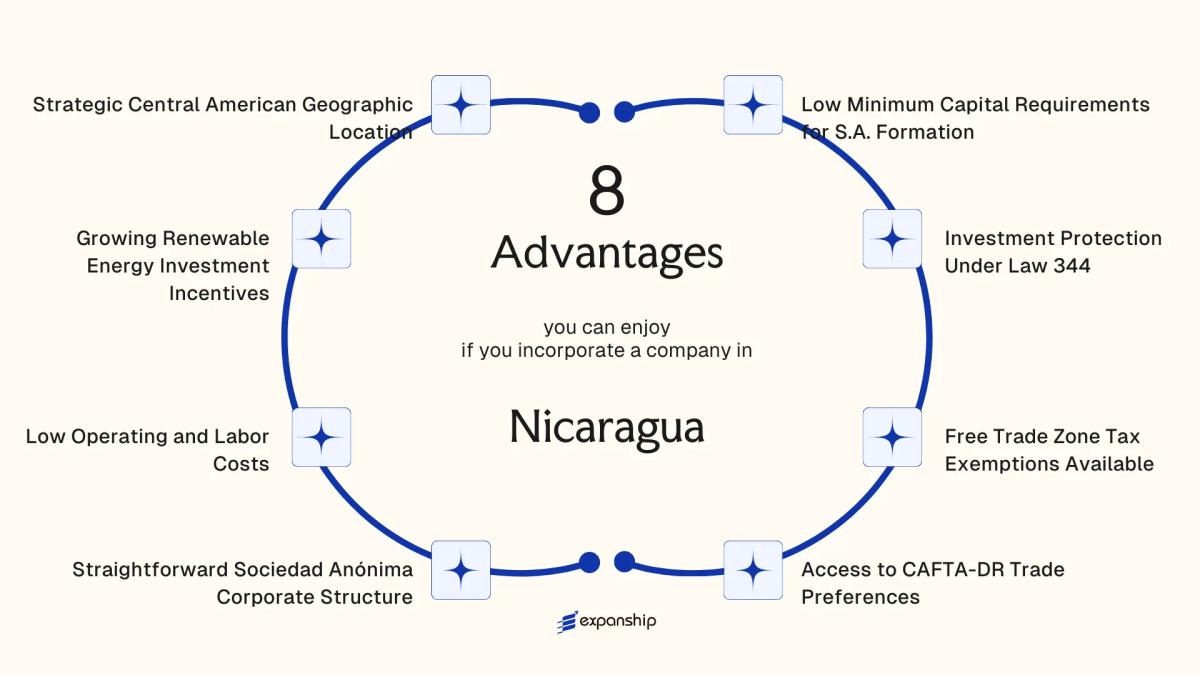
Low Minimum Capital Requirements for S.A. Formation
Nicaragua S.A. low minimum capital requirements stand out as a structural feature that directly reduces the financial barrier to market entry. Under the Nicaraguan Commercial Code, there is no mandatory minimum paid-in capital threshold for forming a Sociedad Anónima.
What This Means in Practice
Capital can be subscribed without an immediate obligation to fully pay it in at the time of incorporation, which means your initial outlay is not tied to an arbitrary statutory figure. This separates the legal formation of the entity from the operational funding decision.
For a foreign investor, that distinction matters: you retain control over how and when capital is deployed rather than having it locked into compliance with a minimum figure set by law. Many jurisdictions in Europe and parts of Latin America impose fixed minimums ranging from several hundred to several thousand dollars before a company can be registered.
Flexibility Within the S.A. Framework
Nicaraguan law permits shareholders to determine the authorized capital structure themselves within the company's articles of incorporation, filed before a local notary and registered with the Registro Mercantil. That flexibility allows the corporate structure to reflect actual business needs from the outset.
You can incorporate a Sociedad Anónima in Nicaragua without committing to a fixed statutory capital amount, keeping startup costs proportional to your actual operational requirements.
Investment Protection Under Law 344
Enacted in 2000, Nicaragua's Law 344 (Promotion of Foreign Investments) establishes a formal legal framework that grants foreign investors the same rights as domestic investors. This statutory equivalence is the foundation of Nicaragua investment guarantee law advantages — it means your business cannot be legally subjected to discriminatory treatment simply because of its foreign origin.
The law specifically prohibits the expropriation of foreign-owned assets except in cases of public interest, and even then, it mandates fair and prompt compensation. For capital-intensive operations, this protection directly reduces the political risk premium you would otherwise need to factor into your investment calculus.
Foreign investment protection under Law 344 also guarantees the free repatriation of profits, dividends, and capital. There are no restrictions on transferring earnings abroad, provided applicable taxes have been settled. This repatriation guarantee eliminates the currency-trap risk that affects foreign investors in jurisdictions with capital controls.
What makes these provisions particularly practical:
- The protections apply automatically upon investment registration, without requiring a separate contractual agreement with the state
- Compensation in expropriation cases must be paid in freely convertible currency
- The law covers reinvested earnings, not just initial capital contributions
- Disputes can be submitted to international arbitration under treaties to which Nicaragua is a signatory

Company Incorporation in Nicaragua
Register your company in Nicaragua with Expanship's end-to-end incorporation service, covering entity formation, legal registration, and ongoing compliance support.
Free Trade Zone Tax Exemptions Available
Nicaragua free trade zone tax exemptions rank among the most defined fiscal incentives available under the country's investment framework. Governed primarily by Law 344 (Ley de Zonas Francas), companies operating within a designated zona franca are fully exempt from corporate income tax for the duration of their zone authorization. This exemption also covers import duties on raw materials, equipment, and machinery, which directly reduces capital expenditure for manufacturers and assemblers setting up operations.
| Tax or Duty | Exemption Status | Governing Framework |
|---|---|---|
| Corporate income tax | 100% exempt | Law 344 / Zona Franca regime |
| Import duties on inputs | 100% exempt | Customs provisions under zona franca |
| Municipal taxes | Exempt during zone authorization period | Local tax provisions |
| Export taxes | 100% exempt | Free trade zone incentives Nicaragua |
Sales tax exemptions on goods and services consumed within the zone further reduce operating costs for eligible entities. To qualify, your business must operate through an authorized zone operator and receive approval from the Corporación de Zonas Francas, the regulatory body that administers and supervises FTZ activity nationwide. Approved activities typically include manufacturing for export, logistics, and certain services operations. The fiscal benefit is directly tied to maintaining active zone status, meaning compliance with operational and employment conditions is required to retain exemption coverage.
Access to CAFTA-DR Trade Preferences
CAFTA-DR trade benefits for Nicaragua companies represent one of the more tangible structural advantages available to exporters operating from this jurisdiction. Under the Dominican Republic-Central America-United States Free Trade Agreement, goods produced by entities incorporated in Nicaragua can qualify for preferential or zero-tariff access to the U.S. market, provided they meet the agreement's rules of origin requirements.
For a foreign business owner, this has a direct commercial implication. The U.S. applies standard Most Favored Nation tariff rates to most trading partners, but qualifying Nicaraguan exporters can bypass these costs entirely on eligible product categories, including textiles, apparel, and certain agricultural goods. This tariff differential directly affects unit economics and competitive pricing in the U.S. market.
CAFTA-DR also extends preferences to Costa Rica, El Salvador, Guatemala, Honduras, and the Dominican Republic, meaning a company incorporated here can serve as a regional hub for trade across multiple treaty-covered markets. The agreement is administered on the U.S. side by the Office of the United States Trade Representative (USTR treaty text).
Keep in mind:
- Rules of origin compliance is mandatory; products must meet the regional content thresholds defined in the agreement
- Certain product categories carry specific staging provisions affecting when zero-tariff rates apply
- Exporters must obtain proper certification documentation to claim preferential treatment at U.S. customs
Nicaragua's textile and apparel sector benefits from a special tariff preference level under CAFTA-DR that allows some non-originating fabrics to still qualify for reduced tariffs, a provision not available to all CAFTA-DR member countries equally.
Straightforward Sociedad Anónima Corporate Structure
The Nicaragua Sociedad Anónima corporate structure advantages begin with how the entity itself is designed. Governed by the Nicaraguan Commercial Code (Código de Comercio), the S.A. is a share-based corporation in which shareholders bear liability only to the extent of their capital contributions. That separation between personal and corporate liability is not incidental — it directly limits the financial exposure of foreign investors who may hold assets or obligations in multiple jurisdictions.
Shareholder and Ownership Flexibility
A Sociedad Anónima can be formed with as few as two shareholders, and no residency requirement applies to those shareholders or directors under current Nicaraguan corporate law. Shares can be issued as bearer or registered instruments, giving your business genuine flexibility in how ownership is structured and transferred.
Foreign nationals can hold 100% of the equity without a local partner, which removes a structural barrier that exists in several other emerging market jurisdictions. Ownership restructuring, including share transfers between non-resident parties, can generally be executed without regulatory pre-approval at the corporate level.
Board and Governance Structure
The S.A. requires a board of directors (Junta Directiva) with a minimum of three officers, but there is no requirement that any of them be Nicaraguan residents. A single foreign individual can simultaneously hold multiple officer positions, such as President and Treasurer, reducing the administrative complexity of assembling a compliant board from abroad.
That governance flexibility, combined with the relative speed of incorporation through a Nicaraguan notary public and registration with the Registro Mercantil, means the entity can become operational without prolonged formation timelines.
Structure Your Nicaragua S.A. the Right Way
Get professional guidance on setting up a compliant and efficient Sociedad Anónima structure tailored to your business objectives in Nicaragua.
Low Operating and Labor Costs
Nicaragua low operating costs for businesses stem from a combination of below-regional-average wages and comparatively affordable commercial real estate and utilities. For a foreign investor establishing manufacturing, back-office, or services operations, this translates directly into lower fixed overheads from the first month of operation.
- The minimum wage in Nicaragua is set by sector through biannual negotiations governed by the Ministry of Labor (MITRAB) under the Labor Code. Rates vary by industry, with agricultural and some manufacturing sectors carrying lower minimums than financial services, meaning your actual wage liability depends on the specific activity your entity conducts.
- Statutory employer contributions, including social security (INSS) and training fund (INATEC) obligations, add to payroll costs, but the combined burden remains lower in absolute terms than comparable obligations in Costa Rica or Panama, giving cost-sensitive operations a measurable advantage.
- Commercial lease rates in secondary cities such as León and Matagalpa are substantially lower than in Managua, and well below comparable industrial space in San José or Panama City. For firms that do not require a capital-city presence, this difference can reduce occupancy costs significantly.
- Electricity and water tariffs, regulated by TELCOR and IRENA respectively, are among the more affordable in the Central American region, which matters for energy-dependent production or processing businesses.
Growing Renewable Energy Investment Incentives
Nicaragua renewable energy investment incentives are governed primarily by Law 532, the Law for the Promotion of Electricity Generation from Renewable Sources. Under this framework, qualifying projects receive full exemption from import duties on equipment and machinery, exemption from income tax for up to ten years, and relief from the Value Added Tax (VAT) on imported goods used in project construction.
For a foreign investor, this matters because capital expenditure on generation infrastructure, which is typically the largest cost in any renewable project, can proceed without the tax drag that applies in most other jurisdictions.
Eligible sources include solar, wind, geothermal, biomass, and small-scale hydroelectric generation. The Ministry of Energy and Mines (MEM) administers approvals and project registration under the law.
A solar generation project requiring $2 million USD in imported equipment would face zero import duty and zero VAT on that equipment under Law 532, effectively reducing upfront capital costs compared to a non-exempt jurisdiction where combined import duties and VAT could add 15-30% to equipment costs.
The clean energy tax incentives for investors apply from the date MEM formally approves the project, meaning the eligibility clock starts at the regulatory stage rather than at commercial operation.
Strategic Central American Geographic Location
Nicaragua's position at the center of the Central American isthmus places it within close proximity to both North and South American markets. For businesses handling physical goods, this geography reduces transit times to major consumption hubs compared to sourcing from outside the region.
The country shares land borders with Honduras to the north and Costa Rica to the south, giving your firm direct overland access to six neighboring Central American economies without crossing a single ocean. Pacific and Atlantic coastlines further extend that reach, supporting dual-ocean logistics strategies.
Nicaragua Central America strategic location advantages become tangible when you consider regional distribution. Key operational benefits include:
- Proximity to the Panama Canal corridor, relevant for transoceanic freight routing
- Access to Port Corinto on the Pacific and Puerto Cabezas on the Caribbean, supporting import and export operations
- Central position within the SICA (Central American Integration System) trade bloc, which facilitates regional commerce under unified frameworks
Managua's Augusto C. Sandino International Airport also handles cargo operations, giving time-sensitive shipments an air freight alternative to ocean transit.
Geographic advantages apply primarily to businesses with physical goods movement or regional distribution needs; service-based entities may not realize the same operational benefit from this positioning.
Is Nicaragua Right for Your Business Expansion?
Determining whether a particular jurisdiction suits your business model requires more than reviewing its domestic incentives in isolation. The competitors most relevant to this comparison are Costa Rica, Honduras, and Panama, three Central American jurisdictions that attract similar foreign investor profiles, offer comparable trade access, and present overlapping incorporation structures. Measuring Nicaragua's position against these markets reveals where its regulatory and cost framework holds a practical edge.
What the comparison shows is that the combination of low statutory capital thresholds for the Sociedad Anónima, Law 344 investment protections, and Free Trade Zone fiscal exemptions produces a cost baseline that is difficult to match at equivalent entry points in the region. Incorporating in Nicaragua for foreign companies targeting export manufacturing or agribusiness carries cost implications that differ materially from the higher operating environments in Panama City or San José.
| Parameter | Nicaragua | Costa Rica | Honduras | Panama |
|---|---|---|---|---|
| Standard Corporate Tax Rate | 30% | 30% | 25% | 25% |
| Free Trade Zone Tax Exemption | Up to 100% for qualifying period | Up to 100% | Up to 100% | Up to 100% |
| Foreign Investment Protection Law | Law 344 | Law 7472 / bilateral treaties | Law 54-2011 | Law 54 (1998) |
| CAFTA-DR Membership | Yes | Yes | Yes | No |
| Minimum Capital Requirement (S.A.) | No statutory minimum | No statutory minimum | No statutory minimum | No statutory minimum |
| Labor Cost Index (relative to region) | Low | Moderate-High | Low | Moderate |
Compliance Services for Companies in Nicaragua
Maintain good standing with Nicaraguan regulatory requirements, including annual filings, tax obligations, and corporate record maintenance under local law.
Conclusion
Nicaragua's core appeal for foreign incorporation rests on a single, coherent argument: the legal and fiscal architecture is structured to reduce friction for foreign capital. The combination of investment protections under Law 344, Free Trade Zone exemptions under Law 917, and preferential market access through CAFTA-DR creates an environment where the regulatory framework actively supports foreign business activity rather than simply permitting it.
Two benefits stand out as particularly concrete. The zero-tariff access to the United States market through CAFTA-DR has direct revenue implications for firms in manufacturing, agribusiness, and textiles. For capital-intensive operations, the income tax exemptions available under Free Trade Zone status eliminate a cost that would otherwise compound annually.
Your business structure and sector will determine how much of this framework applies. A firm oriented toward domestic services will engage the Sociedad Anónima structure and Law 344 protections differently than one established specifically to export under Free Trade Zone conditions. The benefits of incorporating in Nicaragua are real, but they are not uniformly applicable across all business models. Understanding precisely where your entity sits within this framework is the point at which general research gives way to jurisdiction-specific legal and corporate planning.
Start Your Nicaragua Company Formation With Expanship
Nicaragua company formation with Expanship covers the full cycle of establishing a Sociedad Anónima under the Commercial Code, from notarized deed preparation through registration with the Registro Mercantil and publication in La Gaceta, the official gazette. The process also intersects with obligations to the Dirección General de Ingresos for tax registration and, where applicable, the relevant Free Trade Zone authority. Expanship handles each stage with direct engagement with these bodies.
Beyond initial incorporation, the service scope extends to ongoing compliance requirements that keep your entity in good standing. Specific services include:
- Preparation and notarization of the company deed and bylaws
- Registro Mercantil filing and commercial registry coordination
- Registered agent and registered office provision within Nicaragua
- Tax registration with the Dirección General de Ingresos
- Post-incorporation compliance management, including annual obligations
- Corporate bank account introduction assistance
Expanship Nicaragua is available to assist with your incorporation and ongoing compliance requirements.
Frequently Asked Questions (FAQ)
Yes, foreign nationals can hold 100% ownership of a Sociedad Anónima without any requirement for local shareholder participation. The Commercial Code permits full foreign ownership, and Law 344 on Promotion of Foreign Investment reinforces this by guaranteeing equal treatment between foreign and domestic investors. No special authorization from a government ministry is required solely on the basis of foreign nationality.
There is no statutory minimum paid-in capital requirement for forming a Sociedad Anónima under the Nicaraguan Commercial Code, making entry accessible regardless of initial funding size. The subscribed capital must be stated in the articles of incorporation, but there is no mandated threshold that must be deposited before registration. This differs from many civil law jurisdictions that impose minimum capital thresholds as a condition of incorporation.
Registration with the Registro Mercantil and subsequent enrollment in the Registro Único del Contribuyente (RUC) at the Dirección General de Ingresos typically takes between two and four weeks, depending on notarization timelines and document completeness. The public deed of incorporation must be executed before a Nicaraguan notary and then submitted for mercantile registration. Delays most commonly occur when founding documents require corrections or apostilles on foreign-issued identification.
Law 344 on Promotion of Foreign Investment guarantees foreign investors prompt, adequate, and effective compensation in the event of expropriation, consistent with international law standards. The law also grants access to international arbitration under treaties to which Nicaragua is a party, allowing disputes to be resolved outside the domestic court system. This protection applies to investors from countries with which Nicaragua has a bilateral investment treaty in force.
No, Free Trade Zone status under Law 160 and its amendments eliminates or reduces a defined set of taxes, including corporate income tax, import duties on inputs, and certain municipal taxes, but it does not eliminate all fiscal obligations. Firms operating under this regime must still comply with labor law requirements, social security contributions to the Instituto Nicaragüense de Seguridad Social (INSS), and reporting obligations to the Zona Franca authority. Eligibility is restricted to activities that meet export-oriented criteria established by the Comisión Nacional de Zonas Francas.
Yes, a company incorporated in Nicaragua can export qualifying goods to the United States and other CAFTA-DR member countries at preferential or zero tariff rates, provided the products meet the agreement's rules of origin requirements. This benefit is particularly relevant for manufacturing and agro-industrial businesses that use Nicaraguan inputs and intend to access North American markets. Compliance with origin documentation is administered through customs authorities, and failure to meet origin thresholds results in standard MFN tariff rates applying instead.
A resident agent is not a statutory requirement for an S.A. in the way some offshore jurisdictions mandate one, but the entity must maintain a registered address in Nicaragua and have at least one legal representative authorized to act on its behalf domestically. The board of directors can be composed entirely of foreign nationals. Practical compliance, including filing tax returns with the Dirección General de Ingresos and responding to regulatory correspondence, requires either a local representative or an authorized proxy with power of attorney registered in the country.
Law 344 explicitly grants foreign investors national treatment, meaning your business is entitled to the same legal protections and operating conditions extended to Nicaraguan-owned firms in comparable sectors. If differential treatment occurs, the law provides a basis for administrative or judicial challenge within the domestic system, and applicable bilateral investment treaties may allow recourse to international arbitration. The practical enforceability of these protections depends on the specific facts and the treaty framework applicable to the investor's home country.
Legal Disclaimer
The information provided in this article is for general informational purposes only and does not constitute legal, tax, or professional advice. While we strive to ensure the accuracy and timeliness of the content, laws and regulations are subject to change, and the application of laws can vary widely based on specific facts and circumstances.
Readers should not act upon this information without seeking professional counsel tailored to their individual situation. Expanship and its authors disclaim any liability for actions taken or not taken based on the content of this article.
For specific advice regarding your business setup, compliance requirements, or any legal matters, please consult with qualified legal and tax professionals in the relevant jurisdiction.