
Key Takeaways
- Nicaragua's judicial system operates under a framework where enforcement of the Código de Comercio is inconsistent, creating material legal uncertainty for foreign investors seeking predictable contract outcomes or dispute resolution.
- Foreign businesses incorporating in Nicaragua must navigate registration procedures administered by MIFIC and tax compliance obligations under the DGI, both of which are subject to bureaucratic delays that extend operational timelines.
- Restricted foreign ownership rules in designated sectors add a structural constraint that limits the viability of capital-intensive foreign-controlled enterprises beyond standard incorporation hurdles.
- Access to international banking services remains constrained for Nicaragua-registered entities due to the country's elevated risk perception among correspondent banks, complicating routine cross-border transactions and trade finance.
Nicaragua's regulatory environment for business registration sits within an evolving but inconsistently enforced framework, governed primarily by the Código de Comercio and overseen by bodies including the Dirección General de Ingresos (DGI) and the Ministerio de Fomento, Industria y Comercio (MIFIC). The disadvantages of incorporating in Nicaragua span legal, financial, institutional, and sectoral dimensions, each covered in detail across this article.
How severely these drawbacks affect your business depends on the industry you operate in, your ownership structure, and whether you require access to international financing or cross-border banking. A foreign investor establishing a capital-intensive firm will face a materially different risk profile than a small consulting operation.
This article is most relevant to foreign nationals and internationally operating businesses considering forming a Sociedad Anónima or other commercial entity in Nicaragua for the first time.
Weak Rule of Law and Judicial Unpredictability
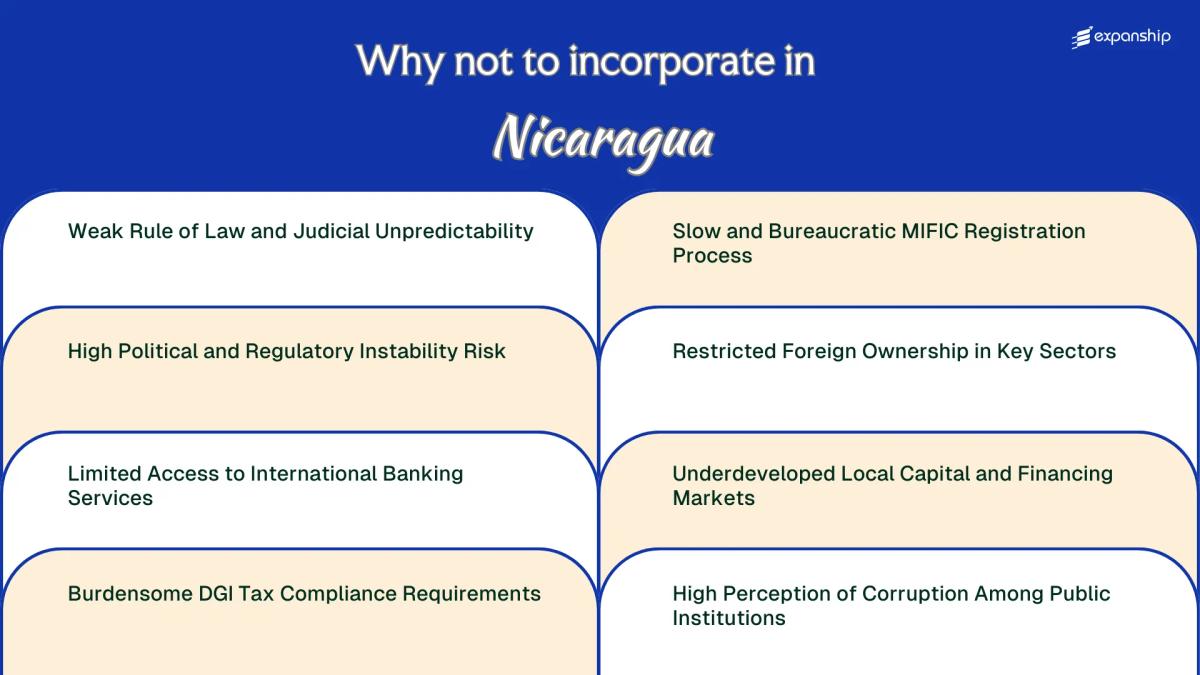
Nicaragua weak rule of law risks present a direct threat to contract enforcement and asset protection for foreign-owned entities. Courts operate under a legal framework that has been systematically weakened since constitutional amendments in 2014 concentrated executive authority.
Judicial Independence and Contract Enforcement
The Supreme Court of Justice (Corte Suprema de Justicia) nominally oversees civil and commercial disputes, but judicial appointments are controlled by the ruling party, removing meaningful separation of powers. For your business, this means a breach of contract claim against a well-connected local counterpart carries a materially lower probability of a neutral ruling.
Nicaraguan commercial law is codified under the Código de Comercio, yet statutory rights on paper offer limited protection when enforcement depends on a compromised judiciary.
Arbitration Gaps and Practical Exposure
Even where foreign firms include international arbitration clauses, domestic courts retain authority over interim measures and enforcement of awards. This procedural dependency creates a bottleneck that a hostile local party can exploit.
Foreign judgments and arbitral awards are subject to domestic court review, and enforcement can be blocked indefinitely without any transparent legal basis.
High Political and Regulatory Instability Risk
Nicaragua political instability business risks are not abstract concerns — they translate directly into unpredictable operating conditions that can invalidate prior planning. Since the political crisis of 2018, the government has concentrated executive authority, reduced institutional checks, and expanded discretionary powers across multiple ministries.
Regulatory frameworks can shift without meaningful advance notice. Presidential decrees have been used to amend investment conditions outside of standard legislative processes, meaning rules your legal team reviewed at the time of incorporation may no longer reflect current obligations.
For foreign-owned entities, this creates concrete friction:
- Sector-specific operating permits issued by bodies such as MIFIC or MTI can be revoked or modified under administrative discretion, forcing costly reapplications.
- Licensing conditions for regulated industries have changed mid-operation, leaving firms exposed to compliance gaps they did not create.
- Foreign investors have faced retroactive application of new requirements with no transitional period, generating immediate legal and financial exposure.
- Tax incentive frameworks established under Law 306 or the Free Zone regime have been subject to policy revision, undermining long-term financial projections.
The Investment Promotion Law (Law 344) provides some statutory protections, but enforcement depends on institutions that operate under direct executive influence.

Company Incorporation in Nicaragua
Understand the full legal and regulatory requirements before committing to a Nicaragua incorporation.
Limited Access to International Banking Services
Nicaragua international banking access problems begin at account opening. Foreign-registered entities face systematic reluctance from correspondent banks in the United States and Europe, which have progressively reduced exposure to Nicaraguan financial institutions over the past decade due to elevated compliance risk assessments.
The country's grey-listed status under international anti-money laundering frameworks has had direct operational consequences. Banks in the U.S. and EU that maintain correspondent relationships with Nicaraguan institutions are required to apply enhanced due diligence, and many have chosen to exit those relationships entirely rather than absorb the compliance cost.
| Constraint | Specific Impact |
|---|---|
| Correspondent banking relationships | Significantly reduced since 2018; major U.S. banks have withdrawn or restricted exposure |
| Account opening timeline | Typically 6 to 12 weeks for foreign-owned entities, subject to additional KYC layers |
| USD wire transfer restrictions | Delays of 5 to 15 business days due to intermediary screening requirements |
| Multi-currency account availability | Extremely limited; most local banks offer only NIO and USD accounts |
Your business may find that even licensed Nicaraguan banks, supervised by the Superintendencia de Bancos y de Otras Instituciones Financieras (SIBOIF), cannot process cross-border transactions reliably. Correspondent banking challenges in Nicaragua mean that payroll, supplier payments, and capital repatriation can all face unexpected holds.
This affects firms across sectors, though companies with U.S. beneficial owners may encounter additional layers of scrutiny under OFAC compliance obligations applied by intermediary banks.
Burdensome DGI Tax Compliance Requirements
Nicaragua DGI tax compliance burdens fall heavily on foreign-owned entities, largely because the Dirección General de Ingresos (DGI) operates a multi-tax system that requires separate filings, declarations, and reconciliations across different obligations. Corporate income tax (IR) sits at 30% on net profits, and businesses must also manage IR advance payments — monthly prepayments calculated as a percentage of gross income — regardless of actual profitability.
The Impuesto al Valor Agregado (IVA) at 15% adds a separate monthly filing cycle. A company running both IR advances and IVA declarations simultaneously faces a reporting calendar that consumes significant administrative time and local accountancy costs.
Registration with the DGI is a prerequisite before any operational activity, and errors during this process can delay your tax identification number, blocking invoicing and payroll.
- Monthly IR advance payments are mandatory even when the business reports a net loss for that period.
- Separate IVA declarations are due monthly, with penalties applied for late or incorrect submissions.
- Annual income tax returns require full reconciliation against all advance payments made during the fiscal year.
- Businesses registered under the general tax regime cannot opt out of the advance payment structure mid-year.
- Foreign directors or shareholders may trigger additional withholding tax obligations on dividend remittances.
Nicaragua imposes IR advance payments based on gross revenue, meaning a foreign business can owe monthly tax installments even in months where it records zero net profit.
Slow and Bureaucratic MIFIC Registration Process
Nicaragua MIFIC registration delays present one of the more tangible operational obstacles for foreign firms seeking to establish a legal presence in the country.
Structural Delays Within the Registration Process
Company registration in Nicaragua requires coordination across multiple agencies, including the Ministerio de Fomento, Industria y Comercio (MIFIC), the Registro Mercantil, and the Dirección General de Ingresos (DGI). Each body operates on its own timeline, and your business cannot advance to the next step until each institution processes and approves the prior submission. In practice, what should be a sequential procedure becomes an indefinite waiting process, particularly when documentation requirements shift without formal notice.
Practical Cost to Foreign Investors
Delays in obtaining your commercial operating license through MIFIC directly translate into deferred revenue, extended professional fee exposure, and prolonged legal uncertainty around the entity's status. Foreign firms often must retain local legal representation throughout this period, adding recurring costs without any guarantee of a defined completion date. The slow company registration process in Nicaragua stands in sharp contrast to jurisdictions that offer unified, single-window registration systems with statutory processing deadlines.
Support for Incorporating Through Nicaragua's Regulatory Maze
Get structured guidance on managing MIFIC registration timelines and multi-agency coordination for your Nicaragua incorporation.
Restricted Foreign Ownership in Key Sectors
Nicaragua foreign ownership restrictions apply across several economically significant sectors, creating direct structural barriers for foreign investors that limit how a business can be formed and controlled.
- Foreign nationals are prohibited from owning land within 200 meters of coastlines and national borders under Nicaraguan law, which eliminates direct real estate holding structures that many tourism and agricultural ventures depend on.
- The fishing and aquaculture sector requires majority Nicaraguan ownership in certain concession-linked operations, forcing foreign firms into minority positions or joint venture arrangements where control is diluted.
- Broadcasting and media activities are restricted to Nicaraguan nationals, meaning a foreign-owned entity cannot hold a broadcast license regardless of its operational footprint.
- Extractive industries operating under government concessions issued by MEM (Ministerio de Energía y Minas) are subject to state participation requirements that can reduce the effective equity stake available to foreign shareholders.
- These restrictions are not uniformly codified in a single foreign investment statute, so your legal exposure depends on sector-specific regulations that require individual legal review before incorporation.
Underdeveloped Local Capital and Financing Markets
Nicaragua limited capital markets access is a structural constraint that directly affects how foreign-owned entities can fund operations, expand, or service debt locally.
The Bolsa de Valores de Nicaragua (BVN) exists but remains thin in liquidity and product depth. Equity issuances, corporate bonds, and secondary market instruments are limited in volume, meaning your firm cannot realistically raise growth capital through public markets the way it might in a regional peer like Panama or Costa Rica.
Local commercial banks, supervised by the Superintendencia de Bancos y de Otras Instituciones Financieras (SIBOIF), apply conservative lending criteria to foreign-incorporated entities. Collateral requirements are steep, and credit tenors tend to be short, which misaligns with the timelines most businesses need for capital investment.
Nicaraguan development finance through entities such as BCIE-channeled programs does exist, but access is typically tied to specific sectors or government-aligned priorities. A foreign business operating outside those parameters will find few domestic alternatives.
A foreign-owned manufacturing firm requiring USD 500,000 in working capital financing may find that local banks offer terms at 14–18% annual interest with maximum 3-year tenors and mandatory local collateral, forcing the business to source funding externally at additional cost and complexity.
High Perception of Corruption Among Public Institutions
Nicaragua corruption risks for businesses are well-documented across major international indices. Transparency International's Corruption Perceptions Index consistently ranks the country among the lower-scoring nations in Latin America, reflecting systemic concerns about how public institutions operate in practice.
Interactions with agencies such as the Dirección General de Ingresos (DGI), the Registro Mercantil, and municipal licensing bodies expose foreign-owned entities to informal payment expectations that add unpredictable costs to routine administrative processes. These are not theoretical risks — foreign firms report delays in permit approvals and tax clearances that resolve only after unofficial facilitation.
Public procurement and contract enforcement present particular exposure. If your firm engages with state-linked entities or bids on government contracts, the absence of a transparent, rules-based process means outcomes can depend on relationships rather than legal merit.
Nicaragua's Anti-Corruption Law (Law 438) establishes formal prohibitions on bribery and public sector misconduct. Enforcement, however, is inconsistent, and the law's practical deterrent effect on day-to-day administrative corruption remains limited.
- Customs clearances and import permits are frequently cited as high-friction points
- Land registry processes involve multiple public offices, each carrying independent compliance risk
- Business licensing renewals at the municipal level are reported as particularly opaque
If your company operates under a foreign anti-bribery statute — such as the U.S. Foreign Corrupt Practices Act or the UK Bribery Act — any payment made to a Nicaraguan public official by a local agent or intermediary on your behalf can trigger liability under those laws, regardless of where the payment occurred.
Strategies to Overcome These Challenges
Overcoming Nicaragua incorporation challenges requires a structural approach rather than ad hoc adjustments, since the regulatory, judicial, and financial obstacles are systemic rather than incidental.
- Register your entity through MIFIC and obtain your RUC (Registro Único del Contribuyente) from the DGI before initiating any commercial activity, as operating without either exposes your firm to penalties.
- Structure your shareholding in compliance with Law 344 (Promotion of Foreign Investment) to remain within permitted ownership thresholds in restricted sectors such as natural resources and media.
- Appoint a local legal representative (apoderado legal) with notarized authority to fulfill DGI filing obligations and respond to MIFIC compliance requests on your behalf.
- Open banking relationships in a third jurisdiction before incorporation to reduce dependence on Nicaragua's limited correspondent banking access.
- Maintain Spanish-language accounting records formatted to DGI standards to avoid additional scrutiny during tax audits.
Nicaragua's regulatory framework does not currently offer an expedited or parallel track for foreign investors facing these combined obstacles. Mitigation steps reduce exposure but do not eliminate the structural risks already documented in this article.
Nicaragua's Overall Business Viability
Nicaragua presents a mixed picture for foreign incorporators. The Nicaragua business viability risks assessment across this blog points to structural weaknesses in judicial independence, banking access, tax administration, and anti-corruption enforcement that collectively raise the cost and complexity of operating here. That said, the country maintains a functioning corporate registry under MIFIC, a defined legal framework for foreign investment under Law 344, and comparatively low labour costs that continue to attract certain manufacturing and agricultural operations.
| Pros | Cons |
|---|---|
| Law 344 provides a formal legal basis for foreign investment protection | Judicial decisions lack predictability, undermining contract enforcement |
| Corporate registration through MIFIC follows a defined, codified process | MIFIC's bureaucratic procedures extend formation timelines considerably |
| Foreign ownership is broadly permitted across most commercial sectors | Restricted ownership rules apply in specific strategic industries |
| Low operating costs relative to other Central American jurisdictions | DGI tax compliance imposes recurring administrative burdens on registered entities |
| Nicaragua maintains correspondent banking relationships with some international institutions | Access to international banking services remains limited and difficult to secure |
| No blanket prohibition on repatriating profits under current investment law | Local capital markets are underdeveloped, limiting financing options for growth |
Corruption perceptions across public institutions, including tax and registry bodies, add an unpredictable layer of operational risk that is difficult to price in advance. For businesses with a clear operational rationale and tolerance for regulatory friction, incorporation remains viable, though not without deliberate risk management.
Compliance Services for Companies in Nicaragua
Stay current with Nicaragua's DGI tax obligations, MIFIC reporting requirements, and annual corporate maintenance filings.
Conclusion
The Nicaragua incorporation drawbacks summary presented across this blog reflects a jurisdiction where structural friction is consistent rather than occasional. Political and regulatory instability, operating under a government that has progressively concentrated institutional authority, creates an unpredictable environment for foreign-owned entities. Compounding this, limited access to correspondent banking makes routine treasury operations difficult for firms with cross-border activity. DGI's compliance requirements add further administrative weight. Structural awareness of these constraints, combined with qualified local legal and tax counsel, shapes whether a corporate presence here remains operationally viable over time.
Expanship's Services for Your Nicaragua Expansion
Dealing with MIFIC's slow registration timelines, DGI's layered tax obligations, and Nicaragua's unpredictable regulatory environment creates real operational friction for foreign businesses. Expanship's Nicaragua company formation services are structured around these specific pressures, helping you manage compliance requirements without assuming the procedural burden falls entirely on your team. Our role is to reduce that burden, not remove the underlying complexity of operating in this jurisdiction.
From initial registration through ongoing obligations, our Nicaragua business incorporation support covers the practical essentials your entity will need.
- We prepare and coordinate all company registration documentation required for MIFIC submission.
- Our team provides registered agent and office services to satisfy local presence requirements.
- We handle government filings and liaise directly with regulatory bodies on your behalf.
- Post-incorporation compliance management keeps your entity in good standing with Nicaraguan authorities.
- Banking introduction assistance connects your business with viable local and regional options.
- We manage tax registration and coordinate with the DGI for initial and ongoing filings.
Reach out to Expanship Nicaragua to discuss how we can support your entry into this market.
Frequently Asked Questions (FAQ)
All foreign companies are exposed, not just those in sensitive industries. Nicaragua's judiciary lacks meaningful independence from the executive branch, which means commercial disputes, contract enforcement, and property rights claims can produce unpredictable rulings regardless of sector. Companies with significant fixed assets or long-term contracts face the greatest exposure, since there is no reliable mechanism to enforce judgments against state actors or well-connected local parties.
Non-compliance with DGI filing requirements triggers surcharges, interest accrual, and the potential suspension of your Registro Único del Contribuyente (RUC), which effectively halts legal business activity in Nicaragua. The DGI applies monthly interest on outstanding balances and can issue embargoes against company assets without prior judicial approval. Reinstatement after suspension requires full payment of outstanding obligations plus administrative penalties before normal operations can resume.
Nicaragua presents more difficulty than Costa Rica or Panama for foreign-owned entities seeking correspondent banking relationships. International banks apply elevated due diligence to Nicaraguan-registered companies due to OFAC sanctions, the country's exclusion from certain financial cooperation frameworks, and correspondent bank de-risking trends. Even locally licensed banks frequently decline to open accounts for foreign-controlled entities without extensive beneficial ownership documentation and local business history.
The restrictions apply by sector rather than by entity structure. Certain industries, including media, fishing, and activities classified under national security, impose caps or outright prohibitions on foreign participation regardless of whether the vehicle is a Sociedad Anónima or another recognized form. Your entity type does not bypass these restrictions; the nature of the business activity determines eligibility for foreign ownership.
Nicaragua has no functional domestic capital market, and the local banking sector offers limited credit products for foreign-owned firms, particularly at the early stage. If your entity requires financing beyond initial equity contributions, you will typically need to structure external loans from offshore lenders and register those arrangements with the Banco Central de Nicaragua, adding compliance steps and currency risk that do not apply in more developed markets. Relying on local financing as a growth mechanism is not a realistic strategy for most foreign businesses registered here.
Completing MIFIC registration does not insulate your business from subsequent regulatory changes. The Nicaraguan government has introduced sector-specific regulations and foreign investment conditions with little advance notice or public consultation, and MIFIC's administrative capacity to process amendments, updated permits, or sector reclassifications is limited. A company that was fully compliant at formation can face material compliance gaps within months if a new ministerial resolution redefines the terms governing its activity.
Legal Disclaimer
The information provided in this article is for general informational purposes only and does not constitute legal, tax, or professional advice. While we strive to ensure the accuracy and timeliness of the content, laws and regulations are subject to change, and the application of laws can vary widely based on specific facts and circumstances.
Readers should not act upon this information without seeking professional counsel tailored to their individual situation. Expanship and its authors disclaim any liability for actions taken or not taken based on the content of this article.
For specific advice regarding your business setup, compliance requirements, or any legal matters, please consult with qualified legal and tax professionals in the relevant jurisdiction.