
Key Takeaways
- Businesses registering in New Caledonia must file formation documents through the Centre de Formalités des Entreprises (CFE) and complete registration with the Tribunal Mixte de Commerce before conducting commercial activity.
- Share capital requirements vary by entity type and must be satisfied at the time of incorporation, with the société par actions simplifiée (SAS) and société anonyme (SA) subject to distinct minimum thresholds under the French Code de Commerce as applied in the territory.
- Foreign investors are required to disclose ultimate beneficial ownership information as part of the registration process, with non-disclosure exposing the entity to legal sanctions under applicable commercial regulations.
- Director residency and appointment conditions differ depending on the chosen legal structure, meaning foreign nationals must confirm whether a locally resident representative is required before submitting a registration application.
Company registration requirements in New Caledonia are governed by French commercial law, as the territory applies the French Code de Commerce with adaptations reflecting its special collectivity status. The Centre de Formalités des Entreprises (CFE) and the Tribunal Mixte de Commerce handle the registration and administrative formalities for business entities formed within the territory.
This article covers the structural, documentary, and governance requirements applicable to entity formation in the territory.
Non-compliance with formation requirements results in rejection of the registration application or, where an entity operates without proper registration, exposure to legal sanctions under applicable commercial regulations.
Requirements differ depending on the chosen entity type, the sector your business operates in, and whether the investor is a resident or foreign national.
This article is most relevant to foreign investors, holding company owners, and entrepreneurs seeking to establish a formal legal presence in the territory for the first time.
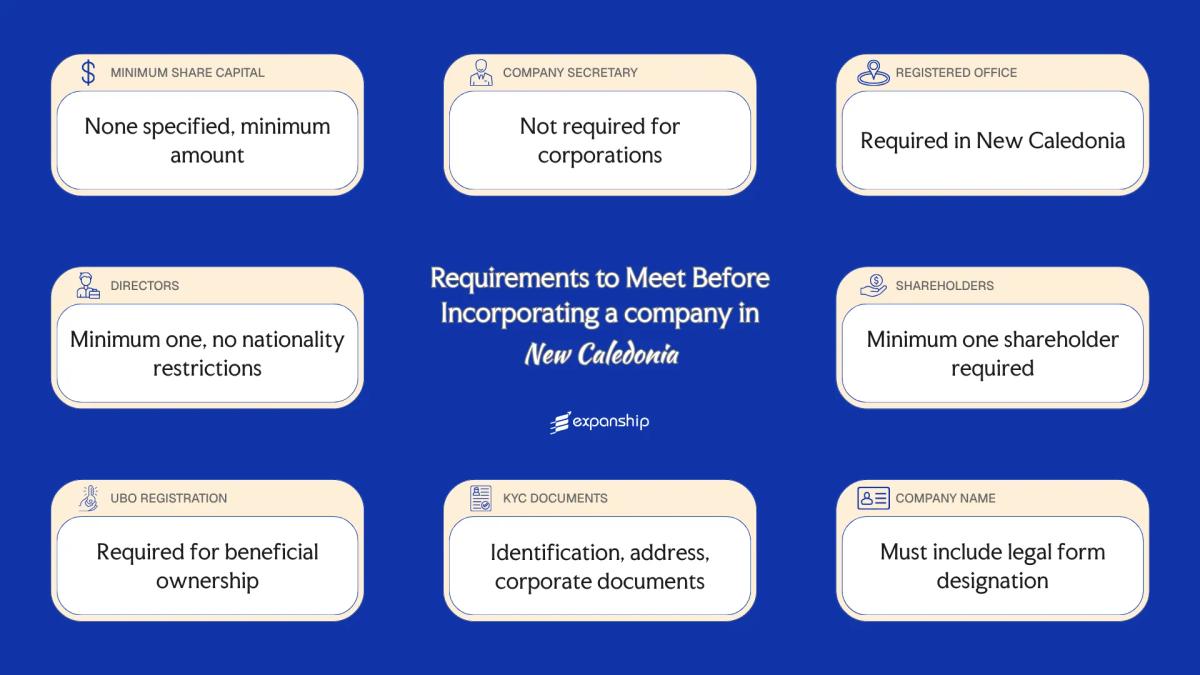
Minimum Share Capital Requirements in New Caledonia
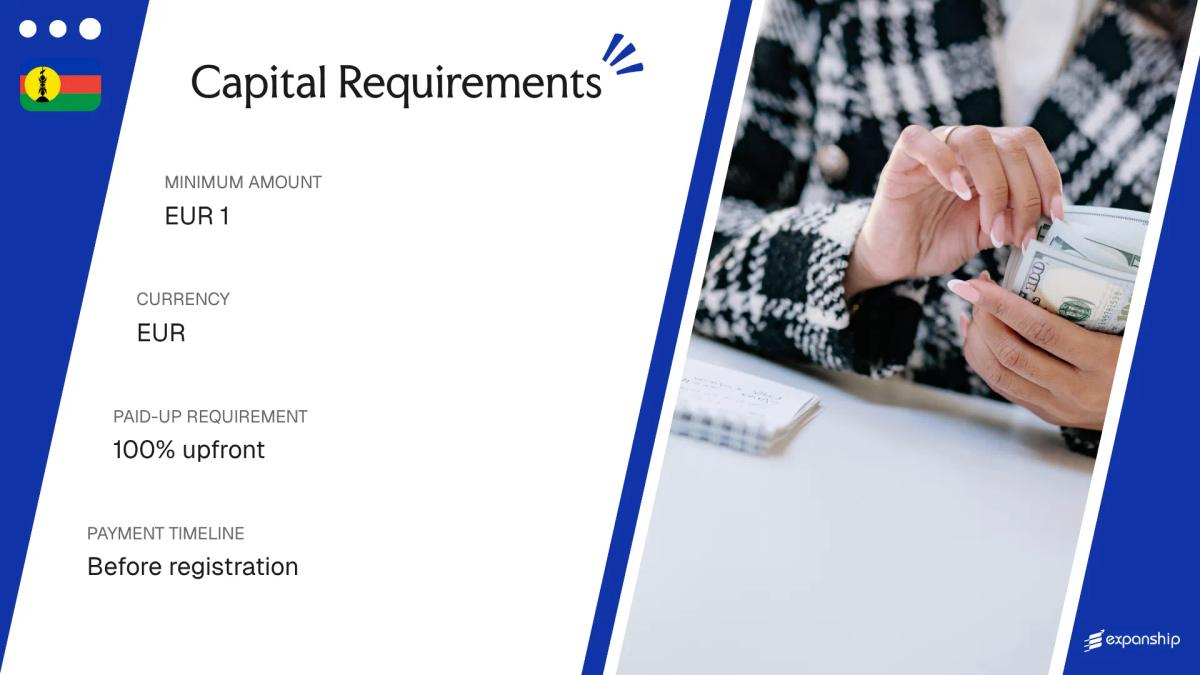
New Caledonia applies French corporate law principles through its local legal framework, meaning minimum share capital requirements in New Caledonia follow rules broadly aligned with the French commercial code as adapted and enforced within the territory. The applicable entity types, including the SARL and SAS, operate on a par value share system where each share carries a nominal value.
Capital contributions are verified through the local banking system and declared to the Tribunal Mixte de Commerce, which oversees commercial registration in the territory. Once deposited and certified, the capital requirement functions as an incorporation condition rather than an ongoing statutory floor subject to annual re-verification.
| Parameter | Detail |
|---|---|
| Minimum Authorized Share Capital | No statutory minimum for SAS; 1 XPF nominal minimum per share for SARL |
| Maximum Authorized Share Capital | No statutory maximum |
| Minimum Paid-Up Capital | No statutory minimum |
| Paid-Up Requirement at Incorporation | Capital stated in the articles must be fully subscribed at incorporation |
| Accepted Currency | CFP Franc (XPF) |
| Accepted Forms of Contribution | Cash contributions; contributions in kind (subject to valuation) |
| Timeframe to Deposit Capital | Prior to filing for commercial registration with the Tribunal Mixte de Commerce |
Absence of a statutory minimum does not remove the obligation to define an authorized capital amount in your articles of association. The stated capital must be fully subscribed before registration is completed.
Company Secretary Requirements in New Caledonia
New Caledonia does not impose a standalone company secretary requirement in the same form as common law jurisdictions. Under the French-derived corporate framework that governs entity formation in the territory, company secretary requirements New Caledonia businesses encounter are fulfilled through the statutory roles assigned to directors and legal representatives rather than a separate secretarial officer.
For a Société par Actions Simplifiée (SAS) or Société à Responsabilité Limitée (SARL), the appointed president or gérant carries the administrative obligations typically associated with a secretary, including maintaining corporate records, filing statutory updates with the Tribunal Mixte de Commerce, and ensuring regulatory correspondence is handled within prescribed timeframes.
Qualification criteria for those serving in this administrative capacity include:
- Natural persons must have full legal capacity under applicable civil law rules.
- No sector-specific licensing is generally required for the administrative role itself.
- Corporate entities may fulfill the representative function depending on the chosen legal structure.
- Residency in New Caledonia is not formally mandated for the legal representative position.
- The appointed individual must not be subject to a court-imposed prohibition on managing a commercial entity.

Incorporate a Company in New Caledonia
Set up your legal entity in New Caledonia with accurate filings, compliant structure, and full support from registration through to operational readiness.
Registered Office Requirements in New Caledonia
Registered office requirements in New Caledonia follow the French civil law framework applied locally, where every company must designate a siège social that serves as its official legal domicile for correspondence, regulatory notices, and judicial proceedings. Failure to maintain a compliant address can result in administrative sanctions, potential nullification of corporate acts, and difficulties with the Tribunal Mixte de Commerce during registration or annual filings.
- A physical address within New Caledonia is required; a P.O. box alone does not satisfy the siège social obligation.
- Virtual office arrangements may be permissible if a genuine physical premises is associated with the service provider's address.
- The registered address must be locally based within New Caledonia's territory, not in metropolitan France or another jurisdiction.
- Supporting documentation, such as a lease agreement, title deed, or domiciliation contract, must evidence the entity's right to occupy the address.
- The siège social is publicly recorded in the Registre du Commerce et des Sociétés (RCS) held at the Tribunal Mixte de Commerce and is accessible to third parties.
- Any change to the registered address requires a formal update filing with the RCS, typically accompanied by an amended corporate decision and updated domiciliation evidence.
Director Requirements in New Caledonia
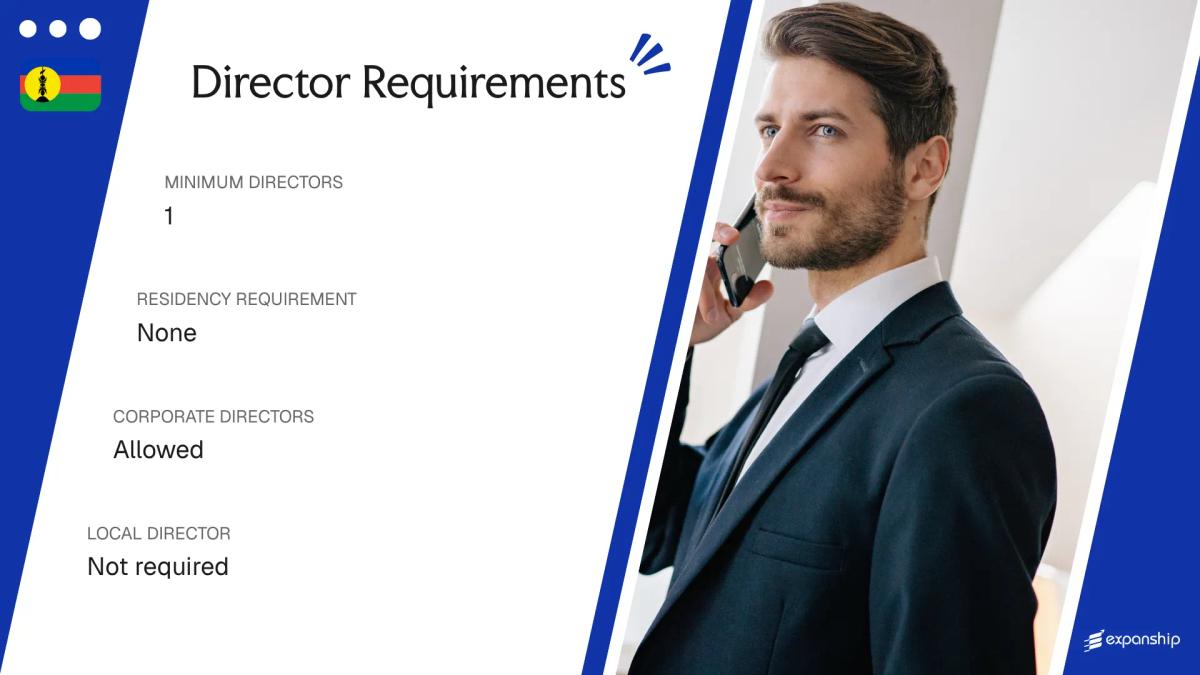
Director requirements in New Caledonia follow the French commercial law framework applied locally, where the gérant of a SARL or the directeur général of an SAS assumes personal liability for statutory obligations from the date of appointment. Upon taking office, a director bears responsibility for ensuring the entity meets its fiscal, accounting, and declaratory obligations under the Code de commerce as transposed into New Caledonian law.
| Parameter | Detail |
|---|---|
| Minimum Number of Directors | One director is required for both SARLs and SASs. |
| Maximum Number of Directors | No statutory maximum applies to an SAS; an SARL is managed by one or more gérants without a fixed upper limit. |
| Local/Resident Director Required | No statutory residency requirement exists under applicable New Caledonian corporate law. |
| Nationality Restrictions | No nationality restrictions are imposed on directors. |
| Minimum Age Requirement | Directors must be at least 18 years of age and have full legal capacity. |
| Corporate Directors Permitted | A legal entity may serve as director of an SAS, but an SARL gérant must be a natural person. |
| Director Must Be a Shareholder | No statutory requirement obliges a director to hold shares in the company. |
| Publicly Listed on Registry | Directors are registered with the Registre du Commerce et des Sociétés (RCS) in Nouméa and are publicly identifiable. |
| Disqualification Conditions | A director may be disqualified following a criminal conviction, court-ordered prohibition, or insolvency proceeding under applicable French-derived commercial law. |
A corporate entity, rather than an individual, can serve as the sole director of an SAS in New Caledonia, meaning a foreign holding company can formally control the subsidiary without any individual being named in that role.
Shareholder Requirements in New Caledonia
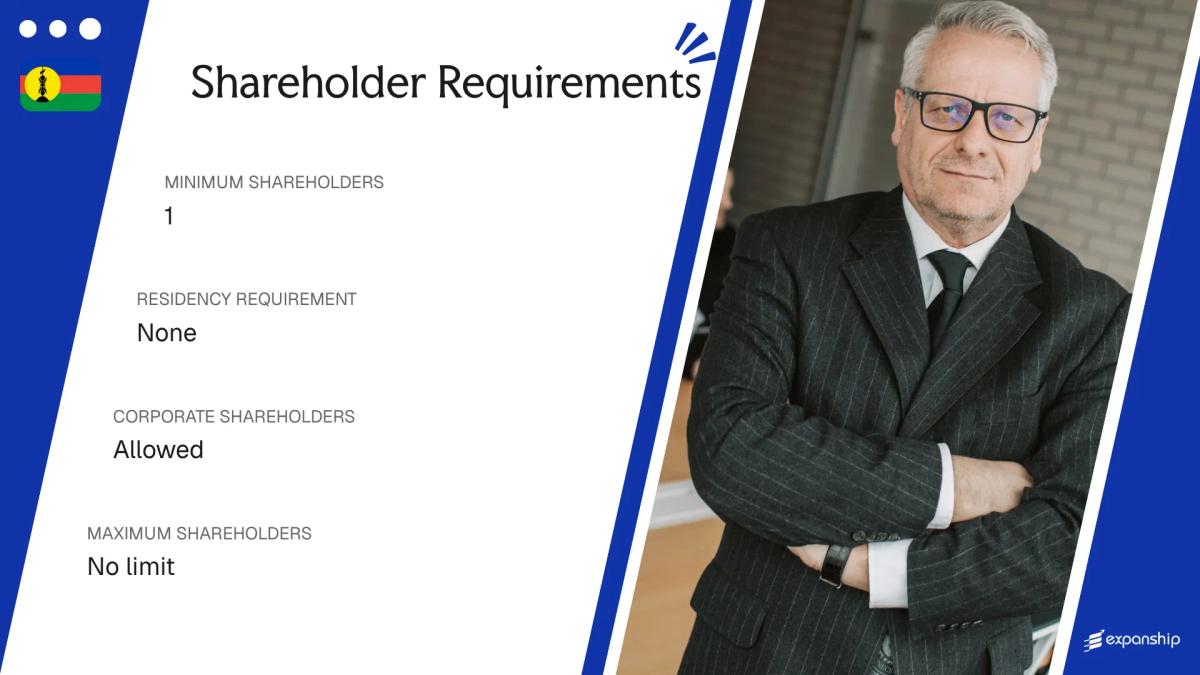
Shareholder requirements in New Caledonia follow French commercial law frameworks adapted to the territory's legal status as a sui generis collectivity. A SARL (Société à Responsabilité Limitée) requires a minimum of one associé, permitting a sole shareholder structure known as an EURL. The maximum is capped at 100 associés.
An SAS (Société par Actions Simplifiée) requires at least one shareholder, with no statutory ceiling on the total number.
Nationality and Residency Restrictions
No nationality or residency requirement applies to shareholders. Foreign individuals and entities may hold 100% of the share capital without restriction.
Corporate Shareholders
Corporate entities are permitted to act as shareholders in both the SARL and SAS structures. No additional conditions are imposed solely on the basis of the shareholder being a legal entity rather than a natural person.
Shareholder Liability
Liability is limited to each associé's capital contribution. Extended personal liability does not arise under standard conditions, though courts may pierce the corporate veil in cases of fraud or asset commingling.
Register of Shareholders
A register of shareholders must be maintained at the company's registered office. It is not publicly accessible, but must be kept current and made available to competent authorities upon request.
Set Up Your New Caledonia Company Structure the Right Way
Get tailored guidance on shareholder arrangements and incorporation requirements specific to New Caledonia's legal framework.
UBO / Beneficial Ownership Disclosure Requirements in New Caledonia
New Caledonia applies French-derived anti-money laundering legislation, under which a beneficial owner (bénéficiaire effectif) is generally defined as any natural person holding, directly or indirectly, more than 25% of the capital or voting rights of a legal entity, or exercising effective control by other means.
- Identify all natural persons meeting the 25% ownership or effective control threshold prior to incorporation or registration of the entity.
- Declare the beneficial owner(s) to the registre du commerce et des sociétés (RCS) at the time of filing the company's constitutive documents.
- Submit a declaration of beneficial ownership (déclaration de bénéficiaire effectif) as a standalone document alongside the standard incorporation filing.
- Report any change in UBO status to the RCS within 30 days of the change occurring.
| Parameter | Detail |
|---|---|
| Ownership Threshold for UBO Status | More than 25% of capital or voting rights, directly or indirectly |
| Filing Authority | Registre du Commerce et des Sociétés (RCS), New Caledonia |
| Disclosure Deadline at Incorporation | At the time of company registration |
| Publicly Accessible Register | Limited access; not fully public under applicable local rules |
| Penalties for Non-Disclosure | Sanctions applicable under French-derived AML legislation; specific local penalties subject to territorial ordinance |
| Ongoing Update Obligation | Updates required within 30 days of any change in UBO status |
KYC / Document Requirements in New Caledonia
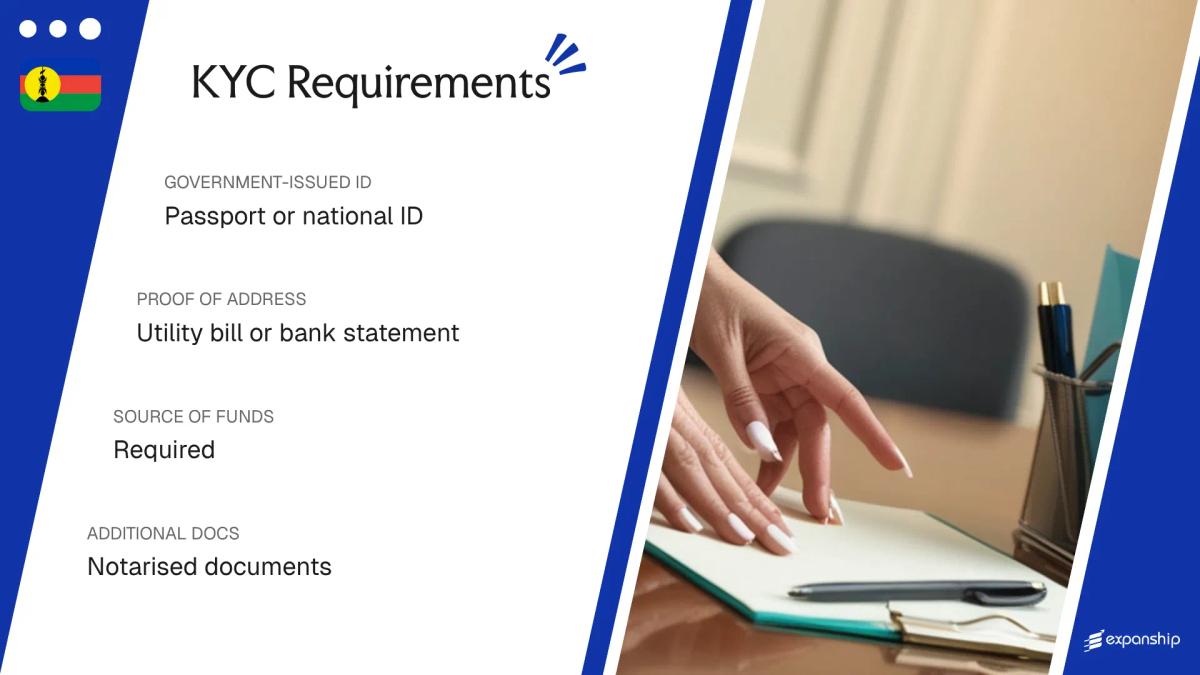
KYC document requirements in New Caledonia are governed by French anti-money laundering legislation extended to the territory, administered locally through the Institut d'Émission d'Outre-Mer (IEOM) and applicable COLB directives. These obligations apply at the point of incorporation and bind all parties with a qualifying interest in the entity being registered.
Individual / Personal Documents
- Valid government-issued photo identification (passport or national identity card) for each director, shareholder, and beneficial owner
- Proof of residential address dated within three months, such as a utility bill or official bank statement
- A specimen signature may be required by the greffier du tribunal mixte de commerce during filing
- For non-French nationals, a certified copy of the relevant residency or entry document may be requested
Corporate Documents
- Certificate of incorporation or equivalent constitutional document for the corporate shareholder or director
- Articles of association or statutes in their current form
- An official register of directors confirming the identity of persons authorised to act
- Proof of the corporate entity's registered office address
Source of Funds Documentation
- Recent bank statements covering a minimum of three months prior to incorporation
- Audited financial accounts where the subscribing entity has an established trading history
- A written declaration of the origin of capital where bank evidence alone is insufficient
Notarisation and Apostille Requirements
- Foreign public documents must carry an apostille under the Hague Convention of 5 October 1961
- Documents not in French must be accompanied by a certified translation prepared by a sworn translator (traducteur assermenté)
- Notarisation by a French notaire may be required for certain constitutional documents submitted to the greffe
The most common cause of registration delay is the submission of foreign identity or corporate documents without an apostille or a certified French translation.
Company Name Requirements in New Caledonia
Proposed company name requirements in New Caledonia are assessed at the point of incorporation to confirm the name is not already in use or confusingly similar to an existing registered entity. The reviewing authority checks for distinctiveness and potential conflicts with prior registrations.
Names must be in French, reflecting the territory's official language, and include a legal suffix that corresponds to the chosen entity type, such as SARL or SAS. No specific character limit is publicly codified, but the name must be sufficiently distinct to avoid confusion.
Certain words implying government affiliation, regulated professions, or financial institutions are restricted and require prior authorization from the relevant supervisory body before use. Outright prohibited terms include those that are deceptive, contrary to public order, or offensive.
Name reservation is generally available through the registration process, though the duration and procedure follow standard French civil law practice applicable in New Caledonia. Reservation is typically requested at the time of filing incorporation documents with the competent commercial registry.
Compliance Services for Companies in New Caledonia
Expanship assists businesses with ongoing compliance obligations in New Caledonia, including annual filings, registered office maintenance, and regulatory reporting requirements.
Conclusion
Incorporation requirements in New Caledonia operate within a French-derived legal framework administered locally through the Tribunal Mixte de Commerce. Registered capital thresholds, director residency rules, and beneficial ownership disclosure obligations each carry distinct implications depending on the entity type you select. Once these requirements are understood, a foreign investor's practical focus shifts to assembling compliant documentation, appointing local representatives where required, and completing registration with the relevant commercial authorities.
Expanship's Corporate Services for New Caledonia Expansion
Incorporating in New Caledonia through a French legal framework, subject to local RIASEC oversight and territorial fiscal rules, creates a specific compliance burden that many foreign businesses underestimate. Expanship's New Caledonia company formation services are structured around these precise requirements, from preparing statuts constitutifs to coordinating with the Tribunal Mixte de Commerce. Your operational workload is reduced, though the regulatory obligations themselves remain yours to fulfil.
Expanship supports your expansion across the full incorporation cycle and beyond:
- We handle company registration and prepare all required constitutional documents for submission.
- A registered agent and physical office address in New Caledonia are provided where required.
- We liaise directly with government bodies and relevant territorial authorities on your behalf.
- Post-incorporation compliance obligations are managed on an ongoing basis.
- Banking introduction support is available to assist your initial setup.
- Tax registration and liaison with local fiscal authorities are coordinated for you.
To discuss your requirements, contact Expanship New Caledonia.
Frequently Asked Questions (FAQ)
A foreign national can serve as a director in New Caledonia, but residency and visa status may affect the practical ability to manage the entity and open local bank accounts. There is no blanket prohibition on foreign directors, though the gérant of a SARL or the president of an SAS must be identified in the incorporation documents filed with the Tribunal Mixte de Commerce. Non-resident directors should verify whether their home country imposes any restrictions on holding such a position abroad.
Beneficial owners holding 25% or more of shares or voting rights must be declared and registered as part of the incorporation process, in line with anti-money laundering obligations extended to New Caledonia under French regulatory frameworks. This information is submitted to the relevant commercial registry and forms part of the official company file. Failure to accurately declare UBO information can result in administrative penalties and delays in registration.
Foreign shareholders are generally required to provide certified copies of identity documents, proof of address dated within three months, and depending on the incorporating agent or notary, an apostilled copy of relevant corporate documents if the shareholder is itself a legal entity. Local shareholders face similar requirements but typically do not need apostille certification on domestic documents. The notary or greffier handling the incorporation will confirm which documents require legalisation based on the shareholder's country of origin.
The Tribunal Mixte de Commerce will reject a company name that conflicts with an existing registered entity, and you will need to submit an alternative before the incorporation process can proceed. A preliminary name availability search through the RIDET (Répertoire d'Identification Des Entreprises et des Établissements) database can help identify conflicts before filing. Reserving a distinctive name early in the process reduces the risk of delays caused by naming disputes.
A physical address in New Caledonia is mandatory for company registration. The registered office must be located within the territory and serves as the official address for all legal correspondence and regulatory notices. A foreign address is not accepted as a substitute, and domiciliation services using a local commercial address are a recognised option for businesses that do not have their own physical premises in the territory.
Non-compliance with beneficial ownership disclosure requirements, including failure to update records following changes in ownership structure, can result in administrative fines under the anti-money laundering provisions applicable in New Caledonia. In serious cases, officers of the company may face personal liability in addition to fines levied against the entity. The obligation to keep UBO information current is ongoing, not limited to the point of incorporation.
Legal Disclaimer
The information provided in this article is for general informational purposes only and does not constitute legal, tax, or professional advice. While we strive to ensure the accuracy and timeliness of the content, laws and regulations are subject to change, and the application of laws can vary widely based on specific facts and circumstances.
Readers should not act upon this information without seeking professional counsel tailored to their individual situation. Expanship and its authors disclaim any liability for actions taken or not taken based on the content of this article.
For specific advice regarding your business setup, compliance requirements, or any legal matters, please consult with qualified legal and tax professionals in the relevant jurisdiction.