
Key Takeaways
- Incorporating under the Code de Commerce as applied in New Caledonia gives foreign businesses direct access to a French civil law framework, providing contractual predictability and enforcement mechanisms aligned with one of the world's most established legal traditions.
- The territory's Code des Impôts de Nouvelle-Calédonie provides sector-specific tax exemptions that can materially reduce the fiscal burden for businesses operating in targeted industries, particularly those linked to resource extraction and processing.
- New Caledonia's position as the world's third-largest nickel reserve holder creates a structurally advantaged environment for businesses entering the mining supply chain, where local demand for ancillary services and capital investment remains directly tied to global commodity cycles.
- Registration through the Tribunal Mixte de Commerce de Nouméa and the Registre du Commerce et des Sociétés places incorporated entities within a regulated, French-standard commercial registry system, which supports credibility with international counterparties and financiers operating across the Pacific region.
New Caledonia is a French special collectivity located in the southwestern Pacific Ocean, governed under a sui generis political status established by the Nouméa Accord of 1998. This arrangement grants the territory significant autonomy while maintaining constitutional ties to France. Company registration falls under the oversight of the Tribunal Mixte de Commerce, which administers the local commercial register known as the Registre du Commerce et des Sociétés.
Foreign businesses incorporating here most commonly do so through a SARL. The territory operates a territorial tax system, meaning locally sourced income is subject to local taxation while certain foreign-source income may fall outside the scope of New Caledonian tax obligations.
Foreign ownership is generally permitted, and the territory maintains an open posture toward foreign direct investment across most sectors, though some resource industries are subject to specific local regulatory conditions. This article examines the concrete benefits of incorporating in New Caledonia for businesses considering a formal presence in this part of the Pacific.
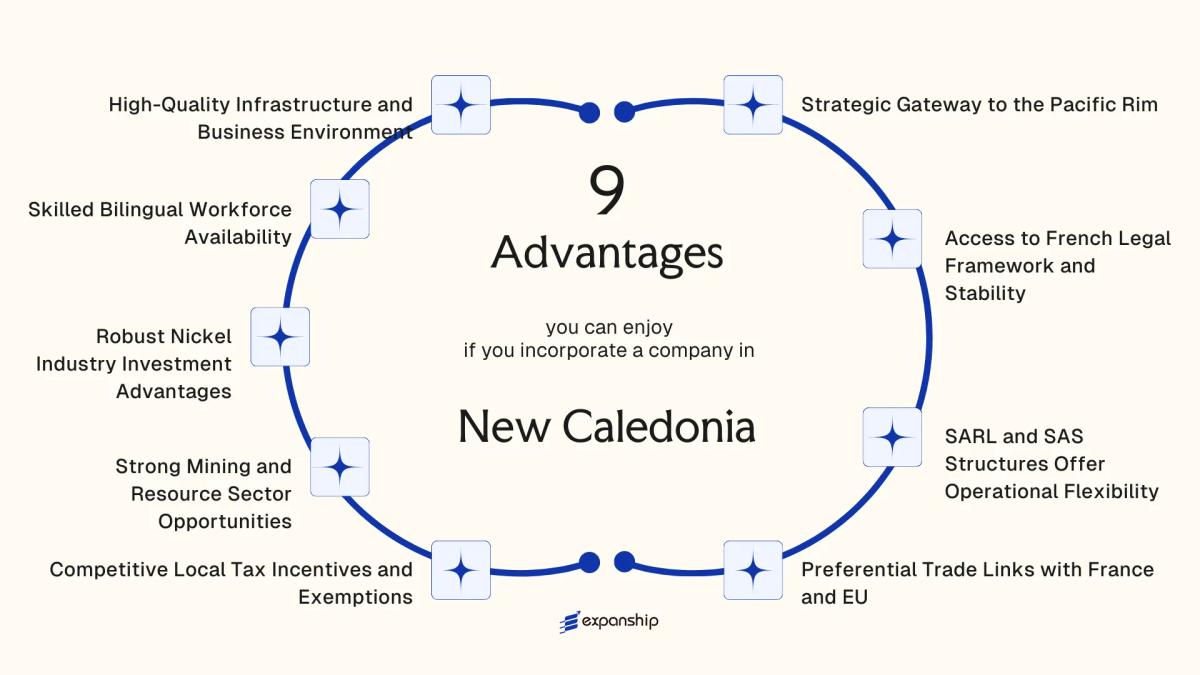
Strategic Gateway to the Pacific Rim
Located in the southwest Pacific Ocean, New Caledonia sits approximately 1,500 kilometres east of Australia and within direct reach of major Asia-Pacific economies including Japan, South Korea, and the Philippines. For businesses targeting Pacific Rim market access from New Caledonia, this geography translates into measurable logistical and commercial positioning advantages.
Proximity to High-Value Pacific Markets
Noumea's port and international airport connect directly to regional trade corridors that serve both Oceania and Southeast Asia. A firm registered here can reach Sydney in roughly three hours by air and maintains shipping access to Asian manufacturing hubs without routing through European or North American transit points.
French Territorial Status as a Trade Anchor
As a French special collectivity, the territory's trade and regulatory alignment with France underpins its position as a credible Pacific Asia trade hub. Foreign companies benefit from French diplomatic networks and bilateral commercial agreements that smaller Pacific island states cannot offer independently.
Businesses operating here also benefit from the franc CFP (XPF), a currency pegged to the euro, which reduces exchange rate exposure when transacting with French and eurozone counterparties.
Your company gains simultaneous access to Pacific Rim supply chains and French commercial infrastructure from a single registered entity.
Access to French Legal Framework and Stability
French legal framework benefits in New Caledonia stem directly from the territory's status as a French collectivity, which means the French Civil Code and the Code de Commerce apply to commercial activity there. For foreign investors, this eliminates much of the legal uncertainty typically associated with Pacific island jurisdictions. You are operating under a codified system with centuries of precedent, not a nascent or untested regulatory environment.
Contract enforcement, property rights, and corporate governance all follow French metropolitan principles. Disputes can be brought before courts applying established civil law doctrine, which gives foreign creditors and counterparties a predictable basis for legal recourse.
The practical advantages of this alignment include:
- French commercial law defines clear director liability rules, reducing personal exposure ambiguity
- Accounting standards follow French norms, which are internationally recognised and audit-ready
- Corporate documents drafted under the Code de Commerce are generally accepted by French and EU banks
- Judicial decisions can reference the extensive body of French case law, giving your legal counsel reliable precedent to work with
The Tribunal Mixte de Commerce handles commercial disputes locally. Its application of French procedural law means litigation timelines and processes are broadly comparable to metropolitan France, offering foreign firms a degree of institutional familiarity that few Pacific jurisdictions can match.

Company Incorporation in New Caledonia
Set up your company in New Caledonia under the French legal framework with full compliance support from Expanship.
SARL and SAS Structures Offer Operational Flexibility
Two primary corporate forms are available to foreign investors incorporating in New Caledonia: the Société à Responsabilité Limitée (SARL) and the Société par Actions Simplifiée (SAS). The New Caledonia SARL SAS structure flexibility derives from French commercial law, which applies in the territory through the Code de Commerce, adapted under New Caledonia's specific legislative competencies.
The SARL suits smaller operations. It requires a minimum of one associate, has no statutory minimum share capital, and limits associate liability to their contributions. This contained liability profile means foreign investors can separate personal assets from business exposure without complex holding arrangements.
| Feature | SARL | SAS |
|---|---|---|
| Minimum shareholders | 1 | 1 |
| Minimum share capital | None (statutory) | None (statutory) |
| Governance structure | Fixed by law | Defined in articles |
| Liability | Limited to contribution | Limited to contribution |
| Share transferability | Restricted | Freely defined by statutes |
The SAS offers a different advantage: its governance framework is largely defined by the company's own statutes rather than mandated by law. For foreign firms structuring joint ventures or phased investment arrangements, this means shareholder agreements can be drafted to reflect the actual commercial relationship rather than conforming to a rigid statutory model.
Both entities can be managed by a non-resident, which removes a practical barrier that other civil law jurisdictions impose through mandatory local director requirements. Your firm retains operational control without establishing a local management presence as a condition of incorporation.
Preferential Trade Links with France and EU
New Caledonia's preferential trade links with the EU stem from its status as a French special collectivity under Article 74 of the French Constitution. This constitutional relationship means goods produced in the territory can benefit from preferential access arrangements that independent Pacific nations simply do not have.
Under the Overseas Association Decision (the EU's framework governing relations with Overseas Countries and Territories), products originating from the collectivity may enter EU markets under terms more favorable than those available to standard third-country exporters. For a firm manufacturing or processing goods locally, this translates into reduced tariff friction when selling into a market of over 440 million consumers.
France trade agreement advantages also extend to administrative alignment. French customs and trade law apply, meaning your entity operates within a known, treaty-backed regulatory system rather than an isolated bilateral arrangement. The EU-OCT framework governs these terms directly.
Keep these points in mind:
- Origin rules under the OCT Decision determine which goods qualify for preferential EU access
- The collectivity is not part of the EU customs union, so standard EU internal market rules do not automatically apply
- French customs authorities administer trade documentation and compliance locally
Because New Caledonia sits outside the EU VAT area, goods can be exported to France without standard EU VAT obligations at the point of departure, which affects how your pricing and invoicing structures work.
Competitive Local Tax Incentives and Exemptions
New Caledonia local tax incentives for businesses stem from the territory's unique fiscal autonomy. As a French special collectivity, New Caledonia operates its own tax code largely independent of French metropolitan tax law, which means the rates and incentive structures you encounter here are not simply replicated from Paris.
Territorial Tax Autonomy and What It Means for Your Business
The territory administers its own corporate tax regime through local institutions, including the Government of New Caledonia and its Direction des Services Fiscaux. Corporate income tax rates in New Caledonia are generally set at the territorial level, giving local authorities discretion to shape incentive programs that respond to investment priorities rather than EU-wide fiscal policy. This independence allows for targeted exemptions that foreign investors in metropolitan France would not qualify for.
Investment-Linked Exemptions and Sector Incentives
New Caledonia has historically offered tax defiscalisation schemes, particularly under frameworks tied to the Loi Girardin, which applies to French overseas territories and allows qualifying investments in productive assets to generate tax reductions. For foreign investors structuring through a local entity, capital investment in eligible sectors can attract partial or full exemption on profits during an initial operating period. Eligibility typically depends on the nature of the activity, the volume of local employment created, and formal approval from the relevant territorial authority. These conditions make the incentives substantive rather than automatic, but they create a clear pathway for firms making genuine capital commitments.
Identify the Tax Incentives Your Business Qualifies for in New Caledonia
Expanship can assess which territorial tax exemptions and investment-linked schemes apply to your structure and sector before you incorporate.
Strong Mining and Resource Sector Opportunities
New Caledonia mining sector investment advantages extend well beyond nickel alone, though nickel defines the territory's economic identity. The island group holds an estimated 10% of the world's known nickel reserves, placing it among a small number of jurisdictions where a single mineral commodity can anchor an entire investment strategy. For a foreign business owner, this concentration creates a defined entry point rather than a diffuse opportunity.
- The territory's mining activity is governed by the Code Minier de Nouvelle-Calédonie, a local regulatory framework that applies independently from metropolitan French mining law. This separation gives the territory direct authority over extraction permits, which are issued by the New Caledonian government rather than Paris.
- Three provincial governments each hold jurisdiction over land use and environmental approvals within their boundaries, meaning resource industry business opportunities can vary significantly by province. Understanding which authority governs a specific site is material to project timelines.
- Mining and processing operations that meet investment thresholds may qualify for exemptions under the territorial tax code, administered by the Direction des Impôts et des Contributions Diverses (DICD).
- Mineral extraction benefits for investors include access to an established port and export infrastructure at Nouméa, which reduces logistical barriers that commonly affect mineral projects in remote Pacific locations.
Robust Nickel Industry Investment Advantages
New Caledonia nickel industry investment benefits are grounded in a tangible geological reality: the territory holds an estimated 25% of the world's known nickel reserves. For a foreign investor, this concentration of supply translates directly into long-term resource security that few jurisdictions can match.
Mining operations fall under a provincial permitting framework, with oversight distributed across the South, North, and Loyalty Islands provinces. The Société Le Nickel (SLN) and Koniambo Nickel SAS (KNS) have established large-scale industrial precedents, which means your firm enters a jurisdiction with functioning smelting infrastructure and supply chain networks already in place.
Foreign entities investing in the nickel sector benefit from proximity to established export routes toward Asia, particularly Japan and South Korea, which are among the territory's primary nickel trading partners. This reduces logistics development costs that would otherwise burden greenfield resource operations.
Companies registered locally can participate directly in supply agreements, joint ventures, or downstream processing partnerships within an existing industrial ecosystem rather than building commercial relationships from zero.
A hypothetical processing firm supplying intermediate nickel products to Japanese manufacturers could, based on current LME nickel pricing trends, generate export revenues in a currency-stable framework backed by French monetary policy, reducing the foreign exchange risk that typically accompanies resource extraction in smaller Pacific island economies.
Skilled Bilingual Workforce Availability
New Caledonia bilingual workforce advantages for business are grounded in a concrete linguistic reality: French is the official administrative and commercial language, yet English proficiency is prevalent across professional and technical sectors due to sustained regional trade with Australia, New Zealand, and other Pacific partners.
For a foreign firm operating across both French-speaking and English-speaking markets, this reduces the cost and complexity of hiring separately for each language function.
The territory's workforce is shaped by the French national education system, which means professional qualifications align with standards recognised in Metropolitan France and, by extension, across the EU. Technical trades, engineering, and legal roles draw on French vocational and higher education frameworks, giving employers a degree of credential consistency that is less common in smaller Pacific jurisdictions.
- Mining, logistics, and infrastructure sectors have historically attracted multilingual professionals.
- Local universities and vocational institutions produce graduates with bilingual capability in commerce and technical disciplines.
- Public administration operates in French, so compliance and regulatory interactions do not require specialist translation infrastructure.
Skilled bilingual talent is concentrated in and around Nouméa; businesses operating in outer provinces may face a materially smaller available pool and should factor this into workforce planning.
High-Quality Infrastructure and Business Environment
New Caledonia business infrastructure advantages stem from decades of French public investment, giving your operations a foundation that most Pacific island territories cannot match.
Transport Connectivity
Nouméa's La Tontouta International Airport handles direct routes to Australia, New Zealand, Japan, and metropolitan France, reducing logistical friction for foreign firms managing regional supply chains. The port of Nouméa functions as a deep-water commercial facility capable of handling bulk cargo, which directly supports the territory's mining and import-dependent industries. For a foreign business owner, this connectivity means your entity can move goods and personnel without routing through a regional hub.
Digital and Utilities Infrastructure
Fixed and mobile telecommunications networks in New Caledonia operate under standards aligned with French metropolitan norms, maintained by operators subject to oversight from local regulatory authorities. Reliable electricity and water services, supplied through infrastructure maintained under French public service obligations, reduce operational uncertainty for businesses that depend on uninterrupted utilities.
Urban Business Environment
Nouméa provides:
- Commercial real estate options across central business districts and industrial zones
- Banking services through established French-affiliated institutions, including BNP Paribas Caledonie and Société Générale Caledonie
- A legal and notarial system that processes corporate filings under the Code de Commerce as applied locally
French civil administration standards govern public services, meaning documentation, permitting, and regulatory interactions follow structured, codified procedures. For foreign investors unfamiliar with Pacific regulatory environments, this procedural consistency reduces unpredictability in day-to-day business operations.
How New Caledonia Stacks Up Against Other Pacific Jurisdictions
Comparing New Caledonia vs other Pacific jurisdictions for business reveals a profile that sits apart from the region's typical incorporation options. Most Pacific territories attract foreign entities through low-tax or zero-tax regimes with minimal regulatory infrastructure. This territory operates differently: it combines a French civil law framework, EU-aligned trade access, and a diversified industrial base that smaller island jurisdictions cannot replicate. The comparison below focuses on Vanuatu and Fiji, the two Pacific jurisdictions most commonly evaluated alongside this territory by foreign investors considering regional operations.
Vanuatu offers zero corporate tax and a fast-track incorporation process, but its legal system lacks the institutional depth of a French overseas collectivity, and it has faced FATF grey-listing in recent years. Fiji provides a more developed economy with stronger banking infrastructure, yet it operates under a distinct regulatory regime without equivalent EU trade preferences. For businesses requiring contractual enforceability under a recognisable civil law system, or preferential access to French and EU markets, those alternatives present structural gaps that affect long-term operational reliability.
| Parameter | New Caledonia | Vanuatu | Fiji |
|---|---|---|---|
| Legal System | French civil law | Dual common/civil law | Common law |
| Corporate Tax Rate | ~30% (with local exemptions) | 0% | 20% |
| EU Trade Access | Yes (via France) | No | No |
| FATF Status | Compliant (France) | Grey-listed (2024) | Compliant |
| Primary Regulator | RIDET / ISEE | VFSC | FRCS |
| Common Corporate Entity | SARL, SAS | Exempt Company | Limited Company |
Compliance Services for Companies in New Caledonia
Stay aligned with local regulatory requirements under the RIDET framework and French overseas collectivity rules.
Conclusion
The benefits of incorporating in New Caledonia are anchored in tangible structural advantages: access to French civil law through the Code de Commerce, sector-specific tax exemptions under the Code des Impôts de Nouvelle-Calédonie, and a resource economy with direct exposure to global nickel demand. These are not incidental features but foundational conditions that shape how a foreign business operates, reports, and grows in this territory.
That said, the strength of any incorporation decision depends on how well a jurisdiction's legal architecture matches your business model. A firm entering the mining supply chain will weigh incentives differently than a regional holding structure or a professional services entity seeking a French-law foundation in the Pacific.
Your next step is ensuring that the company formation process in New Caledonia is executed correctly from the outset, given that procedural requirements, local compliance obligations, and entity registration with the Registre du Commerce et des Sociétés carry real consequences if mishandled.
Let Expanship Handle Your New Caledonia Company Formation
Expanship New Caledonia company formation services cover the full arc of establishing a legal presence in the territory, from selecting between an SARL and SAS structure to filing with the Tribunal Mixte de Commerce and meeting DAFE compliance requirements. The entity types, tax incentive regimes, and nickel sector regulations discussed throughout this blog each carry distinct procedural requirements that Expanship manages on your behalf.
Expanship's service scope for New Caledonia business incorporation assistance includes:
- Preparation and legalization of constitutional documents in accordance with French civil law requirements
- Registered agent and registered office provision within the territory
- Government filing and direct liaison with the Tribunal Mixte de Commerce and relevant local authorities
- Post-incorporation compliance management, including annual reporting and tax registration obligations
- Banking introduction assistance to facilitate opening a local business account
- Ongoing support for maintaining good standing under New Caledonian corporate regulations
Professional company formation services in New Caledonia require familiarity with a hybrid regulatory environment that blends French metropolitan law with locally enacted statutes. That combination adds procedural layers that are straightforward to manage with the right local knowledge, but time-consuming without it.
To discuss your incorporation requirements, contact Expanship New Caledonia directly.
Frequently Asked Questions (FAQ)
Foreign nationals can incorporate a company in New Caledonia without being a resident, though the requirements vary by legal structure. An SARL or SAS can be formed by non-resident shareholders, but at least one director with a valid legal address may be required for registration purposes with the Tribunal de Commerce. Practical considerations around local registered offices and banking relationships with institutions such as BCI or Société Générale Caledonie also apply.
Registration timelines for a new entity depend on the completeness of documentation submitted to the Centre de Formalités des Entreprises (CFE), which coordinates filings across relevant authorities. In straightforward cases, registration can be completed within two to four weeks, though delays arise when notarized documents require apostille certification from overseas. Businesses involving activities subject to specific licensing, such as mining or resource extraction, face additional regulatory review periods.
An SAS incorporated in the territory is subject to New Caledonia's own tax regime, administered locally rather than by the French national tax authority, since the territory retains fiscal autonomy under its organic statutes. Corporate income tax rates and applicable exemptions are governed by the Code des impôts de la Nouvelle-Calédonie. Certain investment-related exemptions and sectoral incentives may reduce the effective rate, particularly for firms operating in qualifying industrial or resource sectors.
French national corporate law does not apply automatically or in full, as New Caledonia holds a special status under the Nouméa Accord and French constitutional arrangements that grant it significant legislative autonomy. Certain foundational principles of French commercial law inform local statutes, but the territory's own legislative assembly, the Congrès, enacts rules that govern company formation and operation. Investors should consult the locally applicable commercial code rather than assuming direct equivalence with metropolitan French law.
Under the commercial rules applicable in New Caledonia, an SARL can generally be formed with a symbolic minimum capital, consistent with the framework derived from French law reforms that eliminated fixed minimums for this structure. The actual capital subscribed should nonetheless reflect the business's operational needs, as undercapitalization can affect creditor protections and banking relationships. Shareholders are required to specify capital contributions and their division in the company's statuts, which must be filed at registration.
Failure to meet filing and compliance obligations in New Caledonia can result in administrative penalties, and persistent non-compliance may lead to the entity being struck from the Registre du Commerce et des Sociétés (RCS). Directors can bear personal liability in cases where statutory duties are demonstrably neglected. The consequences for foreign-owned entities include complications in repatriating funds or maintaining local banking facilities.
Foreign investors entering the nickel or broader mining sector must navigate a distinct regulatory layer beyond standard company incorporation, including approvals tied to mining codes administered by the territorial government and, in some cases, the provincial authorities. The territory is divided into three provinces, each holding certain powers over land use and resource activity, which means approvals may need to be obtained at multiple administrative levels. Equity participation and operational permits are subject to scrutiny reflecting both economic development policies and the customary land rights provisions embedded in the Nouméa Accord.
New Caledonia is an Overseas Country and Territory (OCT) associated with the European Union rather than a full member, which means it does not automatically benefit from the same trade access as entities incorporated in EU member states. Preferential arrangements exist under the EU-OCT framework, but these are more limited in scope than those applying to companies based in metropolitan France or other EU jurisdictions. Access to French public procurement and EU-funded programs may be available under specific conditions, but this should be verified against the applicable EU-OCT association decisions and French public procurement regulations.
Legal Disclaimer
The information provided in this article is for general informational purposes only and does not constitute legal, tax, or professional advice. While we strive to ensure the accuracy and timeliness of the content, laws and regulations are subject to change, and the application of laws can vary widely based on specific facts and circumstances.
Readers should not act upon this information without seeking professional counsel tailored to their individual situation. Expanship and its authors disclaim any liability for actions taken or not taken based on the content of this article.
For specific advice regarding your business setup, compliance requirements, or any legal matters, please consult with qualified legal and tax professionals in the relevant jurisdiction.