
Key Takeaways
- Foreign investors incorporating in New Caledonia must navigate the Code de commerce as locally adapted, which layers metropolitan French commercial law with territory-specific statutes, creating a dual compliance burden that requires expertise in both frameworks simultaneously.
- Businesses operating in sectors such as mining, telecommunications, and financial services face restricted foreign ownership thresholds that materially limit the equity structures available to non-French entities.
- The requirement that all corporate documentation be maintained in French is not merely administrative — it creates ongoing translation and legal review costs for non-Francophone operators across every stage of the company lifecycle.
- New Caledonia's geographic remoteness and limited correspondent banking relationships reduce access to international payment networks, adding friction and cost to cross-border transactions that would be routine in larger financial centers.
New Caledonia operates under a heavily regulated corporate framework derived from French metropolitan law, adapted through local statutes administered by the government of New Caledonia. The disadvantages of incorporating in New Caledonia span legal, financial, administrative, and operational dimensions — each examined in detail across this article.
The specific challenges you will encounter depend significantly on your business structure, the sector you operate in, and whether your firm involves foreign capital. A retail entity faces different friction points than a mining or financial services operation.
This article is most relevant to foreign investors, multinational entities, and non-French-speaking business owners seeking to establish a commercial presence in the territory. The governing commercial framework is found in the Code de commerce as applied locally, which sets the baseline for understanding your compliance obligations before formation.
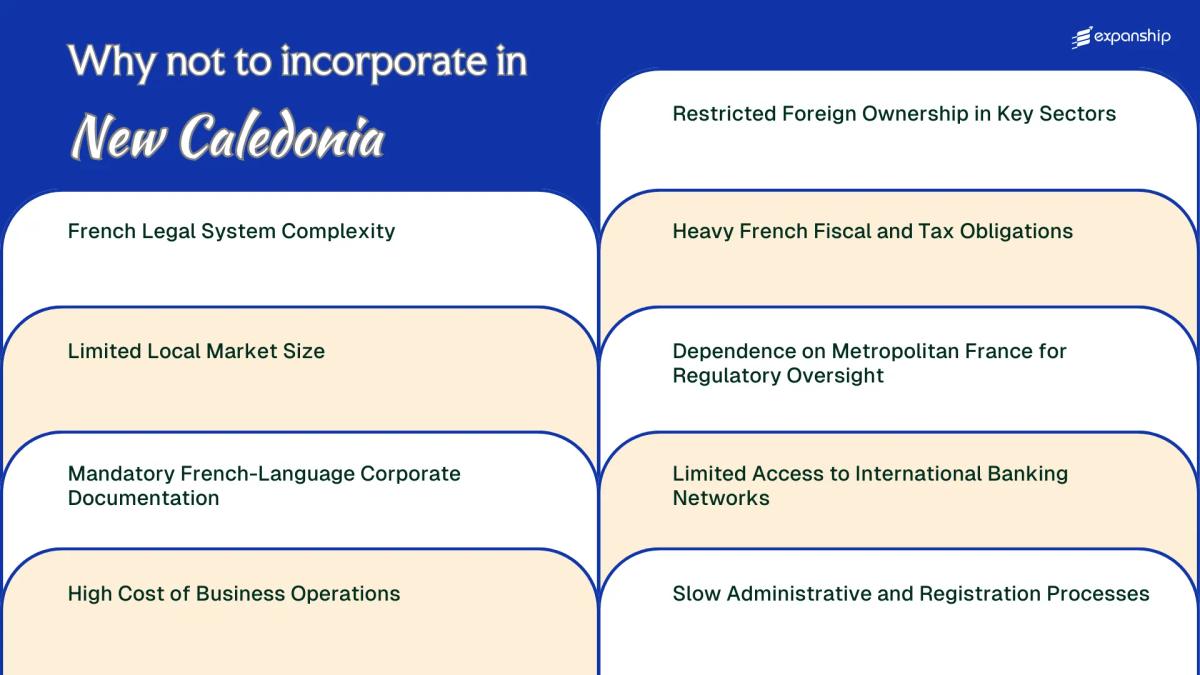
French Legal System Complexity
French legal system complexity in New Caledonia creates a distinctly layered compliance burden that most foreign business owners underestimate before incorporation.
A Dual-Layer Legal Architecture with No Simple Workarounds
New Caledonia operates under a divided legal order: metropolitan French civil law applies alongside locally enacted statutes passed by the Congrès de la Nouvelle-Calédonie, the territory's legislative assembly. Your business may find itself subject to both frameworks simultaneously, depending on the activity sector, making legal exposure harder to map than in a single-jurisdiction civil law country.
The Code de commerce governs core corporate structures, but territorial laws can modify or restrict how those structures function locally. For a foreign director unfamiliar with French civil law, reconciling these two layers requires specialised dual-jurisdiction legal counsel, which adds cost and delays decision-making.
Procedural Rigidity Inherited from French Administrative Tradition
French civil law drawbacks in New Caledonia business extend to procedural formality. Corporate acts, board resolutions, and amendments to statuts must follow strict form requirements derived from French law, with no administrative discretion to accept informal substitutes.
Errors in documentation format or filing sequence can invalidate corporate acts entirely, forcing restart of procedures through the Tribunal Mixte de Commerce.
Foreign directors without prior exposure to French civil law procedure face a structurally higher risk of procedural invalidity, which can freeze corporate actions until corrected through formal legal channels.
Limited Local Market Size
New Caledonia's population sits at approximately 270,000 people. For a foreign business owner evaluating New Caledonia limited market size risks, that figure sets a hard ceiling on domestic revenue potential before operations even begin.
The territory's consumer base is concentrated primarily around Greater Nouméa, which accounts for roughly two-thirds of the population. Businesses structured around volume-dependent models — retail, consumer goods, or domestic services — face immediate structural constraints that cannot be resolved through operational efficiency alone.
Reliance on a small domestic market creates compounding friction across several dimensions:
- Your fixed incorporation and compliance costs, including RIDET registration fees and ongoing obligations to the Direction des Affaires Économiques, are spread across a disproportionately thin revenue base.
- Scaling locally requires capturing a significant share of an already limited market, which increases competitive exposure and pricing pressure.
- Investor return projections built on domestic growth alone rarely justify the administrative overhead of maintaining a local entity.
Export-oriented structures can partially offset this constraint, but they introduce separate regulatory and logistics burdens specific to the territory's geographic isolation in the South Pacific.

Company Incorporation in New Caledonia
Understand the structural requirements and registration process for establishing a business entity in New Caledonia.
Mandatory French-Language Corporate Documentation
French language documentation requirements in New Caledonia apply to every stage of the incorporation and ongoing compliance process. All statutory filings submitted to the Tribunal Mixte de Commerce, the body responsible for company registration, must be prepared in French. For a foreign business owner operating in English or another language, this creates an immediate and recurring translation burden that adds cost before the entity generates a single franc of revenue.
Every shareholders' resolution, articles of association, and annual financial statement must conform to French-language legal standards. Errors in terminology — even minor ones — can result in rejected filings, requiring resubmission and extending your registration timeline.
| Document Type | Required Language | Consequence of Non-Compliance |
|---|---|---|
| Articles of Association (Statuts) | French only | Filing rejected by Tribunal Mixte de Commerce |
| Annual Financial Statements | French only | Non-compliant accounts invalid for tax purposes |
| Shareholders' Resolutions | French only | Resolutions may be ruled void or unenforceable |
| Commercial Contracts (public filings) | French only | Unenforceability risk under local civil law |
Certified translation services in a territory with limited professional resources are not cheap. New Caledonia's small professional services market means fewer qualified legal translators, which reduces competitive pricing and can slow document turnaround. Ongoing compliance cycles compound this cost annually, not just at incorporation.
Foreign-owned entities that conduct internal operations in another language still face mandatory French-language corporate filings for any document entering the public record or regulatory system. There is no bilingual filing option under the applicable territorial regulations.
High Cost of Business Operations
Operating costs in New Caledonia rank among the highest in the Pacific region, a direct consequence of its geographic isolation, heavy import dependency, and the application of French-aligned labor standards. The high cost of business operations in New Caledonia affects every layer of corporate expenditure, from staffing to logistics to professional services.
Wages are governed by the local minimum wage, the Salaire Minimum Garanti (SMG), which is set by the Territorial Congress and sits above the French metropolitan SMIC equivalent when adjusted for local cost-of-living supplements. For a foreign-owned entity, this means payroll costs are structurally elevated before any specialist hiring begins.
Nearly all industrial goods, equipment, and raw materials are imported, primarily through the port of Nouméa. Freight margins add directly to operational overhead, and those costs cannot be absorbed through local sourcing for most sectors.
Professional service fees, including legal, accounting, and fiduciary work, reflect both the limited pool of qualified practitioners and the bilingual French-English requirements many foreign firms impose on their advisors.
- The SMG applies to all employees regardless of business size or foreign ownership structure.
- Import duties and consumption taxes under the local fiscal code increase the landed cost of equipment and supplies.
- Office and commercial lease rates in Nouméa reflect a constrained real estate supply.
- Mandatory employer social contributions under the CAFAT system add a significant percentage above gross salary.
- There is no cost offset mechanism, such as a special economic zone or reduced overhead regime, available to standard commercial entities.
New Caledonia's cost of living is estimated to be around 30–40% higher than metropolitan France, meaning your firm's local operating expenses will exceed what most European benchmarks would predict.
Restricted Foreign Ownership in Key Sectors
Foreign ownership restrictions in New Caledonia apply across several economically significant sectors, creating structural barriers that limit how a foreign-owned entity can operate or hold assets locally.
Sectors Where Foreign Control Is Constrained
Mining and nickel extraction fall under particular scrutiny, given that nickel resources are subject to provincial and territorial governance frameworks under the Nouméa Accord and associated organic laws. Foreign firms seeking majority stakes in extraction or processing operations face approval requirements that effectively subordinate their ownership position to local institutional interests, including those of the Kanak and Caledonian communities with statutory stakes in resource governance.
Land ownership presents a separate constraint. Customary land, which represents a substantial portion of the territory, cannot be privately owned or transferred by foreign investors under any standard corporate structure.
Practical Consequences for Foreign Investors
These limitations on foreign investment in New Caledonia reduce the range of viable corporate structures available to international investors, particularly in capital-intensive industries where controlling ownership is a prerequisite for financing. A foreign business unable to hold majority equity cannot satisfy standard lender requirements, which effectively excludes it from project-level debt financing.
Restricted sectors in New Caledonia are not uniformly defined across its three provinces, meaning the scope of limitation can vary depending on where the business activity is registered or conducted.
Guidance on Incorporation Constraints in New Caledonia
Understand how foreign ownership restrictions affect your corporate structure options before you commit to a setup in this jurisdiction.
Heavy French Fiscal and Tax Obligations
New Caledonia tax obligations drawbacks extend beyond standard corporate rates, imposing a layered fiscal structure that increases compliance costs for any foreign-owned entity operating in the territory.
- The Territory Tax Code (Code des impôts de Nouvelle-Calédonie) imposes a corporate income tax rate of 30%, which exceeds the rates of many competing Asia-Pacific incorporation destinations and directly erodes after-tax returns for foreign investors.
- Your business must also contend with the Taxe Générale sur les Activités (TGA), a local turnover-based levy that applies in addition to corporate income tax, creating a compounding tax burden absent in most comparable jurisdictions.
- French fiscal burdens in New Caledonia companies include mandatory social contribution obligations, where employer payroll charges administered through CAFAT significantly increase the cost of hiring local staff.
- New Caledonia corporate tax challenges are further intensified by the absence of a double taxation treaty network comparable to metropolitan France, leaving foreign shareholders exposed to potential withholding tax on dividend repatriation.
- Heavy taxation risks in New Caledonia business operations are amplified for firms operating across multiple revenue streams, as each activity category may attract separate levy classifications under the territorial tax code.
Dependence on Metropolitan France for Regulatory Oversight
New Caledonia's regulatory dependence on France means that key legislative frameworks originate in Paris, not Nouméa. The French state retains authority over foreign investment rules, monetary policy, and certain commercial regulations, even as the Congrès de la Nouvelle-Calédonie holds jurisdiction over local tax and economic matters under the Organic Law of 1999 (Loi organique n° 99-209).
This division of authority creates a dual compliance burden. Your business may need to satisfy both local provincial regulations and metropolitan French requirements simultaneously, depending on the sector and activity type.
When Paris updates commercial or financial regulations, those changes flow into the territory without a locally driven legislative process. That reduces your ability to anticipate regulatory shifts through local political channels, increasing compliance uncertainty.
Policy changes affecting foreign-owned entities can originate from institutions your business has no practical proximity to, including the French Ministry of Economy and the Autorité des marchés financiers (AMF). Delays in local adaptation of those changes extend the period of regulatory ambiguity for operating firms.
A foreign firm establishing a société par actions simplifiée (SAS) in the territory must track regulatory updates from both the Congrès de la Nouvelle-Calédonie and metropolitan French commercial law simultaneously. If the AMF revises financial services compliance requirements, the firm may face a gap period where local guidance has not yet aligned with the updated French standard, requiring legal counsel in two separate jurisdictions.
Limited Access to International Banking Networks
Limited banking access for New Caledonia businesses stems from a structural reality: the territory operates within a tightly controlled French monetary zone, and its banking sector is dominated by a small number of institutions, primarily Société Générale Caledonie, BNP Paribas Nouvelle-Calédonie, and Banque de Nouvelle-Calédonie. This concentration means your firm has few alternatives if a relationship with one institution breaks down.
Correspondent banking relationships with non-French institutions are limited. Foreign-incorporated entities or companies with complex cross-border ownership structures often face prolonged due diligence requirements under French anti-money laundering directives transposed into local practice, delaying account opening by weeks or months.
The territory is not part of SEPA, the EU's Single Euro Payments Area. This exclusion means your business cannot benefit from low-cost euro transfers available to entities operating within metropolitan France or the EU, and international wire transactions carry higher fees and longer processing times.
- Multi-currency accounts are difficult to obtain locally
- Access to international trade finance products is restricted compared to major financial centres
- Non-resident directors can face additional scrutiny during account opening
Foreign business owners who rely on non-French banking relationships or multi-jurisdictional payment structures should verify account eligibility before incorporation, as New Caledonia's banking institutions are not obligated to onboard entities with complex offshore ownership without full compliance clearance.
Slow Administrative and Registration Processes
The slow company registration process in New Caledonia adds measurable friction to market entry. Business registration is handled through the Tribunal Mixte de Commerce, and processing timelines can extend considerably beyond what foreign investors encounter in comparable Pacific jurisdictions.
New Caledonia operates under a dual administrative layer: local provincial authorities and metropolitan French oversight bodies both have roles in regulatory processing. That overlap creates redundancy, and your application can stall at either level without clear recourse.
Registration with the Répertoire des Métiers or the Registre du Commerce et des Sociétés requires coordinated filings across multiple bodies. Delays compound when documents require apostille certification or translation before submission.
- Administrative delays in New Caledonia business setup directly increase your pre-revenue period, extending the window during which fixed costs accumulate without operational income.
- Time-sensitive sectors, such as mining or construction, face added exposure when licensing approvals from provincial authorities run concurrently with commercial registration.
Overcoming the Key Incorporation Challenges
Overcoming New Caledonia incorporation challenges requires structural preparation before registration begins, not adjustments made after problems arise. The jurisdiction's French-derived legal framework, administered through bodies such as the Tribunal Mixte de Commerce, leaves little room for procedural improvisation.
- Engage a notaire to authenticate founding documents under French civil law requirements before submitting to the Registre du Commerce et des Sociétés (RCS).
- Prepare all corporate documentation exclusively in French, consistent with the mandatory language obligations that apply to SARL and SAS formations.
- Obtain a compte professionnel through a locally licensed banking institution prior to capital deposit, addressing the limited correspondent banking access common in the territory.
- Apply for the relevant sector-specific authorisation through the DITTT or applicable provincial authority if your activity falls under restricted foreign ownership categories.
- Budget for provincial-level taxes and the Taxe Générale sur la Consommation (TGC) obligations from the outset of entity planning.
Solving New Caledonia business registration problems at a structural level means accepting that the territory's dual administrative relationship with metropolitan France extends processing timelines beyond what many foreign investors anticipate. Mitigating drawbacks of New Caledonia company formation depends largely on accuracy at each procedural stage, since corrections require re-engagement with the same administrative bodies that caused the initial delays.
New Caledonia's Overall Business Viability
New Caledonia business viability risks are real and measurable, but they do not disqualify the territory as an incorporation destination. For businesses with a specific operational rationale tied to the Pacific region, the French legal framework, or nickel-adjacent industries, the jurisdiction retains a functional corporate infrastructure.
| Pros | Cons |
|---|---|
| Operates under French civil law, providing a recognised and structured legal framework | That same legal system adds procedural complexity, with local adaptations requiring specialist interpretation |
| Uses the CFP franc (XPF), a currency pegged to the euro, offering monetary stability | Administrative and registration processes are slow, with multiple layers of approval adding time and cost |
| Access to French-standard business protections and dispute resolution mechanisms | Foreign ownership is restricted in key sectors, limiting the scope of investment for many firms |
| Physical proximity to Australia, New Zealand, and Southeast Asian markets | The local market is small, with a population under 300,000, constraining domestic revenue potential |
| French fiscal treaties apply in certain contexts, providing some international tax structure | Tax and fiscal obligations mirror the French metropolitan system, creating a heavy compliance burden |
Operating costs remain structurally high due to the territory's import dependency and wage standards. Your firm should weigh those fixed costs against realistic revenue projections before committing to a local entity.
Compliance Services for Companies in New Caledonia
Maintain good standing with New Caledonia's local and French regulatory requirements, from annual filings to corporate governance obligations.
Conclusion
The cons of New Caledonia company incorporation are substantial enough to warrant careful pre-entry analysis. French civil law governance, sector-specific foreign ownership restrictions, and an administrative registration process that operates through local bodies such as the Tribunal Mixte de Commerce collectively shape an environment where entry timelines and compliance costs are higher than in many comparable Pacific jurisdictions. Structural dependency on metropolitan France for regulatory alignment adds further unpredictability. For businesses that proceed regardless, the path forward requires precise engagement with local legal, fiscal, and administrative frameworks from the outset.
Expanship's New Caledonia Expansion Support
Incorporating in New Caledonia involves a specific set of regulatory obligations that few corporate service providers are equipped to handle from the outset. Expanship's New Caledonia expansion support is structured around the compliance realities this jurisdiction actually presents: French civil law requirements, the RIDET registration system administered through the Direction des Services Fiscaux, French-language documentation obligations, and sector-specific foreign ownership restrictions. The operational burden of managing these requirements doesn't disappear, but having experienced local coordination reduces errors, delays, and filing gaps significantly.
Expanship supports foreign businesses at every stage of the establishment process in New Caledonia.
- Your company registration and corporate document preparation are handled with local regulatory requirements in mind.
- A registered agent and local office address are provided to satisfy in-territory presence obligations.
- Government filings and liaison with relevant authorities, including the RIDET office, are managed on your behalf.
- Post-incorporation compliance obligations are tracked and maintained on an ongoing basis.
- Banking introduction assistance is provided to help your entity establish local financial relationships.
- Tax registration and coordination with the Direction des Services Fiscaux are included in the setup process.
Reach out to Expanship New Caledonia to discuss your incorporation requirements.
Frequently Asked Questions (FAQ)
Restrictions are concentrated in sectors tied to natural resources and strategic industries, most notably nickel mining, which is governed under rules shaped by the Nouméa Accord and local provincial competencies. General commercial or services-based entities face fewer direct ownership barriers, but provincial authorities retain significant discretion over licensing and approvals. The scope of restriction therefore depends on your industry, not a blanket rule applied to all foreign-owned firms.
Submissions in any language other than French are rejected outright, as French is the sole official language of legal and administrative procedure in New Caledonia. This means foreign-language articles of association, resolutions, or shareholder agreements must be professionally translated and, in many cases, notarised before filing. Failure to comply does not trigger a penalty per se, but it halts the registration process entirely until compliant documents are resubmitted.
Operating costs in New Caledonia are substantially higher than in most Pacific Island jurisdictions, driven by the territory's dependence on imports from metropolitan France, high local wages benchmarked against French labour standards, and elevated professional service fees. Accounting, legal, and notarial services in Nouméa are priced at rates closer to mainland France than to regional competitors like Vanuatu or Fiji. For small to mid-sized foreign entities, these costs can make the territory economically unviable without a clear revenue base tied to the local or regional market.
New Caledonia's tax regime is more complex than many other French overseas territories because the territory has its own fiscal autonomy, operating under a separate tax code rather than the French General Tax Code that applies in places like Martinique or Réunion. This means your business faces locally administered corporate tax, import duties, and a territorial consumption tax called the TGC (Taxe Générale sur la Consommation), introduced in 2018. The combination of territorial taxes and compliance obligations derived from French administrative principles creates a layered burden that exceeds what foreign investors typically encounter in comparable Pacific jurisdictions.
No, this dependence cannot be avoided. Although New Caledonia holds significant autonomy under the Nouméa Accord, certain regulatory functions, including financial oversight through the Institut d'Émission d'Outre-Mer (IEOM) and aspects of commercial law, remain tied to French metropolitan frameworks. Your business is therefore subject to supervisory structures that are geographically and institutionally remote, which can slow regulatory responses and create friction when resolving compliance issues.
The banking sector in New Caledonia is dominated by a small number of French-affiliated institutions, and the territory is not connected to major global correspondent banking networks in the same way as established financial centres. Opening a corporate account as a non-resident or foreign-owned entity involves extensive due diligence requirements and can take several months. Cross-border transactions, particularly with counterparties outside the Pacific franc (XPF) zone, often incur higher fees and longer processing times than businesses structured through more internationally connected jurisdictions would expect.
Legal Disclaimer
The information provided in this article is for general informational purposes only and does not constitute legal, tax, or professional advice. While we strive to ensure the accuracy and timeliness of the content, laws and regulations are subject to change, and the application of laws can vary widely based on specific facts and circumstances.
Readers should not act upon this information without seeking professional counsel tailored to their individual situation. Expanship and its authors disclaim any liability for actions taken or not taken based on the content of this article.
For specific advice regarding your business setup, compliance requirements, or any legal matters, please consult with qualified legal and tax professionals in the relevant jurisdiction.