

Key Takeaways
- Foreign investors must satisfy structural, documentary, and governance conditions under the Companies Act (Law Number 10 of 1996) before a company can legally operate in the Maldives, with incomplete filings resulting in registration rejection.
- Businesses operating in regulated sectors such as tourism, fisheries, and financial services are subject to additional regulatory requirements beyond the standard incorporation framework administered by the Registrar of Companies under the Ministry of Economic Development.
- Beneficial ownership disclosure obligations imposed under anti-money laundering regulations constitute ongoing compliance duties that extend beyond the initial company registration.
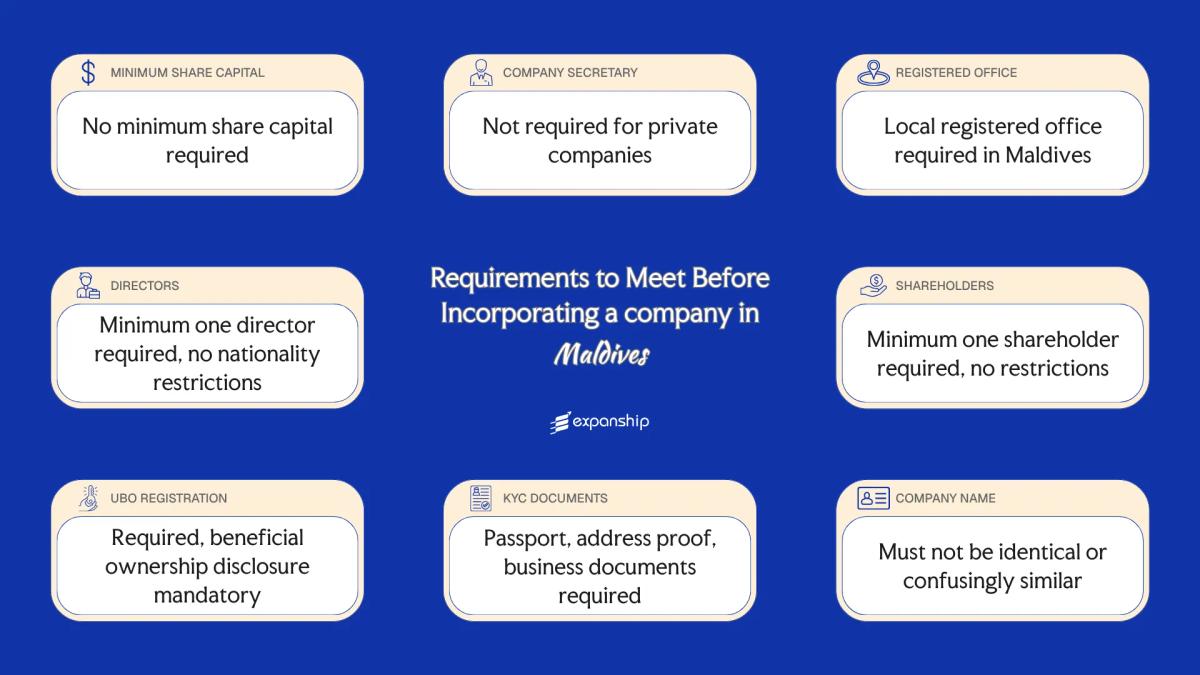
- A local registered office address in the Maldives is a mandatory requirement for incorporation, and foreign investors must arrange this as part of the formation process.
Company incorporation in Maldives is governed by the Companies Act (Law Number 10 of 1996), with entity formation and ongoing compliance administered by the Registrar of Companies under the Ministry of Economic Development. Understanding the full scope of incorporation requirements in Maldives before submitting an application is necessary, as incomplete or non-compliant filings result in registration rejection or the inability to operate lawfully.
Requirements span structural, documentary, and governance categories, each carrying distinct conditions depending on the entity type and the nature of the business activity.
Certain sectors, including tourism, fisheries, and financial services, are subject to additional regulatory oversight beyond the standard company formation framework. Your specific investor profile and ownership structure may also affect which requirements apply.
This article is most relevant to foreign investors and business owners seeking to establish a legal presence in the Maldives for the first time.
Minimum Share Capital Requirements in Maldives
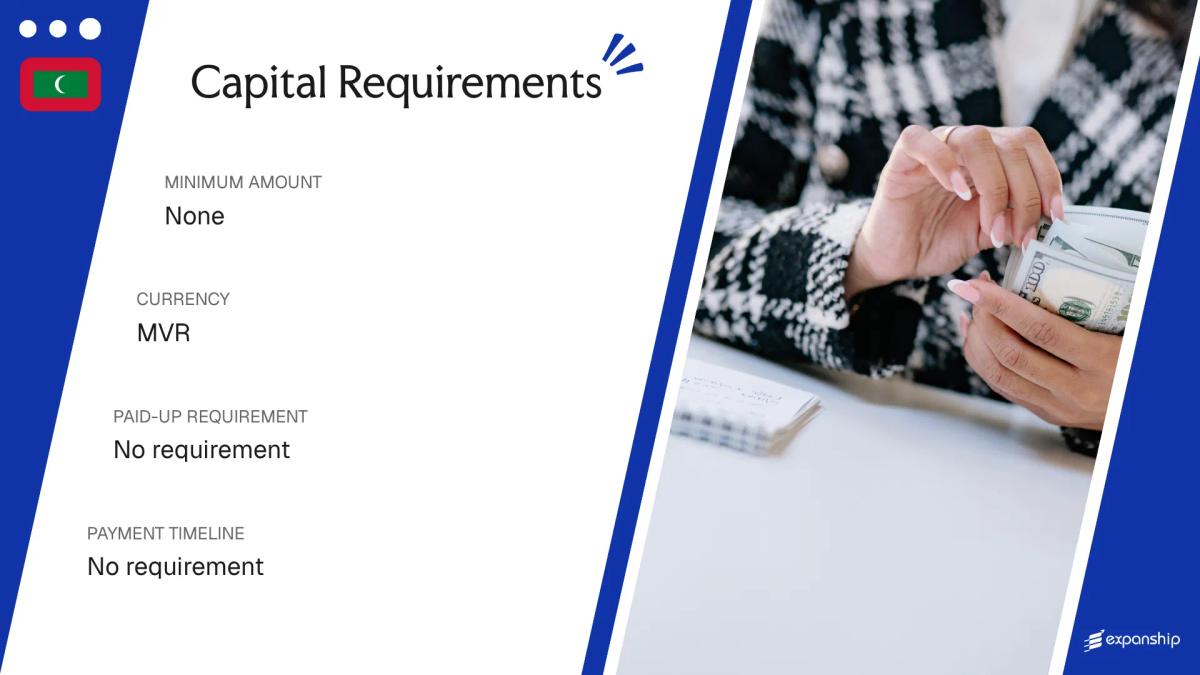
Under the Business Registration Act of Maldives, there are no statutory minimum share capital requirements imposed on private companies at the point of incorporation. The Registrar of Companies, operating under the Ministry of Economic Development, does not mandate a minimum capital threshold before a company can be registered.
Shares in Maldivian companies are issued on a par value basis, and the authorized capital structure must still be defined in the company's constitutional documents at the time of incorporation. Capital compliance is a one-time registration formality rather than an ongoing statutory obligation with periodic verification.
| Parameter | Detail |
|---|---|
| Minimum Authorized Share Capital | No statutory requirement |
| Maximum Authorized Share Capital | No statutory cap |
| Minimum Paid-Up Capital | No statutory requirement |
| Paid-Up Requirement at Incorporation | No statutory requirement |
| Accepted Currency | Maldivian Rufiyaa (MVR); foreign currency accepted for foreign-owned entities |
| Accepted Forms of Contribution | Cash; non-cash contributions permissible subject to valuation |
| Timeframe to Deposit Capital | No statutory deadline prescribed |
Even without a minimum paid-up capital rule, your company's authorized share capital and par value per share must be stated in its memorandum of association filed with the Registrar of Companies.
Company Secretary Requirements in Maldives
Under the Business Registration Act and regulations administered by the Ministry of Economic Development, Maldivian companies are required to appoint a company secretary. Meeting the company secretary requirements Maldives mandates is a statutory obligation, not an optional governance practice.
The secretary carries defined responsibilities under corporate law. These include maintaining the company's statutory registers, ensuring annual returns are filed with the Registrar of Companies, and acting as the formal point of contact for regulatory correspondence.
Qualification criteria for who may serve as company secretary:
- Must be a natural person; a corporate entity cannot fulfil this role
- No mandatory professional qualification is prescribed under current regulations, though competence in corporate compliance is expected
- Residency in the Maldives is generally required to meet the secretary compliance rules Maldives enforces for local regulatory accessibility
- Foreign nationals may be restricted from serving depending on the company type and applicable foreign ownership rules
- Must be at least 18 years of age and of sound legal standing

Incorporate a Company in the Maldives
Set up your business entity in the Maldives with guidance on registration, statutory compliance, and local requirements.
Registered Office Requirements in Maldives
Registered office requirements in Maldives are governed under the Companies Act (Law Number 10/96) and administered by the Registrar of Companies under the Ministry of Economic Development, which mandates that every registered company maintain a physical address within the country at all times. Failure to maintain a compliant address can result in the Registrar issuing notices of non-compliance, and in sustained cases, the company risks administrative deregistration.
- A physical address is required; P.O. Box addresses alone do not satisfy the registered office requirement.
- The address must be located within the Maldives; foreign addresses are not permitted.
- Virtual offices are not formally recognised as compliant registered office addresses under the Companies Act.
- Supporting documentation such as a lease agreement or proof of ownership must evidence the right to occupy the address.
- The registered office address is recorded on the public company registry maintained by the Ministry of Economic Development.
- Any change to the registered office address must be formally notified to the Registrar, with updated records filed accordingly.
Director Requirements in Maldives
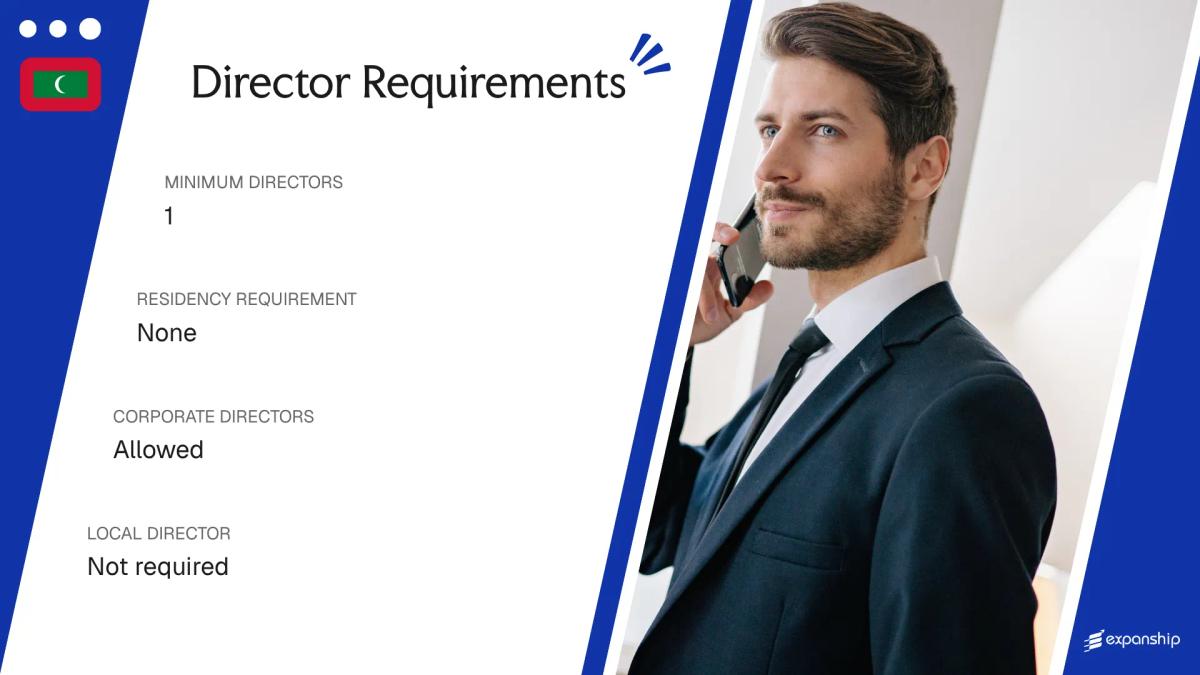
Under the Business Registration Act of Maldives and the Companies Act (Law Number 10/96), director requirements in Maldives place statutory duties of fiduciary care, financial accountability, and regulatory compliance on each appointed director from the date of incorporation.
| Parameter | Detail |
|---|---|
| Minimum Number of Directors | A minimum of one director is required. |
| Maximum Number of Directors | No statutory maximum is prescribed under the Companies Act. |
| Local/Resident Director Required | No mandatory local or resident director requirement exists under current law. |
| Nationality Restrictions | No nationality restrictions apply; foreign nationals may serve as directors. |
| Minimum Age Requirement | Directors must be at least 18 years of age. |
| Corporate Directors Permitted | Corporate directors are generally not recognised; natural persons are required. |
| Director Must Be a Shareholder | No statutory requirement for a director to hold shares in the company. |
| Publicly Listed on Registry | Director information is recorded with the Maldives Inland Revenue Authority and the Registrar of Companies, though full public access to directorship records is limited. |
| Disqualification Conditions | A director may be disqualified for bankruptcy, conviction of a criminal offence, or a court order of disqualification. |
Despite having no local director requirement, all director appointments must be formally registered with the Registrar of Companies under the Ministry of Economic Development, meaning foreign-only boards carry the same full compliance burden as locally constituted ones.
Shareholder Requirements in Maldives
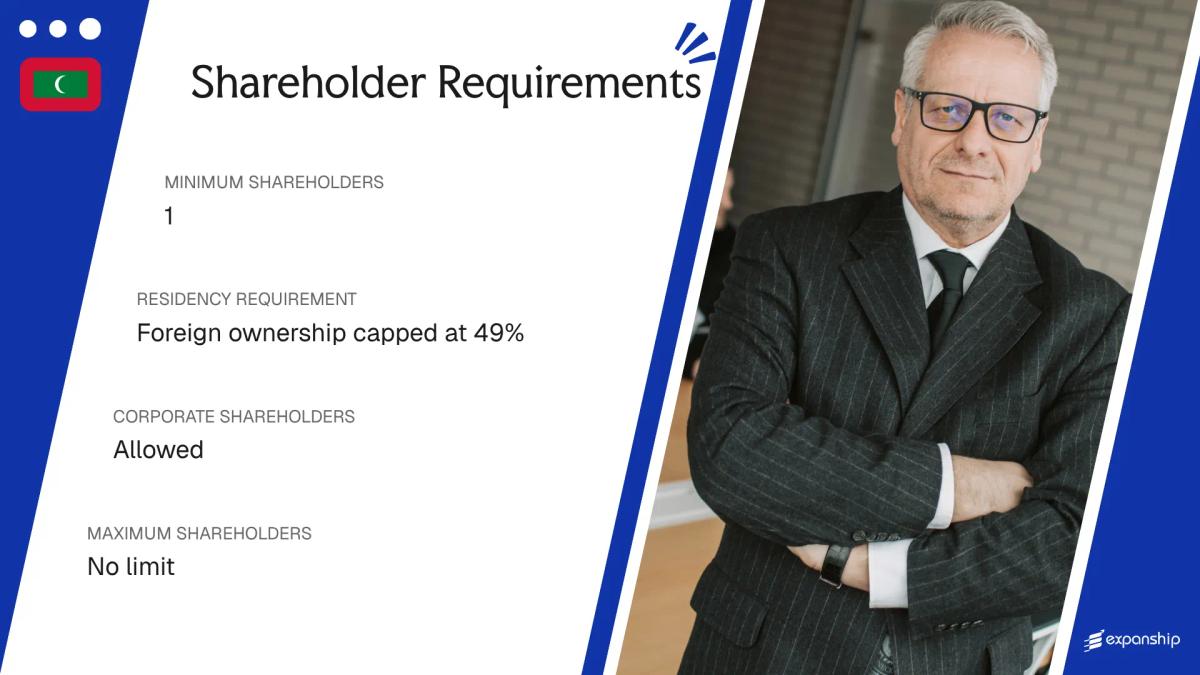
Under the Maldives Companies Act, a private company requires a minimum of one shareholder, permitting a sole shareholder structure. No statutory maximum is prescribed for private companies, though public companies are subject to distinct thresholds.
Nationality and Residency Restrictions
Foreign nationals may hold shares in a Maldivian company, but sector-specific regulations and the Foreign Investment Act impose ownership caps in certain industries. In sectors open to foreign participation, local equity participation may be required depending on the nature of the business activity.
Corporate Shareholders
Corporate entities are permitted to act as shareholders in a Maldives-registered company. The corporate shareholder must provide supporting documentation confirming its legal existence and authority to hold shares.
Shareholder Liability
Shareholder liability in a private limited company is restricted to the amount unpaid on each member's shares. Extended personal liability does not generally arise unless a court pierces the corporate veil in cases of fraud or misuse.
Register of Shareholders
A register of members must be maintained at the company's registered office. Filing obligations with the Registrar of Companies apply when ownership changes occur, though the register is not generally open to unrestricted public inspection.
Structure Your Maldives Company Ownership Correctly
Get guidance on shareholder eligibility, foreign ownership rules, and compliance obligations when setting up a company in the Maldives.
UBO / Beneficial Ownership Disclosure Requirements in Maldives
Under the Maldives' anti-money laundering framework, beneficial ownership disclosure requirements are established through the Prevention of Money Laundering and Terrorism Financing Act and administered by the Maldives Monetary Authority (MMA).
- Identify all individuals who directly or indirectly hold or control 20% or more of the shares or voting rights in the entity.
- Record the full legal name, nationality, date of birth, residential address, and nature of controlling interest for each beneficial owner.
- Submit the beneficial ownership information to the Registrar of Companies at the time of incorporation.
- Notify the relevant authority of any changes to beneficial ownership within a prescribed period following the change.
| Parameter | Detail |
|---|---|
| Ownership Threshold for UBO Status | 20% or more of shares or voting rights |
| Filing Authority | Registrar of Companies / Maldives Monetary Authority (MMA) |
| Disclosure Deadline at Incorporation | At the time of incorporation |
| Publicly Accessible Register | No statutory requirement for public access |
| Penalties for Non-Disclosure | Subject to penalties under the Prevention of Money Laundering and Terrorism Financing Act |
| Ongoing Update Obligation | Required upon any change in beneficial ownership |
KYC / Document Requirements in Maldives
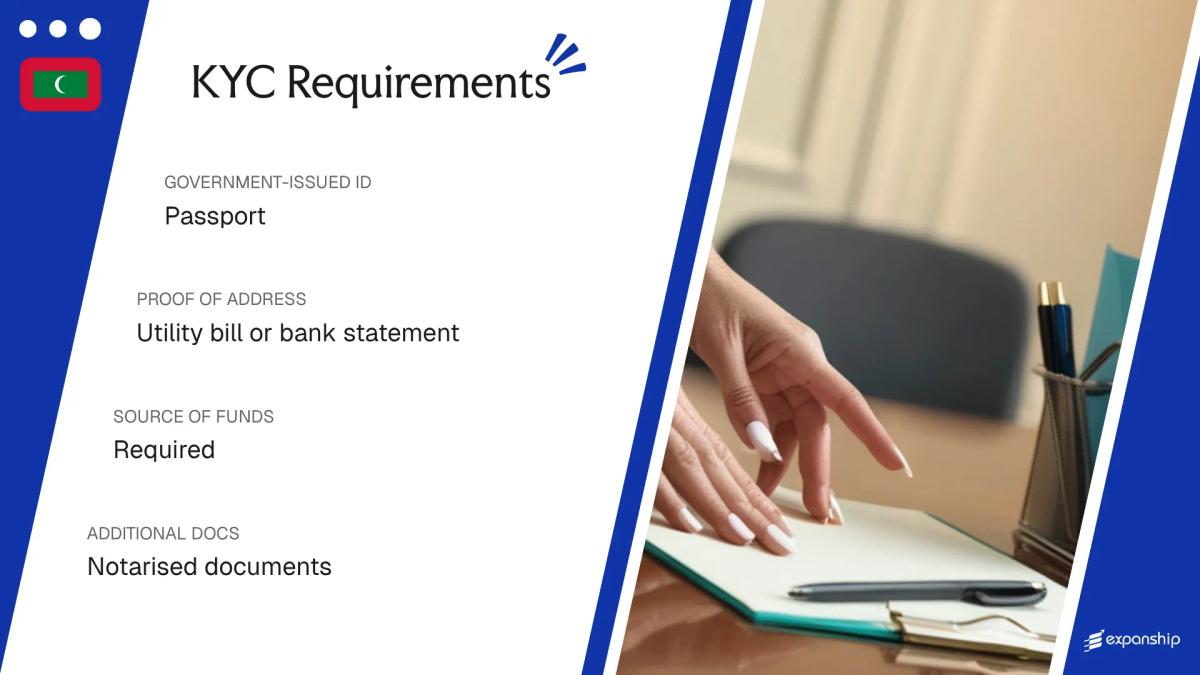
KYC document requirements in Maldives are governed by the Prevention and Prohibition of Money Laundering and Financing of Terrorism Act (Law No. 14/2014), which places due diligence obligations on registered agents and company formation intermediaries at the point of incorporation. The Financial Intelligence Unit oversees AML compliance and issues guidance that shapes what documents must be collected before a company can be registered.
Individual / Personal Documents
- Valid passport or national identity card for each director, shareholder, and beneficial owner
- Proof of residential address dated within three months, such as a utility bill or bank statement
- A signed and dated KYC declaration or self-certification form where required by the registered agent
- Recent passport-sized photograph may be required depending on the registered agent's internal procedures
Corporate Documents
- Certificate of incorporation or equivalent registration certificate for the corporate entity
- Constitutional documents, such as articles of association or memorandum of association
- Register of directors and register of shareholders from the home jurisdiction
- Proof of registered office address for the corporate shareholder or director
Source of Funds Documentation
- Recent bank statements covering a minimum of three to six months
- Audited financial statements or management accounts where bank statements are insufficient
- A written source of funds declaration signed by the relevant party
Notarisation and Apostille Requirements
- Foreign-issued identity and corporate documents generally require notarisation by a qualified notary
- Documents from non-Hague Convention countries may require embassy legalisation instead of an apostille
- Certified English translations are required for any document not originally in English or Dhivehi
Incomplete or unverified source of funds documentation is among the most common reasons for incorporation delays under Maldives AML compliance review.
Company Name Requirements in Maldives
Company name requirements in Maldives are assessed by the registrar at the point of incorporation, with proposed names evaluated for uniqueness, public interest, and general suitability before registration is approved.
Names must be in English or Dhivehi and include a legal suffix that reflects the entity type, such as "Pvt Ltd" for a private limited company. No specific character or word length limit is publicly codified, though names must be clearly distinguishable.
Certain words are restricted. Terms implying government affiliation, financial institutions, or professional bodies typically require prior approval from the relevant authority.
Name reservation is available through the registrar prior to formal incorporation. Reservation periods are generally short-term, and the application is submitted as part of the pre-registration process.
Compliance Services for Companies in the Maldives
Stay aligned with Maldivian regulatory requirements through ongoing compliance support covering filings, renewals, and reporting obligations.
Conclusion
Incorporation requirements in Maldives are governed primarily by the Companies Act 10/96 and administered through the Maldives Inland Revenue Authority and the Registrar of Companies. The framework covers a defined set of conditions that foreign investors must satisfy before a business can legally operate.
Among the more consequential conditions are the foreign ownership restrictions in regulated sectors and the requirement for a local registered office address. Beneficial ownership disclosure obligations under anti-money laundering regulations also impose ongoing compliance duties beyond the initial registration.
Once these requirements are understood, the practical work of preparing documentation, appointing officers, and engaging with the relevant authorities begins.
Expanship's Support for Your Maldives Expansion
Maldives company formation compliance support involves coordinating with the Economic Development and Trade Ministry, maintaining a registered local office, and meeting the foreign ownership restrictions that apply to most standard business structures. Expanship works alongside you to manage the preparation and coordination these requirements involve, reducing the administrative load on your team.
Our services cover the full incorporation and post-setup cycle:
- We handle company registration and prepare the documents required by Maldivian authorities.
- Our team provides registered agent and office arrangements to satisfy local presence requirements.
- We manage government filings and liaise directly with the relevant regulatory bodies on your behalf.
- Ongoing compliance obligations are tracked and managed after your entity is established.
- We facilitate introductions to banking institutions suited to your business profile.
- Tax registration and coordination with local authorities is handled as part of the setup process.
To discuss your requirements, contact Expanship Maldives.
Frequently Asked Questions (FAQ)
A foreigner can serve as a director of a Maldivian company, but the directorship composition requirements and any residency conditions attached to that role are governed by the Companies Act of the Maldives. Whether a sole foreign director is permitted without a local co-director depends on the company type and the sector in which the business operates. Certain regulated industries impose additional local director requirements beyond the general company law baseline.
Your company is required to maintain a valid, physical registered office address in the Maldives at all times, and any change must be formally notified to the Registrar of Companies. Failure to keep this information current can result in compliance issues, including difficulties receiving official correspondence and potential penalties under the Companies Act. The update must be filed promptly; there is no grace period that suspends your legal obligation to maintain a valid local address.
Yes, beneficial ownership obligations in the Maldives extend to indirect ownership arrangements, meaning that individuals who exercise ultimate control through layered or nominee structures are still required to be disclosed. The intent of the UBO framework is to identify the natural person who ultimately owns or controls the entity, regardless of how many intermediate holding layers exist. Structuring ownership indirectly does not exempt your business from these disclosure obligations.
Foreign shareholders are generally required to submit certified copies of valid passports, proof of residential address, and source-of-funds documentation as part of the KYC process administered through the Registrar of Companies. The certification standard for these documents, whether notarized, apostilled, or consularized, depends on the country of origin and any applicable bilateral agreements. Incomplete or improperly certified documents will delay registration, as the Registrar will not process the application until all KYC requirements are satisfied.
Certain words are restricted or prohibited in Maldivian company names, including terms that imply government affiliation, regulated financial activities, or mislead the public about the nature of the business. The Registrar of Companies has the authority to reject a proposed name that conflicts with an existing registered entity or violates naming conventions set out under the Companies Act. You should conduct a name availability search through the official registry before submitting your incorporation application to avoid refiling delays.
Failing to report changes in beneficial ownership to the relevant Maldivian authority is a compliance breach that can attract penalties under the applicable AML and corporate transparency regulations. The obligation to update UBO records is ongoing, not a one-time requirement at incorporation, and any transfer of ownership that changes the ultimate beneficial owner must be reported within the prescribed timeframe. Continued non-disclosure can escalate the severity of the regulatory response, including potential restrictions on the company's ability to operate.
Legal Disclaimer
The information provided in this article is for general informational purposes only and does not constitute legal, tax, or professional advice. While we strive to ensure the accuracy and timeliness of the content, laws and regulations are subject to change, and the application of laws can vary widely based on specific facts and circumstances.
Readers should not act upon this information without seeking professional counsel tailored to their individual situation. Expanship and its authors disclaim any liability for actions taken or not taken based on the content of this article.
For specific advice regarding your business setup, compliance requirements, or any legal matters, please consult with qualified legal and tax professionals in the relevant jurisdiction.