

Key Takeaways
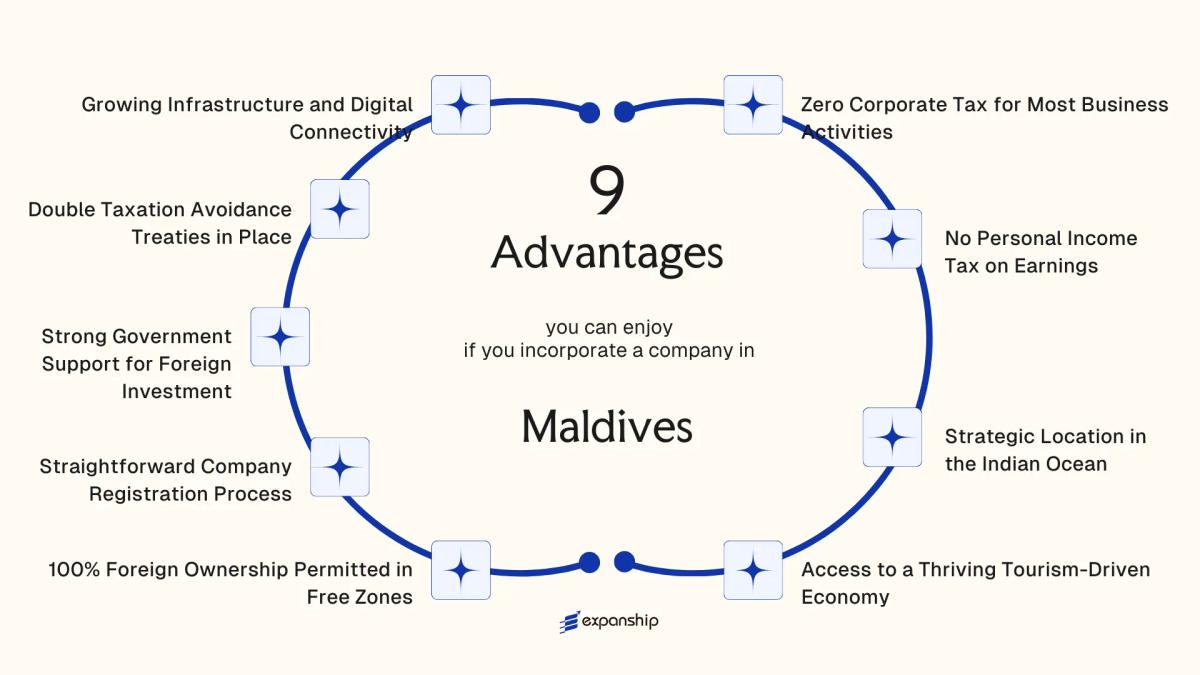
- Businesses incorporated in the Maldives benefit from a zero corporate tax regime across most activity categories, administered by the Maldives Inland Revenue Authority, making it one of the lightest tax environments available to foreign operators in the Indian Ocean region.
- Under the Maldives Investment Act, foreign investors can hold 100% ownership of entities established within free zones, eliminating the local partnership requirements that restrict ownership structures in comparable island jurisdictions.
- The absence of personal income tax means that earnings distributed to foreign founders and shareholders are not subject to individual-level taxation under Maldivian law, a structural advantage that compounds the entity-level tax position.
- Foreign businesses entering through a Private Limited Company structure gain access to a tourism-driven economy where service-sector demand is concentrated and internationally sourced, creating a commercially active environment that the Ministry of Economic Development's licensing framework is designed to accommodate.
The benefits of incorporating in Maldives draw interest from businesses across sectors ranging from tourism and hospitality to trade and financial services. An independent sovereign nation in the Indian Ocean, the Maldives operates under a civil law-influenced legal framework and maintains an open posture toward foreign direct investment across several categories of commercial activity. Company registration falls under the purview of the Maldives Inland Revenue Authority and the Ministry of Economic Development, which administers business licensing and entity formation.
Foreign businesses most commonly enter the market through a Private Limited Company structure. The jurisdiction operates a generally low-tax regime, with specific exemptions and thresholds that vary by activity type and entity classification. Foreign ownership is permitted across many sectors, though certain activities require local participation or are subject to approval conditions outlined in applicable investment regulations. This article covers the key advantages your business gains by establishing a formal presence here.
Zero Corporate Tax for Most Business Activities
The Maldives operates under a tax regime that makes it one of the few jurisdictions where zero corporate tax applies to a broad range of business activities — a feature governed primarily by the Business Profit Tax (BPT) Act.
How BPT Is Structured
Under the Business Profit Tax Act, businesses generating annual profits below MVR 500,000 (approximately USD 32,000) are exempt from BPT entirely. Profits above this threshold are taxed at a flat rate of 15%, which means smaller operations and early-stage entities can operate with no direct tax liability on earnings.
What This Means for Foreign-Owned Entities
For a foreign business structured to operate within that exemption threshold, the practical outcome is a zero-tax environment on retained profits — without requiring offshore structuring or special dispensations. Certain sectors, particularly those operating under specific investment frameworks administered by the Maldives Inland Revenue Authority (MIRA), may qualify for additional tax considerations depending on the nature of the activity and applicable agreements.
Profits below MVR 500,000 annually face no BPT liability, allowing qualifying entities to retain earnings in full without corporate tax obligation.
No Personal Income Tax on Earnings
There is no personal income tax in Maldives. Individuals, including foreign nationals and resident directors, are not subject to tax on salaries, dividends, or other personal earnings received through a locally registered entity. This position is established under the Maldives Income Tax Act (Law Number 25/2019), which introduced a corporate income tax framework but left personal income untaxed for most categories of individuals.
For a foreign investor drawing remuneration or profit distributions from a business here, the absence of a personal levy means your take-home income is not reduced by a layer of individual taxation on top of any corporate obligations. That structural gap between business-level and personal-level taxation is a material financial advantage, particularly for owner-managed firms where salary and dividend planning directly affects net returns.
Several features reinforce why this matters in practice:
- Dividend income paid to individual shareholders carries no withholding obligation at the personal level
- Expatriate directors can receive remuneration without triggering a local personal tax filing requirement
- Profit extraction from a qualifying entity is not subject to progressive rate schedules that would otherwise erode returns at higher income levels
Tax residency rules and any obligations under your home country's tax regime remain separately applicable and should be assessed independently.

Company Incorporation in Maldives
Register your business entity in Maldives with full guidance on legal structure, documentation, and compliance requirements.
Strategic Location in the Indian Ocean
Sitting at the geographic center of the Indian Ocean, the Maldives occupies a position that carries direct commercial significance. The archipelago lies along one of the world's busiest maritime corridors, connecting the Gulf of Aden and the Persian Gulf to the Strait of Malacca. Roughly 60,000 vessels transit the Indian Ocean annually, and businesses registered here can position themselves within reach of that flow without the overhead structures typical of larger port economies.
| Market | Approximate Sea Distance | Relevance |
|---|---|---|
| India (Mumbai) | ~1,200 km | Largest regional trade partner |
| Sri Lanka (Colombo) | ~700 km | Major transhipment port |
| Singapore | ~3,000 km | Southeast Asia gateway |
| UAE (Dubai) | ~2,800 km | Gulf trade and logistics hub |
For companies operating in trade, logistics, or re-export, this proximity to South Asia and the Gulf reduces transit time and operational friction. India alone represents a market of over 1.4 billion people within a few hours by air or sea. Your firm benefits from time zone alignment with markets stretching from East Africa to Southeast Asia, spanning UTC+3 to UTC+8, which supports real-time coordination across a broad trading arc.
The Maldivian government has structured its free zones, governed under the Maldives Free Zone Act, to allow foreign entities to capitalize on this position by permitting goods handling and distribution activities without the standard import duty obligations that apply domestically.
Access to a Thriving Tourism-Driven Economy
Maldives tourism economy business opportunities are concentrated in one of the world's most commercially significant leisure markets. Tourism accounts for roughly 25–30% of the country's GDP and generates the dominant share of foreign exchange earnings. For a foreign business, this concentration creates a direct, high-volume market with consistent cross-border spending.
The Tourism Act (Law No. 2/99) and its successive amendments govern commercial activity tied to hospitality, resort operations, and tourism services. Businesses incorporated locally gain the standing to contract directly with the Maldives Tourism Promotion Board and licensed resort operators, which is not accessible to purely offshore entities.
Visitor arrivals have consistently exceeded 1.5 million annually in recent post-pandemic years. Spending per visitor is among the highest globally within the luxury segment, which means businesses supplying services to this sector face buyers with substantial per-transaction value.
Keep these points in mind:
- Commercial activity linked to tourism may require sector-specific licensing under the Tourism Act
- Certain activities, such as resort island leasing, are reserved for arrangements with the government
- Service providers to resorts must often hold local legal standing to enter procurement contracts
- Benefits of investing in the Maldives tourism sector depend significantly on your business classification under the Ministry of Tourism's licensing categories
The Maldivian government leases resort islands to developers rather than selling land, meaning real estate-style asset ownership in tourism is structured entirely around long-term lease agreements, not title transfer.
100% Foreign Ownership Permitted in Free Zones
100% foreign ownership Maldives free zones is not a blanket national policy — it applies specifically within designated special economic areas regulated by the Maldives Free Zones Authority, operating under the Maldives Free Zones Act (Law Number 18/2014). This legal framework allows foreign nationals to hold the entire equity stake in a free zone entity without requiring a local partner or nominee shareholder. For investors accustomed to jurisdictions that mandate 49% or 51% local ownership, this is a structurally significant distinction.
Ownership Without a Local Partner
Full foreign ownership means your business decisions, profit distribution, and exit strategy remain entirely within your control. There is no obligation to share governance with a resident stakeholder whose interests may diverge from yours over time.
The Maldives Free Zones Authority (MFDA) oversees registration and compliance for entities operating within these zones. Because ownership structure is codified under the Free Zones Act rather than left to administrative discretion, the arrangement carries legal certainty — not just a policy preference that can shift between governments.
Scope and Structural Clarity
Free zone entities are permitted to engage in a defined range of activities, including trade, logistics, and services oriented toward international markets. Ownership rights attach to the entity at incorporation and are not subject to phased dilution requirements that some jurisdictions impose as businesses scale.
This structure is particularly relevant if you plan to consolidate regional operations under a single holding point, since the MFDA framework permits foreign-owned subsidiaries to be established within the zone.
Structure Your Maldives Free Zone Entity the Right Way
Speak with Expanship's corporate services team about setting up a fully foreign-owned entity in a Maldives free zone under the correct regulatory framework.
Straightforward Company Registration Process
Registration in the Maldives is handled through the Maldives Inland Revenue Authority (MIRA) and the Ministry of Economic Development, which serves as the primary registrar for business entities. The process is centralized, document requirements are defined, and incorporation timelines are relatively short compared to many emerging market jurisdictions. For a foreign investor, this structure means your business can become operational without extended administrative delays.
- A private limited company can typically be registered within a few working days once all required documents are submitted to the Ministry of Economic Development, reducing the window between decision and operational status.
- The registration process is conducted through a defined online portal, which removes the need for in-person attendance for many procedural steps, a practical advantage if you are managing the setup from outside the country.
- Required documentation follows a standardized format, so you can prepare materials in advance without navigating unpredictable or jurisdiction-specific procedural variations.
- MIRA assigns a Taxpayer Identification Number (TIN) as part of the post-incorporation process, consolidating your tax registration with your corporate setup rather than treating them as separate administrative tracks.
- The Maldives business-friendly registration environment means that the Registrar of Companies operates under the Companies Act (Law No. 10/96), which provides a codified legal basis for company formation, giving your entity a defined statutory footing from incorporation.
Strong Government Support for Foreign Investment
Maldives government support for foreign investment is institutionally structured through the Maldives Investment Promotion Authority (MIPA), the statutory body established to facilitate, promote, and protect inbound foreign investment. MIPA functions as a single point of contact, coordinating across government agencies to reduce the administrative burden on foreign investors seeking approvals or permits.
Under the Maldives Investment Act (Law Number 25/79 and its subsequent amendments), foreign investors are afforded legal protections including guarantees against expropriation without compensation and the right to repatriate profits, capital, and proceeds from liquidation. These protections are codified rights, not administrative discretions, which gives your business a predictable legal standing from the point of incorporation.
MIPA also administers investment facilitation services directly, including assistance with land lease negotiations, sectoral licensing guidance, and liaising with the Ministry of Economic Development. For a foreign business owner, this means regulatory coordination happens through a single agency rather than across disconnected ministries.
A foreign investor operating through a Maldives-registered entity retains full rights to transfer dividends, loan repayments, and capital abroad, subject to compliance with the Maldives Investment Act, removing a common barrier to profit repatriation that exists in many emerging market jurisdictions.
Double Taxation Avoidance Treaties in Place
Maldives double taxation avoidance treaty benefits are more limited in scope than those offered by larger financial centres, but the existing agreements carry practical weight for specific investor profiles. The country has signed DTAAs with a small number of jurisdictions, including Sri Lanka and the UAE, among others.
For businesses structured to qualify under these treaties, the agreements reduce or eliminate withholding taxes on dividends, interest, and royalties paid across borders. This directly reduces the tax cost of repatriating profits or servicing inter-company loans between a Maldivian entity and a treaty partner.
Treaty eligibility typically requires that your company has genuine substance and tax residency in the Maldives, which the Maldives Inland Revenue Authority (MIRA) administers under the Tax Administration Act. Passive holding structures with no operational presence may not qualify for treaty protection.
- Treaty relief can apply to income streams such as dividends, royalties, and service fees
- Benefits vary by treaty partner, so the applicable rates must be confirmed against the specific bilateral agreement
- MIRA is the competent authority for residency certification and treaty claims
Treaty benefits apply only to entities that can demonstrate tax residency and sufficient economic substance in the Maldives, as assessed by MIRA.
Growing Infrastructure and Digital Connectivity
Maldives infrastructure growth benefits for businesses are increasingly tangible, particularly as the government has committed substantial public investment to inter-atoll transport, energy, and digital systems under successive national development plans.
Submarine Cable Connectivity
The country's connection to international submarine cable networks has materially improved bandwidth availability and reduced latency for data-dependent operations. For a foreign firm running cloud-based services, regional coordination functions, or financial back-office work, reliable high-capacity internet access is a functional requirement rather than a convenience. Ongoing cable infrastructure investments are expected to increase redundancy across the archipelago.
Telecommunications Regulation
The Communications Authority of Maldives (CAM) regulates the sector under the Telecommunications Act, overseeing service quality standards and spectrum allocation. Two primary operators, Dhiraagu and Ooredoo Maldives, provide coverage across inhabited islands, meaning your business does not depend on a single-provider network. Competitive provision across the archipelago gives entities in outlying economic zones access to connectivity that was unavailable a decade ago.
Airport and Port Infrastructure
Velana International Airport's ongoing expansion, including a new passenger terminal and cargo facility, directly affects logistics timelines for goods-based businesses. The port infrastructure upgrades at Malé support import-dependent supply chains. For a foreign company that sources or distributes physical goods through the region, reduced port congestion translates to lower operational holding costs.
- Improved inter-island ferry and domestic aviation networks reduce dependency on Malé as a sole logistics hub
- Expanded cargo handling capacity supports time-sensitive freight operations
- Government-backed energy projects are reducing generator dependency on outer islands, improving operational reliability for businesses outside the capital
Why Maldives Stands Out Among Island Jurisdictions
Comparing the Maldives advantages over other island jurisdictions requires selecting competitors that target a genuinely similar investor profile. Seychelles, Mauritius, and Sri Lanka each attract foreign capital through preferential tax regimes or strategic Indian Ocean positioning, making them the realistic alternatives a foreign investor would weigh. What the comparison reveals is less about headline tax rates and more about which jurisdiction offers structural clarity without layered conditions.
Mauritius, for instance, requires a Global Business Licence for foreign-facing entities and carries treaty obligations that come with substance requirements. Seychelles offers low incorporation costs but limited treaty access, which can complicate repatriation of funds for investors with cross-border operations. Sri Lanka, while geographically proximate, imposes corporate tax at rates up to 30% depending on sector. Against that backdrop, the Maldivian framework — governed by the Maldives Inland Revenue Authority and structured under the Business Profit Tax Act for limited categories — presents a lighter compliance architecture for qualifying businesses.
| Parameter | Maldives | Mauritius | Seychelles |
|---|---|---|---|
| Standard Corporate Tax Rate | 15% (BPT applies above threshold) | 15% | 25% (domestic) |
| Personal Income Tax | None | None | None |
| Foreign Ownership | 100% in Free Zones | 100% in most sectors | 100% permitted |
| Double Taxation Treaties | Limited but growing | Extensive (45+ treaties) | Limited |
| Free Zone Availability | Yes | Yes (Freeport) | Limited |
| Regulatory Body | MIRA / MIRA-registered agents | FSC Mauritius | FSA Seychelles |
Compliance Services for Companies in the Maldives
Maintain good standing with MIRA and meet your annual filing, reporting, and regulatory obligations with structured compliance support.
Conclusion
The core case for the benefits of incorporating in Maldives rests on a convergence of structural tax advantages and a foreign-investment framework that few island jurisdictions replicate: zero corporate tax across most business categories, the absence of personal income tax, and 100% foreign ownership within free zones, all governed by the Maldives Investment Act and overseen by the Maldives Inland Revenue Authority.
These features carry different weight depending on your business model. A firm structured around tourism-adjacent services extracts more value from the economy's composition than one in manufacturing. Tax treaty access and free zone eligibility also vary by entity type and intended activity, so the alignment between your operational structure and the regulatory framework determines how fully these advantages apply.
For foreign investors whose business profile fits the jurisdiction's strengths, the practical foundations are already in place. The next step is translating that alignment into a properly structured, compliant entity registered under Maldivian law.
Let Expanship Handle Your Maldives Company Setup
Expanship provides incorporation and compliance support specifically structured around the regulatory environment discussed throughout this blog. From registering entities under the Companies Act of the Maldives with the Registrar of Companies to maintaining ongoing compliance with the Maldives Inland Revenue Authority (MIRA), each service maps directly to the obligations a foreign business owner faces here. The entity types covered, including private limited companies and foreign investor companies under the Foreign Investment Act, each carry distinct filing requirements that Expanship manages on your behalf.
Across the full incorporation lifecycle, Expanship handles the following:
- Document preparation, notarization, and legalization for submission to the Registrar of Companies
- Registered agent and registered office provision as required under Maldivian corporate law
- Government filing and direct liaison with the Registrar and relevant regulatory authorities
- Post-incorporation compliance management, including annual returns and statutory recordkeeping
- Banking introduction assistance to support account opening with locally operating financial institutions
- Coordination with MIRA for tax registration and Business Profit Tax (BPT) threshold assessments
Each of these services reduces the administrative burden on your team, particularly when your principals are based outside the country and cannot be physically present for procedural steps.
To discuss your incorporation requirements, contact Expanship Maldives directly.
Frequently Asked Questions (FAQ)
Most business activities in the Maldives are subject to a zero percent corporate tax rate, which is governed under the Business Profit Tax (BPT) framework administered by MIRA. The BPT applies to profits exceeding a threshold, and tourism-related entities, particularly those holding resort leases, are subject to specific tax treatment distinct from general commercial entities. Your firm's applicable rate depends on the nature of its registered activities and the jurisdiction in which income is sourced.
The Maldives has signed a limited number of double taxation avoidance treaties, though its treaty network is not as extensive as jurisdictions such as Singapore or Mauritius. The agreements that are in force are intended to prevent the same income from being taxed in both the Maldives and the treaty partner country. You should verify the current list of treaty partners through MIRA, as treaty coverage directly affects how dividend repatriation and cross-border income are treated.
Registration timelines vary depending on the entity type and whether the business falls under the standard Companies Act framework or requires approval under the Special Economic Zones Act of 2014. Standard company incorporation through the Registrar of Companies under the Ministry of Economic Development generally takes between five and fifteen business days, assuming all documents are in order. Activities requiring additional regulatory approvals, such as those in the financial services or telecommunications sectors, are subject to longer processing timelines.
Under the Companies Act of the Maldives, private limited companies are generally required to have at least one director, and for certain business categories, a local presence or nominee arrangement may be required. The specific residency requirements for directors depend on the company type and the sector in which it operates. Foreign investors should review the relevant provisions of the Companies Act alongside any sector-specific licensing conditions issued by the applicable regulatory authority.
The Business Profit Tax in the Maldives is generally applied to income derived from activities conducted within the country, which means foreign-sourced income may fall outside the scope of BPT. However, the precise tax treatment depends on how the income is classified and whether the entity has a taxable presence in the Maldives under MIRA's administrative guidelines. You should obtain a formal tax position assessment from a qualified advisor before assuming that offshore income is entirely excluded from local tax obligations.
The Maldives sits along active Indian Ocean shipping and air corridors, placing it within reach of major South Asian economies including India and Sri Lanka, as well as East African coastal markets. While the country's own domestic market is small, its geographic position and improving digital infrastructure make it a functional operational base for certain logistics, maritime, and digitally delivered services. Its utility as a regional hub depends significantly on the nature of your business and whether your operations require physical distribution infrastructure or primarily rely on connectivity.
Legal Disclaimer
The information provided in this article is for general informational purposes only and does not constitute legal, tax, or professional advice. While we strive to ensure the accuracy and timeliness of the content, laws and regulations are subject to change, and the application of laws can vary widely based on specific facts and circumstances.
Readers should not act upon this information without seeking professional counsel tailored to their individual situation. Expanship and its authors disclaim any liability for actions taken or not taken based on the content of this article.
For specific advice regarding your business setup, compliance requirements, or any legal matters, please consult with qualified legal and tax professionals in the relevant jurisdiction.