
Key Takeaways
- Foreign investors incorporating in Maldives must contend with mandatory local shareholder ownership requirements under the Companies Act, which structurally limits the degree of control non-Maldivian founders can retain in many business types.
- Sector-specific foreign ownership caps in industries such as tourism and fisheries mean that market entry in the economy's most commercially significant areas requires local partnerships rather than fully foreign-owned structures.
- MIRA's tax registration and ongoing compliance obligations add administrative layers that are disproportionately burdensome for small or early-stage foreign businesses with limited in-country operational support.
- The Maldives' narrow domestic market, concentrated tourism dependency, and restricted land lease access for foreign entities collectively constrain the commercial scalability of most non-hospitality business models incorporated there.
Maldives operates under an evolving regulatory framework, shaped largely by the Companies Act and administered through bodies such as the Maldives Inland Revenue Authority (MIRA) and the Economic Development Authority (EDA). The framework is neither heavily prescriptive nor fully liberalized, placing it in a transitional category that foreign investors often find difficult to assess from the outset.
The disadvantages of incorporating in Maldives span ownership restrictions, sector-specific limitations, banking access, workforce constraints, and land tenure issues. Not all of these will apply equally to every business — the drawbacks of Maldives company formation affect a tourism-adjacent service firm differently than a tech startup or a trading entity.
This article is most relevant to foreign entrepreneurs and international firms considering direct market entry, rather than those using the country purely as a holding or pass-through structure. Understanding the cons of registering a business in Maldives requires attention to your specific industry, intended structure, and operational footprint.
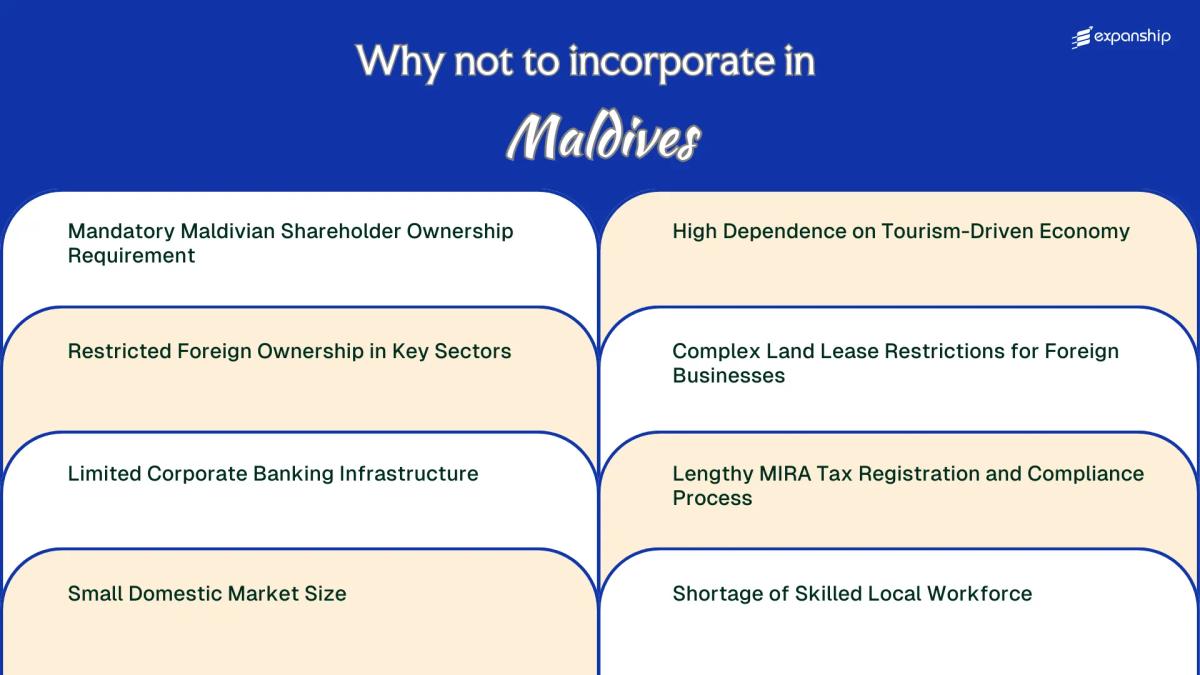
Mandatory Maldivian Shareholder Ownership Requirement
The Maldives mandatory local shareholder requirement directly limits how much of your company a foreign investor can legally own, creating a structural dependency on a local partner from day one.
The 51% Local Ownership Rule and Its Consequences
Under the Maldives Foreign Investment Act and regulations administered by the Economic Development Ministry, most business activities require that a Maldivian national holds a minimum 51% shareholding. Your firm, regardless of its size or the capital it brings in, cannot hold a majority stake in most standard business categories.
This means critical decisions, profit distribution, and directional control are subject to a partner who holds majority ownership by law, not by commercial agreement.
Structural Risk of Mandatory Local Partnership
Dependency on a local partner exposes your business to disputes over profit-sharing, governance rights, and exit terms, particularly since minority foreign shareholders have limited leverage when disagreements arise. Vetting and retaining a reliable Maldivian shareholder adds both cost and delay before operations can begin.
Some sectors permit higher foreign ownership percentages under specific investment agreements, but these are exceptions requiring direct government negotiation rather than a standard registration process.
A foreign investor holding only 49% of shares has no legal majority to override the local shareholder on binding company decisions, regardless of who provided the operating capital.
Restricted Foreign Ownership in Key Sectors
Restricted foreign ownership sectors in the Maldives cover a wider range of industries than many investors anticipate. Under the Maldives Investment Law and its associated regulations, certain sectors are either fully closed to foreign participation or subject to ownership caps that structurally limit your control.
Retail trade is reserved exclusively for Maldivian nationals. Foreign firms are also barred from operating in wholesale trade below specific thresholds, fishing for domestic consumption, and several service categories tied to local community welfare.
For sectors where partial foreign ownership is permitted, the restrictions create tangible friction:
- You may hold a minority stake while a Maldivian partner retains decision-making authority, exposing your capital to governance disputes
- Sectors like fisheries and local trade require full local ownership, eliminating foreign entry regardless of investment size
- Ownership caps force your firm into joint venture structures that increase negotiation costs and legal setup time
- Any sector reclassification by the Ministry of Economic Development can retroactively affect your approved business activities
Certain exemptions apply in designated special economic zones, but these cover a narrow set of industries, primarily large-scale tourism and resort development.

Company Incorporation in the Maldives
Understand ownership requirements and sector restrictions before registering your business in the Maldives.
Limited Corporate Banking Infrastructure
Maldives corporate banking limitations present a tangible operational barrier for foreign-owned entities from the outset. The domestic banking sector is small, with a handful of institutions, including Bank of Maldives (BML) and Maldives Islamic Bank, holding the majority of commercial accounts. This concentration means foreign companies have few alternatives if their account application is rejected or delayed.
Opening a corporate account typically requires extensive documentation, in-person appearances, and approval timelines that can extend several weeks. For a foreign director who is not resident in the country, each stage adds cost and logistical friction that would not arise in jurisdictions with digital onboarding frameworks.
| Constraint | Specific Burden |
|---|---|
| Number of major commercial banks | Fewer than 5 institutions serving the entire market |
| Foreign currency account access | Restricted; USD accounts subject to conditions tied to business activity type |
| Non-resident director account opening | Requires in-person verification; remote processing not standardised |
| International wire transfer capacity | Limited correspondent banking relationships increase transaction costs |
| Offshore banking options | Not available; no offshore or free zone banking framework exists |
Correspondent banking relationships between Maldivian banks and major international financial institutions are limited. This directly affects cross-border payment processing speeds and imposes higher intermediary fees on your transactions compared to firms banking in larger financial centres.
No offshore banking framework exists under current Maldivian financial regulation, meaning businesses cannot access ring-fenced offshore accounts. Companies with high volumes of international transactions face structural inefficiencies that cannot be resolved through domestic banking arrangements alone.
Small Domestic Market Size
The Maldives small domestic market drawbacks are most visible in the numbers. With a resident population of approximately 520,000 people spread across 200 inhabited islands, your addressable customer base is structurally limited before you factor in purchasing power or logistics.
Consumer goods and services businesses face a ceiling that geography enforces without exception. Supplying customers across atolls requires inter-island logistics, which raises per-unit distribution costs considerably compared to a continental or even small landlocked market.
National Bureau of Statistics data shows that GDP per capita is skewed by tourism receipts, meaning real domestic purchasing power among the resident population is narrower than headline figures suggest. A foreign firm targeting the local consumer market will find that actual addressable revenue is much lower than GDP comparisons imply.
Only export-oriented or tourism-linked business models can partially escape this constraint, but those remain tied to a single dominant sector.
- Market size calculations must exclude transient tourist populations, who fall under different commercial regulations
- Inter-atoll distribution adds a structural cost layer with no equivalent in single-island or mainland markets
- Consumer spending by residents is the operative revenue base, not blended GDP figures
- Your business model must account for limited local reinvestment capacity if profits are generated domestically
Did You Know? The Maldives has more uninhabited islands than inhabited ones, meaning over 1,000 islands generate zero domestic commercial activity by population.
High Dependence on Tourism-Driven Economy
The Maldives tourism economy dependency risks are not abstract — they are structural. Over 25% of GDP and more than 60% of foreign exchange earnings flow directly from tourism, leaving the broader economy with few insulating buffers.
Structural Concentration and What It Means for Foreign Businesses
Any business incorporated here that operates in ancillary sectors — retail, logistics, professional services — inherits exposure to tourism cycles without necessarily participating in tourism revenue. When visitor arrivals contracted sharply during the COVID-19 period, downstream businesses across unrelated sectors experienced simultaneous demand collapse, with no domestic consumer base large enough to compensate.
Amplified Volatility for Foreign-Owned Entities
External shocks, whether climatic events, geopolitical disruptions to key source markets, or global travel downturns, translate directly into revenue instability for your business. The Maldives' dependence on a concentrated set of source markets — historically China, India, and select European countries — means that a policy or travel disruption in any one of those markets creates immediate, measurable consequences for the local economy. Sectors outside tourism have limited capacity to absorb that volatility independently.
Managing Business Risk in a Tourism-Dependent Economy
Understand the economic exposure and structural risks your business may face when operating in the Maldives, and how to structure your entity accordingly.
Complex Land Lease Restrictions for Foreign Businesses
Maldives land lease restrictions for foreign businesses add a structural layer of cost and uncertainty that affects long-term investment planning. Under the Tourism Act and related land regulations, foreign entities cannot own land outright and must rely entirely on leasehold arrangements.
- Lease terms for resort and commercial developments are granted for fixed periods, meaning your business holds no permanent interest in the land and faces renegotiation risk at expiry.
- The government retains authority over island allocations, so site access depends on administrative approval processes rather than open-market acquisition.
- Annual lease rents and land-use fees are set by public authorities, removing your firm's ability to negotiate terms competitively.
- Foreign company land ownership problems in the Maldives are compounded by the requirement that lease agreements for tourist zones are tied to specific permitted uses, restricting operational flexibility.
- Leasehold limitations for investors apply across inhabited islands and uninhabited islands differently, creating a fragmented framework that requires separate legal assessment for each site type.
Lengthy MIRA Tax Registration and Compliance Process
Maldives MIRA tax registration challenges begin before your business earns its first dollar. The Maldives Inland Revenue Authority (MIRA) requires all businesses to register for tax purposes, and the process involves submitting documentation that must align with the Registrar of Companies records, creating a dependency between two separate government bodies.
Delays in one agency's processing directly stall the other, extending your overall setup timeline in ways that are difficult to predict or control.
Foreign companies must also comply with the Business Profit Tax Act (Law No. 5/2011), GST obligations under the Goods and Services Tax Act, and, where applicable, withholding tax requirements. Each regime carries its own registration, filing schedule, and penalty framework, multiplying the administrative burden for a single entity.
MIRA compliance difficulties for foreign companies are compounded by limited digital infrastructure for non-resident filers, meaning many filings still require in-person or agent-assisted submission.
A foreign-owned company with both tourism and general business income streams must register separately under different GST categories, file monthly GST returns, quarterly BPT estimates, and annual BPT returns, meaning a minimum of 16 to 17 discrete MIRA submissions per year before any withholding obligations are counted.
Shortage of Skilled Local Workforce
The Maldives skilled workforce shortage is a structural constraint that directly affects how foreign companies staff and operate. With a total population under 500,000, the domestic talent pool is narrow across most professional and technical disciplines.
Sectors requiring specialised skills — such as finance, engineering, legal services, and technology — face particular scarcity. Your firm may find that qualified local candidates are concentrated in tourism-related roles, leaving other industries underserved by the existing labour market.
The Employment Act (Law Number 2/2008) governs hiring practices and includes localisation expectations. Depending on your business category, you may be required to meet Maldivianisation quotas, which restrict the share of expatriate workers you can legally employ.
Sourcing expatriate talent to fill gaps introduces its own friction. Work permit approvals are processed through the Ministry of Economic Development, and each foreign hire adds cost through permit fees, processing time, and renewal obligations.
Smaller island or atoll-based operations face compounded difficulties, as qualified workers are often concentrated in Malé. Relocating staff to outer islands increases operational costs and can affect retention.
If your business falls under a sector subject to Maldivianisation ratios, exceeding the permitted share of foreign employees is a direct legal violation, regardless of whether local candidates with the required qualifications are available in the market.
Overcoming Incorporation Challenges in Maldives
Overcoming Maldives incorporation challenges requires structural preparation before registration, not adjustments made after problems arise. The regulatory conditions here are not incidental — they reflect deliberate policy choices embedded in the Foreign Investment Act and administered through bodies like the Maldives Inland Revenue Authority (MIRA) and the Economic Development Ministry.
- Structure your entity with a qualifying Maldivian national holding the required minimum ownership stake under the Foreign Investment Act before submitting your application.
- Identify whether your intended business activity falls under a restricted sector and obtain the relevant sectoral permit prior to registration.
- Open a corporate bank account early, as limited correspondent banking options mean delays can affect MIRA tax registration timelines.
- Register for GST, BPT, and any applicable withholding obligations directly through MIRA's portal at the point of incorporation.
- Secure your land access through a formal lease agreement under the Land Act before commencing operations.
Each of these steps addresses a structural condition within a framework where non-compliance carries administrative penalties. Foreign investors should assess these requirements against their operational timelines realistically.
Maldives as a Business Destination
| Pros | Cons |
|---|---|
| No corporate income tax applies to most business activities outside the banking sector | Foreign investors must cede a minimum ownership share to a Maldivian national or entity under local equity requirements |
| The Maldives Economic Development Authority provides a defined registration pathway for foreign entities | MIRA tax registration and compliance procedures add time and administrative burden to the setup process |
| Tourism-linked sectors offer consistent commercial demand due to high annual visitor volumes | The domestic consumer market is too small to support businesses dependent on local purchasing power |
| Land is available to foreign businesses through leasehold arrangements | Direct land ownership is constitutionally prohibited for foreign investors, and lease terms involve government negotiation |
| Incorporation is open to foreign nationals across a range of permitted business activities | Restrictions on foreign participation apply across several strategically significant sectors |
The Maldives business destination risks and drawbacks documented in this blog are real structural constraints, not administrative inconveniences. For businesses oriented toward export, tourism services, or regional operations, the jurisdiction remains a credible option despite those constraints.
Your decision ultimately depends on whether the sectors you operate in are open to foreign participation and whether the mandatory Maldivian shareholder requirement is workable within your ownership structure.
Compliance Services for Companies in the Maldives
Stay aligned with MIRA obligations, annual filing requirements, and ongoing regulatory conditions applicable to foreign-owned entities registered in the Maldives.
Conclusion
Forming a company in the Maldives carries structural constraints that cannot be resolved through planning alone. The mandatory local shareholding requirement under the Special Economic Zones Act and the Companies Act limits how foreign investors hold and control their entities. Restricted banking access compounds this, leaving businesses with fewer options for managing corporate accounts and cross-border transactions. For investors weighing the cons of Maldives company registration, the concentration of economic activity in tourism remains a defining risk. Structural guidance on MIRA compliance and ownership arrangements will determine whether your business can operate within these boundaries effectively.
Expanship's Support for Your Maldives Expansion
Expanship Maldives company formation support is structured around the specific friction points this jurisdiction creates for foreign businesses. From coordinating with the Maldives Inland Revenue Authority on tax registration to managing the documentation requirements tied to mandatory local shareholder arrangements, Expanship works to reduce the operational burden these obligations place on your team, without overstating what outside assistance can change about the underlying regulatory framework.
Our services cover the full incorporation and post-registration cycle across one engagement.
- Your company registration and corporate document preparation are handled end to end.
- A registered agent and local office address are provided to satisfy legal presence requirements.
- Your government filings and regulatory body liaison are managed on your behalf.
- Post-incorporation compliance obligations are monitored and actioned on an ongoing basis.
- Banking introduction assistance is available to help your firm establish a local account.
- Tax registration and liaison with MIRA are coordinated through our in-country network.
Reach out through Expanship Maldives to discuss your incorporation requirements.
Frequently Asked Questions (FAQ)
The requirement applies broadly, but certain sectors reserved exclusively for Maldivian nationals impose even stricter restrictions. Activities such as small-scale fishing, specific retail categories, and some tourism-adjacent services are entirely closed to foreign participation. Even in sectors where foreign involvement is permitted, the minority ownership cap remains in effect unless a special concession is granted.
The Maldives Inland Revenue Authority (MIRA) imposes financial penalties for late registration, late filing, and underpayment of taxes including GST and business profit tax. Penalty rates and interest charges accrue on outstanding amounts, and repeated non-compliance can result in business suspension or deregistration. The exact penalty structure is set out in the Tax Administration Act and the relevant practice statements issued by MIRA.
Foreign-owned businesses cannot own land outright in the Maldives. Operational premises must be secured through lease arrangements, typically with the government or island councils, and lease terms for resort and commercial developments are subject to specific regulatory approval. This creates both cost uncertainty and legal complexity for long-term infrastructure planning.
The Maldives has a resident population of approximately 500,000, which is smaller than many comparable island jurisdictions such as Mauritius or Barbados. Unlike some small-island financial centres that offset limited domestic demand through offshore financial services frameworks, the Maldives economy is heavily concentrated in tourism, offering few alternative revenue channels for businesses targeting local consumption.
Structuring through an intermediate holding entity does not remove the underlying obligation. The Foreign Investment Act looks at the beneficial ownership of the operating entity registered in the Maldives, and the 51% local ownership threshold must be satisfied at that level. Attempts to circumvent this through nominee arrangements carry legal risk and do not constitute compliant ownership structures under Maldivian law.
Because the Maldivian economy is built around tourism, external shocks such as travel restrictions, climate events, or global downturns have an outsized effect on the broader business environment. Banking liquidity, consumer spending, and government revenue all contract sharply when tourist arrivals fall, which affects even businesses with no direct exposure to hospitality. The COVID-19 period demonstrated how rapidly this dependency can translate into systemic economic pressure.
Corporate banking in the Maldives is limited in scope, with a small number of domestic banks and restricted access to international banking services from within the jurisdiction. Foreign-owned or foreign-managed entities face enhanced due diligence requirements, and the process can be slow relative to more developed financial centres. The limited correspondent banking relationships also constrain cross-border transaction efficiency for firms with international payment needs.
Legal Disclaimer
The information provided in this article is for general informational purposes only and does not constitute legal, tax, or professional advice. While we strive to ensure the accuracy and timeliness of the content, laws and regulations are subject to change, and the application of laws can vary widely based on specific facts and circumstances.
Readers should not act upon this information without seeking professional counsel tailored to their individual situation. Expanship and its authors disclaim any liability for actions taken or not taken based on the content of this article.
For specific advice regarding your business setup, compliance requirements, or any legal matters, please consult with qualified legal and tax professionals in the relevant jurisdiction.