

Key Takeaways
- All companies seeking legal recognition in Macao must register with the Conservatória do Registo Comercial e de Bens Móveis (CRCBM), the authority responsible for commercial record-keeping under the Código Comercial.
- Sociedade por Quotas (Limitada) formations in Macao carry no mandatory minimum share capital threshold, a structurally significant distinction from many comparable jurisdictions.
- Foreign nationals are not subject to residency restrictions when appointed as directors of a Macao entity, removing a compliance barrier that exists in numerous other Asia-Pacific jurisdictions.
- Beneficial ownership disclosure obligations apply to entities incorporated in Macao, requiring identification and reporting of underlying natural persons who ultimately own or control the company.
Company formation in Macao is governed by the Commercial Code (Código Comercial), with the Conservatória do Registo Comercial e de Bens Móveis (CRCBM) serving as the primary registry authority overseeing entity registration and commercial record-keeping.
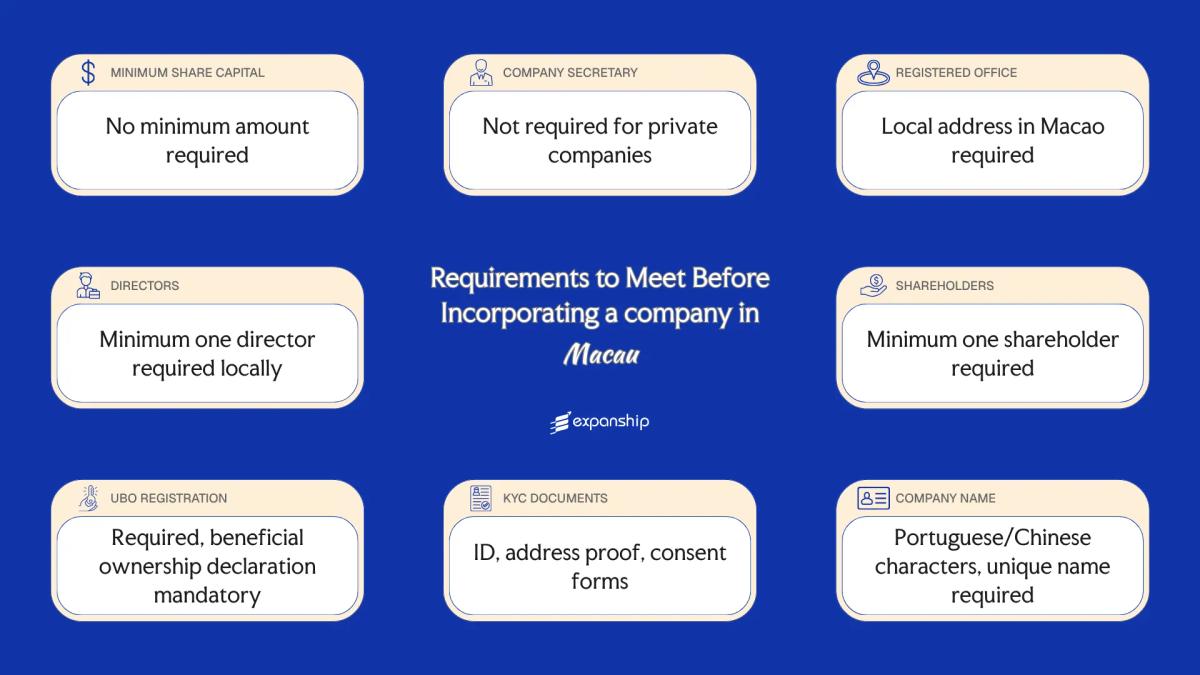
Fulfilling the incorporation requirements in Macao spans several distinct areas, from capital thresholds and directorship conditions to registered office obligations and identity verification procedures.
Failure to satisfy these requirements results in rejection of the registration application or, where non-compliance is discovered post-registration, potential legal liability and inability to operate with a valid commercial status.
Requirements can differ depending on the legal form of the entity selected, whether a Sociedade por Quotas or a Sociedade Anónima, as well as the nature of the business activity and the investor's residency status.
This article is most relevant to foreign entrepreneurs and corporate investors planning to establish a legal presence in Macao and working through the Macao company formation requirements for the first time.
Minimum Share Capital Requirements in Macao
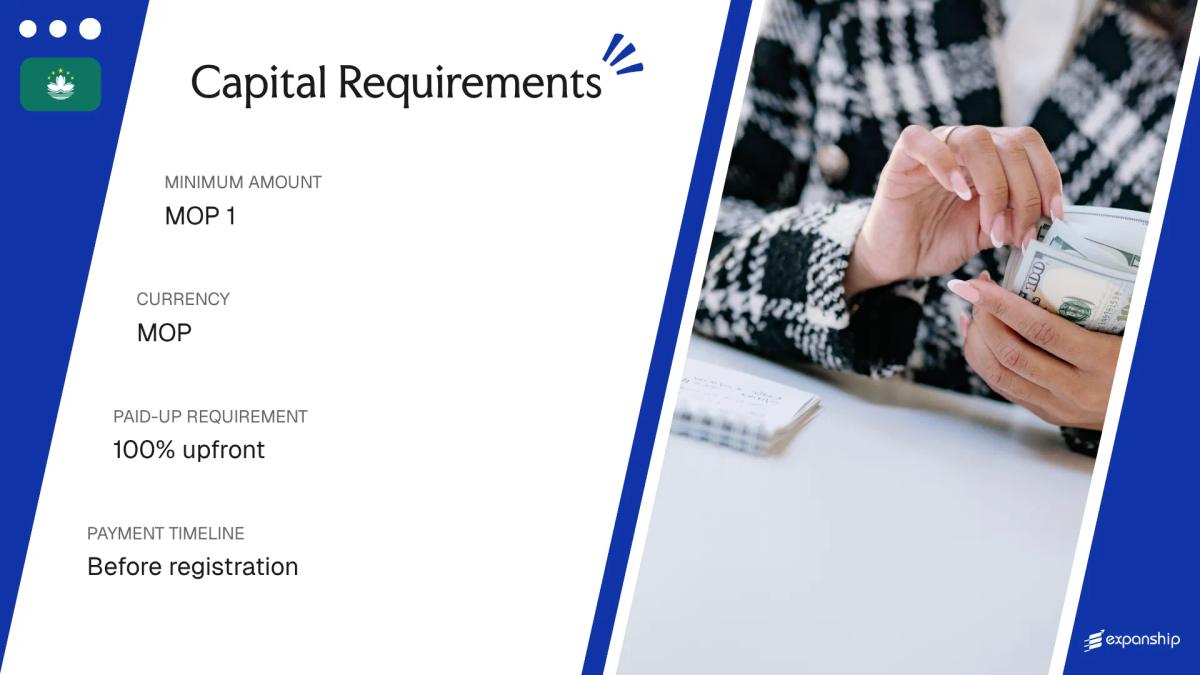
Macao minimum share capital requirements differ by entity type, with the sociedade por quotas (Lda) and the sociedade anónima (SA) subject to distinct thresholds under the Commercial Code of Macao (Decreto-Lei n.º 40/99/M). The Conservatória do Registo Comercial e de Bens Móveis, Macao's commercial registry, verifies the declared capital structure at the point of registration.
Share capital requirements function primarily as an incorporation condition rather than an ongoing statutory maintenance obligation. Your company's capital structure must be accurately declared at the time of filing, and any subsequent changes require formal amendment through the registry.
| Parameter | Detail |
|---|---|
| Minimum Authorized Share Capital | MOP 25,000 for a sociedade por quotas (Lda); MOP 1,000,000 for a sociedade anónima (SA) |
| Maximum Authorized Share Capital | No statutory maximum |
| Minimum Paid-Up Capital | Full amount at incorporation for Lda; general principle requires partial payment at formation for SA |
| Paid-Up Requirement at Incorporation | 100% for sociedade por quotas; SA minimum payment follows Commercial Code provisions |
| Accepted Currency | Macanese Pataca (MOP) |
| Accepted Forms of Contribution | Cash contributions; in-kind contributions are permitted subject to valuation requirements |
| Timeframe to Deposit Capital | At the time of incorporation |
Even where the statutory minimum appears low, the Conservatória requires a properly declared capital structure in the articles of association. An undeclared or improperly documented capital arrangement will prevent registration from proceeding.
Company Secretary Requirements in Macao
Under Macao's commercial framework, company secretary requirements Macao businesses must satisfy differ from common law jurisdictions. There is no statutory obligation to appoint a company secretary in the traditional sense; instead, the Macao Commercial Code establishes the role of a fiscal board or equivalent supervisory body for certain entity types.
For day-to-day corporate compliance, a responsible person or designated representative handles record-keeping, statutory filings with the Conservatória do Registo Comercial e de Bens Móveis, and communication with regulatory authorities. Macao corporate secretary obligations are typically absorbed into the duties of directors or appointed agents under the firm's internal governance structure.
Qualification criteria for who may serve in this representative capacity include:
- Must be a natural person or legally recognized entity under Macao law
- No mandatory residency requirement applies, though local presence is practically expected
- No specific professional licensing is prescribed for the secretary role under the Commercial Code
- Corporate entities acting as representatives must be duly registered in Macao
- Directors may assume secretarial duties if the company's articles permit this

Incorporate a Company in Macao
Set up your business entity in Macao with guidance on registration, compliance, and ongoing corporate maintenance.
Registered Office Requirements in Macao
Registered office requirements in Macao are governed by the Commercial Code of Macao (Código Comercial), which mandates that every registered company maintain a fixed, physical address within the territory where official correspondence and legal notices can be served.
- A physical address is required; a P.O. box alone does not satisfy the legal address requirement.
- The address must be located within Macao; an overseas address cannot serve as the registered office.
- Virtual office addresses are generally not recognised as compliant registered office addresses under local commercial law.
- Your business must hold either ownership title or a valid lease agreement for the premises used as the registered address.
- The registered office address is recorded in the Conservatória do Registo Comercial (Commercial Registry) and is publicly accessible.
- Any change to the registered address must be formally notified to the Commercial Registry; failure to update the record can result in regulatory non-compliance and may affect the validity of official communications served to the company.
Director Requirements in Macao

Under Macao's Commercial Code, director requirements in Macao apply primarily to the gerente, the managing officer responsible for the day-to-day administration of a Limitada (Lda.). Upon appointment, a gerente assumes personal liability for acts performed outside the scope of the company's objects and bears fiduciary duties toward the entity and its quotaholders.
| Parameter | Detail |
|---|---|
| Minimum Number of Directors | One gerente is required for a Limitada. |
| Maximum Number of Directors | No statutory maximum is prescribed under the Commercial Code. |
| Local/Resident Director Required | No statutory requirement for a Macao-resident gerente. |
| Nationality Restrictions | No nationality restrictions apply to the appointment of a gerente. |
| Minimum Age Requirement | The gerente must have attained the age of 18 years. |
| Corporate Directors Permitted | Corporate entities are not permitted to serve as gerente; the role requires a natural person. |
| Director Must Be a Shareholder | No requirement for a gerente to hold a quota in the company. |
| Publicly Listed on Registry | Gerente appointments are registered with the Conservatória do Registo Comercial e de Bens Móveis and are publicly accessible. |
| Disqualification Conditions | Persons adjudicated bankrupt or subject to a court prohibition from commercial activities are disqualified from acting as gerente. |
Unlike many civil law jurisdictions, Macao does not require any gerente to hold a share in the company, meaning a fully external professional manager can be appointed without any ownership stake.
Shareholder Requirements in Macao
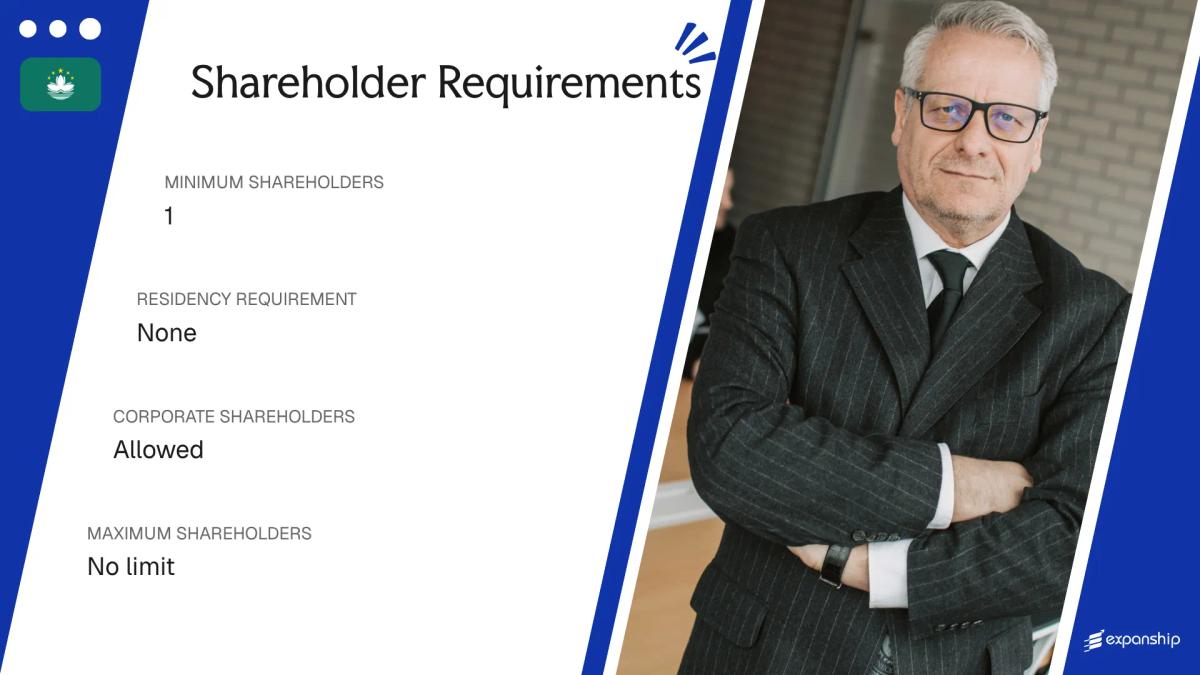
Under Macao's Commercial Code, a Limitada (Lda.) requires a minimum of one shareholder, making sole-shareholder structures permissible. There is no statutory maximum on the number of shareholders for this entity type.
Nationality and Residency Restrictions
Shareholder requirements in Macao impose no nationality or residency conditions on individuals or entities holding quotas. Foreign nationals may hold 100% ownership without restrictions tied to local residency.
Corporate Shareholders
Corporate entities are permitted to act as shareholders in a Macao company. The subscribing corporate body must provide valid incorporation documentation when registering its interest.
Shareholder Liability
In a Limitada, each shareholder's liability is limited to the value of their subscribed quota. Extended personal liability does not generally arise unless a court pierces the corporate veil under applicable provisions of the Commercial Code.
Register of Shareholders
A register of quota holders must be maintained and filed with the Conservatória do Registo Comercial e de Bens Móveis. Transfers of quotas require notarial registration, and the updated ownership information becomes part of the public commercial registry.
Shareholder Structure Guidance for Your Macao Entity
Get clarity on quota holder eligibility, ownership structuring, and documentation requirements for incorporating in Macao.
UBO / Beneficial Ownership Disclosure Requirements in Macao
Beneficial ownership requirements in Macao are governed by Law No. 2/2006 on the Prevention and Repression of the Crime of Money Laundering and its successive amendments, which obligate covered entities to identify and verify the natural persons who ultimately own or control a legal entity. A beneficial owner is generally defined as any individual holding, directly or indirectly, a 25% or greater ownership interest.
- Identify all natural persons who meet the ownership or control threshold before or at the time of incorporation.
- Disclose beneficial owner information to the relevant obliged institution, typically a licensed financial institution or corporate service provider conducting customer due diligence.
- Retain verified UBO records internally and make them available to the Financial Intelligence Office (GIF) upon request.
- Update records whenever a change in beneficial ownership occurs.
| Parameter | Detail |
|---|---|
| Ownership Threshold for UBO Status | 25% |
| Filing Authority | Financial Intelligence Office (GIF) via obliged entities |
| Disclosure Deadline at Incorporation | At or before establishment of business relationship |
| Publicly Accessible Register | No public UBO register |
| Penalties for Non-Disclosure | Subject to sanctions under Law No. 2/2006 |
| Ongoing Update Obligation | Yes; records must reflect any change in ownership or control |
KYC / Document Requirements in Macao
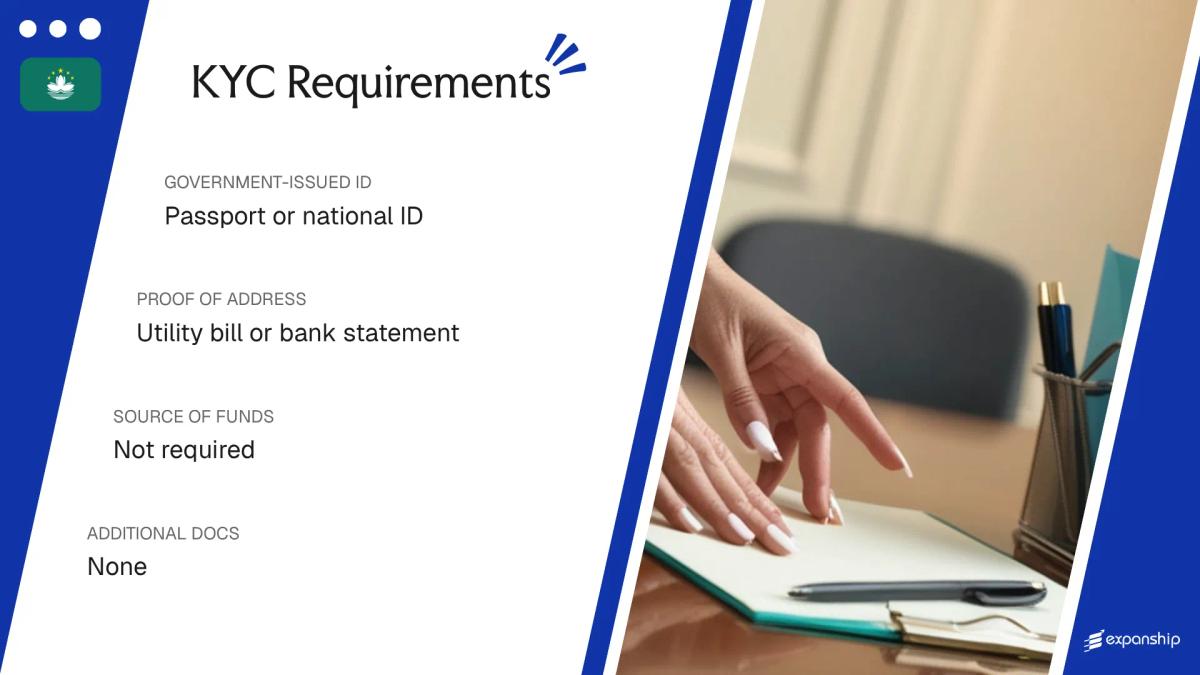
KYC requirements Macao company registration fall under the framework established by Law 2/2006 (the Anti-Money Laundering and Counter-Terrorism Financing Law), administered by the Gaming Inspection and Coordination Bureau and, for financial entities, the Monetary Authority of Macao. Registered service providers and notaries involved in formation must collect due diligence documentation before proceeding.
Individual / Personal Documents
- Valid government-issued passport or national identity card for each individual director, shareholder, or beneficial owner
- Proof of residential address dated within three months, such as a utility bill or bank statement
- Completed and signed KYC declaration or personal information form as required by the notary or formation agent
- Recent passport-sized photograph may be required by certain service providers
Corporate Documents
- Certificate of incorporation or equivalent constitutional document for any corporate shareholder or director
- Articles of association or equivalent constitutional document in the entity's home jurisdiction
- Current register of directors and shareholders from the corporate entity
- Proof of registered office address for the corporate entity
Source of Funds Documentation
- Bank statements covering a minimum recent period to evidence available capital
- Audited financial accounts where the shareholder is a corporate entity
- Signed declaration of origin of funds for individual contributors
Notarisation and Apostille Requirements
- Foreign documents generally require notarisation by a qualified notary in the country of origin
- Documents from non-Portuguese-speaking jurisdictions must be accompanied by a certified Portuguese translation
- Apostille certification is required for documents originating from Hague Convention member states
- Documents from non-Convention countries require legalisation through the relevant Macao consulate
Submission of untranslated foreign-language documents is among the most common reasons for incorporation delays at the Macao Commercial Registry.
Company Name Requirements in Macao
Company name requirements in Macao are assessed during the incorporation process through a formal approval procedure handled by the relevant registration authority. Proposed names are checked for uniqueness and compliance with applicable naming rules before registration is confirmed.
Names must be rendered in Chinese, Portuguese, or both. A legal suffix indicating the company type is mandatory, such as "Limitada" or its Chinese equivalent for a private limited company. No specific character length limits are publicly codified, but names must be sufficiently distinct.
Certain words are restricted and require prior authorization from the appropriate government body before use. Terms implying a connection to public institutions, financial regulators, or sovereign functions fall into this category. Outright prohibited terms include anything contrary to public order or national interest.
Name reservation is available prior to formal incorporation. Once approved, the reservation holds the name for a defined period while the remaining registration steps are completed. The application is submitted to the same authority handling the full registration.
Compliance Services for Companies in Macao
Understand your ongoing compliance obligations as a registered entity in Macao, from annual filings to regulatory reporting requirements.
Conclusion
Macao company incorporation requirements are defined across several legal instruments, with the Commercial Registry Office (Conservatória do Registo Comercial e de Bens Móveis) serving as the central authority overseeing entity registration. Among the requirements covered, the absence of a mandatory minimum share capital for Limitada companies and the lack of residency restrictions on directors are particularly notable. Once these parameters are understood, a foreign investor's practical next step is selecting a qualified local service provider to manage registration filings and ongoing compliance obligations under Macanese commercial law.
Expanship's Company Formation Services in Macao
Macao company formation services involve specific structural requirements, from the Conservatória do Registo Comercial filing process to UBO disclosures and registered office obligations, each adding a layer of administrative coordination. Expanship helps your business manage that coordination without losing sight of what each step actually requires under Macao law.
Our service scope covers the full formation and post-incorporation cycle:
- We prepare and file all incorporation documents with the relevant Macao authorities on your behalf.
- A registered agent and compliant local office address are provided to satisfy Macao's registered office requirements.
- Our team liaises directly with government bodies to handle filings and regulatory correspondence.
- Post-incorporation compliance, including annual obligations, is managed to keep your entity in good standing.
- We facilitate introductions to banking institutions familiar with Macao-incorporated entities.
- Tax registration and liaison with local fiscal authorities are handled as part of the setup process.
To discuss your requirements, contact Expanship Macao.
Frequently Asked Questions (FAQ)
Macao does not impose a residency requirement on directors, meaning foreign nationals can serve without being based in the territory. There is no statutory minimum age specified in the same way as some other jurisdictions, but directors must have full legal capacity. Corporate directors are not permitted under the standard private limited company structure.
A registered office in Macao must be a physical address within the territory, as the Macao Commercial Registry uses it as the official address for all legal correspondence and regulatory notices. Failure to maintain a valid registered office can result in your company being struck off the Commercial Registry of Macao (Conservatória do Registo Comercial). This is not a procedural technicality; loss of registration status means the entity loses its legal standing to conduct business.
A Macao Sociedade por Quotas must have a minimum of one shareholder and can have up to 30. Exceeding that threshold would require the entity to be restructured as a public limited company (Sociedade Anónima), which carries distinct capital and governance obligations. Both individuals and corporate entities are permitted to hold quota interests.
Under Macao's anti-money laundering framework, a beneficial owner is generally any individual who ultimately owns or controls 25% or more of a company's share capital or voting rights. Disclosure obligations apply at the point of incorporation and must be updated whenever ownership or control arrangements change. The Financial Intelligence Office (GIF) oversees compliance with these requirements, and failures to report can trigger administrative and criminal sanctions.
Foreign individual shareholders are generally required to submit a certified copy of a valid passport, proof of residential address dated within three months, and a bank reference or source-of-funds declaration. Corporate shareholders must provide certified constitutional documents, a certificate of incumbency, and details of their own beneficial owners. The exact requirements may vary depending on the registered service provider and the nature of the business activity being registered.
Macao operates under a bilingual administrative system using both Portuguese and Chinese, and company names must be registered in at least one of these two official languages. An English name can be used alongside the official registered name but does not substitute for it in legal and regulatory filings. The name is checked against existing registrations held in the Commercial Registry of Macao to confirm it is sufficiently distinct.
In a Sociedade por Quotas, ownership is represented by quotas rather than freely transferable shares, and any transfer of quota interests is subject to the consent of other quota holders unless the articles provide otherwise. A Sociedade Anónima issues shares that are, in principle, freely transferable, making it a more suitable structure when you anticipate bringing in external investors or listing on a capital market. The distinction affects not only transferability but also the governance and disclosure obligations each structure carries under the Macao Commercial Code.
Legal Disclaimer
The information provided in this article is for general informational purposes only and does not constitute legal, tax, or professional advice. While we strive to ensure the accuracy and timeliness of the content, laws and regulations are subject to change, and the application of laws can vary widely based on specific facts and circumstances.
Readers should not act upon this information without seeking professional counsel tailored to their individual situation. Expanship and its authors disclaim any liability for actions taken or not taken based on the content of this article.
For specific advice regarding your business setup, compliance requirements, or any legal matters, please consult with qualified legal and tax professionals in the relevant jurisdiction.