

Key Takeaways
- Macao's 12% corporate profit tax applies only to income sourced within the SAR, meaning foreign-derived revenues remain outside the territory's tax net entirely.
- Under Macao's Commercial Code, the Sociedade por Quotas (Lda) structure imposes no foreign ownership restrictions, allowing international investors to hold full equity stakes without structural concessions to local partners.
- The complete absence of capital gains tax on business profits means that gains realised from asset disposals or equity transactions are not eroded at the corporate level in Macao.
- Business registration is processed through the DSE (Direcção dos Serviços de Economia), a single government body whose consolidated role over licensing and commercial registration reduces administrative friction during company formation.
Macao is a Special Administrative Region (SAR) of the People's Republic of China, situated on the western Pearl River Delta. It operates under the "one country, two systems" principle, maintaining a distinct legal and economic framework separate from mainland China until at least 2049. Companies are registered through the DSE (Direcção dos Serviços de Economia), the government body responsible for business registration and licensing. The most common legal vehicle for foreign businesses is the Sociedade por Quotas, locally abbreviated as Lda.
The benefits of incorporating in Macao are shaped by a low-tax territorial regime that generally taxes only income sourced within the SAR. Foreign direct investment faces few structural barriers, and the regulatory environment does not impose blanket restrictions on foreign ownership across most sectors. This combination draws businesses across a range of industries seeking a formal presence under a stable, well-defined legal system.
This article examines the key advantages of Macao company formation for businesses considering the jurisdiction as a base for regional or international operations.
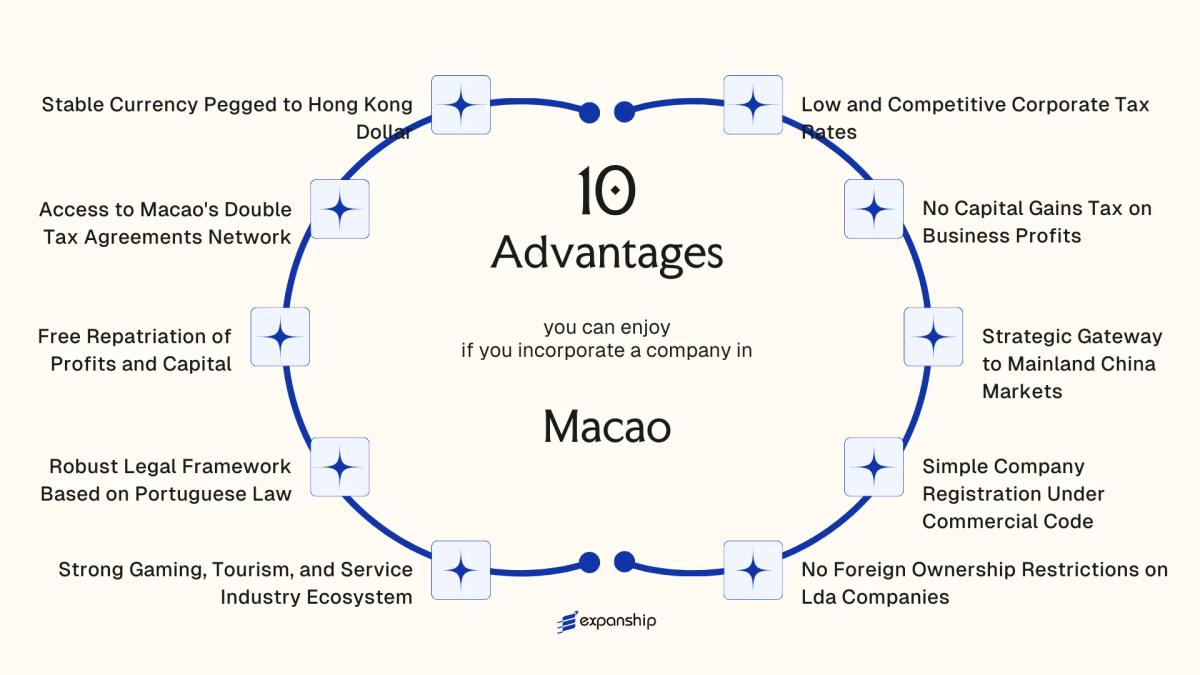
Low and Competitive Corporate Tax Rates
Macao low corporate tax rate advantages stem from a tiered structure under the Complementary Tax (Imposto Complementar de Rendimentos), which applies to corporate profits at a maximum rate of 12%. This places the SAR well below the global average corporate tax rate of approximately 23%.
How the Complementary Tax Is Structured
The first MOP 600,000 of assessable profits is exempt from Complementary Tax entirely. For profitable small and medium-sized firms, this exemption can eliminate the tax liability altogether, meaning retained earnings available for reinvestment are meaningfully higher than in comparable jurisdictions.
What the Rate Means for Your Margins
At 12% on profits above the exemption threshold, the effective tax burden on a foreign-owned entity operating here is structurally low. For businesses generating moderate annual profits, the combined effect of the exemption and the rate ceiling produces an effective rate that can fall well below the statutory maximum.
Your company retains a larger share of operating profit under the Complementary Tax framework than it would under most comparable Asian or European tax regimes.
No Capital Gains Tax on Business Profits
Macao imposes no capital gains tax on business profits. Gains derived from the sale of assets, shares, or business interests are not subject to a separate capital gains levy under the territory's Complementary Tax regime. For a foreign investor, this means the full value of a capital transaction flows through without an additional layer of taxation eroding the return.
Under the Complementary Tax, which governs corporate profits in Macao, taxable income is calculated on operating profits rather than capital appreciation. Because no capital gains tax Macao businesses face is embedded in this structure, companies can realise asset disposals, restructure shareholdings, or exit investments without triggering a distinct tax charge on the gain itself.
This treatment is particularly relevant for holding structures and investment vehicles, where the value created sits primarily in asset appreciation rather than recurring income. A firm incorporated here as a Sociedade por Quotas (Lda) can hold equity stakes in subsidiaries and dispose of them without the capital gains exposure that would apply in many other jurisdictions.
The practical advantages of this treatment include:
- Gains from share sales are not reclassified as ordinary income subject to Complementary Tax
- Asset disposals within a restructuring do not create a separate taxable event
- Retained proceeds from capital transactions can be reinvested or distributed without a post-disposal tax adjustment

Company Incorporation in Macao
Set up a Macao Lda or other corporate entity with full guidance on registration, compliance, and ongoing obligations.
Strategic Gateway to Mainland China Markets
Macao's status as a Special Administrative Region gives incorporated entities a legally distinct operating base from mainland China, while preserving preferential access to it. Under the framework of the Closer Economic Partnership Arrangement (CEPA), goods and services originating from the SAR can enter the Chinese market under reduced or zero tariffs, a concession not available to companies incorporated in most other jurisdictions.
| Sector | Preferential Access Type | Applicable Framework |
|---|---|---|
| Financial Services | Earlier market access than other foreign firms | CEPA Supplement |
| Professional Services | Relaxed qualification recognition | CEPA Annex |
| Tourism & Hospitality | Expedited licensing in Guangdong | Guangdong-Macao Cooperation |
| Trade in Goods | Zero or reduced tariffs on qualifying goods | CEPA Main Body |
Your business also benefits from proximity to the Guangdong-Hong Kong-Macao Greater Bay Area, an integrated economic zone covering 11 cities with a combined GDP exceeding USD 1.9 trillion. Firms incorporated locally can position operations to serve this region while maintaining a separate legal and regulatory environment from the mainland.
Physical proximity matters operationally. The Zhuhai-Macao border crossing is among the most active land crossings between the SAR and Guangdong Province, facilitating frequent cross-border movement of personnel and goods without the logistical distances that affect other offshore-adjacent jurisdictions.
Simple Company Registration Under Commercial Code
Registering a company under the Código Comercial of Macao is procedurally direct by regional standards, and that directness carries real value for foreign founders. The primary vehicle for private business activity is the Sociedade por Quotas (Lda), which requires no minimum paid-up capital under current rules. This removes a common capital-lock hurdle that exists in several Southeast Asian registration regimes.
Filing is handled through the Conservatória do Registo Comercial e de Bens Móveis, Macao's commercial registry. The documentation requirements are defined and finite, which means your timeline is determined by preparation rather than procedural unpredictability.
Macao commercial Code company registration benefits are most visible in the speed to operational status. A properly prepared Lda can be constituted and registered within days. For a foreign investor managing cross-border timelines, that speed directly reduces the cost of the pre-revenue period.
Keep these points in mind while going through registration:
- The company name must be approved before deed execution
- Articles of association must be notarized before filing
- At least one manager must be designated at incorporation
- Foreign documents submitted to the registry must be apostilled or legalized
Macao does not require a local resident director for an Lda, meaning a foreign national can serve as the sole manager without any local nominee arrangement.
No Foreign Ownership Restrictions on Lda Companies
There are no foreign ownership restrictions on Macao Lda companies. A Sociedade por Quotas can be formed and wholly owned by foreign nationals, with no requirement to include a local partner or resident shareholder. This structural openness means you retain full equity control from incorporation without negotiating away ownership to satisfy residency rules.
Full Foreign Control of Equity
Under the Macao Commercial Code, a Lda requires a minimum of two quota holders, but neither is required to be a Macao resident or citizen. Foreign individuals and foreign-incorporated entities can each hold quotas directly. For investors who want to preserve consolidated group ownership without interposing local nominees, this is a concrete structural advantage.
No Sector-Specific Ownership Caps for Most Activities
Outside of regulated industries such as gaming concessions, which are governed by separate licensing law, most commercial and service activities impose no foreign equity limits on a private limited company. Your firm can be set up as a fully foreign-owned vehicle for trading, consulting, or holding activities. This gives foreign investors certainty over governance, profit distribution decisions, and eventual transfer of quotas, all without the compliance overhead of a joint-venture structure.
Maximize Your Ownership Rights in Macao
Speak with our corporate advisors about structuring your Macao Lda with full foreign ownership and ensuring compliance from day one.
Strong Gaming, Tourism, and Service Industry Ecosystem
Macao's gaming tourism industry business advantages extend well beyond casinos. The territory's economy is structured around hospitality, entertainment, retail, financial services, and MICE (meetings, incentives, conferences, and exhibitions) — creating a dense commercial ecosystem that foreign businesses can enter directly.
- Gaming concession revenue funds extensive public infrastructure, which keeps operating costs for service-sector firms comparatively low without relying on high corporate taxation to sustain it.
- Annual visitor arrivals consistently number in the tens of millions, concentrated from mainland China, Hong Kong, and Southeast Asia. For retail, food and beverage, logistics, and professional services firms, this creates a captive, high-frequency customer base without the need for significant market-entry spend.
- The Gaming Inspection and Coordination Bureau (DICJ) regulates licensed operators, whose supply chains and compliance requirements generate sustained commercial demand for legal, accounting, HR, and technology service providers.
- Cotai, the reclaimed land strip between Coloane and Taipa, now functions as an integrated resort district. Businesses incorporated locally gain proximity to anchor tenants — hotel groups, entertainment operators, and convention facilities — that require local vendor relationships.
- The service sector ecosystem benefits for companies registered here include access to a workforce already trained in multilingual hospitality, which reduces onboarding costs for client-facing operations.
Robust Legal Framework Based on Portuguese Law
Macao's legal system is grounded in the Portuguese civil law tradition, codified through the Civil Code and the Commercial Code (Código Comercial) that were adapted and retained following the 1999 handover to China. This inheritance gives your business a predictable, statute-based legal environment where contractual rights, property protections, and corporate obligations are clearly defined in written law rather than determined through evolving case precedent.
For a foreign business owner, that codification has a direct operational value. Disputes are resolved against a fixed legal text, which reduces interpretive unpredictability in commercial relationships. The Court of Final Appeal of the Macao Special Administrative Region operates independently under the "one country, two systems" principle, maintaining judicial separation from mainland China's legal structure.
Contract enforcement, intellectual property protection, and company governance all fall under statutes that mirror the structure of Portuguese and broader continental European commercial law. Foreign investors familiar with civil law jurisdictions across Europe or Latin America will find the legal architecture recognizable.
Under Article 2 of Macao's Basic Law, the National People's Congress authorizes Macao to exercise a high degree of autonomy and to enjoy executive, legislative, and independent judicial power, including that of final adjudication.
Free Repatriation of Profits and Capital
Free profit repatriation Macao companies benefit from is grounded in the territory's exchange control framework, which imposes no restrictions on transferring funds across borders. There are no regulatory approvals required to move dividends, capital gains, or investment principal out of the territory. For a foreign business owner, this means retained earnings can be distributed to shareholders in any jurisdiction without delay or deduction at the transfer stage.
Under the Basic Law of Macao Special Administrative Region, the free flow of capital is constitutionally protected. This legal guarantee sits above ordinary legislation, meaning it cannot be reversed by local administrative policy alone. The practical effect is a high degree of legal certainty for foreign investors structuring dividend flows or exit proceeds.
The Macanese Pataca operates under a linked exchange rate system, but currency conversion itself faces no capital control restrictions. You can hold accounts in foreign currencies, remit proceeds in multiple currencies, and transfer funds to any overseas bank without filing currency movement declarations for standard commercial transactions.
Verify that your home jurisdiction or the receiving country does not impose its own withholding tax obligations or controlled foreign corporation rules that affect the net value of repatriated funds.
Access to Macao's Double Tax Agreements Network
Macao's double tax agreement network benefits foreign-incorporated entities by reducing or eliminating withholding taxes on dividends, royalties, and interest paid across borders. The SAR has concluded tax treaties with a limited but strategically significant group of jurisdictions, including mainland China, Portugal, and several other countries. Each treaty allocates taxing rights between signatory states, which means your business avoids paying full rates in two jurisdictions on the same income stream.
Why the China DTA Carries Particular Weight
The tax arrangement between Macao and mainland China holds the most practical value for cross-border operators. Under this arrangement, withholding tax rates on dividends and other passive income flows between the two territories are reduced below standard statutory rates. For a firm routing transactions or receiving Chinese-sourced income through a Macao entity, this reduction directly lowers the cost of cross-border cash flows.
Treaty Eligibility and Residency Requirements
Access to treaty benefits is conditional on tax residency in Macao, which is determined under the Complementary Tax regime administered by the Financial Services Bureau (DSF). A company must be genuinely resident and subject to local tax obligations to qualify as a treaty resident. Shell structures with no economic substance are unlikely to satisfy residency criteria under most treaty provisions.
Portugal Connection and Lusophone Networks
The treaty with Portugal opens a secondary channel for firms with European operations or shareholders. Given the shared legal heritage between the two jurisdictions, contractual and corporate documentation translates across systems with relative ease, reducing transactional friction for businesses operating in both territories.
Stable Currency Pegged to Hong Kong Dollar
The Macao stable currency peg business advantage is structural, not incidental. The Macao pataca (MOP) is pegged to the Hong Kong dollar (HKD) at a fixed rate of 1 HKD to 1.03 MOP, a rate that has held with minimal deviation for decades. Because the HKD itself operates under a linked exchange rate system pegged to the US dollar since 1983, the MOP effectively carries a secondary anchor to USD, giving your business predictable exposure across two of the world's most traded currency corridors.
For foreign business owners, this arrangement removes a layer of financial risk that affects operations in many other Asian markets. Fluctuating local currencies create unpredictable costs in supplier contracts, payroll, and cross-border invoicing. A business operating in MOP can price, contract, and report with a high degree of certainty about exchange outcomes against both HKD and USD.
This currency stability advantages Macao company formation specifically for firms engaged in regional trade, financial services, and cross-border transactions with Hong Kong counterparts. Since MOP and HKD are freely interchangeable within the territory through the banking system, transactions between the two jurisdictions carry no conversion friction in practice.
Key implications for your business include:
- Contracts denominated in MOP carry negligible HKD conversion risk, reducing hedging costs
- USD-linked pricing remains consistent across procurement and client billing cycles
- Financial reporting across MOP and HKD functional currencies involves minimal reconciliation complexity
- Intra-group transactions between Macao and Hong Kong entities are insulated from exchange rate volatility
Why Macao Stands Out Among Asian Business Hubs
Comparing Macao advantages over Asian business hubs requires selecting the right reference points. Hong Kong and Singapore are the natural benchmarks — both compete for the same pool of foreign investors seeking Chinese-market proximity, low corporate tax, and a common law or civil law framework with international credibility. The comparison below focuses on parameters where Macao holds a neutral or favourable position, drawing on publicly available regulatory data rather than promotional positioning.
What the comparison reveals is structural rather than superficial. Macao's absence of capital gains tax, its Portuguese civil law foundation under the Commercial Code, and its currency peg to the Hong Kong dollar through the Monetary Authority of Macao create a stable, predictable operating environment that is distinct from its neighbours — not simply a lesser version of them. The Lda structure permits full foreign ownership without local partner requirements, a condition that Singapore mirrors but Hong Kong applies differently depending on the business activity.
| Parameter | Macao | Hong Kong | Singapore |
|---|---|---|---|
| Standard Corporate Tax Rate | 12% (MOP 600,000 exemption threshold) | 16.5% (8.25% on first HKD 2M) | 17% (partial exemption for startups) |
| Capital Gains Tax on Business Profits | None | None | None |
| Full Foreign Ownership (standard structures) | Yes (Lda) | Yes | Yes |
| Legal System | Portuguese Civil Law | Common Law | Common Law |
| Currency Stability Mechanism | Pegged to HKD via AMCM | USD peg | Managed float (MAS) |
| Proximity to Mainland China | Direct border (Zhuhai) | Sea/land border | No direct border |
Compliance Services for Companies in Macao
Stay aligned with Macao's Commercial Code requirements and regulatory obligations through ongoing compliance support tailored to your entity type.
Conclusion
Macao's corporate framework offers a legally grounded, tax-efficient foundation that is difficult to replicate elsewhere in the Asia-Pacific region. The territory's 12% corporate profit tax rate, applied only to Macao-sourced income, combined with the complete absence of capital gains tax on business profits, means that foreign investors retain a structurally higher share of earnings from day one. For businesses oriented toward the Pearl River Delta, the geographic and commercial proximity to Mainland China adds direct commercial value that extends well beyond any single tax provision.
Not every business will extract identical value from these benefits of incorporating in Macao. A firm engaged in international trading, professional services, or financial consultancy is positioned differently from one anchored in the gaming or hospitality sectors, where local licensing conditions apply. The Commercial Code's straightforward formation process for Limitada companies and the absence of foreign ownership restrictions provide a reliable starting point, but the relevance of each structural feature depends on your specific operational model and revenue profile.
The advantages of Macao business registration are most consequential when the right legal structure is matched to the right business activity. Understanding which provisions apply to your entity, and how they interact with your home jurisdiction's tax obligations, determines the actual benefit realised. Engaging qualified local legal and compliance advisors early in the process is the practical next step before any formation decision is finalised.
Start Your Macao Company Formation With Expanship
Starting a Macao company formation with Expanship connects you directly to the full range of corporate structuring benefits this blog has outlined, from the territory's competitive tax regime and unrestricted foreign ownership of Lda entities to free profit repatriation and access to its double tax agreement network. Expanship manages the incorporation process through the Macao Commercial Registry (Conservatória do Registo Comercial), covering every procedural and compliance requirement under the Commercial Code and the applicable regulatory framework. Each engagement is structured around your business's specific jurisdiction, entity type, and operational scope.
Expanship's service scope for Macao business incorporation includes:
- Preparation and legalization of incorporation documents, including the articles of association (escritura) and shareholder declarations
- Registered agent and registered office provision in Macao
- Filing and liaison with the Conservatória do Registo Comercial and the Financial Services Bureau (DSF) for tax registration
- Post-incorporation compliance management, including annual reporting and statutory obligations under the Commercial Code
- Introduction to banking institutions operating within the territory for account establishment purposes
Reach out to Expanship Macao to discuss your incorporation requirements.
Frequently Asked Questions (FAQ)
Under the Complementary Tax (Imposto Complementar de Rendimentos) regime, profits up to MOP 600,000 are exempt from corporate tax. Above that threshold, a flat rate of 12% applies, which is among the lower statutory rates in the Asia-Pacific region. No surtaxes or municipal business taxes are layered on top of this rate for standard commercial entities.
Capital gains derived from the disposal of business assets are generally not subject to a separate capital gains tax in Macao. Gains may be folded into assessable profits under the Complementary Tax framework, but there is no standalone capital gains levy. Your corporate structure and the nature of the asset will determine how any gain is ultimately characterised.
Registration with the Conservatória do Registo Comercial e de Bens Móveis can be completed within a few business days once all required documents are submitted in proper form. Online pre-registration options are available, which can reduce the overall timeline. Delays typically arise from incomplete documentation or notarisation requirements rather than processing backlogs at the registry itself.
Macao has concluded a limited network of double tax agreements, including treaties with mainland China and Portugal, among others. These agreements reduce or eliminate withholding taxes on dividends, interest, and royalties flowing between the contracting jurisdictions. The precise withholding rates and eligible income categories vary by treaty, so the applicable agreement should be reviewed against your specific cross-border payment flows.
Macao currently imposes no exchange controls, and the Pataca (MOP) is pegged to the Hong Kong Dollar at a fixed rate, which supports currency stability for cross-border transactions. Profit and capital repatriation are unrestricted under existing monetary policy. Any future change to this framework would require formal policy action by the Monetary Authority of Macao (AMCM), and no such measures are presently in place or publicly proposed.
Incorporation in Macao does not, by itself, grant automatic market access rights in mainland China. However, the territory's status under the "One Country, Two Systems" framework and its participation in the Closer Economic Partnership Arrangement (CEPA) with the mainland can provide preferential treatment for certain service sectors and goods originating in Macao. Eligibility for CEPA benefits depends on the specific industry and the applicable rules of origin or service supplier criteria set out in the relevant CEPA annexes.
Macao's civil and commercial law derives from the Portuguese legal tradition, codified through instruments such as the Commercial Code (Decreto-Lei n.º 40/99/M) and the Civil Code. Contracts governed by Macao law are enforceable through the local court system, which operates independently from mainland Chinese jurisdiction. Foreign judgments may be recognised subject to reciprocity conditions and the procedural requirements of the Code of Civil Procedure of Macao.
Legal Disclaimer
The information provided in this article is for general informational purposes only and does not constitute legal, tax, or professional advice. While we strive to ensure the accuracy and timeliness of the content, laws and regulations are subject to change, and the application of laws can vary widely based on specific facts and circumstances.
Readers should not act upon this information without seeking professional counsel tailored to their individual situation. Expanship and its authors disclaim any liability for actions taken or not taken based on the content of this article.
For specific advice regarding your business setup, compliance requirements, or any legal matters, please consult with qualified legal and tax professionals in the relevant jurisdiction.