
Key Takeaways
- Macao's Commercial Code imposes structured compliance obligations on registered entities that create an ongoing administrative burden, particularly for foreign-owned businesses unfamiliar with the Portuguese civil law framework.
- Foreign investors face meaningful operational constraints from mandatory Macao resident director requirements and restricted foreign ownership in sectors beyond gaming and tourism.
- The DSF tax compliance regime requires navigating jurisdiction-specific filing and reporting obligations that add cost and complexity disproportionate to Macao's small domestic market of under 700,000 residents.
- Gaming sector dominance inflates commercial property costs and distorts the broader business environment, making Macao a structurally difficult base for non-gaming enterprises seeking competitive operating costs.
Macao operates under a dual legal system, with its commercial framework rooted in Portuguese civil law tradition and administered through bodies including the Financial Services Bureau (DSF) and the Macao Trade and Investment Promotion Institute (IPIM). The Commercial Code governs company formation and ongoing obligations, establishing a structured but compliance-intensive environment for registered entities.
The disadvantages of incorporating in Macao span regulatory, financial, and operational categories, each carrying different weight depending on your industry and intended structure.
Not every drawback applies equally to all businesses. A firm operating solely in digital services faces a different set of friction points than one requiring physical premises or local licensing.
This article is most relevant to foreign investors and internationally oriented business owners considering Macao as a base for regional operations, holding structures, or market entry into the Pearl River Delta.
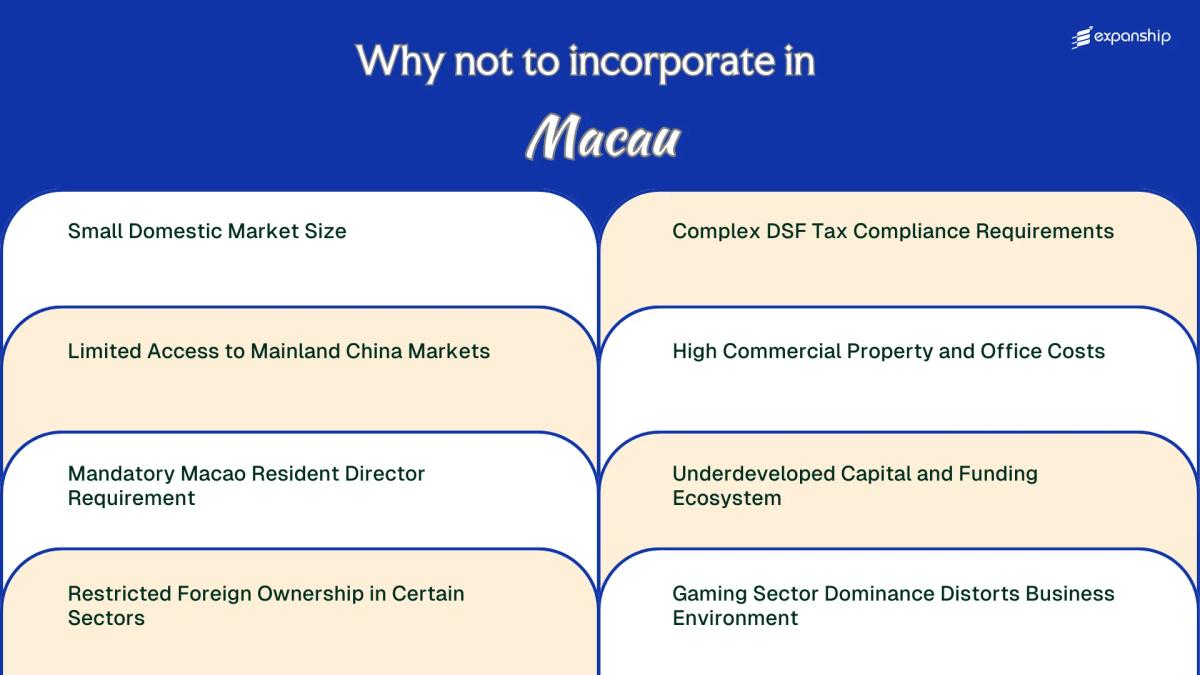
Small Domestic Market Size
Macao small domestic market limitations present a structural constraint that few other incorporation jurisdictions match at a comparable income level. With a resident population of roughly 680,000, the addressable consumer base is among the smallest of any autonomous territory in Asia.
Population Scale and Revenue Ceilings
Your firm's total addressable market within the territory is capped by a population smaller than many mid-sized cities. A business that depends on local consumer volume to reach profitability will struggle to generate sufficient recurring revenue without immediately planning cross-border operations.
Domestic retail, professional services, and hospitality firms outside the gaming concessions face this ceiling acutely. The limited consumer base in Macao means that unit economics viable in a city of five million residents simply do not translate here.
Structural Dependence on Tourism Spending
Visitor-driven demand partially compensates for resident population constraints, but that spending is concentrated in gaming and affiliated hospitality. Non-gaming sectors receive a disproportionately thin share of tourist expenditure, leaving most incorporated entities dependent on a narrow transient customer segment rather than stable domestic demand.
A foreign business owner targeting domestic consumption in Macao should expect revenue ceilings that make local-market-only operations financially unviable for most non-gaming business models.
Limited Access to Mainland China Markets
Macao limited mainland China market access is a structural constraint that affects any foreign-owned entity attempting to use the territory as a gateway into the People's Republic of China. Despite geographic proximity to Guangdong Province, a company registered under Macao commercial law operates under a separate legal system and does not receive automatic rights to trade, establish branches, or repatriate earnings within mainland China.
Under mainland China's regulatory framework, a Macao-registered entity is treated similarly to any other foreign company. This means your business must apply for separate market entry approvals through Chinese authorities, including sector-specific licensing that applies to wholly foreign-owned enterprises.
Participation in the Guangdong-Macao Cooperation Zone offers some preferential treatment, but access remains restricted to defined industries and geographic zones. Most sectors outside that framework require a separately incorporated mainland entity.
Practical burdens this creates for foreign business owners include:
- Needing to establish and maintain a parallel China entity, generating duplicate compliance costs and administrative overhead
- Facing longer approval timelines from Chinese regulators who classify Macao firms under foreign investment rules
- Being excluded from mainland public procurement processes that require a domestically registered business license
- Losing pricing competitiveness against mainland rivals who operate without cross-border regulatory friction

Company Incorporation in Macao
Understand the full regulatory and structural requirements before registering a company in Macao.
Mandatory Macao Resident Director Requirement
Under Macao's Commercial Code, companies are generally required to appoint at least one director who is a resident of the territory. For a foreign business owner without local ties, satisfying this Macao resident director requirement means either relocating personally or hiring a nominee director, both of which carry ongoing costs and governance risks.
| Burden Factor | Detail | Impact on Foreign Owner |
|---|---|---|
| Nominee director annual fee | Typically MOP 8,000–20,000+ per year | Recurring overhead with no operational value |
| Director liability exposure | Directors bear personal legal responsibility under the Commercial Code | Nominee providers may demand indemnity agreements, adding legal cost |
| Director replacement process | Requires notarised documentation and DSAJ filing | Administrative delays if a nominee withdraws |
| Residency verification | Director must hold valid Macao residency status | Eliminates most foreign nationals from serving directly |
Nominee arrangements introduce a dependency that does not exist in jurisdictions with no local director rule. If the nominee resigns or becomes unavailable, the company's directorship falls out of compliance with the Direcção de Serviços de Assuntos de Justiça (DSAJ) registration requirements, which can disrupt operations.
The requirement effectively transfers a layer of governance control to a third party. Nominee directors with genuine signing authority create fiduciary risk, while those with restricted authority still require legal structuring to limit exposure, adding further cost to an already narrow setup.
Restricted Foreign Ownership in Certain Sectors
Macao foreign ownership restrictions vary by sector, but the constraint is most pronounced in gaming, public utilities, telecommunications, and certain financial services. Foreign investors cannot freely acquire majority stakes in these industries without government approval or local partnership requirements, which limits the control your business can exercise over its own structure.
Gaming concessions, governed under Law No. 16/2001 and its subsequent amendments, are granted exclusively by the Macao government and are subject to conditions that effectively preclude foreign-controlled entities from holding concessions independently. The gaming regulatory framework managed by the Gaming Inspection and Coordination Bureau (DICJ) imposes equity and operational conditions that a foreign entity cannot replicate through standard incorporation.
Even outside gaming, sectors tied to public infrastructure require local licensing tied to entity structure, which means foreign founders may be forced into minority positions.
- Foreign equity caps apply in gaming, telecoms, and utilities without exception
- Government approval is required before foreign entities can enter restricted sectors
- Local partnership or co-ownership arrangements may be legally mandated, not optional
- Ownership restrictions are assessed at the entity level, not just the shareholder level
- Post-incorporation restructuring to increase foreign equity in restricted sectors requires fresh regulatory approval
Macao has no general foreign investment law that consolidates sector restrictions in a single statute, meaning ownership limitations are scattered across sector-specific legislation that a foreign investor must identify individually.
Complex DSF Tax Compliance Requirements
Macao DSF tax compliance challenges extend beyond simple filing obligations, placing a distinctive administrative burden on foreign-owned companies that underestimate the local requirements.
Filing Obligations Under the Complementary Tax Regime
Corporate profits in Macao are subject to Complementary Tax, administered by the Direcção dos Serviços de Finanças (DSF). Your company must submit annual profit declarations, and the DSF retains broad authority to reassess declared figures, which exposes businesses to retrospective adjustments that are difficult to contest without locally qualified tax representation.
Structural Compliance Gaps for Foreign Operators
The DSF requires filings in Chinese or Portuguese, immediately creating a language barrier for foreign operators without in-house linguistic capacity. Accounting records must conform to local standards, and firms operating across multiple jurisdictions face the added cost of maintaining separate reporting frameworks that do not align with IFRS or common home-country practices.
Engaging a locally licensed accountant is effectively mandatory in practice, adding recurring operational costs that many foreign founders fail to budget for during the incorporation phase. While the Complementary Tax rate itself is relatively modest, the procedural complexity around DSF compliance disproportionately affects smaller foreign entities with limited administrative infrastructure.
Support for DSF Compliance and Corporate Filing in Macao
Get guidance on meeting Macao's Complementary Tax obligations, DSF filing requirements, and local accounting standards for foreign-owned companies.
High Commercial Property and Office Costs
Macao commercial property costs drawbacks are significant for any foreign firm seeking a physical presence here. Commercial rents in the territory consistently rank among the highest in Asia, driven by a constrained land supply and concentrated property ownership.
- Limited available land under the Lei de Terras (Land Law) keeps commercial real estate supply structurally restricted, meaning your firm competes for a small pool of leasable space against well-capitalised gaming and hospitality operators.
- Prime office rental rates in central districts such as NAPE and the Outer Harbour regularly exceed those found in comparable second-tier business hubs across Southeast Asia, directly inflating your firm's fixed operating costs.
- Short-term commercial lease terms are common in the local market, exposing your business to frequent rent renegotiations in an environment where landlords hold pricing leverage.
- Smaller firms without the financial profile to secure grade-A premises may face restricted access to business addresses that meet counterparty or banking due diligence requirements.
Underdeveloped Capital and Funding Ecosystem
Macao's underdeveloped funding ecosystem presents a concrete structural barrier for foreign businesses that require external capital to grow. There is no established venture capital industry operating at scale, and institutional private equity activity directed at non-gaming sectors remains minimal.
For startups and early-stage companies, this gap is particularly constraining. Your firm cannot rely on a local investor base with appetite for technology, fintech, or professional services deals, which means funding rounds typically must be sourced from Hong Kong, the mainland, or overseas markets entirely.
The Monetary Authority of Macao (AMCM) regulates financial services but does not administer a government-backed startup funding scheme equivalent to those found in Singapore or Hong Kong. Without a formal grant framework or co-investment program for non-gaming businesses, foreign founders carry the full capital risk from incorporation onward.
- No active angel investor network with public infrastructure
- No dedicated innovation fund for foreign-incorporated entities
- Limited access to debt financing from local banks for businesses without established revenue history
A foreign-incorporated technology firm seeking MOP 2,000,000 (approximately USD 250,000) in seed funding would find no institutional local investor to approach, requiring the founder to repatriate capital from abroad, triggering currency transfer administration and additional banking compliance requirements under AMCM oversight.
Gaming Sector Dominance Distorts Business Environment
Macao gaming sector dominance business risks are structural, not incidental. Gaming and related hospitality activities account for the overwhelming majority of GDP, tax revenue, and commercial real estate demand, which means virtually every cost variable your business faces is calibrated to serve an industry you are almost certainly not in.
Commercial rents, labor wages, and service provider pricing are all benchmarked against what casino concessionaires and their contractors can absorb. For a non-gaming firm, this creates a persistent cost disadvantage with no offsetting revenue base.
Government fiscal policy reflects this concentration directly. Because gaming taxes fund the bulk of public expenditure, policy incentives, subsidies, and procurement priorities are oriented toward gaming-adjacent sectors. Non-gaming firms find fewer structural supports built into the regulatory environment.
Talent is another pressure point. Skilled workers are drawn to gaming operators by wage premiums that most non-gaming businesses cannot match, tightening the available labor pool and driving up salary expectations across the board.
The economy concentration drawbacks extend to professional services too. Legal, accounting, and advisory firms with deep non-gaming sector specialization are less developed here than in comparable regional financial centers.
If your business model depends on non-gaming B2B or B2C demand from the local market, the structural skew of the economy toward gaming concessionaires means your total addressable market is materially smaller than headline GDP figures suggest.
How to Overcome These Incorporation Challenges
Overcoming Macao incorporation challenges requires structural decisions made before the company is registered, not after. The jurisdiction's regulatory framework leaves limited room for retrospective fixes once an entity is established.
- Appoint a qualified Macao permanent resident as director at the outset to satisfy the mandatory local director requirement under the Commercial Code.
- Engage a registered DSF-accredited accountant prior to incorporation to establish compliant bookkeeping and tax filing procedures from day one.
- Structure equity through a holding entity in a treaty-aligned jurisdiction to address foreign ownership thresholds in restricted sectors.
- Use a serviced office arrangement registered with the Conservatória do Registo Comercial to reduce commercial property overhead.
- Review the DSAL labour rules before hiring to avoid compliance gaps that compound operational costs.
Mitigating Macao business registration risks depends on aligning your corporate structure with the Código Comercial before submission to the Conservatória do Registo Comercial. Addressing these restrictions early reduces exposure to the cumulative compliance burden the previous sections outlined.
Macao's Overall Business Case
Weighing the disadvantages covered across this blog against the structural features of Macao's corporate framework, the jurisdiction presents a credible but narrowly suited option for foreign incorporation. The constraints are real, documented, and built into the regulatory and economic architecture of the territory.
| Pros | Cons |
|---|---|
| Macao operates a low, territorially-based profits tax system with a standard rate of 12% on assessable profits above the exemption threshold. | The domestic consumer market is small, with a resident population under 700,000, limiting locally-generated revenue potential. |
| The territory functions as a separate customs and legal jurisdiction from mainland China under the "one country, two systems" framework. | Incorporation does not grant preferential access to mainland China markets; separate regulatory approvals apply under PRC law. |
| Portuguese and Chinese are co-official languages, which can support certain Lusophone market strategies. | At least one Macao resident director is required, creating an ongoing administrative and cost obligation for foreign-owned entities. |
| The legal system, derived from Portuguese civil law, provides a codified and documented regulatory structure. | Complementary and Gaming Tax obligations, combined with DSF filing requirements, add compliance complexity beyond headline tax rates. |
| Commercial property costs, while high, reflect a stable and internationally recognised financial hub. | Gaming sector dominance skews local professional services, talent availability, and commercial real estate pricing against non-gaming businesses. |
Capital funding options remain limited for early-stage or growth-focused businesses. The absence of a developed venture or institutional lending ecosystem means most foreign entities must bring their own capitalisation.
Corporate Compliance Services in Macao
Maintain your Macao entity's standing with DSF filings, annual reporting obligations, and ongoing regulatory requirements under Macao's commercial and tax framework.
Conclusion
Macao's position as a special administrative region offers a distinct regulatory and tax environment, yet the Macao company formation cons summary is clear: structural constraints limit its suitability for businesses beyond a narrow set of use cases. The gaming sector's economic dominance distorts commercial property costs and funding access across the broader market. Combined with the mandatory resident director requirement and restricted foreign ownership in regulated industries, incorporation here demands careful prior assessment. Specialist guidance on DSF compliance and sector-specific licensing conditions can determine whether your structure functions as intended from the outset.
Expanship's Macao Company Formation Support
Macao company formation support services from Expanship are structured around the specific compliance demands your business will face once incorporated in the territory. From satisfying the Macao Commercial Registry's documentation requirements to managing ongoing DSF tax filings and meeting the resident director obligation, the operational load is real and jurisdiction-specific. Expanship's role is to reduce that burden, not to reframe the territory's structural constraints as something easily resolved.
Beyond formation, Expanship supports your business across the full incorporation lifecycle. Services available to you include:
- Preparing and filing registration documents with the Conservatória do Registo Comercial e de Bens Móveis.
- Providing a registered agent and local office address to satisfy physical presence requirements.
- Handling government submissions and liaising with relevant regulatory authorities on your behalf.
- Managing post-incorporation compliance obligations as your entity's operational needs evolve.
- Introducing your business to banking institutions active in the Macao market.
- Registering your company for tax purposes and coordinating with local fiscal authorities.
Reach out to Expanship Macao to discuss your incorporation requirements directly.
Frequently Asked Questions (FAQ)
Yes. The Direcção dos Serviços de Finanças (DSF) requires businesses to file annual Complementary Tax returns, and the process involves Portuguese-language documentation, local accounting standards, and procedures that differ materially from common-law jurisdictions that foreign operators may be familiar with. Even though Macao's Complementary Tax rate is capped at 12%, the administrative cost of maintaining compliant books through a local accountant or tax agent adds recurring overhead. Errors or late filings can attract penalties that erode the headline tax advantage.
The restriction extends beyond gaming. Sectors including financial services, certain professional services, and telecommunications have licensing frameworks that either impose local ownership thresholds or require regulatory approval that effectively favours Macao-based entities. Foreign investors often discover these constraints only after the initial incorporation, making sector-specific legal due diligence before registration essential.
Grade A commercial space in central Macao, particularly on the Macao Peninsula, consistently ranks among the most expensive in the Pearl River Delta region on a per-square-metre basis, driven by constrained land supply and competition from gaming and hospitality operators. For a small or early-stage foreign business, even a modest registered office with functional working space can represent a disproportionate fixed cost relative to revenue. Cities such as Zhuhai directly across the border offer substantially lower commercial rents for comparable space.
Late or incorrect filings with the DSF can result in financial surcharges and, in cases of deliberate misreporting, referral for administrative or criminal investigation under Macao's tax legislation. The DSF has authority to conduct audits and issue assessments backdated across multiple tax years, meaning that accumulated underpayments can result in a significant lump-sum liability. The relatively small size of Macao's business community also means regulatory scrutiny per entity is higher than in larger jurisdictions with more dispersed compliance caseloads.
Yes, meaningfully so. The gaming and hospitality concessionaires, including the six licensed operators, consistently offer compensation packages and employment benefits that non-gaming firms cannot match, drawing a large portion of Macao's qualified workforce into those industries. For a foreign business setting up in finance, technology, or professional services, this creates upward pressure on salaries and high staff turnover. The structural wage distortion is a direct consequence of gaming's outsized contribution to Macao's GDP.
Not automatically. A Macao entity is treated as a foreign enterprise under Mainland Chinese law and must comply with the same foreign direct investment regulations, sector restrictions, and SAMR registration requirements as any other non-Chinese entity. While CEPA (the Closer Economic Partnership Arrangement) provides preferential access for qualifying Macao service suppliers in defined sectors, the eligibility criteria are specific and the benefits do not apply broadly across all industries. Assuming that Macao incorporation provides a shortcut into the Mainland market is one of the more costly misconceptions foreign investors bring to this jurisdiction.
Macao has no established venture capital market of meaningful scale outside of government-linked funding schemes administered through bodies such as the Macao Trade and Investment Promotion Institute (IPIM). Private equity activity is minimal, and the absence of a functioning stock exchange means equity capital raising is not a realistic option for most firms incorporated locally. Businesses that anticipate needing external growth capital typically find they must seek funding from Hong Kong or Mainland Chinese investors, adding cross-border complexity to their financing structure.
Legal Disclaimer
The information provided in this article is for general informational purposes only and does not constitute legal, tax, or professional advice. While we strive to ensure the accuracy and timeliness of the content, laws and regulations are subject to change, and the application of laws can vary widely based on specific facts and circumstances.
Readers should not act upon this information without seeking professional counsel tailored to their individual situation. Expanship and its authors disclaim any liability for actions taken or not taken based on the content of this article.
For specific advice regarding your business setup, compliance requirements, or any legal matters, please consult with qualified legal and tax professionals in the relevant jurisdiction.