
Key Takeaways
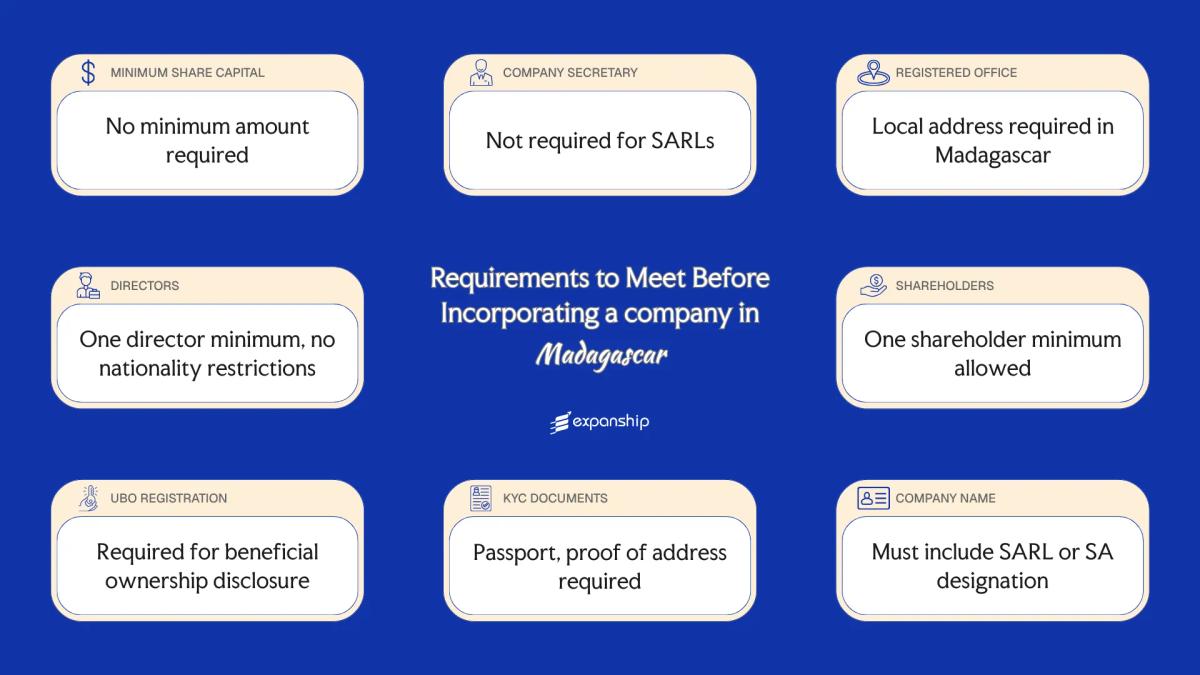
- All companies registering in Madagascar must satisfy the structural, governance, and documentary requirements established under Law No. 2003-036 on Commercial Companies before the Economic Development Board of Madagascar (EDBM) will recognise the entity as legally formed.
- Share capital thresholds are determined by entity type, meaning founders must confirm the applicable minimum before submitting a registration application to the One-Stop Shop (Guichet Unique).
- Foreign investors are required to meet resident director or local representative conditions as a prerequisite to finalising registration, not as a post-incorporation formality.
- Beneficial ownership disclosure obligations apply to all registered entities in Madagascar, regardless of whether the company is domestically or foreign-owned.
Entity formation in Madagascar is governed primarily by Law No. 2003-036 on Commercial Companies, administered through the Economic Development Board of Madagascar (EDBM) and the One-Stop Shop (Guichet Unique), which serves as the central registration authority. Meeting the incorporation requirements in Madagascar is a condition of legal recognition, and failure to satisfy them results in rejection of the registration application or the inability to obtain a legal operating status. This article covers the structural, documentary, and governance requirements that apply to the formation process.
Specific obligations vary depending on the entity type selected, the sector in which the business operates, and whether the investor is a foreign national or locally resident. You should verify which rules apply to your particular structure before initiating registration. The Commercial Companies Act provides the legislative baseline for these determinations.
This article is most relevant to foreign investors and non-resident business owners seeking to establish a formal legal presence through a registered entity in the country.
Minimum Share Capital Requirements in Madagascar
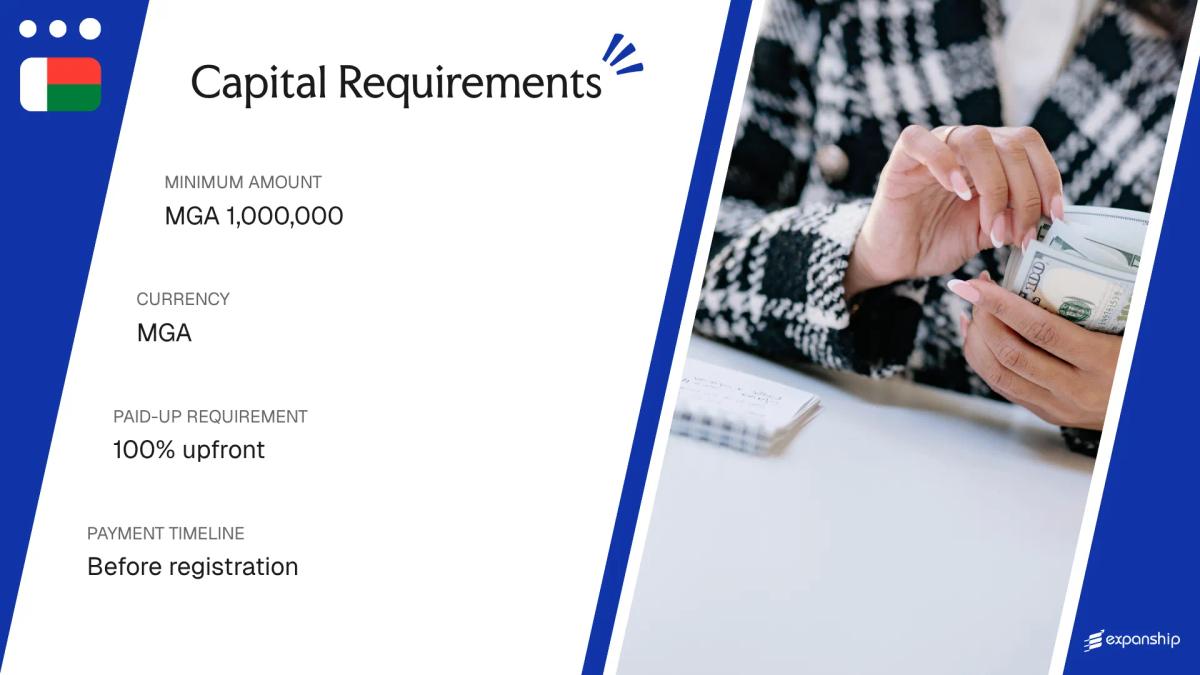
Madagascar minimum share capital requirements vary by entity type and are governed under the framework established by the OHADA Uniform Act on Commercial Companies, which Madagascar adopted as part of its regional legal harmonization. The registering authority is the Guichet Unique de Création d'Entreprise (GUIDE), which processes incorporation filings and verifies submitted capital documentation.
Share capital must be deposited into a blocked bank account prior to incorporation, with proof of deposit submitted to GUIDE as part of the formation dossier. Once the certificate of incorporation is issued, funds are released to the company.
| Parameter | Detail |
|---|---|
| Minimum Authorized Share Capital | MGA 100,000 for SARL; MGA 10,000,000 for SA |
| Maximum Authorized Share Capital | No statutory maximum |
| Minimum Paid-Up Capital | MGA 100,000 for SARL; MGA 2,500,000 for SA (25% of subscribed capital) |
| Paid-Up Requirement at Incorporation | Required in full for SARL; minimum 25% for SA at incorporation |
| Accepted Currency | Malagasy Ariary (MGA) |
| Accepted Forms of Contribution | Cash contributions; in-kind contributions subject to auditor valuation |
| Timeframe to Deposit Capital | Prior to filing incorporation documents with GUIDE |
The blocked account certificate must be obtained before submitting your incorporation dossier to GUIDE. Incorporation cannot proceed without documented proof that the required capital has been deposited.
Company Secretary Requirements in Madagascar
Under Madagascar's commercial framework, the company secretary requirements Madagascar imposes are relatively flexible compared to many civil law jurisdictions. The OHADA Uniform Act on Commercial Companies, which governs corporate structures in Madagascar, does not establish a mandatory company secretary role equivalent to common law traditions.
That said, a société anonyme (SA) and similar formal entities are expected to maintain administrative officers responsible for corporate record-keeping, shareholder communication, and compliance filings with the Centre de Formalités des Entreprises (CFE). Madagascar corporate secretary obligations, where applicable, fall to directors or appointed officers under the entity's statutes.
Qualification criteria for who may serve in this administrative capacity include:
- Natural persons of legal age with no disqualifying criminal record may serve
- Corporate entities or professional service firms may be appointed under the company's internal statutes
- No mandatory local residency requirement applies to this role
- No state-issued license or professional certification is specifically required under the OHADA framework
- The entity's statutes govern any additional eligibility conditions

Incorporate a Company in Madagascar
Set up your business entity in Madagascar with guided support through the CFE registration process and OHADA compliance requirements.
Registered Office Requirements in Madagascar
Registered office requirements in Madagascar are governed under the OHADA Uniform Act on Commercial Companies, which mandates that every company maintain a fixed, physical address within the country where official correspondence and legal notices can be directed. A non-compliant or fictitious address can result in the firm being struck from the commercial register maintained by the Tribunal de Commerce.
- A physical address is required; a PO Box alone does not satisfy the legal domicile requirement.
- The address must be located within Madagascar; a foreign address is not accepted by the registry.
- Virtual offices may be used only if they provide a genuine, occupiable physical premises verifiable by authorities.
- Either a property ownership document or a valid lease agreement must support the registered address.
- The address is publicly listed on the Registre du Commerce et des Sociétés (RCS) and accessible to third parties.
- Any change to the registered address must be formally notified to the RCS, requiring an updated filing to reflect the new location.
- Failure to maintain a valid address can lead to administrative sanctions, including suspension of the entity's legal standing before courts.
Director Requirements in Madagascar
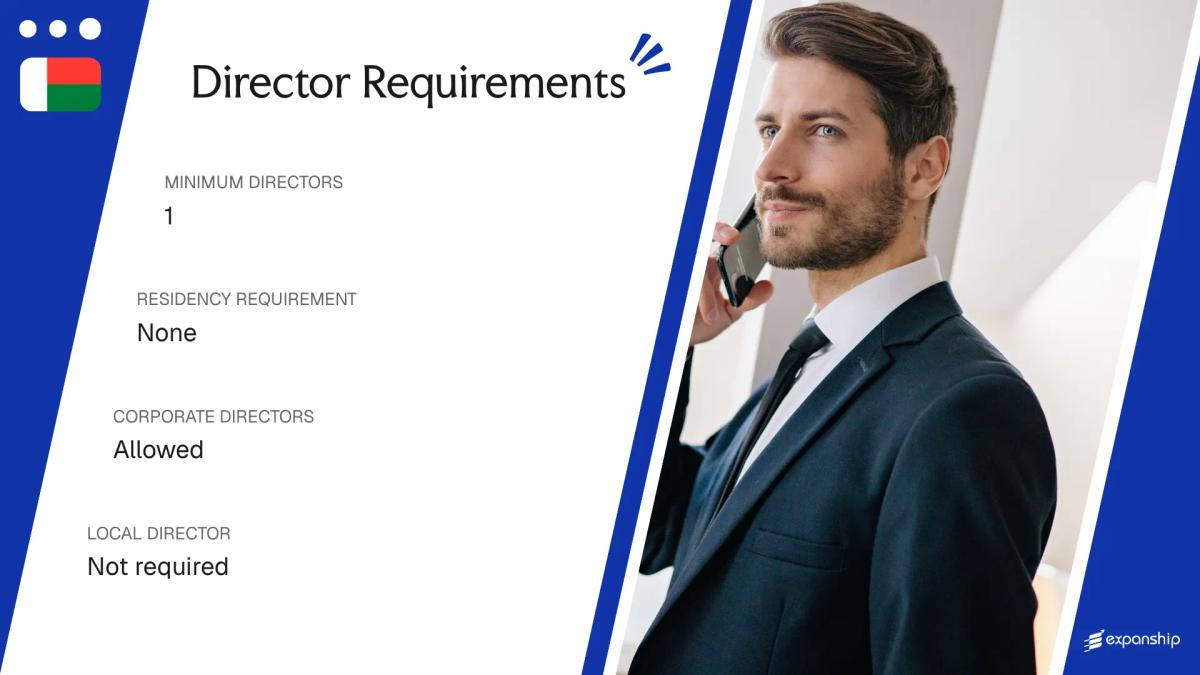
Under Madagascar's commercial law framework, directors of a société anonyme (SA) or société à responsabilité limitée (SARL) assume statutory duties including fiduciary obligations to the company, liability for regulatory non-compliance, and accountability for acts performed beyond their mandate. Director requirements in Madagascar are governed primarily by the OHADA Uniform Act on Commercial Companies and Economic Interest Groups, which Madagascar applies as a member state.
| Parameter | Detail |
|---|---|
| Minimum Number of Directors | An SA requires at least three directors; a SARL is managed by one or more gérants. |
| Maximum Number of Directors | An SA may have up to twelve directors on its board under OHADA rules. |
| Local/Resident Director Required | No statutory requirement for a resident or locally domiciled director. |
| Nationality Restrictions | No nationality restrictions are imposed on directors under OHADA-based rules. |
| Minimum Age Requirement | Directors must be at least eighteen years of age; an upper age limit may apply under company statutes. |
| Corporate Directors Permitted | Corporate directors are generally permitted under OHADA rules, subject to the company's articles. |
| Director Must Be a Shareholder | No statutory requirement for directors to hold shares, unless the articles specify otherwise. |
| Publicly Listed on Registry | Directors are recorded in the Registre du Commerce et des Sociétés (RCS) and are part of the public record. |
| Disqualification Conditions | Persons subject to a court-imposed prohibition, bankruptcy order, or criminal conviction affecting commercial capacity are disqualified. |
Despite no residency requirement, a directeur général of an SA in Madagascar who is a foreign national must still obtain a work permit if they perform executive management functions on Malagasy soil, even when holding no employment contract.
Shareholder Requirements in Madagascar
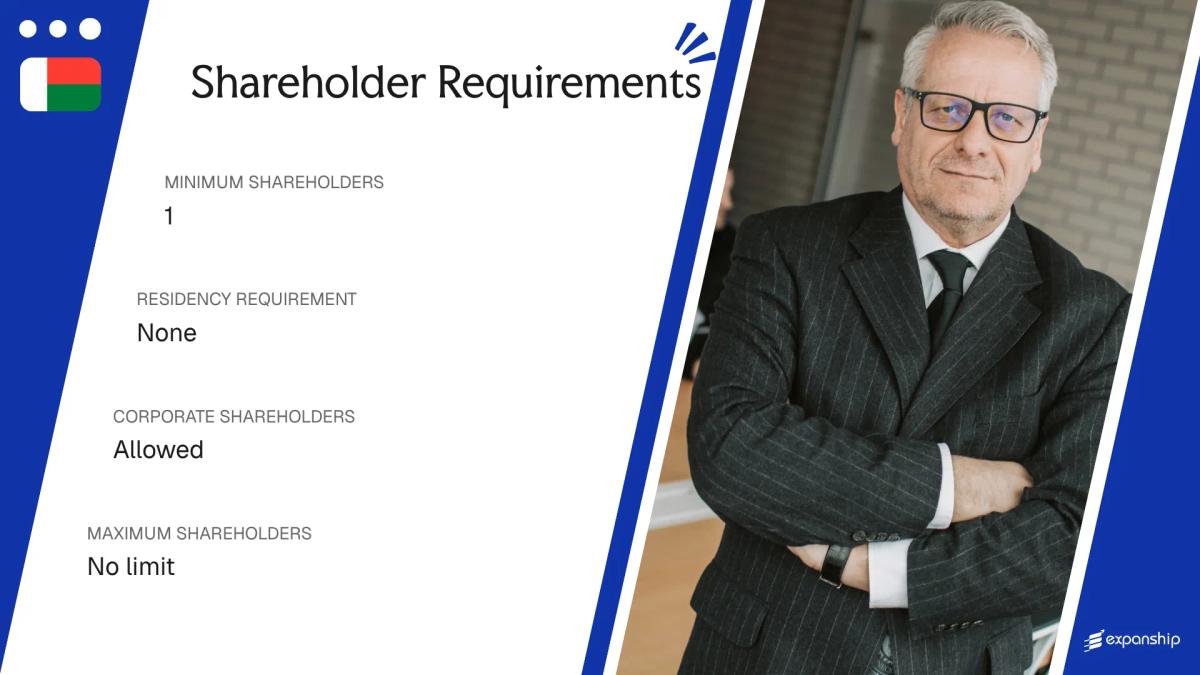
Under Malagasy company law, a Société à Responsabilité Limitée (SARL) requires a minimum of one shareholder, permitting a sole-associate structure. No statutory maximum applies to the number of associés in a SARL, though a Société Anonyme (SA) requires at least three shareholders.
Nationality and Residency Restrictions
Shareholder requirements in Madagascar impose no nationality or residency conditions on shareholders in either a SARL or SA structure. Foreign nationals may hold shares without restriction, and there is no prescribed cap on foreign ownership percentage.
Corporate Shareholders
Corporate entities are permitted to act as shareholders. A legal person holding shares must be represented by a duly authorized representative when exercising shareholder functions.
Shareholder Liability
In a SARL, each associé's liability is limited to their capital contribution. An SA shareholder is similarly protected, though personal liability may arise if a shareholder has acted fraudulently or outside their designated capacity.
Register of Shareholders
Madagascar shareholder compliance criteria include maintaining an internal register of shareholders. This register is not publicly accessible, but the entity must keep it current and produce it upon request by competent authorities.
Shareholder Structure Advisory for Company Formation in Madagascar
Get guidance on structuring your shareholding arrangement to meet local formation requirements in Madagascar.
UBO / Beneficial Ownership Disclosure Requirements in Madagascar
Beneficial ownership disclosure Madagascar operates under a developing regulatory framework, with requirements stemming from Madagascar's anti-money laundering legislation and alignment with FATF recommendations, though the statutory infrastructure remains limited in formal enforcement.
As of the time of writing, Madagascar has not established a fully codified UBO registration regime with a dedicated beneficial owner register or mandatory filing process at incorporation.
No statutory requirement currently mandates the sequential disclosure of beneficial owners to a public or government-held register at the point of company formation.
| Parameter | Detail |
|---|---|
| Ownership Threshold for UBO Status | No statutory threshold defined |
| Filing Authority | No designated authority |
| Disclosure Deadline at Incorporation | No statutory requirement |
| Publicly Accessible Register | No |
| Penalties for Non-Disclosure | No statutory requirement |
| Ongoing Update Obligation | No statutory requirement |
KYC / Document Requirements in Madagascar
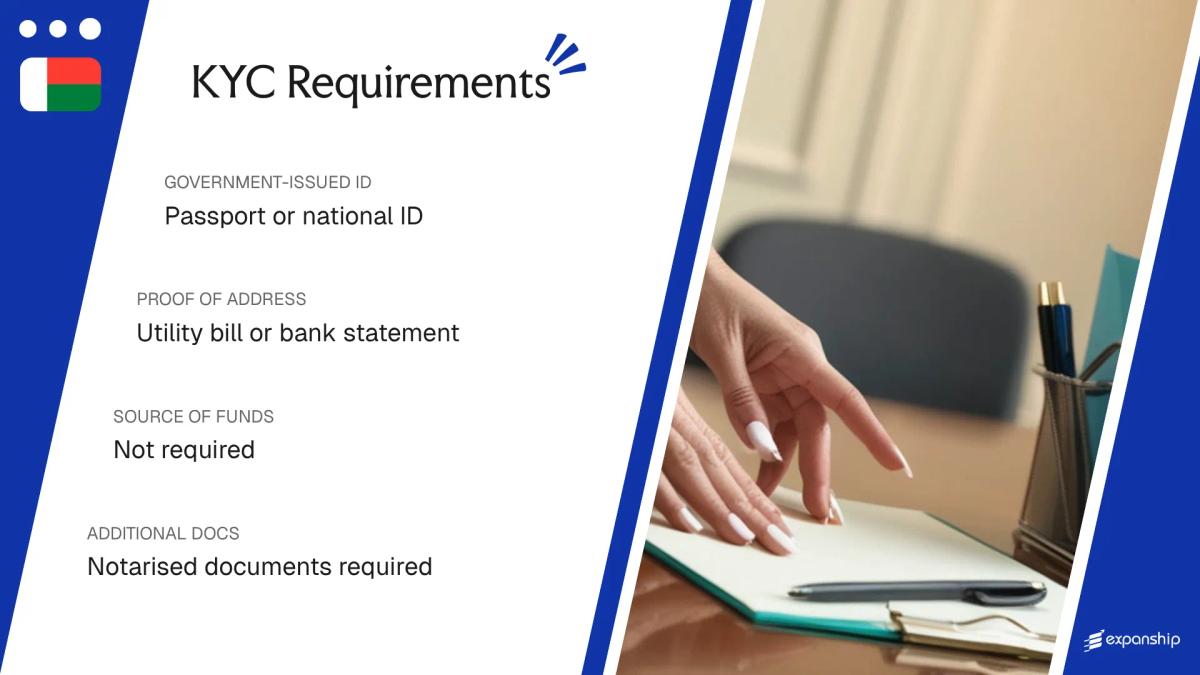
KYC document requirements Madagascar are governed by Law No. 2021-016 on Anti-Money Laundering and Countering the Financing of Terrorism, enforced through the SAMIFIN, the national Financial Intelligence Unit that oversees compliance obligations at the point of entity formation.
Individual / Personal Documents
- Valid government-issued passport or national identity card for each individual director, shareholder, or beneficial owner
- Proof of residential address dated within three months, such as a utility bill or official bank statement
- Completed KYC declaration form disclosing the individual's role and ownership percentage
- Recent passport-sized photograph may be required by the incorporating registry or notary
Corporate Documents
- Certificate of incorporation of the corporate shareholder or director, issued by the relevant authority in its home jurisdiction
- Constitutional documents, such as articles of association or equivalent charter
- Current register of directors confirming the authorised signatories
- Proof of registered office address for the corporate entity
Source of Funds Documentation
- Recent bank statements covering a minimum of three months prior to incorporation
- Audited financial accounts or accountant-certified statements where the entity has trading history
- Written declaration explaining the origin of the capital being introduced
Notarisation and Apostille Requirements
- Foreign-language documents must be accompanied by a certified French translation
- Documents originating outside Madagascar generally require notarisation in the country of origin
- Where the originating country is a Hague Convention signatory, an apostille is required in lieu of full legalisation
Unsigned or uncertified translations of foreign corporate documents are among the most frequently cited reasons for rejection at the Economic Development Board of Madagascar.
Company Name Requirements in Madagascar
Company name requirements in Madagascar are assessed during the incorporation process, with proposed names reviewed for availability and compliance before registration is approved. Each name must be unique and distinguishable from existing registered entities.
Names must be in French, reflecting Madagascar's official business language, and include a legal suffix that identifies the entity type, such as SARL or SA. No specific character limit is publicly codified, but the name must be clear and unambiguous.
Certain terms implying government affiliation, financial regulation, or professional licensing require prior approval from the relevant authorities. Words suggesting banking or insurance functions fall under this restriction.
Name reservation is generally available through the registration authority prior to formal incorporation. The reservation period is limited and must be followed by a completed registration to retain the name.
Compliance Services for Companies in Madagascar
Maintain your company's good standing in Madagascar with ongoing compliance support, from annual filings to regulatory updates.
Conclusion
Madagascar company incorporation requirements span several distinct legal obligations governed primarily through the EDBM (Economic Development Board of Madagascar) and the OHADA-aligned commercial framework. Minimum share capital thresholds vary by entity type, and UBO disclosure obligations apply to all registered firms. Foreign investors must also satisfy resident director or representative conditions before registration is finalised. Once these requirements are understood, the practical next step is engaging a qualified local agent to coordinate filings, notarisation, and ongoing Madagascar business registration compliance on your behalf.
Expanship's Corporate Formation Services in Madagascar
From fulfilling the EDBM's registration procedures to meeting Madagascar's UBO disclosure obligations, the administrative side of setting up a company here carries real weight. Expanship's corporate formation services Madagascar clients use are designed to reduce that operational burden, so your attention stays on building the business rather than managing paperwork across multiple government bodies.
Expanship supports your Madagascar company incorporation from initial structuring through to post-registration compliance. Here is what that covers:
- Preparing and filing all company registration documents with the relevant authorities
- Providing a registered agent and local office address for your entity
- Liaising directly with government bodies and regulatory agencies on your behalf
- Managing ongoing compliance obligations after your firm is incorporated
- Facilitating introductions to banking institutions suited to your business structure
- Handling tax registration and coordination with local fiscal authorities
Reach out to Expanship Madagascar to discuss your incorporation requirements.
Frequently Asked Questions (FAQ)
For a standard SARL, Madagascar law does not impose a statutory minimum share capital, but certain regulated sectors, such as banking, insurance, and financial services, carry their own capital thresholds set by the relevant sectoral authority. If your intended activity falls under a regulated industry, the sector-specific minimum overrides the general rule. You should confirm the applicable requirement with the EDBM or the relevant regulatory body before structuring your capital.
Maintaining a valid registered office address in Madagascar is a continuous legal obligation, not a one-time incorporation step. If the address lapses or becomes unverifiable, your entity risks non-compliance with the EDBM's registration records, which can affect your ability to renew licenses or execute official filings. You are required to formally notify the relevant registry of any address change within the prescribed period.
Madagascar's beneficial ownership framework requires disclosure, but the information is held within the company's statutory records and submitted to the relevant authority rather than published in a fully public registry accessible to all. The threshold for UBO classification, typically a defined percentage of ownership or control, determines who must be declared. Non-disclosure or inaccurate reporting can expose directors to administrative and criminal liability under applicable OHADA-aligned provisions.
A SARL in Madagascar requires at least one shareholder and can be constituted as a single-member entity, while the maximum number of shareholders is capped, generally at 100, beyond which the entity must convert to an SA structure. This cap is established under the OHADA Uniform Act on Commercial Companies as adopted in Madagascar. Exceeding the shareholder limit without converting the legal form constitutes a compliance breach.
Foreign nationals must typically submit notarised and apostilled identity documents, as Madagascar is a signatory to the Hague Apostille Convention, which removes the need for full consular legalisation in most cases. Certified translations into French are required for documents not originally issued in French, given that French remains the official language of corporate filings in Madagascar. The EDBM is the primary point of submission for these authenticated documents during the registration process.
Under the OHADA Uniform Act applicable in Madagascar, a legal person, such as a holding company, can be appointed as a director of an SA, provided it designates a permanent representative who is a natural person to act on its behalf. For a SARL, management is typically vested in one or more natural persons acting as gérants. The permanent representative assumes the same personal liabilities as a directly appointed individual director.
Legal Disclaimer
The information provided in this article is for general informational purposes only and does not constitute legal, tax, or professional advice. While we strive to ensure the accuracy and timeliness of the content, laws and regulations are subject to change, and the application of laws can vary widely based on specific facts and circumstances.
Readers should not act upon this information without seeking professional counsel tailored to their individual situation. Expanship and its authors disclaim any liability for actions taken or not taken based on the content of this article.
For specific advice regarding your business setup, compliance requirements, or any legal matters, please consult with qualified legal and tax professionals in the relevant jurisdiction.