
Key Takeaways
- Madagascar's territorial tax system means foreign-sourced income falls outside the scope of domestic taxation, allowing internationally active entities to contain their Malagasy tax exposure to locally generated revenue only.
- Businesses structured for export can benefit from dual preferential access through both AGOA and COMESA, positioning Madagascar as a cost-effective production base with preferential entry into U.S. and regional African markets simultaneously.
- The SARL formation process is administered through a single-window authority — the Economic Development Board of Madagascar (EDBM) — reducing the procedural friction that typically increases setup timelines and costs in comparable African jurisdictions.
- Companies operating within Madagascar's Special Economic Zones can access tax exemptions beyond the standard IRSA corporate rate, making SEZ designation a material consideration for export-oriented manufacturing and distribution businesses.
Madagascar is an independent island nation situated in the Indian Ocean off the southeastern coast of Africa, governed under a republican constitutional framework. For foreign businesses assessing the benefits of incorporating in Madagascar, the starting point is the Economic Development Board of Madagascar (EDBM), the authority responsible for company registration and investment facilitation. The Société à Responsabilité Limitée is the legal vehicle most commonly used by foreign investors entering the market.
From a tax perspective, the country operates a territorial-based system, meaning income sourced outside its borders is generally not subject to domestic taxation. Foreign ownership is broadly permitted across most sectors, and the government has maintained a stated policy of openness toward foreign direct investment, with the EDBM serving as a single-window entry point for registration procedures.
This article examines the key advantages that Madagascar company formation offers to foreign businesses and investors operating across regional and international markets.
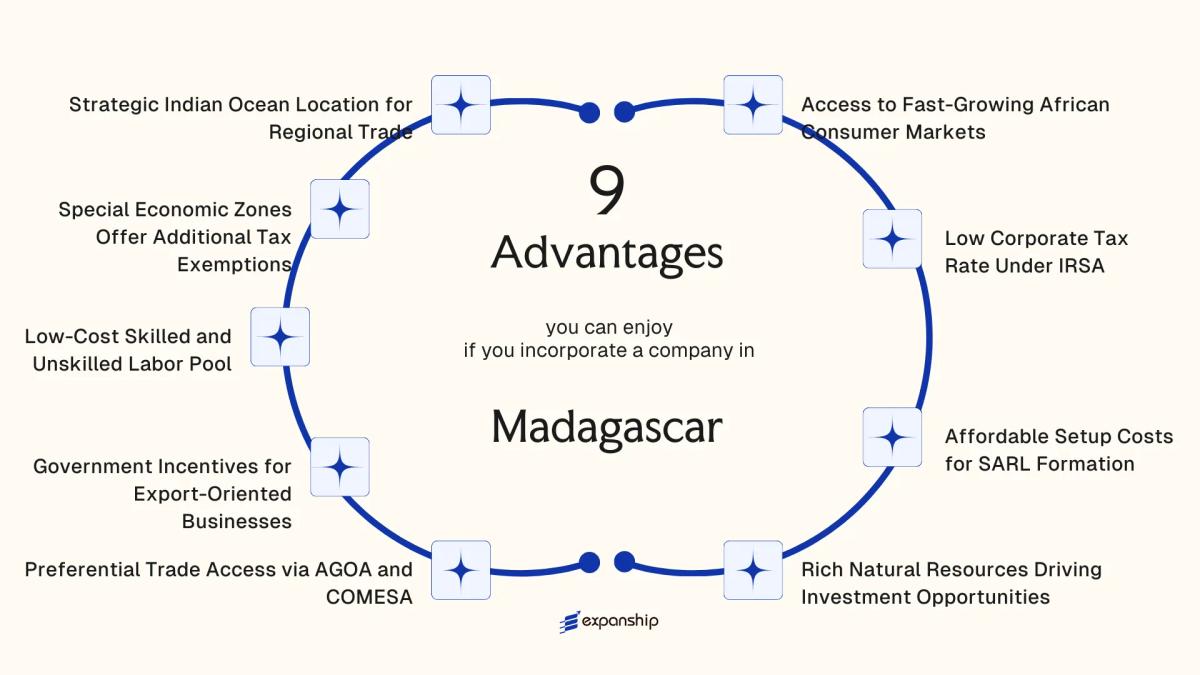
Access to Fast-Growing African Consumer Markets
Madagascar access to African consumer markets is shaped by the country's active membership in two major regional trading blocs, giving incorporated entities reach into a combined consumer base that spans much of the continent.
Regional Bloc Membership as a Market Entry Point
As a member of both COMESA and SADC, a business registered in Madagascar can trade across a network of economies stretching from Egypt to South Africa. COMESA alone represents over 640 million people, and preferential tariff arrangements under the bloc's free trade area reduce the cost of cross-border commerce for qualifying goods.
What This Means for Export-Oriented Structures
Incorporating locally positions your firm as a regional origin-point, not just a domestic operator. A Malagasy entity exporting goods within COMESA can benefit from reduced or zero tariffs on eligible product categories, lowering the landed cost of goods in destination markets compared to non-member competitors.
Eligibility for these preferences typically depends on meeting rules-of-origin requirements set by each respective trade agreement.
A Madagascar-incorporated entity can access preferential tariff rates across COMESA's 21 member states without the export cost burden faced by businesses incorporated outside the bloc.
Low Corporate Tax Rate Under IRSA
Madagascar's corporate tax regime is governed by the Impôt sur les Revenus Salariaux et Assimilés framework, and the Madagascar IRSA corporate tax rate benefits become apparent when you examine the headline rate. Corporate income is taxed at 20%, a figure that sits below the rates applied in many comparable African markets and substantially below the OECD average of roughly 23%.
For a foreign-owned entity registered as a Société à Responsabilité Limitée or Société Anonyme, the 20% rate applies to net taxable profit, meaning deductible business expenses reduce the base before the rate is applied. That structure gives your firm a degree of control over its effective tax burden that a flat turnover-based tax would not allow.
Small and medium enterprises benefit further. Businesses below a defined revenue threshold may qualify for the Impôt Synthétique, a simplified regime with a lower effective rate, reducing the compliance load alongside the tax cost.
The IRSA low corporate tax advantages for qualifying investors include several structural features that compound the headline rate:
- Net profit taxation means ordinary operating costs directly reduce the taxable base
- The regime is codified in the Code Général des Impôts, giving investors a stable, published legal reference
- The threshold-based SME regime removes the burden of full accounting compliance at early revenue stages
- Treaty negotiations and investment code provisions can reduce withholding taxes on dividends remitted abroad

Company Incorporation in Madagascar
Register your business entity in Madagascar with full compliance support across legal, tax, and regulatory requirements.
Affordable Setup Costs for SARL Formation
Forming a Société à Responsabilité Limitée (SARL) in Madagascar carries a cost structure that gives foreign investors a meaningful capital advantage from the outset. Madagascar SARL formation affordable setup benefits begin with the minimum share capital requirement, which the OHADA Uniform Act on Commercial Companies sets at a nominal level, allowing founders to allocate working capital toward operations rather than statutory deposits.
| Cost Element | Indicative Range (USD) | Governing Reference |
|---|---|---|
| Minimum share capital | ~$20 (nominal) | OHADA Uniform Act |
| Registration fees (Economic Development Board) | ~$50–$150 | EDBM administrative schedule |
| Notarial deed (where required) | ~$100–$300 | Malagasy notarial tariffs |
| Business license (patente) | Variable by activity | General Tax Code |
Registration is processed through the Economic Development Board of Madagascar (EDBM), which operates a one-stop-shop service that consolidates tax identification, statistical registration, and commercial registry filing. Completing these formalities through a single authority reduces both the time and the administrative overhead that would otherwise accompany dealing with multiple agencies sequentially.
For a foreign investor, the practical implication is straightforward: initial outlay to establish a legally compliant entity with limited liability protection remains low relative to comparable structures in Francophone Africa. A firm can become operational with substantially less pre-revenue capital committed, preserving liquidity during the early trading period.
Rich Natural Resources Driving Investment Opportunities
Madagascar natural resources investment opportunities are concentrated in sectors that few African jurisdictions can match in variety or scale. The country holds significant deposits of chromite, ilmenite, nickel, cobalt, and graphite, alongside sapphire and other gemstones. For a foreign business structuring an entity here, this resource base creates a direct entry point into extractive and processing industries that remain underdeveloped relative to their actual reserve volumes.
Governance of the sector falls under the Mining Code (Law No. 1999-022 and subsequent amendments), administered by the Ministère des Mines et des Ressources Stratégiques. The Code establishes permit categories including exploration permits and mining permits, with provisions for large-scale operations under a specific mining investment framework. This statutory clarity reduces the ambiguity that typically slows foreign capital deployment in frontier markets.
Madagascar extractive industry benefits for investors extend beyond raw extraction. The country's graphite reserves, for instance, are commercially relevant to battery supply chains, creating downstream processing angles for firms oriented toward energy transition markets.
Keep these points in mind:
- Mining permits are issued by the Ministère des Mines; verify current processing timelines with the Bureau du Cadastre Minier de Madagascar (BCMM)
- Large-scale projects may qualify for a negotiated investment framework under the Mining Code
- Environmental compliance under the Office National pour l'Environnement (ONE) is a prerequisite before operational permits are granted
Madagascar holds one of the world's largest known graphite deposits, a material now classified as a critical mineral by the EU and United States, meaning projects here may qualify for priority procurement partnerships under allied-nation supply chain initiatives.
Preferential Trade Access via AGOA and COMESA
Madagascar AGOA COMESA trade access benefits translate directly into reduced cost of entry for exporters targeting two of the world's most significant preferential trade frameworks. A company incorporated in the country can ship eligible goods to the United States duty-free under the African Growth and Opportunity Act, while simultaneously accessing the broader intra-African market through COMESA membership.
AGOA Eligibility and What It Means for Your Exports
Under AGOA, qualifying Malagasy exporters can access the U.S. market across thousands of product categories without paying standard import tariffs. Apparel and textiles have historically been among the strongest beneficiaries, given the third-country fabric rule that applies to eligible sub-Saharan producers. For a foreign business owner manufacturing in the country, this tariff elimination can substantially reduce the landed cost of goods entering the U.S., improving price competitiveness without requiring changes to the product itself.
Eligibility is tied to compliance with AGOA's rules of origin and the country's continued designation by the U.S. government, which is reviewed annually.
COMESA Membership and Intra-African Market Access
COMESA's free trade area covers a combined GDP that spans over 20 member states across eastern and southern Africa. Businesses incorporated locally can benefit from reduced or eliminated tariffs on goods traded within the bloc, under the COMESA Treaty framework. That tariff reduction applies across a wide range of product categories, giving your entity a structural cost advantage when supplying regional markets compared to competitors incorporated outside the bloc.
Maximize Madagascar's Trade Access Advantages for Your Business
Speak with an Expanship specialist to understand how AGOA eligibility and COMESA membership apply to your specific product category and corporate structure.
Government Incentives for Export-Oriented Businesses
Madagascar government incentives for export businesses are structured primarily through the Export Processing Zone (EPZ) regime, governed by Law No. 89-026 and subsequently updated through investment promotion legislation administered by the Economic Development Board of Madagascar (EDBM). Businesses operating under this framework gain access to a set of fiscal advantages that directly reduce the cost of doing business as an exporter.
- EPZ-registered firms benefit from a 15-year corporate tax exemption during the operational phase, after which a reduced rate applies. For a foreign-owned exporting entity, this defers a significant tax burden during the years when capital recovery is most critical.
- Customs duties on imported raw materials and equipment used in production for export are suspended under the EPZ regime. This allows your manufacturing operation to source inputs without the added cost that would otherwise compress export margins.
- Dividend repatriation and profit transfers are permitted under the EPZ framework, which matters practically when your firm needs to move earnings back to a parent company or investors abroad.
- The EDBM serves as a single-window authority for investment registration, meaning your firm interacts with one body rather than multiple ministries to access these incentives.
Eligibility generally requires that a defined minimum percentage of production output be directed toward export markets, so firms serving primarily the domestic market do not qualify under this structure.
Low-Cost Skilled and Unskilled Labor Pool
Madagascar low cost labor advantages for businesses are grounded in measurable wage differentials. The national minimum wage, set by the government under the Labour Code (Code du Travail), sits among the lowest in Sub-Saharan Africa, which directly reduces your fixed operating costs from day one.
Textile and light manufacturing firms operating in the country have historically paid monthly wages well below comparable rates in Vietnam or Bangladesh, both of which are benchmark low-cost manufacturing destinations. For labor-intensive sectors, this gap represents a structural cost advantage that compounds across large workforces.
The available labor supply is not limited to unskilled workers. Antananarivo and other urban centers produce graduates in engineering, accounting, and information technology through institutions such as the University of Antananarivo, giving your business access to qualified professionals at salary levels far below OECD-country equivalents.
A foreign apparel manufacturer employing 500 workers at Madagascar's minimum wage of approximately 250,000–300,000 Malagasy ariary per month (roughly USD 55–65) would face an annual payroll of under USD 400,000 for that workforce, compared to an estimated USD 1.2–1.5 million for equivalent headcount in Morocco or Sri Lanka at prevailing minimum wage rates.
Special Economic Zones Offer Additional Tax Exemptions
Madagascar special economic zones tax exemptions operate under a dedicated legal framework that allows qualifying export-oriented firms to access fiscal advantages beyond the standard IRSA corporate tax regime. The governing instrument, the Export Processing Zone (EPZ) law and subsequent free zone legislation, grants approved entities full exemption from corporate income tax for a defined period, after which a reduced rate applies.
Businesses operating within these zones also benefit from:
- Exemption from customs duties on imported capital equipment and raw materials
- VAT relief on inputs used in the production of export goods
- Reduced or waived dividend withholding tax during the preferential period
These exemptions directly reduce the cost base for manufacturing, processing, and assembly operations. For a foreign investor producing goods destined for export, the combined effect of duty-free inputs and corporate tax relief can materially improve margins compared to operating under the standard tax code.
Eligibility is tied to export performance thresholds and the approval of the relevant zone authority, so your firm must meet specific criteria before these rates apply.
Free zone tax benefits in Madagascar are conditional on maintaining approved export percentages; failing to meet these thresholds can result in reclassification under the standard tax regime.
Strategic Indian Ocean Location for Regional Trade
Madagascar's Indian Ocean location trade advantages stem from a straightforward geographic fact: the island sits at the crossroads of shipping lanes connecting sub-Saharan Africa, the Gulf states, South Asia, and Southeast Asia. For a business that depends on physical goods movement, proximity to multiple high-volume trade corridors reduces transit times and freight costs in ways that an inland African location simply cannot replicate.
Antananarivo and the port city of Toamasina serve as the primary commercial and logistics anchors. Toamasina handles the majority of the country's international cargo volume, and its position on the eastern coast places it directly along Indian Ocean shipping routes used by vessels transiting between Asia and the African continent.
Membership in the Indian Ocean Commission (IOC) gives firms incorporated here access to a regional diplomatic and economic cooperation framework that spans Comoros, Mauritius, Réunion, and Seychelles. This opens bilateral trade discussions and regional project participation that would otherwise require a separate legal presence in each member state.
- Direct sea access to East African port cities including Mombasa, Dar es Salaam, and Durban
- Positioning within reach of high-growth import markets in the Gulf Cooperation Council (GCC)
- Air connectivity through Ivato International Airport to regional hubs including Nairobi and Johannesburg
For export-oriented businesses in sectors such as agribusiness, seafood, or light manufacturing, the geographic position means your supply chain can realistically serve three distinct regional markets from a single incorporated entity without relying on intermediary distribution hubs.
Why Madagascar Stands Out Among African Jurisdictions
Compared to other Indian Ocean and sub-Saharan African jurisdictions competing for similar foreign investment profiles, the three most instructive comparators are Mauritius, Kenya, and Mozambique. Mauritius targets high-value holding structures and fund vehicles; Kenya draws regional headquarters and tech ventures; Mozambique competes on natural resource extraction. Positioning your entity against these three reveals where the Malagasy framework holds a structurally distinct position.
What the comparison shows is less about headline tax rates and more about the combined effect of formation cost, trade access, and labor economics. A business that can register an SARL through the Guichet Unique at a cost well below comparable processes in Nairobi or Port Louis, while accessing both AGOA and COMESA preferences, occupies a position that neither Mauritius nor Kenya replicates on cost grounds alone.
| Parameter | Madagascar | Mauritius | Kenya | Mozambique |
|---|---|---|---|---|
| Standard Corporate Tax Rate | 20% (IRSA) | 15% | 30% | 32% |
| Minimum Share Capital (Private Company) | MGA 100,000 (approx.) | None (GBP 1 equivalent) | KES 0 | Low / minimal |
| AGOA Beneficiary Status | Yes | Yes | Yes | No |
| COMESA Membership | Yes | Yes | Yes | No |
| Special Economic Zone Regime | Yes | Yes | Yes | Yes |
| Single Registration Window | Yes (EDBM) | Yes (BOI) | Yes (eCitizen) | Partial |
Compliance Services for Companies in Madagascar
Maintain your Madagascar entity's good standing with annual filings, regulatory reporting, and statutory obligations managed by Expanship.
Conclusion
Incorporating in Madagascar offers a grounded case for market entry that rests on structural advantages rather than circumstantial opportunity. Access to preferential trade arrangements under AGOA and COMESA, combined with the cost efficiencies available through Special Economic Zone designations, creates a viable operating environment for export-oriented businesses. The availability of low-cost labor within a formal legal framework further supports sectors where production margins are central to competitiveness.
These benefits of incorporating in Madagascar are not uniform across all business types. An entity focused on resource extraction operates under different regulatory conditions than one structured for textile manufacturing or regional distribution. The strength of this jurisdiction for your business depends on how your corporate structure, revenue model, and target markets align with what the local framework actually offers.
For foreign investors who have assessed that alignment, the next practical step is understanding the registration process under Malagasy law, the obligations that attach to your chosen entity type, and the ongoing compliance requirements that apply after formation.
Start Your Madagascar Company Formation With Expanship
Expanship's Madagascar company formation services cover the full incorporation cycle under the regulatory authority of the Economic Development Board of Madagascar (EDBM), which serves as the primary entry point for foreign investors establishing a presence through an SARL or other recognised entity type. From initial structuring decisions informed by the IRSA tax regime and Special Economic Zone eligibility, through to post-incorporation compliance under the OHADA-aligned commercial code, each stage carries specific documentation and filing requirements that vary by sector and ownership structure.
Working with Expanship on your Madagascar business registration gives you access to coordinated support across the following service areas:
- Document preparation, notarisation, and apostille or legalisation for foreign-sourced records
- Registered agent and registered office provision in Antananarivo
- Government filing and direct liaison with the EDBM one-stop-shop (guichet unique)
- Post-incorporation compliance management, including annual returns and statutory updates
- Corporate bank account introduction assistance with locally licensed financial institutions
- Ongoing registered office maintenance and directorship support where required
Expanship Madagascar can be reached directly to discuss your incorporation requirements.
Frequently Asked Questions (FAQ)
The minimum share capital for a Société à Responsabilité Limitée (SARL) in Madagascar is set at a nominal level, making it one of the more accessible entry points for foreign investors forming a private limited company. Capital requirements can vary depending on the sector and any applicable licensing conditions, so confirming figures with the EDBM or a local legal adviser at the time of registration is advisable. Share capital must be deposited in a Malagasy bank account prior to registration.
IRSA, the Impôt sur les Revenus Salariaux et Assimilés, is primarily a payroll and income tax applicable to employees rather than a corporate profit tax. Corporate income in Madagascar is generally subject to a separate regime, and businesses operating in export zones or under special investment codes may qualify for reduced rates or temporary exemptions. Your tax obligations depend on the nature of the entity, its registered activities, and whether it qualifies under any government incentive framework.
Membership in the Common Market for Eastern and Southern Africa (COMESA) allows qualifying businesses registered in Madagascar to access preferential tariff arrangements when trading with other member states. To benefit from these rates, goods must meet the applicable rules of origin requirements set out under COMESA's trade protocols. Firms engaged in manufacturing or processing for export are typically better positioned to take advantage of these arrangements than purely import-focused businesses.
Company registration through the EDBM's one-stop-shop mechanism is designed to consolidate multiple administrative steps, and timelines can range from a few days to several weeks depending on the completeness of documentation and the business sector. Delays commonly arise from document authentication requirements, particularly for foreign-sourced incorporation documents that must be apostilled or notarized. Sector-specific licenses, if required, are processed separately and may extend the overall setup timeline.
Businesses established within designated Special Economic Zones (SEZs) in Madagascar can access corporate tax exemptions, typically structured as time-limited holidays during an initial operating period, after which reduced rates may apply. The precise terms depend on the specific zone, the nature of the investment, and compliance with employment and export thresholds. These incentives are governed by the investment code and zone-specific regulations rather than the general tax statute.
Failure to meet annual filing and tax obligations can result in penalties imposed by the Direction Générale des Impôts (DGI), including financial fines and potential suspension of business registration. Persistent non-compliance may trigger a formal investigation or administrative dissolution of the entity. Foreign-owned companies face the same compliance obligations as locally owned firms and are not exempt from enforcement action.
Madagascar regained eligibility under the African Growth and Opportunity Act (AGOA) following a period of suspension related to political conditions. This eligibility allows qualifying exports, particularly in textiles and apparel, to enter the United States market duty-free, subject to meeting the Act's rules of origin and country eligibility criteria. Businesses intending to rely on AGOA benefits should monitor eligibility status, as it is reviewed periodically by the United States Trade Representative.
Legal Disclaimer
The information provided in this article is for general informational purposes only and does not constitute legal, tax, or professional advice. While we strive to ensure the accuracy and timeliness of the content, laws and regulations are subject to change, and the application of laws can vary widely based on specific facts and circumstances.
Readers should not act upon this information without seeking professional counsel tailored to their individual situation. Expanship and its authors disclaim any liability for actions taken or not taken based on the content of this article.
For specific advice regarding your business setup, compliance requirements, or any legal matters, please consult with qualified legal and tax professionals in the relevant jurisdiction.