
Key Takeaways
- Foreign investors operating in Madagascar must navigate registration processes administered by the EDBM within a broader legal framework shaped by the 2003 Commercial Code, where bureaucratic delays and inconsistent procedural enforcement can substantially extend the timeline to lawful commercial operation.
- Madagascar's mandatory use of the Malagasy Ariary as the functional currency for local transactions introduces foreign exchange exposure and repatriation complexity for internationally structured entities.
- Weak judicial enforcement of intellectual property rights creates measurable commercial risk for businesses in technology, branding, or proprietary manufacturing sectors seeking to protect assets under Malagasy law.
- Unreliable electricity supply and underdeveloped physical infrastructure impose recurring operational costs and continuity risks that disproportionately affect capital-intensive or production-dependent businesses across the country.
Madagascar operates under an evolving regulatory framework, shaped by the OHADA-influenced commercial code and oversight from bodies such as the Economic Development Board of Madagascar (EDBM). The commercial code provides the statutory foundation for business registration and corporate conduct in the country.
The disadvantages of incorporating in Madagascar span several distinct categories, from institutional and financial barriers to infrastructure and enforcement gaps.
Not every drawback applies equally to all investors. A manufacturing firm faces different operational risks than a service-based entity or a foreign branch structure.
This article is most relevant to foreign investors and internationally operating businesses considering a formal commercial presence, particularly those in capital-intensive or IP-sensitive sectors.
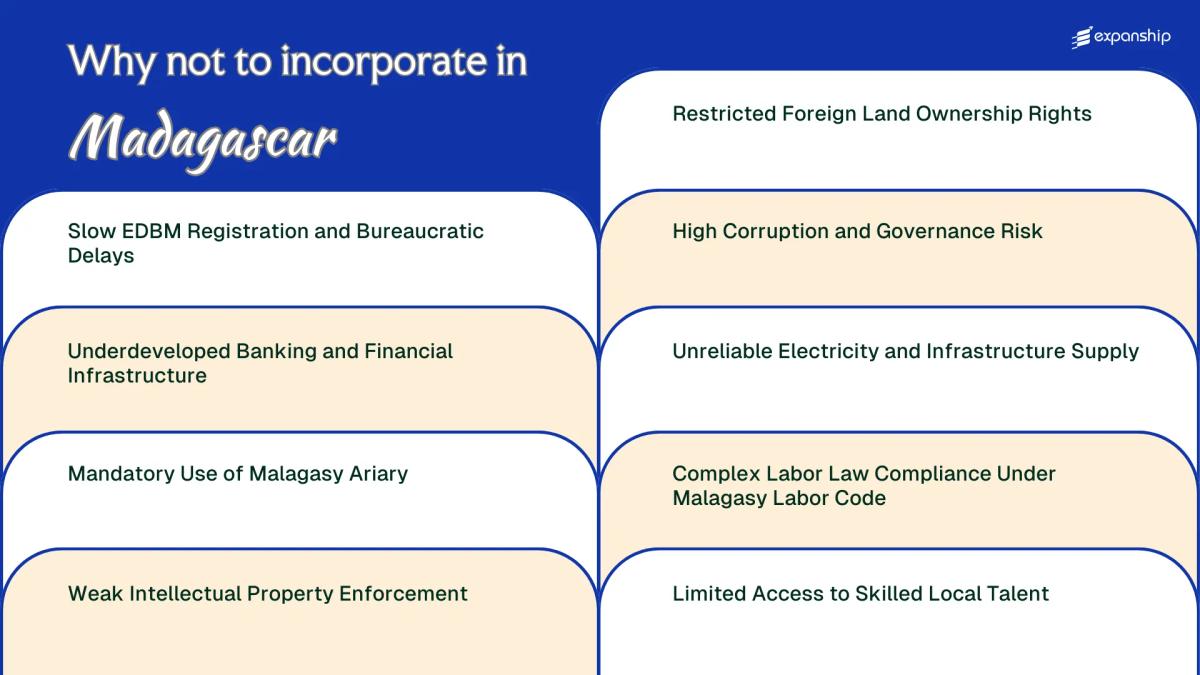
Slow EDBM Registration and Bureaucratic Delays
EDBM registration delays Madagascar are a documented friction point for foreign investors. Processing times at the Economic Development Board of Madagascar frequently exceed the statutory targets, creating uncertainty around your projected launch timeline.
Structural Gaps in the One-Stop-Shop Model
The EDBM was established to consolidate company registration into a single window, but inter-agency coordination with the tax authority (DGI) and the commercial court registry (Tribunal de Commerce) remains inconsistent. Delays in obtaining your NIF (tax identification number) or completing the commercial register inscription can stall operations by several weeks beyond initial estimates.
Cascading Costs of Slow Company Registration
Each postponed registration milestone delays your ability to open a corporate bank account, sign contracts, or hire staff legally under the Malagasy Labor Code. The slow company registration process in Madagascar translates directly into extended periods of overhead without any operational return, a particularly acute burden for small foreign entities with limited pre-launch capital.
Statutory deadlines exist on paper, but enforcement of those timelines against government bodies is not a reliable mechanism for foreign businesses.
If registration extends beyond your projected timeline, any lease agreements, supplier contracts, or employment offers made in anticipation of incorporation may become legally or commercially untenable.
Underdeveloped Banking and Financial Infrastructure
Madagascar's underdeveloped banking infrastructure creates immediate friction for any foreign entity attempting to establish and operate a business there. The country's commercial banking sector is concentrated among a small number of institutions, including BNI Madagascar, Bank of Africa Madagascar, and Société Générale Madagascar, with limited branch networks outside Antananarivo.
Correspondent banking relationships with international banks are sparse. This means cross-border transfers can face delays, intermediary fees, and compliance holds that slow down routine treasury operations significantly.
Opening a corporate bank account often requires physical presence, extensive documentation, and prolonged processing timelines. For foreign-owned entities, banks may apply additional scrutiny under anti-money laundering obligations supervised by the Banque Centrale de Madagascar.
These limitations translate into concrete operational friction:
- Delayed access to credit facilities forces firms to rely on offshore capital, increasing financing costs
- Wire transfers routed through multiple correspondent banks erode margins on each transaction
- Limited digital banking services restrict remote financial management for foreign directors based outside the country
- Inadequate trade finance products make managing supplier payments and import cycles more difficult
Microfinance institutions serve segments of the population but offer no meaningful support for corporate-level financial needs.

Company Incorporation in Madagascar
Understand the full scope of regulatory requirements before establishing a business entity in Madagascar.
Mandatory Use of Malagasy Ariary
Malagasy Ariary currency restrictions on business transactions create an immediate structural problem for any foreign-incorporated entity. The Ariary (MGA) is not freely convertible, and the Banque Centrale de Madagascar enforces exchange controls that restrict how foreign currency enters, moves, and exits the country.
Foreign firms operating in Madagascar must conduct domestic transactions in Ariary. This means pricing, payroll, and supplier contracts denominated in USD or EUR must be converted locally, exposing your business to exchange rate losses that compound over time.
| Restriction or Threshold | Practical Burden |
|---|---|
| Mandatory local currency invoicing for domestic sales | Prevents USD/EUR pricing; creates FX conversion costs on every transaction |
| Repatriation of profits requires central bank approval | Delays fund transfers; no guaranteed timeline for approval |
| Ariary not traded on international forex markets | No hedging instruments available through global banks |
| Inflation rate historically exceeding 8-10% annually | Ariary-denominated revenues lose real value faster than hard currency equivalents |
The absence of internationally traded Ariary means your firm cannot use standard hedging tools to offset currency risk. Exchange rate challenges during incorporation planning are frequently underestimated, since the MGA has depreciated consistently against major currencies over the past decade.
Profit repatriation is not automatic. Approval from the Banque Centrale de Madagascar introduces timing uncertainty that directly affects dividend planning and cash flow forecasts for parent companies abroad.
Weak Intellectual Property Enforcement
Weak intellectual property enforcement Madagascar presents a structural problem for any foreign firm holding trademarks, patents, or proprietary technology. The country's IP framework falls under the jurisdiction of the OMAPI (Office Malgache de la Propriété Industrielle), but registration alone does not translate into reliable protection.
Even registered IP assets can be commercially exploited by third parties with limited legal consequence. Enforcement depends on court proceedings that are slow, under-resourced, and inconsistent in outcome.
Madagascar has not ratified all major international IP conventions, which limits the automatic recognition of foreign IP rights within the country. Your registered trademark in a home jurisdiction carries no presumptive legal weight here without a separate local filing.
Civil litigation through Malagasy courts remains the primary enforcement mechanism, and there is no dedicated IP tribunal. For a foreign entity pursuing infringement, this means prolonged legal proceedings with uncertain costs and no specialist adjudication.
- IP rights must be registered separately with OMAPI to have legal standing domestically
- Infringement claims proceed through general civil courts, not a specialized IP body
- Foreign judgments related to IP are not automatically enforceable under Malagasy law
- There is no expedited injunction process specifically designed for IP violations
Madagascar is a member of the African Intellectual Property Organization (OAPI) framework discussions but has not formally joined, meaning regional IP protections available to francophone African neighbors do not extend here.
Restricted Foreign Land Ownership Rights
Foreign land ownership restrictions in Madagascar present a structural barrier that foreign investors encounter early in the incorporation process. Under Malagasy law, non-citizens and foreign-registered entities are prohibited from owning freehold land outright.
The Legal Barrier to Direct Ownership
The Land Governance Programme and successive regulatory updates have preserved the principle that land title, governed under the Malagasy land tenure system, remains reserved for Malagasy nationals. Your business can access land only through long-term lease arrangements, typically structured under emphyteutic leases, which cap foreign use rights rather than conferring ownership.
This restriction applies regardless of sector or investment scale, meaning a foreign manufacturing firm and a small commercial entity face the same ceiling on property rights limitations.
Operational Consequences for Foreign Companies
Lease dependency creates compounding exposure: rent renegotiations, lessor insolvency, or political shifts can disrupt your operational premises without the security that a title deed would provide. The inability to hold real estate as a balance sheet asset also restricts collateral options when seeking local financing.
Long-term infrastructure investment becomes harder to justify when tenure security rests on a contractual arrangement rather than legal ownership.
Addressing Land Access Challenges for Your Business in Madagascar
Understand how lease structures and tenure arrangements affect your incorporation strategy in Madagascar before committing capital.
High Corruption and Governance Risk
Corruption risks doing business in Madagascar rank among the most documented deterrents for foreign investors, with the country scoring 26 out of 100 on Transparency International's 2023 Corruption Perceptions Index. Governance instability, reinforced by a history of unconstitutional transfers of power, creates an unpredictable regulatory environment where formal legal protections carry inconsistent enforcement weight.
- The Independent Anti-Corruption Bureau (BIANCO) exists as Madagascar's primary anti-graft agency, but its operational independence remains constrained, meaning foreign firms cannot rely on it as a credible enforcement mechanism against solicitation.
- Judicial decisions in commercial disputes are vulnerable to political influence, which exposes your entity to outcomes that may not reflect the written provisions of the OHADA-aligned commercial framework the country applies.
- Obtaining routine administrative approvals from ministries and local authorities frequently involves informal payments, creating undisclosed compliance costs that distort your actual cost of doing business.
- Foreign investors operating under the Investment Code (Law No. 2007-036) have legal guarantees on paper, but enforcement gaps mean those protections are difficult to invoke in practice.
Unreliable Electricity and Infrastructure Supply
Unreliable electricity supply is a structural operational risk for any business incorporated in Madagascar. The state utility, JIRAMA (Jiro sy Rano Malagasy), manages both electricity and water distribution, and chronic underinvestment has left it unable to meet demand consistently across major commercial centers, including Antananarivo and Toamasina.
Outages are frequent and unscheduled. For any firm running continuous operations — manufacturing, cold chain logistics, or data-dependent services — each interruption translates directly into lost output, equipment damage, or spoiled inventory.
Diesel generators are the standard workaround, but they impose a recurring cost burden that undermines margin projections built on paper utility rates. Road infrastructure outside the capital remains poorly maintained, creating supply chain delays that compound distribution costs for firms moving goods across the island.
Broadband connectivity follows a similar pattern. Consistent, high-speed internet access is not reliably available outside Antananarivo, which limits the viability of remote-managed operations or regional expansion.
A foreign-owned manufacturing firm operating a single production facility in Antananarivo and running diesel backup generators for an estimated 8 hours of daily grid failure could face fuel costs exceeding USD 1,500–2,500 per month, a fixed overhead absent from equivalent operations in more grid-stable markets in the region such as Mauritius or Kenya.
Complex Labor Law Compliance Under Malagasy Labor Code
Malagasy Labor Code compliance challenges are a consistent friction point for foreign employers, particularly because the Code (Loi n° 2003-044) imposes layered obligations that exceed what many international investors anticipate before registering a business. Mandatory written employment contracts in Malagasy, strict rules governing fixed-term contract renewal limits, and regulated severance calculations all generate legal exposure that requires local legal counsel from day one.
Terminating an employee outside the Code's defined procedural steps exposes your firm to reinstatement orders or compensatory damages. The cost of a wrongful dismissal claim can significantly outpace the original salary liability.
Collective agreements negotiated at the sectoral level can impose additional obligations beyond the base statutory minimums. Your business may be bound by these agreements without having directly participated in their negotiation.
Foreign companies also face mandatory social contributions to the Caisse Nationale de Prévoyance Sociale (CNaPS), with employer contribution rates that increase total payroll costs beyond base salary expectations.
- Fixed-term contracts face renewal restrictions that can trigger automatic conversion to indefinite-term employment
- Overtime thresholds and compensation rates are strictly regulated under the Code
- Work permits for expatriate staff add a parallel compliance layer
Any fixed-term employment contract that is renewed beyond the legally permitted threshold under Loi n° 2003-044 automatically converts to an indefinite-term contract, binding your entity to full statutory severance and termination protections regardless of the original contractual intent.
Limited Access to Skilled Local Talent
The limited skilled workforce in Madagascar creates direct staffing gaps for foreign-owned entities, particularly in technical, financial, and managerial roles. Tertiary enrollment rates remain low relative to regional peers, and the education system produces insufficient graduates in engineering, accounting, and IT disciplines to meet private sector demand.
Foreign firms frequently report difficulty filling mid-to-senior level positions locally. This forces reliance on expatriate hires, which triggers work permit obligations under the Malagasy Labor Code and adds salary costs that substantially exceed local market rates.
The Labor Code sets quotas on the proportion of foreign employees a company may retain, which means your firm cannot simply import all specialized roles without restriction. Meeting local hiring ratios while the available talent pool is shallow creates a structural contradiction that raises both recruitment timelines and training expenditure.
Strategies to Overcome These Obstacles
Overcoming Madagascar business incorporation challenges requires structural preparation before entity registration begins, not reactive adjustments after problems emerge. The disadvantages covered in this blog are systemic, and addressing them demands deliberate pre-entry decisions.
- Register your entity directly through the EDBM portal to access the official one-stop-shop process and reduce exposure to intermediary delays.
- Open a multi-currency account with a bank operating outside Madagascar to manage Ariary conversion risk and reduce dependence on local banking infrastructure.
- File intellectual property rights with the Office Malgache de la Propriété Industrielle (OMAPI) prior to commencing commercial operations.
- Structure real estate access through long-term lease agreements rather than direct acquisition, given the restrictions on foreign land ownership under Malagasy law.
- Engage a licensed local labor law specialist to audit employment contracts against the Malagasy Labor Code before hiring begins.
- Install independent power generation capacity as a standard operational requirement, not a contingency measure.
Mitigating risks of incorporating in Madagascar does not eliminate the underlying regulatory and infrastructural constraints; it reduces exposure to their most disruptive effects. The EDBM framework and relevant statutory codes provide the formal channels through which these risks are best managed.
Madagascar's Overall Investment Potential
Madagascar investment potential despite risks is real, but it comes with material constraints that restrict which businesses can realistically operate there. The country holds significant natural resources, a growing export-oriented manufacturing base, and preferential trade access under frameworks such as AGOA, yet the structural deficiencies documented across this blog are not peripheral concerns.
| Pros | Cons |
|---|---|
| Preferential export access under AGOA supports manufacturing and textile businesses | EDBM registration delays extend setup timelines beyond regional averages |
| Low labor costs relative to other African markets | Enforcement of intellectual property rights under domestic law remains weak |
| Natural resource endowment across mining, agriculture, and fisheries sectors | Foreign entities are prohibited from owning land directly under Malagasy law |
| Export processing zone incentives available to qualifying businesses | Corruption indices consistently place the country among higher-risk African jurisdictions |
| Young and growing workforce population | Unreliable electricity supply creates operational dependencies on private generation |
| Ariary-denominated economy with a functioning central bank (BFM) | Limited access to skilled local talent constrains capacity for technical operations |
Your assessment of viability here depends largely on tolerance for infrastructure gaps and governance uncertainty.
Compliance Services for Companies in Madagascar
Ongoing compliance obligations for Malagasy-registered entities include annual filings, tax declarations, and labor law adherence under the Code du Travail. Find out how these requirements are managed.
Conclusion
The Madagascar company formation drawbacks summary presented across this blog reflects a market where structural deficiencies are real and measurable. Corruption indices, EDBM processing timelines, and currency restrictions under the Ariary regime each carry direct operational consequences for foreign entities. Unreliable electricity supply compounds those costs further. Structural reform has been incremental, and the gap between formal legal frameworks and practical enforcement remains wide. For businesses that proceed, working with advisors who have on-the-ground experience with Malagasy regulatory processes is less a preference than a practical necessity.
Expanship's Madagascar Incorporation Support
Expanship's Madagascar incorporation support is built around the specific compliance realities that make this jurisdiction demanding for foreign investors. From managing EDBM registration timelines to satisfying the Labour Code's local hiring obligations and working within Madagascar's foreign land ownership restrictions, Expanship reduces the operational burden these requirements place on your business without overstating what external assistance can change on the ground.
Beyond registration, the firm's service scope covers the full post-entry compliance cycle.
- Your company registration and all supporting document preparation are handled on your behalf.
- A registered agent and local office address are provided to satisfy in-country presence requirements.
- Government filing and direct liaison with the EDBM and relevant regulatory bodies are managed throughout the process.
- Ongoing post-incorporation compliance management keeps your entity in good standing.
- Banking introduction assistance connects your business with suitable local financial institutions.
- Tax registration and liaison with the Direction Générale des Impôts are coordinated from the outset.
To discuss your Madagascar setup, contact Expanship Madagascar.
Frequently Asked Questions (FAQ)
Foreign-owned entities generally face additional scrutiny during EDBM registration because foreign investment approvals and sector-specific licensing sit outside the EDBM's standard one-stop-shop process. A business requiring approvals from sector ministries, such as mining or telecoms, can see its timeline extend well beyond the stated registration window. The formal process may advertise a short turnaround, but multi-agency sign-offs routinely add weeks or months.
Power outages in Madagascar are frequent and prolonged, particularly outside Antananarivo, where the state utility JIRAMA struggles with generation and distribution capacity. Without backup generators or off-grid solar systems, your operations face unplanned downtime that directly affects productivity and contractual delivery timelines. The cost of self-supplied power adds a recurring infrastructure expense that businesses in more developed markets do not carry.
Enforcement of IP rights in Madagascar is materially weaker than in regional peers such as South Africa or Kenya, where dedicated IP tribunals and more active customs controls exist. Madagascar's Office Malagasy de la Propriété Industrielle (OMAPI) registers rights, but enforcement through the courts is slow, inconsistently applied, and expensive to pursue. Counterfeit goods and brand imitation cases rarely result in meaningful penalties for infringers.
The restriction on foreign land ownership in Madagascar applies broadly. Foreign individuals and entities cannot directly own land under Malagasy law, regardless of whether the plot is agricultural or commercial. The common workaround is a long-term lease arrangement, but this creates tenure insecurity that affects your ability to use land as collateral or to plan long-term capital investment.
Madagascar's Labor Code imposes strict requirements on employment contracts, termination procedures, and social security contributions through the Caisse Nationale de Prévoyance Sociale (CNaPS). Dismissing an employee without following the Code's procedural requirements exposes your firm to reinstatement orders or significant compensation claims. Expatriate hires require additional work permit approvals, and the ratio of foreign to local employees is subject to regulatory limits that vary by sector.
The Ariary has historically depreciated against major currencies, meaning revenues earned locally lose value in USD or EUR terms when repatriated. While Madagascar does permit profit repatriation, currency conversion at the prevailing rate can significantly erode returns for foreign investors who priced contracts in Ariary. Hedging instruments are not readily available through local banks, leaving your business largely exposed to currency fluctuation without standard risk mitigation tools.
Qualified local candidates for technical, financial, and senior managerial positions are scarce relative to demand, particularly outside Antananarivo. The tertiary education system produces graduates, but specialized skills in areas such as corporate finance, engineering, and compliance are in short supply, which drives up salary expectations for the small pool of qualified professionals. Relying on expatriate hires to fill skill gaps increases your wage bill and adds complexity through work permit and quota requirements under the Labor Code.
Legal Disclaimer
The information provided in this article is for general informational purposes only and does not constitute legal, tax, or professional advice. While we strive to ensure the accuracy and timeliness of the content, laws and regulations are subject to change, and the application of laws can vary widely based on specific facts and circumstances.
Readers should not act upon this information without seeking professional counsel tailored to their individual situation. Expanship and its authors disclaim any liability for actions taken or not taken based on the content of this article.
For specific advice regarding your business setup, compliance requirements, or any legal matters, please consult with qualified legal and tax professionals in the relevant jurisdiction.