
Key Takeaways
- Monaco's Direction de l'Expansion Économique imposes a mandatory government approval process for every company formation, adding a layer of administrative gatekeeping that is absent in most comparable low-tax jurisdictions.
- The Commercial Code's minimum share capital thresholds create an upfront financial commitment that can disadvantage early-stage ventures or leaner holding structures seeking cost-efficient entry.
- Foreign principals without a Monaco-resident shareholder or director on record cannot satisfy local incorporation requirements, forcing structural arrangements that add complexity and ongoing compliance obligations.
- Despite Monaco's customs union with France, the principality sits outside the European Union, meaning companies incorporated there cannot access EU single market passporting rights that would otherwise be available from a comparable continental jurisdiction.
Monaco operates under a tightly regulated corporate framework, administered in part through the Direction de l'Expansion Économique, which oversees company formation and commercial activity within the principality. The Commercial Code governs the principal rules applying to business entities established there.
The disadvantages of incorporating in Monaco span several distinct areas, from capital thresholds and residency obligations to market access and operational costs.
Not every drawback carries equal weight across all business types. A financial services firm faces a different compliance burden than a sole-activity holding structure, and the practical impact of each constraint depends on your industry, intended scale, and ownership model.
This article is most relevant to foreign entrepreneurs, non-resident investors, and internationally active firms evaluating cons of setting up business in Monaco against its well-known fiscal positioning.
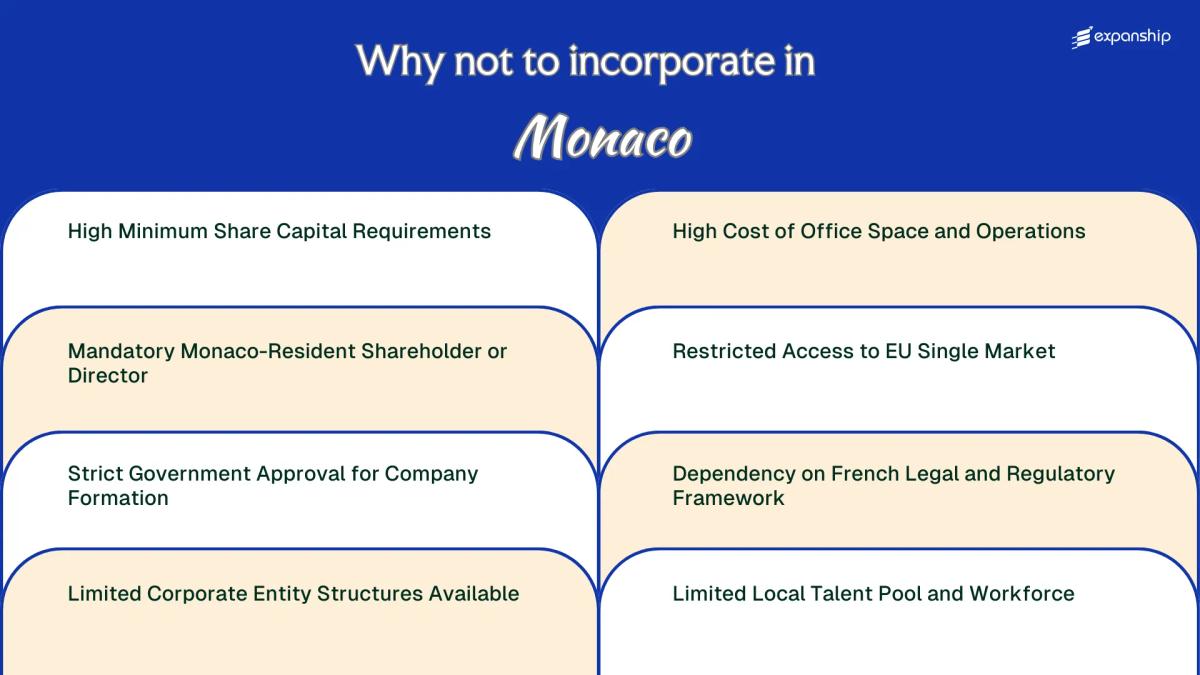
High Minimum Share Capital Requirements
Monaco minimum share capital requirements create a direct financial barrier at the point of incorporation, before your business generates a single euro of revenue.
Capital Thresholds by Entity Type
A Société Anonyme Monégasque (SAM), the structure most commonly used by foreign investors for larger commercial operations, requires a minimum share capital of EUR 150,000. For a Société à Responsabilité Limitée (SARL), the threshold is lower but still non-trivial at EUR 15,000. These figures must be fully subscribed at the time of formation, meaning capital cannot be paid in incrementally.
For an early-stage business or a foreign firm testing a new market, locking up EUR 150,000 in a SAM before receiving government approval ties up working capital during a period of maximum uncertainty.
Structural Inflexibility of Capital Rules
Under Monégasque commercial law, share capital requirements are not adjusted based on business activity, sector, or projected revenue. A small consulting firm and a large trading company face the same fixed thresholds. This one-size structure disproportionately burdens smaller foreign enterprises that would qualify for far lower capital requirements in most EU member states.
For a foreign business owner, the SAM's EUR 150,000 minimum capital must be fully committed before government approval is granted, making cost recovery impossible if the application is subsequently rejected.
Mandatory Monaco-Resident Shareholder or Director
Monaco resident director requirements add a structural layer of complexity that most foreign incorporators do not encounter in comparable low-tax jurisdictions. Under Monegasque company law, certain entity types require at least one director or manager to be a resident of the Principality, and in some cases, a majority of shareholders must also hold local residency status.
Residency in Monaco is not a formality you can quickly arrange. Obtaining a residency permit requires proof of suitable accommodation, sufficient financial means, and approval from the Direction de la Sûreté Publique, a process that typically takes several months.
For a foreign business owner, the practical friction this creates includes:
- Paying ongoing fees to a professional nominee resident director, which adds a recurring operational cost with no business function
- Delaying your incorporation timeline while residency or nominee arrangements are confirmed
- Accepting that a third party holds a formal position in your company structure, which can complicate governance and decision-making
- Facing higher compliance costs if your Monaco company residency obligations require annual renewal or notarized confirmation of residency status
No blanket exemption exists for foreign nationals from EU or treaty countries.

Company Incorporation in Monaco
Understand the residency requirements and structural obligations before setting up a company in Monaco.
Strict Government Approval for Company Formation
Monaco government approval for company formation is not procedural rubber-stamping. Every new business must receive explicit authorization from the government before it can legally operate, and that gatekeeping function sits primarily with the Direction de l'Expansion Économique (DEE), which evaluates applications on substantive economic grounds.
Your application must demonstrate that the proposed activity serves a genuine economic interest for the Principality. This standard is subjective, giving authorities significant discretion to reject entities whose business model is deemed insufficiently tied to Monaco's economic priorities. A foreign-incorporated holding structure or a purely digital business with no local operational footprint faces a materially higher risk of refusal.
| Requirement | Detail | Burden for Foreign Applicants |
|---|---|---|
| Reviewing Authority | Direction de l'Expansion Économique (DEE) | Discretionary economic-interest assessment, no automatic approval |
| Application Timeline | Several weeks to months | Delays formation significantly compared to online-registered jurisdictions |
| Business Plan Scrutiny | Mandatory submission and review | Plans must justify local economic contribution, not just commercial viability |
| Government Decree | Required for SAM (société anonyme monégasque) | Sovereign approval adds a legislative layer absent in most jurisdictions |
Société anonyme monégasques (SAMs) face an additional constraint: formation requires a formal government decree, meaning the Princely government itself must authorize the entity's existence. This is a structural barrier with no equivalent in typical EU incorporation regimes, and it adds an unpredictable political dimension to what most jurisdictions treat as an administrative formality.
Limited Corporate Entity Structures Available
Monaco offers only two principal corporate structures for commercial activity: the Société Anonyme Monégasque (SAM) and the Société à Responsabilité Limitée (SARL). The limited company structures Monaco permits are narrow by international standards, leaving foreign investors with few options to match the entity type used in their home jurisdiction.
The SAM functions similarly to a public limited company and carries substantial capital and governance requirements. The SARL, while simpler, restricts the number of shareholders and limits the transferability of shares, which constrains growth and external investment.
Neither structure accommodates the flexibility that common-law holding structures, limited partnerships, or protected cell companies provide in competing jurisdictions. If your existing group structure relies on entity types not recognised under Monégasque law, restructuring becomes a prerequisite, not an option.
The Code de Commerce governing commercial entities in Monaco is administered through the Répertoire du Commerce et de l'Industrie (RCI), and all entity formations require prior government approval, compounding the structural rigidity.
- Only SAM and SARL are available for standard commercial operations
- SARL imposes shareholder number caps and share transfer restrictions
- SAM requires minimum capital thresholds that affect entity selection
- Neither structure supports limited partnership or hybrid arrangements
- Entity type mismatches with foreign parent structures require legal reorganisation
Monaco does not permit the formation of a branch office as a standalone permanent legal structure in the same simplified manner available in most EU member states, making even temporary market entry more structurally complex than expected.
High Cost of Office Space and Operations
The high cost of business operations in Monaco extends well beyond tax and compliance fees. Physical presence requirements make operational expenditure one of the most significant barriers for foreign businesses establishing a foothold in the Principality.
Cost of Physical Premises
Monaco's commercial real estate market is among the most expensive in the world by surface area, with office rents regularly exceeding €100 per square metre per month in prime districts such as the Carré d'Or. For a foreign business owner, the registered office requirement under Monégasque company law is not optional — your entity must maintain a genuine local address, meaning virtual offices frequently fall short of what the Direction de l'Expansion Économique expects during the approval process.
Broader Operational Cost Pressures
Staffing costs compound the real estate burden, as salaries in Monaco reflect the Principality's exceptionally high cost of living. Even administrative roles command compensation packages that exceed regional norms, meaning your fixed overheads accumulate rapidly before the business generates its first euro of revenue. This cost structure disproportionately affects small and mid-sized foreign firms that cannot distribute Monaco-based expenses across a larger international operation.
Managing Operational Cost Challenges in Monaco
Understand the full scope of Monaco's operational requirements before committing to incorporation, and get structured guidance on meeting local presence obligations efficiently.
Restricted Access to EU Single Market
Monaco EU single market access restrictions present a structural barrier that businesses incorporated there cannot overcome through operational adjustments alone.
- As a non-EU member state, your company cannot passport financial services, insurance products, or investment offerings into EU member states under the single licensing frameworks that govern EU-domiciled firms.
- Goods exported from a Monaco-registered entity into the EU are subject to customs procedures under the entity's third-country status, adding compliance overhead that EU-incorporated competitors do not face.
- Your firm cannot benefit from EU public procurement rules that reserve contract access for businesses established within member states.
- Professional services firms relying on mutual recognition of qualifications under EU directives face additional re-qualification or licensing requirements when operating across the border.
- Monaco non-EU business limitations extend to data transfers, where the firm must meet adequacy or contractual safeguard requirements under the GDPR rather than benefiting from intra-EU data flows as a matter of right.
Dependency on French Legal and Regulatory Framework
Monaco's French legal framework dependency is not merely historical — it creates a structural constraint for any foreign business operating there. The Principality has no fully autonomous commercial code; instead, its legal system incorporates large portions of French law by reference, including elements of the French Code Civil and commercial legislation.
Under the 1963 Franco-Monegasque Convention and related bilateral arrangements, French legal norms carry direct influence over certain regulatory and judicial matters. Your legal team must therefore carry competence in both Monegasque statutes and the French legal tradition, which increases the cost and complexity of local counsel.
Disputes and interpretations may draw on French jurisprudence where Monegasque law is silent, leaving foreign business owners subject to a secondary legal system they did not anticipate when structuring their entity. This dual-layer dependency reduces legal predictability.
The Monaco Code de Commerce restrictions compound this further — gaps in local commercial law are frequently resolved by reference to French equivalents, meaning your compliance obligations can shift based on French legislative changes outside Monaco's direct jurisdiction.
A foreign-owned SAM that retains French-qualified counsel alongside Monegasque legal advisors can realistically face dual advisory retainers, with combined annual legal fees exceeding €15,000–€20,000 per year, compared to a single-jurisdiction engagement in a fully autonomous legal system.
Limited Local Talent Pool and Workforce
Monaco's limited workforce challenges stem directly from its size. With a resident population of approximately 38,000 and a surface area under 2.1 square kilometers, the principality simply does not generate a domestic labor supply sufficient to staff most business functions beyond executive or financial roles.
The workforce is heavily weighted toward high-net-worth individuals and finance professionals. Recruiting for technical, operational, or mid-level roles locally is rarely viable, which means your business will almost certainly depend on cross-border commuters from France and Italy.
Those commuters account for roughly 50,000 workers daily, outnumbering resident workers. While this expands the practical hiring pool, it also introduces dependency on transport infrastructure and residency conditions outside the principality's direct control.
Monaco hiring limitations are further reinforced by the Direction du Travail, the labor authority that oversees employment compliance. Foreign firms must adhere to Monaco's labor code, which mirrors French employment law in several respects, adding procedural layers to hiring that may be unfamiliar to non-French-speaking business owners.
The talent pool restrictions become particularly acute for specialized sectors such as technology or life sciences, where qualified candidates within commuting distance are scarce and international relocation to Monaco is expensive.
If your business requires more than a skeleton staff of senior personnel, you will likely be hiring from France or Italy under conditions governed by bilateral labor arrangements that Monaco does not unilaterally control.
Overcoming Monaco's Incorporation Challenges
Overcoming Monaco's Incorporation Challenges
Overcoming Monaco incorporation challenges requires structural preparation before you engage the Direction du Développement Économique (DDE), not after. Foreign businesses that address capital, residency, and approval requirements in advance tend to encounter fewer delays in the formation process.
- Verify your proposed activity falls within a permitted commercial category before submitting a DDE application to avoid outright rejection.
- Structure ownership to include a Monaco-resident shareholder or director from the outset, satisfying the mandatory residency condition for most entity types.
- Capitalise the entity at or above the required minimum for your chosen structure, whether a Société Anonyme Monégasque or Société à Responsabilité Limitée.
- Secure a compliant registered office address before filing, given that proof of physical premises is a formal requirement under Monaco company law.
- Assess EU market access needs independently, since Monaco's customs union with France does not confer full EU Single Market rights.
These steps operate within a tightly administered legal framework shaped by both Monégasque statute and French civil law principles. Structural decisions made at formation stage have long-term compliance implications that cannot easily be reversed post-incorporation.
Monaco's Overall Business Appeal
Despite the considerable barriers covered throughout this blog, Monaco retains a credible position as an incorporation destination for businesses that can meet its financial and regulatory thresholds. The Monaco business environment drawbacks are real and material, yet they are offset, for some firms, by zero personal income tax, political stability, and a high-concentration wealth base.
| Pros | Cons |
|---|---|
| No personal income tax for resident shareholders | High minimum share capital requirements for SAM and SARL structures |
| Political stability under a constitutional monarchy | Government approval via the Direction du Développement Économique adds time and uncertainty to formation |
| Access to a concentrated high-net-worth client base | No access to EU Single Market passporting rights |
| Strong confidentiality protections under Monégasque law | Mandatory Monaco-resident director or shareholder increases administrative overhead |
| Proximity to major European financial centres | Heavy dependency on French legal and regulatory frameworks limits operational autonomy |
| Prestigious registered address for client-facing businesses | Limited local talent pool constrains hiring options without relying on cross-border commuters |
Operating costs remain among the highest of any jurisdiction globally. Office rental rates and staffing expenses can erode margins before a business reaches profitability.
Corporate Compliance Services in Monaco
Maintain your Monégasque company's standing with the Direction des Services Fiscaux and other regulatory authorities through structured compliance support.
Conclusion
The cons of Monaco company registration are substantive and go beyond surface-level friction. Government approval through the Direction du Développement Économique, mandatory residency requirements for directors or shareholders, and the principality's exclusion from the EU Single Market represent structural constraints that affect how a foreign business can operate and scale. Addressing these challenges requires detailed preparation before formation begins. Firms entering this jurisdiction with a clear understanding of its regulatory architecture and cost structure will be better positioned to make an informed decision about whether incorporation here aligns with their operational objectives.
Expanship's Monaco Expansion Services
Incorporating in Monaco involves a concentrated set of regulatory obligations — government approval through the Direction de l'Expansion Économique, mandatory resident involvement, and sector-specific licensing requirements that vary considerably by business activity. Expanship's Monaco company formation services are structured around these specific procedural demands, helping you manage the administrative load without misrepresenting what that process requires of you.
Beyond formation, our Monaco corporate services compliance and business incorporation support covers the full operational setup:
- Your company registration documents are prepared and submitted in accordance with Monaco's formal requirements.
- A registered agent and local office address are provided where required.
- We handle government filing and direct liaison with the Direction de l'Expansion Économique on your behalf.
- Post-incorporation compliance obligations are managed on a continuing basis.
- Banking introduction support is available to help your business establish a local account.
- Tax registration and coordination with Monaco's relevant local authorities is included.
To discuss your setup, reach out to Expanship Monaco.
Frequently Asked Questions (FAQ)
Yes, the Monegasque government retains discretionary authority to refuse incorporation applications, and approval is not automatic regardless of how well-capitalised your proposed entity is. The Direction du Développement Économique reviews all applications, and the process requires demonstrating genuine economic activity within the Principality. Rejection rates are not publicly disclosed, but the scrutiny applied is considerably more intensive than in most offshore or low-tax jurisdictions.
The residency requirement is a genuine structural constraint, not a formality. At least one director or a defined shareholder stake must be held by a Monaco resident, which directly affects how you structure ownership and governance if your principals are based abroad. This condition applies across the principal corporate forms available in Monaco and cannot be bypassed through nominee arrangements in any straightforward way.
For a Société Anonyme Monégasque (SAM), the minimum share capital is EUR 150,000, which is substantially higher than requirements in many European jurisdictions, including France where the equivalent SA requires EUR 37,000. The Société à Responsabilité Limitée (SARL) in Monaco requires EUR 15,000, which is less acute but still above zero-capital regimes available elsewhere. These thresholds must be fully subscribed at incorporation, not paid in over time.
Monaco offers a narrow range of corporate structures, primarily the SAM and SARL, with limited flexibility for complex holding arrangements or special purpose vehicles compared to jurisdictions like Luxembourg or the Netherlands. If your business model requires a structure that does not map cleanly onto these forms, you may face operational or tax inefficiencies that create ongoing cost exposure. The absence of a broader menu of entity types is a structural limitation that affects long-term scalability for certain business models.
Monaco's legal system draws heavily from French civil law, and several French legislative instruments apply either directly or by analogy within the Principality. This creates a situation where interpreting local regulations may require understanding both Monegasque statutes and the French legal principles underlying them, which increases the complexity and cost of obtaining reliable legal counsel. Foreign businesses from common law jurisdictions in particular may find this dual-layer framework adds meaningful friction to day-to-day governance.
No, Monaco requires companies to maintain a genuine registered office and demonstrable physical presence within the Principality, which means virtual offices or mailbox addresses do not satisfy the requirement. Given that commercial real estate in Monaco ranks among the most expensive per square metre globally, this is a real cost line that must be budgeted at the outset. There is no low-cost compliance path around this obligation for entities that wish to operate as a properly constituted Monaco business.
If a Monaco company no longer meets the residency condition for its director or qualifying shareholder, it falls out of compliance with its incorporation conditions, which can trigger regulatory review by the Direction du Développement Économique. The firm would typically be required to rectify the structure within a defined period or risk having its operating authorisation suspended. This creates a dependency on specific individuals that introduces governance risk, particularly for smaller businesses where personnel changes are less predictable.
Legal Disclaimer
The information provided in this article is for general informational purposes only and does not constitute legal, tax, or professional advice. While we strive to ensure the accuracy and timeliness of the content, laws and regulations are subject to change, and the application of laws can vary widely based on specific facts and circumstances.
Readers should not act upon this information without seeking professional counsel tailored to their individual situation. Expanship and its authors disclaim any liability for actions taken or not taken based on the content of this article.
For specific advice regarding your business setup, compliance requirements, or any legal matters, please consult with qualified legal and tax professionals in the relevant jurisdiction.