
Key Takeaways
- Monaco's corporate tax exemption applies to businesses generating less than 25% of revenue from French sources, meaning the majority of internationally oriented companies pay zero corporate income tax under the Principality's fiscal framework.
- Resident individuals in Monaco face no personal income tax liability, a structural advantage rooted in the Principality's fiscal independence from France despite sitting within the French customs territory.
- Entity structures governed under Monégasque company law — including the Société Anonyme Monégasque and the SARL — allow foreign shareholders to hold direct ownership stakes with clearly defined liability limits, administered through the Répertoire du Commerce et de l'Industrie.
- Operating outside the EU's regulatory architecture gives Monaco-incorporated businesses a degree of legislative continuity and operational autonomy that entities domiciled in EU member states cannot access, without sacrificing proximity to European and Mediterranean markets.
Monaco is an independent city-state and sovereign principality on the French Riviera, bordered almost entirely by France and spanning just over two square kilometres. Company registration falls under the oversight of the Direction de l'Expansion Économique, the government body responsible for economic development and business establishment in the principality. Foreign nationals face no formal restrictions on ownership, and the government has historically maintained an open position toward foreign direct investment across most sectors.
The most common vehicle through which international businesses establish a presence here is the Société Anonyme Monégasque, though other structures are available depending on operational requirements. From a tax standpoint, the principality operates a broadly zero-tax regime for businesses whose revenue is generated domestically. The benefits of incorporating in Monaco are distinct from those offered by other low-tax or offshore environments, rooted in its sovereign legal system and its position within the French customs territory while maintaining fiscal independence.
This article examines the specific advantages that make Monaco company formation a considered choice for qualifying businesses and high-net-worth principals.
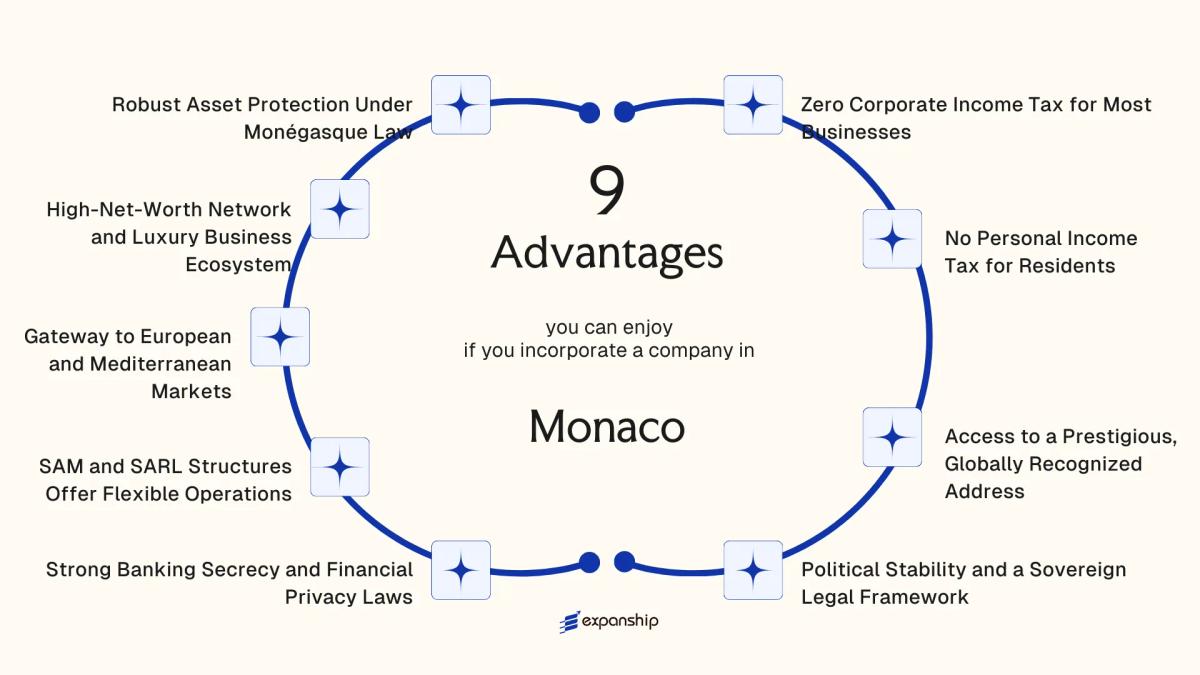
Zero Corporate Income Tax for Most Businesses
The Monaco zero corporate income tax advantage is one of the most structurally significant features of the Principality's fiscal framework. Most companies registered here pay no corporate income tax whatsoever, which directly affects what your business retains after each financial year.
The 75% Revenue Rule and What It Means
Under Monégasque tax law, corporate income tax at a rate of 33.33% applies only to entities that derive more than 25% of their turnover from outside Monaco. If your firm generates all or most of its revenue from clients within the Principality, the tax liability is zero. This threshold gives businesses with a local or internationally diverse client base a clear structural advantage over operating from a standard EU jurisdiction, where the average statutory corporate tax rate exceeds 21%.
Practical Relevance for Foreign-Owned Entities
For a holding company or a firm primarily managing intra-group services, the revenue sourcing rules under the 1963 tax ordinance can effectively eliminate the corporate tax burden entirely. That outcome is not incidental — it is a deliberate feature of Monaco's fiscal design, encoded in law rather than granted through discretionary rulings or temporary incentives.
If your company's revenue qualifies under the 75% domestic threshold, your retained earnings remain fully intact, with no corporate tax deducted at the entity level.
No Personal Income Tax for Residents
Monaco's personal tax treatment is one of the most direct financial advantages available to high-net-worth individuals who establish residency there. Under Monégasque law, residents pay no personal income tax on their earnings — a position the Principality has maintained consistently, making it one of the few sovereign states in Western Europe where this rule applies without conditions tied to income source or amount.
For a foreign business owner, this has a concrete implication: distributions, dividends, and personal income drawn from your company are not subject to individual-level taxation in the Principality. That distinction separates Monaco from jurisdictions that offer corporate tax relief but still impose progressive personal tax rates on founder withdrawals.
The resident tax advantages extend across income types, which is why the structure appeals particularly to owners who draw from multiple revenue streams:
- Residency requirements are tied to physical presence and accommodation, not to complex tax domicile tests
- There is no wealth tax at the individual level
- Capital gains on personal holdings are not subject to personal income tax
- No inheritance tax applies between direct-line heirs under Monégasque succession rules
French nationals remain an exception under the Franco-Monégasque Tax Convention of 1963, which subjects them to French income tax regardless of residency status in the Principality.

Company Incorporation in Monaco
Set up your Monaco-based company with full compliance support across legal, banking, and registration requirements.
Access to a Prestigious, Globally Recognized Address
A Monaco prestigious business address benefits your company in ways that extend well beyond postal convenience. Under Monégasque law, a registered business address within the Principality is a formal legal requirement for company incorporation, and that requirement produces a secondary effect: your firm's correspondence, contracts, and filings all carry a Monaco address, one that counterparties in finance, luxury, and private wealth management associate with financial discipline and exclusivity.
| Counterparty Type | Perceived Signal | Practical Effect |
|---|---|---|
| Private banks | Jurisdictional credibility | Smoother account opening discussions |
| High-net-worth clients | Association with wealth management norms | Reduced due diligence friction |
| European partners | Sovereign, non-EU legal domicile | Clear contractual identity outside EU frameworks |
| Luxury sector firms | Alignment with premium market positioning | Faster relationship establishment |
That address is not simply a postcode. The Principality occupies a sovereign territory governed by the Direction de l'Expansion Économique, the body responsible for business approvals, which means your entity's domicile is tied to a jurisdiction with its own legal order, not a dependency or offshore territory of ambiguous standing.
For foreign business owners, this distinction matters when dealing with correspondent banks or institutional partners who screen entities by registered domicile. A Monaco globally recognized company address reduces the likelihood of automatic exclusion from counterparty onboarding processes that flag certain low-regulation territories.
Political Stability and a Sovereign Legal Framework
Monaco political stability for businesses is not incidental — it is structural. The Principality has operated under continuous sovereign governance since 1297, with the House of Grimaldi maintaining uninterrupted rule. No political transitions, no instability cycles, no regulatory upheaval. For a foreign business owner, this means the legal conditions under which you incorporate are unlikely to shift beneath you.
The Monégasque legal system is codified under civil law principles, drawing from French legal tradition but functioning as a fully independent sovereign framework. The Direction des Services Juridiques oversees the legal architecture that governs commercial entities, and domestic legislation — including provisions under the Code de Commerce — applies without EU regulatory interference. Because Monaco is not an EU member state, your firm is not subject to directives from Brussels.
Political continuity directly supports contractual and regulatory predictability. Agreements made today operate under the same sovereign legal framework that governed transactions decades ago.
Keep these points in mind:
- Monégasque law governs all commercial disputes independently of French or EU courts
- The Principality maintains its own judiciary; the Tribunal de Première Instance handles commercial matters
- Bilateral treaties with France do not override Monaco's internal commercial legislation
- No parliamentary elections create policy uncertainty for business regulation
Despite sharing an open border with France, companies incorporated in Monaco are fully exempt from French corporate tax jurisdiction, with no requirement to register for French tax purposes.
Strong Banking Secrecy and Financial Privacy Laws
Monaco banking secrecy advantages for businesses extend well beyond simple discretion. The Principality operates under a legal framework that formally enshrines financial confidentiality, enforced through the Commission de Contrôle des Activités Financières (CCAF) and the Direction des Services Fiscaux. For foreign business owners, this means that financial information held by Monégasque institutions is not exposed to third-party inquiries absent a specific legal mandate.
Statutory Confidentiality as a Structural Shield
Monégasque law imposes professional secrecy obligations on bankers, accountants, and financial intermediaries. Violations carry criminal liability, which means confidentiality is not a policy preference but a legally enforceable standard. Your company's financial dealings, ownership structures, and account activity are insulated from casual disclosure.
This matters particularly for high-net-worth investors who operate across multiple jurisdictions and whose financial positions could be exploited if exposed. Banking confidentiality benefits extend to corporate accounts, not only personal ones, which makes the protection operationally relevant for trading entities and holding companies alike.
OECD Compliance Without Sacrificing Privacy
The Principality has signed the Common Reporting Standard (CRS) and participates in automatic exchange of information under specific bilateral agreements. Confidentiality therefore operates within a compliant international framework rather than outside it. Information is shared only when treaty conditions are met, not on request from any foreign authority without legal basis.
For your business, this distinction is significant. Financial privacy laws for companies in Monaco do not create opacity for illicit purposes; they create structured, legally grounded protection for legitimate commercial activity.
Structure Your Monaco Company to Maximise Financial Privacy
Speak with an Expanship specialist about how Monaco's confidentiality framework applies to your specific corporate structure and cross-border operations.
SAM and SARL Structures Offer Flexible Operations
Monaco offers two primary corporate vehicles for foreign investors: the Société Anonyme Monégasque (SAM) and the Société à Responsabilité Limitée (SARL). Understanding the Monaco SAM and SARL structure benefits starts with recognizing how each entity allocates liability, governance, and operational control in ways that suit different business profiles.
- The SAM requires a minimum share capital of EUR 150,000, at least two shareholders, and a board of directors. This structure suits firms seeking to raise external capital or establish governance frameworks that signal institutional credibility to counterparties.
- A SARL can be formed with as little as EUR 15,000 in share capital, making it accessible to smaller foreign-owned businesses without the overhead of a full board structure.
- Both entity types offer limited liability, meaning your personal assets remain legally separate from corporate obligations incurred by the business.
- Under Monégasque law, a SAM can issue bearer or registered shares, giving shareholders discretion over how ownership is held and transferred.
- The Direction du Développement Économique (DDE) oversees business authorization for both structures, and its approval requirement means that authorized firms carry a degree of regulatory standing that can support banking and commercial relationships.
- Neither structure imposes residency requirements on shareholders, preserving operational flexibility for foreign-based ownership groups.
Gateway to European and Mediterranean Markets
Monaco's position on the French Riviera places your business at the convergence of Southern Europe, North Africa, and the broader Mediterranean basin. This geographic reality underpins the Monaco gateway to European markets advantage in concrete terms: the Principality borders France directly and sits within a few hours of major commercial centers including Milan, Geneva, and Barcelona.
Although Monaco is not a member of the European Union, it maintains a customs union with France under a bilateral agreement, which means goods moving between Monaco and EU member states generally follow EU customs procedures. For a trading company, this arrangement provides access to EU market infrastructure without requiring incorporation within EU territory.
The Principality also benefits from France's extensive network of bilateral tax treaties, which can apply in certain cross-border contexts. Mediterranean market access for businesses registered here is further supported by the presence of international shipping lanes and proximity to ports including Marseille and Genoa.
A firm incorporated in Monaco and trading physical goods into France moves those goods under the EU Customs Code framework. On a shipment valued at €500,000, this removes the need for separate Monégasque customs declarations, reducing administrative costs that would otherwise apply at a non-EU, non-customs-union border.
High-Net-Worth Network and Luxury Business Ecosystem
Monaco's resident population is among the wealthiest per capita anywhere, with a significant concentration of ultra-high-net-worth individuals living and operating within a territory of just over two square kilometers. For a foreign business owner, the Monaco high-net-worth business ecosystem benefits extend beyond proximity — they translate into direct access to a dense, relationship-driven commercial environment where decision-makers are neighbors, not contacts requiring international travel.
Sectors including private banking, fine art dealing, yacht brokerage, luxury real estate, and family office services are all headquartered or actively represented within the Principality. Your firm operates within the same physical and regulatory space as the clients it may be pursuing.
The Monaco Economic Board (MEB), a public-private body, facilitates structured introductions and networking events specifically oriented toward resident and newly established businesses. Membership gives your entity access to a curated community that spans finance, luxury goods, and high-end professional services.
- Annual events such as the Monaco Business Meetings and the Monte-Carlo Rendez-Vous connect firms with UHNWI stakeholders across multiple industries.
- The compact geography means that informal deal flow and referral networks operate at a pace rarely matched in larger financial centers.
Active participation in the MEB ecosystem typically requires your business to hold a valid establishment license issued by the Direction de l'Expansion Économique, confirming that passive registration alone does not guarantee access.
Robust Asset Protection Under Monégasque Law
Monaco asset protection under Monégasque law draws its strength from a civil law tradition codified in the Code Civil de Monaco, which closely parallels the French civil code but operates within a fully sovereign legal system. That sovereignty matters: Monégasque courts are not subject to EU directives on asset recovery, enforcement, or creditor rights, giving the jurisdiction meaningful insulation from cross-border legal pressure.
Separation of Business and Personal Assets
Structuring through a Société Anonyme Monégasque (SAM) or a Société à Responsabilité Limitée (SARL) establishes a clear legal separation between your personal wealth and corporate liabilities. Creditors of the business cannot reach the personal assets of shareholders beyond their subscribed capital contribution. For investors holding significant private wealth alongside operating businesses, this separation is a structural safeguard, not merely a contractual one.
Judicial Stability and Enforcement Predictability
The Monégasque judiciary operates independently, with a Court of Appeal and a Supreme Court providing defined appellate structure. Foreign judgments are not automatically enforceable; they require recognition proceedings before Monégasque courts, which apply local procedural standards. This creates a controlled enforcement environment where your assets held within the Principality are not immediately exposed to foreign litigation outcomes.
Property and Succession Protections
- Monégasque law recognizes forced heirship rules that can protect designated asset transfers within certain family succession structures.
- Trusts established under foreign law can be registered with the Monégasque Trust Register, providing a formal legal anchor for wealth protection strategies involving the Principality.
- Real and movable property held through a properly structured Monégasque entity benefits from clear title rules under the Code Civil.
Why Monaco Stands Out Against Other Low-Tax Jurisdictions
Jurisdictions like the British Virgin Islands, Luxembourg, and the Cayman Islands each attract different types of foreign investors, but none combine Monaco's advantages in quite the same configuration. The comparison matters because your choice of incorporation jurisdiction affects not just tax exposure, but physical presence requirements, reputational standing with counterparties, and access to banking infrastructure.
What distinguishes the Principality from typical offshore centres is that its benefits derive from domestic law and bilateral agreements rather than opaque special-purpose regimes. The tax framework is grounded in the 1963 Franco-Monégasque Convention and domestic fiscal law, giving it a degree of legal permanence that discretionary tax rulings in other jurisdictions cannot match. For businesses where counterparty perception and banking access are material concerns, that distinction carries real weight.
| Parameter | Monaco | Luxembourg | British Virgin Islands | Cayman Islands |
|---|---|---|---|---|
| Corporate Tax Rate | 0% (domestic revenue below 25% threshold) | 17% CIT + municipal surcharges | 0% | 0% |
| Personal Income Tax | None | Up to 42% | None | None |
| OECD Blacklist Status | Not listed | Not listed | Periodic grey-list reviews | Periodic grey-list reviews |
| Physical Presence Required | Yes, substantive office required | Yes | Minimal | Minimal |
| EU Market Access | Partial (customs union with France) | Full EU member | None | None |
| Reputational Standing with Banks | High | High | Moderate | Moderate |
| Regulatory Body | Direction des Services Fiscaux | Administration des contributions directes | BVI Financial Services Commission | Cayman Islands Monetary Authority |
Compliance Services for Companies in Monaco
Stay aligned with Monaco's regulatory requirements, from annual filings to ongoing statutory obligations under Monégasque law.
Conclusion
Monaco's tax framework, built around the absence of corporate income tax for firms deriving less than 25% of revenue from French sources, combined with the complete absence of personal income tax for resident individuals, creates a structural advantage that few sovereign jurisdictions can replicate within Europe. The benefits of incorporating in Monaco extend beyond tax efficiency: the Principality's sovereign legal order, governed independently of the EU's regulatory architecture, gives your business a degree of operational autonomy that EU-domiciled entities do not have.
Monégasque company law, administered through the Répertoire du Commerce et de l'Industrie, supports entity structures like the SAM and SARL that allow foreign shareholders to hold direct stakes with clearly defined liability limits. For asset-intensive businesses or high-net-worth principals, this translates to predictable ownership protection under a stable civil law system that has not undergone the legislative disruption common in larger European states.
That combination of fiscal neutrality and sovereign legal continuity is what distinguishes a Monaco company formation from comparable structures in other low-tax European territories. Not every business model fits this jurisdiction: firms with substantial French revenue, or those requiring EU passporting rights, face conditions that require careful structuring. For those whose profile aligns with the Principality's framework, the practical advantages are durable rather than circumstantial. The next step is translating that alignment into a compliant, correctly structured entity.
Let Expanship Set Up Your Monaco Company Today
Monaco company formation with Expanship covers the full administrative scope that foreign investors encounter when establishing a presence in the Principality. From preparing articles of association for a SAM or SARL to filing with the Répertoire du Commerce et de l'Industrie (RCI) and coordinating approvals through the Direction de l'Expansion Économique, each stage involves jurisdiction-specific requirements that vary depending on your chosen structure and business activity.
Expanship's services for Monaco include:
- Document preparation, notarization, and legalization in accordance with Monégasque procedural requirements
- Registered agent and registered office provision at a compliant Monaco address
- Government filing and direct liaison with the RCI and relevant ministries
- Post-incorporation compliance management, including annual obligations and share register maintenance
- Banking introduction assistance to support account opening with Monaco-based financial institutions
Reach out to Expanship Monaco to discuss your incorporation requirements.
Frequently Asked Questions (FAQ)
Yes, foreign nationals can incorporate a company in Monaco without being residents, though the process involves meeting specific administrative requirements set by the Direction de l'Expansion Économique (DEE). You will need to submit a formal application for commercial authorization, which includes a review of your business activity, financial standing, and proposed structure. Certain activities may require additional licensing, so the nature of your business directly affects what approvals are needed before registration can proceed.
No. The exemption from corporate income tax under Monégasque tax law applies only to companies that generate 75% or more of their turnover within Monaco. Businesses that derive more than 25% of revenue from outside the Principality are subject to corporate tax at a rate of 33.33% on profits attributable to those external activities. This threshold is a critical factor when structuring your operations, particularly if the business model relies on cross-border sales or international client bases.
A Société Anonyme Monégasque (SAM) requires a minimum share capital of EUR 150,000, at least half of which must be paid up at the time of incorporation. This structure is generally used for larger commercial operations or firms intending to raise external investment. By contrast, a Société à Responsabilité Limitée (SARL) carries a lower capital threshold, making it a more accessible entry point for smaller businesses.
Monaco does not levy personal income tax on residents, but French nationals who establish residency in the Principality are not automatically exempt under the bilateral tax convention signed between France and Monaco in 1963. Under that treaty, French citizens residing in Monaco remain subject to French income tax unless they can demonstrate continuous residency in Monaco prior to 13 October 1962. This carve-out is specific to French nationals and does not affect citizens of other countries who relocate to Monaco.
Monaco has signed the OECD's Common Reporting Standard (CRS) and participates in the automatic exchange of financial account information with other signatory jurisdictions. While domestic financial privacy protections exist under Monégasque law, these international commitments mean that account information held in Monaco may be reported to the tax authorities of a beneficial owner's country of residence. The scope of what is shared depends on the bilateral relationships Monaco maintains and the residency status of the account holder.
The timeline varies depending on the business activity and the completeness of the application submitted to the DEE. In practice, obtaining commercial authorization and completing registration with the Répertoire du Commerce et de l'Industrie (RCI) can take several weeks to a few months. Activities subject to specific regulatory oversight, such as financial services, tend to require longer review periods due to additional vetting by sector-specific authorities.
Monaco is not a member of the European Union, so a company incorporated there does not automatically benefit from EU passporting rights or single market access. The Principality maintains a customs union with France and, by extension, with the EU for goods, but this arrangement does not extend to services or financial products. Businesses that require EU market access may need to establish a separate entity within an EU member state alongside their Monégasque structure.
Legal Disclaimer
The information provided in this article is for general informational purposes only and does not constitute legal, tax, or professional advice. While we strive to ensure the accuracy and timeliness of the content, laws and regulations are subject to change, and the application of laws can vary widely based on specific facts and circumstances.
Readers should not act upon this information without seeking professional counsel tailored to their individual situation. Expanship and its authors disclaim any liability for actions taken or not taken based on the content of this article.
For specific advice regarding your business setup, compliance requirements, or any legal matters, please consult with qualified legal and tax professionals in the relevant jurisdiction.