
Key Takeaways
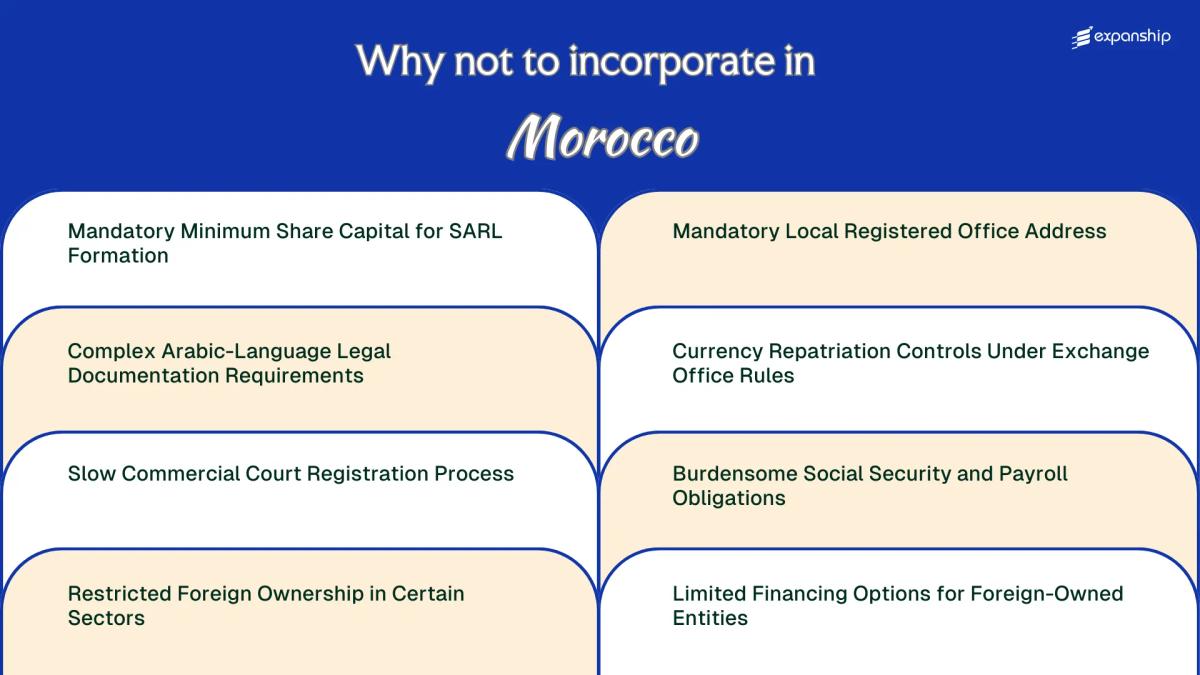
- Foreign investors operating through a SARL must contend with mandatory minimum share capital requirements that add upfront financial commitment before any revenue is generated.
- Under the Office des Changes regulatory framework, repatriating profits or transferring capital abroad requires prior authorization, creating delays and procedural friction for foreign-owned entities.
- Legal documentation submitted to the Regional Investment Centers (CRI) and commercial courts must comply with Arabic-language requirements, imposing translation and notarization costs that increase formation timelines and expenses.
- Certain strategic sectors impose restrictions on foreign ownership percentages, meaning non-resident investors may be unable to hold majority control without a qualifying local partner.
Morocco operates under a structured regulatory framework governed by the Commercial Code, with company formation subject to oversight from multiple public bodies including the Regional Investment Centers (CRI) and the Office des Changes. The framework continues to evolve, and foreign investors should approach it with awareness of its procedural requirements.
The disadvantages of incorporating in Morocco span several distinct areas, from capital requirements and documentation standards to sector-specific ownership restrictions and currency controls.
Not every challenge applies equally across all business types. A sole-activity SARL operated by an EU national faces a different compliance profile than a joint-venture entity in a regulated sector. Your exposure to specific drawbacks depends heavily on corporate structure, industry classification, and the extent of foreign participation.
This article is most relevant to non-resident investors, foreign-owned holding companies, and internationally based entrepreneurs evaluating the cons of setting up business in Morocco for the first time.
Mandatory Minimum Share Capital for SARL Formation
Morocco SARL minimum share capital requirements present a low nominal barrier on paper, but the structural implications for foreign founders are more constraining than the headline figure suggests.
The Statutory Capital Floor and What It Actually Costs You
Under Moroccan law, a Société à Responsabilité Limitée can be formed with a minimum share capital of MAD 1, following the 2006 amendment to Law 5-96. While that figure appears negligible, banks routinely decline to open corporate accounts for entities they deem undercapitalized, effectively imposing an informal threshold well above the legal minimum.
Your ability to operate, hire staff, and enter commercial contracts is directly tied to whether local banks accept your entity as a credible counterparty.
Capital Deposit and Release Constraints
Capital contributions must be deposited with an approved Moroccan bank or notary before registration is finalized, tying up funds during a process that can extend several weeks. For foreign investors transferring capital from abroad, this intersects with Office des Changes reporting obligations, adding a procedural layer that delays access to deposited funds.
Foreign founders who undercapitalize their SARL to minimize initial exposure risk rejection by Moroccan banks during account opening, which can stall all subsequent operational activity indefinitely.
Complex Arabic-Language Legal Documentation Requirements
Arabic legal documentation challenges in Morocco create a distinct operational barrier for foreign founders who do not speak the language or lack access to qualified local counsel.
All formation documents, articles of association, and regulatory filings submitted to the Regional Investment Center (CRI) or the tribunal de commerce must be in Arabic. If your source documents are in another language, certified translation is required before submission.
This requirement generates friction at multiple stages of incorporation:
- Errors in translated legal terminology can cause outright rejection of your SARL statutes, restarting the filing clock.
- Certified translators approved for commercial legal work charge per-page fees that scale significantly with document complexity.
- Notarized deeds executed before a Moroccan notaire must be drafted in Arabic, meaning a foreign director cannot verify the exact content without a bilingual intermediary.
- Any subsequent amendments to company statutes require the same process, making ongoing compliance an ongoing cost.
Morocco's Dahir des obligations et contrats and commercial registry procedures offer no English-language parallel track. Even minor clerical discrepancies in Arabic text can delay registration.

Company Incorporation in Morocco
Understand the documentation requirements and procedural obligations involved in forming a company in Morocco.
Slow Commercial Court Registration Process
Morocco commercial court registration delays are a documented operational friction point that foreign investors frequently encounter when establishing a new entity. The Tribunal de Commerce is the primary body responsible for registering commercial companies, and processing times can extend well beyond the official estimates.
Completing incorporation requires sequential filings across multiple institutions, including the Regional Investment Center (CRI), the tax authority for the Identifiant Fiscal, and the CNSS for social security registration. Each dependency creates a potential stall point outside your direct control.
| Registration Step | Responsible Body | Delay Risk |
|---|---|---|
| Business name reservation | OMPIC | 2-5 business days |
| Articles of association notarization | Notary | 3-7 business days |
| Tax identification number (IF) | Direction Générale des Impôts | 3-10 business days |
| Commercial Register inscription | Tribunal de Commerce | 5-15 business days |
| CNSS affiliation | Caisse Nationale de Sécurité Sociale | 5-10 business days |
The slow business registration process in Morocco means your entity cannot legally operate, open a bank account, or sign contracts until every step is fully completed. Foreign founders managing this remotely face compounded delays, since documents requiring notarization or apostille add external timelines that the CRI cannot accelerate.
Errors in submitted documentation restart specific stages entirely, and Arabic-language requirements at several steps increase the risk of rejection for non-Arabic-speaking applicants. While CRI offices have reduced some delays through single-window reforms, the Tribunal de Commerce inscription itself remains a sequential bottleneck with no guaranteed turnaround period under current procedural rules.
Restricted Foreign Ownership in Certain Sectors
Morocco foreign ownership sector restrictions are not uniform across the economy. Certain industries carry hard legal caps or outright prohibitions on foreign equity participation, which directly limits how your business can be structured at incorporation.
Under Moroccan investment law, sectors such as audiovisual media, domestic maritime transport, and specific agricultural activities involving land ownership impose restrictions on non-resident shareholders. Foreign nationals are generally prohibited from owning agricultural land outright, forcing structures that rely on long-term leases instead. This creates a ceiling on the control and asset base a foreign firm can establish.
The investment framework administered by the Moroccan Investment and Exports Development Agency (AMDIE) governs inward investment approvals, but sector-specific licensing bodies retain separate authority over ownership eligibility. A foreign firm may pass general incorporation requirements yet still fail to qualify for the operating license its business model depends on.
- Audiovisual and broadcast sectors restrict foreign ownership under the High Authority for Audiovisual Communication (HACA) licensing regime.
- Agricultural land cannot be directly owned by foreign nationals; equity structures in agribusiness face additional scrutiny.
- Maritime cabotage activities require Moroccan-majority ownership to obtain operating authorization.
- Foreign ownership caps may apply at the entity level even when a joint venture structure is used.
Foreign companies can hold 100% equity in most manufacturing and export-oriented sectors, yet face a complete ownership bar in others within the same economy, with no single consolidated list publicly codifying every restriction.
Mandatory Local Registered Office Address
Morocco registered office address requirements are stricter than many founders expect. Every company incorporated under Moroccan law must maintain a physical, verifiable address within the country as its registered head office (siège social).
What the Requirement Actually Mandates
Under the law governing commercial companies (Law 17-95 for SAs and Law 5-96 for SARLs), the registered office address must appear in all incorporation documents filed with the Regional Investment Centre (CRI) and the Commercial Registry (Registre de Commerce). Virtual office arrangements that lack a genuine lease agreement or property title are frequently rejected during registration, forcing you to secure a compliant physical premises before incorporation can proceed.
Why This Creates a Real Cost Burden
For a foreign business owner without an established presence, sourcing a compliant address means either leasing commercial space outright or engaging a licensed domiciliation service provider, both of which generate recurring costs before the entity generates any revenue. Domiciliation through a third-party provider, while permitted under Moroccan commercial regulations, typically involves annual fees and does not satisfy requirements where sector-specific licensing authorities demand proof of operational premises.
Overcoming Incorporation Challenges in Morocco
Understand how to address registered office requirements and other structural compliance obligations when setting up a company in Morocco.
Currency Repatriation Controls Under Exchange Office Rules
Morocco currency repatriation controls restrictions create a structurally constrained environment for foreign investors seeking to move profits out of the country. The Office des Changes, the regulatory authority overseeing foreign exchange transactions, enforces rules that directly limit how and when your business can transfer funds abroad.
- Foreign companies must obtain prior authorization from the Office des Changes before repatriating capital gains, which delays access to profits and creates administrative dependency on a government body with discretionary review powers.
- Dividend repatriation is permitted only when the original investment was registered and approved under the foreign investment framework, meaning unregistered or improperly documented capital contributions can be permanently blocked from outward transfer.
- Loan repayments to foreign parent entities are subject to exchange control review, adding friction to intercompany financing arrangements that would face no equivalent restriction in most OECD jurisdictions.
- Violations of Office des Changes regulations expose your firm to penalties under the foreign exchange control regime, including potential freezing of the funds in question.
- Certain exemptions exist for investments made under approved conventions, but these apply narrowly and require upfront negotiation with authorities before incorporation.
Burdensome Social Security and Payroll Obligations
Morocco payroll and social security obligations add a significant layer of fixed cost and administrative complexity that foreign-owned companies often underestimate before incorporation.
Employers are required to register with the Caisse Nationale de Sécurité Sociale (CNSS) and contribute a combined rate that can exceed 26% of gross salary, covering family allowances, long-term benefits, and short-term benefits. This rate applies to each salaried employee from the first day of hiring, with no phased-in period for newly established entities.
Payroll declarations must be submitted monthly to CNSS, alongside withholding income tax (IGR/IR) remittances to the Direction Générale des Impôts. Late or incorrect filings attract penalties that compound quickly for firms without dedicated local payroll expertise.
- CNSS employer contributions currently sit at approximately 21.09% of gross salary
- Employee-side deductions add a further ~6.74%, which you are obligated to withhold and remit
- Professional training tax (taxe de formation professionnelle) adds 1.6% on top of gross payroll
Foreign-owned firms without a resident HR or finance function face an ongoing operational dependency on local payroll agents or accountants to meet these obligations.
A foreign-owned SARL with five mid-level salaried employees earning MAD 15,000 per month each would incur approximately MAD 15,817 monthly in employer-side social charges alone, before accounting for payroll processing fees or professional training tax — a recurring fixed cost that begins immediately upon hiring, regardless of revenue.
Limited Financing Options for Foreign-Owned Entities
Morocco financing limitations for foreign-owned companies stem largely from how local banks assess credit risk for non-resident-controlled entities. Moroccan commercial banks apply conservative underwriting standards, and a foreign-owned SARL or SA with no established domestic credit history is routinely treated as a higher-risk borrower.
Bank Al-Maghrib, the central bank, sets prudential lending guidelines that indirectly disadvantage newly incorporated foreign entities. Without a track record of local operations, tax filings, or collateral held within the kingdom, your business will typically face higher interest rate margins or outright rejection for term financing.
State-backed lending programs through institutions such as the Caisse Centrale de Garantie generally prioritize Moroccan-resident entrepreneurs or SMEs with demonstrated local economic activity. Foreign-owned firms frequently fall outside the eligibility criteria for these guarantee schemes.
- Access to working capital lines is contingent on audited local financial statements, which a newly formed entity cannot produce immediately.
- Lending in foreign currency is restricted under Office des Changes regulations, forcing you to borrow in dirhams and absorb currency conversion costs.
- Parent company guarantees from abroad are rarely accepted as standalone collateral substitutes by Moroccan retail banks.
Office des Changes regulations prohibit foreign currency-denominated lending from domestic banks to locally incorporated entities, meaning your firm cannot structure loans in its home currency to avoid dirham exposure.
Navigating These Incorporation Challenges
Overcoming Morocco incorporation challenges requires structural preparation before formation begins, not reactive fixes applied after registration problems arise.
- Confirm your SARL's MAD 10,000 minimum share capital is fully deposited with an approved Moroccan bank prior to submitting formation documents to the Regional Investment Center (CRI).
- Engage a certified Arabic-language legal translator to prepare all constitutional documents in compliance with the requirements set by the relevant notary and the tribunal de commerce.
- Verify sector classifications under the Investment Charter and relevant sectoral laws to determine whether foreign ownership caps apply to your intended business activity.
- Secure a physical registered office address in Morocco that satisfies the formal domiciliation requirements before filing with the Office des Changes.
- Register all foreign capital contributions with the Office des Changes at the time of incorporation to preserve your legal right to repatriate profits and dividends.
- Enroll your entity with the Caisse Nationale de Sécurité Sociale (CNSS) immediately upon hiring the first employee to avoid penalties under Moroccan social security law.
These steps address discrete regulatory requirements across multiple Moroccan authorities, each operating under its own procedural rules. Full compliance depends on coordinating across the CRI, the tribunal de commerce, CNSS, and the Office des Changes simultaneously.
Morocco's Overall Business Viability
Morocco presents a credible incorporation destination for foreign businesses despite the structural friction documented across this blog. The combination of Office des Changes currency controls, Arabic-language documentation requirements, and sector-specific foreign ownership caps creates a compliance burden that is manageable but not negligible. Morocco business viability risks for investors are real and measurable, yet the country's proximity to European markets, established commercial court infrastructure, and improving digital government services give it a legitimate place in regional expansion planning.
| Pros | Cons |
|---|---|
| Geographic position bridging EU and African markets supports trade and logistics operations. | Office des Changes regulations restrict dividend and capital repatriation without prior approval. |
| Morocco maintains a network of bilateral investment and double taxation treaties that reduce withholding exposure. | SARL formation requires a minimum share capital deposit before registration can proceed. |
| Casablanca Finance City offers a regulated framework for holding and regional headquarters structures. | Commercial court registration timelines extend incorporation beyond what comparable jurisdictions require. |
| The country operates an established commercial court system under the Code de Commerce. | Certain strategic sectors cap or prohibit foreign majority ownership under domestic law. |
| A functioning banking sector supports day-to-day corporate treasury operations. | Foreign-owned entities report limited access to local credit facilities and institutional financing. |
Corporate Compliance Services in Morocco
Maintain your Moroccan entity's good standing through annual filings, regulatory reporting, and ongoing obligations under Moroccan commercial and tax law.
Conclusion
A cons of Morocco company formation summary must account for the structural realities covered across this blog. The country occupies a mid-tier position among African incorporation destinations, and its drawbacks are substantive rather than peripheral.
Exchange Office controls under the Instruction Générale des Opérations de Change remain among the most operationally significant constraints for foreign-owned entities, directly limiting how and when profits leave the country. Sector-specific foreign ownership restrictions add a further layer of regulatory exposure that due diligence alone cannot resolve. Professional guidance with direct knowledge of local administrative processes becomes less optional the further your structure departs from a straightforward domestic setup.
Expanship's Morocco Company Formation Support
Expanship's Morocco company formation support is structured around the specific compliance demands you will encounter when setting up a business here. From preparing Arabic-language documentation to liaising with the Tribunal de Commerce and managing CNSS registration obligations, Expanship works to reduce the administrative burden on your team at each stage of the process.
Our service scope covers the full incorporation and post-registration cycle.
- Your company registration and statutory document preparation are handled end to end.
- A compliant registered office address and agent are provided to satisfy local requirements.
- We manage all government filings and maintain direct liaison with relevant regulatory authorities.
- Post-incorporation compliance obligations, including annual filings, are tracked and managed on your behalf.
- Banking introduction assistance is available to help your entity establish a local account.
- Tax registration with the Direction Générale des Impôts and local authority coordination are included.
Reach out to Expanship Morocco to discuss your incorporation requirements.
Frequently Asked Questions (FAQ)
The standard minimum share capital for a SARL in Morocco is MAD 10,000, but certain regulated sectors impose significantly higher thresholds set by their own licensing authorities. For most general commercial activities the MAD 10,000 floor applies, though it must be fully deposited into a blocked bank account before the Commercial Court will process the registration.
The Commercial Court registrar will reject the filing outright, requiring corrected notarized documents before the process can resume. Since all constitutive acts must be drafted in Arabic or accompanied by a certified Arabic translation, errors introduced through translation or drafting add direct costs and extend the timeline, sometimes by several weeks.
It affects a meaningful range of sectors. Activities in areas such as import-export, certain agricultural operations, and specific professional services carry foreign ownership caps or require Moroccan partner participation under national investment and sectoral regulations. The restrictions are not confined to one or two industries, which means foreign investors need to conduct sector-specific due diligence before choosing a business activity.
Morocco's process is slower than comparable jurisdictions such as Tunisia or the UAE free zones, where digital registration systems have reduced timelines to single-digit business days. In Morocco, physical document submission to the Regional Investment Centre (CRI) and Commercial Court, combined with notarization and publication requirements in the official gazette, typically extends the timeline to three to six weeks under normal conditions.
Employers who fail to register staff with the Caisse Nationale de Sécurité Sociale (CNSS) or under-declare wages face back contributions, surcharges, and late-payment penalties calculated as a percentage of the unpaid amounts. CNSS audits can reach back several years, meaning accumulated liability for a non-compliant foreign-owned firm can become significant before any enforcement action is triggered.
The registered office must be a genuine, verifiable address in Morocco, and the Commercial Court requires supporting documentation such as a lease agreement or property title to confirm it. A purely virtual arrangement without a physical lease or property document on file is unlikely to satisfy the registrar's requirements, making this a real cost consideration for foreign businesses that have no existing physical presence in the country.
Legal Disclaimer
The information provided in this article is for general informational purposes only and does not constitute legal, tax, or professional advice. While we strive to ensure the accuracy and timeliness of the content, laws and regulations are subject to change, and the application of laws can vary widely based on specific facts and circumstances.
Readers should not act upon this information without seeking professional counsel tailored to their individual situation. Expanship and its authors disclaim any liability for actions taken or not taken based on the content of this article.
For specific advice regarding your business setup, compliance requirements, or any legal matters, please consult with qualified legal and tax professionals in the relevant jurisdiction.