
Key Takeaways
- Morocco's standard corporate income tax rate of 20%, combined with full tax exemptions available in designated free zones, allows businesses to significantly reduce their tax burden depending on their operational structure and export profile.
- Companies incorporated under the SARL structure benefit from lower minimum capital requirements and simplified governance rules, making market entry more accessible for foreign investors than entity types requiring broader shareholder arrangements.
- Access to 60+ bilateral trade agreements means a Morocco-registered entity can reach key export markets in Africa and Europe under preferential terms that directly reduce tariff and market entry costs.
- Investment incentives under Morocco's Investment Charter provide sector-specific fiscal advantages — including exemptions and reduced rates — that a manufacturing or export-oriented business can leverage beyond the baseline corporate tax framework overseen by OMPIC.
Incorporating a business in Morocco — an independent sovereign state in North Africa — positions your firm at the intersection of Sub-Saharan African markets and European trade corridors. Company registration is administered by OMPIC (Office Marocain de la Propriété Industrielle et Commerciale), the authority responsible for overseeing business formation and intellectual property at the national level. Foreign investors most commonly establish a Société à Responsabilité Limitée when entering the market.
The country operates a territorial tax system with defined corporate rates, making the overall tax posture moderate rather than zero-rated or purely offshore in nature. Foreign ownership is broadly permitted across most sectors, and the government has progressively relaxed restrictions on foreign direct investment through successive legislative reforms.
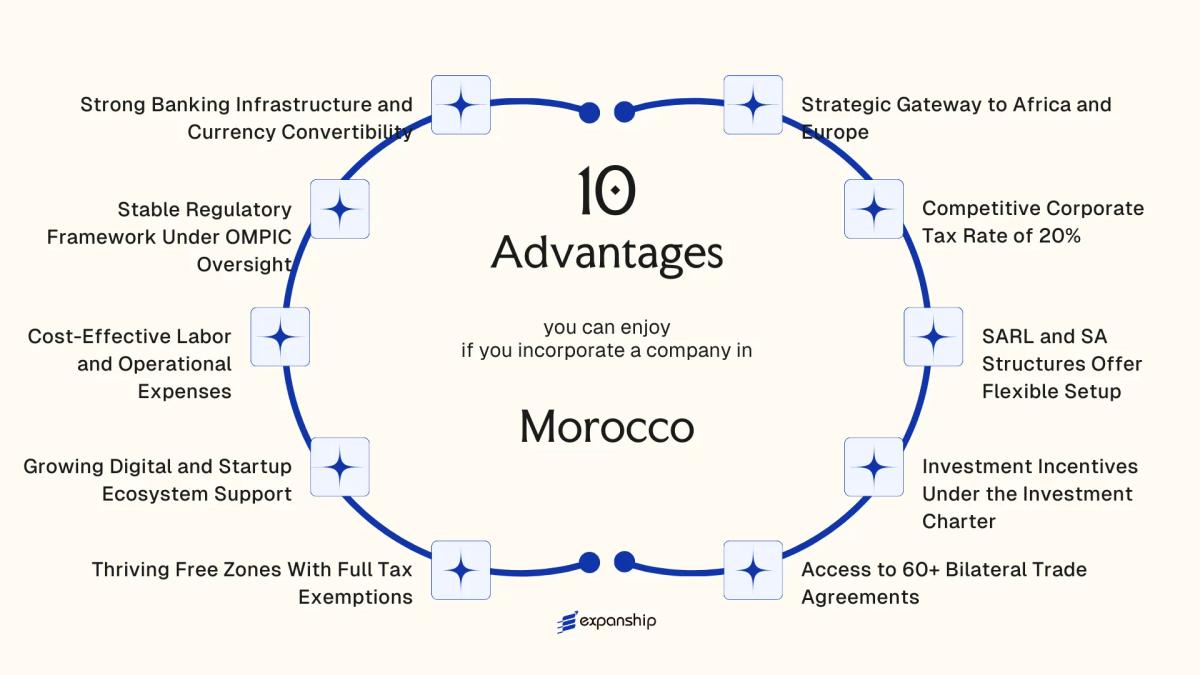
This article examines the specific advantages your business gains through formal incorporation here, drawing on the legal, fiscal, and structural features that define the Moroccan corporate environment.
Strategic Gateway to Africa and Europe
Morocco's strategic location for African business is shaped by geography that few countries can replicate. Positioned at the junction of the Atlantic Ocean and the Mediterranean Sea, the country connects sub-Saharan Africa, the European Union, and the Gulf region within a single operational base.
Proximity That Translates Into Market Access
Casablanca sits approximately 14 kilometers from the Strait of Gibraltar, placing your business within short-haul flight distance of major European financial centers. Mohammed V International Airport operates direct routes to over 90 destinations, which reduces the logistical friction of managing cross-continental operations from a single registered entity.
A Continental Bridge With Institutional Backing
The Association Agreement with the European Union, which came into force in 2000, grants Moroccan-registered firms preferential access to EU markets under defined tariff conditions. As a gateway to Africa and Europe, the country also holds observer status at the African Union and maintains active bilateral ties with 54 African states, giving your firm a recognized institutional footing across both continents.
A company incorporated in Morocco can commercially engage the EU and African markets from a single legal entity without requiring separate regional subsidiaries.
Competitive Corporate Tax Rate of 20%
Morocco's standard corporate income tax rate sits at 20% for companies with net taxable profits above MAD 1 million. Known locally as the Impôt sur les Sociétés (IS), this rate applies to resident entities on worldwide income and to non-resident entities on Moroccan-sourced income. Against the OECD average corporate rate of roughly 23%, the Morocco corporate tax rate advantages become measurable rather than abstract.
For a foreign investor structuring a subsidiary or branch here, the 20% ceiling means that profit repatriation planning starts from a lower base than in many Western European jurisdictions. A progressive rate structure applies below the MAD 1 million threshold, which benefits early-stage operations that are not yet generating high volumes of taxable income.
Several structural features of the IS regime work in your favour:
- Depreciation schedules under Moroccan tax law allow accelerated write-downs on qualifying assets, reducing taxable profit in capital-heavy setups
- Deductible expenses include management fees paid to foreign parent companies, subject to arm's-length conditions, preserving cross-border cost allocations
- Tax losses can be carried forward for up to four consecutive fiscal years, offering relief during a firm's initial operating period
- Dividend distributions to foreign shareholders are subject to a withholding tax that may be reduced under applicable tax treaties, directly affecting post-tax returns
The IS is administered by the Direction Générale des Impôts (DGI), which also oversees Morocco's tax treaty network, giving treaty-resident investors a defined framework for claiming reduced withholding rates.

Incorporate a Company in Morocco
Set up your Moroccan entity with full compliance support, from trade register filing with OMPIC to tax registration with the DGI.
SARL and SA Structures Offer Flexible Setup
Morocco SARL and SA structure benefits stem from how each entity type is calibrated to different business scales and investor profiles, without imposing the same capital or governance burdens.
The Société à Responsabilité Limitée (SARL) can be formed with a minimum share capital of MAD 1, following reforms that removed the previous MAD 10,000 floor. For a foreign investor testing the market or running a service-based operation, this eliminates the need to tie up capital at formation. Liability remains capped at the amount contributed, protecting personal assets from business obligations.
| Feature | SARL | SA |
|---|---|---|
| Minimum Share Capital | MAD 1 | MAD 300,000 |
| Minimum Shareholders | 1 | 5 |
| Public Share Issuance | Not permitted | Permitted |
| Governance Structure | Manager-led | Board of Directors |
| Audit Requirement | Conditional | Mandatory |
The Société Anonyme (SA) requires a minimum capital of MAD 300,000 and at least five shareholders, but this structure permits the public issuance of shares, which directly enables access to equity financing and institutional investment. For businesses planning a capital raise or eventual listing on the Casablanca Stock Exchange, the SA provides the legal framework to support that trajectory.
Both entity types are registered through OMPIC and governed under Law 5-96 for the SARL and Law 17-95 for the SA. Having two distinct legal forms with separate statutory bases allows your business to select a structure that matches its actual capital position, shareholder composition, and long-term financing strategy.
Investment Incentives Under the Investment Charter
Morocco's Investment Charter, formally known as the Charte de l'Investissement, was introduced through Law No. 18-95 and has since been replaced by the updated framework under Law No. 03-22, enacted in 2023. This legislation establishes a structured system of state support for qualifying investments, making the Morocco Investment Charter incentives for businesses one of the more codified commitment mechanisms in the MENA region.
Under Law No. 03-22, investors can access five distinct support categories: common incentives, specific incentives for priority sectors, incentives for structuring projects, territorial incentives for underdeveloped regions, and incentives tied to enterprise development. Each category carries defined eligibility thresholds, meaning the support your firm receives scales with the nature and location of your investment.
The common incentives alone can cover up to 30% of investment costs under certain conditions. For projects located in less-developed provinces, the state contribution rate increases further, which directly reduces your capital outlay during the critical setup phase.
Keep these points in mind:
- Eligibility varies by investment size, sector, and geographic location
- Applications are processed through the Regional Investment Centers (CRI)
- Incentives under Law No. 03-22 apply to both foreign and domestic investors
- Specific incentives require formal approval before disbursement
Foreign investors receive identical incentive access as domestic ones under Law No. 03-22, with no separate foreign investment tier required.
Access to 60+ Bilateral Trade Agreements
Morocco's bilateral trade agreements benefits extend well beyond preferential tariffs. The country has signed trade agreements with over 60 partners, including the United States through the US-Morocco Free Trade Agreement (entered into force in 2006), the European Union under the EU-Morocco Association Agreement, and the Gulf Cooperation Council. For a foreign-owned entity registered in Morocco, these arrangements translate directly into reduced or zero-duty access to some of the world's largest consumer markets.
Preferential Market Access That Changes Your Cost Structure
Goods produced or substantially transformed in Morocco can qualify for preferential tariff treatment when exported to treaty partners. Under rules of origin requirements embedded in these agreements, your firm may access EU markets at reduced duties, which materially lowers the landed cost of Moroccan-manufactured or processed products compared to exporting from a jurisdiction without equivalent coverage.
The Agadir Agreement adds another dimension, creating a free trade zone among Morocco, Tunisia, Egypt, and Jordan. A business incorporated here gains simultaneous preferential access to Arab Mediterranean markets through a single point of establishment.
Investment Protections Embedded in Treaty Architecture
Beyond trade flows, Morocco has signed Bilateral Investment Treaties (BITs) with over 50 countries. These treaties provide foreign investors with protections against expropriation without compensation and guarantee access to international arbitration, reducing the legal exposure that typically accompanies cross-border capital deployment.
For Morocco trade agreements for foreign investors, treaty-based arbitration rights are particularly significant. They ensure disputes are resolved under internationally recognized rules rather than exclusively within domestic courts.
Unlock Morocco's Trade Agreement Advantages for Your Business
Speak with an Expanship specialist to understand which bilateral agreements apply to your structure and how to position your Moroccan entity for maximum treaty benefit.
Thriving Free Zones With Full Tax Exemptions
Morocco free zones tax exemption benefits make this category of incorporation one of the more structurally distinct options in the region. Several designated zones offer exemptions and reduced rates that standard onshore entities do not access, and the specific terms vary by zone type and operator status.
- Tanger Med Special Zone and the broader free zone network grant exporting industrial and logistics companies a five-year full corporate tax exemption, followed by a reduced rate of 8.75% for the subsequent 20 years under the General Tax Code (Code Général des Impôts). For a foreign manufacturer or distribution entity, that 20-year reduced rate period represents a significant structural cost advantage.
- Casablanca Finance City (CFC), governed by its own regulatory statute, offers qualifying financial services firms and regional headquarters a flat 15% corporate tax rate, which sits below the standard 20% onshore rate. CFC status also permits full profit repatriation and currency convertibility, which directly reduces treasury complexity for multinationals.
- Free zone entities are generally exempt from VAT on goods and services exchanged within the zone perimeter, reducing input tax friction for supply chain operations.
- Dividend distributions from free zone companies to foreign shareholders are exempt from withholding tax during the exemption period, preserving the after-tax yield for non-resident investors.
Growing Digital and Startup Ecosystem Support
Morocco's startup ecosystem advantages are increasingly backed by formal legal infrastructure, not just policy intent. The Startup Act (Law 114-13, as amended by more recent framework discussions) grants qualifying early-stage companies official "startup label" status, which unlocks access to public funding mechanisms, reduced administrative fees, and preferential treatment in public procurement.
Casablanca Tech City and Technopark Casablanca function as dedicated innovation clusters, offering subsidized office space and structured access to seed funding programs managed by the Caisse Centrale de Garantie. For a foreign founder, this means your entity can access state-backed financing instruments that are typically reserved for domestically established firms, provided it meets labeling criteria.
The Moroccan government has also expanded the mandate of the Digital Development Agency (ADD) to support e-government integration and digital business registration pathways, reducing the administrative friction for tech-oriented foreign businesses operating in the country.
A startup granted the official label under Morocco's Startup Act can benefit from an exemption on employer social contributions for up to two years, a direct reduction in payroll overhead during the capital-intensive early stages of operations.
Cost-Effective Labor and Operational Expenses
Morocco low operational costs for businesses remain among the most tangible financial advantages for foreign investors. The national minimum wage (SMIG) is set at approximately MAD 15.98 per hour in the industrial sector, translating to a monthly floor well below comparable rates in Southern Europe or Gulf markets. For labor-intensive operations, this differential directly reduces your fixed cost base from day one.
Skilled talent is available across key sectors including engineering, finance, IT, and multilingual customer support, particularly in cities like Casablanca, Rabat, and Tangier. Graduates from institutions such as École Mohammadia d'Ingénieurs enter the workforce at salary levels that remain cost-competitive by international standards, giving your firm access to qualified personnel without the premium typical of Western European hiring markets.
Office and industrial space costs also reflect the broader affordability of operating in the country. Designated industrial zones, including those near the Tanger Med port complex, offer pre-developed infrastructure at structured lease rates, reducing capital expenditure on physical setup.
- Social security contributions are governed by the CNSS (Caisse Nationale de Sécurité Sociale), with employer contributions currently around 21.09% of gross salary.
- This rate is lower than the employer burden in most EU member states, which frequently exceeds 30%.
SMIG rates are subject to periodic government revision, so verify the current applicable rate with ANAPEC or a licensed Moroccan labor law advisor before finalizing your payroll projections.
Stable Regulatory Framework Under OMPIC Oversight
The Morocco OMPIC regulatory framework benefits foreign companies through a centralized, publicly accountable system for business registration and intellectual property protection. The Office Marocain de la Propriété Industrielle et Commerciale (OMPIC) functions as the official registry for commercial entities and industrial property rights, operating under the supervision of the Ministry of Industry. This institutional structure means your company's legal standing is recorded and verifiable within a single, state-administered system.
Predictable Legal Procedures for Foreign-Owned Entities
Registration timelines and documentation requirements are defined under the General Tax Code and the commercial registry procedures governed by OMPIC. Because these rules are codified rather than discretionary, your business faces consistent processing standards rather than variable administrative interpretations. That consistency reduces the legal uncertainty that can complicate cross-border planning and entity maintenance.
Intellectual Property Protection Within the Same Registry
OMPIC also administers trademark, patent, and industrial design protections under Morocco's Law No. 17-97 on industrial property. Registering your business and protecting your brand through the same authority reduces administrative fragmentation. For companies entering the market with proprietary products or trade names, this dual function limits the coordination burden between separate agencies.
Alignment With International Standards
Morocco's commercial law framework incorporates elements aligned with OHADA principles and World Trade Organization obligations, which informs how contracts, disputes, and corporate governance are treated. Investors familiar with civil law systems will find the statutory structure relatively familiar. This alignment gives your legal team a usable reference point when structuring operations or reviewing compliance obligations.
Strong Banking Infrastructure and Currency Convertibility
Morocco banking infrastructure benefits for businesses extend well beyond basic financial access. Bank Al-Maghrib, the country's central bank, oversees a regulated banking sector comprising both domestic institutions and subsidiaries of international banks, including Société Générale, CIH Bank, and Attijariwafa Bank. This gives foreign firms access to trade finance, multi-currency accounts, and correspondent banking relationships without relocating to a larger financial hub.
The dirham (MAD) is not fully convertible, but the Office des Changes administers a current account convertibility regime that permits foreign companies to repatriate profits, dividends, and proceeds from capital liquidation. For an investor, this means earnings generated in Morocco can be transferred abroad without requiring special authorization, provided the transactions fall under approved current account operations.
Capital account transactions remain subject to controls, so large inflows or outflows tied to investments require prior approval from the Office des Changes or Bank Al-Maghrib. That said, the framework governing foreign direct investment transfers is established and documented, which reduces uncertainty when planning cross-border fund movements.
Practical advantages of the Moroccan financial infrastructure for registered foreign entities include:
- Access to trade finance instruments such as letters of credit and documentary collections through major commercial banks
- Multi-currency account options that support invoicing in euros, US dollars, and dirhams
- SWIFT connectivity across the major banking institutions, enabling international wire transfers
- Dedicated business banking services for foreign-owned entities, including those operating in free zones under specific exchange regimes
Casablanca also hosts the Casablanca Finance City (CFC), a designated financial hub where certain entities benefit from a simplified foreign exchange regime under the Office des Changes framework.
Why Morocco Stands Out Against Regional Competitors
Assessing Morocco's competitive positioning against regional alternatives clarifies why the Morocco vs regional competitors business advantages discussion matters for incorporation decisions. The three jurisdictions most likely to appear on the same shortlist are Egypt, Tunisia, and the UAE. Egypt and Tunisia share Morocco's North African profile and target similar foreign investors; the UAE is commonly weighed against any African hub due to its zero-tax reputation and free zone infrastructure.
What the comparison reveals is structural. Morocco's network of bilateral investment treaties, its CFC-style free zone regime, and the oversight role of OMPIC create a regulatory architecture that Egypt and Tunisia have not yet replicated at the same depth of bilateral treaty coverage. Against the UAE, the gap narrows on tax, but Morocco's tariff-free access into Sub-Saharan Africa through the African Continental Free Trade Area (AfCFTA) and its EU Association Agreement together form a trade corridor that Gulf-based entities do not automatically benefit from.
| Parameter | Morocco | Egypt | Tunisia | UAE (Free Zone) |
|---|---|---|---|---|
| Standard Corporate Tax Rate | 20% (graduated) | 22.5% standard | 15% standard | 9% (mainland) / 0% (free zone) |
| Free Zone Tax Exemption | Up to 5 years (CFC); extended in select zones | Available but zone-specific | Available | 0% up to 50 years |
| EU Trade Access | Yes (Association Agreement) | No equivalent | Yes (Association Agreement) | No direct EU agreement |
| AfCFTA Membership | Yes | Yes | Yes | No |
| Bilateral Investment Treaties | 60+ | 40+ | 50+ | 40+ |
| Regulatory Body | OMPIC | GAFI | API | ADGM / DIFC (zones) |
| OHADA-Aligned Legal Framework | Partial alignment | No | Partial | No |
Compliance Services for Companies in Morocco
Maintain good standing with OMPIC and meet Morocco's ongoing corporate compliance requirements with structured support.
Conclusion
Morocco offers a combination of structural, fiscal, and geographic conditions that make it a credible base for businesses targeting African and European markets. The treaty network covering 60+ bilateral agreements, combined with the standard corporate income tax rate of 20% and full exemptions available within designated free zones, creates a layered framework that can reduce both tax exposure and market access costs simultaneously. These are not isolated incentives; they operate within a regulated environment overseen by bodies like OMPIC and governed by codified commercial law.
The benefits of incorporating in Morocco apply differently depending on your sector, intended markets, and chosen legal structure. A manufacturing operation may extract more value from free zone status and export incentives under the Investment Charter, while a service-based entity structured as an SARL may benefit more from the lower capital requirements and the currency convertibility provisions that facilitate profit repatriation.
Forming a company here is an exercise in matching jurisdictional strengths to your specific operational profile. Businesses that align their structure with the available fiscal and regulatory frameworks stand to gain measurably more than those treating incorporation as a formality. The next step is determining which configuration best fits your business objectives before initiating the formation process.
Start Your Moroccan Company With Expanship Today
Incorporating in Morocco with Expanship covers the full formation process, from selecting the appropriate entity structure — whether an SARL with its lower capital requirements or an SA suited to larger investment mandates — through to registration with the Office Marocain de la Propriété Industrielle et Commerciale (OMPIC) and enrollment with the Centre Régional d'Investissement (CRI). Each compliance obligation tied to the General Tax Code, the Investment Charter, and annual reporting duties is managed as part of a defined service scope.
Expanship's services for your Moroccan entity include:
- Document preparation, notarization, and legalization for submission to OMPIC and the relevant CRI
- Registered agent and registered office provision to satisfy local address requirements
- Government filing and liaison with the Tax Administration (Direction Générale des Impôts) for tax identification registration
- Post-incorporation compliance management, covering annual accounts, social security registration with CNSS, and statutory filings
- Banking introduction assistance to support corporate account opening with locally licensed institutions
- Ongoing registered office maintenance and document receipt services
Reach out to Expanship Morocco to discuss your incorporation requirements directly.
Frequently Asked Questions (FAQ)
Registration with OMPIC (Office Marocain de la Propriété Industrielle et Commerciale) typically takes between five and ten business days for a standard SARL, provided all documentation is in order. The process involves trade name reservation, notarized articles of association, registration with the Regional Investment Center (CRI), and publication in the Official Bulletin. Delays generally arise from incomplete notarial filings or missing tax identification documentation.
The standard corporate tax rate is 20%, but it is not applied uniformly across all entities. Companies operating in designated free zones such as Casablanca Finance City benefit from full exemptions for a defined period, after which reduced rates apply. Smaller firms with annual net profits below a statutory threshold are taxed at a lower progressive rate under the General Tax Code (Code Général des Impôts).
Free zone entities are primarily structured for export-oriented operations, and sales into the local Moroccan market are subject to standard customs duties and tax obligations. Casablanca Finance City status, for example, is granted under specific eligibility criteria and carries defined operational perimeters. Conducting domestic sales beyond permitted thresholds can result in the loss of preferential tax treatment.
Morocco has signed over 60 bilateral tax treaties, many of which include reduced withholding tax rates on dividends, interest, and royalties paid to non-resident shareholders. The applicable rate depends on the specific treaty between Morocco and your country of residence, as rates vary by agreement. Where no treaty exists, the domestic withholding tax rate under the Code Général des Impôts applies in full.
Casablanca Finance City grants preferential tax status based on compliance with defined criteria, including the nature of activities conducted and substance requirements. Failure to maintain eligibility can result in reclassification as a standard onshore entity, which subjects the company to the full corporate tax regime retroactively for the non-compliant period. The CFC Authority conducts periodic reviews, and companies should maintain accurate operational records to support their status.
A SARL does not require a Moroccan resident as a director by statute, and foreign nationals can serve as gérant (managing director). However, the company must maintain a registered address in Morocco and appoint a fiscal representative for tax correspondence purposes. Practical considerations such as bank account opening may informally favor having a local signatory, though this is not a legal requirement for incorporation itself.
Legal Disclaimer
The information provided in this article is for general informational purposes only and does not constitute legal, tax, or professional advice. While we strive to ensure the accuracy and timeliness of the content, laws and regulations are subject to change, and the application of laws can vary widely based on specific facts and circumstances.
Readers should not act upon this information without seeking professional counsel tailored to their individual situation. Expanship and its authors disclaim any liability for actions taken or not taken based on the content of this article.
For specific advice regarding your business setup, compliance requirements, or any legal matters, please consult with qualified legal and tax professionals in the relevant jurisdiction.