
Key Takeaways
- All Luxembourg companies must be registered with the Registre de Commerce et des Sociétés (RCS), with the legal form chosen — such as a Société Anonyme or Société à Responsabilité Limitée — determining the applicable minimum share capital threshold under the law of 10 August 1915 on commercial companies.
- Beneficial ownership information must be disclosed and maintained in the Registre des Bénéficiaires Effectifs (RBE), with this obligation extending beyond the point of incorporation as an ongoing compliance duty.
- The choice of legal entity structure directly affects the documentary, capital, and administrative requirements that must be satisfied before the RCS will complete registration.
- Directors, shareholders, and registered office arrangements are each subject to distinct conditions under the Companies Law, and failure to meet any one of these requirements will result in rejection of the registration application or loss of good standing post-incorporation.
Company formation in Luxembourg is governed by the law of 10 August 1915 on commercial companies, as amended, commonly referred to as the Companies Law. The Registre de Commerce et des Sociétés (RCS) administers the registration process and maintains the official commercial register.
This article covers the structural, administrative, and compliance requirements that apply when registering a company in Luxembourg under the Companies Law.
Failure to satisfy these requirements results in rejection of the registration application by the RCS, or in the case of post-incorporation non-compliance, potential legal liability and loss of good standing.
Requirements vary depending on the legal form chosen, such as a Société Anonyme or a Société à Responsabilité Limitée, as well as the business activity and the investor's structure.
This article is most relevant to foreign investors, holding company operators, and fund structuring professionals assessing Luxembourg business incorporation rules before committing to a legal form.
Minimum Share Capital Requirements in Luxembourg
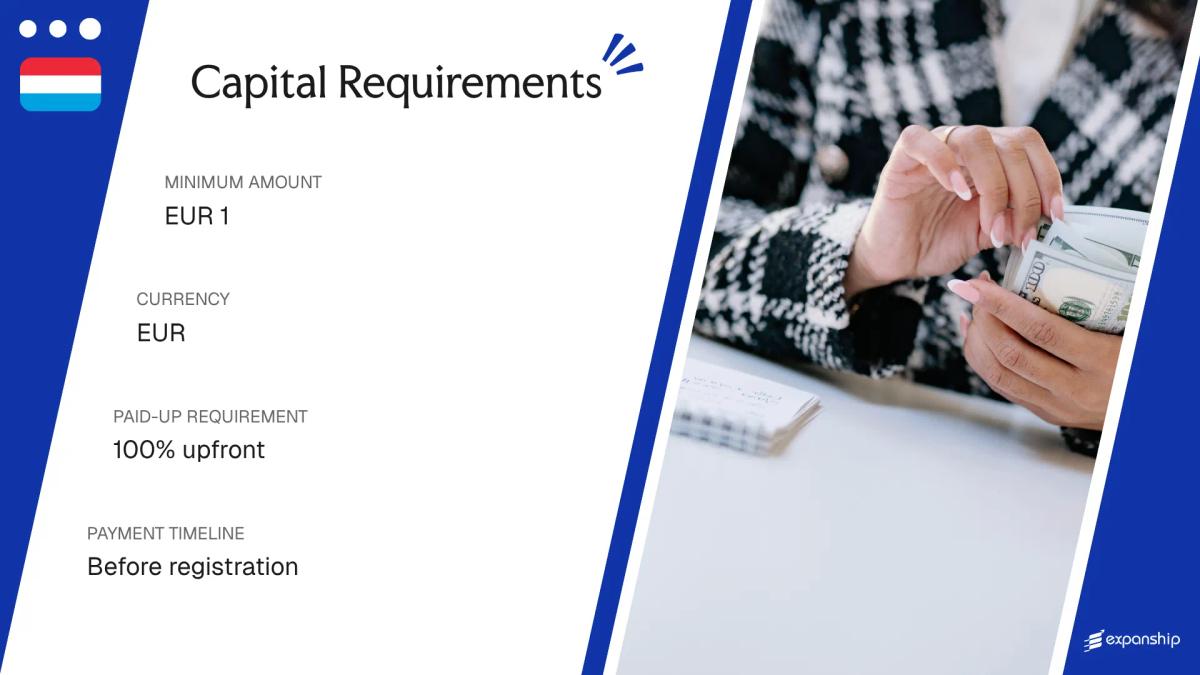
Luxembourg minimum share capital requirements vary depending on the legal form you choose. A Société Anonyme (SA) requires a minimum share capital of EUR 30,000, while a Société à Responsabilité Limitée (SARL) sets the threshold at EUR 12,000, both governed under the Companies Act of 10 August 1915 as amended. Capital contributions are verified by the Registre de Commerce et des Sociétés (RCS) at the point of incorporation and form part of the mandatory notarial deed process.
Share capital in both entity types operates on a par value system, meaning each share carries a nominal value recorded in the articles of association. Once incorporated, the minimum capital requirement is a one-time statutory threshold rather than an ongoing obligation to maintain a specific balance.
| Parameter | Detail |
|---|---|
| Minimum Authorized Share Capital | EUR 30,000 for SA; EUR 12,000 for SARL |
| Maximum Authorized Share Capital | No statutory maximum |
| Minimum Paid-Up Capital | EUR 30,000 for SA (fully paid-up); EUR 1 per share for SARL (no minimum paid-up threshold beyond issued capital) |
| Paid-Up Requirement at Incorporation | 100% for SA; no specific paid-up percentage mandated for SARL beyond the issued amount |
| Accepted Currency | EUR (other currencies permissible if converted to EUR equivalent) |
| Accepted Forms of Contribution | Cash and non-cash (in-kind) contributions; in-kind contributions require an independent auditor's report for SA |
| Timeframe to Deposit Capital | Prior to execution of the notarial deed of incorporation |
For an SA, the full EUR 30,000 must be deposited in a blocked bank account and evidenced to the notary before the deed of incorporation can be executed. The account is unblocked only after the RCS registration is confirmed.
Company Secretary Requirements in Luxembourg
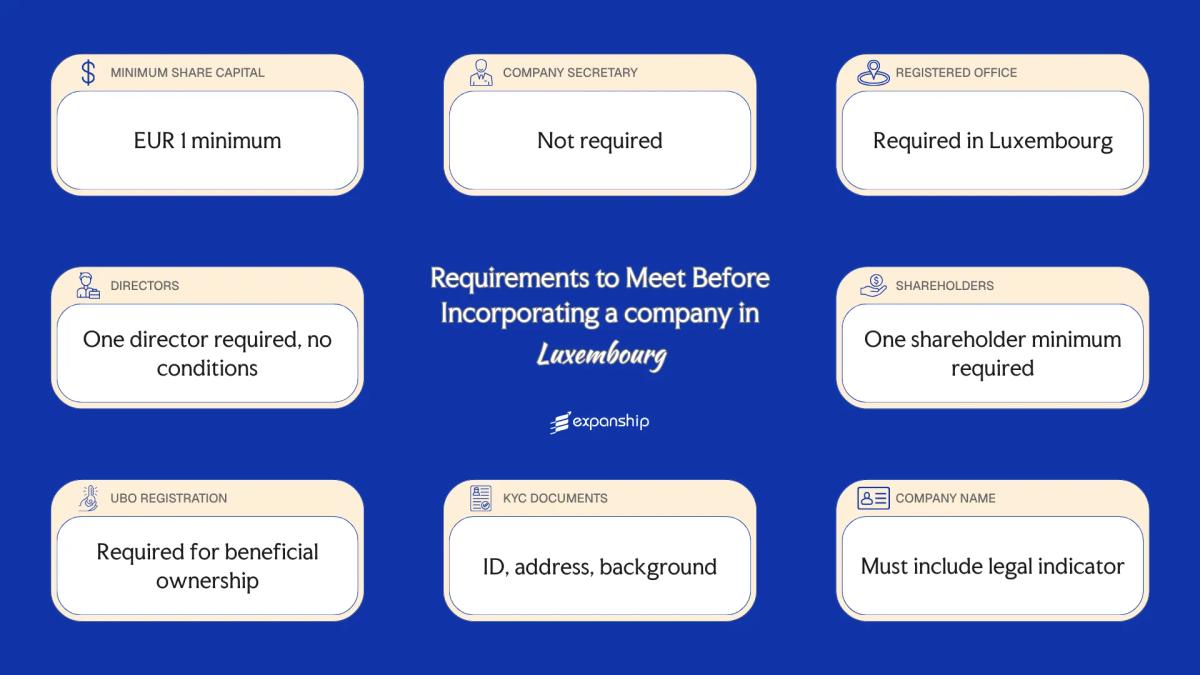
Luxembourg company secretary requirements differ from many other European jurisdictions in one key respect: there is no statutory obligation to appoint a company secretary for a Société à Responsabilité Limitée (S.à r.l.) or Société Anonyme (S.A.). Corporate governance obligations under the Companies Act of 10 August 1915, as amended, are instead distributed among directors, managers, and statutory auditors.
That said, larger entities or those subject to specific regulatory oversight may engage a corporate secretary to manage board documentation, maintain statutory registers, and coordinate filing obligations with the Luxembourg Trade and Companies Register (RCS). These functions are administrative rather than legally mandated under a distinct secretary role.
Qualification criteria for those appointed to perform company secretarial functions in Luxembourg:
- No formal licensing requirement applies to individuals or firms acting as corporate secretary.
- Both natural persons and legal entities may be appointed to the role.
- Residency in Luxembourg is not a statutory condition for eligibility.
- No minimum professional qualification is prescribed by law for this function.
- Entities subject to AML supervision may require a secretary provided by a regulated professional services firm.

Company Incorporation in Luxembourg
Set up your business entity in Luxembourg with full guidance on registration, structuring, and compliance from incorporation through to ongoing maintenance.
Registered Office Requirements in Luxembourg
Luxembourg registered office requirements mandate that every société à responsabilité limitée (S.à r.l.) and société anonyme (S.A.) must maintain a permanent, physical address within the Grand Duchy, as defined under the Luxembourg Commercial Companies Act of 1915. Failure to maintain a compliant legal seat can result in administrative dissolution proceedings initiated by the Luxembourg Business Registers (LBR) or the district court.
- A physical street address is required; a P.O. box alone does not satisfy the legal seat obligation.
- Virtual office addresses are permitted provided they include a genuine physical premises and mail handling service at that location.
- The registered address must be situated within Luxembourg; a foreign address does not fulfill the domicile obligation under the 1915 Act.
- No ownership of the premises is required; a lease or domiciliation agreement with a licensed domiciliation agent is acceptable.
- The registered address is publicly listed in the Registre de Commerce et des Sociétés (RCS) and is accessible through the LBR's online portal.
- Any change of registered address must be formally recorded by notarial or private deed and filed with the RCS to take legal effect.
Director Requirements in Luxembourg
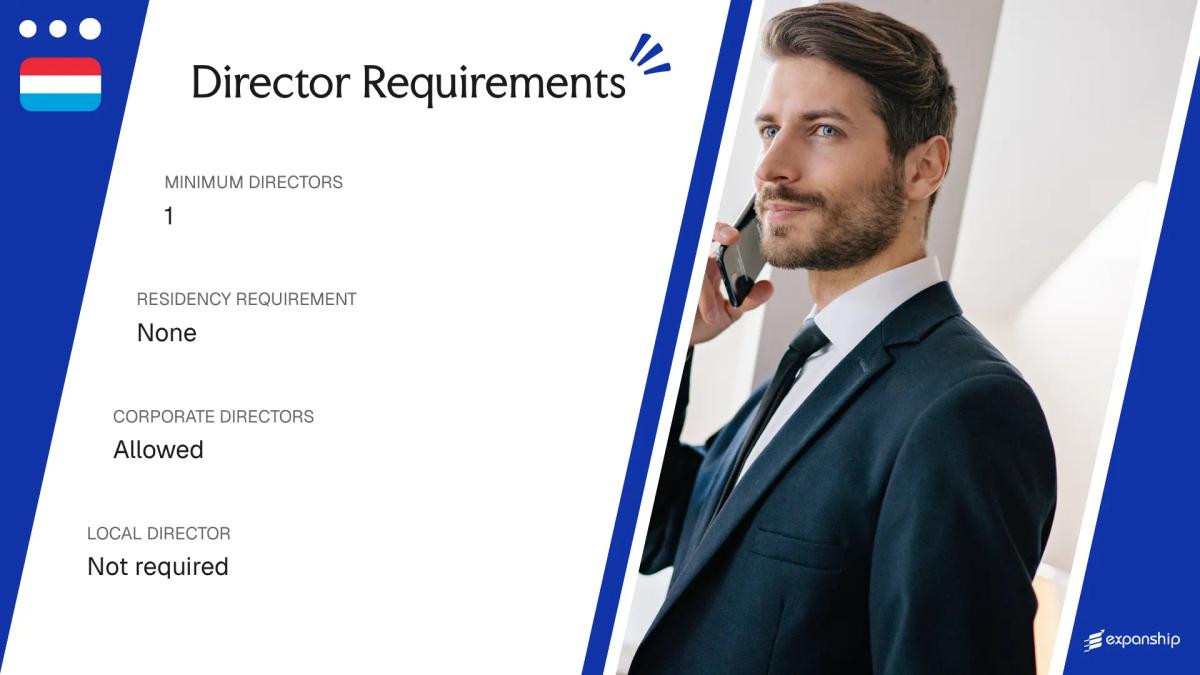
Upon appointment, directors of a Luxembourg société à responsabilité limitée (SARL) or société anonyme (SA) assume fiduciary duties under the Companies Act of 10 August 1915, as amended, including duties of loyalty, care, and acting in the corporate interest. Breaches of these obligations can give rise to personal civil liability toward the company and third parties.
| Parameter | Detail |
|---|---|
| Minimum Number of Directors | One director is sufficient for an SARL (gérant); an SA requires at least three directors if governed by a board, or one director under the single-member structure permitted since the 2016 reform. |
| Maximum Number of Directors | No statutory maximum is prescribed for either the SARL or the SA. |
| Local/Resident Director Required | No statutory requirement exists for a resident or locally domiciled director. |
| Nationality Restrictions | No nationality restrictions apply; directors of any nationality may be appointed. |
| Minimum Age Requirement | Directors must have reached the age of legal majority, which is 18 years under Luxembourg civil law. |
| Corporate Directors Permitted | Corporate entities may serve as directors in an SA; the gérant of an SARL may also be a legal person. |
| Director Must Be a Shareholder | No requirement for a director to hold shares in the company. |
| Publicly Listed on Registry | Directors are listed in the Registre de Commerce et des Sociétés (RCS) and the information is publicly accessible. |
| Disqualification Conditions | Persons subject to a judicial prohibition on managing companies, or those convicted of certain financial offences under Luxembourg criminal and commercial law, are disqualified from serving. |
Despite Luxembourg's reputation as a financial hub, there is no requirement for even a single director of a Luxembourg company to be resident in the country, which sets it apart from jurisdictions that mandate local board presence for tax residency or regulatory purposes.
Shareholder Requirements in Luxembourg
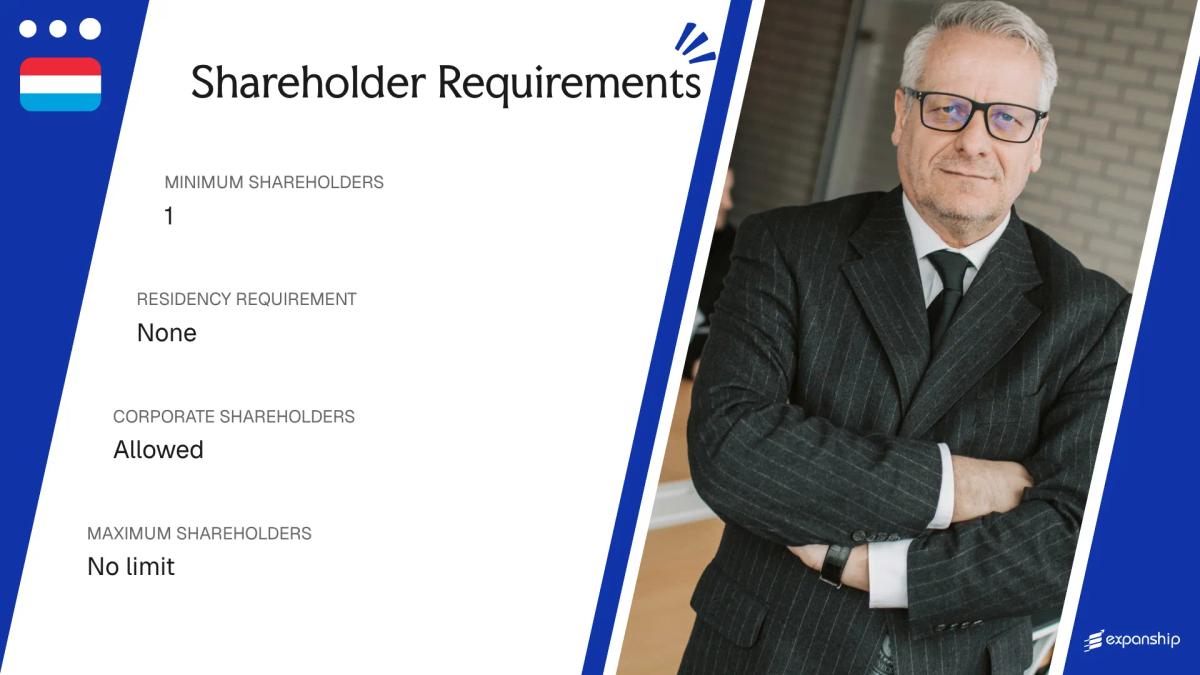
Luxembourg shareholder requirements differ by entity type. A Société à Responsabilité Limitée (SARL) requires a minimum of one shareholder and permits up to 100, making sole-shareholder structures fully permissible under the amended law of 10 August 1915 on commercial companies.
Nationality and Residency Restrictions
No nationality or residency requirements apply to shareholders. Foreign individuals and entities may hold 100% of shares in a Luxembourg-registered company without restriction.
Corporate Shareholders
Corporate entities are permitted to act as shareholders. No conditions specific to corporate shareholders are imposed beyond standard KYC obligations applicable at incorporation.
Shareholder Liability
In a SARL, each associé's liability is limited to their capital contribution. No circumstances under standard company law extend personal liability beyond that subscribed amount, unless a shareholder has also assumed personal guarantees by separate agreement.
Register of Shareholders
A SARL must maintain an internal register of shareholders. This register is not publicly accessible, though certain ownership data is reported to the Luxembourg Business Registers (LBR) and the Register of Beneficial Owners (RBO).
Meet Luxembourg's Incorporation Requirements With Confidence
Get structured guidance on shareholder setup, documentation, and compliance obligations for your Luxembourg entity.
UBO / Beneficial Ownership Registration Requirements in Luxembourg
Luxembourg UBO registration requirements are governed by the Law of 13 January 2019, which established the Registre des Bénéficiaires Effectifs (RBE). A beneficial owner is defined as any natural person who ultimately owns or controls more than 25% of the shares, voting rights, or ownership interest in a legal entity.
- Identify all natural persons holding, directly or indirectly, more than 25% of the shares or voting rights in the entity.
- Collect the required personal data for each UBO, including full name, nationality, date of birth, country of residence, and the nature and extent of the beneficial interest held.
- File the UBO information with the RBE, administered by the Luxembourg Business Registers (LBR), within one month of incorporation.
- Update the RBE within one month of any change to the registered UBO information.
| Parameter | Detail |
|---|---|
| Ownership Threshold for UBO Status | More than 25% of shares, voting rights, or ownership interest |
| Filing Authority | Luxembourg Business Registers (LBR) via the RBE |
| Disclosure Deadline at Incorporation | Within one month of incorporation |
| Publicly Accessible Register | Yes, partially; certain data is accessible to the public |
| Penalties for Non-Disclosure | Administrative fines and criminal sanctions under the Law of 13 January 2019 |
| Ongoing Update Obligation | Within one month of any change to UBO information |
KYC / Document Requirements in Luxembourg
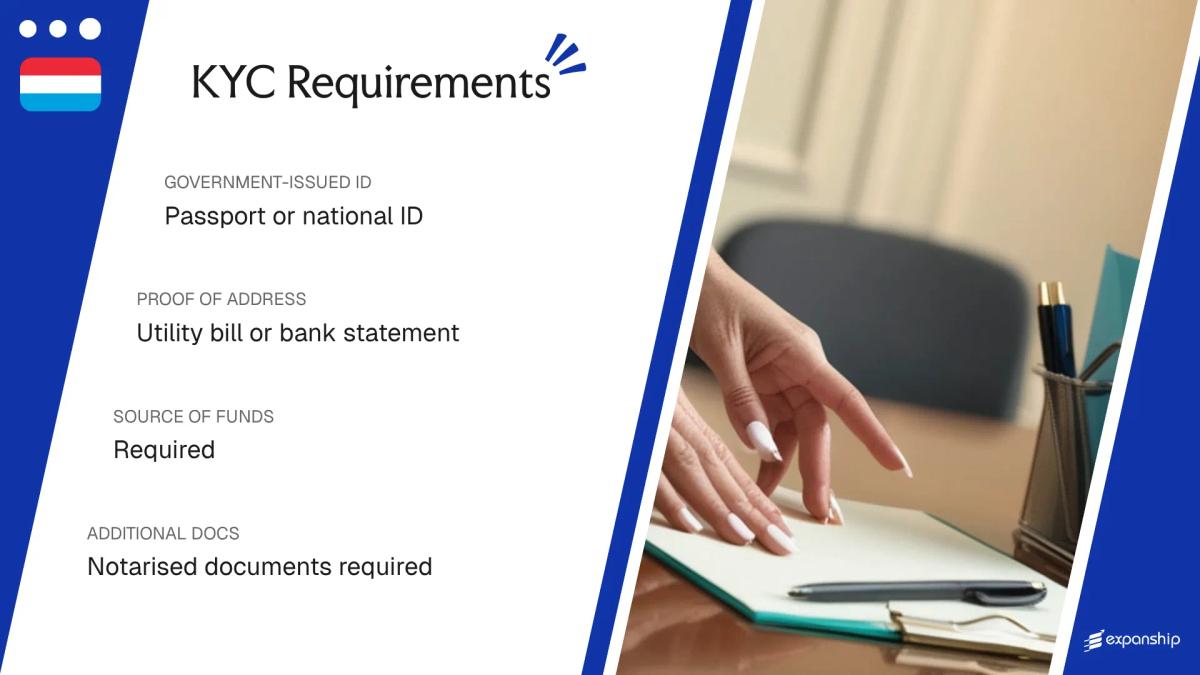
Luxembourg KYC requirements for incorporation are governed by the Law of 12 November 2004 on the fight against money laundering and terrorist financing, as amended, and supervised by the Financial Intelligence Unit (CRF) under the Ministry of Justice.
Individual / Personal Documents
- Valid government-issued photo identification (passport or national identity card) for each director, shareholder, and beneficial owner
- Proof of residential address dated within three months, such as a utility bill or bank statement
- Completed and signed KYC questionnaire disclosing the nature of the business relationship
- Recent curriculum vitae may be required for directors where the service provider conducts fit-and-proper assessments
Corporate Documents
- Certified copy of the certificate of incorporation for each corporate shareholder or director
- Constitutional documents, including the articles of association, in their current form
- Register of directors and, where applicable, the register of shareholders of the parent entity
- Proof of registered address for the corporate entity, such as a utility bill or official correspondence
Source of Funds Documentation
- Bank statements covering the preceding three to six months evidencing the origin of subscribed capital
- Audited financial statements where the subscribing entity has trading history
- A written source-of-wealth declaration signed by the beneficial owner
Notarisation and Apostille Requirements
- Foreign public documents must carry an apostille under the Hague Convention of 5 October 1961
- Documents issued in a language other than French, German, or Luxembourgish require a certified translation
- Notarised copies may be accepted in place of originals at the discretion of the formation notary
Incomplete or uncertified beneficial ownership documentation is the most frequently cited reason for delays in the Luxembourg incorporation process.
Company Name Requirements in Luxembourg
Proposed names for a Luxembourg entity are assessed by the Luxembourg Business Registers (LBR) at the point of incorporation. The name must be unique and must not cause confusion with any existing registered entity.
Your chosen dénomination sociale must be in any language using Latin characters, though French, German, and Luxembourgish are the most commonly used. The legal form suffix — such as S.A., S.à r.l., or S.C.S. — must appear as part of the registered name.
Certain words are restricted and require prior authorisation from relevant authorities before use; these include terms that imply a connection to the state, regulated financial activities, or professional bodies. Words that are misleading or contrary to public order are prohibited outright.
Name reservation is available through the LBR prior to filing incorporation documents. Reserved names are held for a defined period, giving your business time to complete the formation process without risk of the name being registered by another party.
Compliance Services for Companies in Luxembourg
Ongoing compliance obligations for Luxembourg entities include annual filings, beneficial ownership reporting, and statutory record maintenance. Expanship manages these requirements on your behalf.
Conclusion
Luxembourg company incorporation requirements span several distinct legal obligations, each governed by the Luxembourg Commercial Code, the law of 10 August 1915 on commercial companies, and supervised by the Registre de Commerce et des Sociétés. Among the more consequential obligations are the minimum share capital thresholds tied to entity type and the UBO registration requirements under the RBE, which carry ongoing disclosure duties beyond the formation stage. Once these requirements are understood, the practical work of engaging local registered agents, preparing notarised documentation, and coordinating with the RCS can begin.
Expanship's Corporate Formation Services in Luxembourg
Expanship's Luxembourg corporate formation services cover the full scope of requirements outlined in this guide, from coordinating your registered office arrangements with a licensed domiciliation agent to preparing the documentation your notaire will need before deed execution. Your operational burden does not disappear, but having a dedicated team manage the sequencing of each step reduces the risk of delays caused by incomplete filings or missed regulatory obligations.
Expanship supports your business across the entire incorporation and post-incorporation process in Luxembourg:
- Preparing your company registration documents and coordinating notarial deed execution
- Providing registered agent and domiciliation office services in accordance with Luxembourg law
- Handling filings with the Registre de Commerce et des Sociétés and liaising with relevant authorities on your behalf
- Managing ongoing compliance obligations after your entity is incorporated
- Facilitating introductions to banking partners familiar with Luxembourg-incorporated structures
- Registering your firm for tax purposes and coordinating with the Administration des contributions directes where required
Reach out to Expanship Luxembourg to discuss your incorporation requirements.
Frequently Asked Questions (FAQ)
Failure to file or maintain accurate UBO information in the RBE can result in criminal fines under Luxembourg law, with sanctions applicable to both the entity and its responsible officers. The Luxembourg Business Registers authority oversees compliance, and deliberate omission or false declaration is treated more seriously than an administrative oversight. Correcting an incomplete filing promptly after identification typically reduces exposure, but the violation remains on record.
Luxembourg law imposes no statutory residency requirement for directors of a SARL or SA. However, your company's tax residency and substance position can be affected if all directors reside and make decisions abroad, which is a separate concern governed by OECD guidelines and Luxembourg's domestic tax rules. If your structure requires demonstrable local substance, appointing at least one Luxembourg-resident director is a practical response to that requirement.
A société anonyme requires a minimum share capital of EUR 30,000, all of which must be fully paid up at incorporation. A société à responsabilité limitée requires a minimum of EUR 12,000, also fully paid up. Both amounts must be deposited in a blocked bank account before the notarial deed is executed, and the bank confirmation of deposit forms part of the incorporation file submitted to the Luxembourg Trade and Companies Register (RCS).
The RCS will reject an incorporation filing if the proposed name is identical or confusingly similar to an existing registered name. You are responsible for conducting a name availability check against the RCS database before submitting your notarial deed, as the notary cannot proceed with a name that fails this check. Reserving an alternative name in advance is advisable if your preferred choice is common or closely tied to a widely used term.
A virtual or nominee registered office address is legally permissible in Luxembourg for the purpose of satisfying the statutory requirement under the law on commercial companies. The registered office must be a valid Luxembourg address capable of receiving official correspondence and service of legal documents. That said, relying solely on a virtual office without any supporting substance may create complications if your entity is subject to tax residency assessments or regulatory scrutiny regarding its centre of effective management.
Yes. A Luxembourg SARL can be formed by a single shareholder who simultaneously acts as the sole manager, making it a suitable structure for sole entrepreneurs or wholly owned subsidiaries. The individual's dual role must be accurately reflected in the articles of association and in the RCS filing. There is no prohibition on this arrangement under the law on commercial companies, though corporate governance considerations may still apply depending on the entity's activities and any applicable regulatory licences.
Legal Disclaimer
The information provided in this article is for general informational purposes only and does not constitute legal, tax, or professional advice. While we strive to ensure the accuracy and timeliness of the content, laws and regulations are subject to change, and the application of laws can vary widely based on specific facts and circumstances.
Readers should not act upon this information without seeking professional counsel tailored to their individual situation. Expanship and its authors disclaim any liability for actions taken or not taken based on the content of this article.
For specific advice regarding your business setup, compliance requirements, or any legal matters, please consult with qualified legal and tax professionals in the relevant jurisdiction.