
Key Takeaways
- Every company incorporated in Liechtenstein must maintain a physical registered office and appoint a licensed local trustee, as mandated under the Persons and Companies Act (PGR), making these structural appointments a legal prerequisite rather than an optional formality.
- Beneficial ownership information must be disclosed and kept current under Liechtenstein's Due Diligence Act, with the Financial Intelligence Unit (FIU) overseeing compliance once the entity is operational.
- Sector-specific activities, particularly those involving financial services, require separate authorisation from the Financial Market Authority (FMA) in addition to standard Commercial Register (Handelsregister) registration through the Office of Justice.
- Capital requirements, governance structure, and ownership disclosure obligations each vary by entity type under the PGR, meaning the applicable compliance framework must be assessed at the point of entity selection rather than after incorporation.
Liechtenstein company incorporation is governed primarily by the Persons and Companies Act (Personen- und Gesellschaftsrecht, or PGR), which has regulated private and commercial entities in the principality since 1926. The Office of Justice (Amt für Justiz) oversees entity registration through the Commercial Register (Handelsregister).
Liechtenstein incorporation requirements span several categories, including capital thresholds, governance structure, registered presence, and ownership disclosure obligations.
Failure to satisfy these requirements results in rejection of the registration application or, where deficiencies emerge post-incorporation, potential deregistration and legal liability. Requirements vary depending on the chosen entity type, the nature of the business activity, and whether the applicant is subject to sector-specific regulation under authorities such as the Financial Market Authority (FMA).
This article is most relevant to foreign entrepreneurs, holding company owners, and fund structuring professionals seeking to establish or maintain a legal entity within the principality's commercial framework.
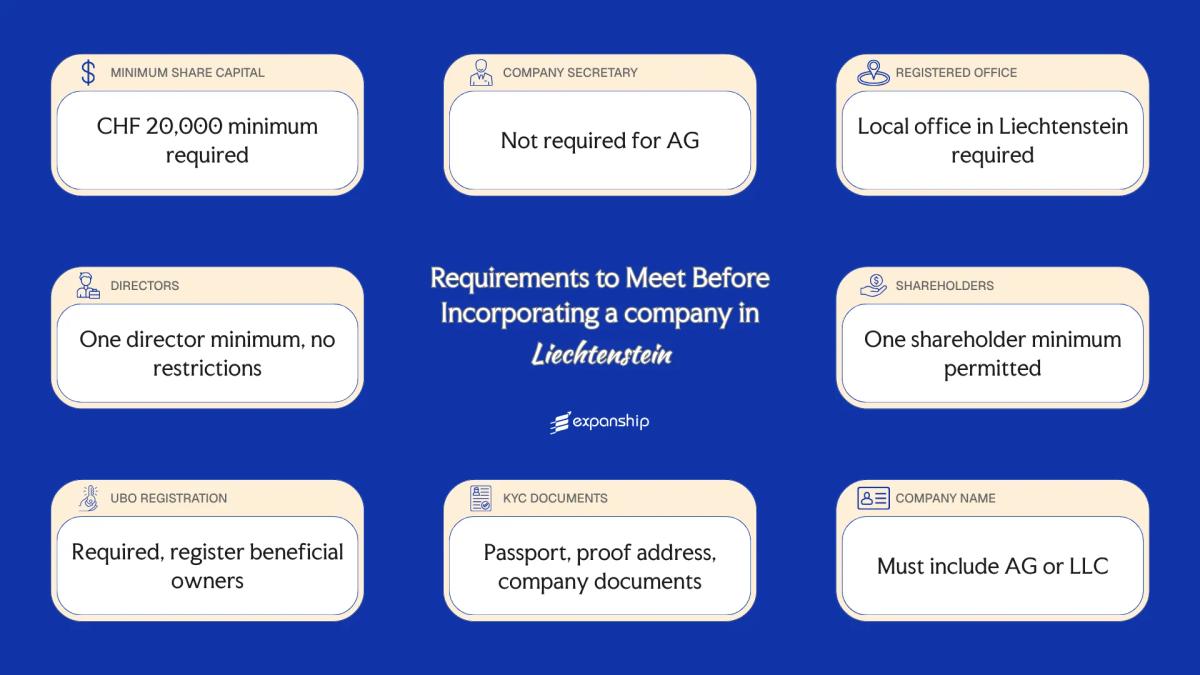
Minimum Share Capital Requirements in Liechtenstein
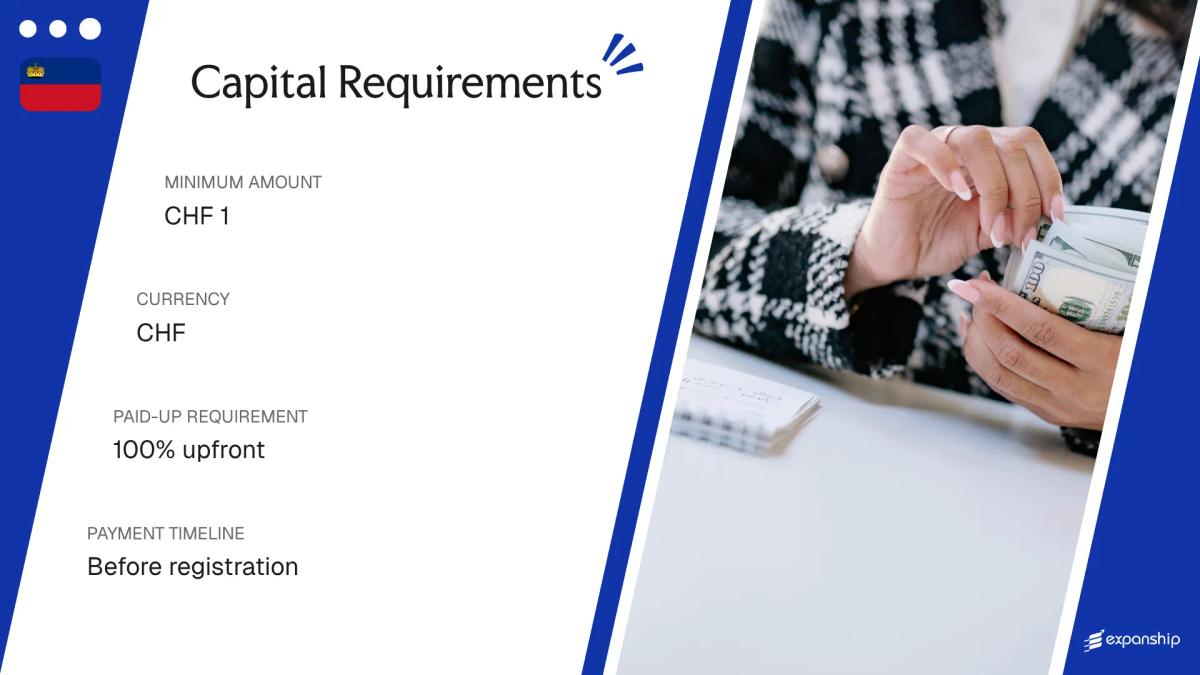
Liechtenstein minimum share capital requirements vary by legal form and are governed by the Person and Company Act (PGR). For an Aktiengesellschaft (AG), the required minimum authorized share capital is CHF 50,000, while a Gesellschaft mit beschränktem Haftung (GmbH) requires a minimum of CHF 30,000.
Capital contributions are verified by the Liechtenstein National Registry (Handelsregister) during the incorporation process, with confirmation typically required before the entity is entered into the commercial register. Share capital obligations under the PGR are not purely a one-time formality; the firm must maintain adequate equity coverage on an ongoing basis to avoid statutory impairment provisions.
| Parameter | Detail |
|---|---|
| Minimum Authorized Share Capital | CHF 50,000 for AG; CHF 30,000 for GmbH |
| Maximum Authorized Share Capital | No statutory maximum |
| Minimum Paid-Up Capital | 50% of minimum authorized capital at incorporation |
| Paid-Up Requirement at Incorporation | Yes, prior to registration with the Handelsregister |
| Accepted Currency | Swiss Franc (CHF); foreign currency permitted if equivalent value is demonstrated |
| Accepted Forms of Contribution | Cash contributions; non-cash contributions subject to valuation and disclosure |
| Timeframe to Deposit Capital | Prior to filing for commercial registration |
Paid-up capital must be deposited and confirmed before the Handelsregister processes the incorporation filing. Registration will not proceed without evidence of the required contribution being in place.
Registered Agent Requirements in Liechtenstein
Under the Persons and Companies Act (PGR), every legal entity registered in Liechtenstein must appoint a domiciliary agent. This is a mandatory requirement, not an administrative formality, and the obligation applies from the point of incorporation.
The domiciliary agent serves as the official point of contact with the Office of Justice, accepts service of legal documents on behalf of the entity, and holds responsibility for maintaining certain statutory records. Fulfilling Liechtenstein registered agent requirements means ensuring this agent meets specific eligibility conditions set out under the PGR.
Qualification criteria for serving as a domiciliary agent:
- The agent must be physically resident or legally established in Liechtenstein.
- Only licensed professionals or regulated entities are eligible, typically lawyers, fiduciaries, or licensed trust companies.
- Fiduciary service providers must hold a valid licence issued by the Liechtenstein Financial Market Authority (FMA).
- Corporate entities may act as domiciliary agents, provided they hold the requisite FMA authorisation.
- Natural persons acting in this capacity must meet the professional qualification standards defined under fiduciary licensing rules.

Incorporate a Company in Liechtenstein
Set up your legal entity in Liechtenstein with the correct structure, a qualified domiciliary agent, and full compliance with PGR requirements from day one.
Registered Office Requirements in Liechtenstein
Liechtenstein registered office requirements follow the rules set out under the Persons and Companies Act (PGR), which mandates that every company maintain a statutory seat within the Principality at all times. Failure to maintain a compliant domicile address can result in regulatory intervention by the Office of Justice (Amt für Justiz), including potential deregistration from the Commercial Register (Handelsregister).
- A physical address located within Liechtenstein is required; a postal box alone does not satisfy the statutory seat obligation.
- Virtual office addresses are generally not accepted unless they correspond to a genuine, verifiable physical location in the jurisdiction.
- The registered address must be locally based; a foreign address cannot serve as the company domicile under the PGR.
- Proof of occupancy, such as a lease agreement or title document, is typically required to establish the legitimacy of the address.
- The statutory seat is publicly listed in the Handelsregister and is accessible to third parties.
- Any change to the registered address must be formally notified to the Office of Justice and recorded through an amendment to the Commercial Register entry.
Director Requirements in Liechtenstein
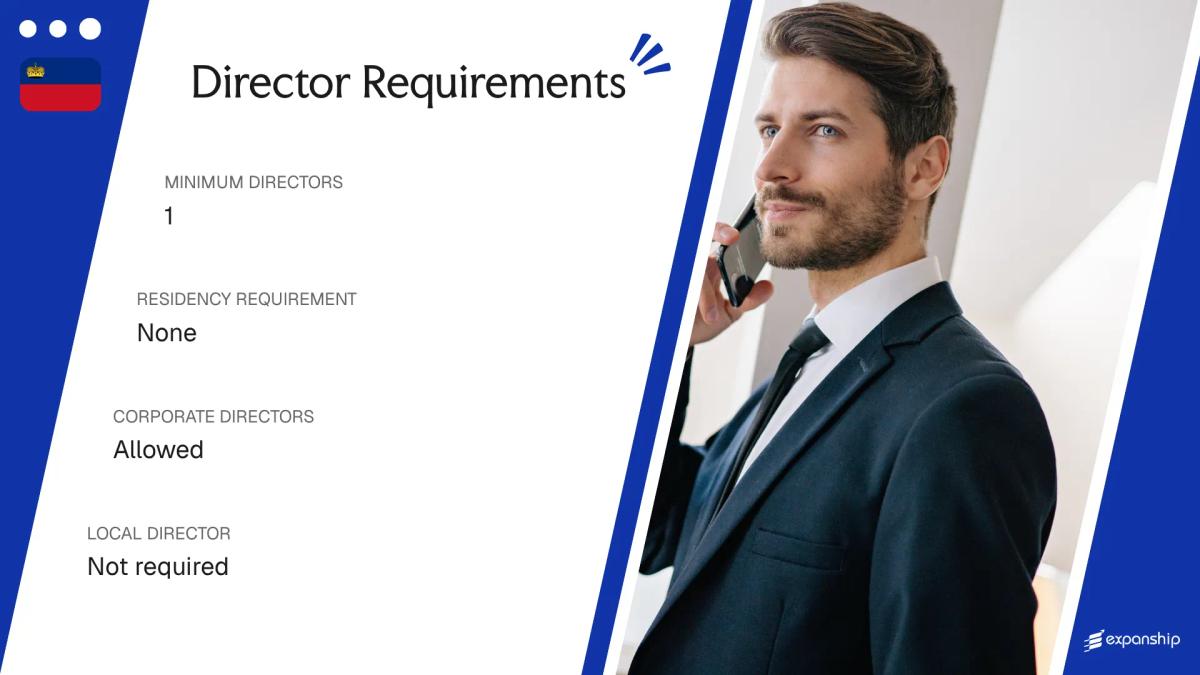
Upon appointment, directors of a Liechtenstein entity assume statutory duties under the Personen- und Gesellschaftsrecht (PGR), including the duty of loyalty, duty of care, and personal liability for breaches of fiduciary obligation. The Verwaltungsrat bears collective responsibility for ensuring the company's acts remain within its registered purpose and that annual reporting obligations are met.
| Parameter | Detail |
|---|---|
| Minimum Number of Directors | One director is required for an AG (Aktiengesellschaft); an LLC (GmbH) requires at least one managing director. |
| Maximum Number of Directors | No statutory maximum is prescribed under the PGR. |
| Local/Resident Director Required | At least one member of the board must be resident in Liechtenstein or be a licensed local representative. |
| Nationality Restrictions | No nationality restrictions apply, provided residency or representation requirements are met. |
| Minimum Age Requirement | Directors must be at least 18 years of age. |
| Corporate Directors Permitted | Corporate directors are permitted under the PGR, subject to disclosure requirements. |
| Director Must Be a Shareholder | No statutory requirement exists for a director to hold shares in the company. |
| Publicly Listed on Registry | Directors are recorded in the Öffentlichkeitsregister (public commercial register). |
| Disqualification Conditions | Persons convicted of fraud, insolvency offences, or breach of fiduciary duty may be disqualified from directorship. |
Despite Liechtenstein's reputation as a private wealth jurisdiction, director names are publicly accessible through the Öffentlichkeitsregister, meaning there is no statutory anonymity at the board level.
Shareholder Requirements in Liechtenstein
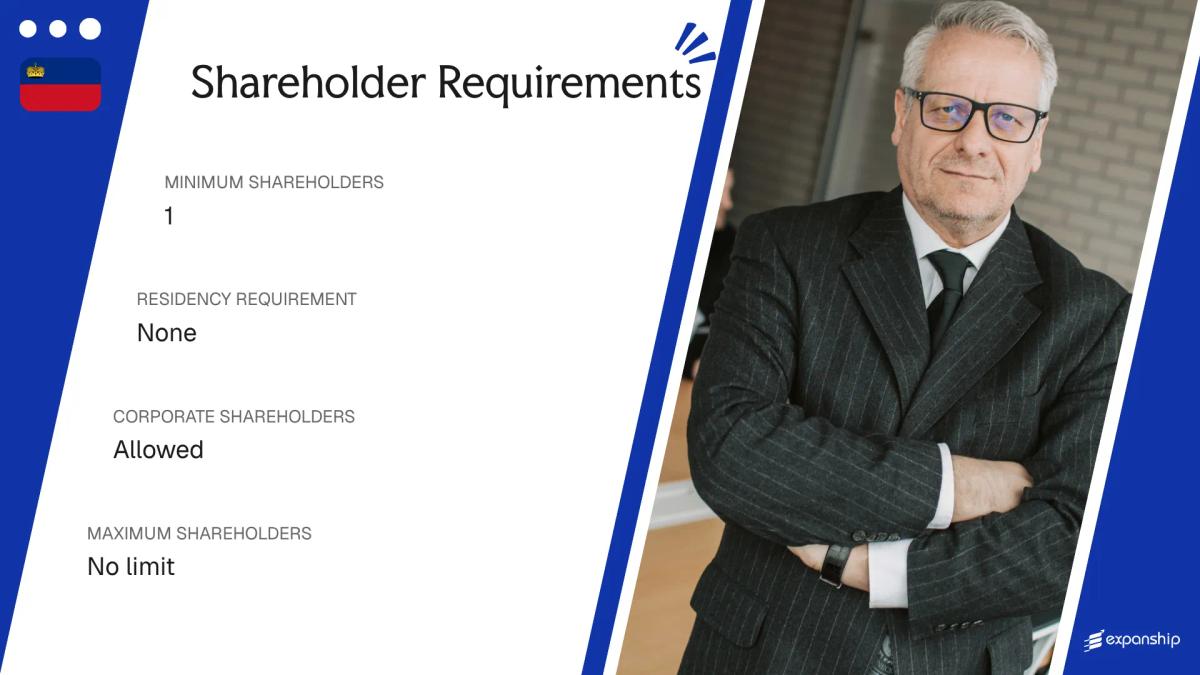
A Liechtenstein GmbH requires at least one shareholder, meaning a sole shareholder structure is fully permissible. There is no statutory maximum on the number of shareholders.
Nationality and Residency Restrictions
Shareholders face no nationality or residency requirements under Liechtenstein company ownership rules. Foreign individuals and entities may hold 100% of the share capital without restriction.
Corporate Shareholders
Corporate entities are permitted to act as shareholders, and no special conditions are imposed solely on the basis of the shareholder being a legal person. The corporate shareholder must still meet applicable KYC and beneficial ownership disclosure obligations.
Shareholder Liability
In a GmbH, shareholder liability is limited to the amount of each member's capital contribution. No general mechanism extends personal liability beyond that contribution under ordinary circumstances.
Register of Shareholders
A register of shareholders must be maintained at the registered office and is not publicly accessible. Any changes in ownership must be reflected in the register, with certain transfers also requiring notification to the Handelsregister.
Shareholder Structuring Support for Your Liechtenstein Incorporation
Get guidance on meeting ownership and shareholder compliance obligations when setting up a company in Liechtenstein.
UBO / Beneficial Ownership Registration Requirements in Liechtenstein
Liechtenstein beneficial ownership registration is governed by the Due Diligence Act (Sorgfaltspflichtgesetz, SPG) and the associated Due Diligence Ordinance, which define a beneficial owner as any natural person who directly or indirectly holds 25% or more of the shares or voting rights in a legal entity.
- Identify all natural persons meeting the 25% ownership or control threshold and prepare their personal details for submission.
- Submit beneficial ownership information to the Liechtenstein Financial Intelligence Unit (FIU) or the relevant trust and company service provider acting as the obliged entity under the SPG.
- Record and maintain UBO data within the entity's internal registers, as obliged entities are required to verify and document this information.
- Report any changes to beneficial ownership to the relevant authority without undue delay.
| Parameter | Detail |
|---|---|
| Ownership Threshold for UBO Status | 25% of shares or voting rights |
| Filing Authority | Liechtenstein FIU / obliged entity under the SPG |
| Disclosure Deadline at Incorporation | At the time of establishing the business relationship |
| Publicly Accessible Register | No public register; information held by obliged entities |
| Penalties for Non-Disclosure | Administrative and criminal sanctions under the SPG |
| Ongoing Update Obligation | Yes; changes must be reported without undue delay |
KYC / Document Requirements in Liechtenstein
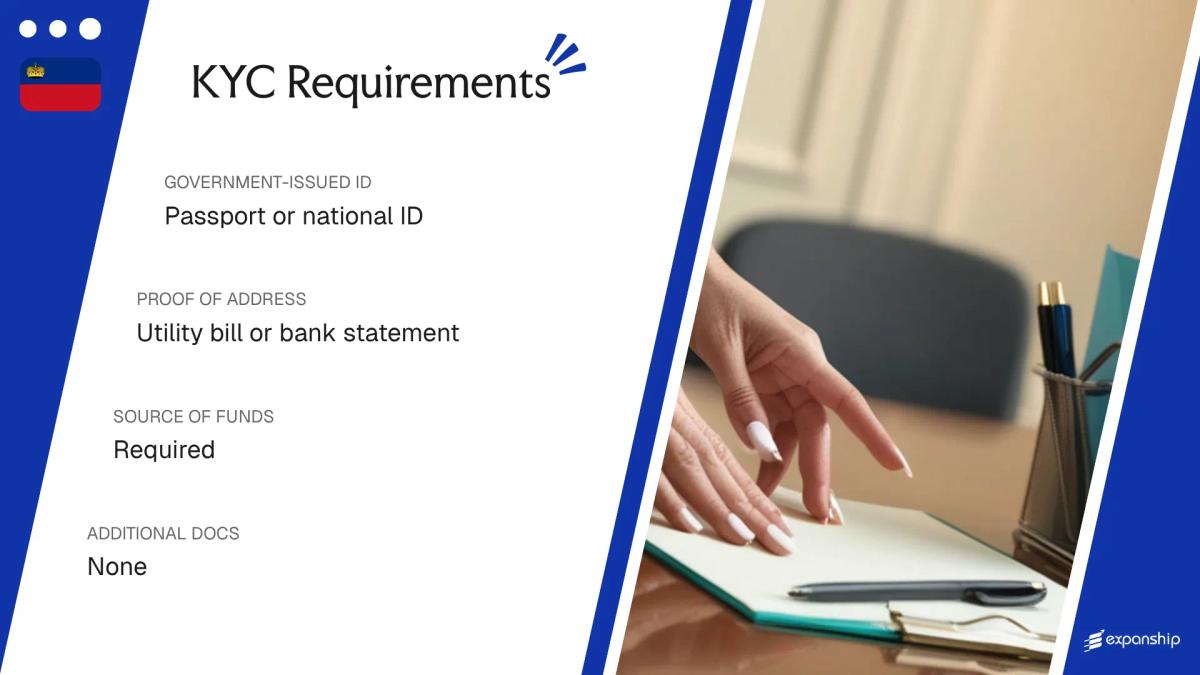
Liechtenstein KYC requirements incorporation are governed by the Due Diligence Act (Sorgfaltspflichtgesetz, SPG), which mandates identity verification and source of funds documentation before a company can be registered. The FIU Liechtenstein oversees AML compliance obligations that service providers must satisfy at the incorporation stage.
Individual / Personal Documents
- Valid government-issued photo identification (passport or national identity card)
- Proof of residential address dated within three months, such as a utility bill or bank statement
- Completed and signed personal declaration form as required by the service provider under the SPG
- For beneficial owners, a signed confirmation of beneficial ownership status
Corporate Documents
- Certificate of incorporation or equivalent constitutional document from the entity's home jurisdiction
- Current register of directors and shareholders
- Proof of the corporate entity's registered office address
- Copy of the entity's articles of association or equivalent constitutional document
Source of Funds Documentation
- Recent bank statements covering a minimum of three to six months
- Audited financial statements or equivalent where the entity has trading history
- Written explanation of the origin of capital if funds derive from asset sales or inheritance
Notarisation and Apostille Requirements
- Foreign public documents generally require an apostille under the Hague Convention
- Certified translations into German are required for documents not issued in German
- Notarisation may be required for corporate documents depending on the issuing jurisdiction
Incomplete or unverified source of funds documentation is the most common reason for incorporation delays under SPG due diligence reviews.
Company Name Requirements in Liechtenstein
Proposed company names in Liechtenstein are assessed by the Office of Justice (Amt für Justiz) before registration is confirmed through the Öffentlichkeitsregister (Public Register). Each name must be sufficiently distinct from existing registered entities and must not mislead the public about the nature or scope of the business.
Names must be in German or use Latin-script characters consistent with German orthographic conventions. The legal form suffix, such as AG (Aktiengesellschaft) or GmbH (Gesellschaft mit beschränkter Haftung), must appear in the name and correspond to the actual entity type being formed.
Certain words are subject to approval restrictions. Terms implying a connection to government bodies, financial regulators, or royal institutions require explicit authorization. Words such as "Bank," "Versicherung" (insurance), or "Stiftung" (foundation) may only be used where the entity is licensed or structured accordingly.
Name reservation is available prior to incorporation. A reservation request is submitted to the Public Register, and the reserved name is typically held for a defined period while incorporation formalities are completed.
Compliance Services for Companies in Liechtenstein
Expanship supports Liechtenstein-registered entities with ongoing compliance obligations, including annual filings, UBO reporting, and regulatory correspondence with the Öffentlichkeitsregister.
Conclusion
Liechtenstein incorporation requirements span multiple regulatory layers, from the Persons and Companies Act (PGR) to AML obligations administered by the Financial Intelligence Unit (FIU). Registered office and licensed trustee mandates stand out as structural commitments, not procedural formalities. Beneficial ownership disclosure under the Due Diligence Act adds another layer of ongoing obligation once the entity is active. With these requirements understood, a foreign investor's attention turns to operational readiness: appointing qualified local representatives, maintaining compliant documentation, and meeting annual reporting obligations under Liechtenstein law.
Expanship's Corporate Services for Liechtenstein Expansion
Expanship's Liechtenstein company formation services are structured around the specific compliance requirements you'll encounter when establishing a presence in the Principality, from satisfying the Office of Justice's registration protocols to meeting local director and UBO disclosure obligations. Our team manages the operational coordination so your business can focus on substance rather than procedural overhead.
Beyond registration, Expanship supports your entity across its full compliance lifecycle:
- We prepare and file all incorporation documents with the relevant Liechtenstein authorities on your behalf.
- A local registered agent and compliant registered office address are provided as part of our Liechtenstein corporate registration support.
- We liaise directly with government bodies, including the Commercial Registry, to handle filings and regulatory correspondence.
- Ongoing post-incorporation compliance is managed to keep your entity in good standing under Liechtenstein law.
- Banking introductions are facilitated to help your firm establish the financial relationships it needs.
- Tax registration and coordination with local fiscal authorities is handled through our Liechtenstein business setup compliance services.
To discuss your specific requirements, contact Expanship Liechtenstein.
Frequently Asked Questions (FAQ)
Failure to disclose beneficial owners to the Liechtenstein Beneficial Ownership Register constitutes a breach of the Due Diligence Act (Sorgfaltspflichtgesetz, SPG) and can result in administrative penalties against the company and its directors. The Financial Intelligence Unit (FIU) Liechtenstein oversees compliance, and persistent non-disclosure may trigger broader regulatory sanctions. Directors bear personal liability for ensuring the register is kept accurate and current.
A foreign national can serve as a director of a Liechtenstein AG, but at least one member of the board must be a Liechtenstein-licensed trustee or a person with legal residence in Liechtenstein who meets the local representation requirement under the Persons and Companies Act (PGR). This requirement exists to ensure the company has a locally accountable representative for regulatory and legal correspondence. Appointing only foreign-resident directors without fulfilling this condition will prevent successful registration.
The obligation to engage a licensed professional intermediary applies across the principal commercial entity types registered in Liechtenstein, including the AG, GmbH, and Anstalt. Licensed trustees and attorneys regulated by the Liechtenstein Financial Market Authority (FMA) are the designated intermediaries authorised to act in this capacity. There is no exemption for smaller entities or wholly foreign-owned structures.
Where the shareholder is a corporate entity, you will generally need to provide certified constitutional documents, a certificate of good standing, a register of directors, and documentation identifying the underlying beneficial owners of that corporate shareholder. The licensed intermediary conducting due diligence under the SPG must trace ownership to the natural person level, regardless of how many corporate layers exist. Apostilled or notarised translations may be required if the documents originate outside the EEA.
The registered office must be a genuine, functional address in Liechtenstein through which official correspondence and regulatory notices are received; a virtual mailbox arrangement alone does not satisfy the requirement under the PGR. Your licensed trustee or registered agent typically provides this address as part of their mandate, and they are responsible for forwarding legally significant communications. Maintaining an address that no longer meets this standard can expose the entity to deregistration proceedings.
The name must be clearly distinguishable from all entities already entered in the Öffentlichkeitsregister and must include the correct legal suffix for the chosen structure, such as "AG" for an Aktiengesellschaft or "GmbH" for a Gesellschaft mit beschränkter Haftung. Names that are purely descriptive, misleading as to the nature of the business, or likely to imply a connection with state bodies will be rejected. A preliminary name check through the Public Registry or via your licensed intermediary before submission avoids delays in the registration process.
Legal Disclaimer
The information provided in this article is for general informational purposes only and does not constitute legal, tax, or professional advice. While we strive to ensure the accuracy and timeliness of the content, laws and regulations are subject to change, and the application of laws can vary widely based on specific facts and circumstances.
Readers should not act upon this information without seeking professional counsel tailored to their individual situation. Expanship and its authors disclaim any liability for actions taken or not taken based on the content of this article.
For specific advice regarding your business setup, compliance requirements, or any legal matters, please consult with qualified legal and tax professionals in the relevant jurisdiction.