
Key Takeaways
- Liechtenstein's flat 12.5% corporate income tax on net income places the jurisdiction in a structurally lower bracket than most EU member states while maintaining a legitimate, treaty-compatible fiscal framework.
- Companies registered under the Person and Company Law (PGR) can utilise Anstalt and Foundation structures to achieve asset separation and organisational flexibility that is largely unavailable in standard EU or common law jurisdictions.
- EEA membership grants Liechtenstein-incorporated entities access to European single market protocols without subjecting them to the full scope of EU regulatory obligations, a distinction that affects both compliance costs and operational reach.
- The absence of withholding tax on dividends and interest paid from Liechtenstein entities directly improves after-tax returns on cross-border profit distributions, making the jurisdiction particularly advantageous for holding and treasury structures.
Liechtenstein is a small, constitutionally governed principality situated between Switzerland and Austria, operating as a fully independent sovereign state and a member of the European Economic Area. Company registration is administered through the Handelsregister, the official public registry maintained by the Office of Justice. Foreign nationals face no general restrictions on ownership, and the jurisdiction actively permits full foreign shareholding across most entity types.
The GmbH is the legal vehicle most commonly used by foreign businesses establishing a presence here. From a fiscal standpoint, the country operates a low-tax regime grounded in a flat corporate income tax rather than a zero-rate or purely territorial model.
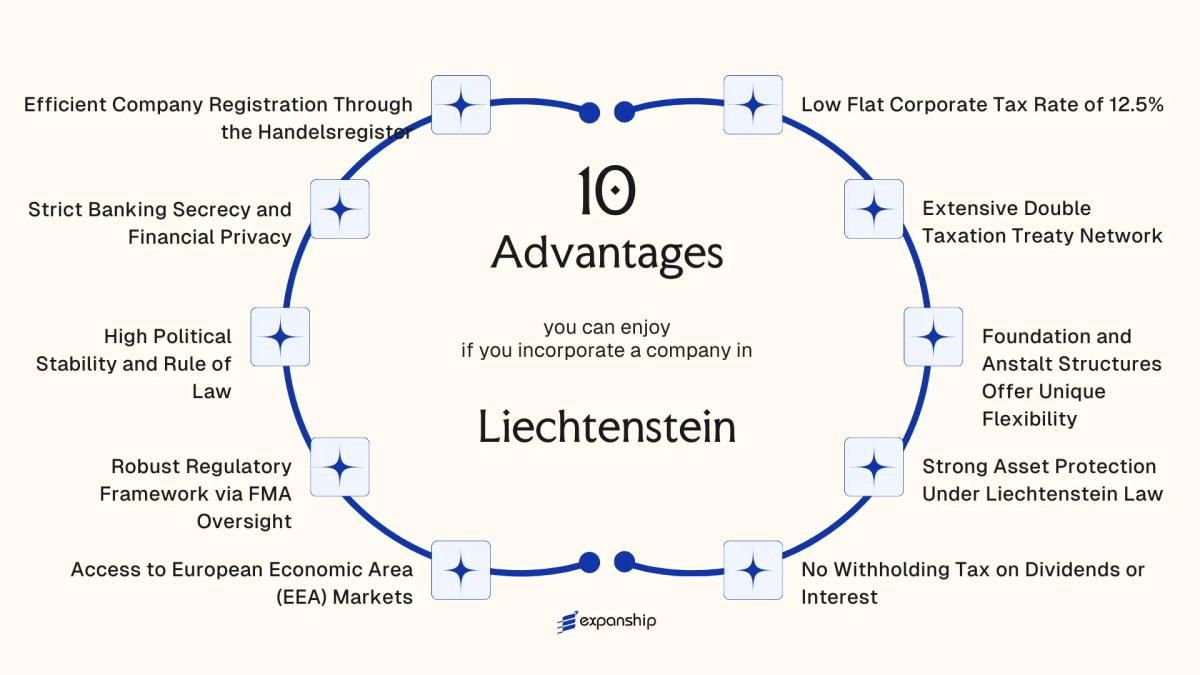
This article outlines the principal advantages your business may gain through Liechtenstein company formation — from the tax structure to the regulatory environment and market access that come with EEA membership. Each benefit is examined on its own terms, drawing on the specific legal and institutional framework that governs entities registered under Liechtenstein law.
Low Flat Corporate Tax Rate of 12.5%
Liechtenstein's flat corporate tax rate of 12.5% applies to net taxable income, with a statutory minimum tax of CHF 1,800 per year for entities with low or no taxable profit. The Liechtenstein 12.5% flat corporate tax benefit is codified under the Tax Act (Steuergesetz) of 2010.
What the Rate Structure Means in Practice
The EU average corporate tax rate sits above 21%, making this jurisdiction's headline rate a material cost advantage for foreign-owned entities. A predictable flat rate also simplifies annual tax planning, since your firm is not subject to progressive brackets that increase liability as profits grow.
Qualifying Income and the Minimum Tax Threshold
All legal entities registered in Liechtenstein, including Aktiengesellschaften (AGs) and Gesellschaften mit beschränkter Haftung (GmbHs), are subject to this rate on worldwide income. The CHF 1,800 minimum tax ensures that dormant or early-stage companies carry a defined, limited fiscal obligation rather than an unpredictable one.
Your company's effective tax burden is capped by a flat rate and a fixed floor, giving you reliable cost forecasting from the first year of operation.
Extensive Double Taxation Treaty Network
Liechtenstein's double taxation treaty network benefits businesses by reducing or eliminating the risk of the same income being taxed twice across multiple jurisdictions. Though the principality has fewer treaties than large EU member states, the agreements it has concluded are strategically significant, covering key financial and trading partners including Germany, Austria, Switzerland, Luxembourg, the United Kingdom, and several others through bilateral arrangements.
Each treaty typically assigns taxing rights to one jurisdiction, reducing friction for cross-border income flows such as royalties, dividends, and business profits. For a foreign business owner, this means income earned through a Liechtenstein entity and repatriated to a treaty partner country is subject to defined, predictable rates rather than full double taxation under domestic law.
The practical advantages of these treaty positions include:
- Treaty access reduces effective withholding burdens on outbound income, which directly improves after-tax returns for foreign shareholders
- Defined residency tiebreaker rules under individual treaties prevent prolonged disputes over where a company is taxable
- Businesses operating across EEA member states benefit from EU directives that complement treaty provisions on interest and royalty payments
Treaty eligibility generally requires that the entity demonstrates genuine substance and tax residency within the principality under the Tax Act (Steuergesetz).

Company Incorporation in Liechtenstein
Establish a tax-resident entity in Liechtenstein and access its treaty network with full compliance support from Expanship.
Foundation and Anstalt Structures Offer Unique Flexibility
Two entity types under Liechtenstein corporate law stand out for the structural freedom they give foreign business owners: the Stiftung (foundation) and the Anstalt (establishment). Each is governed by the Persons and Companies Act (PGR), which provides the statutory basis for both forms and defines their operational parameters.
The Anstalt is particularly uncommon in global corporate practice. It can be structured either with or without share capital, and it does not require multiple founders or shareholders. A single founder can establish the entity with full control retained in their own hands, which reduces the administrative overhead typical of multi-shareholder arrangements. For holding operations or personal asset management, this concentration of control has clear practical value.
| Feature | Stiftung (Foundation) | Anstalt (Establishment) |
|---|---|---|
| Governing Law | PGR (Persons and Companies Act) | PGR (Persons and Companies Act) |
| Share Capital Required | No | Optional |
| Shareholders | None (beneficiaries only) | Not required |
| Commercial Activity | Restricted (purpose-bound) | Permitted |
| Legal Personality | Yes | Yes |
The Stiftung, by contrast, holds assets without shareholders. Ownership is replaced by a defined purpose and a set of beneficiaries, making it suited to succession planning and wealth preservation across generations. Assets transferred into a Liechtenstein Stiftung are legally separated from the founder's personal estate under the PGR, which has direct consequences for estate and inheritance planning.
The Liechtenstein Foundation and Anstalt structure benefits are not confined to a single use case. Your business can configure either entity around specific commercial, philanthropic, or holding objectives, with the PGR providing the legal framework to do so without requiring a standardised corporate template.
Strong Asset Protection Under Liechtenstein Law
Liechtenstein asset protection benefits for businesses stem from a legal framework that has been deliberately designed to separate personal liability from corporate exposure. Under the Person and Company Act (PGR), Foundations (Stiftungen) and Anstalts can hold assets in structures where beneficiaries have no direct ownership claim, making those assets difficult to attach by creditors under foreign judgments.
This structural separation is the key advantage. A creditor pursuing a claim against you personally may be unable to reach assets held within a correctly structured Liechtenstein entity, because the PGR governs how such claims are recognised domestically, not by the law of the creditor's home jurisdiction.
Wealth protection for foreign investors is further reinforced by the principle that foreign court orders are not automatically enforceable. Enforcement requires a separate recognition process under domestic law, which introduces a meaningful procedural barrier.
Keep the following in mind:
- Asset protection structures must be established before any creditor claim arises to be valid
- The PGR governs Foundations, Anstalts, and Trusts; each has distinct liability insulation rules
- Sham structures created solely to evade existing debts can be challenged under fraudulent conveyance principles
- Foreign judgments require domestic court recognition before enforcement proceeds
A Liechtenstein Foundation does not require a named beneficiary at formation, meaning the identity of those who ultimately benefit can remain legally undisclosed for an extended period.
No Withholding Tax on Dividends or Interest
Liechtenstein imposes no withholding tax on dividends paid to non-resident shareholders. This means profits distributed from a company incorporated there reach foreign investors without any deduction at source, a meaningful contrast to jurisdictions across the EU where withholding rates on dividends commonly range from 15% to 26%.
What This Means for Profit Distribution
Under the Liechtenstein Tax Act (Steuergesetz), dividend payments to both resident and non-resident recipients are exempt from withholding tax. For a foreign holding company or individual investor receiving distributions, the full declared dividend transfers intact, leaving tax treatment entirely to the recipient's home jurisdiction rather than splitting it between two authorities.
Retaining complete control over where and how income is taxed gives your business a structural planning advantage that few European jurisdictions provide without conditions attached.
Interest Payments Receive the Same Treatment
The zero withholding tax treatment extends equally to interest payments. If your entity in Vaduz services a shareholder loan or issues debt instruments, interest transferred to non-resident lenders is not subject to any deduction at source under current Liechtenstein tax law.
This matters particularly for intra-group financing structures, where withholding tax on interest can erode returns at every layer of a corporate group. With no tax withheld at source, the cost of capital within a group structure remains predictable and unaffected by local deduction requirements that would otherwise require treaty relief claims or reclaim procedures.
Structure Your Distributions Efficiently in Liechtenstein
Speak with our team about how Liechtenstein's zero withholding tax framework applies to your specific ownership and financing structure.
Access to European Economic Area (EEA) Markets
Liechtenstein EEA market access benefits stem directly from the country's membership in the European Economic Area, which it joined via the EEA Agreement that entered into force on 1 May 1995. Despite not being an EU member state, companies incorporated here operate under the same four freedoms that govern the single market: free movement of goods, services, capital, and persons across all 30 EEA member states.
- A firm registered in Vaduz can passport financial services into EU and EEA member states without requiring a separate license in each jurisdiction. This is governed by EEA financial services directives, making market entry into countries like Germany, France, or the Netherlands structurally simpler for your business.
- EEA membership means your company benefits from EU single market regulations on product standards and market access, reducing the compliance burden of selling goods across member states.
- Capital can move freely between your Liechtenstein entity and counterparts in other EEA states, which directly affects how you structure cross-border investment and financing arrangements.
- The EEA Agreement also incorporates EU competition law and state aid rules, giving your business legal certainty around commercial conduct that mirrors the standards applied across the wider European single market.
Robust Regulatory Framework via FMA Oversight
The Liechtenstein FMA regulatory framework benefits foreign businesses primarily through institutional credibility. The Financial Market Authority (FMA), established under the Financial Market Authority Act (FMAG), supervises banks, insurance firms, fund managers, and other financial intermediaries operating within the jurisdiction. For your business, this means operating under a regulator that is formally recognized across the EEA, which directly reduces due diligence friction with European counterparties and institutional investors.
FMA authorization carries weight that many offshore registrations do not. A fund or holding structure authorized by the FMA can passport financial services into EEA member states under applicable EU directives, giving your entity market access that purely offshore vehicles cannot replicate.
The FMA also enforces compliance with FATF standards, EU anti-money laundering directives, and OECD transparency requirements. Meeting these standards is not optional, but that obligation works in your favor: counterparties, banks, and institutional partners treat FMA-supervised entities as lower-risk, which can shorten onboarding timelines and broaden your access to banking relationships.
A 2024 MONEYVAL assessment of Liechtenstein noted the country's high level of technical compliance with FATF Recommendations, reflecting the FMA's consistent enforcement across the financial sector. (Source: MONEYVAL, Council of Europe)
High Political Stability and Rule of Law
Liechtenstein political stability benefits for businesses are grounded in measurable institutional factors, not perception alone. The country has maintained an uninterrupted constitutional monarchy since 1921, operates under the 1921 Constitution, and has never experienced a government seizure of private assets. For a foreign business owner, this means contractual obligations and ownership rights are not subject to sudden policy reversal.
The legal system is based on codified civil law, with commercial disputes adjudicated through an independent judiciary that applies the Person and Companies Act (PGR) consistently. Judicial independence from executive influence gives investors a reliable enforcement environment for contracts, shareholder agreements, and corporate structures.
Liechtenstein holds a high ranking in rule of law indices published by the World Justice Project, reflecting its performance across civil justice, regulatory enforcement, and absence of corruption. Your business operates in an environment where regulatory decisions follow published legal standards rather than discretionary political processes.
- Foreign ownership rights are protected under domestic law with no forced localization requirements.
- Intellectual property and corporate assets held through registered entities are subject to the same legal protections as domestically owned property.
- Court judgments are enforceable, and the legal framework is compatible with EEA dispute resolution mechanisms.
Political stability does not exempt your entity from compliance with the Financial Market Authority's (FMA) anti-money laundering and beneficial ownership disclosure requirements.
Strict Banking Secrecy and Financial Privacy
Liechtenstein banking secrecy benefits for investors are grounded in statutory law, specifically the Banking Act (Bankengesetz) and the Due Diligence Act (Sorgfaltspflichtgesetz), both of which impose legally enforceable confidentiality obligations on financial institutions. Bank employees and advisors face criminal liability for unauthorized disclosure of client information. This legal architecture gives your financial affairs a layer of protection that contractual privacy policies alone cannot provide.
Confidentiality as a Legal Obligation
Statutory secrecy applies to account details, transaction records, and beneficial ownership information held by licensed banks. Disclosure to third parties, including foreign authorities in many circumstances, requires a formal legal process rather than administrative convenience. For foreign investors managing cross-border wealth, this distinction directly limits exposure to unsolicited information sharing.
Scope and Structure of Privacy Protections
Privacy protections extend beyond banking to encompass investment funds, insurance wrappers, and trust structures supervised by the Financial Market Authority (FMA). This breadth means your business arrangements across multiple asset classes can fall under the same confidentiality framework, rather than requiring separate jurisdictional planning for each.
- Information exchange with foreign tax authorities occurs under OECD Common Reporting Standard (CRS) frameworks and applicable bilateral agreements, not unilaterally
- Requests must generally meet defined legal thresholds before Liechtenstein authorities are obligated to respond
- Domestic financial intermediaries are prohibited from voluntarily disclosing client data outside established legal channels
Practical Implication for Foreign Business Owners
For a foreign business owner, this means your corporate banking activity, investment positions, and ownership records are not accessible through informal inquiries. Accessing that information requires formal legal process, which creates a measurable procedural barrier against unauthorized third-party scrutiny.
Efficient Company Registration Through the Handelsregister
The Liechtenstein Handelsregister company registration benefits are, in practical terms, a function of speed and administrative clarity. Under the Persons and Companies Act (PGR), an Aktiengesellschaft (AG) or Gesellschaft mit beschränkter Haftung (GmbH) can typically be registered within a few business days once documentation is complete. For a foreign investor, that timeline directly reduces the cost of entry.
Registration is handled through the Handelsregister maintained by the Office of Justice (Amt für Justiz). The filing process does not require physical presence; notarial procedures and submissions can be coordinated remotely through a local authorized representative. This matters because it removes a practical barrier that often delays market entry in other jurisdictions.
The commercial register is publicly accessible, which has a concrete operational consequence: third parties, including banks, counterparties, and EEA regulators, can verify your entity's legal standing without extensive back-and-forth. That transparency accelerates due diligence processes in cross-border transactions.
Minimum capital requirements for a GmbH stand at CHF 10,000, while an AG requires CHF 50,000. These thresholds are fixed by the PGR and define the entry cost for each structure:
- GmbH formation suits smaller operations or holding vehicles where capital efficiency matters
- AG formation supports structures where share transferability or institutional credibility is relevant
- Both entity types gain full legal standing upon entry in the Handelsregister, not upon payment of capital calls
Once registered, the entity is also recognized across EEA member states under the freedom of establishment provisions, giving your business an immediate cross-border operational footprint.
Why Liechtenstein Stands Out Among Offshore Jurisdictions
Evaluated against its most direct competitors, the Liechtenstein advantages over other offshore jurisdictions become clearer when examined through the lens of what foreign investors actually prioritise: tax efficiency, structural flexibility, market access, and legal certainty. The jurisdictions most frequently considered alongside it are Switzerland, Luxembourg, and the British Virgin Islands. Switzerland and Luxembourg share its European profile and are often weighed by investors seeking proximity to EU markets. The BVI represents the alternative path of a pure offshore structure with no regional market access.
What the comparison surfaces is not simply a tax rate differential, but a combination of factors that few jurisdictions offer simultaneously. The EEA membership, which neither Switzerland in all respects nor the BVI can match, means your business operates under a treaty framework that enables cross-border service provision into the EU. At the same time, the 12.5% flat corporate tax rate sits below Luxembourg's standard rate and carries no withholding tax on outbound dividends, a position that competes directly with classical offshore destinations. The Liechtenstein FMA provides regulatory oversight that adds institutional credibility the BVI cannot replicate.
| Parameter | Liechtenstein | Switzerland | Luxembourg | BVI |
|---|---|---|---|---|
| Corporate Tax Rate | 12.5% flat | ~8.5–21.6% (canton-dependent) | 24.94% (standard combined) | 0% |
| Withholding Tax on Dividends | None | 35% (standard) | 15% (standard) | None |
| EEA/EU Market Access | Yes (EEA member) | Limited (bilateral treaties) | Yes (EU member) | No |
| Foundation Structures | Yes (Stiftung, Anstalt) | Yes (Stiftung) | Limited | No |
| DTT Network | Yes | Extensive | Extensive | Very limited |
| Regulatory Oversight Body | FMA | FINMA | CSSF | FSC |
| Political Stability (Rule of Law) | High | High | High | Moderate |
Compliance Services for Companies in Liechtenstein
Maintain your Liechtenstein entity in good standing with ongoing compliance support, including annual filings, registered agent services, and regulatory reporting under FMA guidelines.
Conclusion
Liechtenstein presents a compelling case for foreign incorporation: a 12.5% flat corporate tax rate applied to net income, privacy protections underpinned by the Person and Company Law (PGR), and EEA market access without EU membership obligations. These features, taken together, create a legal and fiscal environment that is structurally distinct from both standard EU jurisdictions and traditional offshore locations.
The benefits of incorporating in Liechtenstein are most pronounced for businesses that require asset separation, cross-border financial activity, or holding structures. The Anstalt and Foundation vehicles offer organisational flexibility that few jurisdictions can match at this level of legal formality. For firms distributing profits internationally, the absence of withholding tax on dividends directly affects after-tax returns.
Not every business structure will extract equal value from what this jurisdiction offers. A trading company with no cross-border distribution needs will benefit differently than a holding firm or private asset vehicle. The fit depends on your specific operational model, ownership structure, and the jurisdictions where your income originates or is deployed.
For businesses that do align with what the framework provides, the combination of tax efficiency, recognised legal structures, and EEA access positions the jurisdiction as a serious option worth evaluating with qualified legal and tax counsel before formation.
Start Your Liechtenstein Company Formation With Expanship Today
Expanship supports foreign investors through every stage of Liechtenstein company formation, from selecting the appropriate legal vehicle under the Persons and Companies Act (PGR) to maintaining standing with the Handelsregister and satisfying the Financial Market Authority's (FMA) ongoing oversight requirements. This blog has outlined the distinct structural, fiscal, and regulatory characteristics that define Liechtenstein as a corporate domicile — the flat 12.5% corporate tax rate, the availability of Anstalt and Foundation structures, EEA market access, and the absence of withholding tax on dividends and interest. Expanship's engagement covers the practical mechanics of converting those characteristics into a functioning, compliant entity for your specific business objectives.
The firm's service scope across Liechtenstein incorporations includes:
- Preparation and notarization of constitutional documents in accordance with PGR requirements
- Registered agent and registered office provision to satisfy domicile obligations
- Filing and liaison with the Handelsregister and relevant government bodies
- Post-incorporation compliance management, including annual reporting obligations
- Director, nominee, and local representative appointment coordination
- Banking introduction assistance with Liechtenstein-based financial institutions
To discuss your incorporation requirements with Expanship Liechtenstein, contact the team directly for a factual assessment of the structure that fits your situation.
Frequently Asked Questions (FAQ)
The standard corporate income tax rate is 12.5%, applied as a flat rate on net taxable income. Entities are also subject to a minimum annual tax, which applies even if no profit is generated, ensuring a baseline fiscal contribution regardless of activity level. The combination of the flat rate and minimum tax structure means your effective rate varies depending on profit volume.
A local registered address is required for filing with the Handelsregister, and in practice most foreign-owned entities engage a licensed local representative or trust company to satisfy this requirement. Whether a resident director is mandatory depends on the entity type and any applicable regulatory obligations under FMA oversight. For unregulated holding structures, the requirement is primarily one of administrative presence rather than executive control.
No withholding tax applies to dividends distributed to foreign shareholders under current domestic tax law. This applies equally to interest payments, making the jurisdiction particularly efficient for intra-group financing arrangements. The absence of withholding tax is a statutory feature, not a discretionary exemption, so it does not require advance approval or a specific treaty position.
As a member of the European Economic Area, a firm incorporated here benefits from the four fundamental freedoms, including the free movement of goods, services, capital, and persons across EEA member states. This grants a degree of market access comparable to EU membership for many commercial purposes, without the entity being subject to full EU institutional governance. Specific regulated sectors, such as financial services, may require passporting procedures governed by the relevant EEA directives.
The Financial Market Authority (FMA) is the primary supervisory body for financial services, fund management, banking, and insurance activities. For entities operating in these regulated sectors, the FMA sets licensing requirements, ongoing reporting obligations, and conduct standards derived from EEA-aligned directives. Non-regulated commercial or holding companies are not subject to FMA oversight but remain subject to the general compliance requirements administered through the Handelsregister and tax authorities.
The Anstalt (Establishment) is a legal form unique to Liechtenstein under the PGR, combining features of both a corporate entity and a foundation. Unlike a standard LLC, it can be structured without shareholders in the traditional sense, with the founder retaining defined rights over the entity's assets and purpose. This makes it a distinct option for asset-holding or purpose-specific activities where conventional share-based ownership is not the preferred structure.
Asset continuity depends on the legal form of the entity and how the constitutional documents are drafted. For a foundation or Anstalt established under the PGR, the governing statutes can specify succession rules that operate independently of the founder's personal estate, which is one of the structural reasons these forms are used for cross-border estate planning. In the absence of specific provisions, the general rules of the PGR and applicable private international law principles would govern the treatment of the entity's assets.
Legal Disclaimer
The information provided in this article is for general informational purposes only and does not constitute legal, tax, or professional advice. While we strive to ensure the accuracy and timeliness of the content, laws and regulations are subject to change, and the application of laws can vary widely based on specific facts and circumstances.
Readers should not act upon this information without seeking professional counsel tailored to their individual situation. Expanship and its authors disclaim any liability for actions taken or not taken based on the content of this article.
For specific advice regarding your business setup, compliance requirements, or any legal matters, please consult with qualified legal and tax professionals in the relevant jurisdiction.