
Key Takeaways
- Liechtenstein's Persons and Companies Act (PGR) imposes a layered compliance structure that varies significantly by entity type, meaning an Aktiengesellschaft, Anstalt, or Stiftung each carries distinct capital, disclosure, and operational obligations that foreign investors must assess separately before proceeding.
- Minimum capital requirements for regulated entity types such as the AG create a meaningful financial barrier at the formation stage, disproportionately affecting first-time foreign incorporators without existing capital deployed in the jurisdiction.
- Oversight by the Financial Market Authority (FMA) requires beneficial ownership disclosures that reduce structural privacy to a degree that may conflict with the confidentiality expectations many investors associate with Liechtenstein structures.
- Access to the necessary licensed fiduciary and registered agent network is limited in practice, which increases both the cost and timeline of formation for non-EEA business owners who lack pre-existing relationships within Liechtenstein's professional services sector.
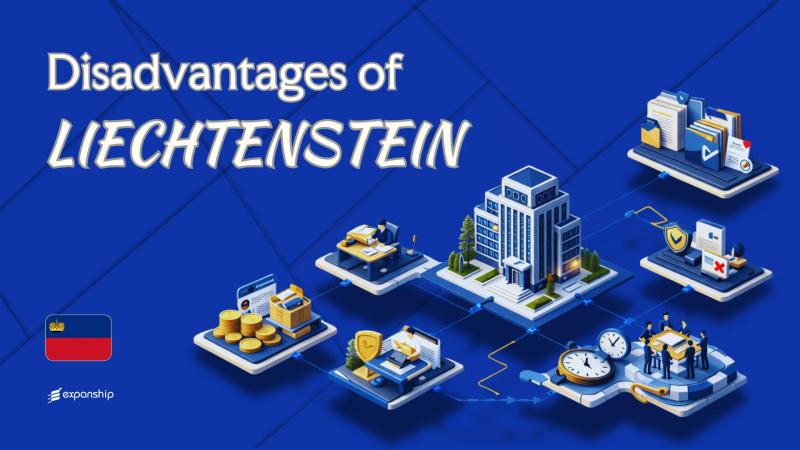
Liechtenstein operates under a heavily regulated corporate framework, administered by the Financial Market Authority (FMA) and governed primarily by the Persons and Companies Act (PGR). The disadvantages of incorporating in Liechtenstein span capital requirements, disclosure obligations, cost structures, and market access limitations.
These drawbacks do not apply uniformly. The entity type you select, whether an Aktiengesellschaft (AG), Anstalt, or Stiftung, directly shapes which compliance burdens and financial thresholds your business will face.
This article is most relevant to foreign investors and non-EEA business owners considering Liechtenstein company formation drawbacks for the first time, particularly those without existing ties to the jurisdiction's licensed fiduciary network.
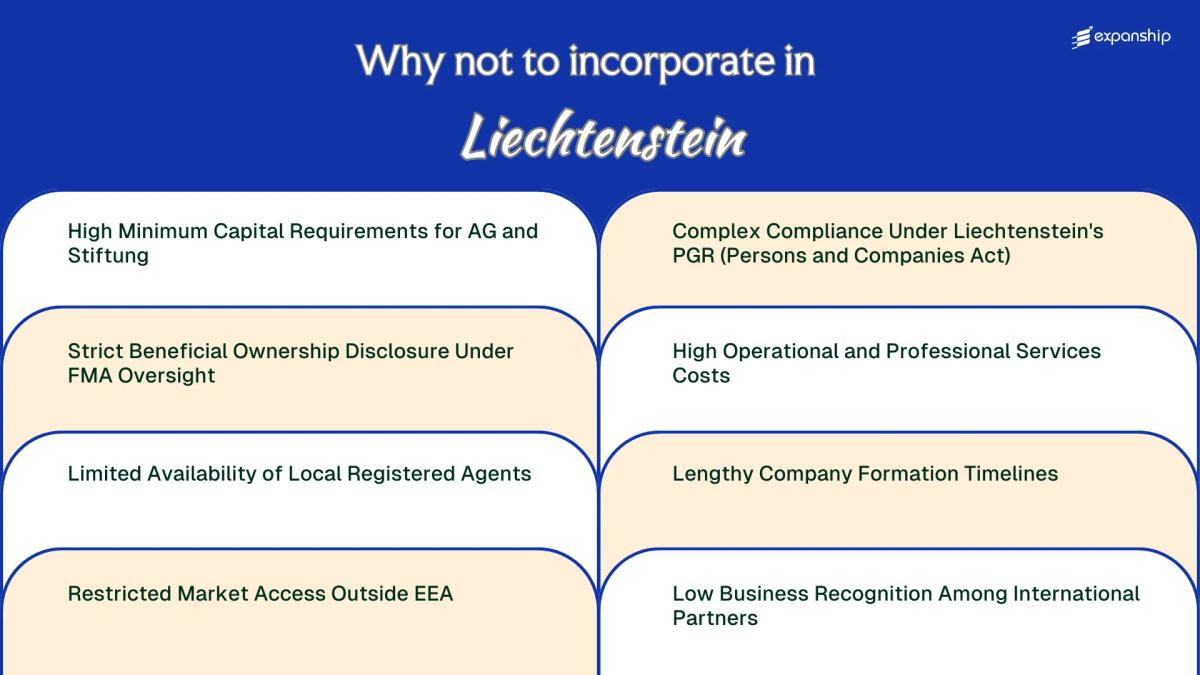
High Minimum Capital Requirements for AG and Stiftung
Liechtenstein AG minimum capital requirements sit significantly above what most comparable small jurisdictions demand, making entry costs a practical barrier before operations even begin.
Capital Thresholds Under the PGR
For an Aktiengesellschaft (AG), the Persons and Companies Act (PGR) sets a minimum share capital of CHF 50,000, with at least 50% paid up at formation. For a Stiftung, the minimum endowment capital is CHF 30,000. These are not nominal figures; your business must commit real capital before the Office of Justice registers the entity.
What This Means for Foreign Founders
Compared to jurisdictions where comparable corporate structures require EUR 1 or a nominal amount, the high share capital requirements here represent an immediate liquidity demand with no operational return. For early-stage businesses or founders testing a market entry structure, that tied capital carries an opportunity cost from day one.
Private foundation structures face a similar constraint, as Stiftung capital restrictions prevent founders from pledging assets that remain encumbered elsewhere.
If your available capital is limited or partially allocated to other entities, meeting the paid-up capital requirement at the point of registration may delay or block formation entirely.
Strict Beneficial Ownership Disclosure Under FMA Oversight
Liechtenstein beneficial ownership disclosure risks are among the more operationally demanding aspects of incorporating there. Under the Due Diligence Act (SPG) and oversight from the Financial Market Authority (FMA), every beneficial owner holding 25% or more of an entity must be identified, verified, and registered in the transparency register maintained under the Register of Persons and Companies (ORA).
This is not a one-time filing. Any change in ownership structure triggers an update obligation, which creates ongoing compliance costs that accumulate over the life of the entity.
For foreign business owners operating layered holding structures, this requirement creates specific friction:
- Disclosure of non-EEA beneficial owners can delay account opening with local banks already cautious about cross-border structures
- Professional intermediaries required to verify and submit ownership data charge recurring fees for each structural change
- Failure to update the register exposes directors and trustees to FMA enforcement action, including fines
- Structures involving multiple jurisdictions require additional documentation to satisfy FMA due diligence standards
Trustees and licensed service providers bear primary responsibility for submitting accurate data, but your firm ultimately carries the compliance exposure. Inaccurate or late filings can trigger formal investigations.
The disclosure threshold of 25% applies uniformly, with limited carve-outs for publicly listed entities.

Company Incorporation in Liechtenstein
Understand the full compliance requirements before incorporating in Liechtenstein, including FMA oversight and beneficial ownership obligations.
Limited Availability of Local Registered Agents
Finding qualified limited registered agents in Liechtenstein is a genuine structural obstacle. The country has a population of roughly 39,000, and its pool of licensed corporate service providers is correspondingly small. Under the PGR (Persons and Companies Act), a registered office must be maintained within the principality, which means your business cannot simply appoint a foreign administrator to fulfill this function.
| Factor | Reality for Foreign Businesses |
|---|---|
| Total licensed fiduciary firms | Estimated fewer than 100 active providers in the jurisdiction |
| FMA licensing requirement | All trustees and fiduciaries must hold a licence under the Trustee Act (TrHG), limiting who qualifies |
| Capacity constraints | Small firm sizes mean limited client intake, creating waitlists or refusals |
| Fee leverage due to scarcity | Limited competition allows providers to charge significantly above regional averages |
Because the Financial Market Authority (FMA) imposes strict licensing requirements on fiduciaries under the Treuhändergesetz (TrHG), only a limited number of firms are authorized to act in this capacity. That restriction directly reduces your options and increases the negotiating power of existing providers.
Smaller licensed firms frequently operate at capacity. A foreign firm entering the market may face outright refusals or extended lead times before a provider agrees to take on the engagement. This is not a temporary inconvenience but a recurring structural feature of Liechtenstein's corporate services market.
Restricted Market Access Outside EEA
Liechtenstein market access restrictions outside EEA are a structural consequence of the country's unusual position: it is part of the European Economic Area through its membership but is not an EU member state. For businesses targeting markets beyond Europe, this arrangement offers little advantage and introduces real friction.
A company incorporated here gains passporting rights within the EEA under directives such as MiFID II and Solvency II. Outside that bloc, however, the entity is treated as a third-country firm by most major trading partners, including the United States, the United Kingdom post-Brexit, and jurisdictions in Asia-Pacific.
Third-country status triggers separate licensing requirements, regulatory equivalence assessments, and market access applications in each target jurisdiction. Your business cannot assume that EEA membership confers any recognition beyond European borders.
The UK's post-Brexit framework, governed by the Financial Services and Markets Act 2023, treats EEA-passported firms as non-equivalent by default. This means a Liechtenstein-registered financial entity seeking UK clients must meet the FCA's overseas persons conditions or establish a UK presence separately.
- Third-country status applies to your entity in all non-EEA jurisdictions, regardless of EEA passporting rights held
- Separate licensing or equivalence applications are required in each target market outside the EEA
- The UK no longer recognises EEA passporting, creating an additional access barrier for UK-bound services
- US market entry requires compliance with SEC, CFTC, or state-level regulations entirely independent of EEA status
- Non-EEA trading limitations Liechtenstein entities face are not resolved by double tax treaties alone
Despite being outside the EU customs union, Liechtenstein operates within the Swiss customs territory, meaning its EEA membership and Swiss trade alignment exist simultaneously — a combination found nowhere else in the world.
Complex Compliance Under Liechtenstein's PGR (Persons and Companies Act)
Liechtenstein PGR compliance challenges stem directly from the structure of the Persons and Companies Act (PGR) itself, which imposes obligations that go well beyond standard EU corporate law norms.
Scope of Statutory Requirements
The PGR governs all legal entities incorporated in Liechtenstein and sets detailed requirements for articles of association, auditing, accounting, and ongoing reporting. For foreign business owners, these obligations often require retaining local legal counsel fluent in both the PGR and its interaction with Liechtenstein's Financial Market Authority (FMA) directives, adding a permanent layer of professional dependency that is difficult to manage remotely.
Burden on Foreign-Owned Structures
Certain entity types, particularly the Anstalt and Stiftung, carry hybrid legal characteristics under the PGR that have no direct equivalent in most civil law systems. This structural unfamiliarity means your legal and accounting advisors outside Liechtenstein will often lack the specific expertise to interpret PGR provisions, forcing you to source specialist guidance locally at substantially higher cost.
The PGR also requires that statutory documents reflect precise formalities, and deviations can trigger rejection by the Public Registry without straightforward appeal mechanisms, extending your compliance timelines considerably.
Addressing PGR Compliance Challenges in Liechtenstein
Understand the specific obligations the Persons and Companies Act places on your entity and get structured guidance on meeting them without unnecessary delays or cost overruns.
High Operational and Professional Services Costs
High operational costs Liechtenstein company are a predictable reality, driven by the concentration of qualified licensed intermediaries and the regulatory standard required to service entities under the PGR.
- Licensed fiduciaries regulated by the Financial Market Authority (FMA) are the primary providers of registered office, directorship, and compliance services, and their fees reflect both the licensing overhead and the limited supply of qualified operators in a jurisdiction with a population under 40,000.
- Annual corporate maintenance costs, including mandatory local domiciliation, accounting under Liechtenstein GAAP, and FMA-related reporting obligations, routinely exceed what comparable offshore or mid-tier EU jurisdictions charge for equivalent services.
- Engaging a local legal adviser for PGR-compliant drafting of articles of association or foundation deeds adds a distinct cost layer that foreign business owners cannot avoid by using foreign counsel.
- Specialist tax advisory fees for treaty analysis or VAT registration under Liechtenstein's customs union with Switzerland add further expense that smaller entities may find disproportionate to operational scale.
Lengthy Company Formation Timelines
The Liechtenstein company formation timeline problems begin before incorporation even starts. The Office of Economic Affairs (Amt für Volkswirtschaft) reviews all new commercial registrations, and that review involves verifying documentation that must often be notarized, apostilled, and translated into German — requirements that add weeks before a submission is formally accepted.
Formation periods for a GmbH or AG typically range from four to eight weeks under standard conditions. For fiduciary-structured entities such as an Anstalt or Stiftung, the process can run longer, as the FMA may require additional due diligence documentation tied to beneficial ownership disclosure obligations under the Due Diligence Act (Sorgfaltspflichtgesetz).
Your business cannot conduct regulated activity or open a corporate bank account until the Commercial Register (Handelsregister) issues a confirmed extract. That dependency creates a hard operational delay that falls entirely on the foreign incorporator.
A foreign-owned GmbH requiring apostilled identity documents from a non-EU jurisdiction, German-certified translations, and FMA due diligence review could realistically face a 10 to 12-week formation window before receiving a valid Handelsregister extract — compared to a 5 to 10 business day timeline in comparable EEA jurisdictions such as Estonia.
Low Business Recognition Among International Partners
Liechtenstein business recognition limitations are most acute at the operational level, where foreign counterparties simply lack familiarity with the jurisdiction's legal forms, such as the Anstalt or the Stiftung, and treat them with automatic suspicion.
Banks in North America, Southeast Asia, and parts of the Middle East routinely flag entities registered under the Persons and Companies Act (PGR) for enhanced due diligence, regardless of the firm's actual compliance standing. This means correspondent banking relationships, trade credit lines, and supplier agreements can stall or collapse entirely before any substantive negotiation begins.
Low international awareness of Liechtenstein companies also affects how institutional partners categorize the jurisdiction. Many compliance teams in larger corporations classify it alongside higher-risk offshore centers, which forces your business to invest additional time and documentation just to reach the starting point of a commercial conversation.
Unlike Ireland or the Netherlands, which carry strong EU corporate recognition by association, this principality's size and low profile mean your entity's legitimacy is rarely assumed. The credibility gap must be closed through supporting documentation on every engagement.
Even a fully compliant entity registered under the PGR may be declined or delayed by foreign financial institutions solely on the basis of jurisdictional unfamiliarity, a condition that no amount of local regulatory standing can automatically resolve.
Overcoming Incorporation Challenges in Liechtenstein
Overcoming Incorporation challenges in Liechtenstein requires a structured approach rather than isolated fixes. The jurisdictions regulatory density, spanning the PGR, FMA oversight, and EEA-specific market access rules, means that gaps in preparation tend to compound.
- Confirm your entity type meets the CHF 50,000 minimum share capital threshold for an AG before filing with the Office of Justice.
- Register beneficial ownership information with the FMA-administered transparency register at the outset to avoid compliance delays post-incorporation.
- Secure a locally licensed registered agent early, given the limited pool of qualified professionals authorised under Liechtenstein law.
- Structure your business activities to align with EEA passporting rights if cross-border access is a commercial requirement.
- Budget for ongoing PGR compliance costs, including annual reporting obligations, before committing to a legal form.
Each of these steps maps directly to structural requirements under the PGR framework, not discretionary best practices. Addressing them in sequence reduces cumulative formation risk without eliminating the underlying regulatory demands of this jurisdiction.
Liechtenstein's Value Despite Its Drawbacks
Weighing the Liechtenstein incorporation pros and cons reveals a jurisdiction that carries real structural costs and regulatory demands, yet retains a distinct profile that not every offshore or European domicile can replicate. Its treaty network, EEA membership, and the legal depth of the PGR place it in a category few small jurisdictions occupy.
| Pros | Cons |
|---|---|
| EEA membership grants access to EU single market passporting for financial services | Restricted market access applies outside EEA, limiting non-financial business reach |
| The PGR offers a broad range of recognized entity structures, including the Anstalt and Stiftung | Compliance under the PGR is technically demanding and requires ongoing professional oversight |
| Liechtenstein's FMA is a recognized and reputable regulator, lending credibility to licensed entities | FMA's beneficial ownership disclosure requirements reduce structural confidentiality |
| Corporate tax rate is a flat 12.5%, with no cantonal-level taxation | Professional and operational service costs are among the highest in the region |
| The Stiftung and trust structures remain legally sophisticated tools for asset holding | Minimum capital thresholds for the AG and Stiftung require substantial upfront commitment |
Formation timelines and limited registered agent availability add friction that businesses with urgent structuring needs may find prohibitive. Weighing the risks of incorporating in Liechtenstein ultimately depends on whether the legal architecture and regulatory standing justify those frictions for your specific structure.
Compliance Services for Companies in Liechtenstein
Ongoing compliance for Liechtenstein entities involves FMA reporting obligations, PGR requirements, and beneficial ownership filings. This service covers the regulatory upkeep your structure requires.
Conclusion
Liechtenstein presents a distinctive but demanding incorporation environment. The Liechtenstein company formation cons summary is consistent across entity types: high minimum capital thresholds under the PGR, persistent FMA disclosure obligations, and operating costs that exceed most comparable jurisdictions. These are structural features of the system, not anomalies. For businesses weighing whether incorporating in Liechtenstein is worth the risks, the answer depends heavily on your firm's capacity to sustain ongoing compliance expenditure. Specialist legal and fiduciary support remains a practical necessity, not an optional consideration.
Expanship's Liechtenstein Incorporation Support
Expanship's Liechtenstein incorporation support is built around the specific obligations your business will face under the PGR, FMA oversight, and the high-cost professional services environment this jurisdiction demands. From beneficial ownership disclosure to the capital requirements for an AG or Stiftung, these are not minor administrative steps. Expanship's role is to reduce the operational weight of managing them, not to make them disappear.
From initial registration through to ongoing compliance, our services cover the full scope of what a Liechtenstein entity requires.
- Your company registration and all supporting documentation are prepared to meet Office of Economic Affairs requirements.
- A local registered agent and official office address are provided on your behalf.
- Government filings and direct liaison with the FMA and relevant authorities are handled for your entity.
- Post-incorporation compliance obligations are managed on a continuing basis.
- Banking introduction assistance is provided to help your firm establish local financial relationships.
- Tax registration and coordination with local authorities are arranged as part of the setup process.
Reach out through Expanship Liechtenstein to discuss how we can support your incorporation.
Frequently Asked Questions (FAQ)
The Financial Market Authority (FMA) applies beneficial ownership disclosure requirements across all entity types registered in Liechtenstein, including AGs, Anstalts, and Stiftungs. Under the Due Diligence Act (SPG), any individual holding 25% or more of shares or voting rights must be identified and recorded in the beneficial owner register. There are no exemptions based on company size or revenue.
Non-compliance with the Persons and Companies Act (PGR) can result in administrative penalties issued through the Office of Justice, and in serious cases, deregistration of the entity. The PGR governs ongoing obligations including annual filings, governance documentation, and director disclosures. Failures are not treated as minor procedural lapses — repeated non-compliance can trigger FMA scrutiny.
Annual compliance and professional services costs in Liechtenstein are broadly comparable to Luxembourg but generally higher than Switzerland for equivalent entity types. Local licensed trustees, who are mandatory for many structures, charge premium fees due to the limited pool of qualified practitioners in the country. For smaller businesses, these recurring costs can erode the tax efficiency advantages the jurisdiction offers.
Liechtenstein is part of the European Economic Area (EEA) through a unique arrangement, but its market access comes with sector-specific limitations not found in EU member states. Financial services passporting, for example, involves additional conditions compared to firms incorporated in Luxembourg or Ireland. Businesses operating outside the EEA — particularly those targeting North American or Asian markets — may find that counterparties are unfamiliar with or skeptical of a Liechtenstein-registered entity.
Formation timelines typically range from four to eight weeks, depending on entity type and the completeness of documentation submitted to the Office of Justice. Structures involving a Stiftung or Anstalt with complex governance arrangements can extend beyond this range if the FMA requests additional due diligence under the SPG. This is considerably slower than jurisdictions such as the UAE or Hong Kong, where incorporation can be completed within days.
Failure to register beneficial ownership information in accordance with the Due Diligence Act (SPG) can result in fines and, in cases of deliberate concealment, criminal liability for directors and trustees. The FMA actively monitors compliance and has the authority to suspend the business activities of a non-compliant entity. Liechtenstein's FATF-aligned enforcement posture means these rules are applied with consistency rather than treated as formalities.
Yes, the small number of licensed trustees and registered agents operating in Liechtenstein creates real concentration risk. If your service provider withdraws, becomes insolvent, or loses their license, your entity's compliance standing can be disrupted while you source an alternative. Finding a replacement with the necessary FMA authorization and capacity to take on new clients is not straightforward given how few firms operate in this market.
Legal Disclaimer
The information provided in this article is for general informational purposes only and does not constitute legal, tax, or professional advice. While we strive to ensure the accuracy and timeliness of the content, laws and regulations are subject to change, and the application of laws can vary widely based on specific facts and circumstances.
Readers should not act upon this information without seeking professional counsel tailored to their individual situation. Expanship and its authors disclaim any liability for actions taken or not taken based on the content of this article.
For specific advice regarding your business setup, compliance requirements, or any legal matters, please consult with qualified legal and tax professionals in the relevant jurisdiction.