

Key Takeaways
- Companies incorporating in Lebanon must register through the Commercial Register at the Ministry of Justice under the Lebanese Code of Commerce, and failure to complete this process results in the entity lacking legal standing to operate.
- A Société Anonyme Libanaise carries a minimum share capital threshold that constitutes a binding structural requirement before registration can proceed.
- Beneficial ownership disclosure obligations under Law No. 44 of 2015 apply to Lebanese entities and must be satisfied as part of the formation process, not treated as a post-incorporation formality.
- Foreign nationals seeking to establish a Lebanese entity must account for sector-specific ownership restrictions from the outset, as these directly determine which legal structures and shareholder configurations are permissible.
Entity formation in Lebanon is governed by the Lebanese Commercial Code, administered through the Commercial Register at the Ministry of Justice. Meeting the incorporation requirements in Lebanon is a prerequisite for obtaining legal standing; failure to satisfy them results in rejection of the registration application or inability to operate in a lawful capacity.
This article addresses the structural and documentary conditions that apply across the formation process, covering areas from capital and governance to identity verification and naming rules.
Requirements can differ based on the type of legal entity chosen, the sector in which your business intends to operate, and whether the ownership structure involves foreign nationals. Treating these variables as secondary considerations often leads to compliance gaps.
Foreign investors and business owners seeking to establish a presence through a Lebanese entity will find this article most directly applicable to their situation.
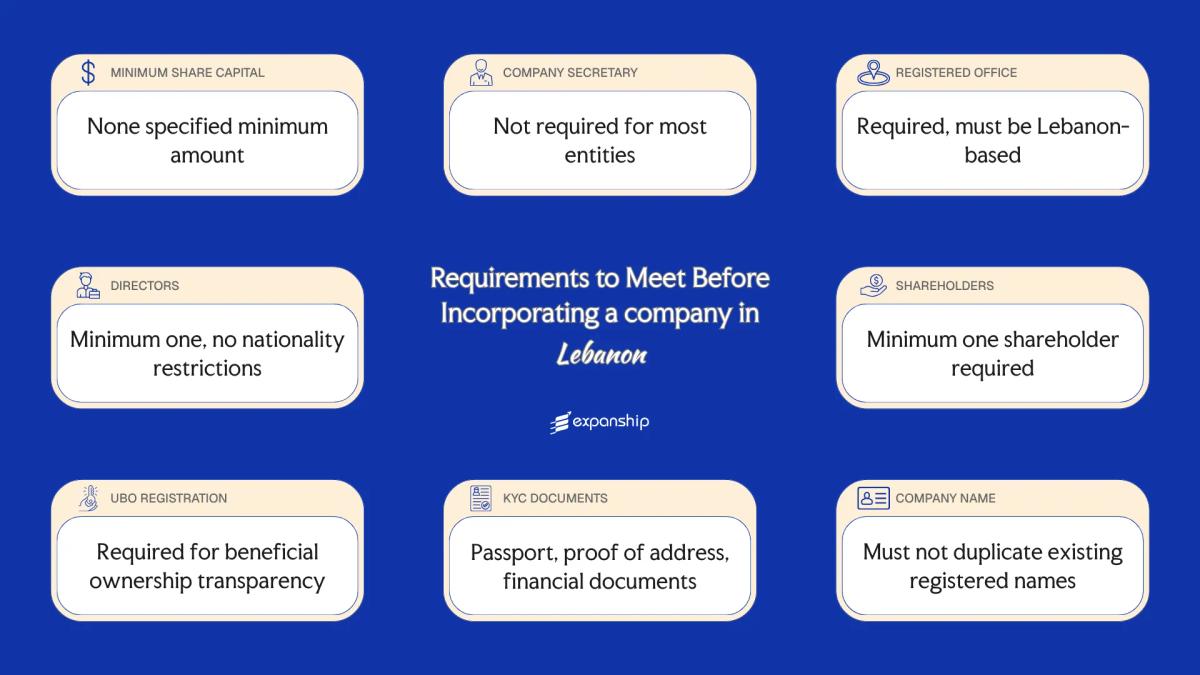
Minimum Share Capital Requirements in Lebanon
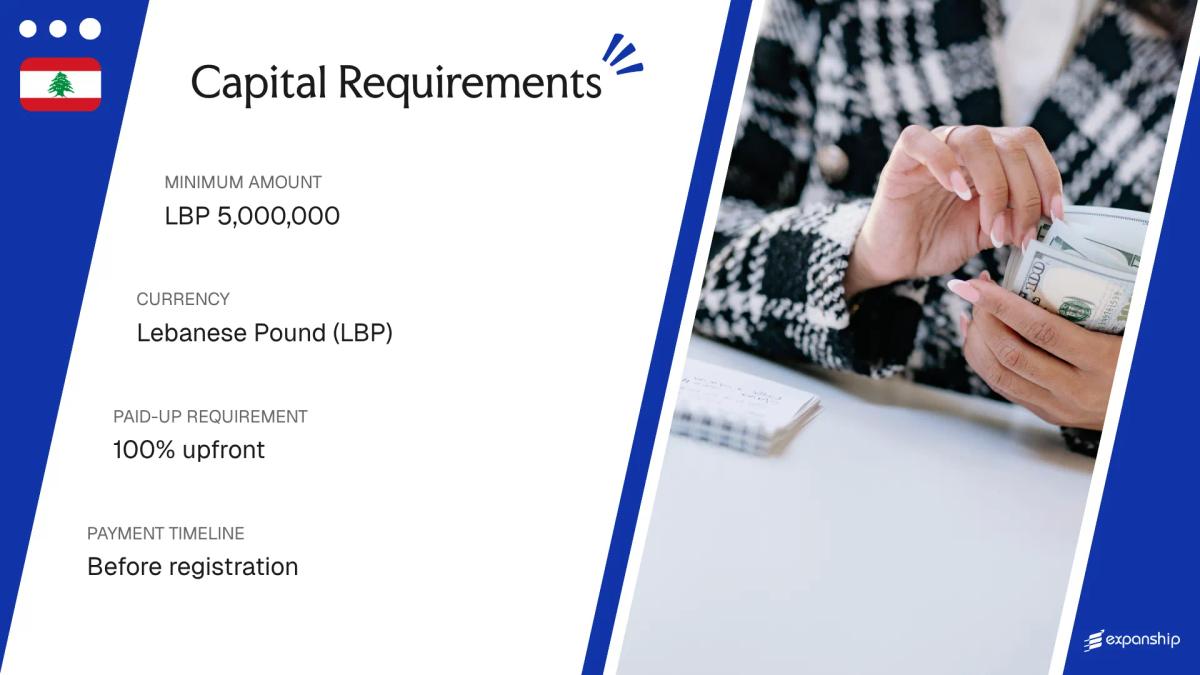
Lebanon minimum share capital requirements differ by entity type and are governed by the Lebanese Code of Commerce. The relevant registry for verifying capital at the point of incorporation is the Commercial Registry (Registre du Commerce), where capital declarations are filed before the firm is formally registered.
For a Société Anonyme Libanaise (SAL), the statutory minimum authorized capital is set by law, and a portion must be paid up at the time of incorporation. The SARL structure carries its own distinct capital thresholds, with shares denominated at par value under Lebanese commercial law.
| Parameter | Detail |
|---|---|
| Minimum Authorized Share Capital | LBP 30,000,000 for SAL; LBP 5,000,000 for SARL |
| Maximum Authorized Share Capital | No statutory maximum |
| Minimum Paid-Up Capital | At least one-quarter of authorized capital for SAL at incorporation |
| Paid-Up Requirement at Incorporation | Yes; partial payment required before Commercial Registry filing |
| Accepted Currency | Lebanese Pound (LBP); foreign currency may be accepted in practice |
| Accepted Forms of Contribution | Cash and in-kind contributions; in-kind assets subject to independent valuation |
| Timeframe to Deposit Capital | Prior to submission of incorporation documents to the Commercial Registry |
Capital must be deposited before the incorporation deed is notarized and filed. Failing to complete this step prevents registration from proceeding.
Company Secretary Requirements in Lebanon
Under Lebanese commercial law, there is no statutory requirement for a dedicated company secretary position equivalent to those found in common law jurisdictions. That said, corporate secretary obligations in Lebanon are typically fulfilled by directors or appointed legal representatives who manage official correspondence and regulatory filings with the Commercial Register (Registre du Commerce).
Certain administrative duties fall to this function by default. These include maintaining the company's statutory books, coordinating with the Ministry of Finance and the Commercial Register, and ensuring documentation is kept current for annual compliance purposes.
Qualification criteria for who may serve in this capacity generally include:
- No mandatory professional licensing is required under Lebanese commercial regulations
- Both natural persons and corporate entities may fulfil this role
- Residency in Lebanon is not a stated legal requirement for this function
- The role is commonly assigned to a director, legal counsel, or an authorised representative of the firm
- Foreign nationals may serve without restriction under general commercial practice

Company Incorporation in Lebanon
Set up your business entity in Lebanon with guidance on Commercial Register filings, capital requirements, and ongoing compliance obligations.
Registered Office Requirements in Lebanon
Lebanon registered office requirements follow the general framework established under the Lebanese Code of Commerce, which governs where a company's legal domicile must be situated and how that address functions within the national registry system.
- A physical address within Lebanese territory is required; a P.O. box alone does not satisfy the registered address requirement.
- Virtual offices are not formally recognised as compliant registered addresses under Lebanese commercial law.
- The address must be located in Lebanon, as foreign addresses cannot serve as a company's legal domicile.
- Proof of occupancy, such as a lease agreement or title deed, is generally required to establish the address as the company's legal seat.
- The registered address is recorded in the Commercial Register held by the relevant Court of First Instance and is publicly accessible.
- Any change to the company's legal address must be formally notified to the Commercial Register and published in the Official Gazette to take effect.
- Operating with a non-compliant or fictitious address can expose the entity to administrative sanctions and may affect the validity of official correspondence served at that address.
Director Requirements in Lebanon
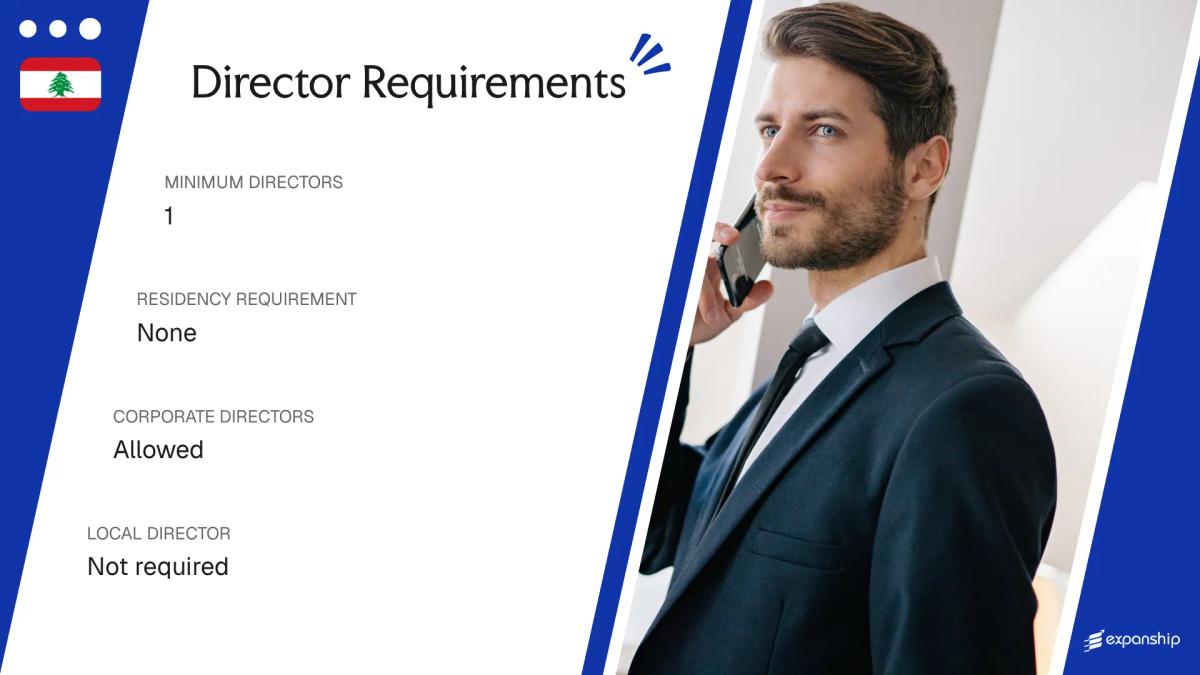
Under Lebanon's Code of Commerce, directors of a Société Anonyme Libanaise (SAL) assume personal liability for acts contrary to the law or the company's articles of association, making an understanding of Lebanon director requirements incorporation a necessary step before filing. Upon appointment, directors collectively form the board and bear joint responsibility for ensuring statutory compliance, accurate financial reporting, and the proper convening of general assemblies.
| Parameter | Detail |
|---|---|
| Minimum Number of Directors | An SAL requires a minimum of three directors on its board. |
| Maximum Number of Directors | No statutory maximum is prescribed under the Code of Commerce, though the articles of association may set a ceiling. |
| Local/Resident Director Required | No statutory requirement for a locally resident director exists under Lebanese law. |
| Nationality Restrictions | Foreign nationals may serve as directors, subject to any sector-specific restrictions imposed by relevant licensing authorities. |
| Minimum Age Requirement | Directors must have reached the age of legal majority, which is 18 years under Lebanese civil law. |
| Corporate Directors Permitted | Corporate entities are generally not permitted to serve as directors of an SAL under the Code of Commerce. |
| Director Must Be a Shareholder | Each director of an SAL is required to hold a qualifying number of shares as specified in the company's articles of association. |
| Publicly Listed on Registry | Director information is filed with the Commercial Registry at the Court of First Instance and forms part of the public commercial record. |
| Disqualification Conditions | Persons convicted of bankruptcy-related offences, fraud, or crimes involving breach of trust may be disqualified from directorship under Lebanese law. |
Every SAL director in Lebanon must personally hold a qualifying shareholding as a condition of office, meaning a director who transfers or loses those shares automatically vacates their seat on the board.
Shareholder Requirements in Lebanon
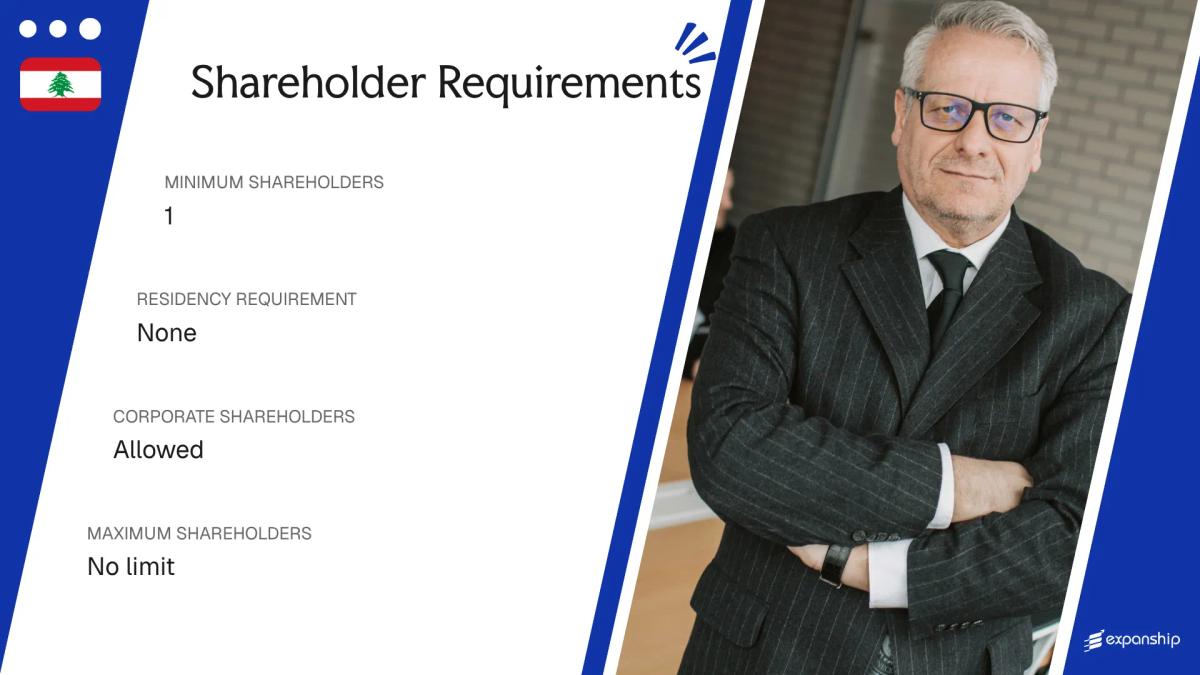
Under Lebanese law, a Société à Responsabilité Limitée (SARL) requires a minimum of one shareholder and permits up to fifty. Exceeding that ceiling obligates the entity to convert to a joint-stock structure (SAL).
Nationality and Residency Restrictions
Lebanon shareholder requirements for incorporation impose no mandatory residency on shareholders. Foreign nationals may hold shares freely, though certain regulated sectors restrict non-Lebanese ownership percentages under specific licensing laws.
Corporate Shareholders
Corporate entities are permitted to act as shareholders in a Lebanese SARL or SAL. No prohibition on foreign corporate shareholders exists under the Commercial Code, though documentation requirements for legal-entity shareholders apply during registration.
Shareholder Liability
In a SARL, shareholder liability is limited to each party's capital contribution. Extended personal liability does not arise from ordinary operations, though courts may pierce the corporate veil in cases of fraud or deliberate misuse of the structure.
Register of Shareholders
A register of shareholders must be maintained at the company's registered office. Filing updates with the Commercial Registry is required when ownership changes occur, though the register is not generally accessible to the public.
Shareholder Structuring Guidance for Your Lebanese Entity
Get expert support on meeting ownership and shareholding requirements when setting up a company in Lebanon.
UBO / Beneficial Ownership Disclosure Requirements in Lebanon
Lebanon beneficial ownership disclosure requirements are governed primarily by Law No. 44 of 2015 on combating money laundering and terrorist financing, which establishes obligations for identifying the ultimate beneficial owner of legal entities. A beneficial owner is generally defined as any natural person who ultimately owns or controls 25% or more of a company's shares or voting rights.
- Identify all natural persons holding 25% or more of the entity's shares or voting rights at the time of incorporation.
- Disclose UBO information to the relevant financial institution or notary during the incorporation process.
- Submit required UBO declarations to Banque du Liban (BdL) or the Special Investigation Commission (SIC) as part of anti-money laundering compliance procedures.
- Update UBO records whenever a change in ownership or control occurs.
| Parameter | Detail |
|---|---|
| Ownership Threshold for UBO Status | 25% of shares or voting rights |
| Filing Authority | Special Investigation Commission (SIC) / Banque du Liban |
| Disclosure Deadline at Incorporation | At time of incorporation |
| Publicly Accessible Register | No publicly accessible register |
| Penalties for Non-Disclosure | Sanctions under Law No. 44 of 2015; specific penalties subject to regulatory determination |
| Ongoing Update Obligation | Required upon any change in ownership or control |
KYC / Document Requirements in Lebanon
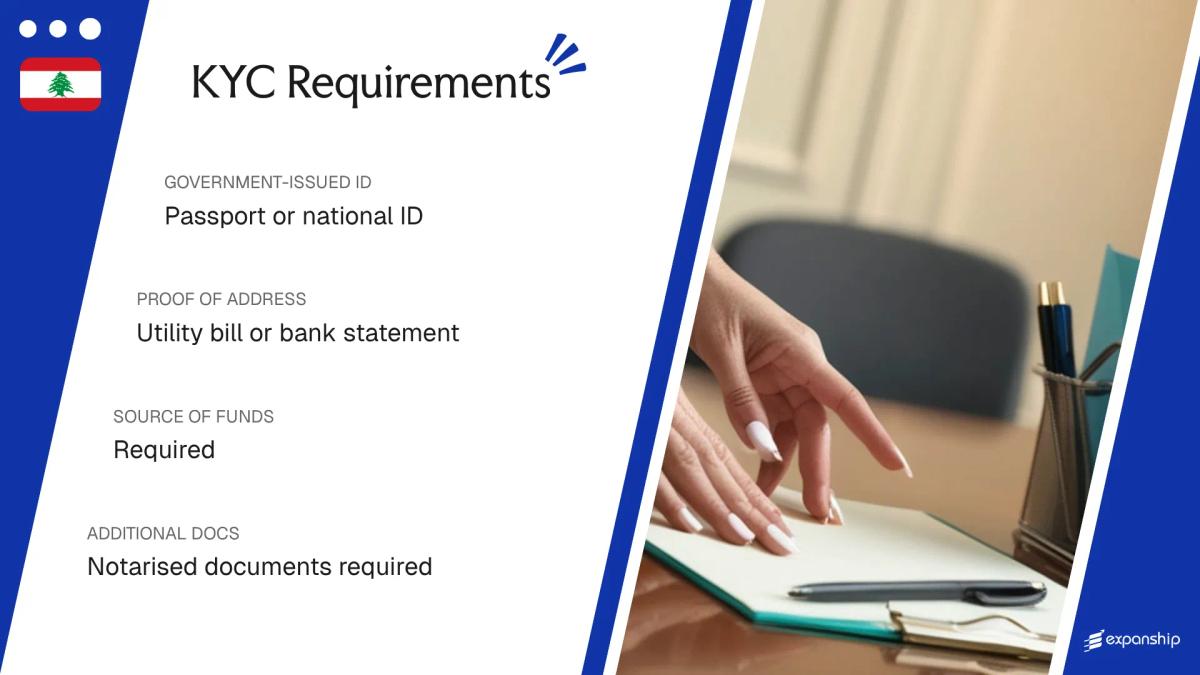
Lebanon KYC requirements for company formation are governed by Law No. 44 of 2015 on combating money laundering and terrorist financing, administered by the Special Investigation Commission (SIC), Lebanon's financial intelligence unit.
Individual / Personal Documents
- Valid passport or national identity card for each individual director, shareholder, or beneficial owner
- Recent proof of residential address (utility bill or bank statement, generally not older than three months)
- Completed KYC declaration or due diligence questionnaire as required by the incorporating notary or commercial registry
- Specimen signature form where requested by the notary
Corporate Documents
- Certificate of incorporation of the corporate shareholder or parent entity
- Memorandum and articles of association, or equivalent constitutional document
- Current register of directors confirming authorised signatories
- Proof of registered address of the corporate entity
Source of Funds Documentation
- Recent bank statements covering a minimum of three to six months
- Audited financial statements where the corporate shareholder is an established operating entity
- A written declaration of the origin of capital to be introduced into the Lebanese entity
Notarisation and Apostille Requirements
- Foreign-issued documents generally require notarisation by a local notary or authentication by the issuing country's authorities
- Documents originating from non-Hague Convention states may require Lebanese consular legalisation rather than an apostille
- Official Arabic translation is required for all documents not originally issued in Arabic or French
Incomplete or inconsistently translated corporate documents submitted to the Commercial Registry are among the most frequent causes of registration delay.
Company Name Requirements in Lebanon
Proposed company names in Lebanon are reviewed for distinctiveness and compliance at the point of incorporation. Each name must be unique and must not create confusion with an already-registered entity.
The name must be written in Arabic, though a transliteration into Latin script is generally permitted alongside it. A legal suffix identifying the entity type is mandatory — such as "S.A.R.L." for a limited liability company.
Certain words are restricted from use without prior approval from the relevant authority. Terms implying government affiliation, banking activity, or regulated professions fall into this category.
Name reservation is available in Lebanon prior to formal incorporation. Reservations are typically valid for a limited period, after which the name must be resubmitted if incorporation has not been completed.
Company Compliance Services in Lebanon
Keep your Lebanese entity in good standing with registered office maintenance, annual filings, and ongoing regulatory support.
Conclusion
Lebanon company incorporation requirements are governed by the Code of Commerce and administered through the Commercial Register at the Ministry of Justice. The framework spans entity type selection, capital thresholds, shareholder composition, and disclosure obligations under Law No. 44 of 2015.
Beneficial ownership disclosure and the minimum share capital thresholds for a Société Anonyme Libanaise stand out as structurally significant. Foreign investor eligibility, particularly sector-specific restrictions, also shapes how a business can be structured from the outset.
Once these requirements are understood, the practical focus shifts to preparing compliant documentation and engaging with the relevant Lebanese authorities to complete registration.
Expanship's Corporate Formation Services in Lebanon
Expanship's Lebanon corporate formation services are structured around the specific requirements set by the Commercial Register, the Ministry of Finance, and the notarization procedures that govern entity formation in the country. From capital deposit confirmation to apostilled director documentation, each step carries administrative weight that multiplies quickly without local coordination. Expanship's role is to manage that coordination so your business can progress without unnecessary delays.
Our service scope covers the full formation and post-incorporation cycle:
- We prepare and file all incorporation documents with the relevant Lebanese authorities, including Commercial Register submissions.
- A registered agent and local office address are provided to satisfy Lebanon's residency requirements.
- We handle direct liaison with government bodies throughout the filing process.
- Ongoing compliance obligations, including annual filings, are managed on your behalf after incorporation.
- Banking introduction support is available to help your entity establish a local or international account.
- Tax registration with the Lebanese Ministry of Finance and coordination with local authorities is included in the formation process.
Reach out to Expanship Lebanon to discuss how we can support your incorporation.
Frequently Asked Questions (FAQ)
No. A SAL requires a minimum share capital of LBP 30 million, while a SARL carries a lower threshold. The two structures also differ in how capital must be deposited and evidenced at the time of registration with the Commercial Register at the Ministry of Justice. Choosing the wrong structure at incorporation can require a formal conversion process later, which involves additional notarial and registration steps.
Failure to comply with beneficial ownership disclosure obligations under Lebanon's anti-money laundering framework can result in administrative sanctions, fines, and in serious cases, suspension of business activity. The Special Investigation Commission (SIC), Lebanon's financial intelligence unit, oversees AML compliance, and non-disclosure that implicates financial institutions may trigger further regulatory scrutiny. The severity of the penalty generally scales with whether the omission was deemed negligent or deliberate.
A foreign national may serve as a director of a Lebanese SAL, but the entity must still appoint a board of at least three directors as required under the Lebanese Code of Commerce. Sole-director arrangements are not permitted for a SAL; that structure simply does not exist under this form. If your preferred governance model involves a single controlling officer, a SARL may be a more appropriate vehicle to examine.
The Commercial Register will reject the incorporation application if the proposed name conflicts with an existing registered name. A preliminary name availability search through the Commercial Register is a standard pre-filing step, and notaries handling the deed of incorporation will typically flag conflicts before submission. Reserving a name in advance is advisable if your timeline is sensitive, as the registration process cannot proceed until a unique, compliant name is confirmed.
Yes. The deed of incorporation for a Lebanese company must be drafted and authenticated before a Lebanese notary public, and supporting KYC documents provided by foreign shareholders or directors generally require apostille certification or Lebanese consular legalization depending on the issuing country. Documents not in Arabic must be accompanied by a certified Arabic translation. Submitting improperly authenticated documents is one of the most common causes of delays at the Commercial Register.
Beneficial ownership information must be disclosed as part of the incorporation process, not solely as a post-registration obligation. Lebanon's AML legislation, reinforced by circulars from the Banque du Liban and the SIC, requires that the ultimate beneficial owners of a legal entity be identified before the entity can open bank accounts or engage in regulated activity. In practice, the Commercial Register and the banking sector each have their own UBO verification requirements, and satisfying one does not automatically satisfy the other.
Legal Disclaimer
The information provided in this article is for general informational purposes only and does not constitute legal, tax, or professional advice. While we strive to ensure the accuracy and timeliness of the content, laws and regulations are subject to change, and the application of laws can vary widely based on specific facts and circumstances.
Readers should not act upon this information without seeking professional counsel tailored to their individual situation. Expanship and its authors disclaim any liability for actions taken or not taken based on the content of this article.
For specific advice regarding your business setup, compliance requirements, or any legal matters, please consult with qualified legal and tax professionals in the relevant jurisdiction.