
Key Takeaways
- Under the Lebanese Code of Commerce, foreign investors are structurally barred from holding a majority stake in most Lebanese commercial entities, directly limiting control over locally incorporated operations.
- Lebanon's banking sector restrictions and severed correspondent banking relationships mean that a Lebanese-registered company faces material obstacles in executing routine cross-border transactions and maintaining functional USD-denominated accounts.
- The Lebanese pound's collapse — among the most severe currency devaluations recorded globally in recent decades — exposes any entity holding LBP-denominated assets or obligations to chronic real-value erosion.
- Regulatory inconsistency across the Commercial Registry, licensing bodies, and sector-specific authorities creates unpredictable compliance timelines and elevates the informal cost burden for foreign-owned firms seeking to operate in Lebanon.
Lebanon's regulatory framework for business formation is governed primarily by the Lebanese Code of Commerce, an evolving body of legislation that has seen limited modernization relative to international standards. The disadvantages of incorporating in Lebanon span structural, financial, and institutional categories, each presenting distinct challenges for foreign-owned entities.
Not every drawback applies equally across all business types. The risks faced by a sole-activity holding company differ considerably from those encountered by an operationally active trading firm or a licensed financial services entity.
This article is most relevant to foreign investors and internationally based entrepreneurs considering direct incorporation, particularly those assessing whether a Lebanese registered entity can support cross-border operations, hold assets, or access international financial infrastructure.
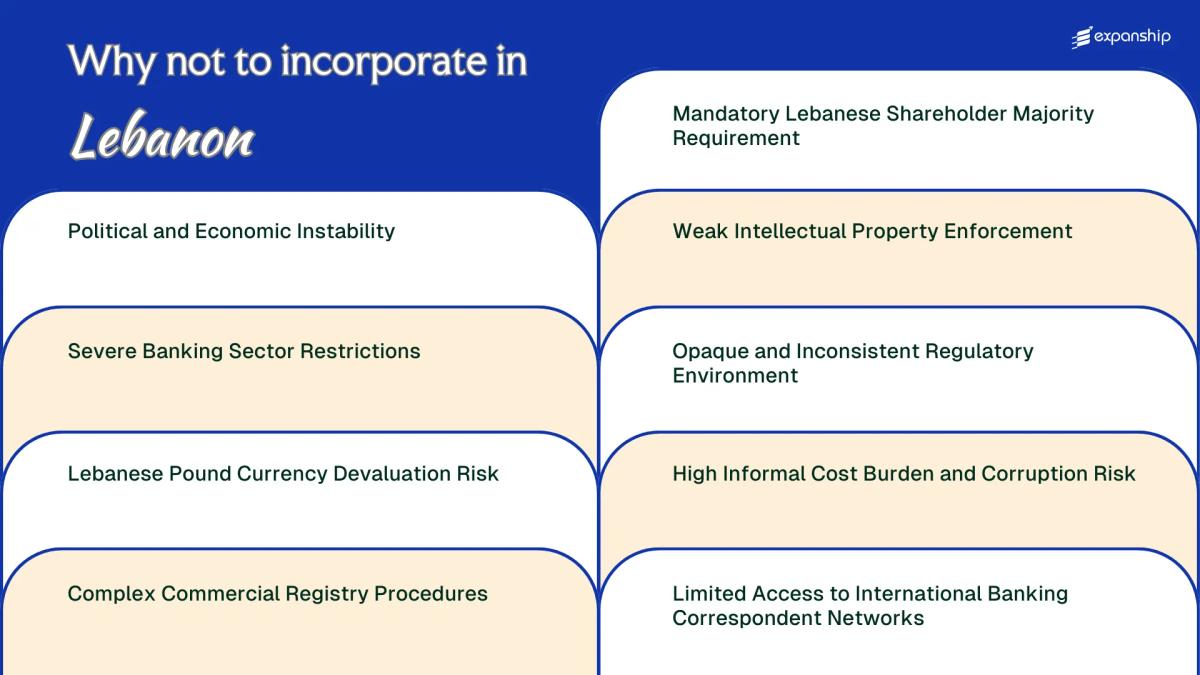
Political and Economic Instability
Lebanon political instability business risks are not theoretical. Since 2019, the country has experienced a sovereign debt default, the collapse of its formal government on multiple occasions, and an ongoing economic crisis that the World Bank has classified as one of the most severe globally since the mid-nineteenth century.
Structural Political Risk for Operating Entities
Lebanon's sectarian power-sharing system, codified through the National Pact and reinforced by the Taif Agreement of 1989, produces chronic governmental gridlock. Cabinet formations have historically taken over a year, leaving regulatory bodies without effective leadership and causing policy decisions to stall. For a foreign-owned entity, this means licensing renewals, permits, and approvals can be suspended indefinitely without any legal recourse.
The sovereign risk for foreign investors extends to contract enforceability. Judicial institutions have faced severe underfunding, and commercial dispute resolution through Lebanese courts has grown materially slower.
Economic Deterioration and Business Continuity
GDP contracted by an estimated 58% in real terms between 2019 and 2021, an erosion that decimated domestic purchasing power and supplier networks simultaneously. Your business operations would be exposed to an economy where basic infrastructure, including electricity supply, remains unreliable due to state fiscal insolvency.
The economic crisis impact on Lebanon companies includes the near-total inability to repatriate profits through formal banking channels.
Foreign business owners face sovereign-level instability that directly impairs operational continuity, contract enforcement, and capital repatriation with no regulatory mechanism offering protection.
Severe Banking Sector Restrictions
Lebanon banking sector restrictions on companies go far beyond ordinary regulatory friction. Since the financial collapse that accelerated after 2019, Banque du Liban and commercial banks have imposed sweeping informal capital controls that carry no formal legislative basis but are enforced in practice, leaving businesses with little legal recourse.
Opening a corporate bank account is exceptionally difficult. Banks impose arbitrary due diligence requirements, and many institutions refuse accounts for newly incorporated entities entirely.
For a foreign business owner, the operational consequences are concrete:
- Transferring profits abroad is effectively blocked, trapping revenue inside an illiquid system denominated in a depreciating currency
- Correspondent banking relationships have deteriorated, making USD wire transfers unreliable even when accounts technically exist
- Payroll in hard currency requires workarounds that expose your firm to informal money exchange risks
- Auditors and counterparties in other jurisdictions may refuse to engage with entities holding Lebanese bank accounts due to compliance concerns
Circular 154, issued by Banque du Liban, did attempt to partially restore foreign currency access, but its requirements are restrictive and apply unevenly across institutions.
The practical result is that even a properly incorporated entity cannot reliably execute basic treasury functions.

Company Incorporation in Lebanon
Understand the full regulatory and banking environment before committing to a Lebanese company structure.
Lebanese Pound Currency Devaluation Risk
Lebanese pound devaluation risk for businesses is not theoretical. The LBP lost over 98% of its value against the US dollar between 2019 and 2023, collapsing from a pegged rate of approximately 1,507 LBP/USD to exchange rates exceeding 100,000 LBP/USD on the parallel market.
Banque du Liban, the central bank, maintained an official peg for years while the parallel market told a different story entirely. Your company's reported financials, contracts denominated in LBP, or any receivables held in local currency can be rendered near-worthless within months.
| Exposure Area | Impact of LBP Depreciation |
|---|---|
| LBP-denominated contracts | Real value collapses as rate deteriorates |
| Local payroll obligations | Purchasing power erosion creates constant renegotiation pressure |
| Statutory capital requirements | Nominal LBP thresholds become meaningless as currency weakens |
| Tax obligations assessed in LBP | Timing mismatches between assessment and payment can distort real tax burden |
Lebanon's hyperinflation has made multi-rate confusion a structural operating problem. Transactions may be assessed under different official rates depending on the regulatory context, creating accounting inconsistencies that complicate audits and foreign parent consolidation.
Even firms that invoice in USD face LBP currency risk indirectly, since local costs, fees, and certain statutory obligations are still calculated or settled using rates set by Banque du Liban circulars, which have historically lagged the parallel rate significantly.
Complex Commercial Registry Procedures
Lebanon commercial registry challenges begin before your entity is legally recognised. Registering a company requires filing with the Commercial Register (Registre du Commerce), which operates under the Ministry of Justice, and the process involves multiple sequential steps across different offices, each with its own queue, documentation requirements, and informal expectations.
Delays at any single stage cascade across the entire timeline. A process that might take days in comparable jurisdictions can stretch into weeks or months in Beirut, partly due to chronic underfunding of public institutions and partly due to manual, paper-based procedures that have not been digitised in any meaningful way.
Foreign owners face an added layer: notarised and apostilled documents from abroad must be translated into Arabic by a certified translator before submission. Any discrepancy between the original documents and the translated versions can trigger rejection and restart the clock entirely.
Lebanese company registration bureaucracy problems extend to post-incorporation compliance. Annual filings with the Commercial Register require physical attendance or a formally appointed local representative, imposing an ongoing operational cost on businesses without a permanent local presence.
- The Registre du Commerce requires all foreign-language documents to be translated into Arabic by a court-certified translator before filing.
- Notarisation and apostille of founding documents must be completed before submission, not after.
- No fully digital filing pathway currently exists for company incorporation through the Commercial Register.
- Late or missed annual filings can result in the entity being struck from the register, requiring reinstatement procedures.
- A local legal representative is required for entities without a physical presence to manage registry correspondence.
Lebanon has no unified business registration window; a single incorporation can require visits to the Commercial Register, the tax authority, the social security fund, and a notary public as entirely separate, uncoordinated steps.
Mandatory Lebanese Shareholder Majority Requirement
Under Lebanese commercial law, foreign investors face a structural ownership ceiling that directly limits how much of a business they can control. The Lebanon mandatory local shareholder requirement applies to Société Anonyme Libanaise (SAL) companies, where foreign nationals are generally restricted from holding a majority stake without special authorization.
The Statutory Ownership Ceiling
Legislative Decree No. 304 of 1942, which governs SAL formations, alongside sector-specific regulations, restricts foreign ownership in several industries to below 50%. This means your business may be legally required to cede majority control to a Lebanese national or entity, regardless of your capital contribution or operational role.
Practical Consequences for Foreign Control
Depending on a Lebanese majority partner for compliance and decision-making introduces governance risk that is difficult to contractually eliminate. The local partner holds structural voting authority, which can create disputes over profit distribution, strategic direction, or exit terms.
Certain free zones and specific sector licenses offer partial exemptions, but these apply narrowly and do not address the general SAL framework that most foreign-owned businesses fall under.
Structuring Your Lebanon Entry Around Ownership Restrictions
Speak with Expanship's corporate specialists about ownership structuring options for foreign investors incorporating in Lebanon.
Weak Intellectual Property Enforcement
Lebanon intellectual property enforcement risks are a practical concern for any foreign business registering a brand, patent, or proprietary technology in the country. Enforcement mechanisms exist on paper but consistently fail in practice.
- The Ministry of Economy and Trade administers IP registrations under Law No. 75 of 1999, but the ministry lacks the operational capacity and judicial coordination needed to act against infringers without the rights holder funding and driving the process.
- Trademark counterfeiting and unauthorized use of registered marks persist in commercial districts, and right holders typically bear the full cost of private legal action to obtain any remedy.
- Lebanon's IP courts operate within a broader judiciary facing severe resource constraints, meaning infringement cases can take years to resolve, eroding the commercial value of the disputed right.
- Weak IP protection in Lebanon particularly affects software, pharmaceutical formulations, and branded consumer goods, where copying is difficult to prevent through registration alone.
- No specialized fast-track enforcement mechanism exists for foreign IP holders, placing them at the same disadvantage as domestic claimants.
Opaque and Inconsistent Regulatory Environment
Lebanon regulatory environment inconsistency risks are compounded by the absence of a single, consolidated commercial regulatory framework. Overlapping jurisdiction between the Ministry of Economy and Trade, the Ministry of Finance, and sector-specific regulators means your business may receive conflicting compliance directives depending on which authority is engaged.
Circulars and administrative decisions frequently modify operational requirements without formal legislative process or advance notice. A firm that was compliant under one directive can find itself non-compliant following an unpublicized amendment.
Regulatory interpretation also varies between individual officials at the same institution. There is no binding administrative guidance system that standardizes how frontline officers apply existing rules, which means your compliance costs depend partly on which desk processes your file.
- Licensing requirements in certain sectors lack codified renewal timelines
- Enforcement of the Commercial Code of Obligations and Contracts applies inconsistently across regions
- Foreign-owned entities face additional scrutiny layers that are not always grounded in published regulation
A foreign-owned entity seeking a sector-specific operating license in Beirut may face document requirements that differ from those communicated during pre-registration consultations, with no formal appeals mechanism to challenge the discrepancy, resulting in repeated submission cycles that can extend setup timelines by several months and multiply notarization and legal translation costs accordingly.
High Informal Cost Burden and Corruption Risk
Lebanon corruption risk business incorporation is a documented operational reality, not a peripheral concern. Transparency International's Corruption Perceptions Index consistently ranks Lebanon among the lower-performing countries in the MENA region, reflecting systemic issues across public administration and regulatory bodies.
Registering a commercial entity at the Commercial Registry (Registre du Commerce) often involves delays that informal payments are expected to resolve. For a foreign business owner, this creates unbudgeted costs with no contractual basis and no legal recourse if those payments don't produce results.
Beyond registration, interactions with municipal authorities, customs, and sector-specific regulators carry similar risk. Each additional approval layer your firm requires multiplies exposure to informal cost demands.
Lebanon's Anti-Corruption Law (Law No. 175 of 2020) established the National Anti-Corruption Commission, but enforcement capacity remains limited. A legal framework against bribery offers little practical protection when institutional implementation is weak and judicial independence is constrained.
Foreign companies operating under strict home-country anti-bribery legislation — such as the U.S. Foreign Corrupt Practices Act or the UK Bribery Act 2010 — face a direct conflict. Informal payments that are routine locally can constitute criminal liability under your own jurisdiction's law.
If your parent company is incorporated in a jurisdiction with extraterritorial anti-bribery legislation, any informal payment made by a local representative or agent on your behalf can trigger criminal liability regardless of where the payment occurred.
Limited Access to International Banking Correspondent Networks
Lebanon international banking access limitations affect incorporated companies well before they begin trading. Following Banque du Liban's capital controls and the sector's partial collapse after 2019, major international correspondent banks have severed or severely restricted their ties with Lebanese commercial banks, cutting off routine cross-border payment channels.
Your company may technically hold a local bank account, but that account may have no viable correspondent relationship for USD or EUR wire transfers. De-risking by global banks, driven by FATF's greylisting of Lebanon in 2022, has made foreign counterparties unwilling to process transactions that route through Lebanese institutions.
SWIFT access itself is not universally blocked, but the correspondent infrastructure required to settle international payments has thinned to a point where transaction delays, rejections, and frozen funds are routine operational realities for companies incorporated here.
Strategies to Overcome These Obstacles
Overcoming Lebanon company incorporation obstacles requires structural decisions made before the entity is formed, not after problems emerge.
- Structure ownership to comply with the Lebanese Commercial Code's requirement that Lebanese nationals hold the majority of shares in certain entity types, such as the S.A.L.
- Open multi-currency accounts in a third-country jurisdiction to reduce direct exposure to Lebanese Pound devaluation and Banque du Liban capital control circulars.
- Register the entity through the Commercial Registry under the Ministry of Justice to establish a verifiable legal record that supports correspondent banking due diligence.
- File intellectual property rights with the Ministry of Economy and Trade's IP directorate at the time of incorporation rather than retrospectively.
- Budget explicitly for notarization, authentication, and registry fees at each procedural stage to account for the informal cost burden documented across the incorporation process.
Mitigating risks of incorporating in Lebanon does not eliminate the structural constraints that govern foreign business formation. Each step above operates within the boundaries set by the Commercial Code and sector-specific regulations, which remain subject to the inconsistent enforcement already documented in this blog.
Lebanon's Viability as a Business Destination
Despite the significant disadvantages covered in this blog, Lebanon remains a credible incorporation destination for specific business profiles — particularly those with deep regional ties, existing local networks, or sector exposure in trade and professional services. Assessing Lebanon viability as a business destination requires weighing structural constraints against real commercial opportunities that the country's geographic position and talent base still offer.
| Pros | Cons |
|---|---|
| Access to a multilingual, highly educated professional workforce | Banking sector capital controls severely restrict fund transfers and operational liquidity |
| Strategic geographic position bridging Arab, European, and African markets | The Lebanese pound has lost over 90% of its value since 2019, creating acute currency risk |
| Relatively open foreign investment framework in certain sectors | Foreign investors are legally barred from holding majority equity in many business activities |
| Established commercial and legal traditions rooted in civil law | Informal cost burdens and corruption risk add unpredictable expenses to routine operations |
| Active diaspora networks facilitating cross-border trade and financing | Correspondent banking relationships have contracted sharply, limiting access to USD transactions |
Incorporating here carries measurable risk. For businesses that can structure around capital controls and the mandatory local shareholder requirement, the commercial rationale may still hold.
Corporate Compliance Services for Companies in Lebanon
Maintain your Lebanese entity's standing with timely filings, regulatory reporting, and ongoing compliance support under Lebanese commercial law.
Conclusion
The Lebanon incorporation drawbacks summary presented across this blog reflects a jurisdiction carrying compounded structural risk. Currency controls administered through Banque du Liban circulars have severed reliable access to foreign exchange, while capital restrictions imposed since 2019 continue to limit cross-border fund transfers for operating businesses. Layered over that, the mandatory Lebanese shareholder majority requirement under the Code of Commerce directly constrains foreign ownership. Forming a company here requires clear-eyed assessment of those exposures. Professional guidance on registry procedures, ownership structuring, and banking alternatives remains a practical necessity rather than a discretionary step.
Expanship's Lebanon Company Formation Support
Incorporating in Lebanon means contending with the specific obstacles this blog has outlined: Commercial Registry delays, mandatory Lebanese majority shareholding under the Code of Commerce, currency exposure through the Lebanese pound, and a banking sector operating under severe capital restrictions. Expanship's Lebanon company formation support services are structured to reduce the administrative and procedural burden these conditions place on your business, particularly during the registration and early compliance stages.
Our service scope covers the full formation and maintenance cycle:
- Your entity's registration documents are prepared and filed with the relevant Commercial Registry.
- A registered agent and local office address are provided to satisfy residency requirements.
- Our team handles direct liaison with government departments and regulatory authorities on your behalf.
- Post-incorporation obligations, including annual filings, are tracked and managed for your firm.
- Banking introductions are facilitated to help identify accessible account options.
- Tax registration and coordination with the Lebanese fiscal authorities are handled as part of the process.
Reach out to Expanship Lebanon to discuss your specific formation requirements.
Frequently Asked Questions (FAQ)
It applies specifically to certain sectors and structures, most notably the joint-stock company (SAL) operating in areas such as real estate, where Lebanese nationals must hold the majority of shares under Lebanese Commercial Code provisions. For foreign investors seeking full ownership, this effectively rules out several commercially attractive structures and forces partnership arrangements with local shareholders whose interests may not align with yours.
The Lebanese pound lost over 90% of its official value against the US dollar between 2019 and 2023, one of the most severe currency collapses recorded in modern economic history. Even businesses that operate in US dollars face exposure because staff costs, local fees, and certain statutory obligations are calculated in local currency terms, creating accounting inconsistencies and compliance complications tied to the multiple exchange rate tiers Banque du Liban has operated simultaneously.
A Lebanese-registered company currently cannot rely on the domestic banking system for normal operational functions. Since 2019, commercial banks have imposed informal capital controls that restrict transfers abroad, cap withdrawals, and in many cases freeze corporate account balances, none of which are codified in formal legislation, making legal challenge difficult and outcomes unpredictable.
Lebanon consistently ranks among the lowest performers in the region on Transparency International's Corruption Perceptions Index, scoring significantly below Jordan, the UAE, and Saudi Arabia. For a foreign company, this manifests as informal payments expected at multiple stages of the Commercial Registry process, municipal licensing, and sector-specific approvals, costs that do not appear in any official fee schedule but materially affect your total setup expenditure.
Without correspondent banking access, your Lebanese entity cannot send or receive international wire transfers through standard SWIFT channels, which effectively isolates it from global supply chains and foreign clients. Many international banks have reduced or eliminated their correspondent relationships with Lebanese institutions following concerns over AML compliance and the Banque du Liban's own regulatory difficulties, and there is no short-term regulatory mechanism in place to reverse this.
Lebanon is a signatory to several international IP conventions, including the Paris Convention, but domestic enforcement through the Lebanese court system is slow, costly, and inconsistent. A foreign firm holding patents, trademarks, or proprietary software has limited practical deterrence against infringement because civil IP proceedings can take years to resolve and interim injunctions are difficult to obtain and enforce at the operational level.
Legal Disclaimer
The information provided in this article is for general informational purposes only and does not constitute legal, tax, or professional advice. While we strive to ensure the accuracy and timeliness of the content, laws and regulations are subject to change, and the application of laws can vary widely based on specific facts and circumstances.
Readers should not act upon this information without seeking professional counsel tailored to their individual situation. Expanship and its authors disclaim any liability for actions taken or not taken based on the content of this article.
For specific advice regarding your business setup, compliance requirements, or any legal matters, please consult with qualified legal and tax professionals in the relevant jurisdiction.