
Key Takeaways
- Lebanon's Income Tax Law imposes a corporate income tax rate of 17%, and the absence of withholding tax on dividends distributed to non-resident shareholders means after-tax profits can leave the jurisdiction without triggering a second layer of fiscal cost.
- Foreign investors structuring cross-border operations through a Lebanese SAL or SARL benefit from entity frameworks defined under the Lebanese Code of Commerce that allow meaningful operational flexibility without blanket restrictions on foreign ownership in standard commercial sectors.
- Lebanon's territorial tax system means income generated outside Lebanese territory is generally excluded from local taxable income, making the jurisdiction materially more efficient for internationally oriented businesses routing revenues through a Beirut-based entity.
- Membership in the Arab League positions a Lebanese-registered entity as a practical access point to the broader MENA market, a geographic advantage that compounds the jurisdiction's treaty network in reducing double taxation exposure across key trading partner countries.
Situated on the eastern Mediterranean coast, Lebanon is an independent republic bordered by Syria to the north and east, and Israel to the south. Company registration falls under the oversight of the Commercial Register, which operates under the Ministry of Justice and serves as the primary authority for formalizing business entities. Foreign investors most commonly establish a Société Anonyme Libanaise (SAL) when entering the market. The country operates a territorial tax system, meaning income generated outside Lebanese territory is generally not subject to local taxation.
Foreign ownership of Lebanese commercial entities is broadly permitted across most sectors, and the legal framework does not impose blanket restrictions on foreign direct investment in standard business activities. This openness, combined with the country's geographic position at the intersection of Europe, the Arab world, and Africa, has historically made it a point of interest for internationally oriented firms. This article examines the key advantages of incorporating a business here under current Lebanese commercial and tax law.
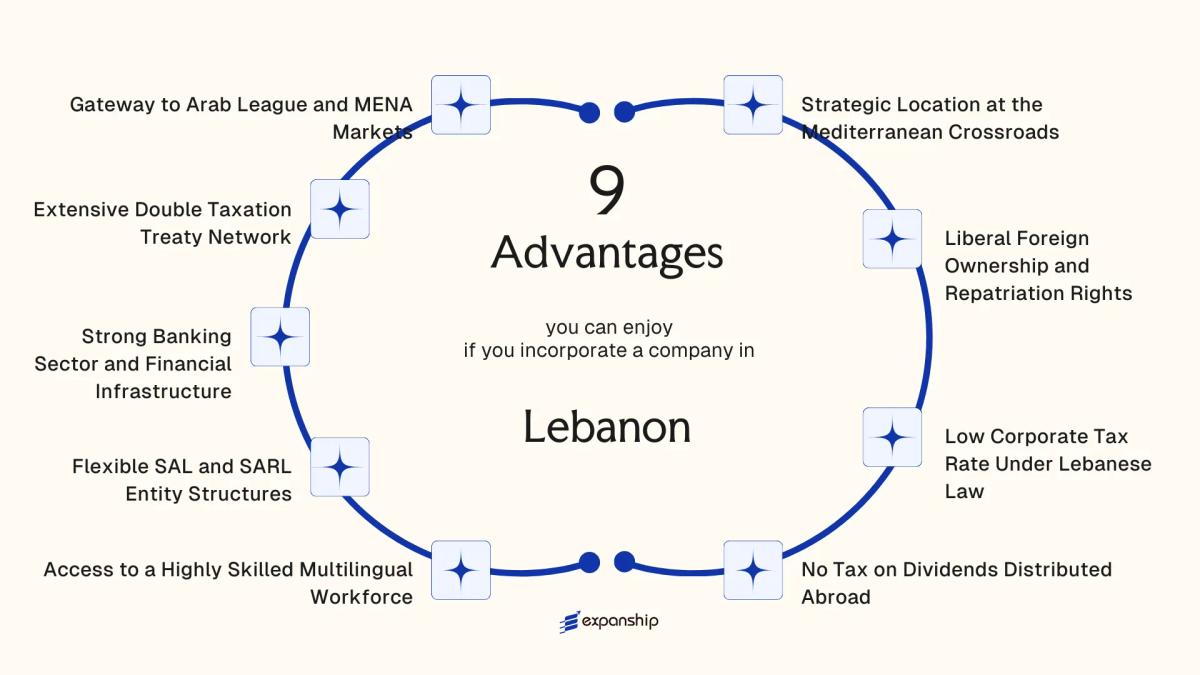
Strategic Location at the Mediterranean Crossroads
Beirut sits at the intersection of three continents, giving any entity registered there a geographic position that translates directly into reduced logistics costs and shorter supply chains. The Lebanon Mediterranean location business advantage is rooted in physical proximity: the country shares borders with Syria to the north and east, faces Cyprus across roughly 175 kilometres of sea, and sits within a four-hour flight of over 500 million consumers across Europe, Africa, and the Gulf.
Direct Access to Regional Trade Routes
Port of Beirut and Rafic Hariri International Airport serve as primary transit points for goods moving between Mediterranean Europe and the Arab interior. For a firm distributing physical products, that positioning cuts transit times significantly compared to routing through Northern European hubs.
A Natural Base for Cross-Regional Operations
Companies operating across the MENA region and Southern Europe find that Beirut's time zone, UTC+3, overlaps with both Gulf working hours and European business hours simultaneously. A single office can coordinate with Dubai and Frankfurt within the same working day without the scheduling friction common in further eastern jurisdictions.
Your operational calendar can cover Gulf and European markets within a single standard workday from one registered office.
Liberal Foreign Ownership and Repatriation Rights
Lebanon foreign ownership rights for investors are, by regional standards, notably permissive. Under the general framework of Lebanese commercial law, foreign nationals can hold up to 100 percent of shares in a Société à Responsabilité Limitée (SARL) or a Société Anonyme Libanaise (SAL) without requiring a local partner. That structural openness means your capital and your control remain entirely your own from the outset.
Profit repatriation follows the same logic. Foreign investors face no statutory restrictions on transferring dividends, capital gains, or returns on investment out of the country. The Lebanese pound has historically operated within a relatively open foreign exchange environment, and no prior approval from the Banque du Liban is required solely to repatriate investment proceeds in most standard cases.
What makes this combination particularly useful for foreign-owned firms is the absence of graduated foreign ownership thresholds. There is no requirement to dilute equity over time or bring in a national shareholder as the business scales.
The conditions that do apply are minimal and structurally straightforward:
- Sector-specific restrictions exist in a narrow set of industries such as media and certain land ownership categories, leaving the majority of commercial activities fully open
- No minimum local employment quota is tied to the ownership structure itself
- Registration through the Lebanese Commercial Registry does not require a separate foreign investment approval authority for most business types

Company Incorporation in Lebanon
Register your company in Lebanon with full foreign ownership and no local partner requirement.
Low Corporate Tax Rate Under Lebanese Law
Lebanon applies a flat corporate income tax rate of 17 percent on net profits, established under the Lebanese Income Tax Law. For a foreign-owned entity operating through a Société Anonyme Libanaise (SAL) or a Société à Responsabilité Limitée (SARL), this rate applies uniformly regardless of profit volume, which means your tax liability scales predictably as revenues grow.
| Tax Type | Rate | Applicable Entity Types |
|---|---|---|
| Corporate Income Tax | 17% | SAL, SARL, Branch |
| Built Environment Tax (on undistributed profits) | 10% | SAL (listed companies) |
| Capital Gains on Real Property | Separate schedule | All entities |
By comparison, the OECD average corporate tax rate sits above 23 percent, making the Lebanese rate a structurally lower baseline for calculating post-tax returns. For businesses with significant net margins, this differential directly affects how much capital remains available for reinvestment or distribution after each fiscal year.
Taxable income is calculated on net profits after allowable deductions, including operating expenses and depreciation, under the framework administered by the Lebanese Ministry of Finance. The rate applies to Lebanese-sourced income, so foreign-sourced income earned outside the country is generally outside the scope of local corporate tax, which benefits holding structures and firms with diversified international operations.
No Tax on Dividends Distributed Abroad
Lebanon no dividend tax foreign shareholders is not a promotional claim — it reflects the actual position under Lebanese tax law. Dividends distributed by a Lebanese joint-stock company (SAL) or limited liability company (SARL) to non-resident shareholders are not subject to withholding tax at the source. The practical result: your full dividend entitlement leaves the country without a fiscal reduction at the distribution stage.
This treatment sits within the framework administered by the Lebanese Ministry of Finance. Profit repatriation to foreign parent companies or individual investors abroad carries no additional tax burden beyond the corporate income tax already settled at the entity level. For a holding structure or a regional operating company, that distinction directly affects after-tax yield calculations.
Under Lebanese exchange control regulations, there are generally no restrictions on transferring dividend proceeds in foreign currency, which compounds the benefit of zero withholding at source.
Keep the following in mind:
- The dividend exemption applies to distributions made after corporate tax has been settled at the standard rate
- Confirm your entity type qualifies — both SAL and SARL structures are eligible
- Retain documentation of profit distributions for cross-border tax reporting in the recipient's home jurisdiction
- Foreign shareholders must still assess their own country's controlled foreign corporation rules
For the applicable fiscal framework, refer to the Lebanese tax law.
Lebanon imposes no capital gains tax on the sale of shares in Lebanese companies, meaning both the investment and its return can exit the country without a Lebanese tax charge.
Access to a Highly Skilled Multilingual Workforce
Lebanon's multilingual skilled workforce advantage is one of the most operationally significant factors for foreign companies establishing a presence in the region. Lebanese professionals routinely work across Arabic, French, and English, a product of a bilingual education system embedded in institutions governed by the Ministry of Education and Higher Education, where instruction in at least two languages is standard from primary school onward. For a foreign firm, this means hiring locally without sacrificing the linguistic capacity needed to serve European, Gulf, or North African clients.
Depth of Specialized Talent
The country's universities, including the American University of Beirut and the Université Saint-Joseph, have produced successive generations of graduates in law, finance, engineering, and medicine. Many Lebanese professionals also hold postgraduate degrees from European or North American institutions, then return to the local market. That combination of international academic exposure and regional cultural fluency is difficult to replicate in neighboring markets.
Commercial Value for Foreign Firms
Payroll costs for qualified professionals remain materially lower than in Western Europe or the Gulf Cooperation Council states, which directly affects the cost structure of a Lebanese-registered entity. A foreign business can staff a regional back-office, legal, or client-facing operation with degree-qualified, multilingual personnel at compensation levels that would be unattainable in comparable European cities. The Lebanese Labour Law (Legislative Decree No. 136 of 1983) governs employment contracts, providing a defined legal framework within which foreign employers can engage local staff.
Put Lebanon's Talent Advantage to Work for Your Business
Speak with Expanship's team about structuring your Lebanese entity to access the local workforce effectively and remain compliant with Lebanese labour regulations.
Flexible SAL and SARL Entity Structures
Lebanese commercial law offers two principal corporate forms under the Code of Commerce: the Société Anonyme Libanaise (SAL) and the Société à Responsabilité Limitée (SARL). The Lebanon SAL SARL entity structure benefits foreign investors primarily through the structural flexibility each form provides, allowing you to match the legal vehicle to the actual scale and purpose of your operation.
- The SAL suits larger enterprises or those seeking external capital. It requires a minimum of three shareholders and a minimum capital of LBP 30,000,000, and it can issue transferable shares, making equity transfers and future capital raises administratively straightforward.
- The SARL is designed for smaller or closely held operations. With a minimum of one shareholder and no prescribed minimum capital under current practice, it reduces both the initial outlay and the administrative overhead associated with maintaining a larger corporate structure.
- Liability in both forms is capped at each shareholder's contributed capital. Your personal assets remain insulated from the company's obligations, which is a direct risk-management consideration for foreign principals operating across multiple jurisdictions.
- Foreign nationals may hold shares in either structure without restrictions on ownership percentage, meaning you retain full control without mandatory local partnership requirements.
Strong Banking Sector and Financial Infrastructure
Lebanon banking sector advantages for businesses have historically been grounded in one structural feature: a legally enforced high reserve ratio. The Banque du Liban (BDL), the country's central bank established under the Money and Credit Code of 1963, requires commercial banks to maintain reserve requirements that have kept the sector relatively well-capitalized by regional standards.
Lebanese commercial banks have long operated with multi-currency accounts as standard practice, accepting deposits and processing transactions in USD, EUR, and LBP. For a foreign-owned entity, this means your firm can hold and move funds in major trading currencies without converting into local currency as a prerequisite.
Correspondent banking relationships with institutions across Europe, the Gulf, and North America mean cross-border transfers are processed through established channels rather than routed through intermediary jurisdictions.
A foreign-registered holding company with a Lebanese subsidiary can maintain separate USD-denominated operating accounts, allowing payroll, supplier payments, and dividend distributions to be processed in the same currency as the parent company's reporting currency, eliminating a layer of conversion cost and accounting complexity.
Banking documentation requirements for company account opening are governed by BDL circulars on anti-money laundering compliance, specifically aligning with FATF recommendations, which means the due diligence framework is internationally recognizable to compliance teams at multinational firms.
Extensive Double Taxation Treaty Network
Lebanon double taxation treaty benefits apply across a network of agreements that the country has signed with trading partners spanning Europe, the Arab world, and beyond. These treaties typically reduce or eliminate withholding taxes on dividends, interest, and royalties paid between contracting states, which directly reduces the tax cost of cross-border transactions for your business.
Treaty coverage includes agreements with countries such as France, Italy, the UAE, Egypt, and several other MENA and European nations. For a foreign-owned entity incorporated in Lebanon, this means profits and payments flowing to parent companies or shareholders in treaty jurisdictions may face reduced withholding rates rather than standard domestic rates.
Under Lebanese domestic tax law, income is taxed on a territorial basis, so treaty provisions primarily become relevant when foreign-source income or cross-border payments are in scope. The interaction between treaty relief and the general territorial framework can meaningfully reduce the overall effective tax rate on international structures routed through a Lebanese entity.
- Treaty-based withholding reductions lower the cost of repatriating royalties and interest to foreign group entities.
- Businesses in treaty countries gain a defined legal framework for resolving disputes over double taxation through mutual agreement procedures.
Treaty benefits apply only to residents of the contracting states as defined under each specific agreement; confirm your entity's qualifying residency status before relying on reduced withholding rates.
Gateway to Arab League and MENA Markets
Lebanon's position as a founding member of the Arab League gives businesses incorporated there a recognized institutional footing across a bloc of 22 member states. For companies targeting Arab world trade, that membership is not ceremonial — it shapes how goods move, how agreements are recognized, and how your entity is perceived by counterparts in the Gulf, North Africa, and the Levant.
Under the Greater Arab Free Trade Area (GAFTA) agreement, products of Lebanese origin benefit from preferential or zero-tariff access across participating Arab League members. This lowers the cost of goods moving from a Lebanese entity into markets like Egypt, Jordan, Saudi Arabia, and the UAE compared to what a non-member origin would face. The practical result is that your supply chain economics change depending on where the exporting entity is domiciled.
Beyond GAFTA, Lebanon's commercial legal tradition is rooted in French civil law while operating in an Arab regulatory environment. That combination makes Lebanese firms familiar to both European counterparts and regional Arab buyers, reducing the friction that often slows cross-border transactions.
The country's private sector also has long-established trading networks with diaspora communities across West Africa, Latin America, and the Gulf states. A firm incorporated locally can draw on existing commercial relationships that would otherwise take years to build independently.
- GAFTA covers preferential tariff treatment for qualifying goods originating in member states
- Arab League membership supports recognition in bilateral trade dispute mechanisms
- Proximity to Syria, Jordan, and Cyprus creates multi-corridor logistics options
Why Lebanon Stands Out Against Regional Competitors
Assessing Lebanon's advantages over regional competitors requires selecting peer jurisdictions that target a comparable investor profile. The UAE (particularly Dubai's free zones), Jordan, and Cyprus are the most relevant benchmarks — each competes for the same foreign capital, MENA market access, and holding or trading company mandates that draw investors to Beirut. What the comparison reveals is that while some peers offer zero corporate tax, your entity in Lebanon benefits from a combination of treaty coverage, multilingual professional infrastructure, and Arab League membership that free zone jurisdictions structurally cannot replicate.
One distinction that becomes clear across parameters is ownership flexibility. Unlike many Gulf Cooperation Council states, where foreign ownership restrictions outside free zones remain common, Lebanese commercial law permits 100% foreign ownership in most sectors under the Commercial Code. That baseline, combined with no restrictions on profit repatriation and access to a civil law framework familiar to European and Francophone investors, positions the country differently from free zone-only models that confine your operations to designated geographic areas.
| Parameter | Lebanon | UAE (Mainland) | Jordan | Cyprus |
|---|---|---|---|---|
| Corporate Tax Rate | 17% | 9% (from 2023) | 20% | 12.5% |
| Foreign Ownership (Outside Free Zones) | Up to 100% (most sectors) | Restricted in some sectors | Up to 100% (most sectors) | 100% |
| Dividend Withholding Tax (Non-residents) | 0% | 0% | 10% | 0% |
| Arab League Membership | Yes | Yes | Yes | No |
| Double Tax Treaties | 30+ | 140+ | 60+ | 65+ |
| Official Business Languages | Arabic, French, English | Arabic, English | Arabic, English | Greek, English |
Compliance Services for Companies in Lebanon
Stay aligned with Lebanese regulatory requirements, from annual filings to commercial registry obligations.
Conclusion
Lebanon's position as a jurisdiction for foreign incorporation rests on a combination of structural and fiscal features that few regional alternatives replicate at the same level. The absence of withholding tax on dividends distributed to non-resident shareholders, combined with a 17% corporate income tax rate under the Income Tax Law, means after-tax returns can be repatriated without an additional layer of fiscal cost. For businesses using a Lebanese entity to access the Arab League market, that combination carries real commercial weight.
The SAL and SARL structures under the Lebanese Code of Commerce offer foreign investors a meaningful degree of operational flexibility, while the country's treaty network reduces double taxation exposure across a range of key trading partner jurisdictions. These are not incidental features; they are the structural foundations that make the jurisdiction viable for cross-border holding, trading, and service operations.
Fit still depends on your specific business model, the sectors you operate in, and how your parent structure is organized. A services firm routing regional revenues through Beirut faces a different calculus than a manufacturing entity or a holding company. The legal and tax position of your home jurisdiction also affects how Lebanese treaty benefits apply in practice. Proper legal and tax analysis before formation determines whether the available advantages translate into measurable outcomes for your particular situation.
Start Your Lebanese Company Formation With Expanship
Proceeding with a Lebanon company formation with Expanship means your SAL or SARL is handled with direct knowledge of the filing requirements set by the Commercial Register at the Ministry of Justice, the notarial authentication process, and the ongoing obligations that apply once your entity is active. The benefits covered across this blog, from the 17% corporate tax rate under the Income Tax Law to full dividend repatriation rights and the SAL's flexibility for foreign shareholders, form the regulatory environment your structure will operate within.
Expanship's scope across the incorporation and maintenance lifecycle includes:
- Preparation and legalization of incorporation documents, including articles of association and notarial deeds
- Registered agent and registered office provision in Beirut
- Filing and liaison with the Commercial Register and relevant government departments
- Post-incorporation compliance management, including annual filings and statutory record maintenance
- Banking introduction assistance to support your corporate account opening process
Your business can engage Expanship at incorporation or at any subsequent compliance stage, depending on where your requirements begin.
Reach Expanship Lebanon to discuss how these services apply to your specific structure and timeline.
Frequently Asked Questions (FAQ)
Yes, foreign nationals can own 100% of a Société à Responsabilité Limitée (SARL) in Lebanon without requiring a local partner. However, ownership restrictions apply to certain regulated sectors, including media and real estate, where Lebanese law limits or conditions foreign participation. Outside those sectors, full foreign ownership is permitted under the Commercial Code.
The standard corporate income tax rate is 17% on net profits, as established under Lebanese tax legislation. This rate applies to SALs and SARLs operating within the country. It does not apply to offshore holding structures, which are subject to a separate flat-fee regime under Decree-Law No. 45 of 1983.
Dividends distributed to foreign shareholders are subject to a 10% withholding tax under Lebanese law, not a zero rate. However, this liability may be reduced or eliminated under applicable double taxation treaties that Lebanon has concluded with the investor's country of residence. The effective rate depends on the specific treaty provisions in force between the two jurisdictions.
Lebanon has concluded double taxation treaties with a number of countries, including several Arab states and European nations, which can reduce withholding tax obligations on dividends, interest, and royalties. These treaties are administered in accordance with Lebanese domestic tax law and the terms of each bilateral agreement. The Ministry of Finance oversees treaty application and taxpayer relief claims.
A SARL does not statutorily require a resident director, but the appointed manager must be identified in the articles of association filed with the Commercial Register at the Ministry of Justice. If the manager is a foreign national, additional documentation may be required by the relevant authority. There is no mandatory local nominee requirement for standard commercial entities outside restricted sectors.
The timeline for registering a company at the Lebanese Commercial Register varies depending on entity type and documentation completeness, but the process generally takes several weeks from submission to formal registration. A SAL (Société Anonyme Libanaise) involves more procedural steps than a SARL, including a constituent general assembly and a minimum capital deposit, which can extend the formation period. Delays in notarisation or document authentication can affect the overall timeline.
The minimum share capital for a SARL is LBP 5,000,000, while a SAL requires a minimum capital of LBP 30,000,000 under the Lebanese Code of Commerce. Given currency fluctuations affecting the Lebanese pound, the practical USD equivalent of these thresholds has changed significantly in recent years. Foreign investors should confirm current exchange-rate implications with a local legal advisor before proceeding with formation.
Historically, Lebanese law permitted free repatriation of profits and capital without exchange controls, and this principle remains codified in law. In practice, however, banking sector restrictions introduced since 2019 have affected the ability to transfer funds internationally through Lebanese commercial banks. Investors should assess current banking access conditions alongside the legal framework before making capital deployment decisions.
Legal Disclaimer
The information provided in this article is for general informational purposes only and does not constitute legal, tax, or professional advice. While we strive to ensure the accuracy and timeliness of the content, laws and regulations are subject to change, and the application of laws can vary widely based on specific facts and circumstances.
Readers should not act upon this information without seeking professional counsel tailored to their individual situation. Expanship and its authors disclaim any liability for actions taken or not taken based on the content of this article.
For specific advice regarding your business setup, compliance requirements, or any legal matters, please consult with qualified legal and tax professionals in the relevant jurisdiction.