
Key Takeaways
- The Multi-Member Company Limited is the most commonly registered entity among foreign investors in Laos, offering limited liability protections within a structure regulated by the Ministry of Industry and Commerce.
- Foreign-invested entities in Laos are subject to dual oversight, falling under both the Ministry of Industry and Commerce and the Ministry of Planning and Investment.
- Public Companies Limited are suited to businesses targeting the Lao Securities Exchange or requiring broad share distribution, distinguishing them from the more privately held Single-Member and Multi-Member Company Limited structures.
- Branch offices and representative offices allow foreign firms to establish a presence in Lao PDR without undergoing local incorporation.
Introduction to Entity Types in Laos
Laos is a landlocked country in Southeast Asia, bordered by China, Vietnam, Cambodia, Thailand, and Myanmar. It operates as a single-party socialist republic under the Lao People's Democratic Republic (Lao PDR), with the national economy guided by a combination of state planning and market-oriented reform.
Company registration falls under the jurisdiction of the Ministry of Industry and Commerce (MOIC), specifically through its Department of Enterprise Registration and Management. Foreign-invested entities are additionally subject to oversight by the Ministry of Planning and Investment. Lao PDR applies a territorial tax system with a standard corporate income tax rate, and the country has entered into a limited number of double taxation agreements.
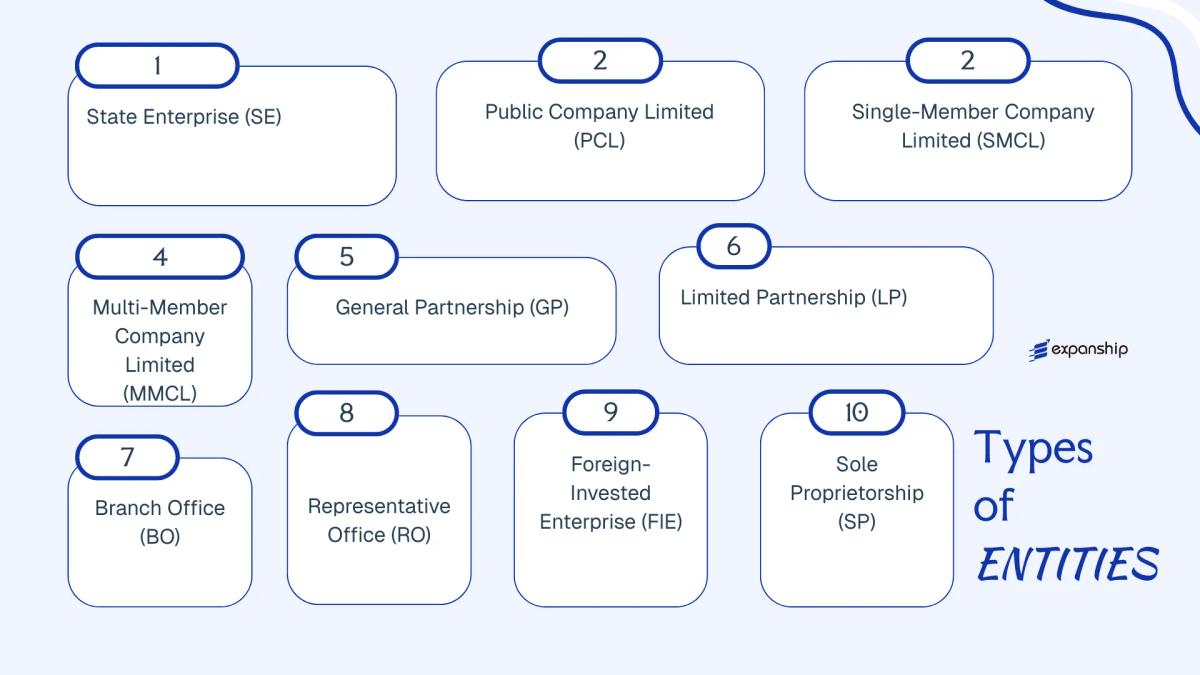
The principal business entity types in Laos are:
- State Enterprise
- Public Company Limited
- Single-Member Company Limited
- Multi-Member Company Limited
- General Partnership
- Limited Partnership
- Branch Office
- Representative Office
- Foreign-Invested Enterprise
- Sole Proprietorship
This article covers each of these Lao PDR corporate forms in turn — examining their structure, ownership rules, liability framework, and registration requirements.
An Overview of Business Structures in Laos
Lao PDR recognises several distinct entity types under the Enterprise Law (No. 46/NA, 2013, as amended), which serves as the primary legislative framework governing business registration and corporate conduct. Each structure carries different rules on liability, ownership, capital, and permitted activities. The sections that follow examine each type in detail.
Business Structures at a Glance
| Entity Type | Legal Form | Liability | Tax Status | Local Trading | Minimum Members | Regulatory Authority | Governing Act |
|---|---|---|---|---|---|---|---|
| State Enterprise | Public body / SOE | State-backed | Taxable | Yes | N/A (state-owned) | Ministry of Finance | Enterprise Law 2013 |
| Public Company Limited | Incorporated company | Limited | Taxable | Yes | 3 shareholders | Ministry of Industry & Commerce | Enterprise Law 2013 |
| Multi-Member Company Limited | Private company | Limited | Taxable | Yes | 2 members | Ministry of Industry & Commerce | Enterprise Law 2013 |
| Single-Member Company Limited | Private company | Limited | Taxable | Yes | 1 member | Ministry of Industry & Commerce | Enterprise Law 2013 |
| General Partnership | Unincorporated firm | Unlimited | Taxable | Yes | 2 partners | Ministry of Industry & Commerce | Enterprise Law 2013 |
| Limited Partnership | Unincorporated firm | Mixed | Taxable | Yes | 2 partners (1 general, 1 limited) | Ministry of Industry & Commerce | Enterprise Law 2013 |
| Branch Office | Foreign entity extension | Parent liability | Taxable | Restricted | N/A | Ministry of Industry & Commerce | Foreign Investment Law |
| Representative Office | Non-trading presence | Parent liability | Generally exempt | No | N/A | Ministry of Industry & Commerce | Foreign Investment Law |
| Foreign-Invested Enterprise | Incorporated entity | Limited | Taxable | Yes | 1+ foreign investor | Ministry of Planning & Investment | Foreign Investment Law |
| Sole Proprietorship | Individual trader | Unlimited | Taxable | Yes | 1 owner | Ministry of Industry & Commerce | Enterprise Law 2013 |
Each of these structures is examined in full in the sections below.
State Enterprise (ວິສາຫະກິດລັດ)
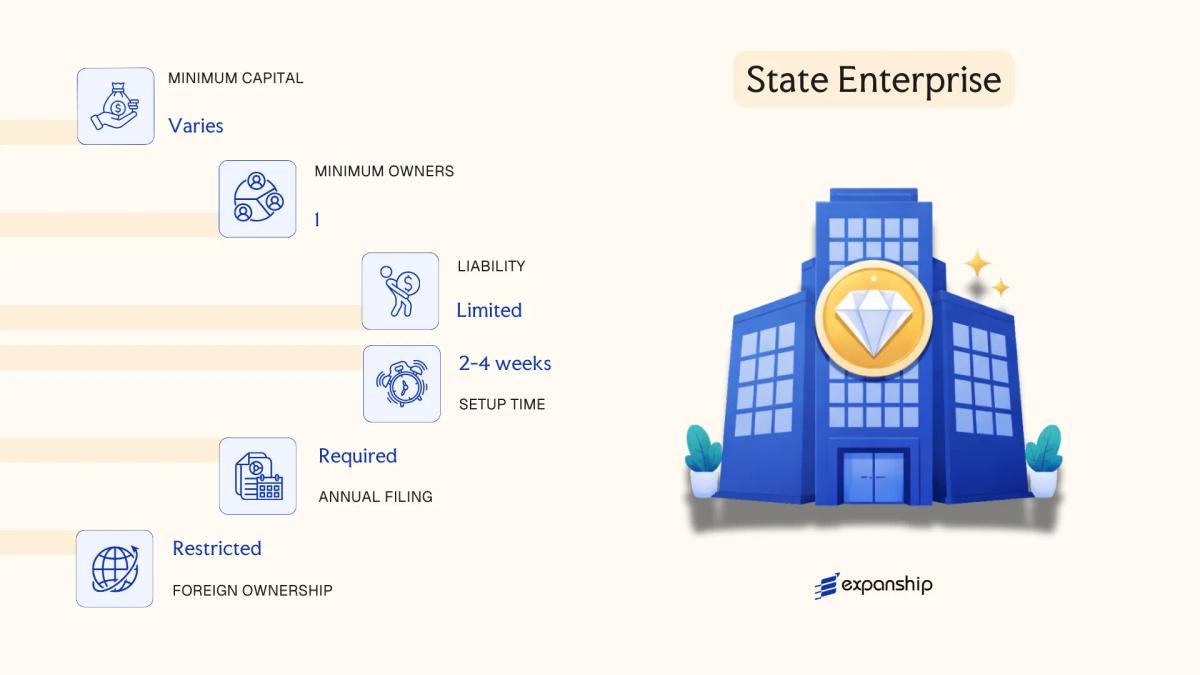
A state enterprise in Laos (ວິສາຫະກິດລັດ) is a government-owned business entity established under the Law on State Enterprises, most recently revised in 2014. The entity holds separate legal personality, meaning it can enter contracts, own assets, and incur liabilities in its own name.
Ownership rests entirely with the state, though the enterprise operates with varying degrees of commercial autonomy depending on its mandate. As a hybrid structure, it sits between a purely administrative government body and a fully commercial company, with the Ministry of Finance retaining supervisory authority over financial performance and reporting.
Key Characteristics
| Requirement | Detail | Notes |
|---|---|---|
| Legal Form | State Enterprise (ວິສາຫະກິດລັດ) | Separate legal personality; governed by the 2014 Law on State Enterprises |
| Ownership | 100% state-owned | No private shareholding permitted under this structure |
| Governing Body | Board of Directors / Director General | Appointed by the relevant line ministry or the Prime Minister's Office |
| Registered Office | Must maintain a physical presence in Laos | Address registered with the Ministry of Industry and Commerce |
| Capital | State-allocated capital in Lao Kip (LAK) | No private capital injection; budget allocated through state mechanisms |
| Privacy | Ownership and financials are public record | Subject to state audit by the National Audit Office |
Focus Points
- Taxation: State enterprises are subject to profit tax at the standard corporate rate of 20%, VAT at 10%, and applicable withholding taxes on dividends and service payments; specific exemptions may apply by ministerial decree.
- Annual Compliance: Must submit audited financial statements to the Ministry of Finance and report operational performance to the supervising ministry annually.
- Conversion: Conversion to a partially or fully privatised structure is possible under the government's state enterprise reform programme, subject to Prime Minister approval.
- Restrictions: Foreign individuals and private entities cannot hold ownership interests; this structure is not available for private investors.
- Treaty Access: Access to Laos's double tax agreements depends on the nature of income and the specific treaty; state enterprises do not automatically receive preferential treatment.
Closing
This structure is used for utilities, infrastructure, natural resources, and strategic industries where the government retains direct operational control. The primary advantage is state-backed capital access; the clear limitation is the absence of private investment flexibility.
Best suited for government-led commercial operations in strategic sectors — not accessible to private or foreign investors.

Company Incorporation in Laos
Explore the right structure for your business in Laos with Expanship's incorporation services.
Public Company Limited (ບໍລິສັດຈຳກັດສາທາລະນະ)
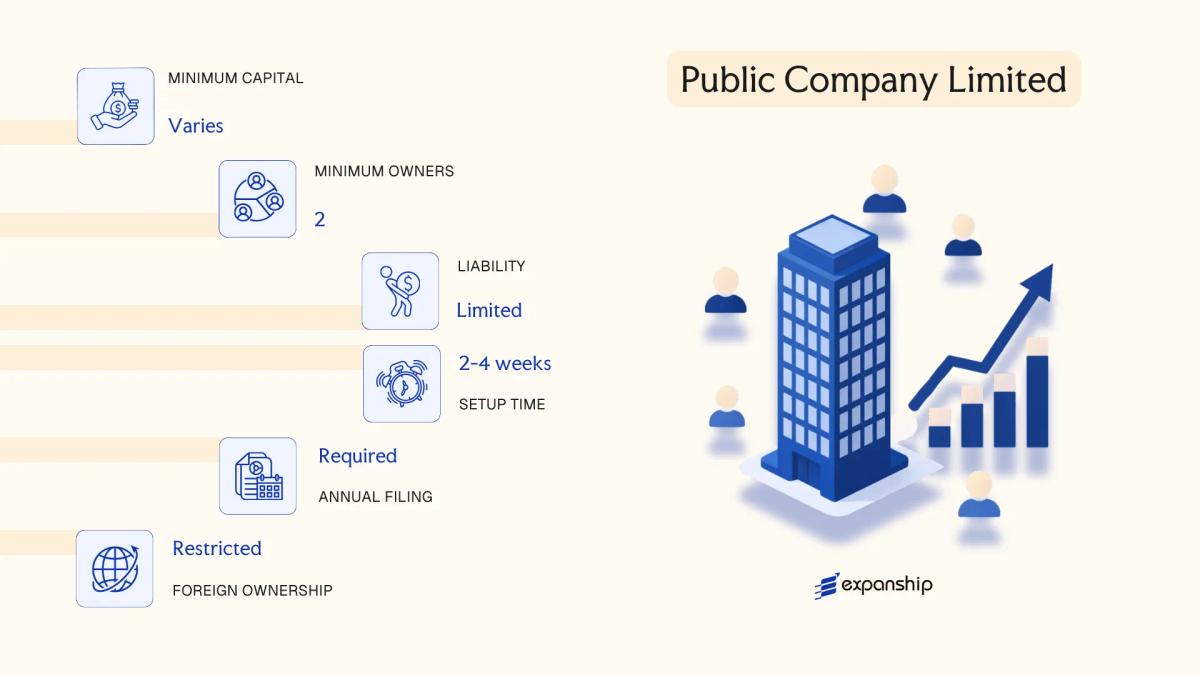
A public company limited Laos ບໍລິສັດຈຳກັດສາທາລະນະ is governed by the Law on Business Entities (2013, as amended), which establishes it as a distinct legal person with liability confined to each shareholder's capital contribution. Unlike its private counterpart, this structure is expressly designed to raise capital from the public through share issuance.
Shares in a public company limited may be offered to the general public and listed on the Lao Securities Exchange (LSX), subject to oversight by the Securities and Exchange Commission of Laos (SECOM). This makes it the only locally incorporated structure through which equity can be publicly traded in Lao PDR.
Key Characteristics
| Requirement | Detail | Notes |
|---|---|---|
| Legal Form | Public Company Limited | Separate legal personality; limited liability |
| Members | Shareholders: minimum 3 founders at incorporation | No statutory maximum on shareholders |
| Governance | Board of Directors (minimum 3); Supervisory Board required | Directors need not be Lao nationals |
| Local Presence | Registered office address in Laos required | Physical or representative address |
| Capital | Minimum share capital not publicly codified; must be sufficient for intended public offering | Capital denominated in Lao Kip (LAK) |
| Privacy | Shareholder register is not fully public, but SECOM filings introduce disclosure obligations | Listed companies face enhanced disclosure |
Focus Points
- Taxation: Subject to 20% Corporate Income Tax; 10% VAT applies to taxable supplies; dividend withholding tax of 10% applies to distributions; stamp duty applies to certain instruments.
- Annual Compliance: Mandatory audited financial statements, annual general meeting, and SECOM periodic reporting for listed entities.
- Treaty Access: Lao PDR's limited double tax treaty network may restrict treaty benefits depending on shareholder jurisdiction.
- Conversion: A private company limited may convert to public status through a formal restructuring process under the Law on Business Entities.
- Restrictions: Foreign ownership ceilings may apply in regulated or restricted sectors under the Investment Promotion Law.
Closing
This structure suits businesses targeting public capital markets, large-scale domestic operations, or eventual LSX listing. The primary advantage is unrestricted public share issuance; the key drawback is the elevated regulatory burden, including mandatory audits and SECOM oversight, which adds ongoing compliance cost.
Established enterprises or joint ventures seeking to raise public capital through the Lao Securities Exchange.
Single-Member Company Limited and Multi-Member Company Limited (ບໍລິສັດຈຳກັດ)
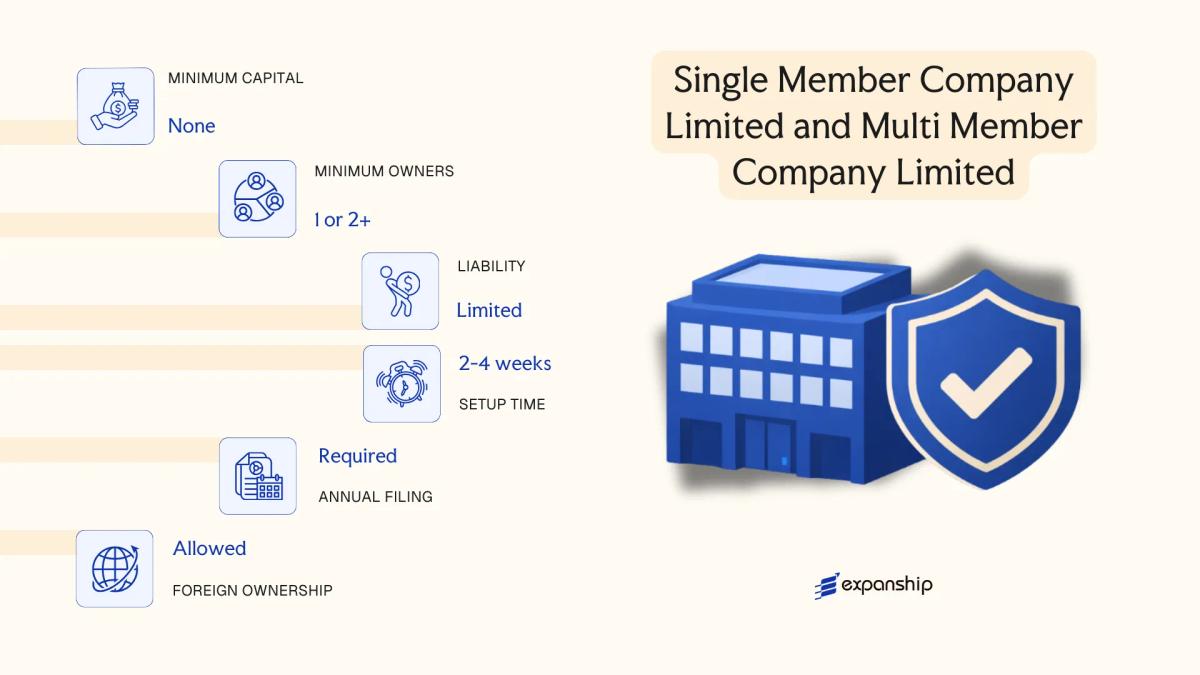
Governed by the Law on Business Entities No. 46/NA (2013) and its subsequent amendments, the single member company limited Laos ບໍລິສັດຈຳກັດ framework establishes a distinct legal personality separate from its owner or owners. The entity carries limited liability, meaning members are only exposed to the extent of their capital contributions.
Both structural forms — single-member and multi-member — fall under the same statutory category, differing only in the number of members permitted. Registration is administered through the Ministry of Industry and Commerce (MoIC).
Key Characteristics
| Requirement | Detail | Notes |
|---|---|---|
| Legal Form | Company Limited (ບໍລິສັດຈຳກັດ) | Separate legal personality; limited liability applies |
| Members | Single-member: exactly 1; Multi-member: 2–30 members | Members are referred to as "members"; a member may be an individual or legal entity |
| Management | At least 1 Director | Director need not be a member; no nationality restriction specified under general rules |
| Local Presence | Registered office address required in Laos | A physical office address must be maintained; a registered agent is not a statutory requirement |
| Capital | No statutory minimum for domestic LLCs; foreign-invested entities subject to sectoral minimums | Denominated in Lao Kip (LAK); capital requirements vary by business activity |
| Privacy | Member and director details filed with MoIC | The business register is accessible to the public |
Focus Points
- Taxation: Subject to 20% corporate income tax (CIT); VAT at 10% applies to taxable supplies; withholding tax rates vary (5–10%) depending on payment type; dividend distributions to foreign members attract withholding tax.
- Annual Compliance: Annual financial statements must be filed; accounts are subject to audit requirements depending on company size and activity.
- Foreign Ownership: Foreign investors structuring through a multi-member company limited Laos must obtain an Investment Approval Certificate from the Ministry of Planning and Investment (MPI) in addition to standard MoIC registration.
- Conversion: A multi-member company limited may convert to a public company limited upon meeting applicable thresholds under the Law on Business Entities.
- Profit Repatriation: No blanket restriction on repatriating profits, though foreign exchange transfers must route through licensed commercial banks and comply with Bank of the Lao PDR regulations.
Sub-Types
Single-Member Company Limited
Owned entirely by one member, this form suits founders or investors who require full control without admitting additional equity participants. The sole member assumes the role of the highest decision-making authority unless a separate director is appointed.
Multi-Member Company Limited
This variant accommodates between two and thirty members, making it the standard structure for joint ventures and partnerships among a defined group of investors. Ownership interests are recorded in a members' register rather than publicly traded shares.
Closing
Both forms are commonly used for trading operations, service businesses, and domestic holding structures where a defined membership cap is acceptable. The liability shield is a clear structural advantage; however, the thirty-member ceiling limits scalability for businesses anticipating broader equity participation.
This entity type suits small-to-medium foreign or domestic investors seeking a straightforward, liability-protected operating structure with a fixed ownership group.
Partnerships [General Partnership, Limited Partnership]
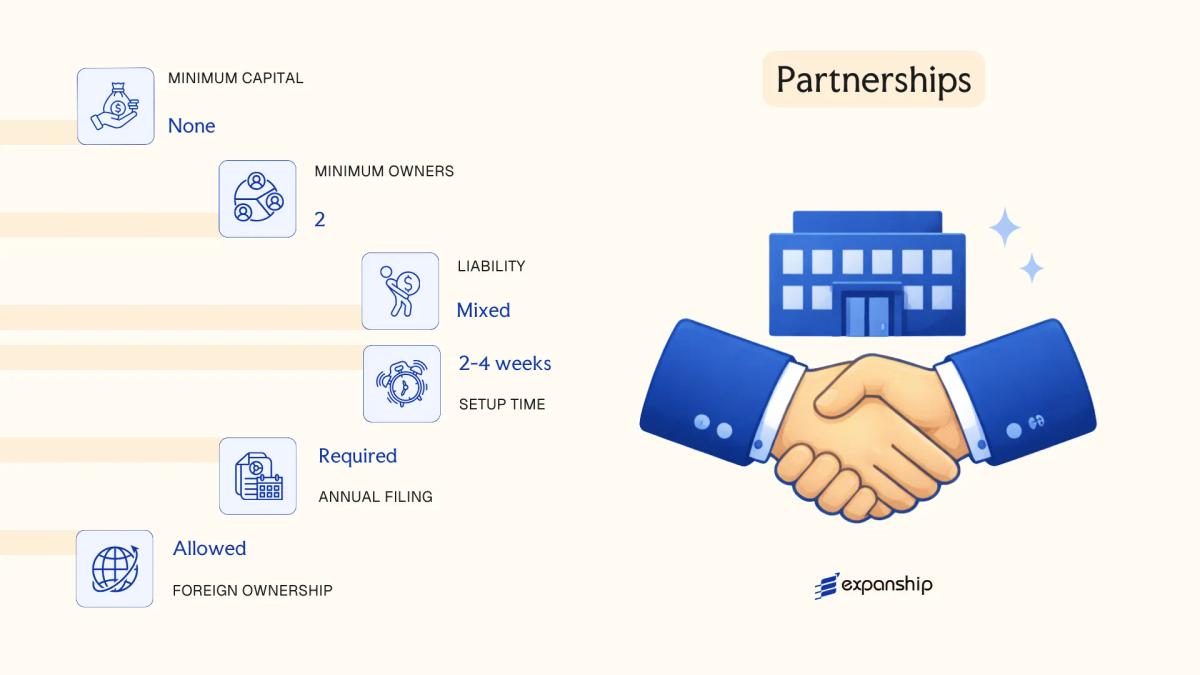
Partnership registration in Laos is governed by the Law on Business Entities (2013, amended 2014), the same legislation that underpins most commercial structures in the country. Partnerships do not hold separate legal personality in the same way a company limited does, meaning partners bear direct exposure to the firm's obligations depending on the partnership type.
Key Characteristics
| Requirement | Detail | Notes |
|---|---|---|
| Legal Form | Partnership (ຫ້າງຫຸ້ນສ່ວນ) | No separate legal personality from partners |
| Members | Partners; minimum 2, no statutory maximum | Referred to as "partners" across both types |
| Local Presence | Registered office address required in Lao PDR | Must be a physical address, not a PO Box |
| Capital | Lao Kip (LAK); no statutory minimum | Contributions recorded in the partnership deed |
| Liability | Varies by partnership type | General: unlimited; Limited: mixed |
| Registration Body | Ministry of Industry and Commerce (MOIC) | Registered via the Enterprise Registration Certificate process |
Focus Points
- Taxation: Partnerships are subject to profit tax under the Lao tax framework; VAT applies if annual turnover meets the registration threshold; withholding tax applies to distributions.
- Annual Compliance: Partners must file annual financial statements and maintain accounting records in accordance with Lao accounting standards.
- Foreign Participation: Foreign nationals may participate, but foreign-invested partnerships are subject to additional scrutiny under the Law on Investment Promotion.
- Conversion: Partnerships may convert to a company limited structure, subject to MOIC approval and re-registration formalities.
- Treaty Access: Laos maintains a limited tax treaty network; treaty benefits depend on the tax residency status of individual partners.
Sub-Types
General Partnership (ຫ້າງຫຸ້ນສ່ວນສາມັນ)
All partners bear joint and several unlimited liability for the debts of the firm. This structure is typically used by small, domestically-focused businesses where the partners have an established trust relationship and prefer a simpler administrative framework.
Limited Partnership (ຫ້າງຫຸ້ນສ່ວນຈຳກັດ)
At least one general partner retains unlimited liability while one or more limited partners are liable only to the extent of their capital contributions. Limited partners in a Lao PDR limited partnership formation are generally restricted from participating in day-to-day management without risking the loss of their limited liability status.
Closing
Partnerships suit small-scale trading operations and professional service arrangements where two or more individuals wish to operate without the formalities of a company structure. The simplified setup process is a practical advantage, though the exposure to unlimited liability for general partners represents a significant structural risk for businesses with meaningful commercial obligations.
Partnerships in Laos are most appropriate for small domestic ventures or professional collaborations where all partners are known to one another and the business carries limited financial risk.
Foreign Business Structures [Branch Office, Representative Office, Foreign-Invested Enterprise]
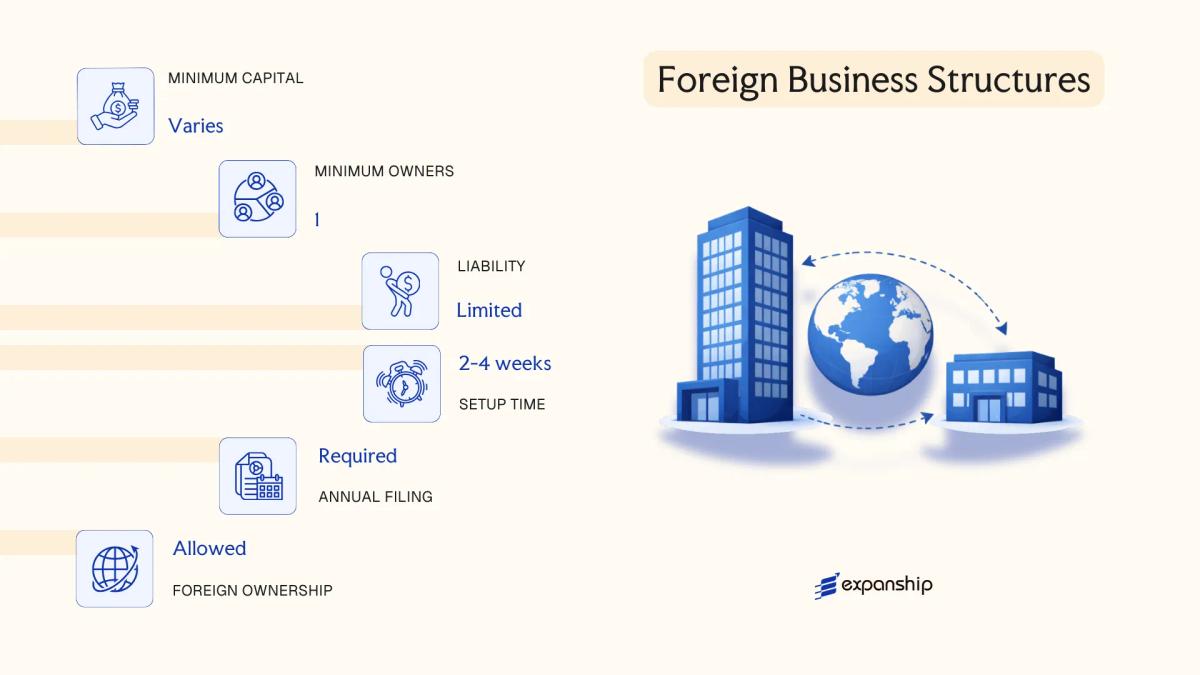
Foreign business structures in Laos are primarily governed by the Law on Investment Promotion No. 14/NA (2016) and the Enterprise Law No. 46/NA (2014), alongside implementing regulations issued by the Ministry of Industry and Commerce (MoIC). The structure you register determines the scope of permitted activities, tax obligations, and the degree of operational control your firm retains in-country.
Unlike locally incorporated entities, foreign business structures do not always carry full separate legal personality. A branch office, for instance, remains an extension of its parent and bears no independent liability — the parent company is directly accountable for all obligations incurred.
Key Characteristics
| Requirement | Branch Office | Representative Office | Foreign-Invested Enterprise (FIE) |
|---|---|---|---|
| Legal Form | Extension of parent; no separate legal personality | Extension of parent; no separate legal personality | Separate legal entity incorporated under Lao law |
| Permitted Activities | Commercial operations permitted; scope tied to parent's business | Non-commercial only (market research, liaison, promotion) | Full commercial operations per investment licence |
| Local Presence | Registered address in Laos required | Registered address required | Registered office required |
| Capital | No statutory minimum; parent guarantees liabilities | No statutory minimum | Minimum capital varies by sector and foreign ownership percentage |
| Staffing | Local and expatriate staff permitted | Limited staffing; no revenue-generating activity | Local and foreign staff; local hiring quotas may apply |
| Privacy | Parent company details disclosed in registration filings | Parent company details disclosed | Shareholder details filed with MoIC |
Focus Points
- Taxation: Branch offices are subject to corporate income tax (CIT) at the standard 20% rate on Lao-sourced profits; representative offices are non-taxable but cannot generate revenue; FIEs may access reduced CIT rates under the investment promotion regime; VAT at 10% applies to taxable supplies; withholding tax applies to dividends, royalties, and service fees paid abroad.
- Economic Substance: FIEs operating under promoted sector licences must maintain genuine business activity in-country to retain incentive status.
- Annual Compliance: All three structures must renew their registration or operational licences annually with the MoIC and file audited financial statements where applicable.
- Restrictions: Representative offices are prohibited from invoicing, signing commercial contracts, or receiving payment for services; certain sectors restrict or prohibit foreign ownership entirely under the Negative List.
- Conversion: A representative office cannot be converted directly into a branch or FIE; a fresh registration process is required.
Sub-Types
Branch Office
A branch office is authorised to carry out revenue-generating commercial activity in the name of its parent corporation. It is typically used by foreign firms wanting operational presence without incorporating a standalone subsidiary.
Representative Office
A representative office is restricted to liaison, market research, and promotional functions on behalf of the parent. No commercial transactions or direct revenue generation are permitted under this structure.
Foreign-Invested Enterprise (FIE)
An FIE is a locally incorporated entity with full or partial foreign shareholding, structured as either a single-member or multi-member company limited under Lao law. It is the most operationally flexible structure for foreign investors seeking long-term commercial activity.
Closing
Foreign business structures suit firms at different stages of market entry — representative offices work for preliminary market assessment, while an FIE is appropriate for sustained commercial operations requiring local contracts, banking, and asset ownership. The primary limitation across all three is the Negative List, which restricts or bars foreign participation in specified sectors regardless of structure chosen.
FIEs are best suited for foreign investors committing to active, revenue-generating operations in Laos; representative offices fit firms conducting preliminary market research before committing capital.
Sole Proprietorship (ກິດຈະການສ່ວນຕົວ)
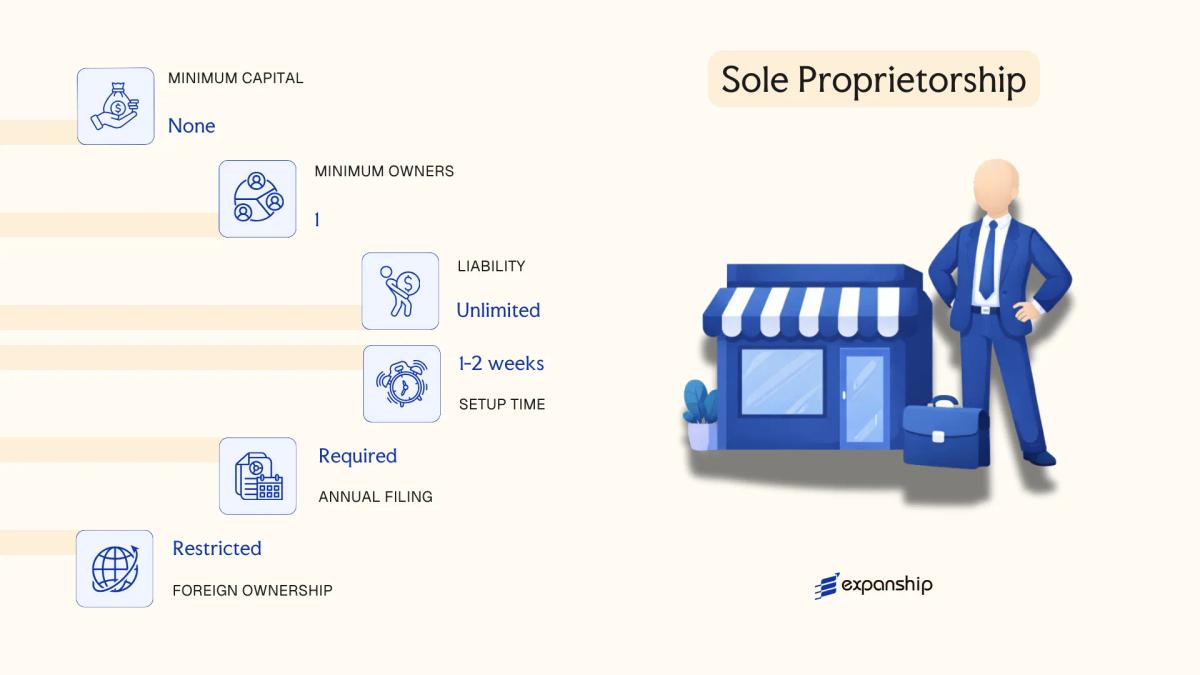
A sole proprietorship in Laos, known locally as ກິດຈະການສ່ວນຕົວ, is governed by the Enterprise Law No. 46/NA (2014) and its subsequent amendments, alongside implementing regulations issued by the Ministry of Industry and Commerce (MOIC). Unlike corporate structures, this form carries no separate legal personality — the owner and the business are legally the same entity, meaning personal assets are directly exposed to business liabilities.
Registration for individual business registration in Lao PDR is handled through the MOIC's Business Registration Division, with filings now processed via the Lao National Business Registry. Only Lao nationals may establish this structure; foreign nationals are not permitted to register as sole traders under current law.
Key Characteristics
| Requirement | Detail | Notes |
|---|---|---|
| Legal Form | Unincorporated individual business | No separate legal personality; owner bears unlimited liability |
| Member Title | Proprietor | Single natural person only |
| Ownership | 1 proprietor (Lao national only) | Foreign nationals are excluded from this structure |
| Local Presence | Registered business address required | Must maintain a physical address within Laos |
| Capital | No statutory minimum | Capital declared at registration but not legally mandated |
| Privacy | Owner's name appears on public register | No beneficial ownership separation |
Focus Points
- Taxation: Subject to income tax on business profits under the personal income tax (PIT) regime; VAT registration required if annual turnover exceeds the prescribed threshold; no corporate income tax applies.
- Annual Compliance: Must file annual tax returns with the Lao Tax Department; business licence renewal required with the MOIC.
- Treaty Access: No access to double tax treaties as a separate legal entity; income flows directly to the individual proprietor.
- Restrictions: Restricted to small-scale commercial activities; certain licensed or regulated sectors require a corporate entity rather than a sole proprietorship.
- Conversion: Can be converted into a company limited, though the process requires a fresh registration rather than a structural transformation of the existing business record.
Closing
This structure suits small domestic traders and individual service providers operating at a local scale, with the principal advantage being minimal administrative setup and low registration costs. The critical limitation is unlimited personal liability, which exposes the proprietor's personal assets entirely to any business debts or legal claims.
Best suited for Lao nationals running small, low-risk, owner-operated businesses who do not require foreign investment, liability protection, or access to formal financing structures.
How to Choose the Right Entity Type in Laos
Knowing how to choose a business entity in Laos before you register prevents structural problems that are costly to unwind later.
Why Your Entity Choice Matters
Selecting the wrong structure carries concrete regulatory and financial consequences:
- Registering a Representative Office when you intend to conduct revenue-generating transactions violates its permitted scope under the Law on Enterprise — exposing your business to administrative penalties or forced closure.
- Choosing an entity without legal standing to employ staff or hold assets in Lao PDR means operational contracts may be unenforceable.
- Forming a Multi-Member Company Limited when a sole operator structure would suffice creates ongoing shareholder meeting obligations and governance requirements that serve no practical purpose.
- Selecting a structure ineligible under Lao PDR's investment promotion framework means your firm cannot access the tax incentives available under the Investment Promotion Law.
Key Factors to Consider
- Business Activity: Active trading, asset holding, and regulated sectors each require distinct structures under Lao enterprise law.
- Ownership Configuration: A single investor may register a Single-Member Company Limited, while multiple parties require a Multi-Member Company Limited or partnership structure.
- Foreign Ownership: If your investors are non-Lao nationals, the entity must be registered as a Foreign-Invested Enterprise through the Ministry of Planning and Investment.
- Tax Position: Your structure determines eligibility for profit tax rates, exemption periods, and withholding obligations under the Tax Law.
- Operational Scope: A Branch Office can conduct business but remains liable through its parent; a Representative Office cannot generate revenue at all.
- Exit Flexibility: Consider whether your chosen structure permits redomiciliation or conversion, as Lao law imposes specific procedures for dissolution and liquidation.
The Law on Enterprise (2021) governs the formation and operation of most business entities and is the primary reference for structural requirements.
Corporate Compliance Services in Laos
Maintain your entity's good standing in Lao PDR with ongoing compliance support covering annual filings, reporting obligations, and regulatory requirements.
Conclusion
Choosing the right structure at the point of company incorporation in Laos shapes your tax position, liability exposure, and operational flexibility for years ahead. State enterprises serve a narrow public-sector function and remain outside the reach of private investors. Public Companies Limited suit businesses targeting the Lao Securities Exchange or requiring broad share distribution. The Multi-Member Company Limited is the most commonly registered entity among foreign investors, while its Single-Member counterpart fits sole owners seeking equivalent protections. General and Limited Partnerships work for smaller domestic ventures where partners accept shared accountability. Branch offices and representative offices give foreign firms a controlled presence without local incorporation.
Lao PDR continues to expand its bilateral investment treaty network and refine the investment licensing framework under the Ministry of Industry and Commerce. This trajectory points toward incrementally greater regulatory predictability for foreign-registered businesses. Expanship's team works directly within this framework to support your registration and ongoing compliance requirements.
How Expanship Can Assist You
Expanship provides corporate services for Laos incorporation across every entity type covered in this guide — from a Single-Member Company Limited to a Foreign-Invested Enterprise. Whether your structure requires approval from the Ministry of Industry and Commerce (MOIC) or involves sector-specific licensing under line ministries, our team manages each step with direct knowledge of Lao regulatory requirements.
From initial registration through to post-incorporation obligations, here is what Expanship Laos covers for your business:
- Document preparation, notarization, and legalization
- Registered agent and registered office provision
- Filing and liaison with the MOIC Enterprise Registration Office
- Post-incorporation compliance management, including annual renewals
- Banking introduction assistance for account opening in Lao PDR
Our team offers business registration assistance in Lao PDR for both local and foreign-owned structures, working within the legal framework established under Lao enterprise law.
To discuss your incorporation requirements, contact Expanship Laos.
Frequently Asked Questions (FAQ)
The Multi-Member Company Limited is the most frequently registered structure in Lao PDR. Its familiar governance model and limited liability protection make it accessible to both domestic entrepreneurs and foreign joint venture partners operating under the Law on Business Entities.
A Foreign-Invested Enterprise is subject to the foreign investment approval process administered by the Ministry of Planning and Investment, while a Multi-Member Company Limited formed by Lao nationals follows a more straightforward registration path through the Ministry of Industry and Commerce. Both structures carry limited liability, but foreign-invested entities face additional sector restrictions and minimum capital requirements depending on the approved business activity. Ongoing compliance obligations, including reporting to investment authorities, are generally more extensive for foreign-invested entities.
Among available structures, the Single-Member Company Limited involves the fewest parties in its formation, with ownership held by one individual or legal person. Beneficial ownership disclosure requirements apply broadly under Lao financial regulation, so complete privacy is limited regardless of structure. Nominee arrangements are not formally prohibited but carry regulatory scrutiny.
No. A General Partnership requires at least two partners, and a Limited Partnership similarly requires both a general and a limited partner. The Single-Member Company Limited is the only structure explicitly designed for sole ownership by one individual or entity. A Sole Proprietorship also accommodates single ownership but carries unlimited personal liability.
Foreigners may establish a Foreign-Invested Enterprise, a branch office, or a representative office under the Law on Investment Promotion. Participation in a Multi-Member Company Limited is also permitted subject to sector-specific foreign ownership caps. Representative offices are restricted from generating direct revenue, making them unsuitable for active commercial operations.
Conversion between entity types is possible under Lao business law, though the procedural requirements vary by the structures involved. A Multi-Member Company Limited may, in principle, be restructured into a Public Company Limited upon meeting the requisite shareholder thresholds and capital conditions. Any such conversion requires re-registration with the Ministry of Industry and Commerce and updated licensing where applicable.
Not all structures do. Companies Limited, including both single-member and multi-member variants, and Public Companies Limited hold distinct legal personality separate from their owners. Sole Proprietorships do not, meaning the owner bears direct personal liability for all business obligations. General Partnerships also expose partners to unlimited joint liability without a legal separation between the firm and its members.
Legal Disclaimer
The information provided in this article is for general informational purposes only and does not constitute legal, tax, or professional advice. While we strive to ensure the accuracy and timeliness of the content, laws and regulations are subject to change, and the application of laws can vary widely based on specific facts and circumstances.
Readers should not act upon this information without seeking professional counsel tailored to their individual situation. Expanship and its authors disclaim any liability for actions taken or not taken based on the content of this article.
For specific advice regarding your business setup, compliance requirements, or any legal matters, please consult with qualified legal and tax professionals in the relevant jurisdiction.