
Key Takeaways
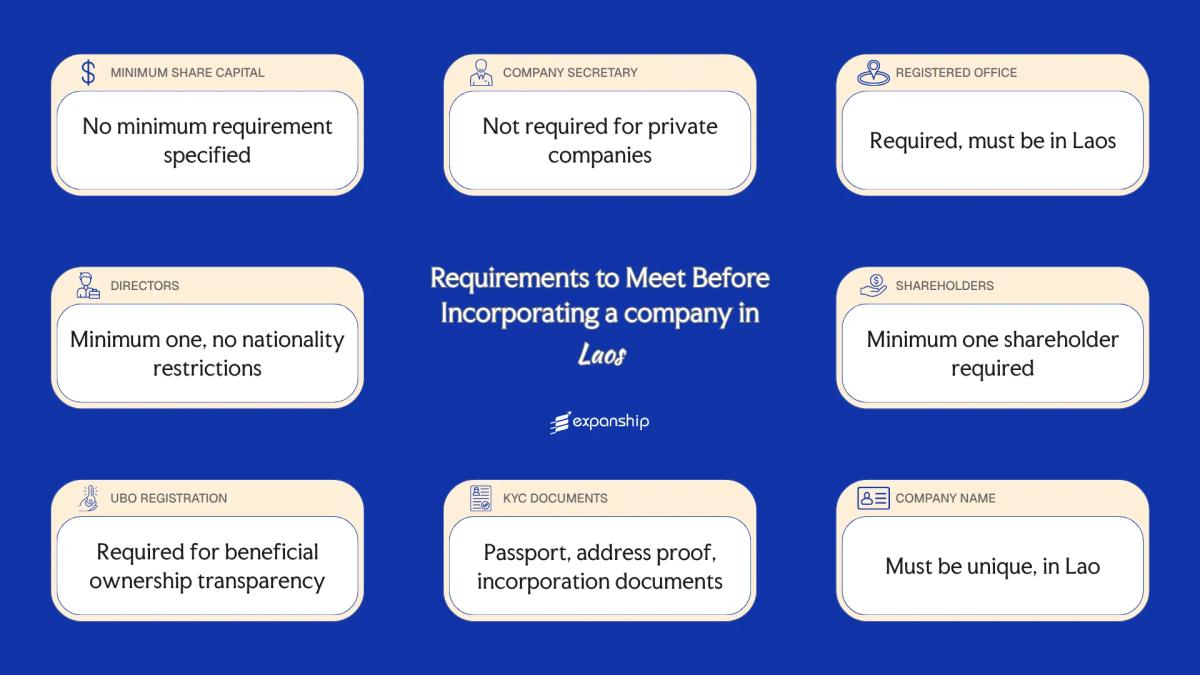
- Foreign-owned entities in Laos must meet sector-specific minimum share capital thresholds set under the Law on Business Entities before the Ministry of Industry and Commerce will approve a registration application.
- Every company incorporated in Lao PDR is required to maintain a physical registered office address within the country, which must be verifiable at the point of registration through the Lao National Single Window portal.
- Beneficial ownership information must be disclosed as part of the incorporation process, obligating applicants to identify and declare the ultimate beneficial owners of the entity to the relevant Lao authorities.
- The composition of directors and shareholders in a Lao entity is subject to requirements that differ depending on whether the ownership structure involves foreign nationals or foreign capital, making it necessary to confirm eligibility before filing.
Entity formation in Laos is governed by the Law on Business Entities, administered through the Ministry of Industry and Commerce (MOIC) and processed via the Lao National Single Window portal. This article covers the structural, documentary, and legal requirements that apply when registering a business under Lao law.
Failure to satisfy these conditions results in rejection of the registration application or, where a business is already operating, exposure to administrative sanctions and potential suspension of business activities.
Requirements differ depending on the type of legal entity, the sector in which the firm intends to operate, and whether the ownership structure involves foreign nationals or foreign capital.
Foreign investors, joint venture partners, and business owners seeking to establish a presence in Lao PDR will find this article most directly applicable to their situation.
Minimum Share Capital Requirements in Laos
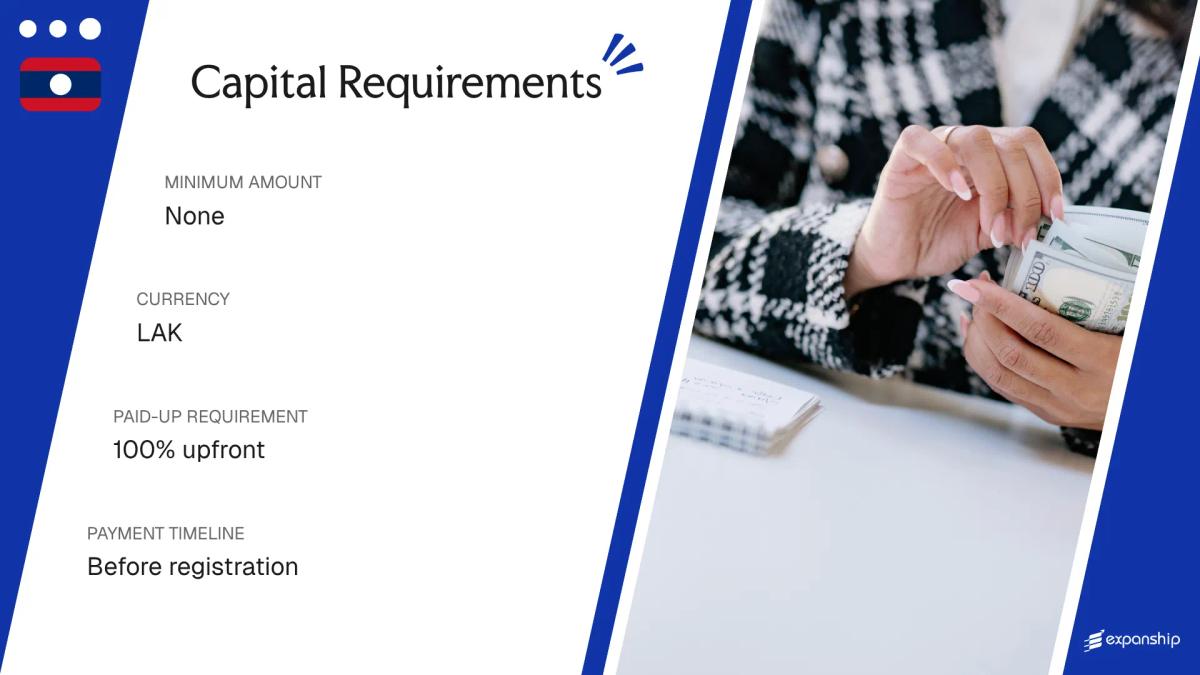
Under the Enterprise Law of Lao PDR, minimum share capital requirements in Laos vary depending on the type of business entity and the sector in which it operates. Laos operates on a par value share system, meaning each share carries a stated nominal value.
Capital requirements are verified by the Ministry of Industry and Commerce (MoIC) through its business registration process, with sector-specific thresholds sometimes enforced by the relevant line ministry or regulatory authority. Meeting the applicable capital threshold is a condition of registration, not merely a post-incorporation obligation.
| Parameter | Detail |
|---|---|
| Minimum Authorized Share Capital | Varies by entity type and sector; no single universal statutory minimum |
| Maximum Authorized Share Capital | No statutory maximum |
| Minimum Paid-Up Capital | Varies by sector; foreign-invested entities may face higher thresholds |
| Paid-Up Requirement at Incorporation | Required prior to or at the point of business registration |
| Accepted Currency | Lao Kip (LAK); foreign currency permitted in certain foreign-invested structures |
| Accepted Forms of Contribution | Cash and non-cash contributions including assets and intellectual property |
| Timeframe to Deposit Capital | Generally required before registration is finalized with the MoIC |
Your capital must typically be deposited and verifiable before the MoIC finalizes registration. Delaying this step can stall the entire business registration process.
Company Secretary Requirements in Laos
Under Lao PDR's company registration framework, there is no statutory requirement for a dedicated company secretary role equivalent to those found in common law jurisdictions. That said, company secretary requirements in Laos are addressed through the broader obligations assigned to appointed directors and responsible officers under the Enterprise Law.
Certain administrative functions must still be fulfilled by a designated individual within the firm. These include maintaining statutory registers, ensuring timely filing of annual reports with the Ministry of Industry and Commerce, and keeping corporate resolutions in order.
Regarding who may serve in a qualifying administrative or representative capacity, the general eligibility criteria include:
- Natural persons of legal age; no specific professional qualification is mandated by statute
- Foreign nationals may serve, subject to applicable visa and work authorisation conditions
- Corporate entities may not fulfil this role in a personal representative capacity
- The individual must be reachable for regulatory correspondence through the entity's official channels

Incorporate a Company in Laos
Set up your business in Laos with guidance on entity structure, registration filings, and ongoing Lao PDR compliance obligations.
Registered Office Requirements in Laos
Registered office requirements in Laos are governed by the Enterprise Law (revised), which mandates that every registered company maintain a physical address within the Lao PDR as its official legal address for government correspondence and regulatory notices. Failure to maintain a compliant address can result in administrative penalties and may expose the entity to deregistration proceedings by the Ministry of Industry and Commerce.
- A physical address is required; P.O. boxes are not accepted as a registered address.
- The address must be located within Lao PDR, not abroad.
- Virtual offices are generally not recognised as compliant registered addresses under current practice.
- Either ownership documentation or a lease agreement for the premises is required to substantiate the address.
- The registered address is publicly listed on the Enterprise Registration Certificate issued by the Ministry of Industry and Commerce.
- Any change to the registered address must be formally notified to the Ministry of Industry and Commerce through an official amendment filing.
Director Requirements in Laos
Under the Enterprise Law of Laos (No. 46/NA, 2014) and its subsequent amendments, director requirements in Laos company formations are governed by obligations that attach at the point of appointment, including fiduciary duties to act in the best interests of the entity and personal liability for decisions that cause loss through negligence or misconduct.
| Parameter | Detail |
|---|---|
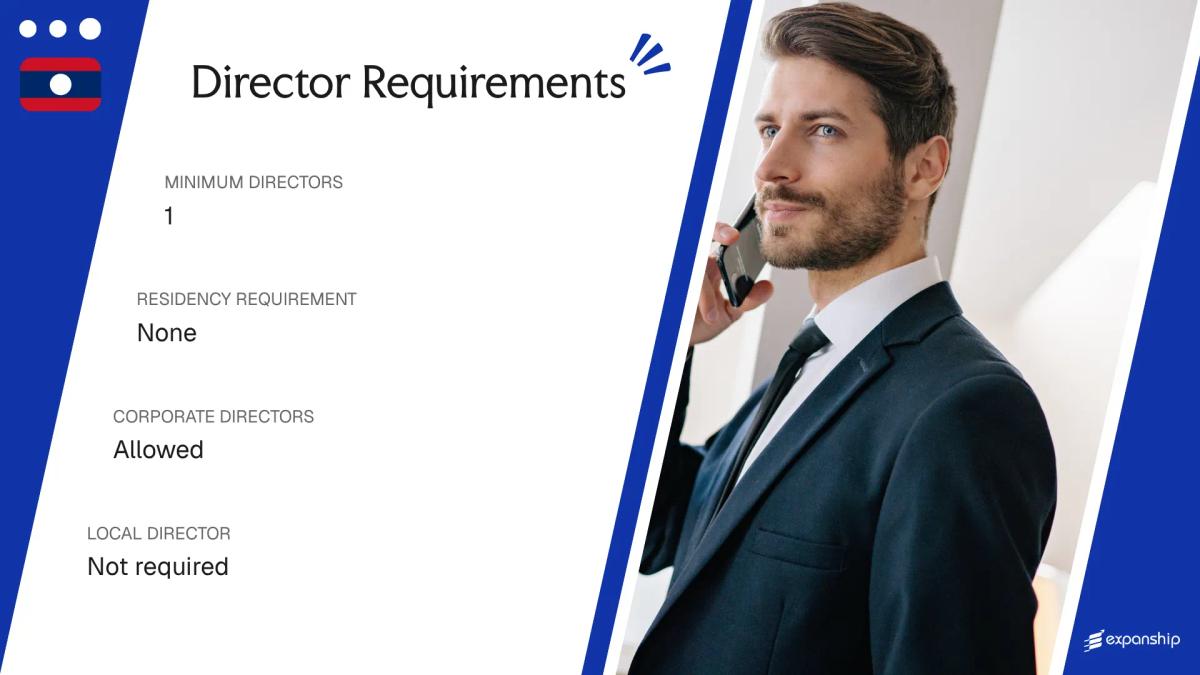
| Minimum Number of Directors | One director is required. |
| Maximum Number of Directors | No statutory maximum is prescribed under the Enterprise Law. |
| Local/Resident Director Required | No residency requirement is imposed by statute. |
| Nationality Restrictions | No nationality restrictions apply; foreign nationals may serve as directors. |
| Minimum Age Requirement | Directors must be at least 18 years of age. |
| Corporate Directors Permitted | No statutory provision explicitly permits corporate directors; individual persons are the standard requirement. |
| Director Must Be a Shareholder | Directors are not required to hold shares in the company. |
| Publicly Listed on Registry | Director information is recorded with the Department of Enterprise Registration and Management (DERM). |
| Disqualification Conditions | Persons who have been declared bankrupt or convicted of fraud-related offences may be disqualified from serving. |
Despite Laos having no local director residency requirement, all director appointments must still be physically registered with DERM in Vientiane, meaning a foreign-resident director's documentation must be authenticated and submitted in-country regardless of where that individual is based.
Shareholder Requirements in Laos
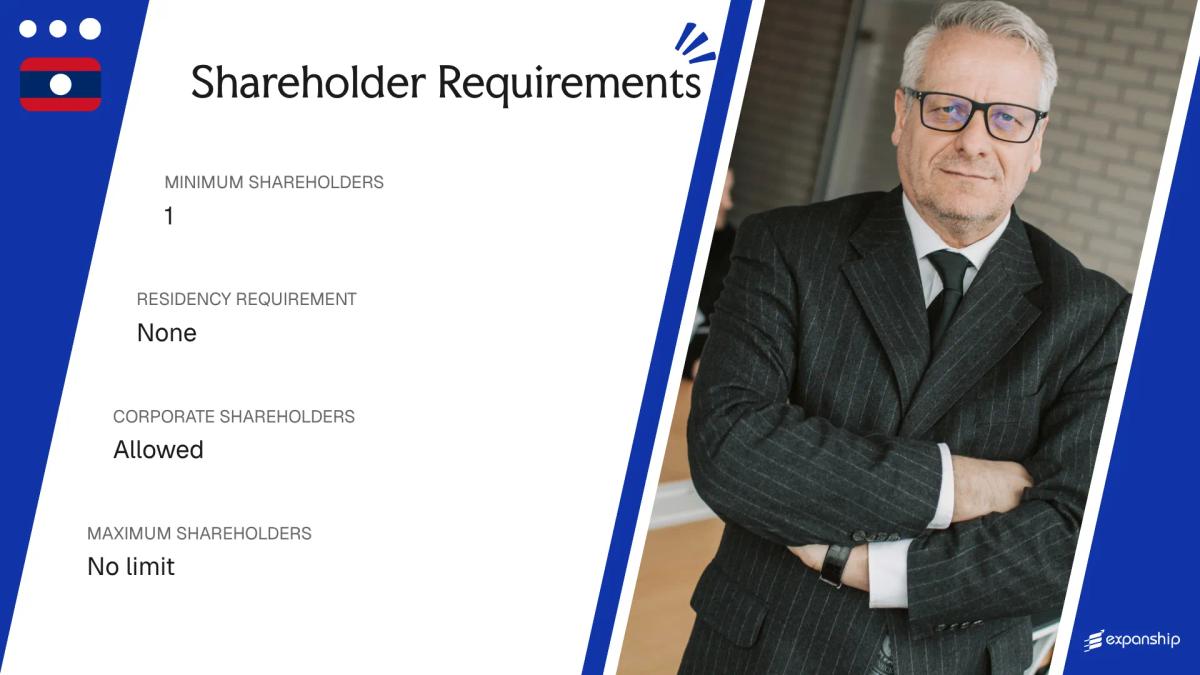
Under Lao PDR company law, a limited liability company requires a minimum of one shareholder and may have up to thirty. A sole shareholder structure is permitted, allowing single-owner formation without a secondary party.
Nationality and Residency Restrictions
Meeting the shareholder requirements Laos company law imposes means understanding that foreign nationals may hold shares, but sector-specific restrictions apply under the Investment Promotion Law. Certain industries cap foreign ownership at below 100%, and some activities remain reserved exclusively for Lao nationals.
Corporate Shareholders
Legal entities may act as shareholders in a Lao-registered firm. No blanket prohibition exists against corporate ownership, though the foreign ownership rules applicable to individuals extend equally to foreign-incorporated entities.
Shareholder Liability
Liability is generally limited to each shareholder's capital contribution. In cases of fraud or misuse of the corporate structure, courts may disregard this limitation and impose extended personal liability.
Register of Shareholders
A register of shareholders must be maintained at the firm's registered office. Under the Enterprise Law, updates to shareholder information require notification to the Ministry of Industry and Commerce, though the register is not publicly accessible in full.
Shareholder Structure Guidance for Your Lao Entity
Get clarity on ownership rules, foreign shareholder conditions, and compliance obligations before incorporating in Laos.
UBO / Beneficial Ownership Disclosure Requirements in Laos
Beneficial ownership disclosure Laos obligations are governed by the Anti-Money Laundering Law (No. 34/NA, 2015) and subsequent regulations issued by the Anti-Money Laundering Intelligence Office (AMLIO), which define a beneficial owner as any natural person who ultimately owns or controls 20% or more of an entity's shares or voting rights.
- Identify all natural persons meeting the 20% ownership or control threshold prior to registration.
- Submit beneficial ownership information to the Ministry of Industry and Commerce (MOIC) as part of the enterprise registration process.
- Report UBO details to AMLIO if the entity falls within designated non-financial business or financial institution categories under AML obligations.
- Update recorded UBO information with the MOIC within a prescribed period following any change in ownership or control structure.
| Parameter | Detail |
|---|---|
| Ownership Threshold for UBO Status | 20% of shares or voting rights |
| Filing Authority | Ministry of Industry and Commerce (MOIC); AMLIO for AML-regulated entities |
| Disclosure Deadline at Incorporation | At the time of enterprise registration |
| Publicly Accessible Register | No publicly accessible register |
| Penalties for Non-Disclosure | Administrative penalties under the Anti-Money Laundering Law; specific fines not publicly codified |
| Ongoing Update Obligation | Required upon material changes to ownership or control |
KYC / Document Requirements in Laos
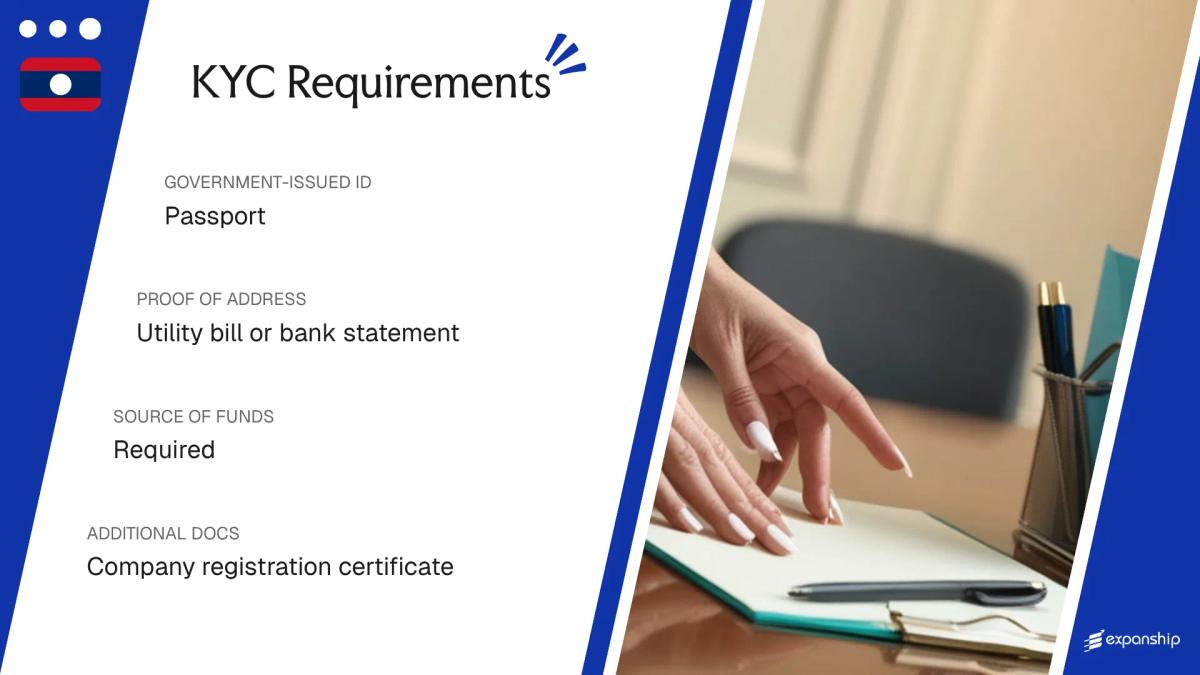
KYC document requirements in Laos are governed by the Law on Anti-Money Laundering and Counter-Financing of Terrorism, enforced through the Bank of Laos, which sets the baseline due diligence standards that apply at the point of company formation.
Individual / Personal Documents
- Valid passport or government-issued national identity card for each individual director, shareholder, or beneficial owner
- Proof of residential address dated within three months, such as a utility bill or bank statement
- Completed KYC declaration or personal information form as required by the registration agent or Ministry of Industry and Commerce
- Recent passport-sized photograph may be required depending on the registration channel
Corporate Documents
- Certificate of incorporation of the corporate shareholder or director, issued by the relevant home jurisdiction authority
- Certified copy of the articles of association or equivalent constitutional document
- Register of directors and register of shareholders of the corporate entity
- Proof of registered office address for the corporate entity
Source of Funds Documentation
- Bank statements from the preceding three to six months evidencing available capital
- Audited financial statements where the entity has an established operating history
- A written declaration of source of funds may be required for capital introductions above prescribed thresholds
Notarisation and Apostille Requirements
- Foreign documents generally require notarisation by a qualified notary in the country of origin
- Official translation into Lao by a certified translator is required for all documents not in the Lao language
- Laos is not a party to the Hague Apostille Convention, so legalisation through consular or embassy channels is typically required instead
Incomplete or improperly legalised foreign corporate documents are among the most frequent causes of incorporation delays at the Ministry of Industry and Commerce.
Company Name Requirements in Laos
Company name requirements in Laos are assessed by the business registration authority at the point of incorporation. Proposed names are reviewed for uniqueness and compliance with applicable naming rules before registration is approved.
Names must be written in the Lao language or include a Lao-language version. The legal suffix, such as "ບໍລິສັດຈຳກັດ" (Co., Ltd.) for a limited company, is mandatory and must appear in the registered name.
Certain words are prohibited or require prior governmental approval. Names implying a connection to the state, international organisations, or regulated industries generally fall into a restricted category.
Name reservation is available through the registration authority prior to formal incorporation. The reservation period is limited, and the application is submitted alongside other pre-incorporation documentation.
Compliance Services for Companies in Laos
Maintain your company's good standing in Laos with ongoing compliance support, including annual filings, licence renewals, and regulatory reporting.
Conclusion
Laos company incorporation requirements span several distinct areas governed primarily by the Law on Enterprise and administered through the Ministry of Industry and Commerce. Foreign investors must satisfy conditions around share capital thresholds, directorship, registered office presence, and beneficial ownership disclosure before registration is complete.
Two requirements tend to carry the most practical weight. Foreign-owned entities face sector-specific share capital minimums that vary by activity, and the mandatory physical registered office address within Lao PDR ties the entity to a verifiable local presence. Once these obligations are understood, the next step is executing the registration process itself with the relevant authorities.
Expanship's Corporate Formation Services in Laos
Expanship's company formation services in Laos are structured around the specific requirements that govern foreign-owned entities under the Enterprise Law and the Foreign Investment Promotion Law. From minimum capital thresholds to registered office obligations, the firm helps you manage the documentation, filings, and regulatory interactions that these requirements generate. That reduces the operational burden on your team without overstating what professional support can achieve in a jurisdiction where government processing timelines are set by local authorities.
Expanship's service scope for Lao PDR company registration assistance covers the full incorporation and post-registration cycle:
- Preparing incorporation documents and filing your company registration with the Ministry of Industry and Commerce
- Providing a registered agent and local office address to satisfy residency requirements
- Liaising with government departments and regulatory bodies on your behalf
- Managing ongoing compliance obligations after your entity is established
- Facilitating introductions to banking institutions for account opening
- Handling tax registration and coordination with the Tax Department
To discuss your requirements, contact Expanship Laos.
Frequently Asked Questions (FAQ)
Beneficial ownership disclosure in Laos applies regardless of company type and covers any individual who ultimately owns or controls the entity. The requirement extends to indirect ownership structures, meaning foreign holding companies with Lao subsidiaries must disclose the natural persons at the top of the ownership chain, not just the immediate corporate shareholder.
Operating without a valid registered office address on file with the Business Registration Office can result in administrative penalties and complications with license renewals. Regulatory correspondence sent to an invalid address does not exempt your company from compliance obligations, and unresponsive entities risk suspension of their enterprise registration certificate.
A foreign national can serve as the sole director of a company registered in Laos without a mandatory local co-director requirement. However, certain restricted or concession-based sectors may impose additional conditions through sector-specific licensing that effectively require local representation at the board level.
The minimum shareholder requirement in Laos varies by entity type under the Enterprise Law. A sole proprietorship requires one individual, while a limited liability company can be formed with a single member, but a public company requires a higher minimum number of shareholders as stipulated at registration with the relevant ministry.
Foreign shareholders must submit notarised and apostilled identity documents, which typically include a certified passport copy and proof of address, whereas Lao nationals provide national identification documents that do not require the same level of authentication. Where the foreign shareholder is a corporate entity rather than an individual, certified copies of the parent company's constitutional documents and a certificate of incumbency are generally required.
Company names in Laos cannot include references to government institutions, the state, or regulated industries such as banking, insurance, or securities without prior approval from the relevant supervisory authority. The Business Registration Office will reject applications where the proposed name implies an affiliation with a public body or a licensed sector in which the entity has not obtained the corresponding regulatory approval.
Legal Disclaimer
The information provided in this article is for general informational purposes only and does not constitute legal, tax, or professional advice. While we strive to ensure the accuracy and timeliness of the content, laws and regulations are subject to change, and the application of laws can vary widely based on specific facts and circumstances.
Readers should not act upon this information without seeking professional counsel tailored to their individual situation. Expanship and its authors disclaim any liability for actions taken or not taken based on the content of this article.
For specific advice regarding your business setup, compliance requirements, or any legal matters, please consult with qualified legal and tax professionals in the relevant jurisdiction.