

Key Takeaways
- Foreign investors in most sectors cannot hold majority ownership without a Lao joint venture partner, a structural constraint embedded in the Enterprise Law that directly limits operational control and profit repatriation flexibility.
- Wholly foreign-owned entities are effectively barred from owning land, restricting long-term asset security to leasehold arrangements that depend on government concession terms rather than freehold title.
- Currency controls on the Lao kip create tangible friction for businesses needing to convert local revenues into hard currency, adding transactional costs and timing risk to cross-border financial operations.
- Intellectual property protections exist on paper but suffer from inconsistent enforcement at the regulatory level, exposing foreign brands, patents, and proprietary technology to infringement without reliable legal recourse.
Laos operates under an evolving regulatory framework, shaped significantly by the Enterprise Law and ongoing reforms tied to the country's ASEAN commitments and foreign investment promotion agenda. The disadvantages of incorporating in Laos span structural, financial, and operational dimensions, each varying in severity depending on your sector, entity type, and intended scale of operations.
Foreign investors entering manufacturing, services, or retail will encounter a different set of constraints than those operating in concession-based or special economic zone structures. This article is most directly relevant to foreign entrepreneurs and multinational firms seeking to establish a wholly or majority foreign-owned entity under Lao jurisdiction.
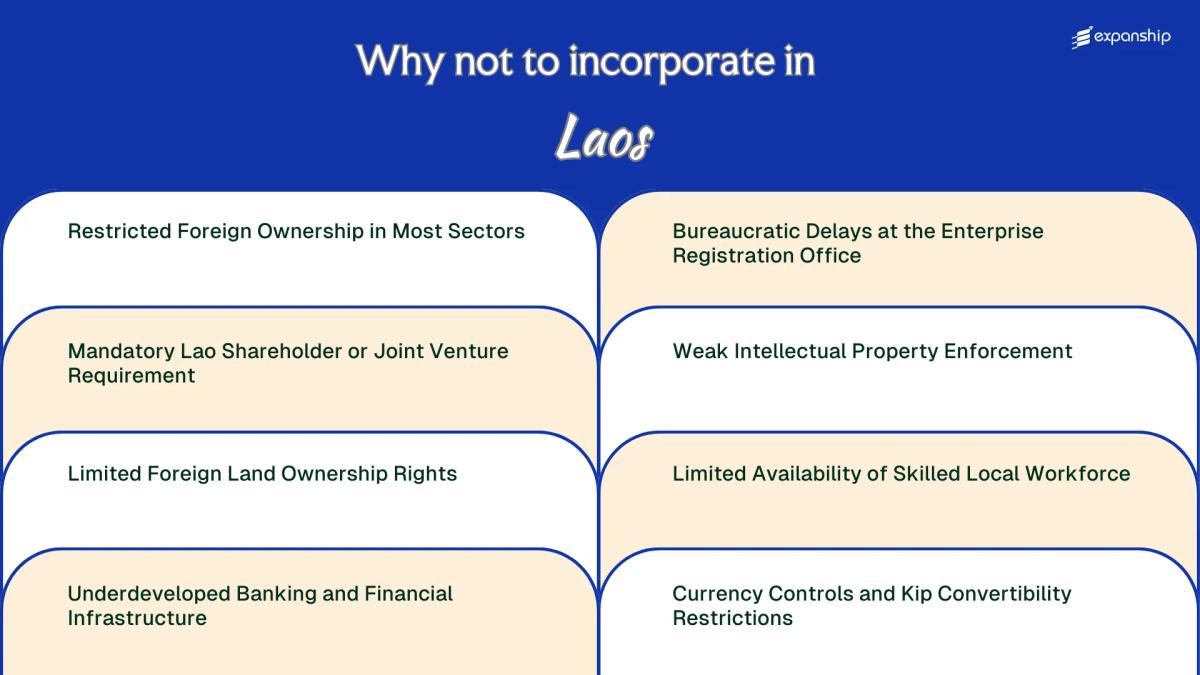
Restricted Foreign Ownership in Most Sectors
Foreign ownership restrictions in Laos affect virtually every commercially significant sector, leaving foreign investors with limited structural options for full-equity entry. Under the Investment Promotion Law No. 14/NA (2016), the government categorizes business activities into promoted, conditional, and prohibited zones, with the conditional category covering most industries where foreigners seek to operate.
Sector-Level Ownership Caps Reduce Operational Control
Foreign equity ceilings in conditional sectors can fall below 50%, meaning your firm may be legally prevented from holding a controlling stake in its own operating entity. This cap directly undermines decision-making authority, profit repatriation arrangements, and exit options.
Retail trade, agriculture, and certain service industries are routinely subject to Lao FDI ownership constraints that are determined through interministerial review rather than published as fixed percentages. The opacity of that process adds unpredictability to what is already a structurally restrictive entry environment.
Prohibited Activities Close Off Entire Market Segments
Certain industries remain outright closed to foreign participation under the investment classification framework, regardless of equity structure or capitalization. Your business cannot enter these segments through any corporate arrangement.
The restricted industries for foreigners include specific areas tied to national security, media, and land-linked businesses, with the Ministry of Planning and Investment holding discretionary authority over classification decisions.
In sectors where equity caps apply, foreign investors without a controlling stake face binding decisions made by Lao co-shareholders over budgets, staffing, and profit distribution.
Mandatory Lao Shareholder or Joint Venture Requirement
The Laos joint venture requirement for foreign investors is embedded in the Investment Promotion Law (No. 14/NA, 2016) and sector-specific concession frameworks. In restricted sectors, foreign entities cannot hold 100% ownership and must bring in a Lao national or Lao-registered entity as a co-owner. This structural constraint is not a formality — it redistributes control, profit rights, and decision-making authority before your business has generated a single kip.
Finding a qualified, trustworthy local partner is itself a time-consuming and legally consequential process.
Practically, the mandatory Lao shareholder disadvantage surfaces across multiple operational layers:
- Profit distribution clauses must account for a local partner's share, directly reducing the return on your invested capital
- Deadlocks in shareholder decisions can delay operational changes because local partners hold protected voting rights
- Confidential business information, proprietary processes, and client relationships become accessible to a party whose long-term interests may not align with yours
- Replacing a local partner requires formal amendment procedures with the Ministry of Planning and Investment, creating delays and legal costs
Some wholly foreign-owned structures are permitted in specific promoted sectors under the investment promotion framework, but these exceptions are narrow and subject to ministerial discretion.

Company Incorporation in Laos
Understand the ownership structures, regulatory requirements, and registration process before establishing your entity in Laos.
Limited Foreign Land Ownership Rights
Foreign land ownership restrictions in Laos are among the most structurally binding constraints a foreign business will encounter. Under the Land Law (No. 04/NA, 2019) and the Investment Promotion Law (No. 14/NA, 2016), foreign investors cannot hold freehold title to land. Your company can only access land through use rights, concession agreements, or lease arrangements with the Lao state or private Lao landholders.
Concession agreements are typically government-granted for specific project types, but the terms are negotiable on a case-by-case basis, which introduces significant unpredictability into your cost and tenure planning.
| Access Type | Maximum Permitted Duration | Freehold Title Available to Foreigners |
|---|---|---|
| Land lease (private) | Up to 30 years (renewable) | No |
| State land concession | Up to 50 years (extendable by approval) | No |
| Land use rights (residential) | Up to 30 years | No |
| Special Economic Zone lease | Up to 75 years (project-dependent) | No |
Lease renewals are not guaranteed by statute, which means your operational infrastructure can be jeopardized at the end of a lease term. For capital-intensive projects requiring long-term site security, this creates real exposure that would not exist in jurisdictions where foreign entities can acquire freehold commercial property.
The concession land risks foreign companies face are compounded by the fact that the state retains the authority to revoke or modify concession terms under certain conditions defined in the Investment Promotion Law.
Underdeveloped Banking and Financial Infrastructure
Laos banking infrastructure limitations affect foreign companies at nearly every operational stage, from opening a corporate account to moving funds across borders. The banking sector remains dominated by state-owned institutions, with the Bank of the Lao PDR acting as the central regulatory authority under the Law on the Bank of the Lao PDR.
Account opening timelines at commercial banks are significantly longer than regional peers, often requiring extensive documentation and in-person appearances that delay business operations. For foreign-owned entities, correspondent banking relationships are limited, making international wire transfers slower and more costly than in neighboring Thailand or Vietnam.
Credit access is another structural constraint. Local lending markets are underdeveloped, meaning foreign firms cannot easily secure working capital financing through domestic banks and must rely on offshore funding arrangements.
- Corporate bank accounts may require extended processing periods before becoming operational
- International transfers are subject to documentation requirements under Bank of the Lao PDR regulations
- Foreign currency account options for businesses are limited and subject to approval conditions
- Access to trade finance instruments such as letters of credit is restricted at most local institutions
- Digital banking infrastructure for business accounts remains functionally limited compared to regional standards
Laos has one of the lowest rates of business banking penetration in Southeast Asia, meaning many commercial transactions — even at the corporate level — still default to cash-based settlement.
Bureaucratic Delays at the Enterprise Registration Office
Laos Enterprise Registration Office delays present one of the more tangible friction points for foreign investors. Processing times at the Department of Enterprise Registration and Management (DERM) under the Ministry of Industry and Commerce routinely exceed official timelines.
Structural Bottlenecks in the Registration Process
DERM handles enterprise registration, but approval often requires sequential sign-offs from multiple ministries depending on the business sector, meaning a single incomplete document can reset the entire queue. For foreign-owned entities, this sequential review process can extend incorporation from weeks into several months, generating real costs in legal fees, delayed market entry, and prolonged personal presence requirements.
Practical Consequences for Foreign Businesses
The business registration process problems in Laos are compounded by inconsistent document requirements, where applicants sometimes receive different checklists from the same office across separate visits. Your firm's capital sits idle during this period, and any operational commitments made in anticipation of a registration date carry meaningful financial exposure.
Even businesses operating in sectors with pre-approved investment frameworks under the Investment Promotion Law (No. 14/NA, 2016) are not exempt from administrative delays at the registration stage itself.
Managing Registration Delays for Your Laos Entity
Expanship works directly with local authorities and licensed agents in Laos to manage document coordination, ministry approvals, and registration timelines on your behalf.
Weak Intellectual Property Enforcement
Weak intellectual property enforcement Laos presents a direct commercial risk: your proprietary assets, including trademarks, trade secrets, and software, receive limited practical protection regardless of formal registration. The Intellectual Property Law (2011, amended 2017) establishes a legal framework, but enforcement capacity at the Department of Intellectual Property under the Ministry of Science and Technology remains structurally underdeveloped.
- Trademark registration does not guarantee market protection, since counterfeit goods and brand imitation frequently persist without meaningful administrative or judicial intervention.
- Civil litigation for IP infringement is slow and unpredictable, exposing your business to prolonged loss of market position before any remedy is issued.
- Customs authorities lack the technical resources to intercept infringing imports systematically, which limits border enforcement as a practical tool.
- Damages awarded in IP disputes are generally low, reducing the deterrent effect of litigation for foreign rights holders.
- Enforcement actions typically require the rights holder to initiate and fund the process, placing the operational and financial burden entirely on your firm.
Limited Availability of Skilled Local Workforce
Laos skilled workforce shortage risks are a structural constraint, not a temporary gap. The country's tertiary enrollment rate remains low relative to regional peers, and technical and vocational training capacity is limited, meaning foreign firms cannot reliably source qualified local professionals for mid-to-senior operational roles.
Under the Labour Law (amended 2013), foreign businesses are subject to quotas on expatriate hires, which means your firm cannot simply offset local talent gaps by staffing positions with foreign nationals. Filling skilled roles then requires either extended recruitment timelines or significant investment in on-site training programs.
Industries requiring specialized expertise — finance, engineering, IT, and life sciences — face the sharpest constraints. The absence of a deep local talent pool also drives up compensation expectations for the few qualified candidates available.
A foreign-owned firm in Vientiane attempting to hire five mid-level finance professionals locally may face a 6-to-9 month recruitment cycle, and may ultimately need to fund accredited training for hires who meet only partial qualification requirements — adding an estimated $15,000–$25,000 USD per hire in combined recruitment and development costs before the employee reaches full productivity.
Currency Controls and Kip Convertibility Restrictions
Laos currency controls business risks are among the more concrete financial barriers foreign investors encounter after incorporation. The Bank of the Lao PDR (BOL) governs all foreign exchange transactions, and converting Lao Kip (LAK) into hard currency requires documented justification tied to approved business purposes.
Repatriation of profits is not freely permitted. Your firm must demonstrate that underlying transactions are legitimate and properly recorded, a requirement that creates delays when treasury teams expect routine dividend transfers.
The Kip is not freely convertible on international markets. This means your entity cannot hedge currency exposure through standard financial instruments available in more open economies, leaving profit margins directly vulnerable to exchange rate movements.
- Foreign currency accounts held by businesses in Laos require BOL authorization.
- Transfers above prescribed thresholds trigger additional documentation and approval procedures.
- Foreign loan repayments and royalty remittances to overseas entities are subject to separate review under BOL regulations.
Exceptions exist for enterprises operating within Special Economic Zones, where certain foreign exchange rules are relaxed under their specific concession agreements, but most standard business registrations fall outside that framework.
Any foreign business that has not secured prior BOL authorization for foreign currency accounts or outbound transfers may find that profits are effectively trapped in Kip with no legal mechanism for immediate repatriation.
Strategies to Overcome These Disadvantages
Overcoming Laos business incorporation challenges requires structural planning before the entity is formed, not after problems emerge.
- Structure your entry through a joint venture with a Lao national or state-owned enterprise, as required under the Investment Promotion Law for restricted sectors.
- Register your business under a qualifying sector with the Ministry of Planning and Investment to access concession land rights in lieu of freehold ownership.
- Open multi-currency accounts with foreign bank branches licensed to operate domestically, reducing exposure to kip convertibility constraints.
- File trademark and copyright registrations with the Department of Intellectual Property under the Ministry of Science and Technology before commencing operations.
- Retain qualified bilingual legal counsel familiar with the Enterprise Registration Office's submission protocols to reduce processing delays.
- Establish internal workforce development programmes, given the constrained availability of locally qualified professionals in specialised fields.
Each of these steps operates within a regulatory framework that continues to evolve through periodic amendments to the Investment Promotion Law and related ministerial regulations. Structural compliance decisions made at incorporation have lasting legal and operational consequences.
Laos as a Business Destination Today
Laos presents a credible incorporation destination for foreign businesses with specific regional objectives, particularly those targeting the Greater Mekong Subregion or operating under the ASEAN framework. The Laos business environment risks today are real and well-documented, but they are not uniform in how they affect every business profile.
| Pro | Con |
|---|---|
| ASEAN membership provides preferential trade access across member states | Foreign ownership is restricted in most sectors, requiring Lao partners or joint venture structures |
| Special Economic Zones offer land concession rights unavailable in standard arrangements | Outright foreign land ownership is prohibited under Lao law |
| Low corporate tax rates and available tax incentives in promoted sectors | Banking infrastructure remains underdeveloped, limiting financing and treasury options |
| A young and growing workforce provides a base labor pool | Skilled local professionals are limited, increasing reliance on expatriate hires |
| Strategic position as a land-linked corridor between China, Thailand, and Vietnam | The kip is not freely convertible, and currency controls restrict profit repatriation |
Formal registration through the Enterprise Registration Office can extend timelines considerably. Intellectual property protections exist on paper but are inconsistently applied in practice.
Compliance Services for Companies in Laos
Keep your Lao-registered entity in good standing with local regulatory requirements, from annual filings to ongoing statutory obligations.
Conclusion
Laos presents a defined set of structural constraints for foreign investors, and the Laos company incorporation cons summary reflects challenges that are institutional rather than incidental. Restricted sector access under the Foreign Investment Promotion Law, joint venture requirements that limit operational control, and currency controls affecting Kip convertibility are among the most consequential factors shaping the cost and complexity of doing business here. Thin banking infrastructure compounds these issues at the operational level. For businesses that have assessed these risks and still see viable opportunity, the path forward depends heavily on local legal structuring and regulatory guidance.
Expanship's Services for Your Laos Expansion
Incorporating in Laos involves a set of compliance obligations that are not always straightforward for foreign businesses to manage independently. From satisfying the Enterprise Registration Office's documentation requirements to meeting joint venture conditions under the Investment Promotion Law, the administrative load is real. Expanship's Laos company formation compliance services help you manage that load without overstating what external support can change about the regulatory environment.
Beyond registration, your business may need ongoing structural and compliance support across multiple fronts.
- Preparing and submitting incorporation documents with the Enterprise Registration Office.
- Providing a registered agent and local office address in Laos.
- Handling government filings and liaising with relevant regulatory authorities on your behalf.
- Managing post-incorporation compliance obligations as they arise.
- Facilitating introductions to local banking institutions to support account opening.
- Registering your entity with the Tax Department and coordinating with local authorities.
Reach out to Expanship Laos to discuss your specific setup requirements.
Frequently Asked Questions (FAQ)
The requirement does not apply uniformly, but the exemptions are narrow. Certain activities in the concession and special economic zone categories may permit majority or full foreign ownership under negotiated terms, while standard commercial sectors routinely require a Lao national to hold a defined equity stake. Without a verified sector-specific analysis against the Investment Promotion Law and relevant ministerial regulations, assuming your industry qualifies for an exemption carries real legal risk.
Repatriating profits from Laos requires converting Kip into a hard currency, and the Bank of the Lao PDR maintains controls that can delay or limit the volume of outward transfers. The Kip is not freely convertible on international markets, which exposes your business to exchange rate risk during the conversion window. For firms with significant revenue in Laos, this creates a structural mismatch between local earnings and the currency in which offshore obligations are denominated.
Registration through the Ministry of Industry and Commerce's Enterprise Registration Office routinely extends beyond the published timelines, particularly where sector-specific approvals from line ministries are required. A business that would register in days in Singapore or Hong Kong may take several months in Laos when environmental assessments, land-use permits, or investment approvals run concurrently. These delays have direct cost implications, including extended pre-revenue periods and ongoing professional service fees.
Laos ranks among the weakest in Southeast Asia for IP enforcement, even relative to regional peers such as Cambodia and Myanmar that are themselves frequently cited for enforcement gaps. While Laos is a member of WIPO and has domestic IP legislation on the books, the practical capacity of courts and regulatory agencies to pursue infringement cases is limited. For businesses whose value is tied to trademarks, proprietary processes, or software, this translates directly into unmitigated commercial exposure.
If local hiring requirements under the Labor Law cannot be met due to workforce skill shortages, companies often face a difficult choice between under-staffing and applying for foreign worker quotas, which require government approval and are subject to caps. Bringing in expatriate staff adds cost through visa fees, work permit processes, and higher compensation expectations, eroding the wage advantage that Laos is sometimes assumed to offer. In technical or management-heavy operations, workforce constraints can become a ceiling on what the entity is operationally capable of achieving.
Foreign investors cannot own land outright in Laos. The Land Law restricts land ownership to Lao nationals and the Lao state, leaving foreign businesses dependent on land concession agreements or long-term lease structures. These arrangements introduce counterparty and political risk, since concession terms can be renegotiated or revoked, particularly for land in areas the government designates for national development priorities.
Access to trade finance, multi-currency accounts, and reliable cross-border payment infrastructure is materially limited in Laos compared to regional financial hubs. Correspondent banking relationships between Lao commercial banks and major international institutions are thin, which slows international transactions and increases the cost of routine foreign exchange operations. Businesses that depend on frequent supplier payments abroad or invoice clients in multiple currencies will encounter friction that does not exist in more financially developed jurisdictions.
Legal Disclaimer
The information provided in this article is for general informational purposes only and does not constitute legal, tax, or professional advice. While we strive to ensure the accuracy and timeliness of the content, laws and regulations are subject to change, and the application of laws can vary widely based on specific facts and circumstances.
Readers should not act upon this information without seeking professional counsel tailored to their individual situation. Expanship and its authors disclaim any liability for actions taken or not taken based on the content of this article.
For specific advice regarding your business setup, compliance requirements, or any legal matters, please consult with qualified legal and tax professionals in the relevant jurisdiction.