
Key Takeaways
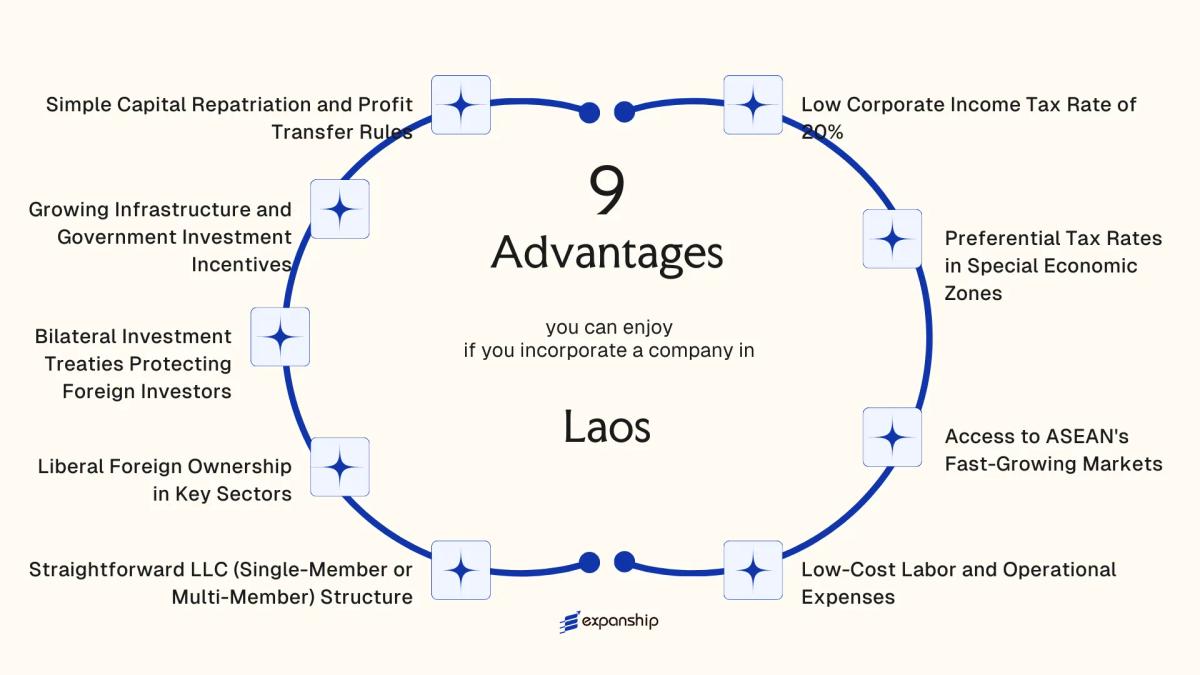
- Laos applies a standard corporate income tax rate of 20%, with further reductions available to qualifying businesses established within Special Economic Zones, allowing foreign investors to structure their effective tax burden below the regional ASEAN average.
- Under the Investment Promotion Law, key sectors are open to foreign direct investment with defined ownership parameters, giving investors a clear legal basis for establishing majority or wholly foreign-owned entities where permitted.
- Bilateral investment treaties provide foreign-owned Lao entities with enforceable legal protections that operate outside the domestic court system, offering a dispute resolution foundation backed by international treaty obligations.
- The LLC structure governed by the Law on Business Entities — available as either a single-member or multi-member vehicle — keeps ongoing compliance requirements proportionate to the scale of the operation, reducing administrative overhead for market-entry structures.
Laos is a landlocked, single-party socialist republic in mainland Southeast Asia, bordered by China, Vietnam, Thailand, Myanmar, and Cambodia. The benefits of incorporating in Laos have drawn increasing attention from foreign investors, particularly those seeking access to the Greater Mekong Subregion's trade corridors. Company registration falls under the authority of the Ministry of Industry and Commerce, which administers the business registration process through its Enterprise Registration Department. Foreign businesses most commonly establish a presence through a Limited Liability Company.
From a tax standpoint, the country operates a low-tax territorial regime with a standard corporate income tax rate that remains competitive within the ASEAN bloc. The government has progressively opened key sectors to foreign direct investment, though certain industries remain subject to ownership restrictions under the Investment Promotion Law.
This article examines the principal advantages your business gains by registering a company here, drawing on the regulatory framework and investment conditions currently in place.
Low Corporate Income Tax Rate of 20%
Laos applies a standard corporate income tax (CIT) rate of 20% under the Law on Tax, which sits below the global average of approximately 23% and below several regional peers such as Thailand at 20% (matching) and Vietnam at 20%, while the Philippines applies 25%. For foreign investors, this rate applies to net profit derived from business activities conducted within the country.
What the 20% Rate Means in Practice
The Laos 20% corporate income tax advantage is straightforward: your entity pays tax on net profit, not gross revenue, which allows legitimate deductions for operating costs to reduce the taxable base. This structure gives businesses room to manage their effective tax burden through ordinary expense recognition.
Consistency as a Planning Advantage
Rate predictability matters as much as the rate itself. The 20% CIT rate has remained consistent, allowing foreign firms to model multi-year financial projections without accounting for frequent legislative shifts that can affect tax planning in more volatile jurisdictions.
Laos corporate tax benefits for foreign investors extend further when your business qualifies for sector-specific exemptions under the Investment Promotion Law, which can reduce or defer CIT obligations during an initial operating period.
A stable 20% CIT rate on net profit gives your firm a predictable tax cost from the first year of operation.
Preferential Tax Rates in Special Economic Zones
Laos special economic zone tax incentives represent one of the more concrete fiscal advantages available to foreign investors incorporating in the country. Under the Special Economic Zone (SEZ) framework governed by the Law on Investment Promotion (No. 14/NA, 2016), businesses operating within designated zones qualify for preferential corporate income tax rates that fall well below the standard 20% rate applied nationally.
Depending on the specific SEZ and the nature of the investment, corporate income tax can be reduced to as low as 8% to 10% for qualifying enterprises. This reduction applies for defined periods, often ranging from 10 to 15 years, giving your business a predictable tax position during the critical early stages of operation.
Beyond the reduced rate itself, the practical advantage is compounded by additional concessions available within SEZ frameworks:
- Import duties on raw materials and production equipment are waived for qualifying manufacturing operations, directly reducing capital expenditure
- Value-added tax exemptions apply to certain goods produced within SEZs for export, improving margin on outbound sales
- Land lease terms within SEZs are typically structured on long-term concession agreements, reducing location costs that would otherwise affect operational budgets
Eligibility is contingent on the investment falling within promoted activity categories as defined under the Law on Investment Promotion and the specific SEZ's governing concession agreement.

Company Incorporation in Laos
Set up your company in Laos and access SEZ tax incentives with full regulatory compliance from day one.
Access to ASEAN's Fast-Growing Markets
As an ASEAN member state, Laos gives incorporated entities direct access to a regional bloc of over 670 million consumers operating under coordinated trade frameworks. The Laos ASEAN market access benefits stem specifically from the ASEAN Trade in Goods Agreement (ATIGA), which reduces or eliminates tariffs on thousands of product categories traded between member states. For businesses with regional supply or distribution goals, this means a company registered in Vientiane can ship goods to Thailand, Vietnam, or Cambodia under preferential duty rates that would not be available to a firm based outside the bloc.
| Agreement | Primary Benefit | Key Trading Partners Covered |
|---|---|---|
| ATIGA | Intra-ASEAN tariff reductions | All 10 ASEAN member states |
| ASEAN-China FTA | Preferential goods and services access | China |
| ASEAN-Australia-NZ FTA | Reduced tariffs on eligible exports | Australia, New Zealand |
| ASEAN-India FTA | Goods trade concessions | India |
Beyond goods, the ASEAN Framework Agreement on Services (AFAS) and its successor commitments under the ASEAN Trade in Services Agreement (ATISA) extend preferential conditions to service-based businesses. A firm incorporated here that meets local substance requirements can use these agreements to operate across multiple ASEAN markets without establishing separate legal entities in each country. Geographic positioning also matters: the country borders five nations, including China to the north, making it a functional transit and distribution base for cross-border trade flows throughout mainland Southeast Asia.
Low-Cost Labor and Operational Expenses
Laos low-cost labor advantages for businesses are among the most concrete, measurable factors drawing foreign capital into the country. Monthly minimum wages, set under the Labour Law and periodically revised by the Ministry of Labour and Social Welfare, remain significantly below regional peers such as Thailand and Vietnam. Lower payroll obligations translate directly into reduced recurring costs for labor-intensive operations.
Beyond wages, office rental and light industrial space carry lower price points than in comparable ASEAN cities. For a foreign firm setting up manufacturing, back-office, or processing functions, this gap in baseline overhead meaningfully reduces break-even timelines.
Utility costs, including electricity tariffs from Électricité du Laos, are structured to support industrial users, and the government has actively promoted the country as a regional energy exporter, which contributes to stable domestic supply.
Keep these points in mind when factoring in cost advantages:
- Minimum wage rates are revised periodically; confirm the current figure with the Ministry of Labour and Social Welfare before finalizing payroll projections
- Social security contribution rates for employers are defined under the Social Security Law and must be factored into total labor cost calculations
- Industrial zone operating costs may differ from standard commercial premises
- Actual cost comparisons should use verified sector-specific data, not general averages
Laos is one of the few ASEAN nations where electricity costs for industrial users are partly subsidized through cross-border power export revenues, which indirectly supports lower domestic tariffs.
Straightforward LLC (Single-Member or Multi-Member) Structure
Laos LLC structure benefits for foreign investors begin with a formation framework that keeps administrative complexity low without sacrificing legal clarity. Under the Enterprise Law of Laos, foreign investors can register either a single-member or multi-member limited liability company, with ownership structured to match the actual business arrangement from day one.
Single-Member Structure: Full Control Without a Partner Requirement
A foreign national can establish and wholly own a single-member LLC without mandating a local partner in sectors open to 100% foreign ownership. That means you retain sole decision-making authority over capital allocation, profit distribution, and operational direction, which matters significantly when you are coordinating across multiple jurisdictions or reporting to a parent entity abroad.
Liability for shareholders is capped at the value of their contributed capital. This separation between personal assets and company obligations gives individual investors a defined ceiling on financial exposure.
Multi-Member Structure: Flexible Equity Distribution
For joint ventures or businesses with multiple stakeholders, the multi-member LLC allows equity to be distributed according to negotiated terms among up to the legally permitted number of shareholders. This structural flexibility lets you accommodate both foreign co-investors and, where sector rules permit, Lao partners within the same legal vehicle.
The Enterprise Law also allows for changes in shareholding composition over the company's lifetime, so ownership can be restructured as the business scales without dissolving and re-registering the entity. That continuity reduces disruption and the administrative cost of reorganisation.
Structure Your Laos LLC the Right Way
Get guidance on choosing between single-member and multi-member LLC structures in Laos, and ensure your setup aligns with the Enterprise Law from the start.
Liberal Foreign Ownership in Key Sectors
Laos foreign ownership rights in key sectors are defined primarily under the Investment Promotion Law (No. 14/NA, 2016), which permits 100% foreign ownership across a broad range of activities. Unlike many regional counterparts that impose mandatory local partnership requirements in core industries, the Lao framework does not default to joint-venture structures for most commercial sectors.
- Foreign investors can hold full equity in manufacturing, agribusiness processing, hospitality, logistics, and a range of service industries without requiring a Lao national as a co-shareholder. This removes the operational and financial complications that arise when profit-sharing or governance rights must be split with a local partner.
- The Investment Promotion Law distinguishes between promoted and non-promoted activities, with the former receiving additional incentives. Structuring your business within a promoted category not only unlocks tax concessions but also supports unrestricted foreign equity, giving you both ownership security and a preferential cost position.
- Full ownership means your firm retains unilateral decision-making authority over dividends, reinvestment, and corporate restructuring. In jurisdictions where minority local partners hold veto rights, these decisions are routinely delayed or contested.
- The Ministry of Planning and Investment (MPI) administers foreign investment approvals, and ownership permissions are formalized at the registration stage, providing documented legal clarity from the outset.
Bilateral Investment Treaties Protecting Foreign Investors
Laos bilateral investment treaties for foreign investors provide a formal legal layer of protection that sits above domestic law. The country has signed BITs with over 20 partner states, including China, Japan, South Korea, Thailand, Germany, France, and Australia, among others.
Under these treaties, your business typically receives guarantees across several core protections:
- Fair and equitable treatment standards
- Protection against expropriation without adequate compensation
- Most-favored-nation treatment
- Access to international arbitration in the event of a dispute with the Lao state
The arbitration access is particularly consequential. Rather than relying solely on domestic courts, treaty-covered investors can refer disputes to neutral international forums, including ICSID or ad hoc arbitration under UNCITRAL rules, depending on the specific treaty text.
The Investment Promotion Law of Laos (amended 2016) reinforces these protections at the domestic level, prohibiting nationalization of foreign-owned investments without fair compensation. This alignment between treaty obligations and national law reduces legal exposure for foreign-owned entities operating in the country.
A foreign investor incorporated under a Laos-Germany BIT-covered structure retains the right to initiate ICSID arbitration directly against the Lao state, bypassing domestic court proceedings entirely, a procedural protection unavailable to purely domestic firms.
Growing Infrastructure and Government Investment Incentives
Laos government investment incentives for businesses are administered primarily through the Investment Promotion Law (No. 14/NA, 2016), which grants profit tax exemptions ranging from one to ten years depending on the sector and geographic zone of operation. For a foreign firm, this means pre-revenue and early-revenue years carry a reduced tax burden without requiring special negotiation.
The National Committee for Special Economic Zones (NCSEZ) oversees dedicated zones where infrastructure investment by the government directly reduces your setup costs. Roads, logistics corridors, and utilities in these zones are state-funded, which lowers the capital expenditure your entity would otherwise absorb.
Several government-backed incentives apply across qualifying sectors:
- Import duty exemptions on raw materials and equipment used in production
- Value-added tax exemptions during the construction and operational phases
- Land use rights for foreign investors up to 50 years, extendable under specific conditions
Laos has also committed infrastructure investment toward cross-border connectivity, including the Laos-China Railway, which has created measurable logistics advantages for manufacturing and export-oriented businesses registered in the country.
Profit tax exemption periods are tiered by promoted sector and zone classification; not all business activities qualify at the maximum exemption duration.
Simple Capital Repatriation and Profit Transfer Rules
Laos profit repatriation rules for foreign investors are governed primarily by the Law on Investment Promotion (No. 14/NA, 2016), which explicitly guarantees the right to transfer profits, dividends, and capital abroad. This statutory protection means your ability to move earnings out of the country is not subject to administrative discretion — it is a codified entitlement.
Under this framework, foreign investors can repatriate:
- Net profits and dividends after tax
- Proceeds from the sale or liquidation of an investment
- Funds related to intellectual property fees and royalties
- Loan repayments and associated interest to foreign creditors
Transfers must be conducted through licensed commercial banks operating in the country, in accordance with the Bank of the Lao PDR's foreign exchange regulations. This bank-mediated process creates a clear, traceable channel rather than an opaque approval system, reducing administrative uncertainty for treasury planning.
A withholding tax of 10% applies to dividend distributions to foreign shareholders, which aligns with rates across several ASEAN peers. Because this rate is fixed by statute rather than negotiated case-by-case, your firm can model after-tax cash flows with reasonable predictability before committing capital.
Capital originally introduced as a registered foreign investment is also protected against arbitrary restrictions on outward transfer. For businesses managing multi-jurisdiction treasury operations, this statutory guarantee reduces the risk of capital being trapped in-country, a practical concern that directly affects how you structure intercompany funding and exit planning.
Why Laos Stands Out Among Southeast Asian Jurisdictions
Comparing the Laos advantages over Southeast Asian jurisdictions reveals a profile that suits a specific category of foreign investor: one prioritising low tax exposure, cost efficiency, and legal protections in a frontier market rather than the more saturated incorporation environments of the region. The most relevant competitors for this comparison are Thailand, Vietnam, and Cambodia, each of which targets a similar class of foreign-owned manufacturing, trading, or services business and is geographically proximate.
What the table below shows is not simply a rate comparison, but a structural one. Vietnam imposes a standard corporate tax rate of 20% but pairs it with more restrictive foreign ownership rules across several sectors. Thailand's 20% rate applies alongside a more complex regulatory environment administered by the Board of Investment. Cambodia offers competitive SEZ incentives, yet its bilateral investment treaty network remains thinner than what the 1990 Law on Foreign Investment and subsequent BITs provide in Laos.
| Parameter | Laos | Thailand | Vietnam | Cambodia |
|---|---|---|---|---|
| Standard Corporate Tax Rate | 20% | 20% | 20% | 20% |
| SEZ Tax Incentive | 0–5% for qualifying periods | 0–8% BOI-approved | 10% preferential rate | 0% up to 9 years |
| Foreign Ownership (General) | Up to 100% in many sectors | Restricted to 49% in several sectors | Sector-dependent; JV often required | Up to 100% in most sectors |
| BIT Coverage | 20+ treaties | 40+ treaties | 60+ treaties | 25+ treaties |
| Capital Repatriation | Permitted under foreign exchange regulations | Permitted with documentation | Permitted; subject to tax clearance | Permitted |
| Minimum Paid-Up Capital (General) | No statutory minimum for most LLCs | Varies by business type | No universal minimum | No universal minimum |
Compliance Services for Companies in Laos
Maintain your Laos entity in good standing with ongoing compliance support, including annual filings, accounting obligations, and regulatory reporting under Lao PDR law.
Conclusion
Laos presents a coherent case for foreign incorporation when the underlying commercial logic fits. A 20% standard corporate income tax rate, reduced further for qualifying businesses within Special Economic Zones, means your effective tax burden can be structured well below regional norms. Bilateral investment treaties provide enforceable protections that go beyond domestic goodwill, giving foreign-owned entities a legal foundation that holds outside the Lao court system if necessary.
The benefits of incorporating in Laos are most tangible for businesses that can position themselves to use the country's ASEAN membership as a market gateway while keeping operational costs low. Labor expenses and physical overheads remain among the more competitive in Southeast Asia, and the LLC structure available under the Law on Business Entities keeps the compliance burden proportionate to the size of the operation.
Those advantages are not universal. The fit depends on your industry, the sectors in which foreign ownership is permitted without restriction, and whether your supply chain or customer base makes a Lao-registered entity commercially practical. For businesses where that alignment exists, the regulatory and fiscal framework offers a stable, treaty-backed environment. Determining whether your specific structure qualifies for SEZ incentives, ownership exemptions, or preferential rates is where precise legal and jurisdictional guidance becomes the deciding factor.
Start Your Laos Company Formation With Expanship Today
Expanship Laos incorporation services cover the full formation process for limited liability companies registered under the Enterprise Law, whether single-member or multi-member, coordinated with the Ministry of Industry and Commerce's business registration department. Every engagement is structured around the regulatory steps and compliance obligations discussed across this blog, from SEZ incentive applications to profit repatriation procedures.
Starting your Laos company formation with Expanship means you have direct support at each stage of the process, without needing to manage filings or authority liaison independently.
- Preparation and legalization of incorporation documents, including charter and shareholder agreements
- Registered agent and registered office provision within Laos
- Filing and liaison with the Ministry of Industry and Commerce and relevant licensing authorities
- Post-incorporation compliance management, including annual reporting and license renewals
- Corporate bank account introduction assistance with local and regional financial institutions
- Support for SEZ incentive registration where applicable
To start a business in Laos with Expanship or discuss how our Laos company setup services for foreign investors apply to your structure, contact Expanship Laos directly.
Frequently Asked Questions (FAQ)
A standard company registered in Laos is subject to a corporate income tax (CIT) rate of 20% under the Tax Law. This rate applies to net profit after allowable deductions and is consistent across most general business activities. Enterprises operating within designated Special Economic Zones may qualify for reduced rates or time-limited exemptions under separate SEZ-specific incentive frameworks.
Laos has signed bilateral investment treaties (BITs) with multiple countries that provide protections such as fair and equitable treatment, protection against expropriation without compensation, and access to international arbitration. The specific protections available to your business depend on whether your home country has a BIT in force with Laos. You should confirm treaty coverage through your home jurisdiction's trade ministry or the MOIC before structuring your investment.
Foreign investors can transfer profits and dividends abroad under the Foreign Investment Law, provided applicable taxes have been settled. There is no general prohibition on profit repatriation, though the transfers must be processed through licensed commercial banks operating in Laos. Withholding tax may apply to dividend payments at the rate set under the Tax Law before funds are remitted overseas.
Registration timelines vary depending on the business activity, required approvals, and document completeness, but standard LLC formation through the MOIC's Enterprise Registration Office can be completed within a few weeks for straightforward cases. Activities requiring sector-specific licenses from additional ministries will extend this timeline. Preparation of notarized and translated documents before submission is the most common factor that delays the process.
Lao law does not universally require a local national as a director for foreign-owned companies, but certain licensed activities or SEZ registrations may impose residency or local representation conditions. The LLC structure under the Enterprise Law permits foreign nationals to serve as directors. Practical requirements such as a registered local address and a designated legal representative for correspondence with authorities are standard obligations regardless of director nationality.
Existing investment contracts and concession agreements may include stabilization clauses that limit the retroactive application of less favorable tax treatment, though this depends on the terms negotiated at the time of registration. The Foreign Investment Law provides general protections against discriminatory treatment, but these do not guarantee that statutory tax rates will remain unchanged throughout the investment period. Investors operating under SEZ incentive packages should review their specific concession agreements for any applicable guarantee provisions.
Legal Disclaimer
The information provided in this article is for general informational purposes only and does not constitute legal, tax, or professional advice. While we strive to ensure the accuracy and timeliness of the content, laws and regulations are subject to change, and the application of laws can vary widely based on specific facts and circumstances.
Readers should not act upon this information without seeking professional counsel tailored to their individual situation. Expanship and its authors disclaim any liability for actions taken or not taken based on the content of this article.
For specific advice regarding your business setup, compliance requirements, or any legal matters, please consult with qualified legal and tax professionals in the relevant jurisdiction.