

Key Takeaways
- Under the Law on State Registration of Legal Entities and Record Registration of Branches and Representative Offices, all entities must complete registration through the Ministry of Justice, and any failure to satisfy formation requirements results in application rejection or post-registration suspension of operating licenses.
- LLPs in Kazakhstan are not subject to a minimum share capital threshold, which distinguishes the jurisdiction from many comparable emerging markets but does not eliminate other structural compliance obligations at the point of incorporation.
- Foreign investors must disclose ultimate beneficial ownership through Kazakhstan's centralised State Database of Legal Entities, making UBO transparency a mandatory registration obligation rather than a discretionary disclosure.
- Neither a resident director nor a company secretary appointment is legally mandated for entities incorporated in Kazakhstan, though director eligibility criteria and registered address obligations must still be satisfied before registration can proceed.
Entity formation in Kazakhstan is governed by the Law on State Registration of Legal Entities and Record Registration of Branches and Representative Offices, administered through the Ministry of Justice. The Civil Code of the Republic also establishes foundational rules for legal entity structures recognized under national law.
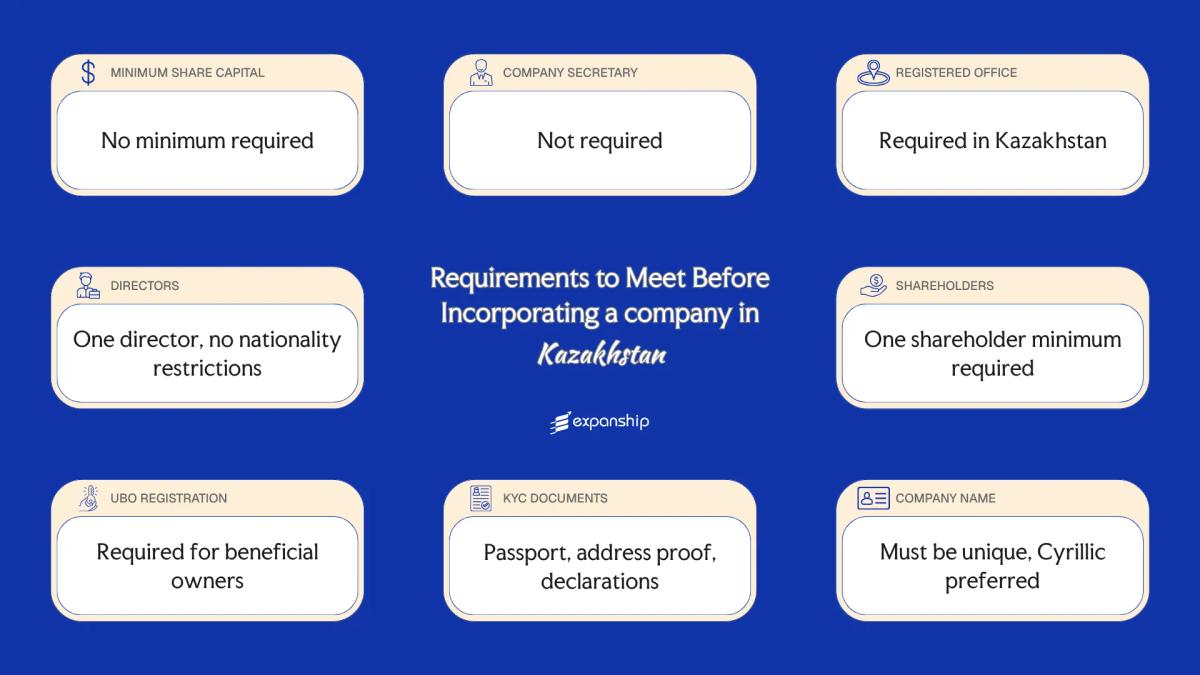
Kazakhstan incorporation requirements span several distinct categories, from capital thresholds and director eligibility to registered address obligations and beneficial ownership disclosure.
Failure to satisfy these requirements results in rejection of the registration application or, where non-compliance is identified post-registration, potential suspension of operating licenses and legal liability under applicable statutes.
Specific obligations vary depending on the chosen entity type, the industry sector, and whether the investor is a foreign national or a locally resident shareholder.
Foreign entrepreneurs and non-resident investors evaluating a business setup in Kazakhstan will find this article most directly applicable to their planning process.
Minimum Share Capital Requirements in Kazakhstan

Kazakhstan minimum share capital requirements differ by entity type and are governed primarily by the Law on Limited Liability Partnerships and the Law on Joint Stock Companies. The Business Registration Authority, operating under the Ministry of Justice, oversees entity registration, while capital deposit obligations are typically verified through a second-tier bank account in your company's name.
For a Limited Liability Partnership (TOO), no statutory minimum charter capital is prescribed under current legislation, though the charter must specify an authorized capital amount. A Joint Stock Company (JSC) is subject to a minimum authorized capital threshold set by the National Bank of Kazakhstan for financial sector entities, with general JSCs governed by separate requirements under the Law on Joint Stock Companies.
| Parameter | Detail |
|---|---|
| Minimum Authorized Share Capital | No statutory minimum for a TOO; JSC minimums vary by activity and regulatory body |
| Maximum Authorized Share Capital | No statutory maximum |
| Minimum Paid-Up Capital | No statutory minimum for a TOO |
| Paid-Up Requirement at Incorporation | No statutory requirement for a TOO; JSC requires partial payment before registration |
| Accepted Currency | Kazakhstani Tenge (KZT) |
| Accepted Forms of Contribution | Cash and non-cash contributions (property, intellectual rights, other assets) |
| Timeframe to Deposit Capital | No prescribed statutory deadline for a TOO |
A TOO with no statutory minimum must still define a specific charter capital figure in its founding documents. Leaving this undefined or inconsistent with contributed assets can cause registration delays at the Ministry of Justice.
Company Secretary Requirements in Kazakhstan
Kazakhstan company secretary requirements differ by entity type. For joint-stock companies (JSCs), a corporate secretary is a mandatory position under the Law on Joint-Stock Companies, whereas limited liability partnerships (LLPs) are not subject to the same obligation.
The corporate secretary of a JSC operates under oversight principles set by the Financial Market Regulatory Authority and is responsible for ensuring shareholder meeting procedures are properly observed, maintaining the share register, and organising documentation for the board of directors.
Qualification criteria for who may serve as corporate secretary in a JSC:
- Must be an individual; a legal entity cannot hold the corporate secretary position
- No statutory requirement for Kazakhstani citizenship or residency, though local knowledge of regulatory procedures is expected in practice
- Cannot simultaneously serve as a member of the board of directors of the same JSC
- Must meet qualification requirements established in the company's internal documents or board resolution
- Subject to JSC corporate secretary obligations Kazakhstan regulations set out in the company charter

Incorporate a Company in Kazakhstan
Register your business entity in Kazakhstan with support for document preparation, statutory filings, and ongoing compliance management.
Legal Address Requirements in Kazakhstan
Kazakhstan legal address requirements mandate that every legal entity maintain a registered office address within the country that corresponds to its actual place of business or administrative management, as recorded in the State Register of Legal Entities maintained by the Ministry of Justice.
- A physical address is required; correspondence-only or mail-forwarding arrangements without a genuine presence do not satisfy registration conditions.
- Virtual office addresses are generally not accepted as a qualifying registered office unless the space can be demonstrated as a functional place of business activity.
- The address must be located within Kazakhstan; a foreign address cannot serve as the registered office of a locally incorporated entity.
- Documentary proof of occupancy is required, either a title deed confirming ownership or a lease agreement in the company's name.
- The registered address is publicly listed in the State Register of Legal Entities and is accessible to third parties through official registry searches.
- Any change to the registered office address must be formally notified to the registering authority, and failure to update the registry can result in the entity being classified as unreliable or inactive under Kazakhstani company law.
- Operating with an invalid or non-compliant address exposes the entity to administrative penalties and may result in the suspension of state registration or invalidation of official correspondence.
Director Requirements in Kazakhstan

Upon appointment, directors of a Kazakhstan-registered entity assume statutory duties under the Law of the Republic of Kazakhstan on Limited Liability Partnerships (No. 220-I, 1998), including fiduciary obligations toward the company and personal liability for decisions that cause demonstrable harm to the firm.
| Parameter | Detail |
|---|---|
| Minimum Number of Directors | One director is required to serve as the executive body. |
| Maximum Number of Directors | No statutory maximum for a sole executive; a collegial executive body (directorate) may have multiple members as defined in the charter. |
| Local/Resident Director Required | No statutory residency requirement exists under current law. |
| Nationality Restrictions | No nationality restrictions apply; foreign nationals may serve as directors. |
| Minimum Age Requirement | Directors must be at least 18 years of age. |
| Corporate Directors Permitted | Corporate directors are not permitted; the executive body must be an individual. |
| Director Must Be a Shareholder | No requirement for a director to hold a participation interest in the entity. |
| Publicly Listed on Registry | Director information is recorded in the State Register of Legal Entities maintained by the Ministry of Justice. |
| Disqualification Conditions | Individuals with unexpunged criminal convictions for economic crimes or court-imposed prohibitions on holding managerial positions are disqualified. |
Foreign nationals can serve as the sole director of a Kazakhstan LLP without any local co-director requirement, even where the business operates in regulated sectors.
Shareholder Requirements in Kazakhstan
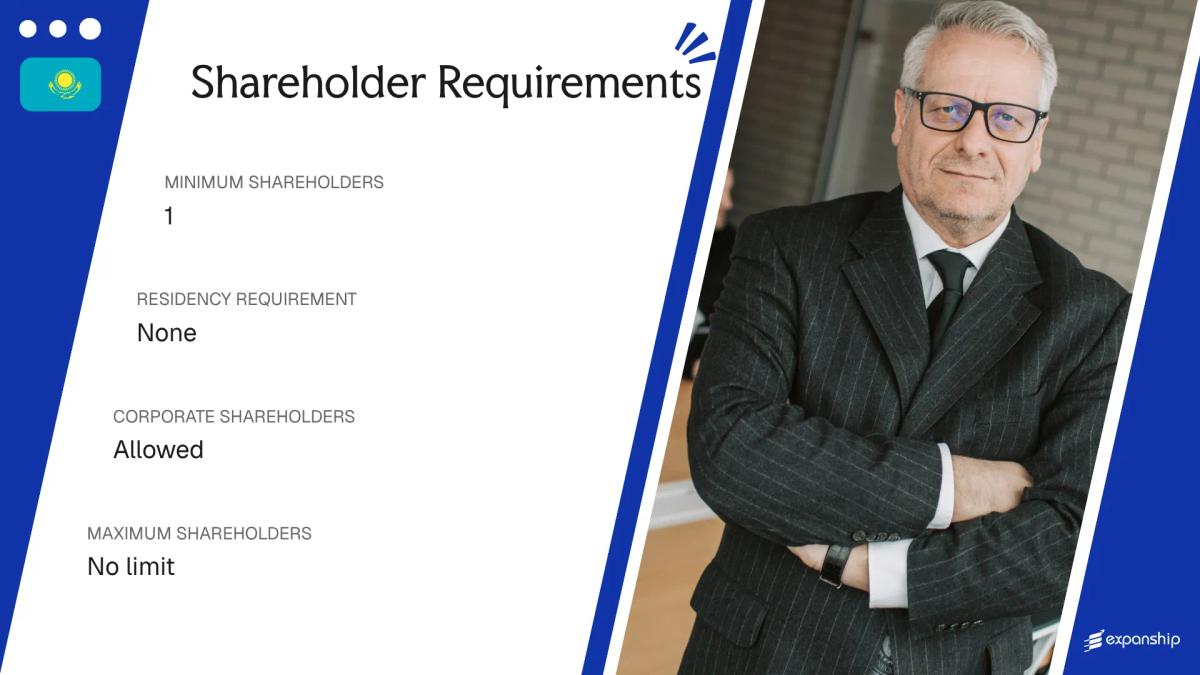
A Kazakhstan TOO (Товарищество с ограниченной ответственностью) requires at least one participant, meaning a sole shareholder structure is permitted. The maximum number of participants is capped at fifty under the Law on Limited Liability Partnerships.
Nationality and Residency Restrictions
Kazakhstan shareholder requirements impose no nationality or residency conditions on participants. Foreign individuals and entities may hold up to 100% of the charter capital without restriction, subject to sector-specific rules in areas such as subsoil use or media.
Corporate Shareholders
Legal entities, including foreign-incorporated companies, are eligible to act as participants in a TOO. No additional licensing or local registration is required solely by virtue of the shareholder being a corporate body.
Shareholder Liability
Participant liability is limited to the value of each individual's contribution to the charter capital. Under Kazakhstani law, participants are not personally liable for the firm's obligations beyond that contribution, except where courts pierce the corporate veil in cases of deliberate insolvency or fraud.
Register of Shareholders
A TOO must maintain an internal register of participants recording ownership interests. This register is not publicly accessible, though ownership changes must be reflected in updated foundation documents filed with the State Corporation "Government for Citizens."
Shareholder Structuring Support for Your Kazakhstan Entity
Get guidance on participant eligibility, ownership structuring, and documentation requirements when setting up a TOO in Kazakhstan.
UBO / Beneficial Ownership Disclosure Requirements in Kazakhstan
Under Kazakhstan's AML legislation, specifically the Law on Combating the Legalisation of Illegally Obtained Income and the Financing of Terrorism, a beneficial owner is any individual who ultimately owns or controls 10% or more of a legal entity's shares or voting rights.
- Identify all individuals meeting the 10% ownership or control threshold prior to registration.
- Disclose UBO information to the State Revenue Committee at the point of incorporation.
- Submit updated UBO data whenever ownership or control structures change.
- Maintain internal records of beneficial ownership that are available for inspection by authorised bodies.
| Parameter | Detail |
|---|---|
| Ownership Threshold for UBO Status | 10% of shares or voting rights |
| Filing Authority | State Revenue Committee |
| Disclosure Deadline at Incorporation | At the time of entity registration |
| Publicly Accessible Register | No publicly accessible register |
| Penalties for Non-Disclosure | Administrative liability under the Code of Administrative Offences |
| Ongoing Update Obligation | Required upon any change in beneficial ownership |
KYC / Document Requirements in Kazakhstan
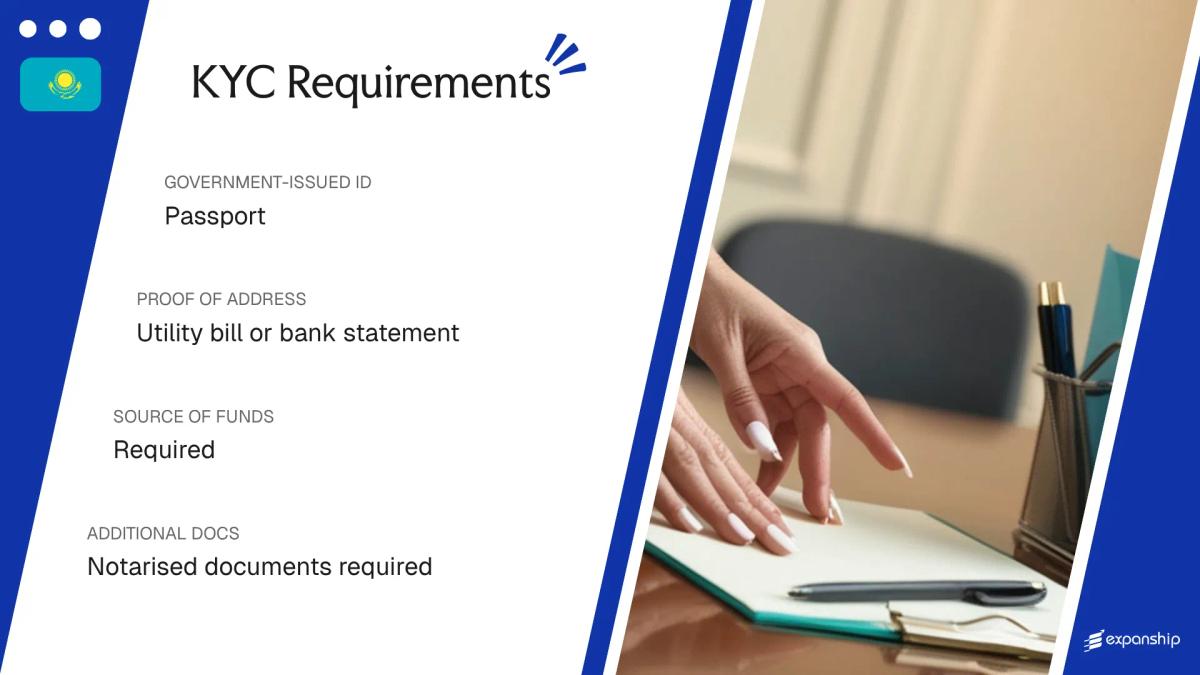
Kazakhstan KYC document requirements apply at the point of incorporation and are governed by the Law of the Republic of Kazakhstan No. 191-IV "On Counteracting Legalisation (Laundering) of Proceeds from Crime and Financing of Terrorism," administered by the Financial Monitoring Committee.
Individual / Personal Documents
- Valid passport or national identity card for each director, shareholder, and beneficial owner
- Proof of residential address dated within three months (utility bill or bank statement)
- Completed personal data consent form as required under Kazakhstani personal data legislation
- Specimen signature in the format required by the registering notary
Corporate Documents
- Certificate of incorporation or equivalent constitutional document for the corporate shareholder or director
- Current register of directors confirming authorised signatories
- Proof of the corporate entity's registered address, issued by the relevant authority in its home jurisdiction
Source of Funds Documentation
- Bank statements covering a minimum recent period to demonstrate the origin of contributed capital
- Audited financial statements where the corporate shareholder is an operating entity
- A signed source of funds declaration from individual shareholders introducing capital
Notarisation and Apostille Requirements
- Foreign-issued documents must carry an apostille under the 1961 Hague Convention unless a bilateral treaty applies
- All non-Kazakh and non-Russian language documents require certified translation into Kazakh or Russian
- Notarisation must be performed by a licensed Kazakhstani notary or a recognised foreign notary prior to apostille
Submission of documents without certified Kazakh or Russian translation is the most common reason for incorporation rejection at the Ministry of Justice.
Company Name Requirements in Kazakhstan
Proposed names for a Kazakhstan company undergo a uniqueness check at the point of registration. Kazakhstan company name requirements prohibit names that duplicate or closely resemble those of existing registered entities.
Names must be rendered in Kazakh or Russian, with translations permitted alongside the primary form. A legal suffix indicating the entity type, such as "ТОО" for a limited liability partnership, is mandatory.
Certain words are restricted and require prior authorisation from relevant state bodies before use. Words referencing state institutions, national symbols, or financial regulatory functions fall into this category.
Name reservation is available through the registration portal prior to formal incorporation. Reservations are generally granted for a limited period, during which the name cannot be registered by another applicant.
Compliance Services for Companies in Kazakhstan
Ongoing compliance support for Kazakhstan-registered entities, covering statutory filings, regulatory reporting, and corporate maintenance.
Conclusion
Kazakhstan incorporation requirements span entity structuring, capital thresholds, director and shareholder composition, beneficial ownership disclosure, and name registration under the oversight of the Ministry of Justice. Among the more consequential elements for foreign investors are the absence of a minimum share capital requirement for an LLP, the lack of mandatory local director or secretary appointments, and the obligation to disclose UBOs through the centralised State Database of Legal Entities. Once these requirements are understood, the practical next step involves coordinating document preparation, notarisation, and registration filings with the relevant Kazakhstani authorities.
Expanship's Corporate Services for Kazakhstan Expansion
Forming a business entity in Kazakhstan involves a specific sequence of regulatory steps, from notarised document preparation to registration with the State Revenue Committee and obtaining a Business Identification Number. Expanship's Kazakhstan company formation services are structured to reduce the operational weight of coordinating these requirements across the right government bodies. Your team stays focused on business decisions while Expanship manages the procedural side.
Beyond initial registration, the firm supports your entity through every stage of its lifecycle in Kazakhstan.
- We prepare and file all incorporation documents, including charter drafts and notarisation coordination.
- A registered agent and legal address are provided to satisfy Kazakhstan's address requirements.
- Our team liaises directly with the Ministry of Justice and State Revenue Committee on your behalf.
- Post-incorporation compliance obligations, including annual filings, are monitored and managed.
- Banking introductions are facilitated to support your business account setup in Kazakhstan.
- Tax registration with the State Revenue Committee is handled as part of your setup process.
Reach out to Expanship Kazakhstan to discuss your incorporation requirements.
Frequently Asked Questions (FAQ)
A foreign national can be appointed as the sole director of a Kazakhstani entity, but work permit and visa obligations under the Labour Code of Kazakhstan will apply if that individual is physically present and working in the country. Remote directorship arrangements may reduce this exposure, though the regulatory risk should be assessed on a case-by-case basis depending on where management decisions are actually exercised. The Agency of the Republic of Kazakhstan for Regulation and Development of the Financial Market may also impose additional requirements for entities operating in regulated sectors.
If the legal address registered with the State Corporation "Government for Citizens" ceases to be valid, the company is required to notify authorities and update its registration records. Operating with an outdated address can result in administrative penalties and may cause official correspondence to go undelivered, creating compliance gaps. The address update must be reflected in the Unified State Register of Legal Entities.
Failure to disclose accurate beneficial ownership information in Kazakhstan constitutes a violation under the Law on Combating Legalisation of Illegally Obtained Income and Financing of Terrorism. The Financial Monitoring Committee, which operates under the Ministry of Finance, has authority to impose fines and initiate further investigations. Persistent non-compliance can result in suspension of banking relationships, as obliged entities such as banks are required to conduct their own verification of UBO data.
Yes, the requirements differ. Individual shareholders typically submit a notarised passport copy and proof of address, while corporate shareholders must provide incorporation documents, a certificate of good standing, and beneficial ownership declarations from the parent entity's home jurisdiction. All foreign-language documents must be apostilled and translated into Kazakh or Russian before submission to the registering authority.
Kazakhstani law permits foreign words in a company name, but the name must be transliterated into Kazakh and Russian scripts for official registration purposes. Names that imply state affiliation, such as terms referencing "National" or "Kazakhstan" without government approval, require a separate authorisation process. The State Corporation "Government for Citizens" will reject names that conflict with existing registered entities or violate these naming conventions during the registration review.
The difference is substantial. A Joint Stock Company in Kazakhstan requires a minimum share capital of 50,000 MCI, compared to just 100 MCI for an LLP, making the JSC structure significantly more capital-intensive and better suited to larger enterprises or those seeking public investment. The National Bank of Kazakhstan oversees JSC formations in the financial sector, where additional paid-in capital thresholds may apply on top of the statutory minimum.
Legal Disclaimer
The information provided in this article is for general informational purposes only and does not constitute legal, tax, or professional advice. While we strive to ensure the accuracy and timeliness of the content, laws and regulations are subject to change, and the application of laws can vary widely based on specific facts and circumstances.
Readers should not act upon this information without seeking professional counsel tailored to their individual situation. Expanship and its authors disclaim any liability for actions taken or not taken based on the content of this article.
For specific advice regarding your business setup, compliance requirements, or any legal matters, please consult with qualified legal and tax professionals in the relevant jurisdiction.