
Key Takeaways
- Foreign investors operating under Kazakhstan's Civil Code must navigate oversight from at least three distinct state bodies — the Ministry of Justice, the State Revenue Committee, and sector-specific regulators — creating layered compliance obligations that multiply administrative costs and timelines.
- Mandatory minimum charter capital requirements for Joint-Stock Companies impose upfront financial thresholds that can restrict market entry for smaller foreign investors before operations have even commenced.
- Sector-specific restrictions on foreign ownership in regulated industries such as banking, media, and natural resources effectively limit the structural options available to multinational firms seeking full control over their Kazakhstan-registered entity.
- Official documentation requirements in Kazakh and Russian, combined with a high dependence on notarized submissions, extend incorporation timelines and add recurring translation and notarization costs that compound across the entity's compliance lifecycle.
Kazakhstan operates under an evolving but heavily regulated corporate framework, with foreign investors subject to oversight from multiple state bodies, including the Ministry of Justice, the State Revenue Committee, and sector-specific regulators. The disadvantages of incorporating in Kazakhstan span procedural, financial, linguistic, and structural categories, each presenting distinct friction points for foreign-owned entities.
The drawbacks of company formation in Kazakhstan affect businesses unevenly. A manufacturing firm faces different constraints than a fintech startup, and a sole-activity LLC encounters fewer regulatory layers than a joint-stock company operating in a licensed sector.
This article is most relevant to foreign entrepreneurs, cross-border investors, and multinational firms seeking to establish a legal presence through a Limited Liability Partnership or Joint-Stock Company under the Civil Code and applicable corporate legislation.
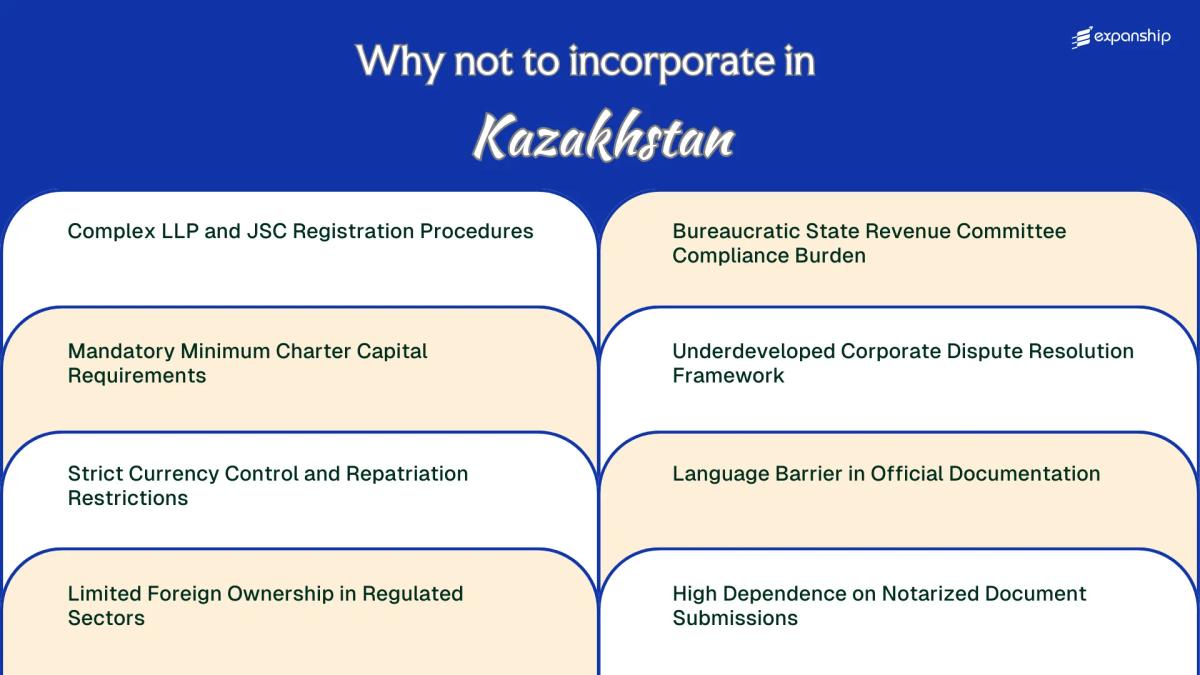
Complex LLP and JSC Registration Procedures
Kazakhstan LLP registration challenges are not confined to paperwork volume alone. The structural requirements governing both LLP and JSC formation create procedural friction that delays market entry and raises professional service costs.
Sequential Approval Stages Slow Formation
Registering either entity type requires engagement with the State Corporation "Government for Citizens," the body responsible for legal entity registration. The process involves sequential steps: name reservation, charter preparation, notarization, and submission through the eGov portal or service centers. Each stage depends on the completion of the prior one, meaning a single document deficiency restarts the queue and extends the formation timeline by days or weeks.
JSC Formation Adds a Mandatory Regulatory Layer
JSC registration problems in Kazakhstan arise partly because joint-stock companies must additionally register their initial share issuance with the Agency for Regulation and Development of the Financial Market. This requirement adds a distinct regulatory filing stage absent in most comparable jurisdictions, binding your timeline to a separate authority's processing schedule.
Foreign founders face the added complication that charter documents must conform precisely to Kazakhstani corporate law standards under the Law on Limited and Additional Liability Partnerships or the Law on Joint-Stock Companies.
A document deficiency at any single stage of the sequential registration process can delay entity formation by several weeks, directly deferring your legal ability to contract, open bank accounts, or employ staff.
Mandatory Minimum Charter Capital Requirements
Kazakhstan minimum charter capital requirements differ by entity type and create an immediate financial threshold that foreign founders must meet before operations can begin. Under the Law on Limited Liability Partnerships, an LLP requires a minimum charter capital equivalent to 100 times the Monthly Calculation Index (MCI), a figure adjusted annually by the government. For joint-stock companies, the minimum rises substantially, with the Financial Supervisory Authority imposing stricter paid-in capital thresholds for regulated activities.
Capital must be contributed and confirmed before state registration completes. This upfront obligation ties up working funds during a period when your business has no revenue, no operational infrastructure, and no guarantee of regulatory approval.
Practical burdens this creates for foreign investors include:
- Funds deposited into a Kazakh accumulation account cannot be redeployed until registration finalizes, creating a dead capital period with no operational return
- Annual MCI adjustments mean the baseline threshold can shift year to year, complicating multi-year entry planning
- JSC share capital restrictions require independent valuation of non-cash contributions, adding professional fees and delay before the entity becomes active
Non-banking commercial entities generally face lower thresholds, but firms entering financial services, insurance, or banking face capital requirements orders of magnitude higher.

Company Incorporation in Kazakhstan
Understand the capital obligations and registration requirements before establishing your entity in Kazakhstan.
Strict Currency Control and Repatriation Restrictions
Kazakhstan currency control restrictions are governed primarily by the Law on Currency Regulation and Currency Control (No. 57-IV), administered by the National Bank of Kazakhstan. Under this framework, foreign companies operating through local entities face mandatory registration of certain foreign currency contracts and are subject to transaction monitoring obligations that add procedural weight to routine cross-border payments.
Repatriating profits is not a simple transfer. Foreign investors moving dividends or loan repayments offshore must route transactions through authorized banks, which are required to monitor and report these flows to the National Bank. Delays at the banking level can hold up distributions for weeks, directly affecting your firm's cash flow planning.
| Requirement | Threshold / Condition | Practical Burden |
|---|---|---|
| Currency contract registration | Contracts above KZT 50,000 equivalent (indicative) | Mandatory registration before settlement; delays payment timelines |
| Authorized bank monitoring | All cross-border transfers | Bank compliance reviews can stall transfers without notice |
| Dividend repatriation documentation | Required per distribution event | Supporting documents must satisfy both tax and currency regulations |
| Reporting obligation period | Ongoing for registered contracts | Continuous compliance cost, not a one-time requirement |
Profit repatriation problems in Kazakhstan are compounded by the requirement to demonstrate tax clearance before certain outbound payments are processed. If your entity has any unresolved position with the State Revenue Committee, authorized banks may decline to execute the transfer. The absence of a clear statutory timeline for bank-level reviews means foreign exchange limitations in Kazakhstan create unpredictability rather than simply extra paperwork.
Limited Foreign Ownership in Regulated Sectors
Kazakhstan foreign ownership limitations are most consequential in sectors the government classifies as strategically significant. Under the Law on Subsoil and Subsoil Use, as well as sector-specific licensing frameworks, foreign participation is either capped or subject to prior state approval in areas including telecommunications, media, banking, and natural resource extraction.
In the banking sector, the Agency of the Republic of Kazakhstan for Regulation and Development of the Financial Market enforces ownership thresholds that restrict how much equity a foreign entity can hold without triggering additional supervisory requirements. This directly raises the cost and timeline of structuring a compliant entry.
Broadcast media presents a harder ceiling. Foreign ownership in Kazakhstani broadcast entities is capped at 20%, a figure that effectively bars foreign investors from exercising operational control in that industry.
These restrictions are not uniform across all foreign investors, as treaty-based investors from EAEU member states may face different conditions under applicable bilateral or multilateral agreements.
- Foreign equity caps in banking, media, and subsoil sectors are set by separate legal instruments, not a single unified law.
- State approval is required before acquiring qualifying stakes in strategically designated industries.
- The 20% ceiling in broadcast media applies regardless of the foreign entity's size or capitalization.
- Licensing bodies, not the company registry, determine whether a foreign ownership structure is permissible in restricted sectors.
A foreign company can own 100% of a general trading or manufacturing LLP in Kazakhstan, yet be entirely barred from majority ownership in a broadcast media firm operating in the same city.
Bureaucratic State Revenue Committee Compliance Burden
The Kazakhstan State Revenue Committee compliance burden falls primarily on the Komitet Gosudarstvennykh Dokhodov (KGD), which administers tax registration, reporting, and audit functions under the Tax Code of the Republic of Kazakhstan. Foreign-owned entities face a dense calendar of mandatory filings that demand local accounting expertise from day one.
Frequency and Scope of Mandatory Reporting
The KGD requires registered entities to submit multiple periodic declarations, including VAT returns, corporate income tax filings, and payroll-related social contribution reports, with schedules that can be monthly, quarterly, or annual depending on the tax regime applied. For a foreign director managing operations remotely, coordinating these deadlines across different obligation types generates sustained administrative overhead that is difficult to absorb without a dedicated local compliance officer.
Practical Consequences for Foreign-Owned Entities
Penalties for late or incorrect filings under the Tax Code are applied per violation, meaning that a single reporting period with multiple errors can accumulate fines quickly. The KGD also conducts desk audits triggered by data mismatches in electronic declarations submitted through the Taxpayer Cabinet portal, and resolving these inquiries typically requires in-country representation and Kazakh-language documentation.
Managing KGD Compliance Obligations in Kazakhstan
Get structured guidance on meeting State Revenue Committee reporting requirements as a foreign-owned entity registered in Kazakhstan.
Underdeveloped Corporate Dispute Resolution Framework
Kazakhstan corporate dispute resolution problems stem from a combination of underfunded commercial courts and an arbitration framework that lacks the procedural maturity foreign investors expect in established markets.
- The Specialized Inter-District Economic Courts, which handle commercial disputes, face capacity constraints that produce prolonged case resolution timelines, delaying your ability to enforce contracts or recover assets.
- Judicial decisions in commercial matters can be inconsistent across regions, creating unpredictability that directly undermines contractual certainty for foreign-owned entities.
- The International Arbitration Centre under the Astana International Financial Centre (AIFC) offers an alternative forum, but its jurisdiction is generally limited to disputes involving AIFC-registered entities, excluding most standard LLP or JSC structures.
- Weaknesses of Kazakhstan commercial courts include limited familiarity with complex cross-border transactions, which increases the risk of misapplied legal standards in disputes involving foreign capital structures.
- Enforcement of foreign arbitral awards under the New York Convention, to which the country is a signatory, remains procedurally cumbersome in practice.
Language Barrier in Official Documentation
The Kazakhstan language barrier in business registration extends beyond translation inconvenience. Under the Law of the Republic of Kazakhstan "On Languages," state bodies conduct all official proceedings in Kazakh, with Russian permitted as a language of interethnic communication. For foreign founders, this dual-language environment means virtually every founding document, regulatory filing, and notarized submission must be prepared or certified in Kazakh.
Incorporation documents submitted to the Ministry of Justice, tax registrations with the State Revenue Committee, and licensing applications all require Kazakh-language versions. A foreign-language source document does not substitute — it must be translated by a certified translator and then notarized, adding both cost and processing time to each filing cycle.
The implication compounds over the corporate lifecycle. Amendments to charter documents, annual reporting, and correspondence with state bodies each require renewed translation and certification, creating a recurring operational burden that many foreign-owned entities underestimate at the outset.
- Kazakh language requirements for official documents apply to founding charters, state registration applications, and regulatory submissions
- Errors in translated documents trigger rejections, restarting timelines entirely
- Certified translators with legal specialization are limited outside Almaty and Astana
A foreign-owned LLP based outside Almaty requiring certified Kazakh translations for an initial registration package of five documents — charter, founding decision, application, director appointment order, and registered address confirmation — could realistically incur $400–$700 in translation and notarization fees before a single state authority has reviewed the filing.
High Dependence on Notarized Document Submissions
Kazakhstan notarized document requirements apply at nearly every stage of the corporate lifecycle, from initial registration through to ongoing structural changes. Notarization in Kazakhstan is not a formality — it is a procedural gate that controls access to the state registration system operated by the Ministry of Justice.
Founding documents, power of attorney instruments, and director appointment resolutions typically require notarization before submission to the State Corporation "Government for Citizens," the body that processes entity registrations. For foreign-incorporated parent companies, this means authenticating documents abroad and obtaining an apostille under the 1961 Hague Convention, then having those documents translated by a certified translator and re-notarized locally.
This chain of authentication adds both cost and lead time that foreign businesses do not face in most OECD jurisdictions. A single structural amendment — such as a change in ownership — can require repeating the entire authentication sequence.
- Documents issued outside Kazakhstan require apostille certification before local notarization is accepted.
- Certified translation into Kazakh or Russian is mandatory, adding a further dependency on accredited local translators.
- Notarial fees in Kazakhstan are calculated based on transaction value for certain document types, making costs variable and difficult to predict.
If your parent company's home jurisdiction is not a party to the Hague Apostille Convention, documents must instead be legalized through the full consular legalization chain, which is significantly more time-consuming and costly than the apostille process.
Overcoming Incorporation Challenges in Kazakhstan
Overcoming Kazakhstan incorporation challenges begins with recognising that the structural barriers covered in this blog are systemic, not incidental, and require deliberate preparation before entity formation.
- Engage a licensed Kazakhstani notary early in the process to address mandatory notarized document requirements for both LLP and JSC registration with the State Corporation "Government for Citizens."
- Confirm charter capital thresholds for your chosen entity type and structure pre-incorporation funding arrangements to satisfy minimum deposit requirements at the time of registration.
- Identify whether your intended sector falls under restricted foreign ownership rules before selecting your legal structure, cross-referencing applicable sector-specific legislation.
- Register with the State Revenue Committee and establish internal accounting procedures that align with Kazakhstan's tax reporting cycles from the outset.
- Prepare all founding documents in Kazakh, as official submissions require the state language regardless of the internal working language of the foreign parent entity.
- Structure intra-group payment flows in compliance with National Bank of Kazakhstan currency control regulations to avoid repatriation restrictions on profit transfers.
Each of these steps corresponds to a discrete regulatory requirement embedded in Kazakhstan's legal framework. The cumulative effect of these requirements means that solutions to Kazakhstan business registration problems are rarely resolved through a single corrective action.
Kazakhstan's Overall Investment Appeal
Kazakhstan's investment appeal despite drawbacks is real, but conditional. The country holds a defined position as Central Asia's largest economy, with a legal framework that has absorbed meaningful reform over the past decade, yet the structural friction documented in this blog is not incidental — it reflects systemic patterns that affect how foreign businesses operate day to day.
| Pro | Con |
|---|---|
| Kazakhstan operates under a codified civil law system with a dedicated International Financial Centre (AIFC) offering English-language common law arbitration | LLP and JSC registration involves multi-stage procedures across several state bodies, increasing setup timelines |
| The AIFC court and arbitration centre provides an internationally recognized dispute resolution venue separate from domestic courts | Domestic corporate dispute resolution outside the AIFC remains underdeveloped and inconsistent |
| Access to a large domestic market and proximity to Russia, China, and Central Asian trade routes supports regional distribution strategies | Currency repatriation is subject to National Bank of Kazakhstan controls, restricting free movement of profits |
| Certain sectors permit full foreign ownership with no mandatory local partnership requirement | Regulated industries including media, telecoms, and agricultural land restrict foreign ownership by statute |
| Kazakhstan is party to over 50 bilateral investment treaties, providing treaty-based protections for qualifying investors | Official documentation requirements in Kazakh and Russian create ongoing operational and translation costs |
Notarization requirements and State Revenue Committee compliance obligations add recurring administrative costs that scale with the entity's transaction volume.
Compliance Services for Companies in Kazakhstan
Maintain your Kazakhstan entity in good standing with the State Revenue Committee, annual filing obligations, and ongoing regulatory requirements.
Conclusion
The cons of company formation in Kazakhstan are concentrated in a few structural areas that directly affect operational timelines and ongoing compliance costs. Currency repatriation restrictions under the Law on Currency Regulation and Currency Control, combined with the compliance demands imposed by the State Revenue Committee, represent the most tangible friction points for foreign-owned entities. Language requirements across official filings add a further administrative layer. Recognizing these constraints before committing to a legal structure allows your business to allocate resources accurately and avoid procedural delays after registration is complete.
Expanship's Kazakhstan Expansion Services
Expanship's Kazakhstan business expansion services are structured around the specific compliance obligations that foreign investors face when incorporating in Kazakhstan, from State Revenue Committee tax registration to notarized document requirements and currency control reporting under the National Bank's framework. Expanship reduces the operational burden of managing these parallel obligations, particularly for firms unfamiliar with Kazakh regulatory timelines and language requirements.
Beyond incorporation, Expanship supports your business across the full corporate lifecycle in Kazakhstan.
- Expanship prepares and files all registration documents for your LLP or JSC with the relevant Kazakh authorities.
- A registered agent and local office address are provided to satisfy statutory presence requirements.
- Expanship liaises directly with government bodies on filings and regulatory submissions on your behalf.
- Post-incorporation compliance management keeps your entity in good standing over time.
- Banking introduction assistance connects your firm with suitable local financial institutions.
- Tax registration and liaison with the State Revenue Committee is handled for your entity from the outset.
Reach out to Expanship Kazakhstan to discuss your incorporation requirements.
Frequently Asked Questions (FAQ)
The requirement applies broadly across entity types, including LLPs, which are the most common structure for foreign investors. Foundation documents, powers of attorney, and certain shareholder resolutions must be notarized under Kazakhstani notarial procedure, and foreign documents typically require apostille certification before a local notary will process them. This adds procedural layers that slow down incorporation timelines considerably.
Penalties under the Kazakhstani Administrative Code include financial fines scaled to the severity and duration of the violation, and repeated non-compliance can trigger suspension of tax registration. The State Revenue Committee has broad authority to audit filings and impose sanctions without prior warning in cases of suspected evasion. For a newly registered foreign-owned entity, even procedural errors in initial tax registration can generate enforcement action.
Kazakhstan's foreign exchange controls under the Law on Currency Regulation and Currency Control are among the stricter frameworks in the region, requiring that export earnings be repatriated within set timeframes and that certain cross-border transactions receive prior approval. Uzbekistan and Kyrgyzstan have been actively liberalizing their currency regimes, making Kazakhstan comparatively more burdensome for businesses that depend on frequent cross-border capital flows. The National Bank of Kazakhstan enforces these rules, and violations carry administrative penalties.
A foreign investor can hold 100% of an LLP in most sectors, but sector-specific legislation imposes ownership caps or licensing conditions in areas including subsoil use, banking, telecommunications, and media. The Law on Subsoil and Subsoil Use, for instance, grants the state a pre-emptive right over strategic assets, which effectively limits foreign control in extractive industries. Outside these regulated sectors, full foreign ownership is legally permissible.
Failure to pay up the minimum charter capital within the period prescribed under the Law on Joint Stock Companies can result in the registration being invalidated or the entity being subject to compulsory liquidation proceedings. The Financial Regulatory Authority monitors JSC capital adequacy, particularly for entities in financial services. For a standard JSC outside financial services, the minimum threshold and payment schedule are still legally binding, and non-compliance is treated as a material registration defect.
The cost varies depending on document volume and language pair, but foreign founders should budget several hundred to over a thousand US dollars in translation and notarization fees alone, separate from state registration fees. Apostille certification in the country of origin adds further cost and processing time. These are unavoidable costs for any foreign national submitting non-Kazakh documentation to Kazakhstani authorities.
It poses a measurable risk. Kazakhstani commercial courts handle corporate disputes, but procedural delays and limited judicial familiarity with complex cross-border shareholder arrangements can disadvantage minority foreign investors seeking enforcement of contractual rights. While Kazakhstan is a signatory to the New York Convention on arbitral awards, domestic enforcement of foreign arbitration decisions is not always straightforward, particularly where state-linked entities are involved.
Legal Disclaimer
The information provided in this article is for general informational purposes only and does not constitute legal, tax, or professional advice. While we strive to ensure the accuracy and timeliness of the content, laws and regulations are subject to change, and the application of laws can vary widely based on specific facts and circumstances.
Readers should not act upon this information without seeking professional counsel tailored to their individual situation. Expanship and its authors disclaim any liability for actions taken or not taken based on the content of this article.
For specific advice regarding your business setup, compliance requirements, or any legal matters, please consult with qualified legal and tax professionals in the relevant jurisdiction.