

Key Takeaways
- Kazakhstan's flat 20% corporate income tax rate under the Tax Code of Kazakhstan delivers predictable cost structures for operating companies across most sectors, making cross-border profit planning more straightforward than in jurisdictions with tiered or variable rates.
- Financial services firms incorporated within the Astana International Financial Centre benefit from a zero-tax regime administered by the Astana Financial Services Authority, a combination unavailable through standard Kazakhstani registration.
- With over 50 bilateral double tax treaties in force, businesses can materially reduce withholding obligations on dividends, royalties, and interest flowing across borders, directly lowering the effective tax burden on international operations.
- Structuring as an LLP or JSC from the outset determines which incentive programmes, SEZ exemptions, and treaty protections apply, making entity selection at the registration stage a consequential legal and financial decision rather than a formality.
Situated in Central Asia and bordering Russia, China, and three other regional states, Kazakhstan is a sovereign republic and the world's largest landlocked country by area. Company registration falls under the authority of the Ministry of Justice, which oversees the incorporation process through its state registration systems. Foreign investors most commonly establish a Limited Liability Partnership when entering the market.
The tax posture combines a standard corporate rate with treaty-based relief across a broad network of bilateral agreements, making the overall structure one that rewards cross-border planning. On the question of foreign ownership, the regulatory framework permits 100% foreign ownership in most sectors, and the government has formally positioned foreign direct investment as a priority through national development programs such as the Nur Otan-era economic reforms and subsequent policy continuations.
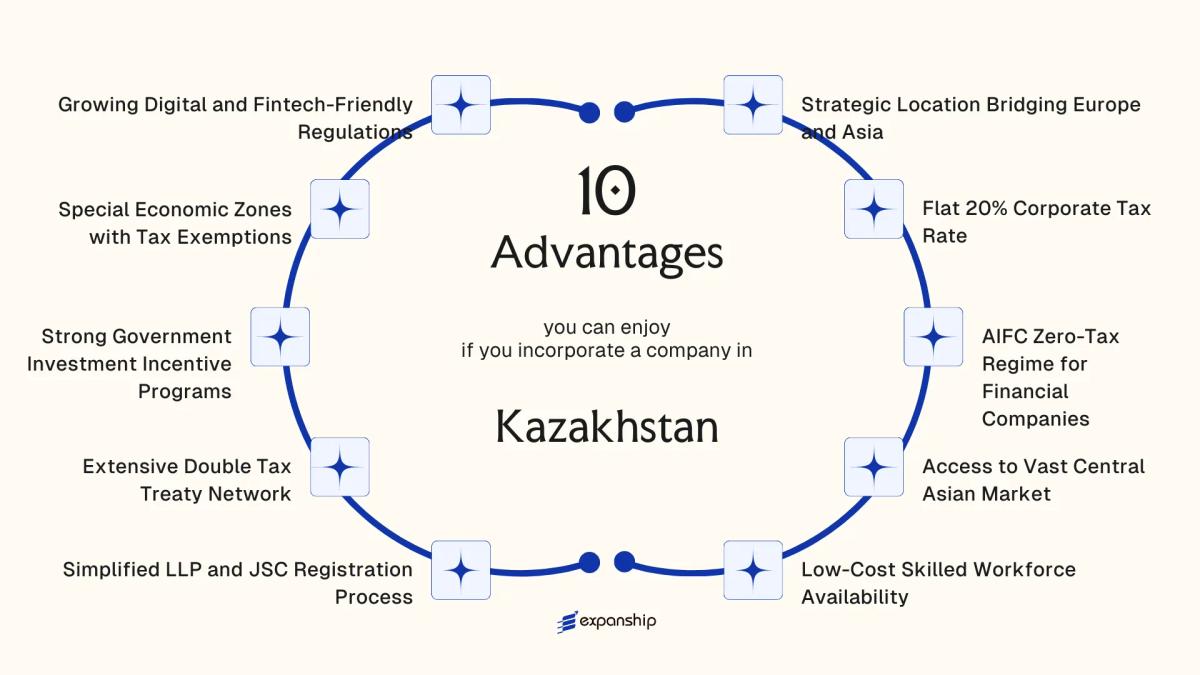
The benefits of incorporating in Kazakhstan extend across tax, regulatory, and geographic dimensions. This article examines the key advantages your business can draw from establishing a legal presence there.
Strategic Location Bridging Europe and Asia
Kazakhstan sits at the geographic center of the Eurasian continent, sharing borders with Russia, China, and three other Central Asian states. For businesses oriented toward cross-continental trade, this positioning creates direct logistical access to markets that would otherwise require multiple transit jurisdictions.
Position Along Active Trade Corridors
Kazakhstan is a core transit country within China's Belt and Road Initiative, and the Trans-Caspian International Transport Route runs through its territory, connecting China to Europe via the Caspian Sea and the Caucasus. Your freight moves along established rail and road networks rather than theoretical routes.
The country is also a founding member of the Eurasian Economic Union (EAEU), which provides preferential trade terms across a combined market of over 180 million people. Goods produced or processed by a company registered here can move within EAEU member states without standard customs duties applying.
Infrastructure Supporting Commercial Transit
Khorgos Gateway, the dry port on the Chinese border, is one of the largest inland container terminals in the region, reducing transit times between China and European destinations. A firm incorporated here gains proximity to this infrastructure without requiring a separate Chinese or Russian entity.
An entity registered in Kazakhstan can access EAEU preferential trade terms and Belt and Road logistics networks simultaneously, reducing both transit costs and jurisdictional complexity for cross-continental supply chains.
Flat 20% Corporate Tax Rate
Kazakhstan's corporate income tax is set at a flat rate of 20%, established under the Tax Code of the Republic of Kazakhstan. This structure eliminates the graduated tax brackets that many jurisdictions use, meaning your liability scales predictably with profit rather than triggering higher marginal rates as earnings grow.
For foreign investors, predictability matters. A fixed rate simplifies financial modelling, reduces the administrative burden of tax planning, and allows accurate forecasting of post-tax returns from the outset of operations.
At 20%, the rate sits below the OECD average corporate tax rate of approximately 23.6%, and compares favourably against several regional peers, where headline rates frequently reach 25% or higher. The Kazakhstan low corporate income tax for foreign investors becomes particularly relevant when structuring holding or operating entities intended to generate consistent earnings over time.
Resident legal entities pay this rate on worldwide income, while non-residents are taxed only on Kazakhstan-source income, a distinction that affects how multinational groups position their entities within a regional structure.
Several features of the rate structure work in your favour:
- The flat rate applies uniformly, removing uncertainty about which bracket applies to a given income level
- Non-resident taxation is limited to domestic-source income, reducing exposure for groups with diversified geographic revenue
- The Tax Code provides defined rules for deductible expenses, giving your firm a clear basis for calculating taxable profit

Company Incorporation in Kazakhstan
Set up a legal entity in Kazakhstan with full compliance support, from registration through to tax structuring.
AIFC Zero-Tax Regime for Financial Companies
The AIFC zero-tax regime for financial companies is one of the most structurally significant tax privileges available to foreign businesses operating within the Astana International Financial Centre. Established under the Constitutional Statute of the Republic of Kazakhstan on the AIFC (2015), the regime grants qualifying firms a full exemption from corporate income tax and individual income tax until 2066. That is a fixed horizon of over four decades, which gives foreign investors a degree of fiscal predictability that annual budget cycles and policy shifts in other jurisdictions simply cannot match.
| Tax Type | Standard Kazakhstan Rate | AIFC Rate for Qualifying Participants |
|---|---|---|
| Corporate Income Tax | 20% | 0% |
| Individual Income Tax | 10% | 0% |
| VAT on financial services | Standard rate applies | Exempt for qualifying transactions |
| Land and property tax | Applicable | Exempt within AIFC perimeter |
Qualifying as an AIFC participant requires registration with the AIFC Authority and conducting permitted financial activities, which include banking, insurance, capital markets operations, and fintech services. The AIFC operates under English common law principles, administered by its own courts and the AIFC Court, which removes the uncertainty of navigating an unfamiliar civil law system. For a foreign firm structuring regional treasury, fund management, or financial holding operations, the combination of zero tax liability and a familiar legal framework substantially reduces both cost and structural complexity over the long term.
Access to Vast Central Asian Market
Kazakhstan's access to Central Asian market advantages begin with a single structural fact: membership in the Eurasian Economic Union (EAEU). Goods produced or processed by a registered entity here circulate freely across Russia, Belarus, Armenia, and Kyrgyzstan without customs duties. That is a combined market of over 180 million consumers reachable without additional trade barriers at each border.
Under the EAEU Treaty framework, your company benefits from unified customs tariffs and harmonised technical regulations across member states. A firm incorporated here does not need separate distribution entities in each EAEU country to move goods commercially. This significantly reduces the operational cost of regional expansion.
Beyond the EAEU, the country holds observer or partnership status with the Shanghai Cooperation Organisation and maintains active trade agreements with China and Central Asian neighbours. For businesses targeting both westward and eastward distribution, this dual access is structurally difficult to replicate from most other regional incorporation points.
Keep these points in mind:
- EAEU free movement applies to goods meeting local origin rules; verify rules of origin under the EAEU Customs Code
- Services and capital movement are governed by separate EAEU protocols, not the same goods framework
- Physical presence or a registered legal entity is required to qualify for EAEU market access benefits
- Sector-specific restrictions may apply in certain EAEU member states regardless of the treaty
Kazakhstan's EAEU membership also gives your company access to Russia's public procurement market, which is otherwise largely closed to non-member state firms.
Low-Cost Skilled Workforce Availability
Kazakhstan's skilled workforce cost advantages position foreign businesses to operate with significantly lower payroll expenditure than in comparable mid-tier economies. The statutory minimum wage stands at 85,000 KZT per month as of 2024, and average engineering or IT salaries remain well below those in Eastern European markets, let alone Western Europe. For a foreign firm building a regional team, this gap directly reduces fixed operating costs without a corresponding reduction in output quality.
A Technically Trained Labor Pool
The country's Soviet-era emphasis on technical education left a durable legacy. Kazakhstan produces tens of thousands of graduates annually in engineering, mathematics, and natural sciences through universities such as Nazarbayev University and the Kazakh National Research Technical University. Many professionals also hold bilingual proficiency in Russian and Kazakh, with English increasingly common among younger graduates entering the technology and finance sectors.
What This Means for Payroll-Sensitive Operations
Under the Labor Code of Kazakhstan (enacted 2015, with subsequent amendments), employment contracts are straightforward to execute, and standard employer social contributions are defined at a flat rate, making payroll costs predictable from the outset. For businesses in software development, back-office processing, or financial analysis, this combination of formal technical training and contained salary benchmarks means that human capital advantages for foreign investors are structural rather than cyclical. Wage inflation exists but remains moderate relative to the skilled talent pool available in Almaty and Astana.
Put Kazakhstan's Workforce Advantage to Work for Your Business
Speak with an Expanship specialist to understand how staffing costs, employment regulations, and entity structure interact when setting up operations in Kazakhstan.
Simplified LLP and JSC Registration Process
Registering a business in Kazakhstan carries procedural advantages that translate directly into reduced setup time and lower administrative costs for foreign investors. The Kazakhstan LLP JSC registration advantages stem from a digitized, centralized system that eliminates much of the bureaucratic friction common in comparable emerging markets.
- Both the Limited Liability Partnership (LLP) and Joint Stock Company (JSC) can be registered through the government's e-government portal (egov.kz), removing the requirement for in-person attendance at state offices.
- The minimum charter capital for an LLP is set at a nominal level, meaning your business can be incorporated without committing significant capital upfront before operations begin.
- Registration is handled through the State Corporation "Government for Citizens," which consolidates multiple filings into a single submission process rather than requiring sequential applications to separate agencies.
- For foreign legal entities, a notarized and apostilled set of founding documents is sufficient to satisfy incorporation requirements, avoiding the need for locally-issued guarantees or locally-resident shareholders.
- Processing timelines under the standard procedure are short relative to regional peers, allowing your firm to obtain a Business Identification Number (BIN) and commence legal activity within days of a completed submission.
The BIN functions as the unified identifier across tax, customs, and licensing authorities, so post-registration compliance filings operate through a single reference number from the outset.
Extensive Double Tax Treaty Network
Kazakhstan's double tax treaty network benefits foreign businesses by reducing or eliminating withholding taxes on cross-border payments. The country has concluded over 50 DTTs, covering major trading and investment partners including Germany, China, the United Kingdom, the Netherlands, and the United Arab Emirates. Under these agreements, withholding tax rates on dividends, interest, and royalties are often reduced well below the standard domestic rates set under the Tax Code of Kazakhstan (Code No. 120-VI).
For a foreign parent company receiving dividends from a Kazakhstani subsidiary, the applicable DTT may reduce the withholding rate to as low as 5% on dividends, depending on the treaty and ownership threshold. Without treaty protection, the standard withholding rate on dividends paid to non-residents is 15%. That difference directly affects the after-tax return on equity for any foreign investor.
Treaty benefits are not automatic. Your entity must satisfy the residency requirements under the relevant agreement and, in some cases, meet beneficial ownership conditions to qualify for reduced rates.
A foreign holding company receiving $500,000 in annual dividends from its Kazakhstani subsidiary could retain an additional $50,000 per year under a 5% treaty rate compared to the standard 15% domestic withholding rate — a material difference over a five-year investment horizon.
Strong Government Investment Incentive Programs
Kazakhstan government investment incentive programs benefits extend well beyond tax rates, reaching into direct financial support, customs relief, and regulatory facilitation administered through official state channels.
Kazakhstan Invest, the national company operating under the Ministry of Foreign Affairs, serves as the primary gateway for foreign investors seeking state support. It coordinates investment agreements, facilitates project approvals, and connects qualifying businesses with relevant government bodies, reducing the administrative burden that typically slows market entry in emerging economies.
Under the Law on Investments, qualifying foreign investors can access several structured benefits:
- Exemptions from customs duties on imported equipment used in investment projects
- In-kind grants covering infrastructure costs such as utility connections and access roads
- Investment preferences for priority sectors including manufacturing, agriculture, and IT
- Stability guarantees protecting investors against adverse legislative changes for the duration of approved contracts
The Kazakhstan Investment Contracts (KIC) mechanism allows eligible businesses to lock in agreed conditions with the state for up to 25 years. For capital-intensive projects, this long-term regulatory certainty has direct implications for financial modelling and risk assessment.
Investment preferences and stability guarantees under the Law on Investments apply only to projects meeting defined minimum investment thresholds, which vary by sector and region.
Special Economic Zones with Tax Exemptions
Kazakhstan special economic zones tax exemptions operate under a structured legislative framework, primarily governed by the Law on Special Economic and Industrial Zones. Qualifying residents within designated SEZs are exempt from corporate income tax, land tax, and property tax for the duration of their SEZ membership, which can extend up to 25 years depending on the zone. For a foreign investor, this means the effective tax burden on qualifying operations can drop to zero for an extended, legally defined period.
Currently, there are ten active SEZs across the country, each structured around a specific industry cluster:
- Astana – EXPO (innovation and green technologies)
- Khorgos – Eastern Gate (logistics and trade, near the Chinese border)
- Ontustik (textile manufacturing)
- Chemical Park Taraz (petrochemicals)
- Saryarka (metallurgy and mechanical engineering)
- Pavlodar (petrochemical processing)
- Qyzylorda (oil and gas services)
- Turkistan (tourism and light industry)
- Ulytau (mining and metallurgy)
- Almaty (information technology and innovation)
Eligibility for SEZ benefits requires your entity to register as an SEZ participant, conduct only activities permitted under the zone's approved list, and meet minimum investment thresholds set by zone administrators.
The industry-specific structure matters because it allows your business to select a zone where the permitted activity directly matches its operational profile, rather than fitting into a general-purpose free zone with broad but shallow incentives. VAT exemptions on goods and services consumed within the zone can further reduce input costs for manufacturing and logistics operations.
Growing Digital and Fintech-Friendly Regulations
Kazakhstan fintech-friendly regulations benefits are most visible through the Astana International Financial Centre (AIFC), which operates under its own legal framework based on English common law principles. This matters for foreign fintech founders because it removes the uncertainty of working within a civil law system unfamiliar to most international operators.
The AIFC FinTech Lab serves as the designated regulatory sandbox for financial technology firms. Accepted participants can test products and services under a controlled regulatory environment, with temporary exemptions from certain AIFC financial services licensing requirements. This allows a firm to validate its business model before committing to full licensing obligations.
Governing oversight sits with the Astana Financial Services Authority (AFSA), which issues licenses across categories including payment services, digital asset exchange, and crowdfunding. AFSA's licensing framework is purpose-built for digital financial services, meaning your firm is not trying to fit a fintech model into a regulatory structure designed for traditional banks.
Kazakhstan amended its legislation to provide a legal framework for digital assets and cryptocurrency-related businesses, distinguishing between different asset classes rather than applying a blanket prohibition. That clarity reduces legal exposure for firms operating in this space.
- AFSA licenses cover payment services, crowdfunding platforms, and digital asset businesses as distinct categories
- Sandbox participants operate under relaxed licensing conditions for a defined test period
- The AIFC's common law basis means contracts, dispute resolution, and corporate governance follow internationally recognized standards
- Digital asset regulation provides defined classifications rather than regulatory ambiguity
Foreign firms operating under AFSA authorization can access the AIFC's framework without needing a separate license from the National Bank of Kazakhstan for activities within AIFC jurisdiction.
Why Kazakhstan Stands Out Against Regional Competitors
Businesses evaluating Kazakhstan's incorporation profile against regional alternatives will most commonly weigh it against Uzbekistan and Kyrgyzstan. These three jurisdictions compete for similar pools of foreign direct investment, share overlapping trade corridors, and each offers some form of preferential economic zone. The comparison is instructive because Kazakhstan's advantages are structural, not incidental: they stem from codified frameworks such as the AIFC Act and its underlying English common law jurisdiction, the breadth of its double tax treaty network, and the maturity of its regulatory institutions relative to neighbours at earlier stages of reform.
Where Uzbekistan has accelerated liberalisation since 2017 and Kyrgyzstan offers low setup costs, neither provides the combination of a zero-tax financial hub operating under internationally recognised legal norms, a dedicated fintech regulatory sandbox, and access to 50-plus tax treaties simultaneously. For a foreign investor, that combination reduces legal uncertainty and lowers the cost of cross-border structuring in ways that a single low-rate incentive cannot replicate.
| Parameter | Kazakhstan | Uzbekistan | Kyrgyzstan |
|---|---|---|---|
| Standard Corporate Tax Rate | 20% | 15% | 10% |
| Zero-Tax Financial Hub | Yes (AIFC) | No | No |
| English Common Law Jurisdiction | Yes (AIFC only) | No | No |
| Double Tax Treaties | 50+ | 55+ | ~25 |
| Dedicated Fintech Sandbox | Yes (AFSA) | Developing | No |
| Special Economic Zones | 14 active SEZs | Multiple | Limited |
| Minimum Share Capital (LLP) | No statutory minimum | No statutory minimum | No statutory minimum |
| Membership in EAEU | Yes | No | Yes |
Compliance Services for Companies in Kazakhstan
Maintain your Kazakhstan entity in good standing with ongoing compliance support, including annual filings, statutory reporting, and regulatory obligations under Kazakhstani corporate law.
Conclusion
Kazakhstan's position as a Central Asian incorporation destination rests on a combination of structural tax advantages, treaty access, and a purpose-built financial hub that few regional peers offer. The AIFC's zero-tax framework, available through the Astana Financial Services Authority, creates a genuinely distinct environment for financial services firms, while the flat 20% corporate income rate under the Tax Code of Kazakhstan provides predictability for operating companies across other sectors.
Fit depends on your business model. A financial services entity and a manufacturing company will draw on different parts of what this jurisdiction offers, from SEZ exemptions under specific regulatory decrees to the network of over 50 bilateral double tax treaties that reduce withholding obligations on cross-border income flows.
Your next step is working with incorporation specialists who can match your structure to the correct entity type, whether an LLP or JSC, and identify which incentive programmes your business qualifies for under current Kazakhstani law. Proper entity selection at the outset determines which tax regimes, treaty benefits, and regulatory frameworks apply to your operations going forward.
Start Your Kazakhstan Company Formation with Expanship Today
Forming a company in Kazakhstan involves interaction with the Ministry of Justice, registration through the State Corporation "Government for Citizens," and, for financial entities, licensing under the Astana Financial Services Authority (AFSA). Expanship manages this process on your behalf, covering entity structuring for both the standard LLP and JSC formats, as well as AIFC-registered companies for eligible financial and technology firms. Every stage, from document authentication to post-incorporation filings, is handled with knowledge of the specific procedural requirements each authority imposes.
Expanship's services for Kazakhstan company formation with Expanship clients cover the full formation and maintenance cycle:
- Preparation and notarization of incorporation documents, including charter drafts and founder resolutions
- Registered legal address and resident agent provision, as required under Kazakhstani civil legislation
- Government filing and liaison with the State Corporation "Government for Citizens" and, where applicable, the AFSA
- Post-incorporation compliance management, including annual reporting and statutory record maintenance
- Corporate bank account introduction assistance with local and international banking institutions
For businesses that incorporate in Kazakhstan through Expanship, the firm also assists with ongoing obligations under the Tax Code of Kazakhstan, including corporate tax registration and VAT threshold monitoring.
Reach out to Expanship Kazakhstan to discuss your incorporation requirements.
Frequently Asked Questions (FAQ)
An LLP can typically be registered within one to three business days through the State Corporation "Government for Citizens," which administers company registration via the e-gov.kz portal. The process does not require notarized founding documents for standard LLP formation. Timeline can extend if additional licensing is required for the intended activity.
Companies operating within the Astana International Financial Centre under the AIFC Constitutional Statute are exempt from corporate income tax, income tax on dividends, and certain other taxes until 2066. This zero-tax regime applies specifically to qualifying financial services activities conducted within the AIFC perimeter. Standard Kazakhstani tax rates apply to any income generated outside that framework.
Kazakhstan has concluded double tax treaties with over 50 countries, including Germany, China, the United Kingdom, and the Netherlands. These treaties generally reduce or eliminate withholding taxes on dividends, interest, and royalties paid across borders. The specific rates depend on the applicable treaty and whether the recipient meets the residency and beneficial ownership conditions set out in each agreement.
No statutory requirement mandates that a director be a Kazakhstani resident or national for an LLP or JSC under the general corporate framework. However, for practical banking and operational purposes, having a locally present signatory can reduce administrative friction. Regulated entities in certain sectors may face additional requirements under their respective licensing conditions.
If an SEZ resident company fails to maintain the conditions under which its tax exemptions were granted, the tax authorities can revoke the preferential status and reassess the company under standard rates. The specific consequences depend on the applicable SEZ regulation and the nature of the breach. Companies should monitor compliance with activity type, investment thresholds, and other qualifying criteria stipulated in their SEZ agreement.
For tax-resident companies incorporated in Kazakhstan, the 20% corporate income tax rate under the Tax Code of the Republic of Kazakhstan applies to worldwide income. Non-resident entities operating through a permanent establishment are taxed only on income attributable to that establishment. Applicable double tax treaties may modify this treatment depending on the jurisdiction of the parent entity.
Legal Disclaimer
The information provided in this article is for general informational purposes only and does not constitute legal, tax, or professional advice. While we strive to ensure the accuracy and timeliness of the content, laws and regulations are subject to change, and the application of laws can vary widely based on specific facts and circumstances.
Readers should not act upon this information without seeking professional counsel tailored to their individual situation. Expanship and its authors disclaim any liability for actions taken or not taken based on the content of this article.
For specific advice regarding your business setup, compliance requirements, or any legal matters, please consult with qualified legal and tax professionals in the relevant jurisdiction.