
Key Takeaways
- Foreign investors must structure their Kuwait entity to comply with the 51% Kuwaiti ownership requirement mandated under Companies Law No. 1 of 2016, which applies to most commercial entity types.
- A physical registered office address within Kuwait is a mandatory formation requirement, not an administrative formality, and must be in place at the point of commercial registration.
- Beneficial ownership disclosure obligations apply as a post-incorporation compliance layer, requiring companies to identify and report ultimate beneficial owners to the relevant authorities.
- The Ministry of Commerce and Industry's Companies Affairs Sector serves as the primary approving body for commercial registration applications, and any unresolved documentary or structural deficiency will result in rejection or potential licence suspension.
Corporate entity formation in Kuwait is governed by the Companies Law (Law No. 1 of 2016 and its amendments), administered by the Ministry of Commerce and Industry. The ministry's Companies Affairs Sector serves as the primary regulatory body responsible for reviewing and approving commercial registration applications.
This article addresses the structural and documentary requirements that apply across the formation process, from capital thresholds to identity verification obligations.
Failure to satisfy any mandatory requirement results in rejection of the registration application or, if deficiencies arise post-incorporation, potential suspension of the commercial licence.
Requirements differ depending on the entity type selected, the nature of the business activity, and whether the investor is a GCC national or a non-GCC foreign party. Certain activities are subject to additional oversight from sector-specific regulators beyond the Ministry of Commerce and Industry.
Foreign investors and business owners intending to establish or acquire a presence in Kuwait will find this article most relevant to their planning process.
Minimum Share Capital Requirements in Kuwait
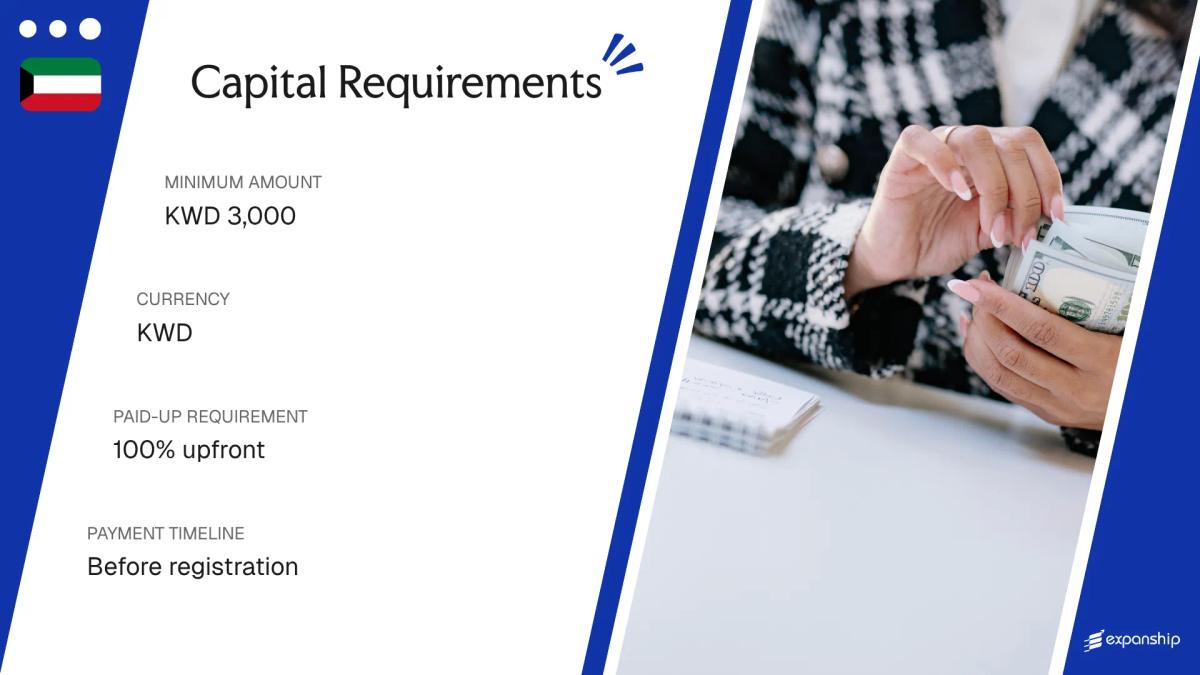
Kuwait minimum share capital requirements vary by legal entity type and are governed under the Companies Law (Law No. 1 of 2016) and its executive regulations. The Ministry of Commerce and Industry (MOCI) oversees the incorporation process and verifies that capital conditions are met before a commercial registration is issued.
For a With Limited Liability company (WLL), the paid-up capital must be deposited in full at a licensed Kuwaiti bank prior to registration. Kuwaiti Shareholding Companies (KSCC) are subject to higher statutory minimums, and capital verification forms part of the formal incorporation filing submitted to MOCI.
| Parameter | Detail |
|---|---|
| Minimum Authorized Share Capital | KWD 1,000 for a WLL; KWD 250,000 for a closed KSCC; KWD 1,000,000 for a public KSCC |
| Maximum Authorized Share Capital | No statutory maximum |
| Minimum Paid-Up Capital | 100% of the stated capital for a WLL at incorporation |
| Paid-Up Requirement at Incorporation | Full capital must be deposited before commercial registration is issued |
| Accepted Currency | Kuwaiti Dinar (KWD) |
| Accepted Forms of Contribution | Cash; in-kind contributions subject to MOCI valuation approval |
| Timeframe to Deposit Capital | Prior to submission of incorporation documents to MOCI |
The bank deposit certificate confirming full capital payment must be obtained before MOCI will accept your incorporation application. Post-incorporation deposit is not permitted for a WLL.
Local Agent Requirements in Kuwait
Foreign companies operating in Kuwait are generally required to appoint a local commercial agent or partner under the framework governed by the Ministry of Commerce and Industry. Kuwait local agent requirements exist to ensure that a foreign entity has an accountable local presence responsible for commercial activity within the country.
Under Law No. 36 of 1964 and subsequent commercial agency regulations, the appointed agent carries defined obligations. These include representing the foreign principal before government authorities, facilitating contract execution with local counterparties, and maintaining records of commercial transactions conducted under the agency arrangement.
Qualification criteria for who may serve as a local agent or commercial partner in Kuwait:
- The agent must be a Kuwaiti national or a wholly Kuwaiti-owned legal entity.
- The individual or firm must be registered in the Commercial Agents Register held by the Ministry of Commerce and Industry.
- Corporate agents must hold a valid commercial license covering agency or representation activities.
- The agent must not be a civil servant or hold a government position.
- For foreign companies in restricted sectors, the local partner may be required to hold a minimum ownership stake rather than act solely as an agent.

Incorporate a Company in Kuwait
Set up your business entity in Kuwait with guidance on local partner structures, licensing, and regulatory registration.
Registered Office Requirements in Kuwait
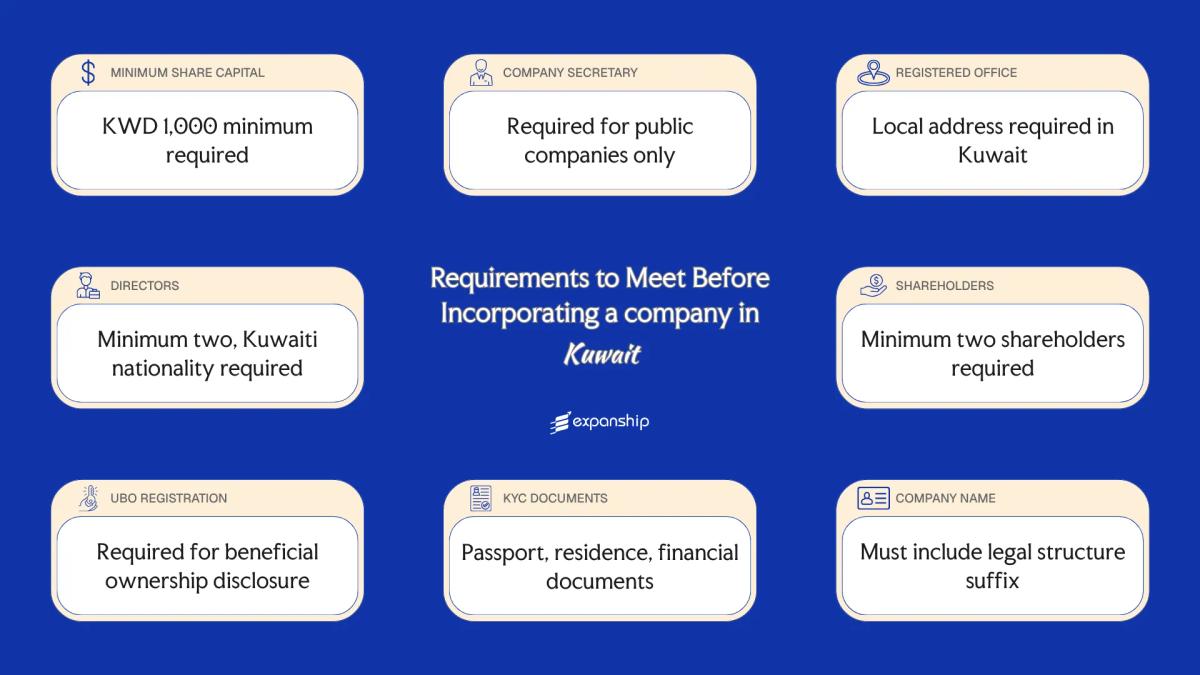
Kuwait registered office requirements mandate that every company maintain a physical address within the country, serving as the official domicile through which the Ministry of Commerce and Industry (MOCI) and other authorities direct formal correspondence and regulatory notices. Failure to maintain a compliant address can result in administrative penalties, suspension of the commercial registration, or rejection of license renewals under the Commercial Companies Law No. 1 of 2016.
- A physical address is required; P.O. Box numbers alone do not satisfy the registered address rules in Kuwait.
- Virtual offices are not recognized as compliant registered addresses under current MOCI registration practice.
- The address must be located within Kuwait; foreign addresses are not accepted for company domicile purposes.
- Supporting documentation, such as a lease agreement or title deed, must be submitted to MOCI as proof of occupancy.
- The registered address is recorded on the commercial register and is publicly accessible through MOCI's company registry.
- Any change to the registered address requires formal notification to MOCI, accompanied by updated tenancy documentation, before the amendment takes effect on the commercial register.
Director Requirements in Kuwait
Upon appointment, directors of Kuwaiti companies assume statutory duties under the Commercial Companies Law (Law No. 1 of 2016), including fiduciary obligations to the entity and personal liability for resolutions passed in violation of the law or the company's articles.
| Parameter | Detail |
|---|---|
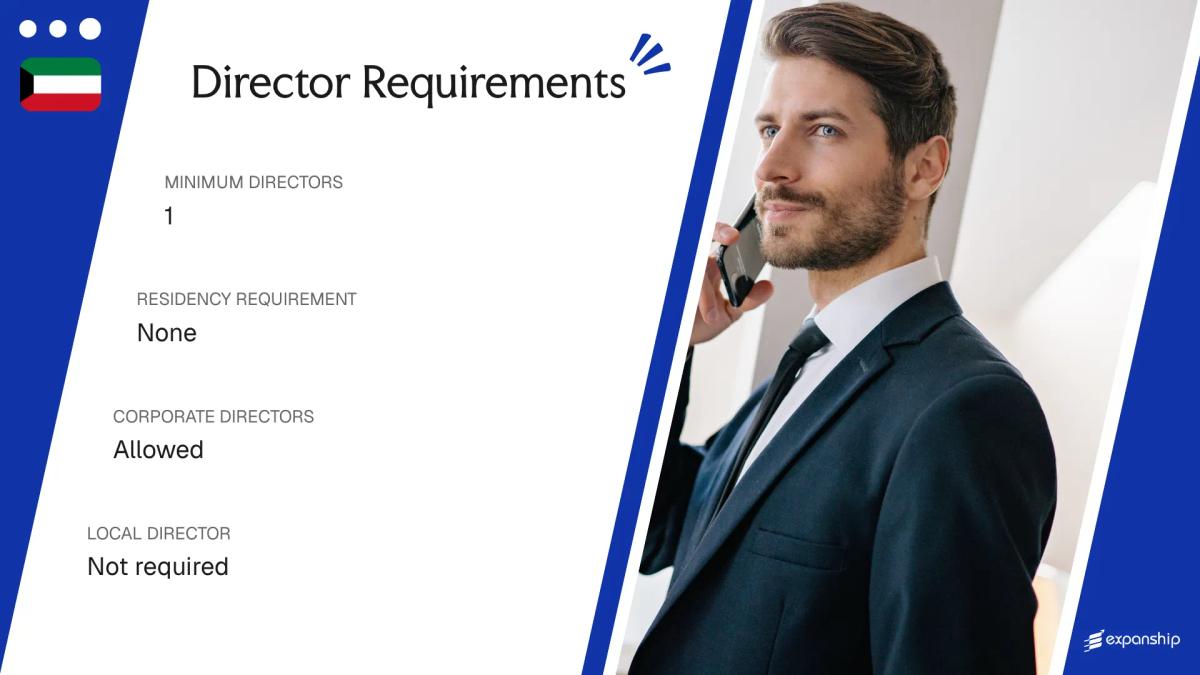
| Minimum Number of Directors | A minimum of one manager or director is required for a With Limited Liability Company (WLL); joint stock companies require a board of at least three directors. |
| Maximum Number of Directors | No statutory maximum is prescribed for WLL managers; joint stock companies are generally subject to limits defined in their articles or the Companies Law. |
| Local/Resident Director Required | No statutory residency requirement exists, though a local presence is effectively necessary for operational licensing purposes. |
| Nationality Restrictions | No outright nationality restriction applies to directors, but majority Kuwaiti ownership rules indirectly shape board composition in many entity types. |
| Minimum Age Requirement | Directors must be of legal age, which is 21 years under Kuwaiti civil law. |
| Corporate Directors Permitted | No statutory provision expressly permits corporate directors; natural persons are the standard requirement in practice. |
| Director Must Be a Shareholder | No statutory requirement exists for directors to hold shares in the company. |
| Publicly Listed on Registry | Director information is filed with the Ministry of Commerce and Industry but is not routinely available through a fully public online registry. |
| Disqualification Conditions | Persons convicted of fraud, bankruptcy offences, or crimes of dishonesty may be disqualified from serving as a director under the Commercial Companies Law. |
Despite Kuwait's majority local-ownership rules for many business structures, there is no statutory requirement that any director hold Kuwaiti nationality, meaning a company can be entirely foreign-managed even when it must be majority Kuwaiti-owned.
Shareholder Requirements in Kuwait
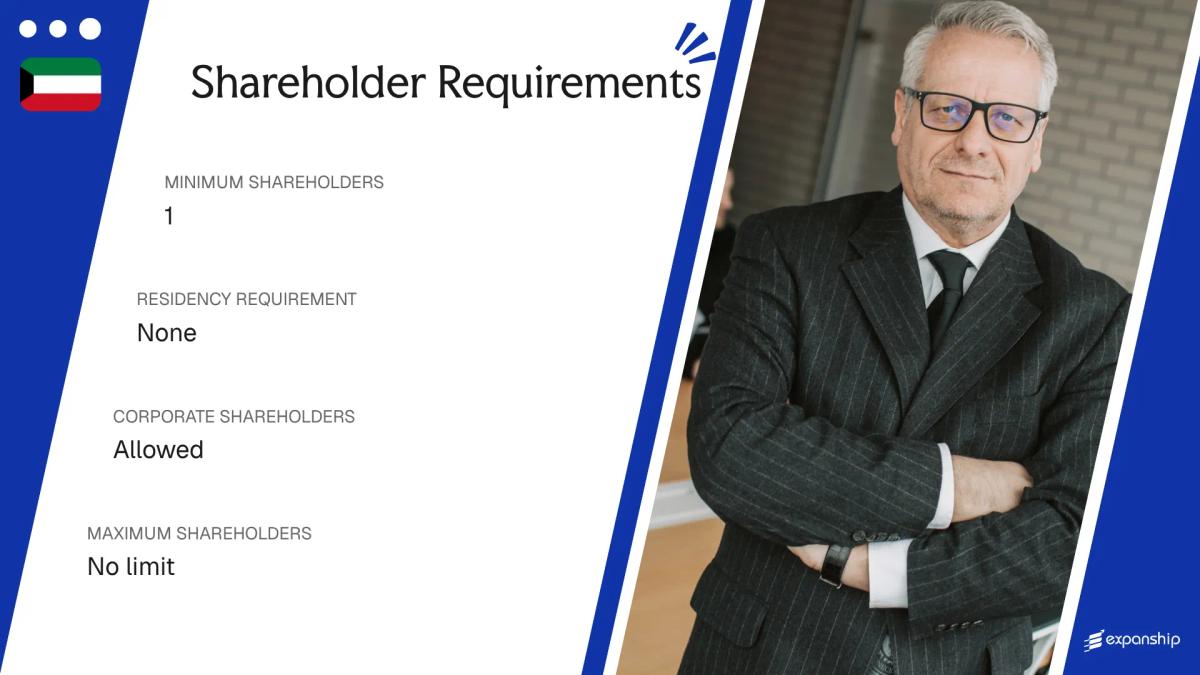
Kuwait shareholder requirements vary by entity type. A With Limited Liability company (WLL) requires a minimum of two shareholders and permits up to fifty.
A sole shareholder structure is not permitted under the WLL framework. The Kuwaiti Companies Law No. 1 of 2016 governs these thresholds.
Nationality and Residency Restrictions
Foreign ownership in most commercial entities is capped at 49%, with Kuwaiti nationals required to hold at least 51% under the Foreign Capital Investment Law. Certain sectors open to foreign investors under specific licensing regimes may permit higher foreign stakes, subject to ministerial approval.
Corporate Shareholders
Corporate entities may act as shareholders in a WLL. No residency requirement applies to the corporate shareholder itself, though the 49% foreign ownership ceiling still applies.
Shareholder Liability
Liability is limited to each shareholder's capital contribution. No general circumstances under the Companies Law extend personal liability beyond that subscribed amount.
Register of Shareholders
A register of shareholders must be maintained and filed with the Ministry of Commerce and Industry. This register is not publicly accessible in the same manner as filings in open-registry jurisdictions, though regulatory authorities retain inspection rights.
Structuring Your Shareholder Setup for Kuwait Incorporation
Get guidance on meeting ownership thresholds, foreign equity limits, and shareholder registration obligations under Kuwaiti corporate law.
UBO / Beneficial Ownership Disclosure Requirements in Kuwait
Kuwait beneficial ownership disclosure requirements are governed primarily by Law No. 106 of 2013 on Anti-Money Laundering and Terrorist Financing, along with subsequent ministerial resolutions issued by the Ministry of Commerce and Industry (MOCI). A beneficial owner is generally defined as any natural person who ultimately owns or controls 25% or more of a company's shares or voting rights.
- Identify all natural persons holding 25% or more of the entity's ownership or voting rights at the time of incorporation.
- Submit beneficial ownership information to the MOCI as part of the company registration process.
- File UBO declarations with the Financial Intelligence Unit (FIU) where required under AML regulations.
- Update beneficial ownership records with the MOCI whenever a change in ownership occurs.
| Parameter | Detail |
|---|---|
| Ownership Threshold for UBO Status | 25% or more of shares or voting rights |
| Filing Authority | Ministry of Commerce and Industry (MOCI); Financial Intelligence Unit (FIU) |
| Disclosure Deadline at Incorporation | At the point of company registration |
| Publicly Accessible Register | No publicly accessible register |
| Penalties for Non-Disclosure | Subject to penalties under Law No. 106 of 2013; specific fines determined by regulatory authority |
| Ongoing Update Obligation | Yes; updates required upon any change in beneficial ownership |
KYC / Document Requirements in Kuwait
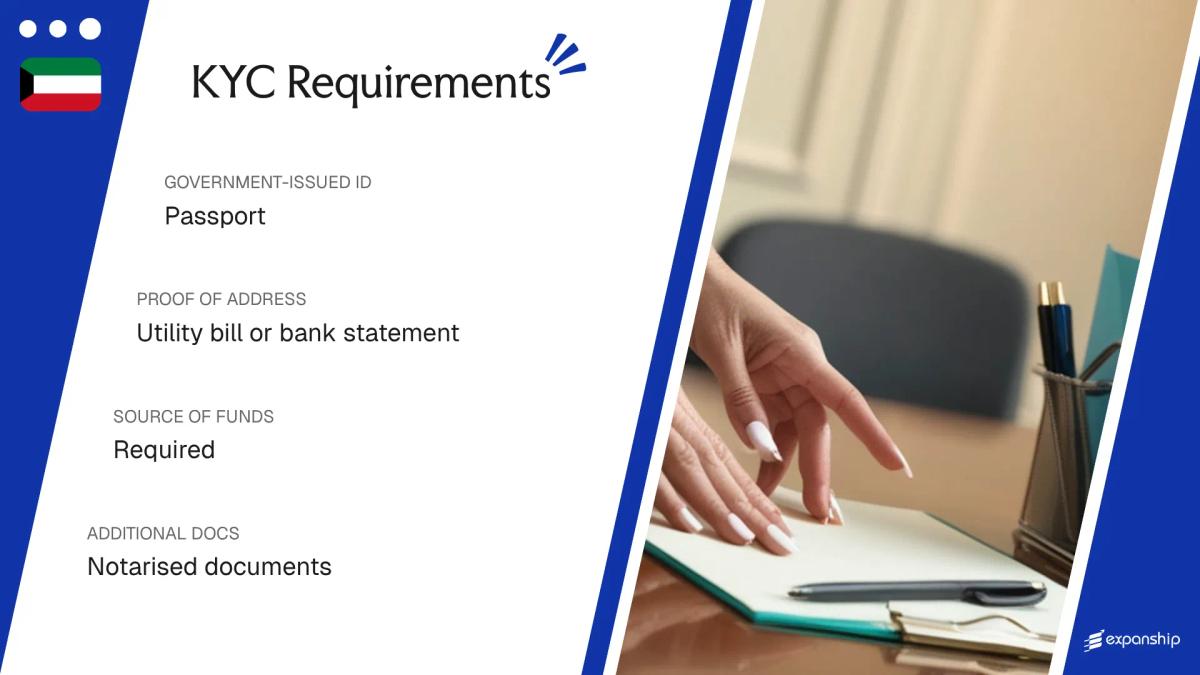
Kuwait KYC document requirements apply at the point of incorporation and are governed by Law No. 106 of 2013 on Combating Money Laundering and Terrorism Financing, overseen by the Kuwait FIU.
Individual / Personal Documents
- Valid passport copy for each individual shareholder, director, or beneficial owner
- National identity card (Civil ID) where the individual is a Kuwaiti national or GCC resident
- Proof of residential address issued within the past three months, such as a utility bill or bank statement
- Curriculum vitae or professional profile may be required for regulated activity applications
Corporate Documents
- Certificate of incorporation of the corporate shareholder or parent entity
- Memorandum and Articles of Association, or equivalent constitutional document
- Current register of directors and shareholders of the corporate entity
- Proof of registered office address of the corporate entity
Source of Funds Documentation
- Recent bank statements (typically covering the past six months) evidencing the origin of invested capital
- Audited financial statements of the introducing entity or individual where available
- A written source of funds declaration signed by the beneficial owner
Notarisation and Apostille Requirements
- Foreign documents must generally be notarised in the country of origin and legalised through the Kuwaiti consulate in that country
- Kuwait is not a signatory to the Hague Apostille Convention, so apostille alone is insufficient
- Official Arabic translations are required for all non-Arabic documents, prepared by a licensed translator
Incomplete or improperly legalised foreign documents are the most frequent cause of incorporation delays at the Ministry of Commerce and Industry.
Company Name Requirements in Kuwait
Kuwait company name requirements are assessed by the Ministry of Commerce and Industry (MOCI) during the incorporation process. Proposed names are reviewed against an existing registry of registered trade names to confirm uniqueness before approval is granted.
Names must be rendered in Arabic, though a transliterated or translated version in another language may accompany the Arabic form. The legal suffix must correspond to the entity type, such as "W.L.L." for a with-limited-liability company.
Certain words are prohibited outright, including references to government bodies, royal titles, and terms implying state affiliation. Words connected to regulated sectors, such as banking or insurance, require prior clearance from the relevant supervisory authority.
Name reservation is available through MOCI's online portal before formal incorporation is initiated. Reserved names are held for a limited period, after which the reservation lapses if the incorporation process has not advanced.
Compliance Services for Companies in Kuwait
Maintain your Kuwait entity's good standing with ongoing compliance support, from annual filings to regulatory reporting.
Conclusion
Kuwait company incorporation requirements are defined by the Companies Law (Law No. 1 of 2016) and administered through the Ministry of Commerce and Industry. Among the requirements covered, the 51% Kuwaiti ownership rule for most commercial entities and the mandatory local registered office address carry practical weight for foreign investors structuring their entry. Beneficial ownership disclosure obligations add a further compliance layer post-formation. Once these requirements are understood, the next step is coordinating the registration process across the relevant government bodies and preparing the documentation your entity will need to operate legally.
Expanship's Corporate Formation Services in Kuwait
Expanship's Kuwait corporate formation services are designed to help your business work through the specific requirements set by the Ministry of Commerce and Industry, from ensuring local partner arrangements are correctly structured to preparing documentation in line with Kuwait's Commercial Companies Law. Our role is to reduce the operational burden of these requirements, not remove the underlying obligations your entity must meet.
Beyond initial registration, Expanship supports the full formation process across Kuwait:
- We prepare and file all company registration documents with the relevant Kuwaiti authorities.
- Our team provides registered agent and office solutions that satisfy local presence requirements.
- We handle government filings and liaise directly with regulatory bodies on your behalf.
- Post-incorporation compliance management keeps your firm in good standing over time.
- Banking introduction assistance helps connect your business with suitable local institutions.
- We also support tax registration and coordination with local authorities as required.
Reach out to Expanship Kuwait to discuss your formation requirements.
Frequently Asked Questions (FAQ)
Yes, the paid-up capital must be deposited in a Kuwaiti bank and evidenced by a bank certificate before the Ministry of Commerce and Industry (MOCI) will complete the registration process. The minimum for a WLL is KWD 1,000, though in practice many registrations require higher amounts depending on the business activity. Proof of deposit is a mandatory document submission, not an optional step.
Failure to comply with beneficial ownership disclosure obligations under Kuwait's Anti-Money Laundering Law (Law No. 106 of 2013) and its executive regulations can result in administrative fines, suspension of the company's commercial license, or referral to the Public Prosecution. The Kuwait Financial Intelligence Unit (KFIU) oversees enforcement and has authority to escalate cases where non-disclosure appears deliberate. Penalties are applied at the entity level, meaning directors and shareholders can also be held personally liable in aggravated cases.
A foreign national can serve as a director of a WLL, but the ownership structure must still reflect at least 51% Kuwaiti shareholding unless a KDIPA exemption applies. Directorship nationality requirements are distinct from ownership rules, so a foreign director appointment is permissible as long as they hold a valid residency permit in Kuwait. Practically, the Kuwaiti majority shareholder often also holds a management role, but this is not a legal prerequisite.
Any change to the registered office address must be formally notified to the Ministry of Commerce and Industry and reflected in an amendment to the company's articles of association. The amendment requires notarization and re-submission to MOCI, along with updated lease documentation proving the new address is a legitimate commercial premises. Operating from an address not registered with MOCI can constitute a compliance violation and may affect the validity of official correspondence and license renewals.
For individual shareholders, standard KYC includes a notarized and apostilled passport copy, proof of address, and a source-of-funds declaration. Corporate shareholders face additional requirements: the parent company must supply its certificate of incorporation, constitutional documents, and a certificate of good standing, all apostilled and translated into Arabic by a certified translator. The full corporate ownership chain must be disclosed up to the ultimate beneficial owner, consistent with Kuwait's AML obligations under Law No. 106 of 2013.
Kuwait's Companies Law and MOCI naming guidelines prohibit names that are identical or deceptively similar to existing registered entities, reference government institutions without authorization, or include terms implying banking or insurance activity unless the firm is licensed for those activities. Names must be submitted in Arabic, and transliterations of foreign brand names require MOCI approval on a case-by-case basis. Offensive, politically sensitive, or religiously inappropriate terms are also rejected outright during the name reservation review.
Legal Disclaimer
The information provided in this article is for general informational purposes only and does not constitute legal, tax, or professional advice. While we strive to ensure the accuracy and timeliness of the content, laws and regulations are subject to change, and the application of laws can vary widely based on specific facts and circumstances.
Readers should not act upon this information without seeking professional counsel tailored to their individual situation. Expanship and its authors disclaim any liability for actions taken or not taken based on the content of this article.
For specific advice regarding your business setup, compliance requirements, or any legal matters, please consult with qualified legal and tax professionals in the relevant jurisdiction.