

Key Takeaways
- Under the Law on Business Partnerships and Companies, all entities must complete registration through the Ministry of Justice before acquiring legal standing to operate in Kyrgyzstan.
- Beneficial ownership disclosure is a mandatory compliance obligation, and failure to meet these requirements exposes a registered entity to direct legal consequences under Kyrgyz regulatory frameworks.
- Foreign investors are required to satisfy specific KYC documentation standards as part of the company registration process, regardless of the legal form chosen.
- A locally maintained registered legal address is a baseline registration requirement, and entities operating without one risk rejection of their application or administrative penalties under Kyrgyz law.
Entity formation in Kyrgyzstan is governed by the Law on Business Partnerships and Companies, with registration administered through the Ministry of Justice and its subordinate registration authorities. Meeting the incorporation requirements in Kyrgyzstan is a prerequisite for obtaining legal standing as a business entity.
This article covers the structural, documentary, and compliance-related requirements that apply during the company registration process. Failure to satisfy these requirements results in rejection of the registration application or, where an entity operates without proper registration, exposure to administrative penalties under Kyrgyz law.
Specific requirements vary depending on the legal form chosen, whether that is a limited liability company, joint-stock company, or another recognised structure. Industry-specific licensing obligations may also impose additional conditions beyond the baseline company registration requirements in Kyrgyzstan.
The primary legislation governing entity formation is available directly in the Civil Code published on Zakon.kz. This article is most relevant to foreign investors and business owners seeking to establish a legal presence through a locally incorporated entity.
Minimum Share Capital Requirements in Kyrgyzstan

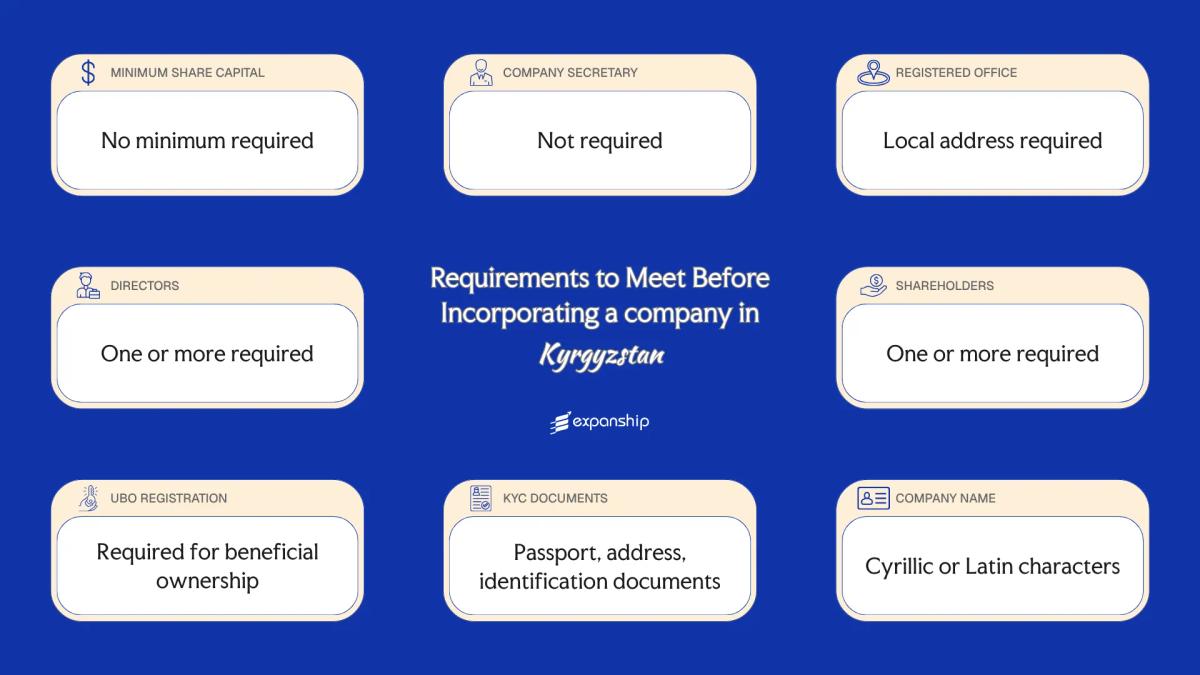
Minimum share capital requirements in Kyrgyzstan are governed by the Law on Limited Liability Companies and the Law on Joint Stock Companies, with the Ministry of Justice overseeing registration through the unified state registry. Your company's authorized capital structure must be declared at the point of incorporation, regardless of the entity type selected.
Kyrgyzstan operates on a par value share system. Capital deposit obligations are verified during the registration process, and while requirements are relatively straightforward for most entity types, the obligation to maintain a declared authorized capital is an ongoing statutory condition, not a one-time formality.
| Parameter | Detail |
|---|---|
| Minimum Authorized Share Capital | No statutory minimum for an LLC (OsOO); JSC requires a minimum as prescribed under the Law on Joint Stock Companies |
| Maximum Authorized Share Capital | No statutory maximum |
| Minimum Paid-Up Capital | No statutory minimum for an LLC |
| Paid-Up Requirement at Incorporation | Founders must contribute at least 50% of declared authorized capital within the first year |
| Accepted Currency | Kyrgyzstani Som (KGS) |
| Accepted Forms of Contribution | Cash, tangible assets, and intellectual property rights |
| Timeframe to Deposit Capital | Remaining balance due within 12 months of incorporation |
Even where no statutory minimum applies, your LLC must declare a specific authorized capital figure in its charter. Omitting or undervaluing this figure can create complications during banking due diligence and future share transfers.
Company Secretary Requirements in Kyrgyzstan
Under Kyrgyz corporate law, the company secretary requirements in Kyrgyzstan differ from common law jurisdictions. There is no statutory obligation for a limited liability company (OsOO) or joint-stock company (AO) to appoint a company secretary as a distinct corporate officer.
Day-to-day corporate compliance functions are typically handled by the executive director or a designated internal officer registered with the Ministry of Justice. That individual bears responsibility for maintaining corporate records, submitting statutory filings, and ensuring the entity remains in good standing with the State Registration Service.
Qualification criteria for the person fulfilling this role include:
- No mandatory residency requirement; the responsible officer may be a foreign national
- Must hold a formal appointment documented in the company's founding documents or internal resolution
- Legal entities cannot serve in this capacity; the role must be held by a natural person
- No licensing requirement applies specifically to this function under general commercial law
- The appointed individual must have legal capacity under Kyrgyz civil law to act on behalf of the entity

Incorporate a Company in Kyrgyzstan
Set up your legal entity in Kyrgyzstan with end-to-end support, from document preparation to registration with the Ministry of Justice.
Legal Address Requirements in Kyrgyzstan
Meeting the legal address requirements in Kyrgyzstan is a foundational obligation under the Civil Code of the Kyrgyz Republic and the Law on State Registration of Legal Entities, as the registered address serves as the official point of contact for all state correspondence, regulatory notices, and legal proceedings. Using a non-compliant or fictitious address can result in the suspension of state registration or forced liquidation initiated by the Ministry of Justice.
- A physical address within the Kyrgyz Republic is required; a post office box alone does not satisfy the registered office obligation.
- The address must be located in Kyrgyzstan; a foreign address cannot serve as the registered office of a locally incorporated entity.
- Virtual office addresses are generally permitted provided the address corresponds to a real, identifiable premises where official correspondence can be received.
- Supporting documentation, such as a lease agreement or proof of ownership, is typically required to confirm the entity's right to use the address.
- The registered address is publicly listed in the Unified State Register of Legal Entities and Individual Entrepreneurs, making it accessible to third parties.
- Any change to the registered office address must be formally notified to the registering authority, and the updated information must be reflected in the state register.
Director Requirements in Kyrgyzstan

Under the Law on Business Partnerships and Companies, directors of a Kyrgyz entity assume statutory duties that include acting in the best interests of the company, maintaining accurate financial records, and bearing personal liability for losses caused by willful misconduct or negligence. Meeting director requirements Kyrgyzstan company regulations impose is a foundational step in the incorporation process.
| Parameter | Detail |
|---|---|
| Minimum Number of Directors | One director is required. |
| Maximum Number of Directors | No statutory maximum is prescribed. |
| Local/Resident Director Required | No residency requirement exists under current law. |
| Nationality Restrictions | No nationality restrictions apply; foreign nationals may serve as directors. |
| Minimum Age Requirement | Directors must be at least 18 years of age. |
| Corporate Directors Permitted | Corporate directors are generally not permitted; the director must be a natural person. |
| Director Must Be a Shareholder | No statutory requirement for a director to hold shares in the company. |
| Publicly Listed on Registry | Directors are recorded in the Unified State Register maintained by the Ministry of Justice. |
| Disqualification Conditions | Persons with a criminal conviction for economic crimes or those previously disqualified by a court order may be barred from directorship. |
Despite having no residency requirement, a foreign national appointed as director in Kyrgyzstan must still obtain a taxpayer identification number (INN) from the State Tax Service before formally assuming the role.
Shareholder Requirements in Kyrgyzstan
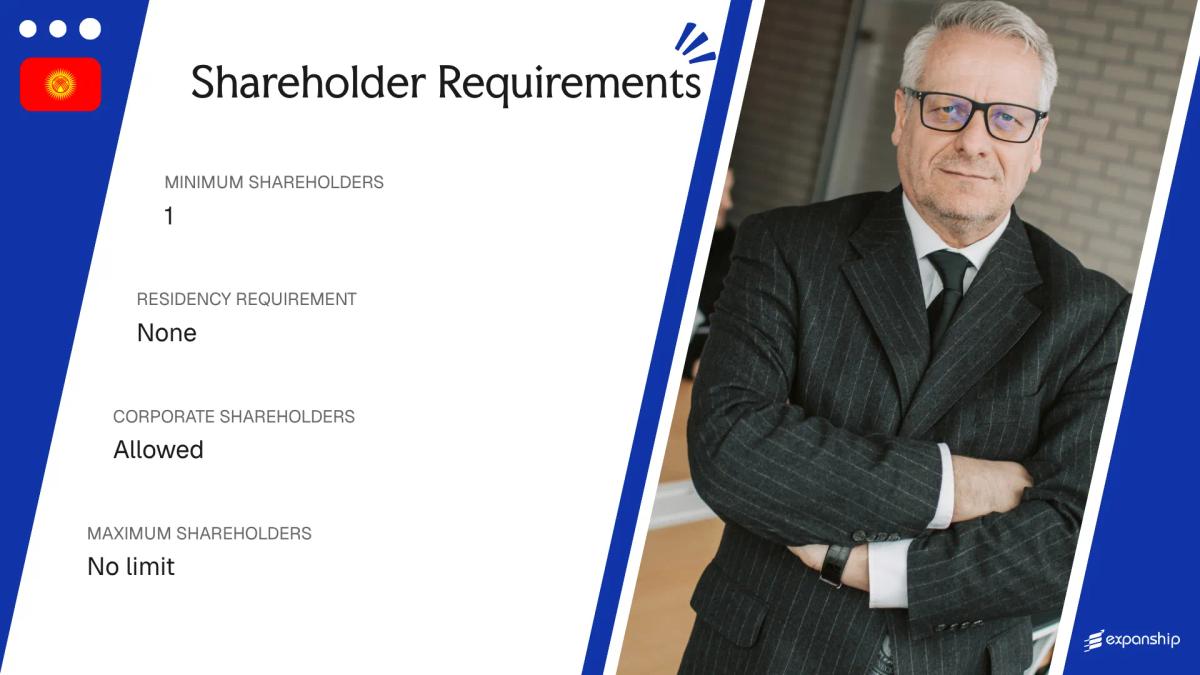
Under Kyrgyz law, a limited liability company (OsOO) requires at least one shareholder and may have up to thirty. A sole shareholder structure is permitted, meaning a single individual or legal entity can fully own the company.
Nationality and Residency Restrictions
Meeting the shareholder requirements for a Kyrgyzstan company does not require local residency or citizenship. Foreign nationals and foreign-registered entities may hold 100% ownership without restriction.
Corporate Shareholders
Legal entities, including foreign corporations, are permitted to act as shareholders in a Kyrgyz OsOO. No special conditions are imposed solely on the basis of the shareholder being a corporate body rather than an individual.
Shareholder Liability
Shareholder obligations in a Kyrgyzstan LLC are limited to the amount each participant contributes to the charter capital. Extended personal liability does not generally apply unless a court pierces the corporate veil in cases of bad faith or abuse.
Register of Shareholders
A register of participants must be maintained by the company and reflects ownership as recorded with the Ministry of Justice. This register is not fully public, though ownership details are disclosed during state registration and may be accessible through official filings.
Set Up Your Shareholder Structure for a Kyrgyz Company
Get guidance on structuring ownership, meeting local registration requirements, and completing incorporation in Kyrgyzstan.
UBO / Beneficial Ownership Disclosure Requirements in Kyrgyzstan
Beneficial ownership requirements in Kyrgyzstan are governed primarily by the Law on Counteracting the Legalisation (Laundering) of Criminally Obtained Income and Financing of Terrorism, which defines a beneficial owner as any individual holding, directly or indirectly, more than 10% of shares or otherwise exercising ultimate control over a legal entity.
- Identify all individuals meeting the beneficial owner threshold and compile their personal details prior to registration.
- Submit beneficial ownership information to the Ministry of Justice during the state registration process.
- Ensure the data is recorded within the Unified State Register of Legal Entities.
- Report any changes to beneficial ownership to the registration authority within a prescribed timeframe following the change.
| Parameter | Detail |
|---|---|
| Ownership Threshold for UBO Status | More than 10% direct or indirect ownership |
| Filing Authority | Ministry of Justice of the Kyrgyz Republic |
| Disclosure Deadline at Incorporation | At the point of state registration |
| Publicly Accessible Register | Unified State Register of Legal Entities |
| Penalties for Non-Disclosure | Administrative liability under general corporate law provisions |
| Ongoing Update Obligation | Yes; changes must be reported to the registration authority |
KYC / Document Requirements in Kyrgyzstan

KYC document requirements Kyrgyzstan are governed primarily by the Law of the Kyrgyz Republic on Counteracting the Legalization (Laundering) of Criminal Proceeds and the Financing of Terrorism, administered by the Financial Intelligence Unit under the State Financial Intelligence Service.
Individual / Personal Documents
- Valid passport or national identity document for each director, shareholder, and beneficial owner
- Proof of residential address dated within three months, such as a utility bill or bank statement
- Completed KYC questionnaire or personal data form as required by the registering agent
- Specimen signature form where required by the incorporating agent or bank
Corporate Documents
- Certificate of incorporation or equivalent constitutional document for any corporate shareholder or director
- Current register of directors and shareholders of the parent entity
- Proof of registered address for the corporate entity
- Good standing certificate issued within the preceding six months
Source of Funds Documentation
- Bank statements covering the preceding three to six months
- Audited financial statements where the shareholder is a corporate entity
- Written declaration of source of funds for individual contributors
Notarisation and Apostille Requirements
- Foreign public documents generally require an apostille under the 1961 Hague Convention
- All documents issued in a foreign language must be accompanied by a certified Russian or Kyrgyz translation
- Notarisation by a licensed notary is typically required for copies of identity documents submitted by foreign nationals
Incorporation filings are commonly delayed when foreign corporate shareholder documents lack a valid apostille or are submitted without a certified translation into Russian or Kyrgyz.
Company Name Requirements in Kyrgyzstan
Company name requirements in Kyrgyzstan are assessed at the point of registration, with the registering authority checking each proposed name for uniqueness and compliance before incorporation proceeds. Duplicate or confusingly similar names are rejected.
Your business name must be in Kyrgyz or Russian and include a legal suffix identifying the entity type, such as "ОсОО" for a limited liability company. No statutory minimum or maximum character count is publicly prescribed.
Certain words are restricted or prohibited outright. Terms implying state affiliation, references to government bodies, and words like "national" or "republic" require special authorization or are barred entirely.
Name reservation is available prior to formal incorporation. The reservation is submitted through the registration authority and holds the chosen name for a defined period while the remaining incorporation documents are prepared.
Compliance Services for Companies in Kyrgyzstan
Manage your ongoing statutory obligations in Kyrgyzstan, from annual filings to regulatory reporting, with support from Expanship's corporate services team.
Conclusion
Incorporation requirements in Kyrgyzstan are defined across multiple regulatory layers, from the Civil Code to sector-specific licensing rules enforced by the Ministry of Justice and the State Tax Service. Among the requirements covered, beneficial ownership disclosure obligations and the mandatory registered legal address stand out as areas where non-compliance carries direct legal consequences. Foreign investors should also account for the KYC documentation standards applied during registration. Once these requirements are understood, the practical next step is engaging with local registration procedures and ongoing compliance obligations specific to your chosen entity structure.
Expanship's Corporate Services for Kyrgyzstan Expansion
Kyrgyzstan company formation services involve a clear set of structural requirements, from registered address obligations under the Civil Code to UBO disclosure rules enforced through the State Registration Service. Expanship helps your business work through each of these requirements methodically, reducing the administrative load that typically accompanies entity setup in the Kyrgyz Republic.
Our support extends across the full incorporation and post-incorporation cycle:
- Your company registration is handled end-to-end, including preparation of founding documents and charter filings.
- We provide a registered agent and a compliant legal address to satisfy local address requirements.
- Our team liaises directly with the Ministry of Justice and relevant state authorities on your behalf.
- Ongoing compliance obligations, including annual filings and statutory updates, are managed after incorporation.
- We facilitate introductions to banking institutions familiar with foreign-owned entities in Kyrgyzstan.
- Tax registration with the State Tax Service and coordination with local authorities is included in our scope.
Reach out to Expanship Kyrgyzstan to discuss your incorporation requirements.
Frequently Asked Questions (FAQ)
A foreign national can serve as sole director of a Kyrgyz LLC without being a resident of Kyrgyzstan. There is no statutory residency requirement for directors under the Civil Code or the Law on Limited Liability Companies. However, practical considerations such as document notarisation and apostille requirements for foreign-issued identity documents can extend the registration timeline.
Failure to disclose beneficial ownership information to the State Registration Service of Kyrgyzstan constitutes a compliance violation under anti-money laundering legislation and can result in administrative penalties against the entity and its officers. The obligation applies to any individual holding 10% or more of shares or exercising effective control over the company. Ongoing non-disclosure can also trigger restrictions on the firm's ability to open bank accounts or conduct certain regulated transactions.
A legal address within Kyrgyzstan is mandatory for company registration, as the Ministry of Justice requires documentary proof of address at the time of incorporation. Whether a virtual office satisfies this depends on the service provider being able to furnish a formal lease agreement or address confirmation letter acceptable to the registering authority. Without a verifiable local address on file, the registration application will not be accepted.
A foreign individual founder must submit a notarised and apostilled copy of their passport, along with a notarised Kyrgyz translation where the original is not in Russian or Kyrgyz. Corporate founders must provide certified constitutional documents, a certificate of good standing, and proof of the authorised signatory's authority to act on behalf of the entity. All foreign-language documents require certified translation before submission to the State Registration Service.
The State Registration Service of Kyrgyzstan will reject a company name that duplicates an existing registered entity or uses terms implying state affiliation without authorisation, such as "national" or "state." Names referencing specific regulated activities, including banking or insurance, require prior approval from the relevant sectoral regulator. Checking name availability through the official registration database before submitting incorporation documents reduces the risk of delays.
A Kyrgyz LLC can be incorporated with a single shareholder, meaning 100% foreign ownership by one individual or one corporate entity is permitted. The Law on Limited Liability Companies does not set a minimum of two founders for this entity type. The maximum number of shareholders in an LLC is capped, and exceeding that threshold would require conversion to a different corporate structure such as a joint-stock company.
Legal Disclaimer
The information provided in this article is for general informational purposes only and does not constitute legal, tax, or professional advice. While we strive to ensure the accuracy and timeliness of the content, laws and regulations are subject to change, and the application of laws can vary widely based on specific facts and circumstances.
Readers should not act upon this information without seeking professional counsel tailored to their individual situation. Expanship and its authors disclaim any liability for actions taken or not taken based on the content of this article.
For specific advice regarding your business setup, compliance requirements, or any legal matters, please consult with qualified legal and tax professionals in the relevant jurisdiction.