
Key Takeaways
- Kyrgyzstan's flat 10% corporate tax rate positions it structurally below most European and Asian jurisdictions, offering a predictable and low-cost fiscal environment for foreign-owned entities.
- Companies registered in Free Economic Zones operate under additional tax exemptions beyond the standard regime, making Kyrgyzstan particularly advantageous for trading and manufacturing operations seeking to minimize their overall tax burden.
- Foreign investors benefit from a network of bilateral investment treaties that provide legally enforceable protections, reducing the sovereign risk typically associated with emerging market jurisdictions.
- Because the Ministry of Justice oversees OsOO registration under a framework that imposes minimal capital requirements and permits full foreign ownership, the practical barriers to establishing a compliant legal entity in Kyrgyzstan remain low relative to comparable jurisdictions.
Kyrgyzstan is a landlocked, independent Central Asian republic that borders China, Kazakhstan, Tajikistan, and Uzbekistan, positioning it at a geographic crossroads between major emerging markets. Company registration falls under the authority of the Ministry of Justice, which oversees the incorporation and maintenance of legal entities operating within the country. Foreign businesses entering the market most commonly do so through an OsOO. The country operates a low-tax regime, making it structurally different from high-tax jurisdictions across Europe and parts of Asia.
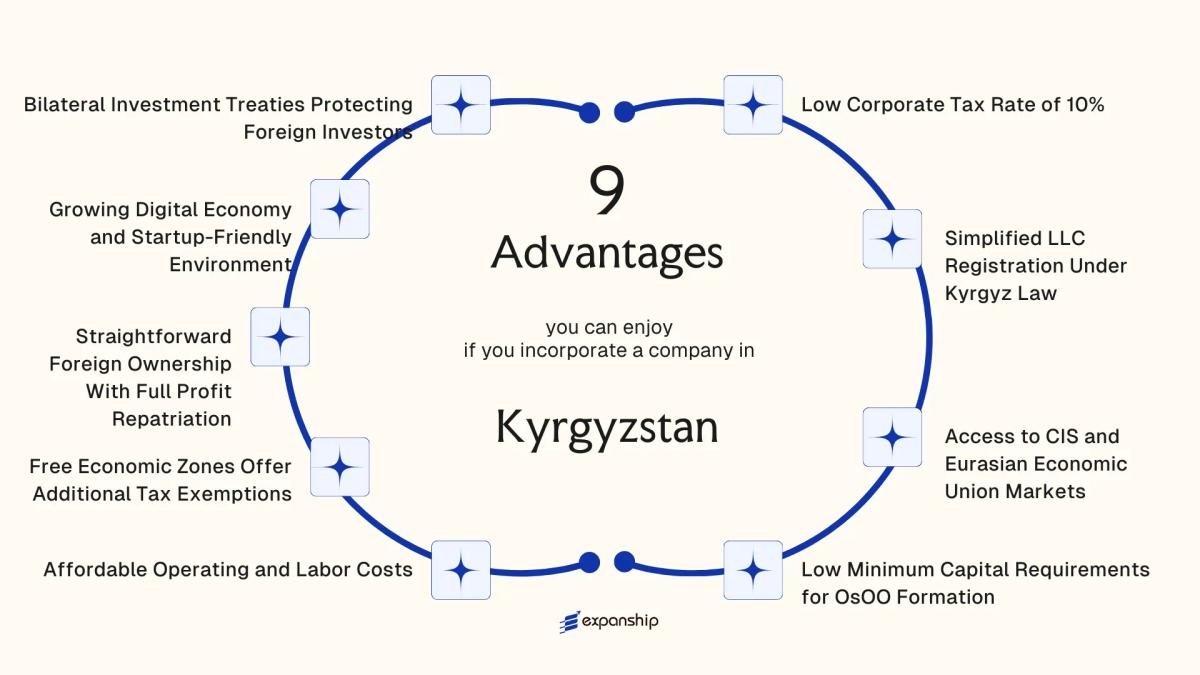
Foreign nationals face few formal barriers to ownership, and the legal framework generally permits full foreign participation in locally registered entities. This openness to foreign direct investment is reflected in both national legislation and international treaty commitments. The benefits of incorporating in Kyrgyzstan extend across tax efficiency, market access, operating costs, and investor protections. This article examines the key advantages your business can draw from establishing a presence here.
Low Corporate Tax Rate of 10%
Under the Kyrgyz Tax Code, resident companies are subject to a flat corporate income tax rate of 10% on net profit. Compared to the OECD average corporate rate of approximately 23%, this represents a structurally lower tax burden that directly increases after-tax returns on operating income.
What the 10% Rate Means in Practice
The Kyrgyzstan 10% corporate tax rate advantage applies to legal entities registered under Kyrgyz law, including the OsOO (limited liability company), on profits generated within the jurisdiction. For a foreign investor running operations through a locally registered entity, a lower statutory rate means a higher proportion of earnings available for reinvestment or distribution without requiring complex tax optimization structures.
How the Rate Is Calculated and Applied
Tax liability is assessed on net profit after allowable deductions, which can include operating expenses, depreciation, and certain business costs recognized under the Tax Code. This calculation method gives your business room to reduce its taxable base through ordinary commercial expenditures, making the effective rate potentially lower than the headline figure depending on your cost structure.
A 10% flat rate on net profit means your entity retains more earnings per operating cycle without relying on special regimes or exemptions.
Simplified LLC Registration Under Kyrgyz Law
Registering an OsOO (Общество с ограниченной ответственностью) under Kyrgyz law carries a procedural advantage that directly reduces the time and cost between deciding to incorporate and actually operating. The simplified LLC registration process under Kyrgyz law allows foreign nationals to establish an entity without being physically present in the country, with registration handled through the Ministry of Justice's one-stop-shop system.
A single application covers tax registration, statistical registration, and legal entity status simultaneously. This consolidated approach means your business can be legally operational within a matter of days rather than weeks, avoiding the multi-agency filing sequences common in many other jurisdictions.
The documentation threshold is also low relative to comparable emerging markets. What makes this genuinely useful for foreign founders:
- No mandatory local director is required, so you retain full management control from abroad
- The charter can be drafted in a flexible format without prescribing rigid operational clauses
- A single founder is sufficient to form the entity, removing the need for a nominal co-shareholder
- No notarization of foreign documents is required beyond standard apostille authentication
Registration fees set by state authorities remain nominal, which means capital is preserved for operational use rather than consumed by formation costs.

Register Your OsOO in Kyrgyzstan
Expanship manages the full OsOO registration process in Kyrgyzstan, from charter preparation to Ministry of Justice filing, without requiring your physical presence.
Access to CIS and Eurasian Economic Union Markets
Kyrgyzstan's accession to the Eurasian Economic Union in August 2015 positioned companies registered here to trade across a combined market of roughly 183 million consumers without facing customs duties on most goods. The EAEU operates as a single customs territory, meaning a firm incorporated locally can move products into Russia, Kazakhstan, Armenia, and Belarus under unified tariff rules rather than navigating separate bilateral arrangements with each state.
| Member State | Population (approx.) | GDP (approx. USD) |
|---|---|---|
| Russia | 144 million | $2.2 trillion |
| Kazakhstan | 19 million | $260 billion |
| Belarus | 9.4 million | $73 billion |
| Armenia | 3 million | $24 billion |
| Kyrgyzstan | 7 million | $13 billion |
Beyond the EAEU, the country participates in the Commonwealth of Independent States free trade area, which extends preferential access to a broader network of post-Soviet economies under the 2011 CIS Free Trade Agreement. For businesses exporting manufactured goods or agricultural products, this dual membership removes a layer of cost and compliance that non-member jurisdictions cannot match.
Goods produced within the EAEU territory qualify for the "made in EAEU" designation, which can open procurement and distribution channels across member states that are otherwise restricted to external suppliers. Your entity benefits from this status from the date of registration, provided production or value-addition activity occurs within the jurisdiction.
Low Minimum Capital Requirements for OsOO Formation
The low minimum capital OsOO formation Kyrgyzstan requirement is set at 1 Kyrgyzstani som — effectively zero in practical terms. Under the Law on Business Partnerships and Companies, an Obshchestvo s Ogranichennoy Otvetstvennostyu (OsOO) is not required to commit meaningful capital at the point of registration. For a foreign investor, this means your entry cost is not artificially inflated by a statutory deposit requirement before operations begin.
This structure separates initial capital from actual operating funds. You are free to deploy your investment into business activity rather than holding it in a reserve account to satisfy a regulatory threshold. Registration fees and professional service costs become the real financial consideration, not a capital lock-up.
Under Kyrgyz company law, the charter capital is declared in founding documents but carries no minimum paid-in obligation tied to a specific monetary floor for an OsOO. This contrasts with jurisdictions that require capital deposits verified by a bank before incorporation is complete.
Keep the following in mind:
- Charter capital must be stated in your founding documents
- Capital contributions can be made in cash or in kind, as permitted under the founding agreement
- There is no mandatory bank deposit or notarial capital verification required prior to registration
- Certain licensed activities may impose sector-specific capital thresholds independent of the general OsOO rules
The 1 som minimum capital rule means a foreign national can technically form a compliant OsOO for less than USD 0.02 in statutory capital.
Affordable Operating and Labor Costs
Affordable operating costs Kyrgyzstan business owners encounter extend well beyond tax rates. The general cost structure — covering rent, utilities, staffing, and day-to-day overheads — sits materially below what businesses pay in comparable emerging markets across Central Asia, making the jurisdiction commercially practical for lean operations and early-stage ventures alike.
Labor Costs and Workforce Availability
Low labor costs in Kyrgyzstan translate directly into lower monthly payroll obligations for foreign-owned entities. The national minimum wage is set by government resolution and remains among the lowest in the post-Soviet space, while average wages in professional and administrative roles are a fraction of Eastern European equivalents.
Employment relationships are governed by the Labor Code of the Kyrgyz Republic, which sets clear terms for contracts, working hours, and termination. For a foreign business owner, this legal predictability reduces exposure to ambiguous labor disputes while keeping compliance costs contained.
Office and Infrastructure Expenses
Commercial office space in Bishkek — the primary hub for registered businesses — carries significantly lower lease rates than capitals in neighboring Kazakhstan or Russia. Your operational overhead for a small-to-mid-sized office remains manageable without requiring complex cost-reduction structures.
Utility and telecommunications costs follow a similar pattern. The Kyrgyz affordable workforce advantages are reinforced by the relatively low cost of maintaining a physical presence, meaning the gap between gross revenue and net operating income is wider than in many peer jurisdictions.
Plan Your Cost-Efficient Business Setup in Kyrgyzstan
Speak with our team to understand the full cost picture for operating a company in Kyrgyzstan, from payroll structuring to office setup and compliance obligations.
Free Economic Zones Offer Additional Tax Exemptions
Kyrgyzstan free economic zone tax exemptions represent one of the more structurally significant incentives available to foreign-owned businesses. The country operates several designated FEZs, including Bishkek, Karakol, Naryn, and Maimak, each governed under the Law on Free Economic Zones. Businesses registered within these zones operate under a distinct tax regime that differs substantially from the standard national framework.
- Entities established inside an FEZ are exempt from corporate income tax on profits generated from activities conducted within the zone, removing one of the primary recurring costs for manufacturing and export-oriented firms.
- FEZ-registered companies are also exempt from VAT on goods produced and sold within the zone, which directly reduces the cost base for businesses involved in goods processing or re-export.
- Customs duties do not apply to equipment, raw materials, and inputs imported for use within the zone, meaning your firm can build or scale operations without the import tax burden that applies outside the FEZ perimeter.
- These exemptions apply specifically to income and transactions tied to in-zone activities; revenue generated outside the zone remains subject to standard Kyrgyz tax rules, so the structure of your operations determines the extent of the benefit.
Straightforward Foreign Ownership With Full Profit Repatriation
Foreign ownership profit repatriation in Kyrgyzstan operates under a permissive legal framework. The Law on Investments in the Kyrgyz Republic grants non-residents the right to own 100% of a locally registered entity without a domestic partner requirement. This means your business structure remains entirely under your control from day one.
Profits earned by a foreign-owned company can be converted and transferred abroad without restrictions on amount or frequency, subject to standard currency conversion procedures through licensed banks. The practical effect is that your returns are not trapped in the local financial system waiting for regulatory approval cycles.
Dividends paid to non-resident shareholders are subject to a 10% withholding tax under the Tax Code of the Kyrgyz Republic. This rate is relatively contained and may be reduced further under applicable double taxation agreements that Kyrgyzstan maintains with partner states.
A foreign investor owning 100% of a Kyrgyz OsOO generating 5,000,000 KGS in annual net profit would pay 500,000 KGS in dividend withholding tax, retaining 4,500,000 KGS fully transferable abroad — with no capital controls or minimum reinvestment requirements imposed by local law.
Property rights over assets, including shares and capital contributions, are also protected against expropriation without compensation under the same investment law.
Growing Digital Economy and Startup-Friendly Environment
Kyrgyzstan's digital economy startup advantages are grounded in deliberate policy rather than incidental circumstance. The government enacted the Digital Kyrgyzstan 2019-2023 strategy, followed by ongoing digital transformation initiatives, to modernize public services and stimulate private-sector technology development. For a foreign-owned tech firm, this policy direction translates into an administrative environment that is increasingly receptive to digital business models.
The High Technology Park (HTP), established under Kyrgyz law, offers resident companies a preferential tax regime. Qualifying IT firms operating within the HTP pay a single 5% tax on revenue in place of standard corporate taxes, which is a meaningful reduction against the baseline 10% rate applicable to general companies.
Startup-friendly conditions extend beyond tax treatment:
- Software development, IT outsourcing, and digital services firms are eligible for HTP residency
- The local talent pool is expanding through state-supported STEM education programs
- Operating costs for tech businesses remain among the lowest in Central Asia, preserving margins during early-stage growth
HTP residency requires your business activity to fall within the officially approved list of qualifying IT and technology services; general trading or non-digital activities do not qualify.
Bilateral Investment Treaties Protecting Foreign Investors
Kyrgyzstan bilateral investment treaties foreign investors form a meaningful layer of legal protection that sits outside the domestic court system. The country has signed BITs with more than 30 states, including Germany, China, France, Switzerland, and the United Kingdom. Each treaty obligates both contracting states to protect investors from the other party against arbitrary expropriation, discriminatory treatment, and unreasonable interference with established investments.
Treaty-Based Protections
Most of the BITs in force grant foreign investors access to international arbitration, typically under ICSID or UNCITRAL rules, when disputes arise with the Kyrgyz state. This matters because it removes you from sole dependence on local courts and places the resolution mechanism in a neutral, internationally recognized forum. The right to initiate such proceedings is written directly into the treaty text, not subject to separate government consent at the time of the dispute.
Fair and Equitable Treatment Standard
Nearly all of these agreements include a fair and equitable treatment clause, which requires the host state to maintain a stable and predictable legal environment for covered investments. If regulatory changes or administrative action materially harm your investment in ways that fall below this standard, the treaty gives you a direct remedy. That protection applies regardless of the corporate structure you use, provided the entity is owned or controlled by a national of the treaty partner state.
Most-Favoured-Nation Application
Several BIT protections for businesses in Kyrgyzstan extend through most-favoured-nation clauses, meaning you may be entitled to invoke more favorable treatment granted to investors from third countries. This creates a floor of protection that can be higher than the literal text of your home country's bilateral agreement.
Why Kyrgyzstan Stands Out Against Competing Jurisdictions
Foreign investors evaluating Central Asian incorporation typically weigh Kyrgyzstan against Kazakhstan and Uzbekistan, given their shared regional trade access, comparable legal frameworks inherited from Soviet-era codification, and overlapping investor profiles. A comparison across these three jurisdictions reveals that the Kyrgyz structure holds measurable advantages in tax rate, capital thresholds, and ownership rules — parameters that directly affect cost and operational flexibility for a foreign-owned entity.
What the numbers alone do not convey is the structural significance of EAEU membership. Unlike Uzbekistan, which holds observer status, a company registered in Kyrgyzstan operates within the bloc's customs union as a full member, giving it preferential trade access that an entity in a non-member state cannot replicate. Kazakhstan shares that membership, but its minimum capital requirements and administrative costs for company formation run considerably higher. For a Kyrgyzstan vs competing jurisdictions incorporation decision, this combination of low entry cost and full treaty participation is a distinguishing structural factor.
| Parameter | Kyrgyzstan | Kazakhstan | Uzbekistan |
|---|---|---|---|
| Standard Corporate Tax Rate | 10% | 20% | 15% |
| Minimum Share Capital (LLC equivalent) | No statutory minimum | No statutory minimum | ~$200 USD equivalent |
| Foreign Ownership Allowed | 100% | 100% | 100% |
| EAEU Full Membership | Yes | Yes | No (observer) |
| Free Economic Zones | Yes (FEZ framework) | Yes | Yes |
| Profit Repatriation Restrictions | None for foreign shareholders | None | None |
Compliance Services for Companies in Kyrgyzstan
Maintain your Kyrgyz entity's good standing with ongoing compliance support, including annual filings, statutory reporting, and regulatory obligations under Kyrgyz law.
Conclusion
Kyrgyzstan's position as a low-cost, treaty-backed jurisdiction with a flat 10% corporate tax rate and unrestricted profit repatriation presents a clear structural case for foreign business formation. The combination of Free Economic Zone exemptions and access to EAEU markets adds further weight to that case, particularly for trading and manufacturing operations.
That said, the advantages of Kyrgyzstan company formation are not uniform across all industries or ownership structures. An e-commerce firm, a logistics company, and a financial services provider will each extract different value from the same regulatory framework, and the optimal structure depends on your specific activity and cross-border requirements.
For those whose business model aligns with what the jurisdiction offers, the practical barriers to entry remain low, and the legal protections available through bilateral investment treaties provide a credible foundation for long-term operations. The next step is translating these structural features into a properly registered, compliant entity.
Start Your Kyrgyzstan Company With Expanship Today
Expanship assists foreign nationals and corporate clients with company formation in Kyrgyzstan, covering the full registration lifecycle for an OsOO (Obshchestvo s Ogranichennoy Otvetstvennostyu) under the Civil Code of the Kyrgyz Republic and the Law on Business Partnerships and Companies. From initial document preparation through filing with the Ministry of Justice and the State Tax Service, the firm handles interactions with the relevant authorities so your entity reaches operational status without procedural delays. The benefits covered in this blog, ranging from the 10% corporate tax rate to Free Economic Zone access and bilateral investment treaty protections, form the practical framework within which Expanship structures its support.
Services provided include:
- Document preparation, notarization, and legalization for foreign founders
- Registered agent and registered office provision in Bishkek
- Government filing and liaison with the Ministry of Justice
- Post-incorporation compliance management, including annual reporting obligations
- Tax registration and State Tax Service enrollment
- Banking introduction assistance with local financial institutions
To discuss your incorporation requirements, contact Expanship Kyrgyzstan directly.
Frequently Asked Questions (FAQ)
Registration with the Ministry of Justice generally takes one to three business days under the current simplified registration procedure. The process involves submitting the charter, founder documents, and registration application, after which the entity receives a taxpayer identification number from the State Tax Service. Delays typically occur only when submitted documents contain errors or require notarization.
The standard corporate income tax rate is 10% of net profit under the Tax Code of the Kyrgyz Republic. Entities operating within designated Free Economic Zones are generally exempt from this rate, along with VAT and customs duties on goods processed within the zone. The specific exemptions vary by zone and the nature of business activity conducted there.
As a member state of the Eurasian Economic Union (EAEU), Kyrgyzstan-registered companies can trade goods across member states including Russia, Kazakhstan, Belarus, and Armenia without customs duties applying at internal borders. This access is governed by the EAEU Treaty and its associated technical regulations. For businesses targeting regional distribution, this membership materially reduces cross-border trade friction.
The minimum charter capital for an OsOO is 1 Kyrgyzstani som, which is effectively a nominal requirement. This figure is set under the Law on Business Partnerships and Companies and is not subject to a paid-up capital deposit requirement prior to registration. In practice, founders set capital at a higher amount to reflect the operational needs of the business.
Bilateral Investment Treaties (BITs) to which Kyrgyzstan is a signatory provide foreign investors with protections including fair and equitable treatment, protection against expropriation without compensation, and access to international arbitration in the event of a dispute with the state. These protections apply to the investments held through a locally incorporated entity, not only to direct cross-border investments. The specific arbitration mechanisms available depend on the treaty in question between Kyrgyzstan and the investor's home country.
No statutory requirement mandates that the director or general manager of an OsOO be a Kyrgyz national or resident. A foreign founder can also serve as the sole director of the company. However, practical considerations such as bank account opening and dealings with the State Tax Service may favor having a locally present authorized representative.
A standard OsOO engaged in digital or technology-related activities is subject to the 10% corporate income tax on net profit and, depending on turnover, may fall within the VAT registration threshold under the Tax Code. Certain software development activities may qualify for simplified tax regimes, though eligibility depends on the specific nature of services provided and the applicable revenue thresholds. The State Tax Service administers these determinations and publishes guidance on qualifying activity classifications.
Legal Disclaimer
The information provided in this article is for general informational purposes only and does not constitute legal, tax, or professional advice. While we strive to ensure the accuracy and timeliness of the content, laws and regulations are subject to change, and the application of laws can vary widely based on specific facts and circumstances.
Readers should not act upon this information without seeking professional counsel tailored to their individual situation. Expanship and its authors disclaim any liability for actions taken or not taken based on the content of this article.
For specific advice regarding your business setup, compliance requirements, or any legal matters, please consult with qualified legal and tax professionals in the relevant jurisdiction.