
Key Takeaways
- Kyrgyzstan's Civil Code framework governing LLCs and joint-stock companies imposes corporate obligations that foreign investors must navigate without the procedural clarity offered by more mature jurisdictions.
- The State Registration Service compliance requirements create a bureaucratic overhead that disproportionately affects foreign-owned entities unfamiliar with domestic administrative processes.
- Kyrgyzstan's narrow double tax treaty network limits foreign investors' ability to efficiently repatriate profits or structure cross-border operations without incurring elevated withholding tax exposure.
- Persistent weaknesses in intellectual property enforcement mean that businesses operating in technology, branding, or proprietary content sectors carry materially higher protection risk than in jurisdictions with established enforcement mechanisms.
Kyrgyzstan operates under an evolving regulatory framework, shaped in part by ongoing reforms under the Ministry of Justice and oversight from the State Registration Service. The primary keyword — disadvantages of incorporating in Kyrgyzstan — covers a range of structural, financial, and institutional friction points that this article addresses across dedicated sections.
Not every drawback applies equally to all business types. A small trading company faces different exposure than a fintech firm or a manufacturing entity seeking foreign investment.
The applicable company law governing limited liability companies and joint-stock entities is the Civil Code, which underpins core corporate obligations in the country.
This article is most relevant to foreign investors, offshore holding structures, and internationally operating businesses considering entry into Central Asian markets through a locally registered entity.
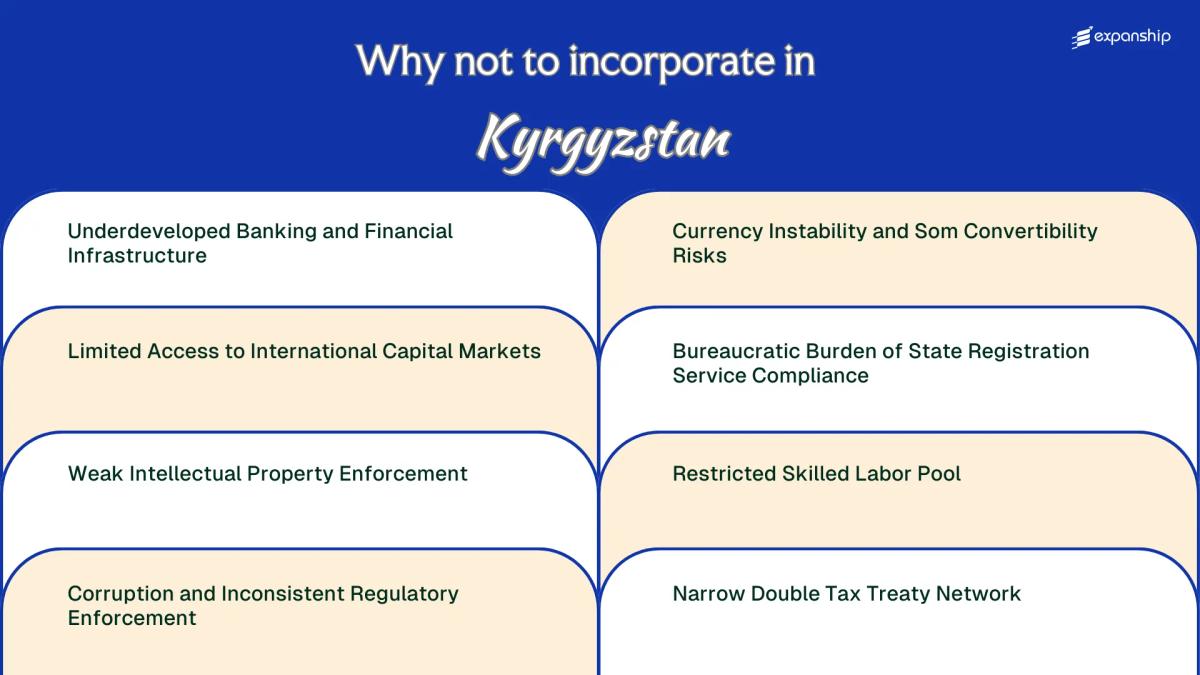
Underdeveloped Banking and Financial Infrastructure
Kyrgyzstan banking infrastructure limitations affect foreign companies from the moment of incorporation. The National Bank of the Kyrgyz Republic oversees a sector that remains shallow by regional standards, with few banks offering services oriented toward non-resident or internationally active entities.
Restricted Access for Foreign-Owned Entities
Opening a corporate bank account as a foreign-owned company typically requires extensive in-person documentation, notarized translations, and prolonged due diligence periods that can extend the post-registration timeline by weeks. Most domestic banks lack correspondent banking relationships with institutions in Western Europe or North America, which means cross-border transactions face delays, elevated fees, or outright refusal.
Structural Weaknesses in Payment and Credit Systems
Card payment infrastructure and electronic settlement systems are underdeveloped relative to neighboring Kazakhstan, limiting your firm's ability to process client payments efficiently. Access to trade finance or credit facilities for foreign-owned businesses is constrained, as local banks apply conservative lending criteria and rarely extend credit to newly registered entities without substantial collateral.
Banking challenges for foreign companies in Kyrgyzstan can directly delay operational launch, since without an active corporate account your entity cannot receive client payments, meet payroll obligations, or fulfill tax remittance requirements.
Limited Access to International Capital Markets
Kyrgyzstan limited access to capital markets is a structural constraint that directly limits how your company can fund growth. The Kyrgyz Stock Exchange (KSE), established in 1994, remains thinly traded, with market capitalization representing a marginal fraction of GDP compared to regional peers such as Kazakhstan.
Foreign firms incorporated locally cannot realistically use KSE listing as a capital-raising mechanism. Institutional investor participation is minimal, and secondary market liquidity is insufficient to support meaningful equity issuance.
Accessing international debt markets presents its own friction. Kyrgyz entities face skepticism from foreign lenders due to limited credit history infrastructure and the absence of internationally recognized ratings on domestic corporate instruments.
For a foreign business owner, these gaps translate into concrete operational burdens:
- Relying on retained earnings or shareholder loans instead of capital markets forces slower scaling timelines
- The absence of venture capital infrastructure means early-stage funding must be sourced entirely from outside the country, adding currency conversion and transfer costs
- Foreign banks unfamiliar with Kyrgyz legal entities often require additional collateral or guarantees, increasing your cost of borrowing
The Law on Securities Market governs capital market activity, but regulatory development has not kept pace with what foreign investors expect from an investable jurisdiction.

Company Incorporation in Kyrgyzstan
Understand the full structural and regulatory picture before forming a company in Kyrgyzstan.
Weak Intellectual Property Enforcement
Weak intellectual property protection Kyrgyzstan presents a concrete operational risk for any foreign firm that holds patents, trademarks, or proprietary software. The country's IP framework is administered by the State Agency of Intellectual Property and Innovation under the Government of the Kyrgyz Republic, but enforcement capacity at the agency level remains limited relative to the scope of infringement activity reported by rights holders.
Registration of a trademark through the local system does not reliably translate into protection in practice. Counterfeit goods and unauthorized use of registered marks persist in commercial markets, and civil proceedings to address infringement can be slow and outcomes unpredictable.
| Enforcement Factor | Practical Reality for Foreign Rights Holders |
|---|---|
| Trademark registration processing time | Can extend beyond 12 months, leaving marks unprotected during the interval |
| Civil IP litigation duration | Multi-year proceedings are common, delaying any remedy |
| Customs border enforcement | Limited systematic interception of counterfeit goods at entry points |
| Criminal prosecution threshold | High evidentiary requirements restrict successful criminal IP cases |
Kyrgyzstan is a member of the Eurasian Patent Organization and has ratified several WIPO treaties, but treaty membership does not compensate for gaps in domestic judicial capacity. Courts handling IP disputes lack specialization, which affects the consistency and predictability of rulings. For a foreign entity whose revenue depends on brand integrity or proprietary technology, this absence of reliable judicial recourse means that IP assets deployed in this market carry elevated exposure with few efficient remedies available locally.
Corruption and Inconsistent Regulatory Enforcement
Corruption risks incorporating in Kyrgyzstan are well-documented. Transparency International's 2023 Corruption Perceptions Index ranked the country 141st out of 180, placing it among the lower tier globally. For a foreign business owner, this score reflects a tangible operational reality, not an abstract ranking.
State bodies responsible for business oversight, including the State Tax Service and the Ministry of Economy and Commerce, apply regulations with a degree of discretion that creates unpredictability for compliance planning. Inspections under the Law on Inspections can be triggered outside of scheduled cycles, and the practical outcome often depends on factors beyond the written rules.
Kyrgyzstan regulatory enforcement inconsistencies mean that two entities in the same industry may face entirely different treatment during audits or licensing reviews. This variance imposes costs on your business that no amount of legal preparation can fully anticipate.
- Scheduled and unscheduled inspections are governed by the Law on Inspections, but unscheduled triggers are broadly defined
- Unofficial payments at various administrative stages are a reported risk, not an isolated incident
- No independent appeals mechanism guarantees a neutral review of enforcement decisions
- Licensing renewals can be delayed without formal written explanation from the issuing authority
Did You Know? Kyrgyzstan introduced a moratorium on business inspections for small and medium enterprises, yet enforcement bodies retain broad exceptions that effectively limit the moratorium's practical reach.
Currency Instability and Som Convertibility Risks
Kyrgyzstan som currency instability risks affect foreign-owned entities from the moment of incorporation, with exchange rate volatility directly eroding the real value of capital held or repatriated in som.
Structural Fragility of the Som
The Kyrgyzstani som (KGS) operates under a managed float regime overseen by the National Bank of the Kyrgyz Republic, but the currency has historically experienced sharp depreciations tied to commodity price shifts and regional spillovers from Russia. Your firm's KGS-denominated revenues can lose significant value against hard currencies between the time contracts are signed and payments are received.
Foreign exchange transactions are governed under the Law on the National Bank of the Kyrgyz Republic and related currency regulation acts, which permit convertibility in principle but do not insulate businesses from illiquid market conditions that widen spreads on KGS conversion.
Practical Consequences for Foreign-Owned Firms
Currency convertibility problems in Kyrgyzstan become acute when your business needs to repatriate profits, since thin foreign exchange market depth can delay conversions or force unfavorable rates. This exchange rate exposure is particularly pronounced for firms with USD- or EUR-denominated supplier contracts but local-currency income streams.
Managing Currency and Operational Risk When Incorporating in Kyrgyzstan
Speak with our team about the structural financial risks of establishing a company in Kyrgyzstan and how to structure your entity accordingly.
Bureaucratic Burden of State Registration Service Compliance
Kyrgyzstan State Registration Service compliance burden falls on your business from the moment of incorporation, with the State Registration Service (SRS) acting as the primary authority over company formation, charter amendments, and director changes. Procedural requirements are document-heavy, and submissions must meet specific notarization and translation standards that add both time and cost for foreign applicants.
- Foreign founders must submit notarized and officially translated incorporation documents to the SRS, creating a processing dependency on local notaries that can delay registration by days or weeks.
- Any amendment to your company's charter, including changes to share capital or management, requires a separate SRS re-registration filing rather than a simple administrative update.
- The SRS operates through physical branch offices, meaning remote or online submission options for foreign principals remain limited compared to jurisdictions with fully digitized registries.
- Errors or omissions in submitted documents result in full rejection rather than correction requests, restarting the compliance clock entirely.
- Business registration red tape compounds for foreign-owned entities that must simultaneously satisfy the SRS and the State Tax Service upon formation.
Restricted Skilled Labor Pool
Kyrgyzstan's skilled labor shortage for businesses is a structural constraint, not a temporary gap. The working-age population skews toward low-skill sectors, and emigration of qualified professionals to Russia and Kazakhstan has reduced the domestic supply of engineers, IT specialists, and senior finance professionals.
Higher education output does not fully address this gap. The country's universities produce graduates, but employer surveys consistently identify mismatches between academic qualifications and applied technical competency required in sectors like fintech, logistics management, and manufacturing.
For foreign firms, the practical cost surfaces quickly:
- Sourcing mid-level technical staff locally often requires extended recruitment cycles.
- Hiring foreign nationals adds work permit processing through the State Agency for Labour, Employment and Social Protection, introducing time and administrative costs.
- Senior roles may ultimately require expatriate staffing, which raises your operational cost base significantly.
Talent pool limitations in Kyrgyzstan compound hiring challenges for foreign firms that need rapid deployment of skilled teams at incorporation.
A foreign-owned IT firm requiring five mid-level software engineers may need to budget an additional 20-30% above base salary to attract qualified candidates away from Bishkek's limited pool of active technical specialists, based on general hiring cost patterns observed in comparable frontier markets.
Narrow Double Tax Treaty Network
Kyrgyzstan's double tax treaty network limitations create measurable exposure for foreign-owned entities, particularly those routing dividends, royalties, or interest payments across borders. The country has concluded treaties with a relatively small number of partners, concentrated largely among CIS states and a handful of others including China, Germany, and India.
If your business operates with counterparties in the United States, the United Kingdom, most of Southeast Asia, or across Latin America, no treaty relief applies. Withholding tax on dividends paid to non-resident shareholders can reach 10%, with no reduction mechanism available where no treaty exists, increasing the effective cost of profit repatriation.
Treaty gaps also affect royalty and interest flows. A firm paying licensing fees to a parent entity in a non-treaty country faces full statutory withholding with no recourse to reduced rates, which undermines structures that rely on IP holding arrangements or intercompany financing.
Tax treaty risks incorporating in Kyrgyzstan are compounded by the absence of a participation exemption or territorial tax system that might otherwise offset the missing treaty coverage.
If your corporate structure routes income through a jurisdiction not covered by Kyrgyzstan's treaty network, full domestic withholding rates apply with no mechanism for reduction or exemption under current tax law.
Overcoming These Incorporation Challenges
Overcoming Kyrgyzstan incorporation challenges requires structural planning rather than reactive adjustments after registration. The disadvantages covered in this blog span regulatory, financial, and institutional dimensions that cannot be resolved through any single measure.
- Register your entity through the State Registration Service to ensure legal standing under the Law on State Registration of Legal Entities before opening any bank accounts or entering contracts.
- Structure equity and inter-company transactions in a currency other than the Kyrgyzstani som where contractually permissible, to reduce exposure to convertibility risk.
- File for intellectual property protection with the Kyrgyzpatent state agency at the point of incorporation, not after commercial operations begin.
- Identify whether your home jurisdiction has a double tax treaty in force with Kyrgyzstan before finalising your corporate structure, to avoid unplanned withholding tax exposure.
- Establish a local compliance calendar aligned with the Tax Code of the Kyrgyz Republic to avoid penalties from inconsistent regulatory enforcement.
These steps operate within a legal framework that continues to undergo reform, meaning current compliance thresholds and procedural requirements can shift without extended notice. Your firm's ongoing exposure depends significantly on how well its structure accounts for that institutional variability from the outset.
Kyrgyzstan's Overall Business Viability
Kyrgyzstan presents a credible, low-cost incorporation option for businesses oriented toward Central Asian trade corridors or EAEU market access. The Kyrgyzstan business viability risks assessment picture is mixed: structural disadvantages are real and documented, yet they do not uniformly disqualify the jurisdiction for every foreign business profile.
| Pro | Con |
|---|---|
| Low statutory tax rates and a simplified tax regime for small businesses | Correspondent banking relationships are limited, complicating cross-border payments |
| EAEU membership provides tariff-free access to a market of roughly 180 million people | The som lacks full convertibility, exposing foreign owners to repatriation and exchange-rate risk |
| Company registration through the State Registration Service can be completed relatively quickly | Corruption indices and inconsistent enforcement by regulatory bodies create unpredictable compliance costs |
| Affordable operational costs compared to most Central Asian peers | The double tax treaty network covers fewer than 30 jurisdictions, limiting tax planning options for global firms |
| No requirements for a local director in standard LLC formations | Intellectual property protections exist under national law but are weakly enforced in practice |
Your decision to incorporate here should rest on whether your operational model tolerates limited banking infrastructure and a shallow skilled labor market.
Compliance Services for Companies in Kyrgyzstan
Stay aligned with the State Registration Service requirements and ongoing regulatory obligations for your Kyrgyzstan-registered entity.
Conclusion
Kyrgyzstan incorporation drawbacks summary points to a jurisdiction with real structural limitations that affect day-to-day business operations. Banking access remains constrained, currency risk tied to the Kyrgyzstani som creates ongoing financial exposure, and the narrow double tax treaty network limits how efficiently cross-border income can be managed. These are not minor friction points. Firms that proceed without a clear-eyed view of the regulatory and financial environment often encounter compliance burdens that were not anticipated at the outset. Specialist guidance on local registration requirements and treaty positioning can determine whether the structure functions as intended.
Expanship's Kyrgyzstan Company Formation Support
Expanship's Kyrgyzstan company formation support is built around the specific compliance pressures this jurisdiction creates, from the State Registration Service requirements to the currency and banking constraints detailed throughout this blog. Expanship's role is to reduce the operational weight of those obligations, not to change the underlying realities of doing business here.
Our service scope covers the full formation and post-incorporation cycle.
- Your company registration and document preparation are handled with reference to local legal requirements.
- A registered agent and office address in Kyrgyzstan are provided for official correspondence purposes.
- Government filings are managed directly, including liaison with relevant regulatory authorities.
- Post-incorporation compliance obligations are tracked and actioned on your behalf.
- Banking introduction assistance is available to help your business establish a local account.
- Tax registration and coordination with local authorities are carried out as part of the setup process.
Reach out to Expanship Kyrgyzstan to discuss your incorporation requirements.
Frequently Asked Questions (FAQ)
Any business with a brand, proprietary process, or product design is exposed. Kyrgyzstan's IP framework falls under the Law on Trademarks and the Law on Copyright and Related Rights, but enforcement through the courts is inconsistent and slow, making it difficult to pursue infringement claims effectively. Manufacturing, franchising, and consumer goods firms face the same risks as tech or media businesses.
Failure to meet State Registration Service filing requirements can result in administrative penalties and, in persistent cases, forced liquidation of the entity. The registration authority in Kyrgyzstan holds discretionary power over reinstatement procedures, and the process of restoring a deregistered company is time-consuming. There is no automatic grace period codified for most routine compliance failures.
Kyrgyzstan consistently scores poorly on Transparency International's Corruption Perceptions Index, ranking below Kazakhstan and generally in a similar range to Tajikistan. Inconsistent regulatory enforcement is a documented pattern, not an isolated risk, meaning permit approvals, inspections, and tax assessments can vary significantly depending on the official or region involved. This unpredictability creates a structural risk for foreign firms that cannot be fully mitigated through legal structuring alone.
Kyrgyzstan's treaty network is narrow, covering a modest number of jurisdictions, most of which are former Soviet states. Compared to Kazakhstan, which maintains treaties with over 50 countries including major EU and OECD members, Kyrgyzstan's coverage leaves significant withholding tax exposure for cross-border transactions with Western partners. This directly increases the cost of dividend repatriation, royalty payments, and intercompany lending with non-treaty jurisdictions.
Direct access is severely restricted. The Kyrgyz Stock Exchange has limited listings and low trading volumes, and Kyrgyzstan-registered entities are not recognized vehicles for institutional investors in Western markets. Most foreign investors who need capital market access use a holding structure in a more recognized jurisdiction and operate the Kyrgyz entity as a subsidiary rather than a primary vehicle.
The shortage is most acute in finance, technology, and advanced manufacturing. While Kyrgyzstan has a functioning university system, emigration of skilled graduates to Russia and Kazakhstan has reduced the available domestic talent base. Companies requiring specialists in these fields typically face higher recruitment costs, longer hiring timelines, or reliance on expatriate staff, which introduces additional work permit and residency compliance obligations.
Legal Disclaimer
The information provided in this article is for general informational purposes only and does not constitute legal, tax, or professional advice. While we strive to ensure the accuracy and timeliness of the content, laws and regulations are subject to change, and the application of laws can vary widely based on specific facts and circumstances.
Readers should not act upon this information without seeking professional counsel tailored to their individual situation. Expanship and its authors disclaim any liability for actions taken or not taken based on the content of this article.
For specific advice regarding your business setup, compliance requirements, or any legal matters, please consult with qualified legal and tax professionals in the relevant jurisdiction.