

Key Takeaways
- Japan's Companies Act imposes a registration and documentation process for Kabushiki Kaisha formation that is substantially more procedurally demanding than incorporation frameworks in most comparable OECD jurisdictions.
- Foreign-owned entities must contend with a corporate tax compliance structure that layers national, local, and consumption tax obligations, creating an ongoing administrative burden that extends well beyond the initial setup phase.
- The absence of a statutory exemption from the resident director requirement means foreign operators without an established local network must incur additional costs to satisfy this structural condition before commencing business.
- Legal and regulatory filings conducted entirely in Japanese place foreign investors at a functional disadvantage, as errors or omissions in official documentation can delay registration or trigger compliance scrutiny.
Japan operates under one of the most heavily regulated corporate environments among OECD economies, with company formation and ongoing compliance governed by a detailed statutory framework, including the Companies Act. The disadvantages of incorporating in Japan span procedural, financial, linguistic, and structural categories, each carrying distinct implications for foreign operators.
Not every drawback will apply equally to your business. The challenges a small foreign-owned Godo Kaisha faces differ considerably from those encountered by a multinational establishing a Kabushiki Kaisha subsidiary, and industry-specific licensing requirements can add further layers of complexity.
This article is most relevant to foreign investors and overseas business owners attempting direct market entry without an established local presence or familiarity with Japanese regulatory procedures.
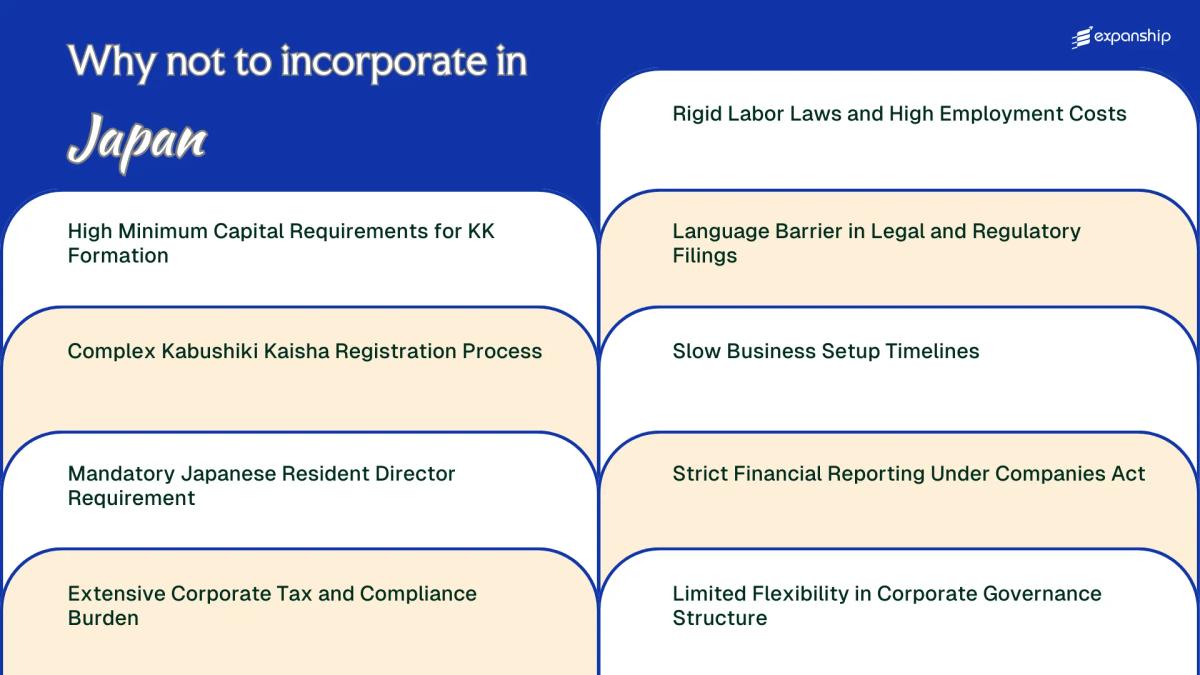
High Minimum Capital Requirements for KK Formation
Under Japan's Companies Act (Kaisha-hō), a Kabushiki Kaisha can technically be formed with as little as ¥1 in paid-in capital. Japan KK minimum capital requirements, however, tell a more complicated story in practice.
The Gap Between Legal Minimum and Operational Reality
Banks, landlords, and government procurement bodies routinely assess a KK's capital base as a proxy for financial credibility. A firm registered with nominal capital is frequently denied corporate bank accounts or rejected from supplier agreements, forcing foreign founders to inject substantially higher amounts before the entity can function commercially.
Certain regulated activities compound this further. Financial services licensing, for instance, imposes statutory minimum capital thresholds under the Financial Instruments and Exchange Act that far exceed ¥1, meaning the legal floor is largely irrelevant for businesses operating in those sectors.
Liquidity Constraints After Incorporation
Capital contributed at incorporation is recorded on the balance sheet as stated capital, and distributing it back to shareholders triggers specific procedures under the Companies Act, including a creditor protection process. This restricts early-stage liquidity in ways foreign founders, accustomed to more flexible capital structures, may not anticipate.
Foreign business owners should treat operational credibility benchmarks, not the ¥1 statutory minimum, as the real capital threshold when planning initial capitalization for a KK.
Complex Kabushiki Kaisha Registration Process
Kabushiki Kaisha registration complexity begins before you file a single document. Forming a KK requires notarial certification of the articles of incorporation by a Japanese notary public, a mandatory step that cannot be completed remotely or substituted with a foreign equivalent.
That notarization alone costs approximately JPY 50,000, and it must precede share payment. Any error in the articles triggers rejection and a restart of the notarization process, generating additional fees.
Registration is filed with the Legal Affairs Bureau (Homukyoku) under the jurisdiction where your registered office is located. The bureau reviews submissions against the Companies Act (Kaisha-ho), and even minor formatting inconsistencies in submitted documents can cause delays or outright rejection.
For a foreign business owner, this creates friction at multiple points:
- Errors in the articles of incorporation require fresh notarization, directly increasing setup costs before the entity is even active
- All submission documents must conform to Japanese-language formatting standards, forcing reliance on local legal professionals whose fees add to overhead
- The physical requirement for notarization means your timeline depends on appointment availability at a Japanese notary office, which you cannot control from abroad
- Seal registration (jitsuin toroku) is required for the representative director, creating an additional procedural step that foreign nationals unfamiliar with the system frequently overlook
Digital filing options exist through the Ministry of Justice's online system, but accessing them requires a certified electronic signature tied to a Japanese infrastructure, which most foreign incorporators do not hold.

Kabushiki Kaisha Incorporation in Japan
Manage the notarization, Legal Affairs Bureau filing, and document requirements for your KK registration with structured support.
Mandatory Japanese Resident Director Requirement
Under Japan's Companies Act, a Kabushiki Kaisha is not legally required to have a Japanese national as a director. However, the registered address of at least one representative director must be within Japan. This Japan resident director requirement effectively forces foreign founders without a local presence to recruit, retain, and compensate a Japan-based individual solely to satisfy a structural legal threshold.
| Requirement | Detail | Implication for Foreign Owners |
|---|---|---|
| Representative Director residence | Must be domiciled in Japan | Excludes wholly foreign management teams |
| Nominee director annual cost | Typically ¥300,000–¥800,000+ per year | Recurring overhead with no operational return |
| Director liability exposure | Personal liability under Companies Act Article 423 | Qualified locals are difficult to recruit without indemnity arrangements |
| Director registration | Filed with Legal Affairs Bureau (法務局) | Any change requires formal amendment and re-registration fees |
Finding a qualified resident willing to accept the role is not straightforward. Personal liability provisions under the Companies Act discourage many candidates, particularly professionals unfamiliar with your firm's operations or sector.
Nominee director services are commercially available, but they introduce governance risk. A third-party individual holds legal representative status over your entity, which creates dependency and potential exposure if that relationship deteriorates.
Extensive Corporate Tax and Compliance Burden
Japan's corporate tax compliance burden is not limited to the headline rate. A Kabushiki Kaisha is subject to a combined effective corporate tax rate that, when national and local levies are stacked together, has historically exceeded 30%. That rate alone does not capture the full administrative weight placed on foreign-owned entities.
Filing obligations under the National Tax Agency require annual corporate tax returns, consumption tax returns, and enterprise tax filings at the prefectural level. Each of these follows distinct deadlines and calculation methods, so errors in one filing can trigger cascading discrepancies across the others.
Consumption tax (shouhizei) registration becomes mandatory once taxable sales exceed ¥10 million in a base period, imposing an additional quarterly or annual reporting cycle. Missing this threshold calculation can expose your business to retroactive tax liability.
- Corporate tax returns must be filed within two months of the fiscal year-end with the NTA
- Prefectural and municipal enterprise tax filings are separate from national returns
- Consumption tax obligations are triggered by the ¥10 million threshold in the base period
- Transfer pricing documentation requirements apply where cross-border related-party transactions exist
- Blue return (aoiro shinkoku) status, which unlocks certain deductions, requires advance NTA approval
Japan requires consumption tax filings even from newly incorporated companies if their paid-in capital at formation equals or exceeds ¥10 million, bypassing the standard two-year exemption period that most new businesses expect to rely on.
Rigid Labor Laws and High Employment Costs
Japan labor law restrictions for employers rank among the most demanding regulatory frameworks in the OECD, creating substantial compliance costs that foreign-owned entities frequently underestimate before entry.
Statutory Protections That Limit Employer Discretion
The Labour Standards Act (LSA) sets binding floors on working hours, overtime pay, paid leave accrual, and dismissal procedures that your business cannot contractually override. Terminating an employee without "objectively reasonable grounds" violates Article 16 of the LSA and exposes the firm to reinstatement orders, making workforce reductions significantly more difficult than in most comparable economies.
Employers must also contribute to four mandatory social insurance programs: health insurance, pension, unemployment, and workers' accident compensation, with combined employer-side contributions typically exceeding 15% of gross payroll per employee.
Cost Implications for Foreign-Owned Entities
High employment costs in Japan compound the challenge because statutory bonuses, known as "teate," while not always legally mandated, have become contractual norms that employees can legally enforce once established in your firm's practices. A foreign business that adopts local compensation norms without understanding their legal consequences can find those commitments extremely difficult to retract. Workforce compliance challenges extend further when your entity employs fixed-term contract workers, as the Labour Contract Act imposes conversion rights to indefinite employment after five consecutive years.
Guidance on Managing Employment Compliance Obligations in Japan
Understand the statutory requirements under Japan's Labour Standards Act and social insurance framework before your entity hires its first employee.
Language Barrier in Legal and Regulatory Filings
The Japan language barrier in regulatory filings is one of the most operationally disruptive challenges a foreign business faces after incorporation. All statutory documents, filings with the Legal Affairs Bureau, and submissions to the National Tax Agency must be prepared in Japanese, with no official English-language alternative accepted.
- Every document filed with the Legal Affairs Bureau (Homukyoku), including articles of incorporation (teikan) and board resolutions, must be drafted in Japanese, requiring certified translation or a qualified local professional for each submission.
- Tax filings submitted to the National Tax Agency, including corporate tax returns under the Corporation Tax Act, are only processed in Japanese, adding mandatory translation costs to each compliance cycle.
- Annual financial statements and shareholder meeting minutes required under the Companies Act (Kaisha-ho) must also be maintained in Japanese, creating a permanent administrative dependency on bilingual legal or accounting support.
- Foreign directors without Japanese proficiency cannot independently review the documents they are legally obligated to sign, increasing exposure to errors or misrepresentation.
Slow Business Setup Timelines
Slow business setup timelines in Japan add measurable friction for foreign companies aiming to begin operations quickly. A Kabushiki Kaisha (KK) registration typically takes four to six weeks from submission to approval, depending on the Legal Affairs Bureau (Homukyoku) workload in your chosen prefecture.
The process requires notarial certification of the articles of incorporation by a licensed Japanese notary before registration can proceed. This pre-registration step alone can consume one to two weeks, and it cannot be bypassed for a KK structure.
Unlike many OECD jurisdictions where digital incorporation portals allow same-day or next-day registration, Japan's system still relies heavily on physical document submission and official seal (hanko) authentication. Each stage is sequential, meaning delays at one point hold up all subsequent steps.
For foreign applicants, obtaining a certified translation of identity documents adds further time outside your direct control.
A foreign founder incorporating a KK in Tokyo while based overseas could realistically spend weeks one through two on notarial preparation, weeks three through four on document submission to the Legal Affairs Bureau, and week five or six awaiting the certificate of registered matters (touki jikoh shomeisho), pushing the earliest operational start date to nearly two months after initial planning.
Strict Financial Reporting Under Companies Act
Japan's Companies Act reporting restrictions impose structured disclosure obligations on Kabushiki Kaisha that go well beyond what many foreign-incorporated entities encounter at home. A KK must prepare annual financial statements including a balance sheet, profit and loss statement, statement of changes in equity, and notes to financial statements, all of which must be approved at the annual general shareholders' meeting.
For larger entities classified as "large companies" under the Companies Act, the obligation extends to consolidated financial statements and mandatory external audit by a certified public accountant or audit firm. This classification triggers when share capital reaches ¥500 million or total liabilities exceed ¥20 billion, thresholds that multinational subsidiaries can meet without being large by global standards.
The strict financial reporting requirements in Japan demand that documents be prepared in Japanese, conform to Japanese GAAP, and be retained for defined statutory periods. Foreign parent companies accustomed to IFRS or US GAAP face a parallel reporting burden, since Japan does not automatically accept those standards at the entity level for domestic compliance purposes.
Even privately held firms without public shareholders must file financial statements with the Legal Affairs Bureau, meaning there is no full exemption from disclosure simply because your business is closely held.
If your KK meets the "large company" thresholds under the Companies Act, external statutory audit becomes legally mandatory regardless of whether your global parent company already undergoes independent audit overseas.
Limited Flexibility in Corporate Governance Structure
Japan corporate governance structure limitations are codified directly in the Companies Act (Kaisha-ho), leaving foreign founders with fewer structural options than they may be accustomed to elsewhere.
A Kabushiki Kaisha (KK) with auditors must maintain a board of at least three directors, a statutory auditor, and in larger firms, a Board of Auditors. This fixed composition is not optional, and it increases your administrative headcount and associated costs regardless of your firm's actual size or operational complexity.
Smaller KKs can adopt a simplified structure, but the Companies Act still imposes prescriptive rules on decision-making authority, shareholder meeting requirements, and director liability. Your ability to customize internal governance through articles of incorporation is narrower than in jurisdictions like Singapore or the UK, where corporate constitutions allow considerably more bespoke arrangements.
Minority shareholder protections under the Companies Act also limit how freely a controlling shareholder can structure equity arrangements, which can complicate joint venture negotiations with local partners.
Overcoming Japan's Incorporation Challenges
Overcoming Japan's Incorporation Challenges
Addressing these challenges begins with understanding which structural decisions and compliance obligations can be planned for before registration. Overcoming Japan incorporation challenges is largely a matter of sequencing the right steps in advance.
- Appoint a Japanese resident as a representative director at the time of Kabushiki Kaisha registration to satisfy the requirement under the Companies Act.
- Set an adequate capital reserve at incorporation that reflects your anticipated operational costs, given the absence of a statutory minimum but the practical expectations of financial institutions.
- Register your entity through the Legal Affairs Bureau using certified translated documents to address the language and procedural requirements of the filing process.
- Engage a certified public tax accountant (zeirishi) to manage corporate tax filings under the Corporation Tax Act and local inhabitant tax obligations from the outset.
- Adopt articles of incorporation that define your governance structure clearly, working within the mandatory framework set by the Companies Act.
These steps operate within a regulatory environment overseen by bodies including the Legal Affairs Bureau and the National Tax Agency. The measures above reduce exposure to procedural delays, but they do not eliminate the structural weight of Japan's corporate compliance obligations.
Japan's Incorporation Potential Weighed Against Drawbacks
The structural barriers covered in this blog are real and, in several cases, more demanding than comparable jurisdictions in Asia. That said, Japan remains a credible destination for incorporation when your business requires access to one of the world's largest consumer markets, a stable legal system, and strong institutional infrastructure.
| Pros | Cons |
|---|---|
| Access to a large, high-income domestic market with strong consumer spending | No statutory minimum capital for GK, but KK formation historically carries capital expectations that deter early-stage foreign entrants |
| Stable legal framework governed by the Companies Act (Kaisha-hō) | Registration through the Legal Affairs Bureau involves multi-step notarization and document authentication |
| High international credibility associated with the Kabushiki Kaisha structure | At least one resident director is required for a KK, complicating remote incorporation |
| Sophisticated banking and financial infrastructure | Corporate tax rates, combined with local inhabitant and enterprise levies, create a significant compliance cost |
| Predictable regulatory environment with clear reporting obligations | All legal and regulatory filings are conducted in Japanese, with no official English-language alternative |
Timelines for company registration routinely exceed those of neighboring jurisdictions, and the labor framework under the Labour Standards Act limits structural flexibility once employees are hired. Strict financial reporting obligations under the Companies Act add recurring administrative costs that compound over time.
Corporate Compliance Services for Companies in Japan
Ongoing compliance support for Japan-registered entities, covering statutory filings, annual reporting obligations, and regulatory maintenance under the Companies Act.
Conclusion
The cons of Japan company incorporation are well-documented: mandatory resident director appointments, a registration process administered through the Legal Affairs Bureau that demands notarized documentation, and a corporate tax and compliance structure that places sustained administrative pressure on foreign-owned entities. These are not minor procedural inconveniences. Each factor carries material cost and operational consequence. Structural constraints under the Companies Act further limit how a Kabushiki Kaisha can be configured to suit a foreign parent's governance preferences. Specialist legal and filing support remains a practical requirement for most foreign businesses entering this market.
Expanship's Japan Incorporation Support Services
Incorporating in Japan involves specific obligations under the Companies Act, coordination with the Legal Affairs Bureau for KK registration, and ongoing compliance with the National Tax Agency's reporting requirements. Expanship's Japan incorporation support for foreign companies is structured around reducing the operational weight of these processes, particularly for businesses without an established local presence or Japanese-language capability.
Our team supports your business across the full formation and post-registration cycle.
- We prepare and file all company registration documents with the relevant Legal Affairs Bureau on your behalf.
- A registered agent and compliant local office address are provided to satisfy statutory requirements.
- We liaise directly with government bodies and regulatory authorities throughout the filing process.
- Post-incorporation compliance management keeps your entity in good standing under Companies Act obligations.
- Banking introduction assistance connects your business with institutions familiar with foreign-owned entities.
- Tax registration and coordination with the National Tax Agency and local municipal offices are handled for you.
Reach out to Expanship Japan to discuss your incorporation requirements.
Frequently Asked Questions (FAQ)
Both the Kabushiki Kaisha and the Godo Kaisha are affected, though the KK structure draws more scrutiny given its stricter governance requirements under the Companies Act. The resident address issue is not written as an absolute statutory bar in all cases, but administrative practice at the Legal Affairs Bureau effectively makes local representation a near-mandatory condition for smooth registration.
Failure to file required financial statements under the Companies Act can result in fines of up to JPY 1,000,000 for violations related to improper accounting records or failure to prepare statutory documents. Directors can be held personally liable in certain cases, which adds personal financial exposure beyond corporate-level penalties.
Japan's effective corporate tax rate sits around 29-34% when national and local taxes are combined, which is substantially higher than Singapore's headline rate of 17% or Hong Kong's 16.5%. Beyond the rate itself, the layered filing obligations to the National Tax Agency, prefectural tax offices, and municipal authorities multiply the administrative workload in a way that most regional competitors do not replicate.
Errors in filings submitted to the Legal Affairs Bureau or the National Tax Agency can result in rejected applications, mandatory resubmissions, and delayed registration timelines that extend well beyond the standard four-to-six week window. Since official filings must be in Japanese, a mistranslated article of incorporation or incorrectly formatted corporate seal registration can invalidate the entire submission, restarting the process from scratch.
Beyond the corporate tax obligations, a KK must budget for mandatory statutory audits if it meets certain size thresholds under the Companies Act, certified public accountant fees, social insurance contributions, and local inhabitant taxes that apply even in loss-making years. For a small foreign-owned KK, annual compliance costs frequently exceed JPY 500,000 before accounting for legal or corporate secretary fees.
Misclassifying workers as independent contractors to avoid obligations under the Labor Standards Act is actively scrutinized by the Ministry of Health, Labour and Welfare. If an employment relationship is found to exist regardless of the contractual label, the company becomes liable for unpaid social insurance contributions, overtime, and potentially severance, with back-payments calculated from the start of the working relationship.
Both factors contribute, but the primary driver is the sequential nature of Japan's registration process through the Legal Affairs Bureau, which does not permit parallel processing of filings in the way some jurisdictions allow. The corporate seal registration, articles of incorporation notarization, and bank account opening each depend on the prior step being completed, meaning a single document error compresses the entire timeline rather than just delaying one stage.
Legal Disclaimer
The information provided in this article is for general informational purposes only and does not constitute legal, tax, or professional advice. While we strive to ensure the accuracy and timeliness of the content, laws and regulations are subject to change, and the application of laws can vary widely based on specific facts and circumstances.
Readers should not act upon this information without seeking professional counsel tailored to their individual situation. Expanship and its authors disclaim any liability for actions taken or not taken based on the content of this article.
For specific advice regarding your business setup, compliance requirements, or any legal matters, please consult with qualified legal and tax professionals in the relevant jurisdiction.